
Review by Katrina Ortega
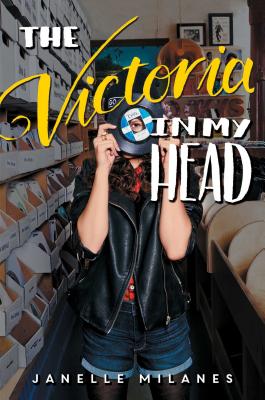 DESCRIPTION OF THE BOOK (from Simon & Schuster): A shy, rule-following teen winds up joining a local rock band in this laugh-out-loud, heartfelt coming-of-age novel.
Victoria Cruz inhabits two worlds: In one, she is a rock star, thrashing the stage with her husky voice and purple-streaked hair. In the other, currently serving as her reality, Victoria is a shy teenager with overprotective Cuban parents, who sleepwalks through her life at the prestigious Evanston Academy. Unable to overcome the whole paralyzing-stage-fright thing, Victoria settles for living inside her fantasies, where nothing can go wrong and everything is set to her expertly crafted music playlists.
But after a chance encounter with an unattainably gorgeous boy named Strand, whose band seeks a lead singer, Victoria is tempted to turn her fevered daydreams into reality. To do that, she must confront her insecurities and break away from the treadmill that is her life. Suddenly, Victoria is faced with the choice of staying on the path she’s always known and straying off-course to find love, adventure, and danger.
From debut author Janelle Milanes comes a hilarious and heartfelt tale of the spectacular things that can happen when you go after what you really want.
MY TWO CENTS: I’m not a voracious reader of romance novels for any age group. This book, however, completely caught me off guard. I won’t say that the book wasn’t predictable. It was, but it would have been disappointing if it had not been predictable.
Without giving too many details away, Victoria Cruz is growing up in a world where all outcomes are designed to please what she thinks others are expecting of her. The Victoria in her head wants so much to be her own person, but she has a hard time dealing with what she thinks her parents reactions will be. Her Cuban parents gave up everything in Cuba and have worked so hard in the United States to give Victoria and her brother the life that is often unavailable in countries like Cuba. Victoria, like so many children of immigrant parents, feels like telling them that she doesn’t want to become a doctor and graduate from Harvard will disappoint them in a way she’s not ready to accept. When she finally takes the plunge and starts rebelling in small ways (which she does with help from her best friend, Annie), Victoria finally starts feeling like herself. In doing this, of course, she lies to her parents, hiding her real self once she begins acting more like the “Victoria in her head.”
Here’s where the predictability sets in. Does Victoria get in over her head with the lies she’s telling to others? Yes. Does she inevitably have to face some truths that she’s been trying to hide from herself? Maybe. Does everything turn out well in the end? Quite possibly, but I don’t want to give any spoilers!
But as I mentioned, that’s not a disadvantage in this case! The version of herself that she tries to hide is a person who is passionate, easy-going, and even incredibly funny. In one passage, Victoria complains about a part of her female anatomy in a way that is “lmao” funny, but in a way that most anyone, regardless of gender, can empathize with. Herein lies Victoria’s real value. She’s a very likable character who makes questionable decisions (just like any of us), is afraid of disappointing her parents, sometimes is a little self-centered, but not maliciously. Readers will want her to succeed, to make the person she is in her head a reality.
Because of her Cuban background, the reader gets a taste of the Latinidad that she identifies with (large family gatherings, celebrating Noche Buena with her abuelita who never lets an opportunity to comment on Victoria’s vegetarianism pass, learning choreographed salsa dances because you’re in your cousin’s quince court). The thing that Milanes does particularly well is she makes Victoria more than just a Cuban-American. While her parents are a little obsessed with her being an exemplary child (for legitimate reasons, of course), Victoria is not defined just by her Cuban identity or her Latina ethnicity. Instead, those things are small parts of the compilation that is a more real representation of identity: where she comes from is important, but so is what she likes and dislikes, who she meshes well with, what her dreams are. The way that Milanes creates a “whole package” character in Victoria is what shines brightest in this book.
TEACHING TIPS: One important lesson to be learned from reading The Victoria In My Head is that it’s important to be true to yourself. Throughout the book, Victoria tries to deny the things that she wants out of life to either please those around her or be the model person that she thinks others want to see. The reader can see her grapple with her identity throughout, and can hopefully associate with her struggle and learn that compromising one’s identity to please the world often leads to catastrophe.
 ABOUT THE AUTHOR (from Author’s Website): Janelle Milanes is originally from Miami, FL and received her BA in English Literature from Davidson College. A lifelong YA addict, she moved to New York for her first job as a children’s literature associate at Simon & Schuster. For the past five years, Janelle has worked as a teacher and librarian throughout the New York City area. Her first novel reflects many of her own experiences growing up as a second-generation Latina in America. Janelle currently lives in Brooklyn with her husband and their two cats. Her favorite Disney princess is Belle, since she was also a big book nerd.
 ABOUT THE REVIEWER: Katrina Ortega (M.L.I.S.) is the Young Adult Librarian at the Hamilton Grange Branch of the New York Public Library. Originally from El Paso, Texas, she has lived in New York City for six years. She is a strong advocate of continuing education (in all of its forms) and is very interested in learning new ways that public libraries can provide higher education to all. She is also very interested in working with non-traditional communities in the library, particularly incarcerated and homeless populations. While pursuing her own higher education, she received two Bachelors of Arts degrees (in English and in History), a Masters of Arts in English, and a Masters of Library and Information Sciences. Katrina loves reading most anything, but particularly loves literary fiction, YA novels, and any type of graphic novel or comic. She’s also an Anglophile when it comes to film and TV, and is a sucker for British period pieces. In her free time, if she’s not reading, Katrina loves to walk around New York, looking for good places to eat.
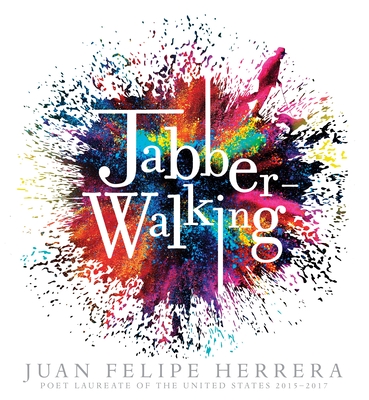 DESCRIPTION OF THE BOOK:
 ABOUT THE REVIEWER: Carolina Hinojosa-Cisneros is a Tejana poet, freelance writer, and speaker. Her work focuses on faith and Latinidad. Both her poetry and essays can be found in On Being, The Rumpus, The Acentos Review, Christianity Today, Rock & Sling, and many others. Hinojosa-Cisneros is a regular contributor at The Mudroom and is a first-year grad student at Our Lady of the Lake University in San Antonio, TX. Additionally, she holds a BA in English from the University of Texas at San Antonio. When she is not writing, she can be found growing nopalitos at her home in San Antonio, Texas.
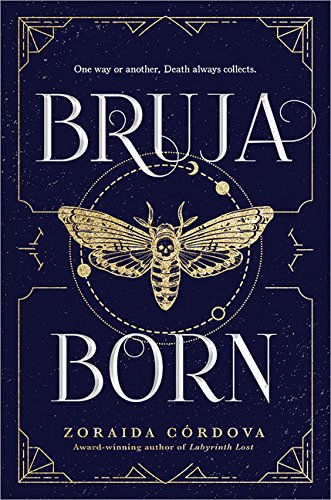 We are especially proud to celebrate the release of the second volume in Zoraida Córdova’s Brooklyn Brujas series, Bruja Born!
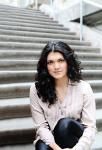 Zoraida Córdova was born in Ecuador and grew up in Queens, New York. Her previous books include the Vicious Deep trilogy and the On the Verge series. For more information about Brooklyn Brujas and the rest of Zoraida’s books, be sure to visit her
 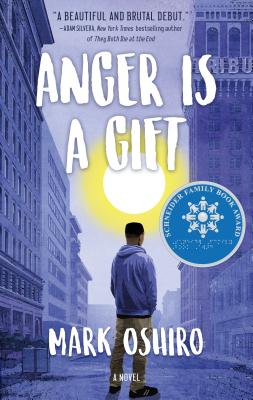 DESCRIPTION OF THE BOOK:
  ABOUT THE AUTHOR:
  ABOUT THE REVIEWER: Araceli Méndez Hintermeister is a librarian and archivist with a background in public, academic, and culinary libraries. She has an M.A. in history and MLIS from Simmons College, where she focused her studies on the role of libraries and archives in the cultural preservation of the U.S.-Mexican border. Additionally, she holds a BA in ethnic studies from Brown University. Her research is greatly influenced by her hometown of Laredo, TX, which has led her to work in serving immigrants and underrepresented communities. Her current work is bringing new and diverse literature to the T in Boston through
  Earlier this week, we published a review of
  By Alberto Ledesma
 The creation of the DACA policy inspired me to return to the questions I had about what being undocumented meant in the United States. But, instead of writing more essays about this issue, I decided to draw cartoons instead. It all happened because of that Summer Bridge class I was teaching when the undocumented student movement exploded across the United States. Though I was excited about doing a lecture about the undocumented student movement, my students had expressed a frustration with the amount of work that I had already assigned them. So, in order to pique their interest, I tapped into and old and neglected talent and drew a quick sketch of “A Day in the Life of an Undocumented Student.” Though my students had complained about all the work that they had had to do, I noticed that many of them began doing research on the movement on their own. So, I sketched other cartoons and shared them via Facebook. All of the sudden, I began getting hundreds of friend requests and they began asking me to draw more cartoons, to share my experience though art. After several years of doing so, of drawing vignettes based on my undocumented life, I had the makings of a book.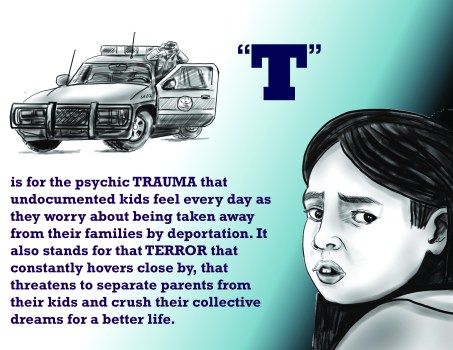
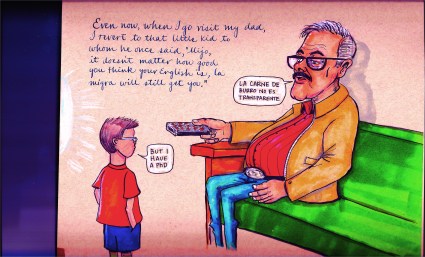 Today, when I attend important lectures and I am really into what the speaker is saying, I don’t take traditional notes. Rather, I take out my sketchbook, my favorite fountain pen, and I start doodling. I judge the quality of a talk by the complexity of the sketches I produce. Indeed, now that I have done a bit more research on it, I have learned that cartooning is an effective form of communication: it allows for better mental digestion of complex ideas; engages multiple intelligences; and, it allows viewers of an image to understand a story from multiple lenses. It is because of this that cartooning has allowed me to communicate the fears I felt when I was undocumented much more effectively than my writing ever could. This is the reason why I created my illustrated memoir, Diary of a Reluctant Dreamer.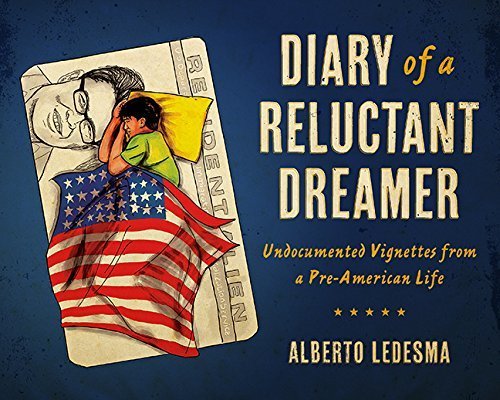

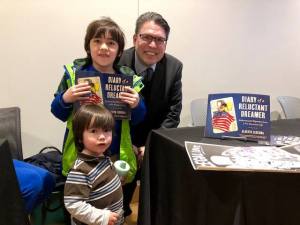 Last month, while Alberto Ledesma was at The Ohio State University for a panel on comics and immigration, he stopped for this photo opportunity with Liam Miguel and Ethan Andrés Pérez, sons of our fellow Latinxs in Kid Lit blogger, Ashley Hope Pérez.
 ABOUT THE AUTHOR-ILLUSTRATOR: Alberto Ledesma, a Mexican-American scholar of literature, holds a doctorate from the University of California, Berkeley. His publications include poetry, academic articles, and short stories, which have appeared in Con/Safos: A Chicana/o Literary Magazine, and in Gary Soto’s Chicano Chapbook Series (#17). He has also published essays in ColorLines and
  Latinxs in Kid Lit