
Reviewed by Lila Quintero Weaver
This review is based on an advance reader’s edition.
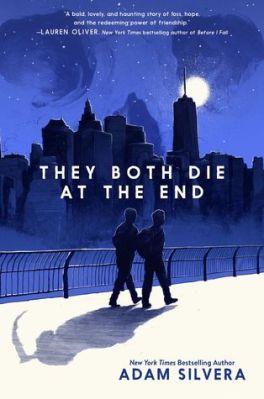 FROM THE BOOK JACKET: In the tradition of Before I Fall and If I Stay, this tour de force from acclaimed author Adam Silvera, whose debut the New York Times called “profound,” reminds us that there’s no life without death, no love without loss—and that it’s possible to change your whole world in a day.
Mateo Torrez and Rufus Emeterio are going to die today. The two boys are total strangers, but, for different reasons, they’re both looking to make a new friend on their End Day. There is some good news: There’s an app for that. It’s called Last Friend, and through it, Rufus and Mateo are about to meet up for one last great adventure—to live a lifetime in a single day.
MY TWO CENTS: The release date for They Both Die at the End was September 5, 2017. It’s no coincidence that the novel also takes place on that date, with chapters time-stamped to reflect the passing hours. This is no ordinary day for Mateo Torrez, 18, and Rufus Emeterio, 17, both of New York City. An unfailingly accurate notification service known as Death-Cast delivers the news that it is their last day on earth. Sadly, both boys have lost loved ones whose deaths were predicted in the same, bone-chilling fashion.
They Both Die at the End sends readers on a spellbinding adventure, following the two main characters as they squeeze in one more day of living. The story hits the ground running at 12:22 a.m., when Mateo’s phone sounds the eerie Death-Cast alert. Rufus receives his alert not long after that. Yet for all the tension of the ticking countdown, this novel narrates a surprisingly tender friendship that springs up between the two strangers. They connect through the app Last Friend, one of numerous social, cultural, and commercial spin-off products resulting from the launch of Death-Cast, which has been in existence for six years.
By the time Rufus and Mateo’s last day arrives, society has accepted the reliability of the Death-Cast predictions, and has developed norms in response to the ubiquitous presence of so-called Deckers, people who’ve received the last-day warning. This is made evident in a scene where subway passengers realize that a Decker and her Last Friend are among them. A stranger offers sympathy. “Sorry to lose you,” she says to the Decker, and commends them both for spending the final hours together. The Death-Cast phenomenon has changed the landscape of everyday life in other ways. Restaurants offer discounts to Deckers, and at a special amusement park called Make a Memory, Deckers and their companions indulge in simulated extreme sports. Social media has summoned a flurry of responses, too, including CountDowners, a blog devoted to the postings and live-feeds of Deckers, who share real-time accounts of their final hours on earth. Silvera weaves these fictitious cultural creations seamlessly into an otherwise recognizable version of contemporary city life.
How Death-Cast knows when a person will expire is anyone’s guess, but because his mom died in childbirth, Mateo has been death-haunted all his life. Paranoia about dying has kept him from making friends and participating in childhood activities, such as going on sleepovers and roller-skating in the park. Now, with the bitter reality of death squarely before him, Mateo is engulfed in the pain of wasted opportunities. When the End Day news comes, he is home alone. His father, who is hospitalized in intensive care, has been in a coma for weeks, and Mateo’s only other significant connections are with a close friend, Lidia, and her one-year-old daughter.
While Mateo is a loner, who from the safe confines of his apartment has engaged primarily with the digital universe of blogs, games, and apps— Rufus is more of a here-and-now guy: confident, socially connected, and comfortable jumping into new experiences in a way that Mateo never has been. When readers meet Rufus, he’s giving his ex-girlfriend’s new guy a beat-down. Then the Death-Cast ringtone goes off and everybody freezes. Although foster brothers Malcolm and Tagoe are on hand to provide Rufus with backup during the fight, for reasons that aren’t immediately revealed, they can’t help him once the police get involved. So Rufus takes flight alone, into the darkened streets of the city. He needs a friend.
The novel follows Mateo and Rufus from their separate, but equally jarring Death-Cast notices until they connect through the Last Friend app. During the course of their hours together, they bridge the initial awkwardness, and in cementing a friendship, defy the opposing pull of their personalities and lifestyles. Rufus gently goads Mateo to push aside long-held fears, and Mateo responds by embracing new experiences, from small to significant. By the time they land at Clint’s Graveyard—a dance and karaoke club that exists to give Deckers an unforgettable send-off—Mateo is more alive, more himself than ever, and the boys’ friendship turns romantic.
In his debut, More Happy Than Not, Adam Silvera demonstrated a fluid command of speculative fiction. In They Both Die at the End, he repeats that impressive feat, crafting a futuristic world that lands credibly in all its disquieting aspects, yet never forgets that telling a specific story is the most important order of business. Silvera’s ability to weave the strange and disturbing world of Death-Cast into a powerful character-driven narrative keeps readers on the edge to the last page, and drives a keen level of anticipation for the next offering from this gifted writer.
WHERE TO GET IT: To find They Both Die at the End, check your local public library, your local bookstore, or IndieBound. Also, check out Goodreads, Amazon, and Barnes & Noble.
 ABOUT THE AUTHOR: Adam Silvera was born and raised in the Bronx. He has worked in the publishing industry as a children’s bookseller, marketing assistant at a literary development company, and book reviewer of children’s and young adult novels. His debut novel, More Happy Than Not, received multiple starred reviews and is a New York Times bestseller. Visit his author site for more information.
 ABOUT THE REVIEWER: Lila Quintero Weaver is the author-illustrator of Darkroom: A Memoir in Black & White. She was born in Buenos Aires, Argentina. Darkroom recounts her family’s immigrant experience in small-town Alabama during the tumultuous 1960s. It is her first major publication and will be available in Spanish in January 2018. Her next book is a middle-grade novel scheduled for release in July 2018 (Candlewick). Lila is a graduate of the University of Alabama. She and her husband, Paul, are the parents of three grown children. She can also be found on her own website, Facebook, Twitter and Goodreads.
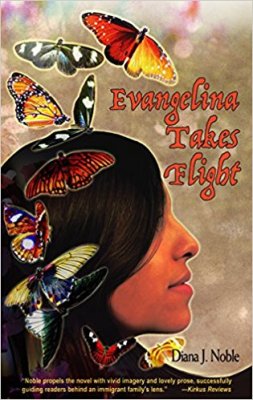 DESCRIPTION FROM THE BOOK JACKET: It’s the summer of 1911 in northern Mexico, and thirteen-year-old Evangelina and her family have learned that the rumors of soldiers in the region are true. Her father decides they must leave their home to avoid the violence of the revolution. The trip north to a small town on the U.S. side of the border is filled with fear and anxiety for the family as they worry about loved ones left behind and the uncertain future ahead.
 ABOUT THE AUTHOR: Diana J. Noble was born in Laredo, Texas, and grew up immersed in both Mexican and American cultures. Her young adult novel, Evangelina Takes Flight, is based loosely on her paternal grandmother’s life, but has stories of other relatives and memories from her own childhood woven into every page. It’s received high praise from Kirkus Reviews, Forward Reviews (5 stars), Booklist Online and was recently named a Junior Library Guild selection. [Condensed bio is from the
  ABOUT THE REVIEWER: Cris Rhodes is a doctoral student at Texas A&M University – Commerce. She received a M.A. in English with an emphasis in borderlands literature and culture from Texas A&M – Corpus Christi, and a B.A. in English with a minor in children’s literature from Longwood University in her home state of Virginia. Cris recently completed a Master’s thesis project on the construction of identity in Chicana young adult literature.

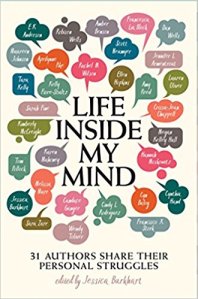 a creator stay focused on your projects, all the while managing the challenges of depression?
 FXS: Finding Cheryl Klein was either a blessing or very fortunate depending on your world view. Writing is both solitary and communal and on the communal side my writing got exactly what it needed when it got Cheryl. Her editorial genius complemented all my writing lacks while allowing me to remain true to my writing voice and my writing vision (and reminding me of that voice and vision when I strayed). Yes, there were many times when the editing process was very hard and even at times discouraging but I never lost faith that Cheryl wanted what was best for the book and for the future reader and that kept me going. What I would like to convey to young writers is that they do all they can to enjoy the actual process of writing, of being alone with the work, and have patience with regards to the results they hope to attain. Those results may or may not come, but the process of creating a work that is beautiful and true is still worth the effort. Most of all, find a way to tell your story that is unique to you. Finding that uniqueness takes a lot of honesty and it takes a lot of practice and all the mistakes and rejections that you get will only make you a better writer and a better person if you see writing not as the publication of a book or the recognition that comes with it but as a way of life you are called to live.
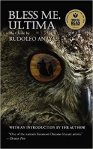 FXS: I’m re-reading Rudolfo Anaya’s Bless me, Ultima. Rudolfo Anaya is in many ways the father of Mexican-American literature and there is so much to learn from him about the presentation of the Mexican-American experience in a novel. One of my favorite books I always recommend to YA writers is The Book Thief by Markus Zusak because, well, there’s an author who found a way to tell an interesting story about a serious situation in a unique way. But I would also encourage YA writers to read all kinds of books, not just YA. Read fiction and non-fiction works that have nothing to do with what you are writing and you will be surprised by how they ultimately do. Read especially those books where the author’s soul touches yours.
 Francisco X. Stork is the author of Marcelo in the Real World, winner of the Schneider Family Book Award for Teens and the Once Upon a World Award; The Last Summer of the Death Warriors, which was named to the YALSA Best Fiction for Teens list and won the Amelia Elizabeth Walden Award; Irises; and The Memory of Light, which received four starred reviews. He lives near Boston with his wife. You can find him online at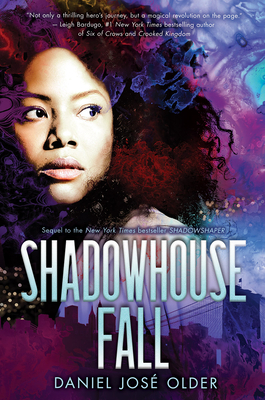
 ABOUT THE AUTHOR:
  ABOUT THE REVIEWER:
 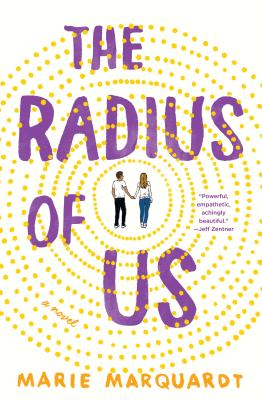 DESCRIPTION OF THE BOOK: Ninety seconds can change a life ― not just daily routine, but who you are as a person. Gretchen Asher knows this, because that’s how long a stranger held her body to the ground. When a car sped toward them and Gretchen’s attacker told her to run, she recognized a surprising terror in his eyes. And now she doesn’t even recognize herself.
 ABOUT THE REVIEWER: Elena Foulis has a Ph.D. in Comparative Literature and Cultural Studies from the University of Arkansas. Her research and teaching interests include U.S. Latina/o literature, and Digital Oral History. She is currently working on a digital oral history collection about Latin@s in Ohio, which has been published as an eBook titled, Latin@ Stories Across Ohio. She currently lives in Cleveland, Ohio.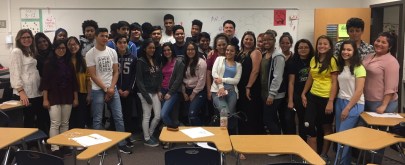
 My very best days as an author are these days, when eager students come rushing up to me after our workshop, asking for selfies; when they tell me about their favorite character; when they marvel at how I learned to cuss like a Salvadoran, or how much I know about making pupusas. I want so much for my books to resonate with them — Their stories inspire me to write young adult novels in the first place.
 Latinxs in Kid Lit