Happy Hanukkah from Latinos in Kid Lit!

by Zoraida Córdova

Happy Hanukkah!

Stockphoto.com

Hanukkah is the eight-day festival of light celebrated during the beginning in the Jewish month of Kislev.

Let’s get serious for a minute. I wanted to do some research about the intersection between Latino and Jewish people.

Latinos and Jewish histories have been intertwined for a long time, and most of it is full of wrong-doing by part of the Spanish. There’s the horrific moment in Spanish history when in 1492 the king of Spain ordered Jewish people to convert or to leave or be put to death. (Why don’t we learn from history?) Because of this, many Jews did convert to Catholicism to stay in their homes. In 2008, a study showed that 20 percent of men in Spain have Sephardic ancestry. In the Latin Americas, those who did go over to the New World kept their faith hidden. More recently, there was the immigration, asylum, refuge, and forced displacement of Jewish people during and after World War II. Thousands of refugees and Nazi camp survivors were able to find homes in South American countries though others barred their entry due to anti-Semitism.

During a visit to Ecuador in my teens, I remember driving past a Jewish home. How could I possibly know that they are Jewish? They had a beautiful Star of David in a mosaic on the outside gate. I say gate, but I mean a wall. Homes are mostly made of cement in Ecuador because of the humidity. Anyway, the neighbors largely mysticized them because they mainly kept to themselves. We have this perception of Jewish people as being separate. But when we spend the entire history of the WORLD marginalizing and trying to convert a group of people, and taking away their lives and rights, how can we even begin to call ourselves neighbors and allies? Today there is still a lack of intersectionality between minority groups and Jewish people.

Meanwhile, I keep thinking about how Jewish culture has enriched Latin culture. As a kid, I listened to lots of salsa music because of my mom and grandma. They listened to the Fania All Stars religiously. There was this guy nicknamed “El Judio Maravilloso” which translates to “The Marvelous Jew.” His name was Larry Harlow and his love and study of Afro-Cuban music spawned some of the best salsa we have. If you love Celia Cruz, she sang a beautiful version of Hava Nagila. For more on the Latino-Jewish music connection, listen to this NPR podcast: Bagels and Bongos. Music has a way of bringing people together.

This brings me to books. As we mix cultures and religions, where is the representation of the growing Latino-Jewish community? I have Ecuadorian-Jewish cousins. My friend (Jewish) and his wife (Bolivian) are celebrating their daughter’s first Hanukkah. They need books that show her different identities. When we talk about representation and diversity, we have to mean it. Latino-Jewish history is steeped in a painful past, but our present has wrought some excellent music and literature. And we need more. Here are eight books, by or about Jewish-Latinos, to get your started.


“My name is Marisol McDonald, and I don’t match. At least, that’s what everyone tells me.”
Marisol McDonald has flaming red hair and nut-brown skin. Polka dots and stripes are her favorite combination. She prefers peanut butter and jelly burritos in her lunch box. And don’t even think of asking her to choose one or the other activity at recess–she’ll just be a soccer playing pirate princess, thank you very much. To Marisol McDonald, these seemingly mismatched things make perfect sense together.
Unfortunately, they don’t always make sense to everyone else. Other people wrinkle their nose in confusion at Marisol–can’t she just be one or the other? Try as she might, in a world where everyone tries to put this biracial, Peruvian-Scottish-American girl into a box, Marisol McDonald doesn’t match. And that’s just fine with her.
A mestiza Peruvian American of European, Jewish, and Amerindian heritage, renowned author Monica Brown wrote this lively story to bring her own experience of being mismatched to life.

Goodreads * Amazon * B&N *


When Isobel is invited to Aunt Luisa’s for Hanukkah, she’s not sure what to expect. Aunt Luisa has recently arrived from Mexico. “At Aunt Luisa’s you’ll get to celebrate the Hanukkah Moon,” Isobel’s father promises. Isobel’s days at Aunt Luisa’s are filled with fun and surprises — a new camera, a dreidel pinata filled with sweets, and a mysterious late night visit to welcome the luna nueva, the new moon that appears on Hanukkah. An unusual Hanukkah story with a multi-cultural focus, this title celebrates a little-known custom of the Latin-Jewish community.

Goodreads * Amazon * B&N 


Jalapeno bagels are the delicious coming together of two cultures as the son of a Jewish baker and his Mexican wife decides what to bring to school for International Day. This warm story, illustrated by rich watercolors, comes complete with recipes for all the items that Pablo helps his parents make. Full color.
Goodreads * Amazon * B&N 


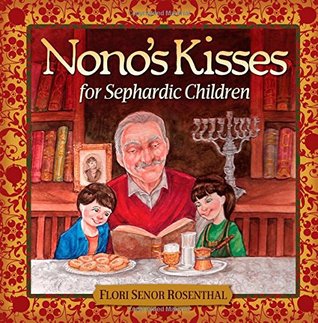
“Nono’s Kisses for Sephardic Children” is Flori Senor Rosenthal’s first of the Legacy and Literacy Scholastics Series. The book contains beautiful illustrations representing Ladino phrases. It was written to teach and encourage the usage of the Ladino language to children between the ages of 4 and 9. However, all ages will enjoy it and find it useful. Ladino or Judeo-Spanish is the language of Sephardic Jews. According to the United Nations, it is an endangered language. With each Ladino phrase found in the book, there is a question relating to its picture. This question, engages the parent and child into conversation. Ladino vocabulary words, pronunciations and English translations are provided to be used in these and other conversations and games between parents and their children. To make the learning experience even more fun, there is a hidden butterfly, in every illustration, to be found by the child. Ms. Senor Rosenthal’s father inspired her to write “Nono’s Kisses for Sephardic Children”. She wrote it to honor a tradition known specifically to Sephardic Jews. The book is an extraordinary teaching and learning tool for Ladino, and the Sephardic culture. However, those interested in the Spanish language and its history will also find this book interesting. Ms. Senor Rosenthal believes that her series will spark renewed interest in the Ladino language with the goal of having it removed from the endangered language list.

Goodreads * Amazon * B&N 


Lola Levine likes writing in her diario, sipping her mom’s cafe con leche, eating her dad’s matzo ball soup, and playing soccer with her team, the Orange Smoothies. So what if she doesn’t always fit in?

Lola is fierce on the field, but when a soccer game during recess gets too competitive, she accidentally hurts her classmate Juan Gomez. Now everyone is calling her Mean Lola Levine! Lola feels terrible, but with the help of her family, her super best friend, Josh Blot, and a little “pencil power,” she just might be able to turn it all around.

Goodreads * Amazon * B&N 


An eleven-year-old’s world is upended by political turmoil in this “lyrically ambitious tale of exile and reunification” (Kirkus Reviews) from an award-winning poet, based on true events in Chile.

Celeste Marconi is a dreamer. She lives peacefully among friends and neighbors and family in the idyllic town of Valparaiso, Chile—until one day when warships are spotted in the harbor and schoolmates start disappearing from class without a word. Celeste doesn’t quite know what is happening, but one thing is clear: no one is safe, not anymore.

The country has been taken over by a government that declares artists, protestors, and anyone who helps the needy to be considered “subversive” and dangerous to Chile’s future. So Celeste’s parents—her educated, generous, kind parents—must go into hiding before they, too, “disappear.” Before they do, however, they send Celeste to America to protect her.

As Celeste adapts to her new life in Maine, she never stops dreaming of Chile. But even after democracy is restored to her home country, questions remain: Will her parents reemerge from hiding? Will she ever be truly safe again?

Accented with interior artwork, steeped in the history of Pinochet’s catastrophic takeover of Chile, and based on many true events, this multicultural ode to the power of revolution, words, and love is both indelibly brave and heartwrenchingly graceful.

Goodreads * Amazon * B&N


Emily is a Jewish girl from the suburbs of New York. Her mother has family in Puerto Rico, but Emily has never had contact with them—- ever. Then Emily’s grandmother dies and Emily is forced to go to the Caribbean for her funeral. Buttoned-up Emily wants nothing to do with her big, noisy Puerto Rican family, until a special person shows her that one dance can change the beat of your heart.

Goodreads * Amazon * B&N 


Shirin is an Iranian princess; Ingrid, a German-Canadian eccentric; and Vivien, a Cuban-Jewish New Yorker culinary phenom. The three are roommates at a Swiss boarding school, where they spend their summers learning more than French and European culture. As the girls’ paths cross and merge—summers together, school years separate—they navigate social and cultural differences and learn the confusing and conflicting legacies of their families’ pasts. In the spirit of The Sisterhood of the Traveling Pants, Shirin, Ingrid, and Vivien grow together even when they are apart, forming unbreakable bonds along the way.
Goodreads * Amazon * B&N *


317988_632439229822_92623787_nZoraida Córdova was born in Guayaquil, Ecuador, where she learned to speak English by watching Disney’s The Little Mermaid and Michael Jackson’s Moonwalker on repeat. Her favorite things are sparkly like merdudes, Christmas, and New York City at night. She is the author ofThe Vicious DeepThe Savage Blue, The Vast and Brutal Sea, Luck on the Line, Love on the Ledgeand Life on the Level.

On Acting and Writing: a Q&A with Sonia Manzano


Becoming MariaBy Cecilia Cackley

Sonia Manzano’s new memoir Becoming Maria: Love and Chaos in the South Bronx was released in August. In it, Manzano tells the story of her childhood in the Bronx, high school at the LaGuardia School of the Performing Arts, her college years at Carnegie Mellon, and breakthrough performance in the Broadway musical Godspell. The book ends with Manzano’s successful audition for a new children’s television show called Sesame Street. I was able to interview Manzano during the 2015 National Book Festival in Washington, D.C.

Cecilia Cackley: Was there a library near your house growing up? What kinds of books did you read as a kid?

Sonia Manzano: There was no library close by my house. We had a library at my school, but we were not allowed to take the books home. Every week we would have a 40 minute ‘library period’ when we would read silently to ourselves. So each week I would mark my place with a scrap of paper and try to find it again the next time so I could finish the book. The book I remember most clearly was Fifteen by Beverly Cleary. I left the school before I could finish it, and although I kept looking for it, I didn’t find it again until I was 35, in a rural library in Pennsylvania!

CC: You’ve written both picture books and a YA novel. What do you think about the state of Latinxs in children’s literature right now?

SM: We have a lot of books with Latino-based stories…I don’t know why more people don’t know about them. I actually asked Pam Muñoz Ryan that recently and she said that while there are wonderful titles, such as El Bronx by Nicholasa Mohr, there aren’t a lot of long lasting titles that have become classics. Also, some elements of traditional Latino stories, like the Juan Bobo stories, play into stereotypes that publishers don’t like. Our culture is always in flux, and publishing houses can’t pin us down.

CC: Are there any recent Latinx books that you’ve read that you would recommend?

SM: I recently read Shadowshaper by Daniel José Older, which was wonderful and relates to the urban experience. I also read I Lived on Butterfly Hill, which was excellent.

CC: Part of Becoming Maria is about your experience as a student at Carnegie Mellon. What advice would you give to today’s students who are the first in their families to attend college?

SM: I would say that if at all possible, visit the college first. I wasn’t able to do that. It is a mind-expanding experience. Visiting will help it seem less strange when you get there.

CC: You’ve worked in theater, television, and now writing. Is there a connection for you between performing and writing?

SM: I think all art forms are connected in some way. I approach acting and writing very differently, though. The best acting is spontaneous, but when you write it is very examined.

CC: Now that you’re leaving Sesame Street, do you think you would do a theater show again?

SM: I would do it in a minute. But I hate auditioning. I would need a group to work with, someone with a vision. It’s hard as an actor because you need to be a vessel of someone else’s dream. But for me, for so long, I have been the character. I don’t know that I’d want to be someone else on stage.

CC: What if you were asked to do a one-woman show about your life?

SM: Yes, absolutely I’d do that.


Books for young readers by Sonia Manzano:

Becoming-Maria  Miracle-on-133rd-Street    no-dogs-allowed  


Cackley_headshotCecilia Cackley is a performing artist and children’s bookseller based in Washington DC where she creates puppet theater for adults and teaches playwriting and creative drama to children. Her bilingual children’s plays have been produced by GALA Hispanic Theatre and her interests in bilingual education, literacy, and immigrant advocacy all tend to find their way into her theatrical work. You can find more of her work at www.witsendpuppets.com.
Guest Post: How My Life With a Guatemelan Street Dog Became a Children’s Book

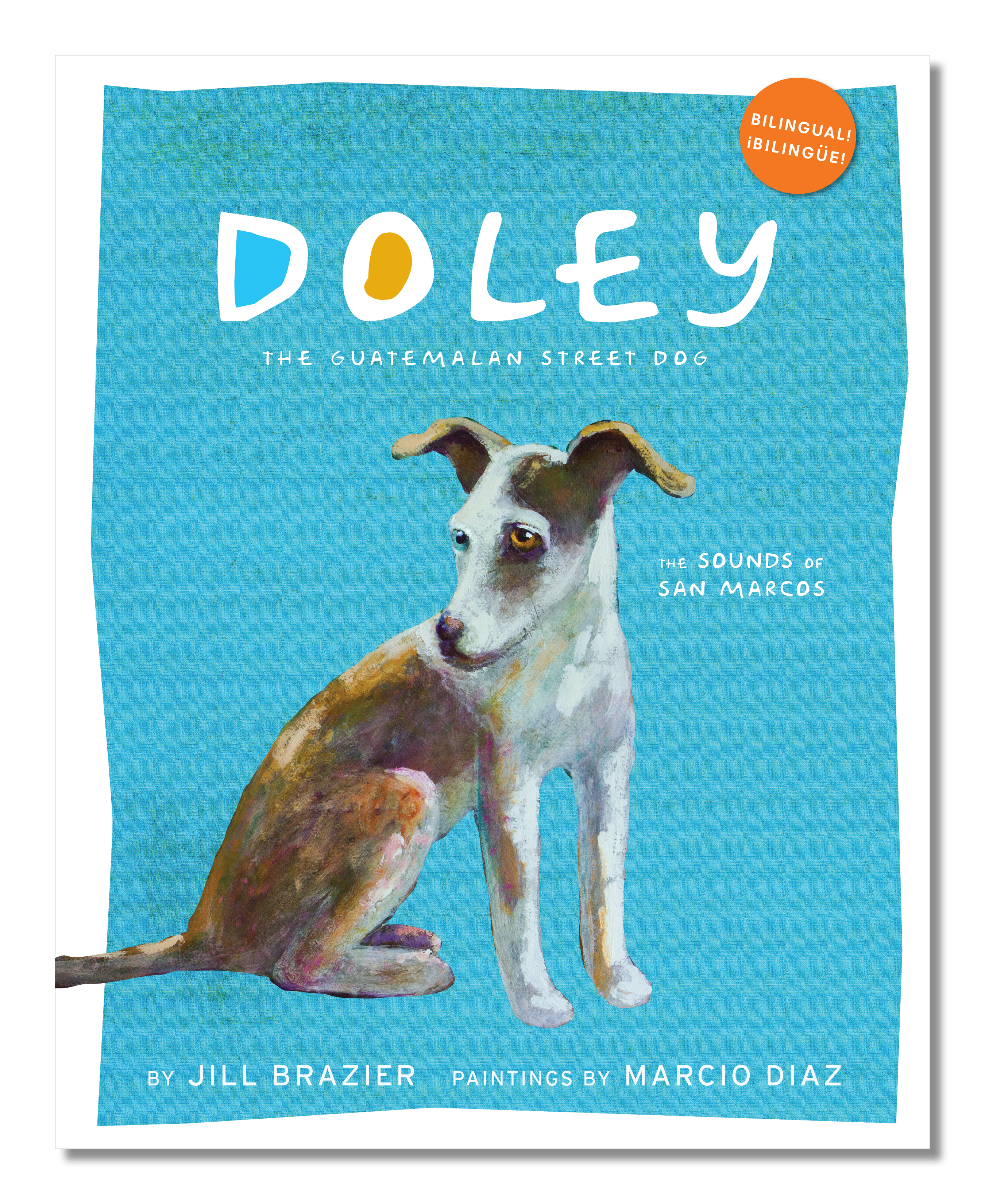
DOLEY Cover PRINTBy Jill Brazier

Use your senses and pay attention to what’s around you. You never know where inspiration might strike! These are two of the lessons that I focus on when presenting my bilingual children’s book, Doley the Guatemalan Street Dog: The Sounds of San Marcos, to students. I never would have imagined that my time living in a treehouse above Lake Atitlan in Guatemala, and my special friendship with a starving little street dog, would direct the course of my life for years to come.

At 20 years old, I traveled by land from Seattle to Guatemala. The trip took over a year, with stops along the way to find work when the money ran out. Guatemala was never on my list, but I loved my time in Mexico and wanted to continue south. I joined up with a traveling companion for a long, bumpy, chicken-bus ride from Chiapas, Mexico, to Panajachel, Guatemala. An immediate and special feeling for this country struck me. I was determined to find a way to stay in this beautiful land.

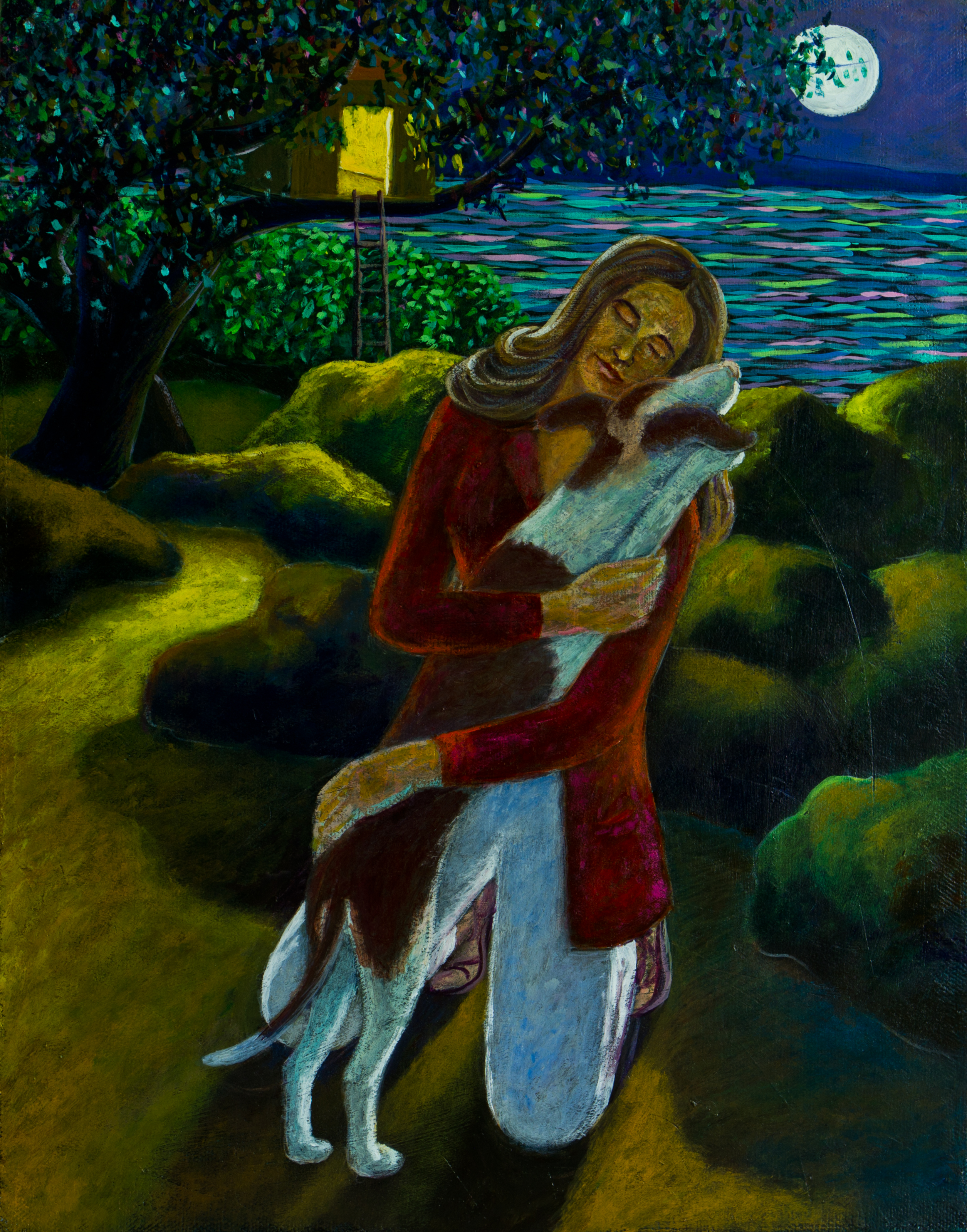
I found a work/trade in a meditation center in the little village of San Marcos La Laguna, one of twelve villages around Lake Atitlan. There was no electricity there at the time. We lit our way with candles, stars and moonlight. My home was a simple bamboo treehouse with one room, a doorway, two windows, and gauze curtains for privacy. At night, I would sit in my treehouse and listen to the many sounds of San Marcos. The breeze blew in, offering constant connection with the lush natural environment.

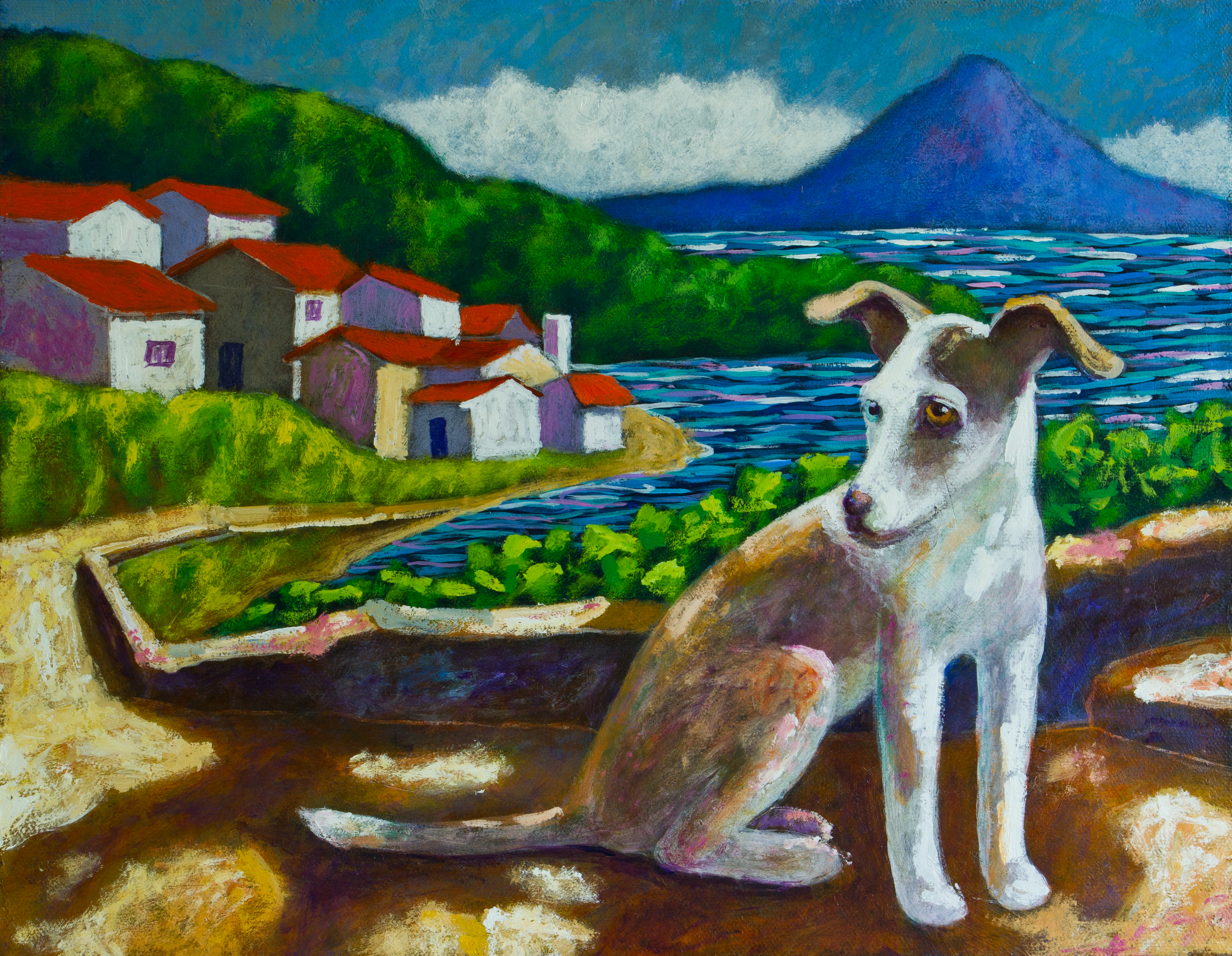
One day, I was preparing a meal in the community kitchen when a tiny, frantic puppy ran in and looked at me with desperation. She had one bright blue eye and one brown eye. After I instinctively gave her a tiny piece of bread, this little puppy visited me daily. She had mange, a belly full of worms, layers of ticks in her ears, and malformed legs which made it difficult for her to walk. I took care of all of these problems, one by one. I wrapped half an ace bandage around each of her legs so that she could walk without her legs buckling, and fed her eggshells to strengthen her bones. Over time, she healed and followed me everywhere I went. Soon, this Guatemalan street dog had a name: Doley. This was the beginning of our fourteen-year friendship as best friends and travel companions.TenderHowling

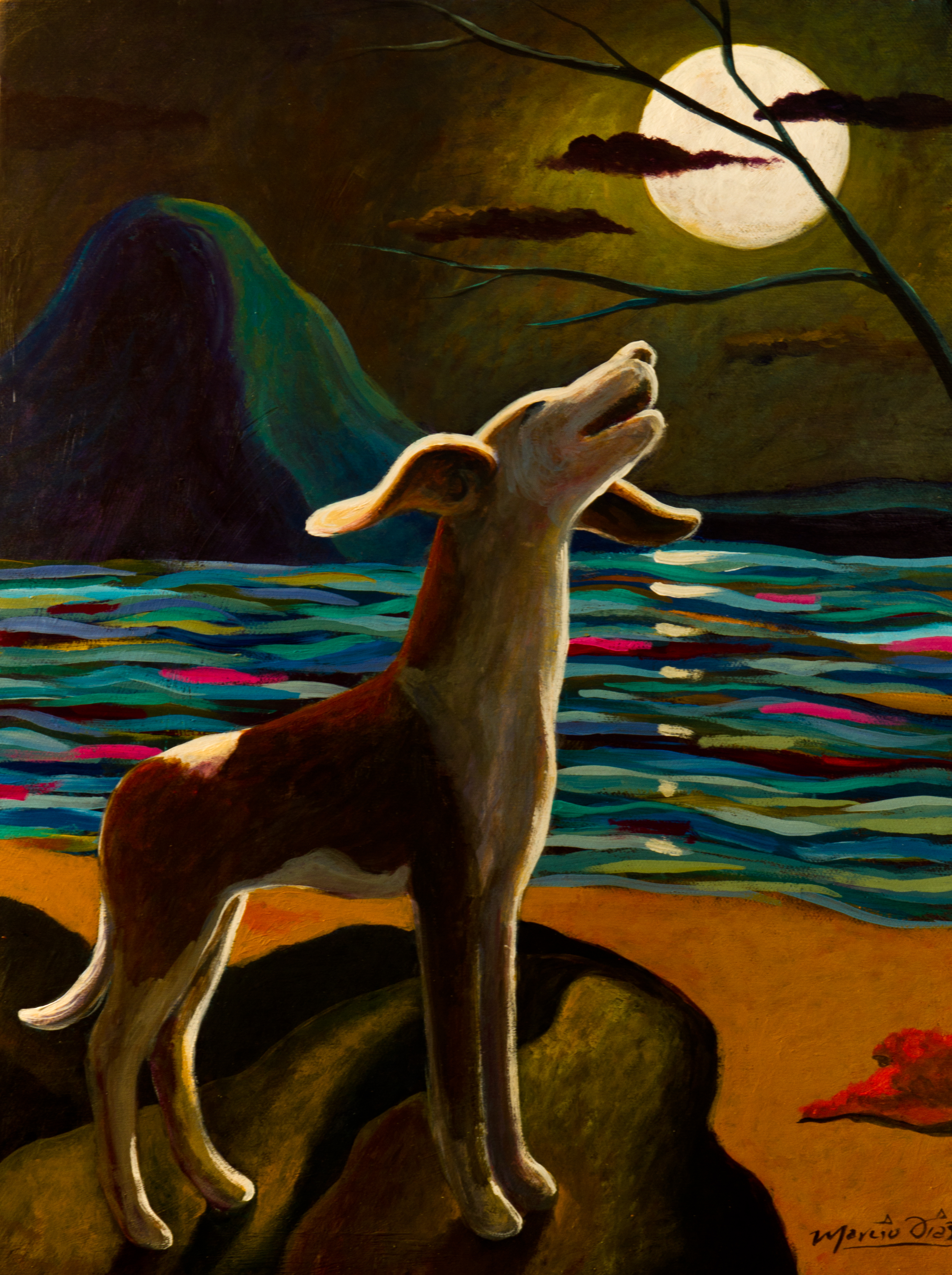
Doley would sleep in the treehouse with me at night, cuddling right into the crook of my stomach. Often, she would wake up to the sound of other street dogs howling and barking, and insist on being taken down from the treehouse, to run and howl with the other dogs. All of these real life experiences, which Doley and I shared during our time together in Guatemala, appear in the book.

The Sounds of San Marcos, was released independently in 2012. The theme of sounds emerged as I wrote the story and reflected on Doley’s acute sensory awareness of everything around her as a street dog, and our rich, sensory experience of living a treehouse in Guatemala. Readers learn the importance of listening – a vital lesson for students and young people! I further developed the idea to make Doley a series based on the five senses.

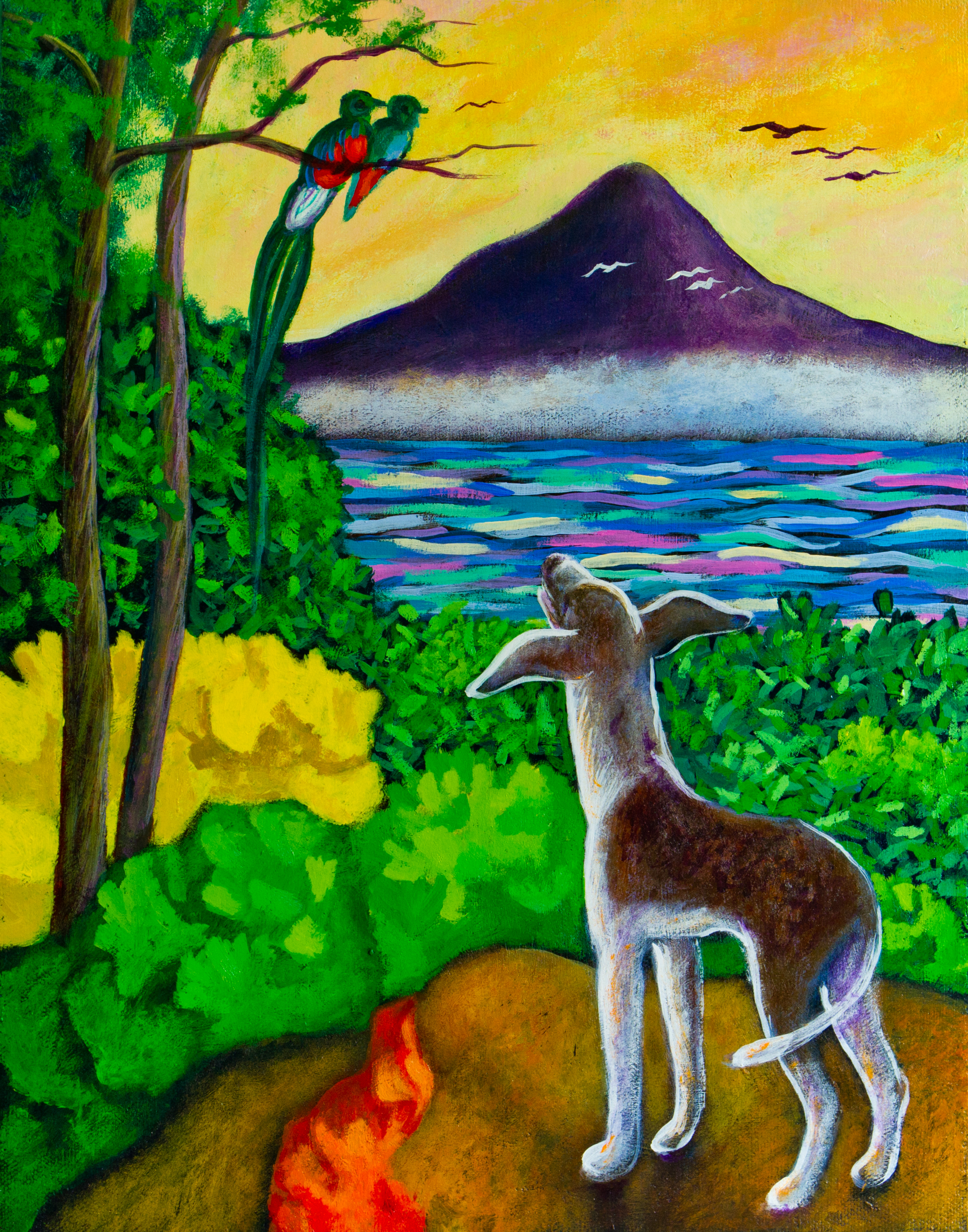
With beautiful artwork by Nicaraguan artist Marcio Diaz, the story comes to life in the vivid color of Guatemalan and Latin American culture. After looking for the right artist for many years, I finally discovered Marcio, whose ability to express profound feeling with bold color evokes the look and feel that I wanted. Marcio says, “In the brushstrokes of a painter, lays the history of his people.”

I want to FlyIt can feel like a daunting task to create something new and find a place for it in the world! There are many ways to share our stories and creative visions. For this project, I chose to publish independently in order to create the books in exactly the look and feel that I wanted. There are many ways to publish these days, and advantages and disadvantages to each. Artists and authors can choose which path to take according to the particular project, goals, intentions, budget, and timeline.

Publishing independently was the right place to start for Doley, and I am thrilled with the result. Everything about it is true to my vision and meets my standards of excellence. Moving forward, I will find a strategic partner to maximize the potential of the Doley series and accompanying reading guides.

Brown and BlueThe Read with Doley Reading Guide, developed according to the National Common Core Standards (K-2 Literature), consists of 134 bilingual questions and answers, designed to engage students in language learning and encourage them to think beyond the text, and is available to download for free on my website. Doley believes in education!

The next book in the series, Doley the Guatemalan Street Dog: The Caravan of Colors, will be released in September 2015 and also features the remarkable artwork of Marcio Diaz, along with its own reading guide. The story is inspired by some traveling performers I met in Guatemala and my own love of trapeze. The Caravan of Colors gives Doley the chance to explore the world around her through the sense of sight, and provides lessons about perseverance and friendship along the way.

It is always a joy to share Doley and the inspiration for the book with students – and to remind them to listen carefully and pay attention. You never know where inspiration will strike or where it may lead you! I am so grateful for where inspiration has taken me.

For purchasing options, and additional information, please visit Jill’s website,

JillWhen Jill Brazier isn’t writing about Doley, she works at a charming Italian restaurant in Seattle. She is a traveler, fitness enthusiast, yoga practitioner, and amateur trapeze artist. After Doley, Jill’s heart belonged to a 12-year old abandoned Husky. They spent three happy years together until she passed away at the age of 15. Jill remains without a dog for now, until the next one chooses her.


Debut Celebration for The Girl at Midnight by Melissa Grey!

By Zoraida Córdova

I am super excited to have Melissa Grey with us at Latin@s in Kid Lit! I love fantasy, and I especially love when Latinas write fantasy. The Girl at Midnight has already received wonderful praise and starred reviews from Kirkus and Booklist! To celebrate tomorrow’s launch of The Girl at Midnight, we are going to get to know the magic behind Melissa.


“Grey’s energetic debut offers a strong protagonist…[and the] well-built world, vivid characters, and perfect blend of action and amour should have readers eagerly seeking the sequel.” — Kirkus Reviews, Starred


Zoraida: Tell me about The Girl at Midnight and your inspiration for it.

Melissa: In The Girl at Midnight, there’s a magical race of creatures that live beneath the streets of New York called the Avicen. They have feathers for hair and their existence is very much a secret, but they take in a human girl who goes by the name of Echo. Echo has run away from a bad home life and finds a new family in the Avicen, so when they’re threatened by a centuries-old war, she takes it upon herself to find the firebird, a mythical entity prophesied to end the conflict once and for a all.

The book really started with Echo and the firebird. I’m a huge fan of the ballet and the legend behind it, so my research into the folklore involving the firebird gave me a lot to think about when I was developing the plot. Echo was the first character to exist and she kind of predated the story. I came up with her first and eventually found a world for her to inhabit.

What is the best writing advice you’ve ever gotten?

It’s not specifically writing advice, but it can be applied to writing. When I was at art school, one of my professors told me not to be precious with my work. It was the first time I’d ever heard the saying “Kill your darlings” and it really stuck with me. I can be a perfectionist, so not treating my work as something delicate and inviolable was an eye-opening change of strategy. To me, it means not being afraid of scrapping drafts or whole chapters or even characters that aren’t working to the benefit of the work as a whole.

What was the hardest scene in your novel (if it’s not too spoilery)?

The last chapter was a struggle. I’m not a huge fan of cliffhangers, but as a writer, you do want to leave people wanting more, especially if you’re writing a series like I am, so I tried very hard to strike a balance between giving readers closure and enticing them to come back for the sequel.

How does your culture play a part in your fantasy (if at all)?

Well, I’m Puerto Rican and food is a huge part of that culture. I don’t include Spanish food specifically in the book, but Echo’s life pretty much revolves around food. It’s the foundation of a lot of her relationships, which is definitely something I can relate to.

Where would be your dream writing location?

A secluded little cabin in the Scottish Highlands.

Are there any lessons you learned while writing TGaM, and how is that helping you with book 2?

I learned that I have to trust my gut while not giving into my inner perfectionist. I also learned that I didn’t need to take every single criticism I received on the manuscript as gospel because sometimes my writing partners (and even my agent and editor) didn’t agree, so I had to trust my instincts.  

What books are you reading right now?

Right now, I’m reading The Archived by Victoria Schwab (it’s amazing), The Walls Around Us by Nova Ren Suma (also amazing), and Get in Trouble by Kelly Link (amazing as well).

What do you wish to see more in YA?

That’s tough because I can only comment on what I’ve read and I don’t want to make it sound like I think YA as a whole (which is a super broad categorization) is lacking, but I will say that I love seeing books like Laura Ruby’s Bone Gap and Renee Ahdieh’s The Wrath and the Dawn that deal with the gray areas of morality and are peopled by characters that aren’t necessarily likable but are still deeply compelling.

Who would attend your magical fantasy tea party?

Echo, naturally. And some of her friends from TGaM. If it’s a magical fantasy, I assume I can invite anyone, real or fictional, so I’ll say Hermione Granger (Harry and Ron can come, too), Door from Neverwhere, Kell and Lila from A Darker Shade of Magic (Rhys can come, too), Tana and Gavriel from The Coldest Girl in Coldtown, and Finn, Petey, Roza, and Sean from Bone Gap. Oh, and all of the Raven Boys.

What is your favorite line from your book? (Or a couple of favorite lines. I know it’s hard to choose.)

At one point, Echo is backed into a corner and she basically has to bullshit her way out of it so she says to herself, “When in doubt, bravado.” I feel like that idea has carried me through life pretty well.


The Girl at Midnight debuts tomorrowApril 28th, 2015!

ORDER A SIGNED COPY FROM BOOKS OF WONDER

Amazon * B&N * Kobo * IndieBound * Powells

Find Melissa on Goodreads.


Praise for THE GIRL AT MIDNIGHT:

“Grey’s energetic debut offers a strong protagonist…[and the] well-built world, vivid characters, and perfect blend of action and amour should have readers eagerly seeking the sequel.” — Kirkus Reviews, Starred

“Sparks fly…This first novel will please fans of Cassandra Clare and Game of Thrones watchers with its remarkable world building; richly developed characters…[and] a breathtaking climax that…cannot come soon enough!”—Booklist starred review

“Inventive, gorgeous, and epic—Grey dazzles in her debut.” — Danielle Paige, New York Times bestselling author of Dorothy Must Die

“A stunning debut. Equal parts atmosphere and adventure … positively divine.” – Victoria Schwab, author of A Darker Shade of Magic


About THE GIRL AT MIDNIGHT:

For readers of Cassandra Clare’s City of Bones and Leigh Bardugo’s Shadow and BoneThe Girl at Midnight is the story of a modern girl caught in an ancient war.

Beneath the streets of New York City live the Avicen, an ancient race of people with feathers for hair and magic running through their veins. Age-old enchantments keep them hidden from humans. All but one. Echo is a runaway pickpocket who survives by selling stolen treasures on the black market, and the Avicen are the only family she’s ever known.

Echo is clever and daring, and at times she can be brash, but above all else she’s fiercely loyal. So when a centuries-old war crests on the borders of her home, she decides it’s time to act.

Legend has it that there is a way to end the conflict once and for all: find the Firebird, a mythical entity believed to possess power the likes of which the world has never seen. It will be no easy task, but if life as a thief has taught Echo anything, it’s how to hunt down what she wants … and how to take it.

But some jobs aren’t as straightforward as they seem. And this one might just set the world on fire.


ABOUT THE AUTHOR:
Melissa Grey was born and raised in New York City. She wrote her first short story at the age of twelve and hasn’t stopped writing since. After earning a degree in fine arts at Yale University, she traveled the world, then returned to New York City where she currently works as a freelance journalist. To learn more about Melissa, visit melissa-grey.com and follow @meligrey on Twitter.

Praise for Books Deemed Perfect for Reluctant Readers

By Cindy L. Rodriguez

Recently, a few 2015 debut author friends have had their books reviewed as being “good for reluctant readers,” and the question was, “Is this a good thing?” I jumped into that online conversation because I work all day, every day with reluctant readers at my full-time day job as a reading specialist in a large suburban middle school in Connecticut.

First, what is a reluctant reader? It’s a student who can read but chooses not to. They are not illiterate. They are aliterate. When it’s designated silent reading time, they fake read. If a movie has been made, they watch it first. They can get by on quizzes and tests by listening to the teacher and peers talk about the book. Reluctant readers are not unintelligent. Some make it through high school successfully, with good grades, without ever reading a book cover to cover.

For some students, however, a lack of reading for years can affect their fluency, vocabulary, and comprehension skills. A reluctant reader turns into a struggling reader. The achievement gap between struggling readers and their peers grows as the work becomes more rigorous and academic expectations increase. Across the nation, the students who represent the achievement gap are largely minority students from urban areas.

My school has about 900 students in grades 6-8. The vast majority of students read well above their grade level, so reluctant and/or struggling readers land in my class. Most of my students are Hispanic and almost all of them are either English Language Learners or students who have transferred to our district from nearby cities. The goal is for them not to need reading support. Getting them there can be a challenge because reading is something they do not enjoy.

The school year usually starts like this:

Me: Welcome to class!

Student: I don’t want to be in this class.

Me: How do you know? We haven’t even started yet.

Student: I hate reading.

Me: I know. That’s why you’re here. Everyone here hates to read, except for me, of course. It’ll be fun, I promise.

Student: How can it be fun if all we’re going to do is read?

Me: Well, that’s not all we’re going to do. We might take a break from reading to chit-chat like we are now, but yeah, we’re going to spend a lot of time reading.

Student: And you consider that fun?

Me: I do, and I think you will, too.

Student: Yeah, right. Good luck with that.

I’ve even had a few students cry on the first day of class and tell me they don’t want to be seen in the “stupid” class. I try to convince them it’s the best class in the building, but their discomfort is real and has been with them since they first started learning how to read and didn’t like it or were separated from their peers for extra help. The older they get, the more embarrassing this is. I do validate their feelings and their frustrations, and I equate it with my ongoing struggle with exercise.

I know it’s important, but I don’t like to do it. The longer I don’t do it, the more out of shape I get. If I decide it’s time to change my habits, it might be uncomfortable, even painful, but it will get easier with time. Eventually, I’ll be stronger and healthier. I may never love exercise, but I’ll do it because it’s good for me.

Some of my students are athletes or musicians or are engaged in some activity that requires an ongoing commitment, so they get my analogy. They understand that they may never love to read, but it’s important for their futures.

So, how to start? Me, I’ll start by walking my dog more now that winter is finally over. My students start by picking books they want to read, not books handed to them by a teacher. Some of them don’t even know where to begin. These are not the students who already have a favorite genre or author. Some of them don’t even know how to find a book in the library. All they’ve had is a longstanding feeling that reading is boring.

Enter books perfect for reluctant readers and teachers, booksellers, and librarians–the people who talk up books and place books in students’ hands.

For its annual Quick Picks for Reluctant Young Adult Readers list, YALSA considers a book’s physical appearance, style, and content. The criteria are meant as suggestions, and they clearly state not all criteria may fit all books. Here are the things they consider when evaluating a book for reluctant readers.

1.  Physical Appearance

  • Cover – catchy, action-oriented, attractive, appealing, good “blurb”
  • Print style – sufficiently large for enjoyable reading
  • Format – appropriate and appealing balance of test and white space
  • Artwork/illustrations – enticing, realistic, demonstrated diversity

2.  Style

  • Clear writing that easily communicates without long convoluted sentences of sophisticated vocabulary
  • Acceptable literary quality and effectiveness of presentation
  • Simple vocabulary but not noticeably controlled

3.  Fiction

  • High interest “hook” in first 10 pages
  • Well-defined characters
  • Sufficient plot to sustain interest
  • Plot lines developed through dialog and action
  •  Familiar themes with emotional appeal for teenagers
  • Believable treatment
  • Single point of view
  • Touches of humor when appropriate
  • Chronological order

4.  Informational Books

  • Technical language acceptable if defined in context
  •  Accuracy
  • Objectivity

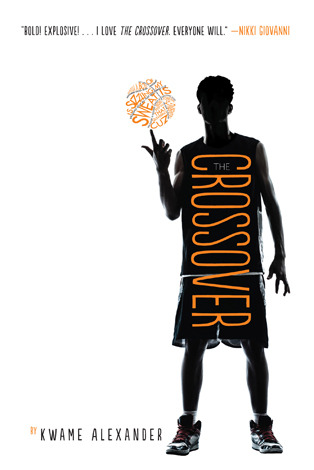
18263725In short, books perfect for reluctant readers have an attractive design, hook the reader early, are relatively easy to read, and are written in a way that keeps them reading. So, to the question, Is it a good thing to have my book called “perfect for reluctant readers”? I say, YES! Some of the titles on this year’s list include the Newbery winner The Crossover by Kwame Alexander and the Morris Award winner, Gabi, A Girl in Pieces by Isabel Quintero. That two of this year’s top prize winners are also good books for reluctant readers should settle any question about whether books for reluctant readers are somehow “less than” in the literary world.

If anything, I’d argue they achieve something special because book lovers will read just about anything or push through a novel, even if they’re not enjoying it entirely. Reluctant readers, though, are an author’s toughest critic. They will put a book down in a heartbeat if it doesn’t keep their interest. If you can capture a reluctant reader’s interest, that’s saying something. And if that reluctant reader goes on to read another book and then another, well, then I cry teacher tears of joy.

Getting these books into students’ hands is a crucial piece of the puzzle. During one-on-one conferences recently, I asked my students about what they were reading and why they chose it. ALL OF THEM said they chose the book because a teacher or librarian recommended it.

Wow, reality check time.

If I say, “This is a great book,” students will want to read it. Seems obvious, right? But, for those of us in this position, please realize the influence we have. We read lots of books as part of our jobs. We stand up in front of students, and we present a handful of books to them through book talks or when they ask for help to find a book. When we do this, they want to read them. The suggestions we make can turn non-readers into readers. This is serious.

So, which books are we recommending? Are we recommending the same books all the time? How diverse are our choices year to year in terms of genre, author, characters, content? Do we think there are girl books and boy books? Do we think there are books for students of color and books for all other students? These are important questions we should be asking ourselves because our answers will determine the books we champion. And the books we champion can become the books students, especially reluctant readers, choose to read.

For the record, here are some of the books my reluctant readers are currently reading and loving:

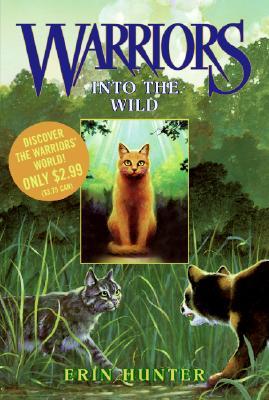
24048  12987986  17166339  6186357  18225810  Into the Wild (Warriors, #1)  After Tupac and D Foster

How and Why I Wrote My Graphic Memoir

by Lila Quintero Weaver

Final CoverreducedLast September at the Comadres and Compadres Writers Conference in Brooklyn, NY, I listened as Daisy Hernandez stated her belief that memoir writing arises from the unanswered questions a writer has about her own life. For me, by contrast, starting a memoir is what led me to realize I had questions.

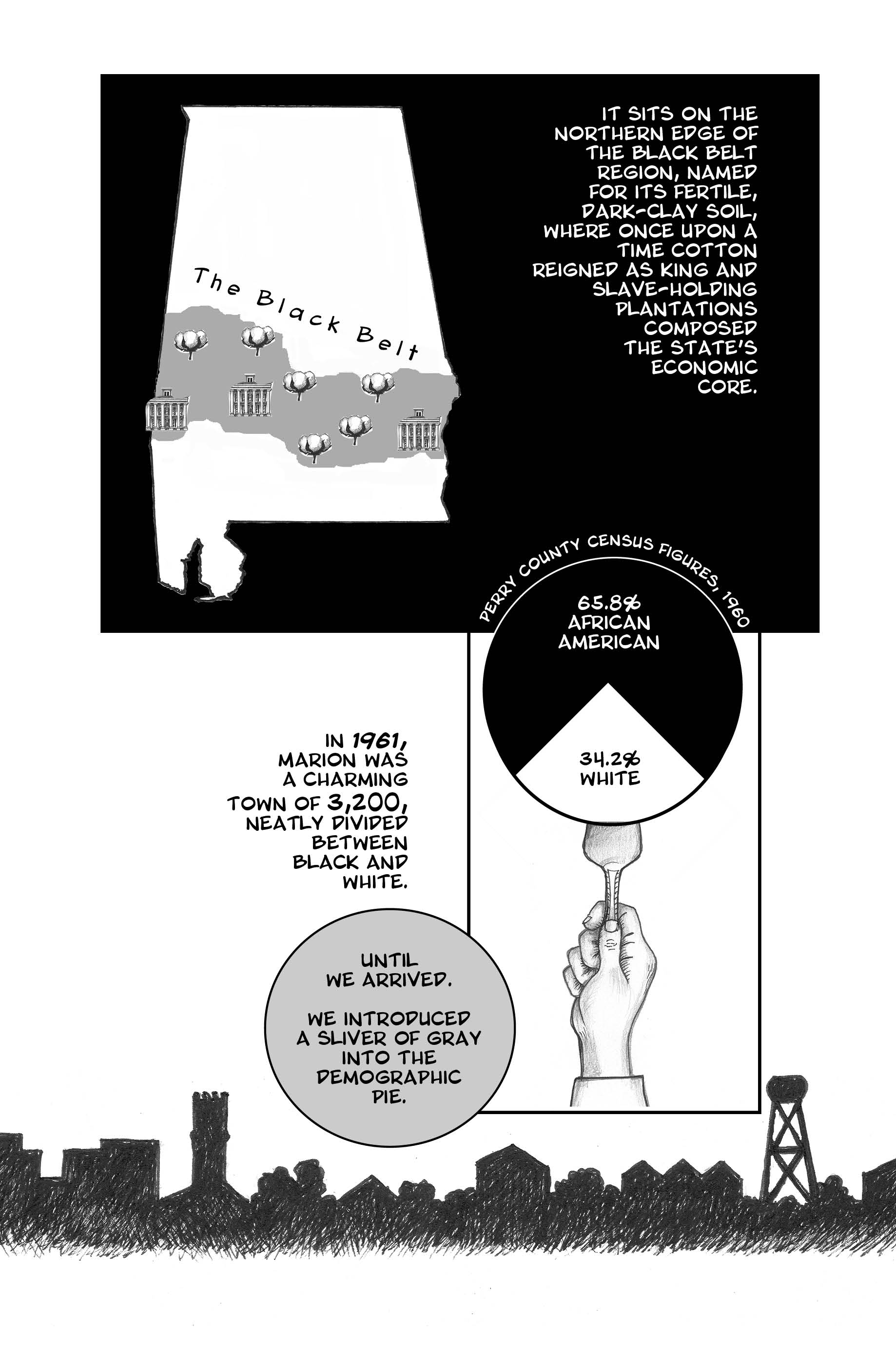
Before beginning my writing journey, it had never occurred to me that there was anything remotely fascinating about my life. I’d grown up as an immigrant child from Argentina in Marion, a tiny dot of a town in the Black Belt region of Alabama, where for most of our 12 years in residence we were the only Latin@s. But then I realized that our isolation at this time and in this place was a story.Demographic pie

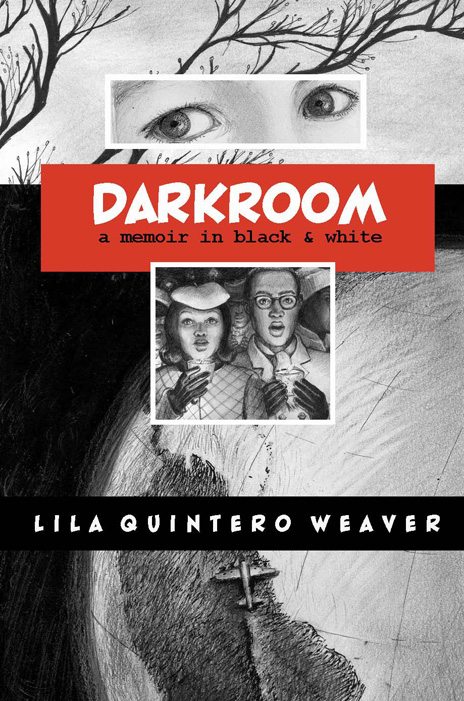
How big of a role did this cultural setting, with its legacy of racism, play in making me who I am? That was one of my biggest questions, and eventually, my outsider status and my awakening to racial inequity formed the narrative core of my graphic memoir, Darkroom: A Memoir in Black and White (The University of Alabama Press, 2012).

[Note: All the art in this post is from Darkroom. Click on images to enlarge the view.]

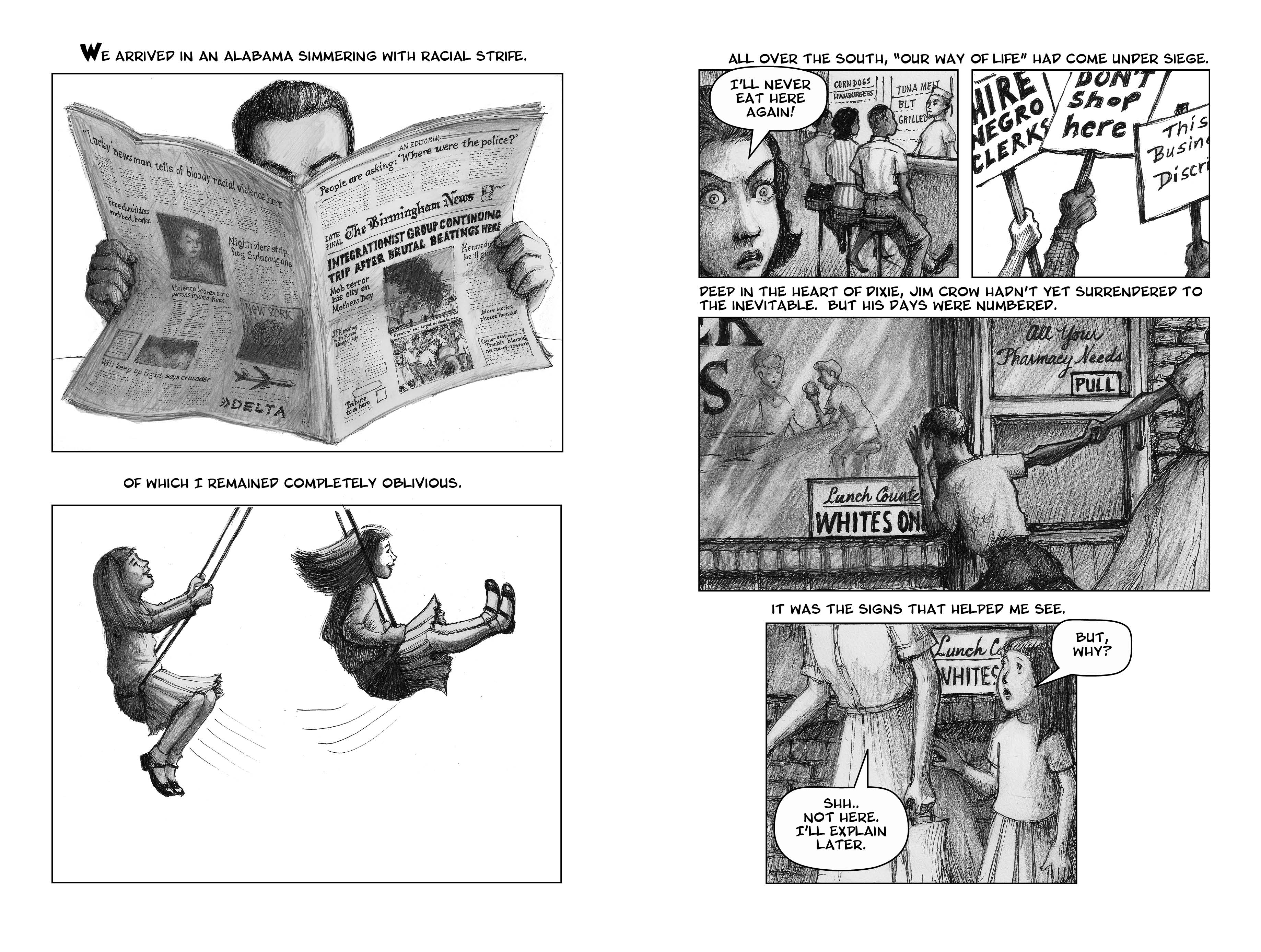
My family’s arrival in Alabama synched up perfectly with several hallmark events in the Civil Rights Movement. We first briefly lived in Birmingham, where within six weeks of our arrival, the Freedom Riders rolled up to the bus depot and into the hands of a vicious mob. Then we moved to Marion, where racial segregation ruled every conceivable setting. Most white people seemed perfectly at home with this arrangement, but it made me deeply uneasy, even at age six.

Whites only

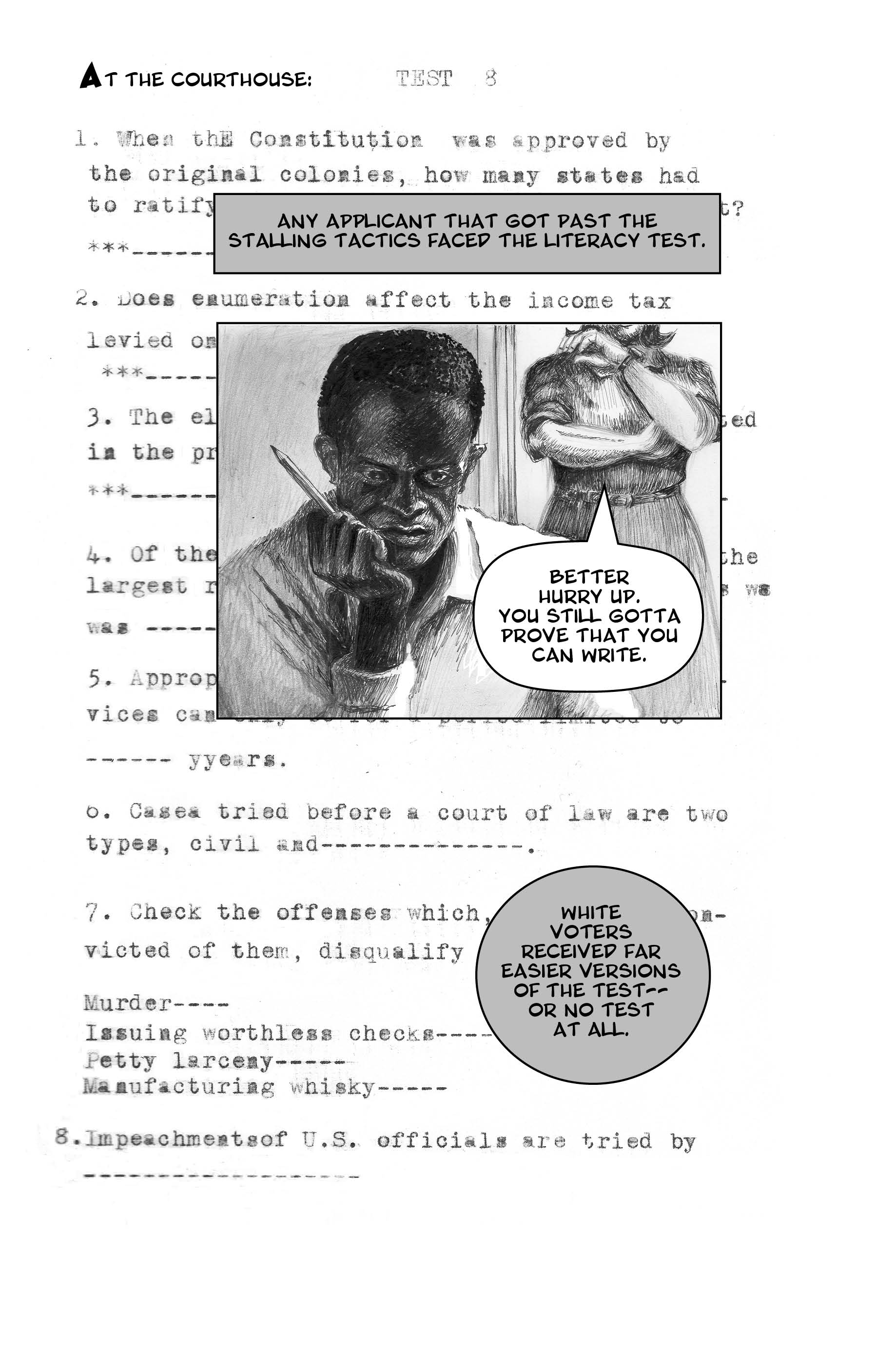
In 1965, African Americans across the Black Belt region were attempting to register as voters, but local officials obstinately barred the way. That February 18th, in Marion’s city square, a white mob clashed with a group of mostly local black protesters, while police stood idly by or participated in the beatings. My father witnessed some of these horrors and so did a host of other citizens, yet none of my teachers ever addressed these events. February 18th and everything surrounding it was quickly swept aside as if it had never happened.

Literacy TestI’d always known that a young black activist had been shot by a state trooper that night, but I’d never actually heard his name—Jimmie Lee Jackson. I did not know that his death—eight days later at Good Samaritan Hospital, in nearby Selma—had triggered Bloody Sunday, which led to the passage of the Voting Rights Act of 1965.

My father died in 1995 before I ever thought to press him for details of what he saw during the violent clash. Among other things, I would have asked how witnessing such brutality at close hand affected his view of America. For decades, the only reason his account of that night didn’t fade from memory completely was because of some home movies he’d taken around the same time. They showed peaceful protest marches in the days leading up to February 18th.

After the Voting Rights Act was signed into law, civil rights activists set their sights on desegregating public schools. This time, I was the eyewitness to history—not that any child understands federal court orders, states’ rights battles, or the long, embittered tug-of-war to sort them out. Those questions would come later.

In 2004, I went back to college to complete my degree. That’s when I started to make up lost ground on the history of my region. The last thing on the checklist before graduating was a senior project.  The graphic memoir Persepolis, by Marjane Satrapi, gave me the idea to combine a written account with images, as an artistic exploration of my family’s immigration journey and the racially troubled times we encountered in our new homeland.

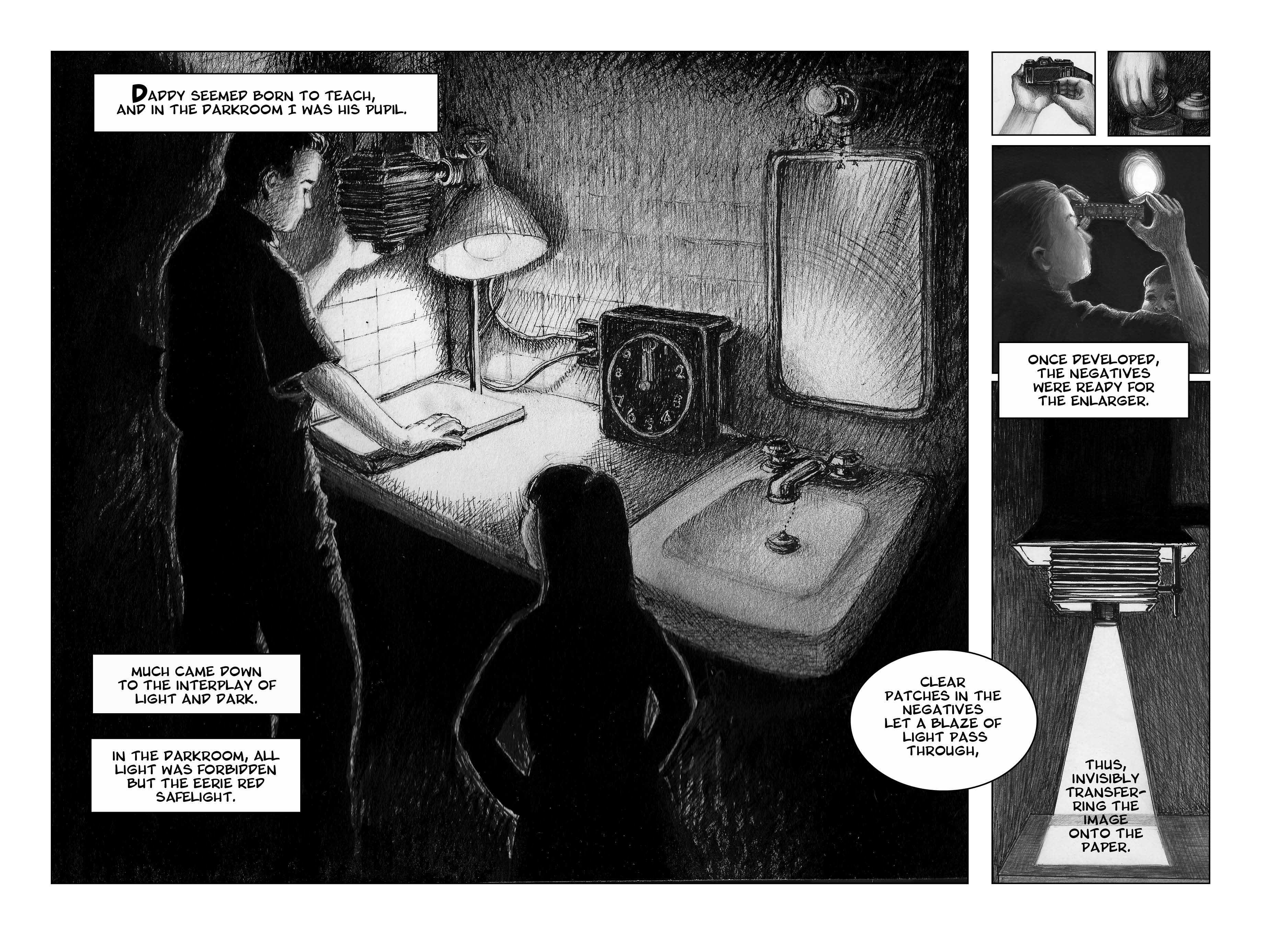
One of my goals was to find out exactly what happened that February night. I also wanted to pay homage to my father’s sideline work as a photographer and the crucial contribution that other photographers, as journalists, made to the Civil Rights Movement.

Darkroom joined spread

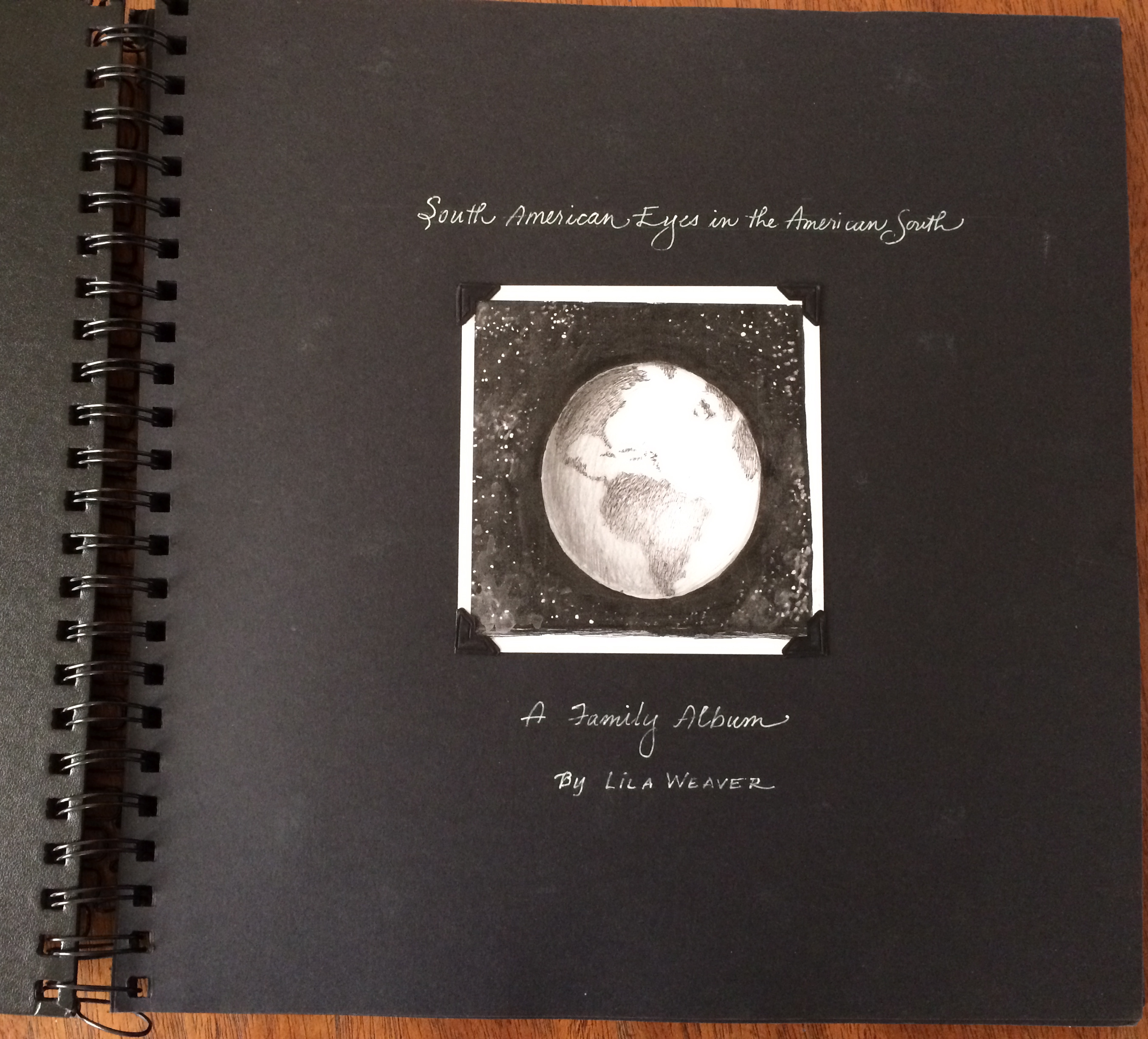
Grabbing the motif of photography helped me unify a complex story through metaphor and add a visual nod to the documenting power of the camera. So this is how my senior project looked: forty pages of drawings and captions, assembled in a photograph album. My drawings stood in for the photos. IMG_0031

At this stage, editors from The University of Alabama Press saw my work and offered me a contract for an expanded version. I said yes before I knew what I was getting into–a project that would consume the next three and a half years of my life.

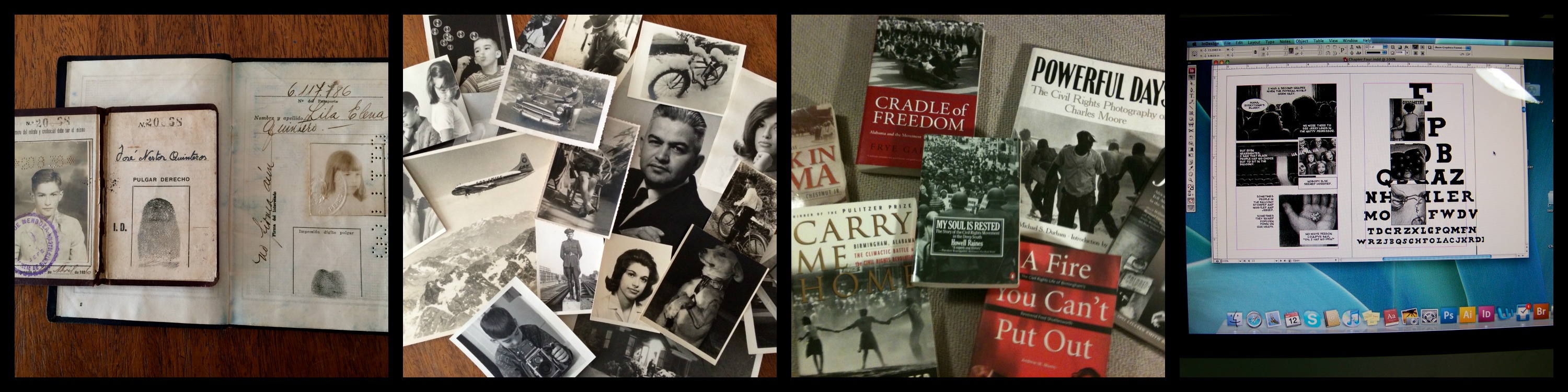
To prepare, I dug down into family memorabilia and photos. I researched the current events of my childhood and gained a degree of perspective that wasn’t possible while the news reports were still fresh.

Darkroom process

One daunting aspect of putting the book together was teaching myself the bare necessities of digital graphics programs. First, I created my drawings traditionally, on paper—more than 500 in all. Then I experimented with different ways of digitally layering the scanned drawings and combining them with text. The effect I was going for was a scrapbook of photos and ephemera.

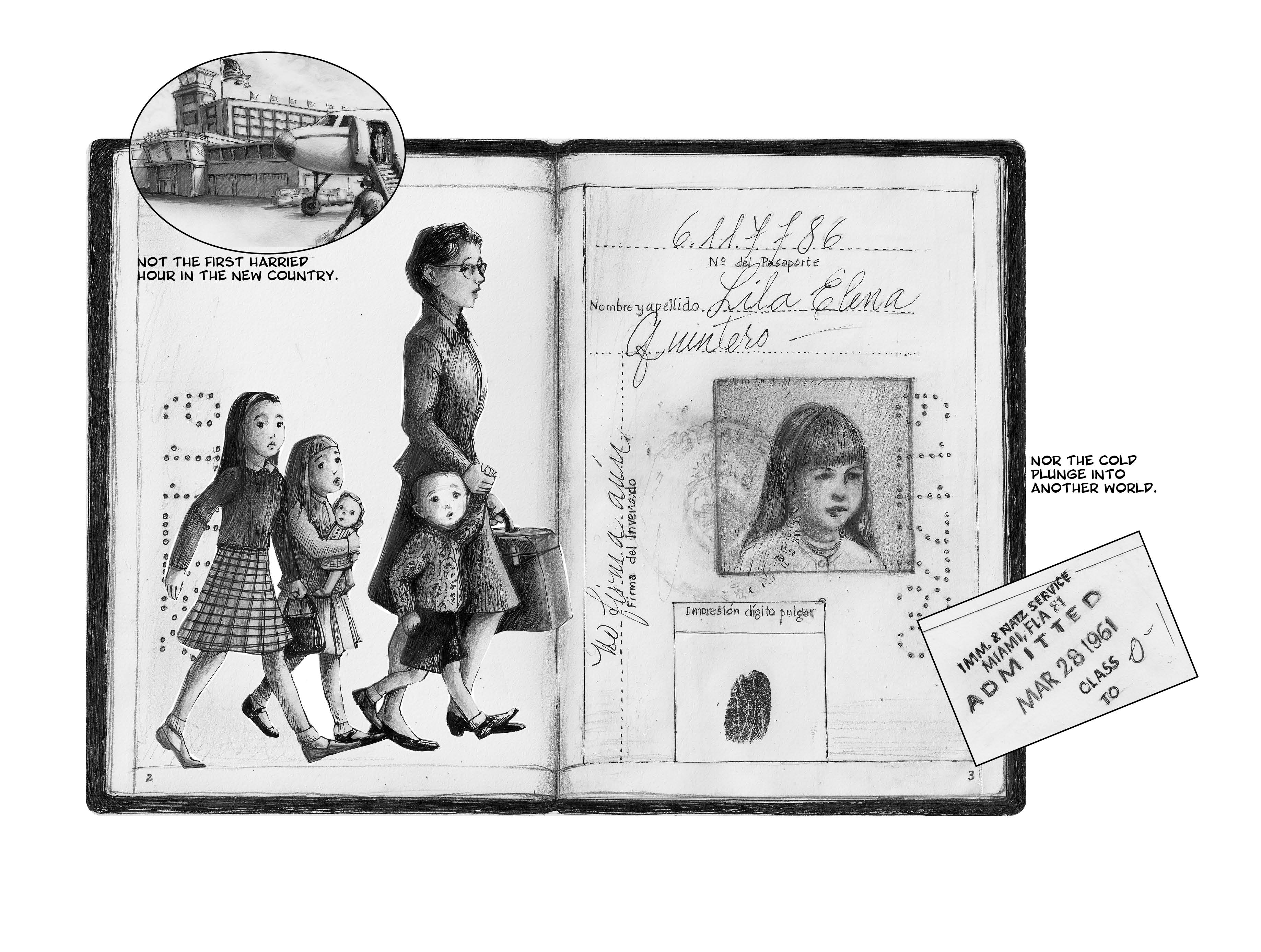
Passport

When the book launched in 2012, people in far-flung places showed interest in my story, including a publisher in France and college instructors from around the country who placed my memoir on their reading lists. Although I didn’t write the book with young readers in mind, it has also received a welcome in some middle school and high school classrooms.

Throughout this decade, the nation has been celebrating the 50th anniversaries of civil rights milestones. The Selma march has come to life in a major motion picture, and in a graphic novel series co-authored by U.S. Congressman John Lewis. Many eyewitnesses have published their stories, forming a rich tapestry of personal accounts. Teaching Tolerance, a division of the Southern Poverty Law Center, recently produced an instructional film for classrooms about the campaign for voting rights. It’s entitled Selma: The Bridge to the Ballot. It features visual documentation from previously untapped primary sources, including footage from the home movies that my father shot.

Bloody Sunday lies half a century behind us, yet racial tension and violence continue. I sometimes ask myself: what has actually changed? I remember the days of Jim Crow, which are, thankfully, well behind us. Yet, it seems like the passage of fifty years would’ve brought us deeper, more enduring changes.

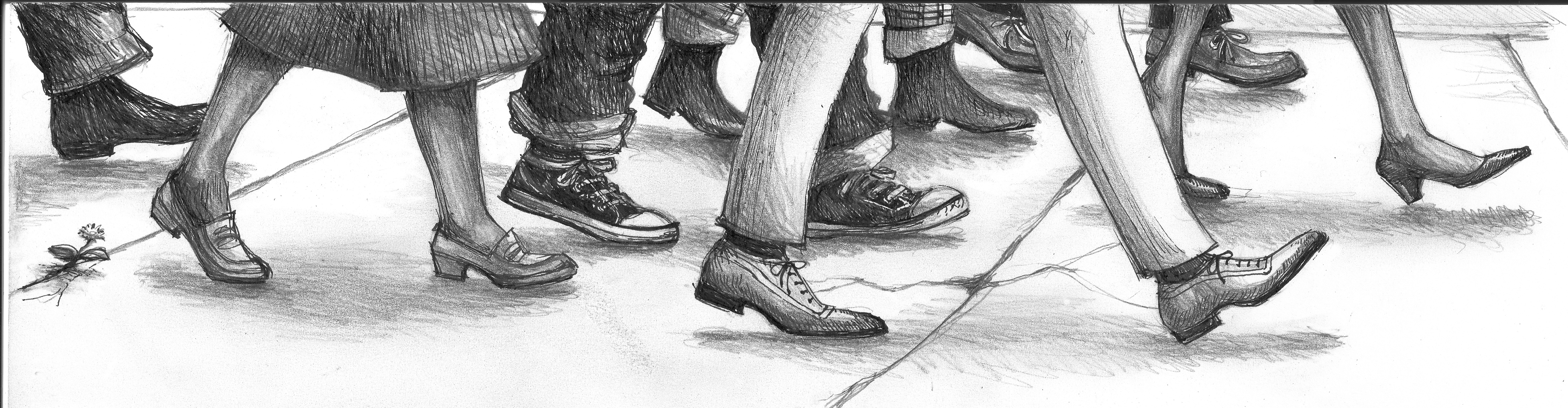
Marching feet for Chpt 8

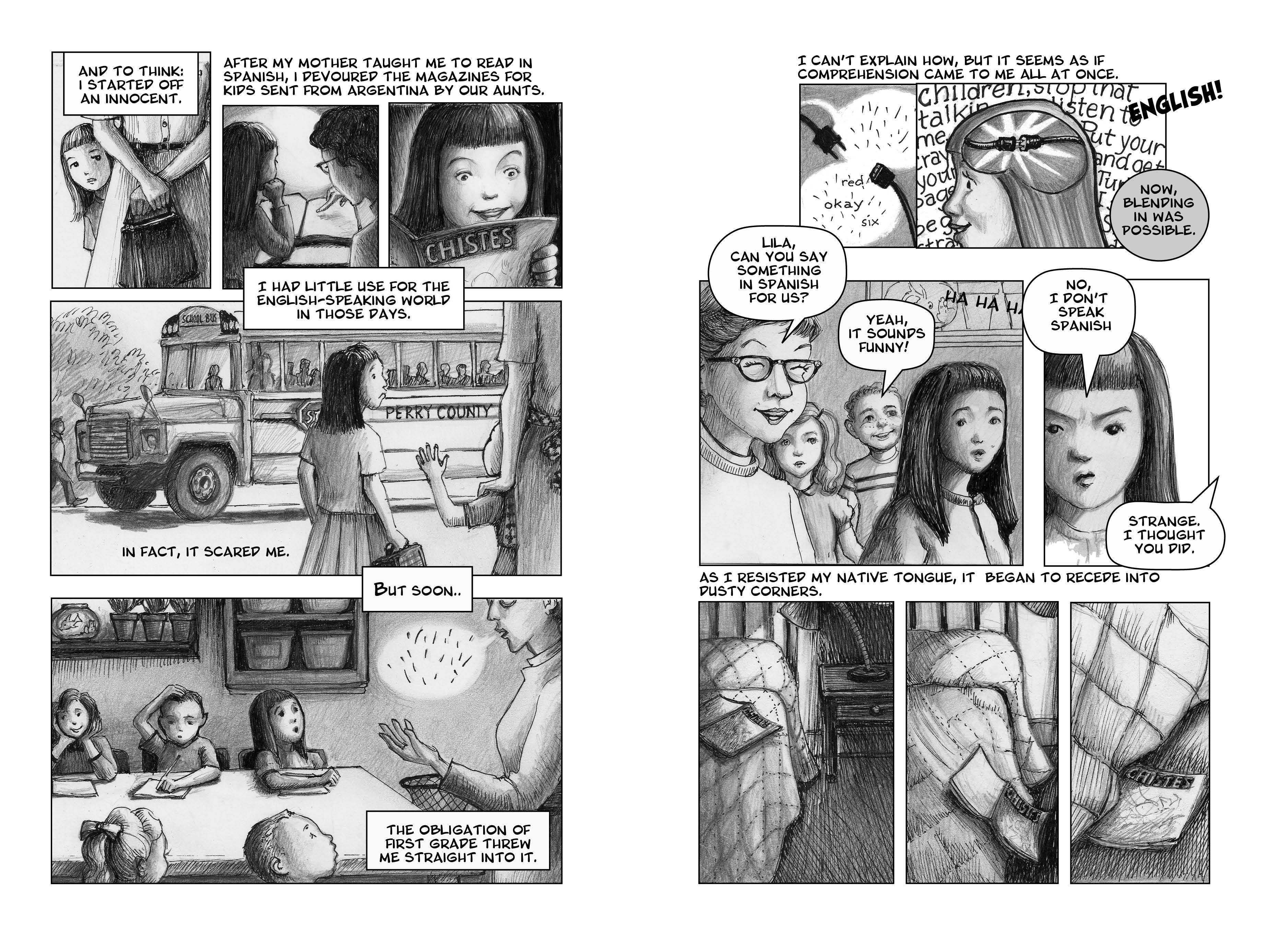
You may be left wondering: where’s the Latino component to my memoir? It’s there, in my initial struggle with learning English—a struggle that soon turned into a childish rejection of Spanish. It’s there, in my family’s generational divide on American culture and how fervently to embrace it.

School bus page

It’s there, in the troublesome fact that my family was spared overt bigotry because in Alabama in the middle of the 20th century, Latin@s were an almost invisible minority that posed little threat. I see this now, through the lens of history. If our immigration journey had taken us to a different region of the U.S., one where Latin@s were openly reviled and denied equality, I would’ve experienced things from a starkly different perspective. I can’t begin to guess what my life’s questions would’ve been then. For that, I turn to the stories of others.

Lila Quintero Weaver is the author-illustrator of Darkroom: A Memoir in Black and White. She’s working on a second book, a middle-grade novel. If Lila’s name looks vaguely familiar, it may be because she’s a regular co-blogger on Latin@s in Kid Lit. You can find her on Twitter, Facebook, and at her official author site.