A Studio Visit with Author-Illustrator Juana Medina

img_4567by Cecilia Cackley

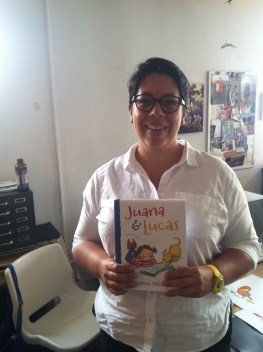
Juana Medina’s latest book is Juana and Lucas, published this September by Candlewick Books. An illustrated early chapter book, it is narrated by Juana, a little girl living with her dog Lucas in Bogotá, Colombia, who gives the reader a tour of her city and her life. Juana loves her family, her friends and her school, but she does not like having to learn English. Only when her family reminds her that they have a trip planned to the theme park Astroland in the United States, does Juana admit that maybe English has its uses after all.

Medina was born in Colombia and now lives in Washington, DC, where she works out of a shared studio space on the northwest side of the city. I spent an afternoon with her there, looking at the tools she used to create the illustrations for Juana and Lucas and talking about the process of creating the book.

Medina started out working in graphic design. She originally came to the United States from Colombia to study at the Corcoran School in DC, but found that the program there didn’t fit her needs and instead she moved to the Rhode Island School of Design (RISD). Her study of graphic design prepared Medina to write and illustrate this story. “It gave me great structure to understand books,” she says, adding that studying alongside undergrad students “made it more fun, gave it a sense of exploration.”
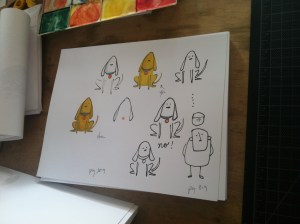
img_4574That sense of exploration is on full display in Juana and Lucas, which features a loose, sketchy quality to the ink drawings. Medina points to the British illustrator Quentin Blake as a key influence, noting that he draws with both hands, and she often does too, or sometimes draws with one hand and colors with the other. Another favorite artist is Joaquin Salvador Lavado, better known by his pen name Quino, who created the iconic comic strip Mafalda for the Argentine newspaper El Mundo. Medina gushes about Quino’s “level of expressiveness.” She points out: “He includes wit in such simple traces and achieves complexity and an incredible level of detail in just a few lines.”

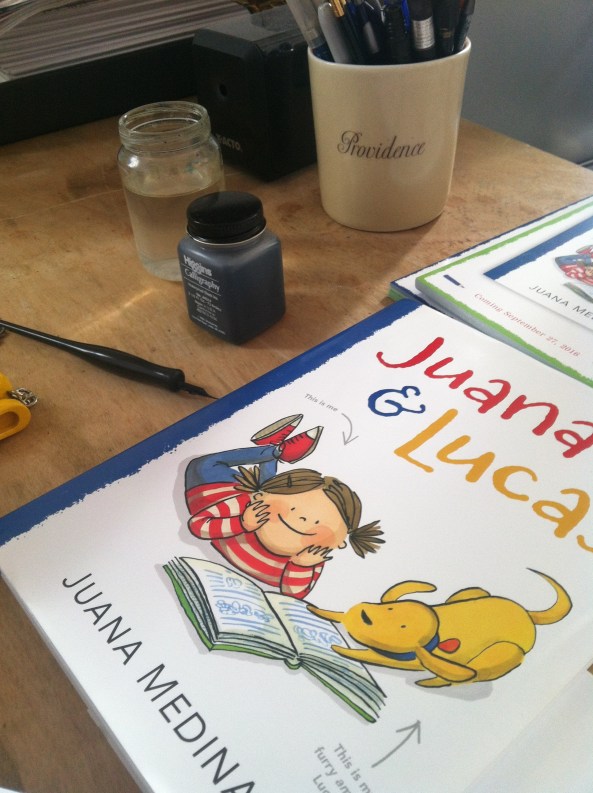
Medina likes the ability to switch between different artistic media from book to book. For her, it’s about what the story asks for.  Juana and Lucas is illustrated in pen and ink, and colored with watercolor, which is a very personal medium for Medina, as it reminds her of childhood and illustrations by favorites such as Quentin Blake. The personal components of the story of Juana and Lucas meant that watercolor felt right for the book, because it gives it a sense of nostalgia. Other illustration projects that Medina has worked on, such as Smick, written by Doreen Cronin, and the counting book 1 Big Salad combine found objects with digital drawings.
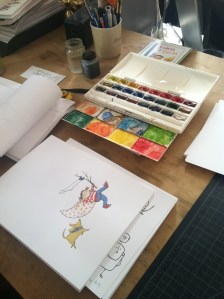
img_4573For Juana and Lucas, Medina experimented with sketches in pencil first, then used a light box to draw the final version of each illustration in ink. Watercolor came next and the drawing was then scanned so that the colors could be adjusted digitally. This process also allowed Medina to correct small errors without having to redraw an entire composition. She showed me one spread containing an airplane that hadn’t been in the original sketch. Later in the process, it was added digitally to cover up an unruly inkblot!img_4571
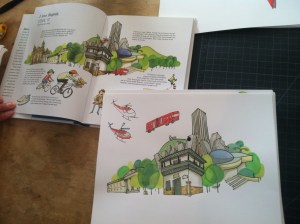
For Juana and Lucas, her first chapter book, Medina wrote the story first, and then went back to draw. Through writing and rewriting, she found the balance between word and image. She says “It’s important to make a book where even if a kid can’t read yet, they can still get a sense of the story.” The relationship between Juana and Lucas, in particular, is mostly visual, so even if Juana isn’t talking about him very much in the text, you see them interacting in the illustrations. Medina points out that this is more realistic, as our interactions with our pets are mostly visual and tactile. Having narrative both in the text and in the illustrations makes this a great choice for readers still transitioning from picture books to chapter books.
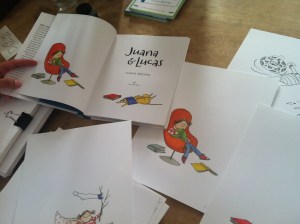
img_4570 The dynamic presentation of text (words that curve, get bigger or in other ways deviate from the standard type) featured throughout the story was Medina’s idea. Her thinking is that typography is part of language, explored, and it can cue certain meanings of words that may be unfamiliar to young readers.

Medina says about her writing process: “I was telling a story that was personal in my second language, so that was hard. I was lucky to be working with an editor who got it—figuring out the exact language to make it understandable without imposing too much. Candlewick has been great at not treating the text as precious, but instead seeing what is working and what isn’t.”

The book was written first in English, and she says it was almost like writing lyrics, choosing places where Spanish could be inserted in a way that made sense. Medina wanted to avoid echoing the English words in Spanish. She felt it was important to be respectful of readers and give them a chance to figure out the meanings of the Spanish words on their own. Its inclusion adds richness and reminds the reader that English isn’t Juana’s first language. The mix of the two languages feels very genuine, because mixing languages happens with all multilingual children. Their brains are trying to figure it out, and it’s natural for them to begin a sentence in one language and end it in another. The Spanish hasn’t deterred young readers who aren’t already familiar with the language. According to Medina, “I gave it to my niece, who was the first kid to ever read it. She doesn’t speak Spanish, but as soon as she finished the book, she went to the computer and pulled up Google Translate. After a moment she turned to me and said, ‘Me encantó tu libro,’ which was just…I was crying.”
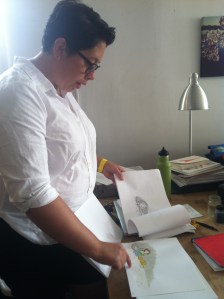
img_4572For readers in the United States used to seeing European cities such as London or Paris in children’s literature, it’s a breath of fresh air to get such a detailed, child’s-eye view of a major South American city. Medina went back to Bogotá after writing several versions, and says the trip was bittersweet. “It was the first time there without my grandparents, without having a place there to call home. It was a difficult trip, but it was sweet to see the mountains and smell the eucalyptus, and it was validating to see everything. I took some license in the book. I’m not tying myself to fact-checking everything, which was liberating in a way. There was a lot I left out, especially surrounding the conflict and civil war I grew up with. That’s something I’ll maybe address in another book. The hardest illustration was my grandparents’ house, which no longer exists. It was a safe haven, so no illustration could truly do it justice.”

Readers will be happy to learn that Medina is already working on a second book in the Juana and Lucas series. In addition, her follow up to 1 Big Salad, an ABC book called ABC Pasta, will be out in the spring from Penguin Random House. Medina’s advice to other Latinx artists looking to break into illustration is to be persistent and disciplined about their work. “Tell your own stories,” she says “Not the ones that will simply please an audience, but the ones that are meaningful.” And like her character Juana, struggling to balance her two languages, Medina advises artists to “find the language for the story you want to tell.”img_4568
Juana Medina is a native of Colombia, who studied and taught at the Rhode Island School of Design. Her illustration and animation work have appeared in U.S. and international media. Currently, she lives in Washington, DC, and teaches at George Washington University. See more of Juana’s work at her official website.

Cackley_headshotCecilia Cackley is a performing artist and children’s bookseller based in Washington, DC, where she creates puppet theater for adults and teaches playwriting and creative drama to children. Her bilingual children’s plays have been produced by GALA Hispanic Theatre and her interests in bilingual education, literacy, and immigrant advocacy all tend to find their way into her theatrical work. You can find more of her work at www.witsendpuppets.com.
 

Viva Smart, Bold Girls, and Viva Lola!: A Guest Post by Author Monica Brown


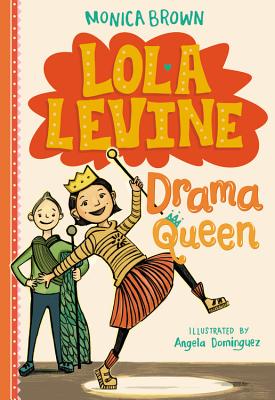
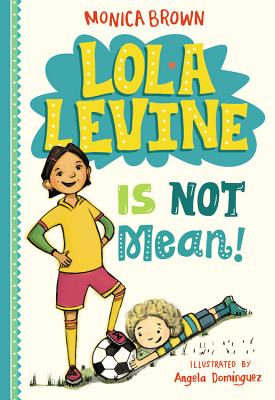
Lola Levine Is Not Mean! CoverBy Monica Brown

Why write a chapter book series?

I love this age of reader and I love this age. It really is an honor and a delight to write an #ownvoice chapter book series because my books might be the very first “novels” a child will be read, and the first read on their own! There are plots, subplots, world creation, and all those things that go into any novel. It’s a challenging genre to write in, but it’s an important one, because chapter books can establish a true love of reading. It is also one that has had a paucity of diverse main characters, and even fewer authors of color. While most librarians will know exactly who Junie B. Jones and Judy Moody are, we just don’t have multicultural chapter books with that reach and readership, and we desperately need them.

I’m very proud of the books my amazing illustrator Angela Dominguez and I created with this series! Picture books, middle-grade, and YA get a lot of literary attention–chapter books much less so. When I Lola Levine Coverdecided to write a chapter books series, my agent told me it would be a challenge to publish because there are fewer houses that publish them and a series is a big investment. Against all odds, Angela and I did it, and our books are among the first, if not the first, Latina-authored and illustrated chapter book series.

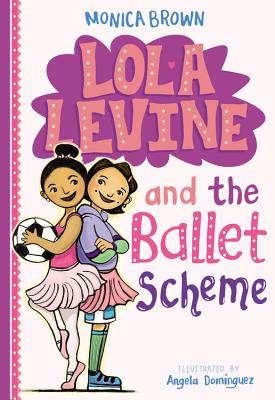
When I was in second grade, I would have loved to meet a rough and tumble girl like Lola Levine. You see, I spent a fair bit of time on the bench at recess! Apparently I talked a lot in class, played tag a little too competitively, and jumped in puddles on purpose. I do remember that my mother was called more than once to bring me dry shoes. In fiction, as in life, rascals and rebels might have more fun, but I learned to channel that mischievousness into creative outlets and team sports, not to mention a great deal of humor. Like Lola, I was also a child of two cultures, and I know first hand that mixed-race children, like myself and my daughters, are sometimes described as “half” this or “half” that, instead of beautifully whole. Lola Levine isn’t a fraction; she is made up of multitudes! As a Lola Levine and the Ballet Scheme Covermother, a teacher, and a writer who meets thousands of children each year, I’ve also observed the way girls (and boys) who don’t quite “fit in” can experience social exclusion, teasing, and even bullying.
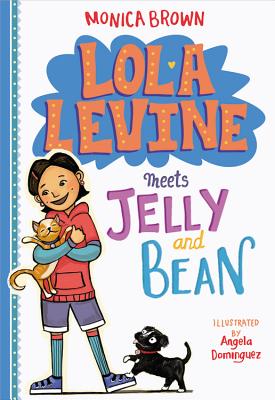
These are some of the reasons I created the chapter book series focusing on this irrepressible character of Lola Levine, who is boldly, fiercely, herself. Lola teaches us that girls can be competitive and loud and funny, but sensitive and nurturing, too. This series is also covering new territory. For example, in the upcoming Lola Levine and the Vacation Dream (Book 5), Lola goes to Peru with her family and visits her beloved Tia Lola. She stays in the house her mother grew up in and learns about her own complex history and Peru’s. This may be the first chapter book that addresses themes of indigenous identity and colonization in Peru.

As a writer, I’ve been inspired by director Guillermo del Toro, famous for the film Pan’s Labyrinth, who in relationship to art, imagination, and childhood once noted that there is “a particular moment that we all go through when we are asked to stop believing and stop choosing who we are and become who Lola Levine Meets Jelly and Bean Covereverybody else tells us to be.” He goes on to say, “we should not obey . . . imagination should not comply.” There is such a freedom in being oneself, and that is a gift I bestow on my character Lola.  It was a dream and a pleasure to create a smart, diverse, multicultural character who each day chooses to be herself, and whose imagination certainly does not comply! Viva smart, bold girls, and viva Lola!

Interested in more Chapter Books featuring Latina Characters?  In her recent blog on “Latina Girl Power! Chapter Books with Latina Characters,” librarian Mary Ann Schuer highlights Lola and other chapter books featuring Latina characters.


To the left is Monica Brown as a young soccer player; to the right is her daughter, JuJu, the original “Lola.”

monicasoccer  julessoccers


monica6Monica Brown, Ph.D. is the author of many award-winning books for children, including Waiting for the BiblioburroMarisol McDonald Doesn’t Match/ Marisol McDonald no combina The Lola Levine series including: Lola Levine is Not Mean!Lola Levine, Drama Queen; Lola Levine and the Ballet Scheme, and Lola Levine Meets Jelly and Bean. Find Monica on Facebook at Monica Brown, Children’s Author, on twitter @monicabrownbks, or online at www.monicabrown.net.
Things Boys Have Asked Me: A Guest Post by Author Joe Jiménez

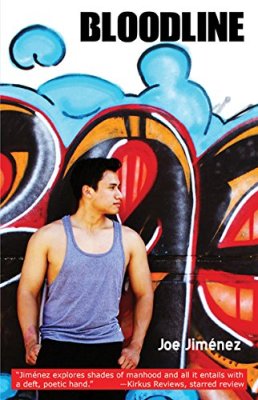
bloodline

by Joe Jiménez

I started my Young Adult novel Bloodline with a question on a single pale yellow Post-it: Does a boy need a father to be a good man?

For much of my life, I grew up without a father, so that question matters to me. When I was in first grade, my father left our family for a life more appealing than the one he had with my mother and with us, and though he came in and out of our lives after that, my mom’s the one who held it down. When I was nineteen, home from college, I ran into my father and his new wife and their son at a Wal-Mart, near the beer aisle, but he didn’t see me, or if he did, he didn’t recognize me, or perhaps he just walked by, all of them pretending I wasn’t there. Maybe I was twenty. Maybe this didn’t hurt.

Asking questions is the way I write.

I start with a question, not so much as a prompt. More as kindling. That’s the comparison I’ll use.

I think of Socrates: Education is the kindling of a flame, not the filling of a vessel.

Questions matter, I tell my students. How we arrive at a question, that matters, too. Over the years, boys in my classes have asked me questions that sometimes blew my mind.

            What’s the worst thing that’s ever happened to you?

            You ever get sad?

            Do you take a pre-workout or just protein?

            Do you think people can change, like go from bad to good?

            Why does my dad hate gay people?

The turmoil we live through manifests in the questions we hold. Sometimes, we tuck them away, deep in the waters of our hearts. No one ever sees them. Sometimes we might even forget they are there. Other times, we let these questions stick to us, like splinters, buried in our hands and feet. There is real pain in people’s lives. There is real triumph, too. A question might disintegrate, might lose its parts, but sometimes, we come to an answer. Other times, we come to more questions.

When I feel stuck with my words or misfire, I come back to these questions. In my notebook, I keep a list of them. I also keep lists of favorite words, odd words, words whose sounds and spellings fascinate me. I keep lists of how writers I love start their sentences. In a folder I keep these Post-Its, scraps of long paper, pages from journals, writing on the backs of receipts—papelitos.

            Do you own a gun?

            In a zombie apocalypse, would you opt out or put up a fight?

            What do you think is more important: street smarts or book smarts?

            What’s the worst way to die?

            Is it scary getting old?

            How did you tell your parents you were gay?

            Why does my dad hate me?

As I was writing Bloodline, I regularly looked at my collection of Post-Its, and I thought of questions—what if? why? how? I questioned: Why does Ophelia have to die? Why else might she climb a tree? What if Hamlet was alive in San Antonio and his father was a cholo? What if we really are destined to be men like our fathers? Is it true that some of us might be genetically predisposed to violent behaviors? How do you become a good man when all the men around you are twisted?

“The answers you get from literature depend on the questions you pose.” Margaret Atwood said this. I put this quote on one of my handwritten posters right near my desk. It’s one of the first things you see when you walk into my classroom. I want my students to know that their questions matter. And the questions keep coming.

            How do I know when I’m in love?

            Can guys be feminists?

            Who gets to decide who are the “good guys”?

            Do you think it’s fair that I work harder than most kids and I can’t get money for college because I don’t have my papers?

            Why does Trump want to deport us?

Questions. Power. Love. Possibilities.

Questioning is an anchor for the learning of consciousness, of the molcajete inside the woke corazón. Rasquache, that’s the Chicanx aesthetic for making beauty and fierceness from what we have available. So much of my life is handmade. I’ve learned to make the best out of what I have available to me. Perhaps that’s a result, a triumph of growing up working class. I’d like to believe it is. If readers and my students leave their time with me with anything, I hope it’s a commitment to questions—and to the belief that each of us has a right to ask them.


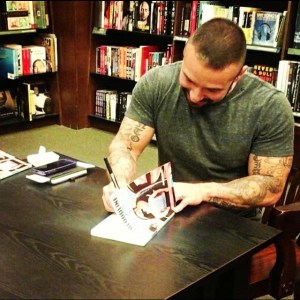
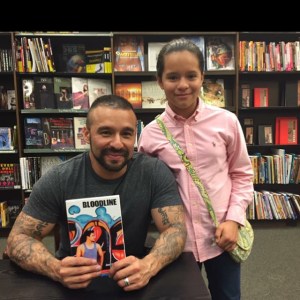
Below, Joe signs books at a Barnes & Noble event. One of his fans is his niece, Sophia Jiménez. 

image2

image1


jimenez-joe-2Joe Jiménez is the author of The Possibilities of Mud (Kórima 2014) and Bloodline, a young adult novel (Arte Público 2016).  Jiménez is the recipient of the 2016 Letras Latinas/ Red Hen Press Poetry Prize and holds an MFA in Creative Writing from Antioch University, Los Angeles.  The short film “El Abuelo,” based on Jiménez’s poem, has been screened in Belgium, the Netherlands, Mexico, France, Argentina, Ireland, England, and the US. He lives in San Antonio, Texas, and is a member of the Macondo Workshops. (Bio taken from Joe’s official website.)  

A Writer Belongs Everywhere: Stories from a Writing Workshop for Middle School Girls


By Tracey Flores

“A woman who writes has power, and a woman with power is feared.” ~Gloria Anzaldúa

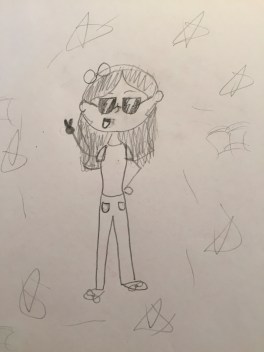
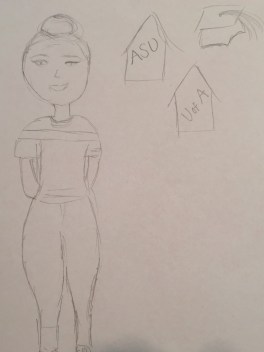
On an overcast and windy day in May, ten young girls and women–daughters, sisters, mothers and teachers–gathered in Mrs. Gonzalez’s 7th grade classroom for an afternoon of sharing, writing and storytelling. Nibbling on pepperoni pizza and pink frosted cookies, desks arranged in a small circle in the front of the room, we sat with folders, notebook paper, and pencils, writing a letter to our sisters or mothers. This letter was the culminating writing of an afternoon of drawing self portraits and writing how we see ourselves and how we see our sisters and mothers.

As the the pencils stopped and everyone came to their closing thoughts, I invited everyone to turn to their sister or mother and read the letter they had just written to them. As I walked around the room to lean in and listen, with permission, I noticed that these handwritten letters were filled with words of advice, encouragement, and promises. They were filled with the words that many times we are too shy or afraid to share for fear of ridicule or embarrassment.

Alexandria read, “Dear Mom, An advice I want to share with you is ‘Live life to the fullest.’”

Dede read to her older sister, “…I believe in you whatever you do.”

Estefania read to her daughter, “…my sweet little miss…just know everything you do big or small I am proud of you everyday.”

IMG_3447 IMG_3448


This vignette of an after-school writing workshop for middle school girls and their families illustrates the transformative power of creating space with and for our students and their families that honors their lived experiences and ways of knowing. For two weeks, we gathered in Mrs. Gonzalez’s room to engage in discussion, reflection, and storytelling on topics such as creating positive self-definitions, family, and education. Although our time together was brief, we created a supportive community of writers.

As a classroom teacher, and now as a PhD candidate, I have the privilege of working with families in after-school bilingual writing workshops, like the one in the vignette. In these writing workshops, students, their siblings and grandparents work side-by-side to tell, draw, write and share stories from their lived experiences. It is an opportunity for families to enter the classroom as experts and draw upon their cultural and linguistic resources to reflect on their lived experience through storytelling, drawing, and writing.

These bilingual family writing workshops are designed within a writing workshop framework, with a mini-lesson, writing time, sharing time, and a closing reflection. Each workshop begins with the reading and discussion of a bilingual picture book, poem, or short memoir. This text is carefully selected and serves multiple purposes. First, it is selected to introduce families to the theme of the workshop. Second, the topic of the text is considered in how families may relate to it or connect it to their own experiences, if the book is culturally relevant or rather recreates negative stereotypes. Lastly, the topics, writing, text structure, and organization are considered in how they might provide families with a powerful mentor text (Fletcher, 2011) for their own writing.

After the opening text is shared and discussed, I model my own writing by talking through what I am doing and thinking as I put drawing and writing on chart paper. Sometimes I model my brainstorm and other times I just draw and write. Then, I invite families to draw and write their own stories or poems. This is my favorite part, watching students and their families write and share their stories, many times for the first time with one another.

Over the years, in these workshops, families shared stories of celebrating Las Posadas with their family and community, stories of ranchos that stretched over acres in rural parts of México where they learned to tend the animals and to cherish all the resources of the tierra, and stories of special abuelitas who embraced them and loved them in that special way only an abuelita loves you.

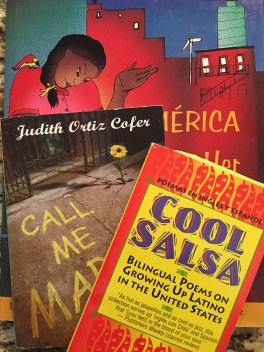
As I wrote earlier in this post, in preparation for working with families in workshops, I always gather several texts in a variety of genres to use as mentor texts. Below is a short list that I have used as mentor texts in bilingual writing workshops with Latinx families in schools and community centers across Phoenix and Glendale in Arizona.

IMG_3446Alarcón, F. (2005). Poems to Dream Together/Poemas para sonar juntos. Illustrations by Paula Barragán. Lee & Low Books.
Carlson, L.M. (2013). Cool Salsa: Bilingual Poems on Growing Up Latino in the United States. Square Fish.

Cisneros, S. (1994). Hairs/Pelitos: A Story in English and Spanish from The House on Mango Street. Dragonfly Books.

Cisneros, S. (1994). La Casa en Mango Street. Translated by Elena Poniatowska. Vintage Books.

Cisneros, S. (1991). The House on Mango Street. Vintage Books

Costales, A. (2007). Abuelita full of life/Abuelita llena de vida. Illustrations by Martha Aviles. Cooper Square Publishing.

Fanelli, Sara. (1995). My Map Book. HarperCollins.

Garza, C.L. (2005). Family Pictures/Cuadros de familia. Children’s Book Press.

Garza, C.L. (1996). In My Family/En mi familia. Children’s Book Press.

González, L. (2008). The Storyteller’s Candle/La velita de los cuentos. Illustrations by Lulu Delacre. Children’s Book Press.

Herrera, J.F. (1998). Laughing Out Loud, I Fly: Poems in English and Spanish. HarperCollins.

Lyon, G.E. (1999). Where I’m From: Where Poems Come From. Absey & Co.

Medina, J. (2004). The Dream on Blanca’s Wall: Poems in English and Spanish/ El sueño pegado en la pared de Blanca: Poemas en ingles y español. Illustrations by Robert Casilla. Wordsong/Boyds Mills Press.

Ortiz Cofer, J. (2004). Call Me María. Scholastic Inc

Ortiz, A. (2015). Rant. Chant. Chisme. Wings Press.

Rodríguez, L. (1998). América is her name. Illustrations by Carlos Vasquez. Curbstone Books.

Soto, G. (2005). Neighborhood Odes. Harcourt.

Note: This summer, I will be collaborating with three teachers to facilitate a second series of bilingual writing workshops for Latina middle school students and their mothers. Stay tuned for an upcoming blog post with stories and learnings from these writing workshops


321988_10101177230382771_455531340_o-1Tracey Flores is a former English Language Development (ELD) and Language Arts teacher who worked in elementary classrooms for eight years. She currently serves as the director of El Día de los Niños, El Día de los Libros and is a teacher consultant with the Central Arizona Writing Project (CAWP) at Arizona State University (ASU). Currently, Tracey is a PhD Candidate in English Education in the Department of English at ASU. Her research focuses on adolescent Latina girls and mothers’ language and literacy practices and on using family literacy as a springboard for advocacy, empowerment, and transformation for students, families, and teachers. In her free time she enjoys writing, reading Young Adult (YA) literature, drinking coffee, running, practicing yoga and spending time with her 8 month old daughter.


Q&A with Author Diana López about NOTHING UP MY SLEEVE


By Marianne Snow Campbell

Today we’re very pleased to host a dialogue with Diana López in honor of her newest middle grades novel, Nothing Up My Sleeve, which released on April 19.  This book follows three friends – Dominic, Loop, and Z – as they discover the exciting world of stage magic one summer. It’s equal parts humor, character study, and magic lessons – a fun and fascinating read. After finishing Nothing Up My Sleeve (click here for our book review), I was definitely curious about Diana’s creative process, so I’m very grateful that she was able to answer these questions for me. Enjoy!

I love the backdrop of stage magic in Nothing Up My Sleeve.  What inspired you to explore this topic?

My husband, Gene, inspired me. I wouldn’t know the first thing about magic if it weren’t for him. He’s an aficionado with a great collection of magic books, props, and videos. Over the years, I’ve been a tagalong at magic lectures and conventions, including the TAOM convention that I write about. Magicians are so creative, and if you think about a magic performance, you’ll realize that it’s just another form of storytelling. How could I resist? I had to write this book! And I had so much fun finding magic tricks that resonated with the characters’ personal lives. This is what stories do—give us tools for coping and for celebrating life.

Another important source of inspiration comes from my nephews who turn absolutely everything into a competition. Think about it. Competitions are wonderful for writers because they have a built-in sense of conflict—you’re “fighting” against others but you’re also fighting against yourself as you work to problem-solve or overcome insecurities. In a sense, a competition is a form of story, too.

Also, could you describe your process in creating this book?

I carry a little notebook around and jot down bits of dialogue or names of interesting things. I sometimes take pictures, too. Anything that feels like a good detail for a story. The magic shop, Conjuring Cats, is completely inspired by JCR Magic in San Antonio, for example.

Eventually, I realized that I wanted to write about three boys at a magic competition. But who were they? What kind of magic did they do? What else were they dealing with? To find out, I had to do a lot of exploratory writing, stuff that never gets into the final novel. It’s my way of searching for voices. And with three boys, I needed three voices that were distinct.

Once I had the voice and general sense of where the book was going, I started drafting. I’m not an outliner. I prefer to write, rewrite, rewrite, and rewrite. Stuff gets moved around, deleted, added, and the story eventually works itself out. I know it’s not the most efficient way to write, but for me, it’s the most enjoyable.

What made you decide to use three narratives? How did you go about developing Dominic, Loop and Z?

My previous books follow one character, so using three narratives was a new experience for me. From the beginning, however, it felt like the best approach for this novel. I love competitions—sports, board games, reality shows like Survivor or Amazing Race. It’s fun to root for someone, but often, I find myself rooting for more than one person. Something similar happened when writing this book. I found myself rooting for all three boys, so I wanted to give each of them time on the stage.

Using three perspectives also gave me a chance to explore how different people learn a new skill and perform in front of audiences. I love the unique set of abilities and insecurities that accompany each character. One of my favorite experiences with this book was taking a classic sleight, like the French drop, and seeing how the boys used their personalities to create different versions of this one move.

As for developing the characters, Dominic, Loop, and Z are very loosely based on three of my nephews. I love to eavesdrop on their conversations, and I’ve had plenty of chances to witness how they fight and how they show affection. Writers harvest ideas and voices from their environment, and that’s exactly what I did. I even called my nephews when I was looking for creative insults like “Fungus Foot, Toilet Clogger, Slobber Boy, and Stink Bomb.” Yup, they get total credit for that.

What do you want readers to carry away from Nothing Up My Sleeve and your other middle-grades books, Confetti Girl, Ask My Mood Ring How I Feel, and Choke?

I want them to enjoy the books. Just have fun. It breaks my heart to hear young people (or anyone) complain that books are boring. If I can make people laugh or nod because they recognize a bit of themselves in the story, then I have done my job.

For readers who like to dig a little deeper, I’ve posted some discussion guides on my website. You can find them on the “classroom” page http://www.dianalopezbooks.com/classroom.php . Find a friend and have a book chat. Published books don’t belong to the authors anymore. They belong to the readers.


As an author and creative writing professor, you clearly know a thing or two about writing. What kind of advice would you like to give to aspiring young writers out there – especially writers who want to publish books that celebrate diverse experiences and perspectives?

Aspiring writers are probably tired of hearing this, but it bears repeating because it’s so true. The best way to improve your writing is to read, read, read. And if you’re interested in celebrating diverse perspectives, then buy those titles. Do a little research to discover writers from your community, and then support them. We need to let publishers know that there’s a real interest in these books.

The second bit of advice is to pay attention to the world around you. Just read the signs, watch the people at parks or malls, browse the aisles at grocery stores. Examine familiar places as if seeing them for the first time. The diversity is built-in, and these are the details you want to capture in your books.

Since you published your first book, have you seen a change in the quality/quantity of diverse books published?

Yes, there’s an enthusiastic call for diverse books right now. I’m thinking of the We Need Diverse Books Campaign, and I’m seeing more diversity in our award-winners. This makes me very happy.

But, we still have a long way to go. I grew up in a working class, Mexican American family, a group that is still underrepresented. Here is a population statistic from “A Demographic Portrait of Mexican-Origin Hispanics in the United States” by Ana Gonzalez-Barrera and Mark Hugo Lopez: “Mexicans are by far the largest Hispanic-origin population in the U.S., accounting for nearly two-thirds (64%) of the U.S. Hispanic population in 2012.” Two-thirds of the Hispanic population in this country! I haven’t done the research, but I’m curious. If you took all the books published by Latinos in this country, what percentage will be by Mexican Americans?

So, moving in the right direction? Yes. But are we there yet? No. That’s why it’s an exciting time to be a writer and an advocate for diverse books.

Do you have any new book projects in the works?  Can you share anything about these projects?

Right now, I’m working hard to spread the news about NOTHING UP MY SLEEVE. I like to write short stories, too, so I’m using the time between book projects to finish and polish some shorter pieces I’ve been working on.

I was so excited to find out about CentroVictoria!  Tell us about your work there.

Photo credit: Todd Yates

Photo credit: Todd Yates

CentroVictoria is supported by the University of Houston-Victoria, where I work. Its founding director is Dagoberto Gilb, author of BEFORE THE END, AFTER THE BEGINNING. Our goal is to promote Mexican American literature and art. Right now, we’re doing this in two ways. One is the publication of an annual magazine called HUIZACHE. It’s a beautiful magazine, and I highly recommend it for people interested in Latino literature. Please visit our website http://huizachemag.org/ to learn more. The second way we promote the literature is to help educators. Dagoberto and his son, Ricardo Gilb, edited a textbook that was just released by Bedford St. Martin’s. It’s called MEXICAN AMERICAN LITERATURE: A PORTABLE ANTHOLOGY, a great resource for those who want a taste of important works and a sense of how the literature has changed. Dagoberto and Ricardo did a phenomenal job. For my part, I wrote an instructor’s manual full of discussion questions. It’s available as a downloadable pdf file.

To learn more about me, my books, and my work with CentroVictoria, please visit my website at www.dianalopezbooks.com


MarianneMarianne Snow Campbell is a doctoral student at The University of Georgia, where she researches nonfiction children’s books about Latin@ and Latin American topics and teaches an undergraduate course on children’s literature. Before graduate school, she taught pre-K and Kindergarten in Texas, her home state. She misses teaching, loves critters, and can also be found on Twitter and Facebook.

Poetry in the Lives of Children and Young Adults


By Dr. Sonia Alejandra Rodriguez

“Before you go further,/ let me tell you what a poem brings,/ first, you must know the secret,/ there is no poem/ to speak of, it is a way to attain/ a life without boundaries”

— from “Let Me Tell You What a Poem Brings by Juan Felipe Herrera

I have been teaching creative writing to middle school and high school students in and outside of traditional classroom spaces for about five years now. For the most part, I have found that despite the need for these creative spaces, they are too hard to come by. My purpose in each teaching space is to create a safe space where youth can use their lived experiences, their communities, and their imagination as inspiration to find their voices—alongside teaching them a skill or two about creative writing. My favorite part of teaching creative writing is the opportunity to listen to youth tell their stories. When I start my classes, I always let youth know that I was undocumented when I was their age, and with high school students, I might reveal that I grew up around domestic violence. I don’t share these personal facts for any shock factor but because there’s still a dangerous misconception that people like me—and like my students—are not writers. The lack of representation and diversity in books available in K-12 classrooms impacts whether children and young adults understand their experiences as valuable and whether they can see themselves as agents of their own stories. In other words, not seeing ourselves represented in what we read while in school influences the value we give to our personal experiences and whether we consider ourselves worthy enough to write our own stories. Most of the work that I do in each teaching space is about undoing the fallacies of who can be a writer and what stories can be told.

I enjoy teaching poetry most of all because, at first, youth are very hesitant about reading and writing poetry because it’s “too hard” to understand or there are “too many rules” to follow, but they are then surprised and even excited when we read poems by the likes of Francisco X. Alarcon, Pat Mora,  or Juan Felipe Herrera. I’m sure what surprises them is that these poems are about tortillas, abuelas, or about barrios like the ones in which they live. The idea here is not to essentialize their Latinx experiences, or their experiences as children of color for that matter, but stories about cultural foods, grandmas, immigration, class, and the like still resonate with children and young adults of color for a reason. Even if they are exposed to writers of color in their classrooms, students and teachers alike are constantly battling the negative messages youth receive about their cultural, ethnic, and class background. Because of this, it’s refreshing and empowering for youth to hear stories they can relate to in hopes that they do will want to share their own stories.

Poetry usually becomes the favorite outlet for many of my students, especially after I tell them that they can write poetry without needing to follow any rules. Poetry has become a safe way for my students to unleash their dreams, their pain, and their imaginations without necessarily revealing the truth about any of the above. Imagery, metaphors, similes, and symbols are very powerful tools for youth to process their experiences without needing to name their afflictions if they don’t want to. On the other hand, poetry is the perfect vessel for them to say what they want with little stress from conventional English grammar rules. Believe it or not, complete sentences, subject-verb agreement, and punctuation can be real bummers. I have had the most hesitant of 6th grade boys write poems about video games, boogers, balls, or about how stupid 6th grade is. And I encourage those types of poems because those, too, are important stories. There are certainly other students that can relate to poetry about video games and the dreadfulness that is 6th grade. In the same vein, I have had students reveal that they struggle with depression, that they don’t like the color of their skin, that they are embarrassed by their parent’s broken English, that they or a family member are undocumented or have been deported. I don’t ever ask students to write about their deepest, darkest secrets. I often give them the option to make something up if they don’t want to write about themselves. But more often than not, students share these personal stories without prompting because they need to. In my poetry sessions[i], I try to give students the opportunity to say what they can’t say aloud in hopes that they may “attain a life without boundaries.”

How to Use Poetry in Latinx Children’s Literature to Encourage Children and Youth to Read/Write Poetry

For elementary and middle school students, I often start off with Francisco X. Alarcón’s poetry for children because they are fun, culturally relevant, and bilingual (English/Spanish). Alarcón has many wonderful books of poetry for children but I use the “The Magical Cycle of the Seasons Series,” which includes Iguanas in the Snow: And Other Winter Poems, Laughing Tomatoes: And Other Spring Poems, From the Bellybutton of the Moon: And other Summer Poems, Angels Ride Bikes: And Other Fall Poems, because it allows me to use the five senses to describe how each season manifest itself in a student’s community.


For example, Alarcón’s poem “Dream,” in Laughing Tomatoes: And Other Summer Poems, is about gardens everywhere and everyone helping to plant gardens. When teaching this poem, I first ask the youth to read the poem aloud. I like to ask different students to read the same poem several times so that we can hear different intonations and discuss if emphasizing different words in the poem changes its meaning. I do the same with the Spanish version of the poem. I then talk about which of the five senses the poem uses to tell the story. I ask students to point to specific lines in the poem to support their arguments. We then move into a group discussion about gardens, their purposes, where we might see them, and if they have one of their own. Depending on the group, I might ask them to write in free verse about the gardens in their homes/communities or to imagine their own garden. If the youth or group needs more structure, I might ask them to write an acrostic or cinquain poem about gardens or a garden related subjects. To close out the session, I often ask students to share their poems, or we might try to mime or sing the poem. When there’s not enough time to go into that much detail with the poem, I read the poem with the youth, ask them what they think the poem is about, and ask them to write their own poem about their garden, a garden they’ve seen, or why there should or shouldn’t be more gardens in their communities. Maya Christina Gonzalez’s beautiful illustrations also present an opportunity for students to create additional garden paintings, drawings, or an entirely new poem based on the illustrations.

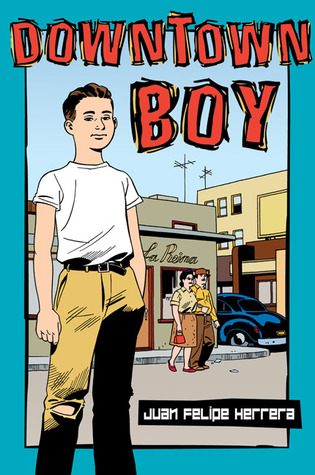
For older students I often refer to Juan Felipe Herrera’s novel in verse Downtown Boy. More often than not, we focus on the young main character Juanito to discuss issues such as discrimination in school, immigration, gender roles, masculinity and femininity, diabetes, family, and more. If I have an opportunity to teach the entire novel, then I often create poetry portfolios with my students where we pick a broader theme like identity, culture, and/or community that will thread throughout all their poems.  If I don’t have enough time to cover the entire novel, then I usually pick the poems that will best represent the student population or the poem with which they can connect to the most.
For example, Downtown Boy opens with Juanito’s cousin trying to coerce him into boxing Sweet Pea Price. Juanito is new to San Francisco and wants to make friends but his father has advised him against fighting. Juanito will need to decide if he will fight or not. When teaching this poem, I ask students to read this poem aloud; we then discuss Juanito’s character traits and the overall voice of the poem. I brainstorm with my students about times they might have been in a similar predicament. Because this poem uses dialogue, I encourage my students to include two different voices. If the youth have finished their poems, I might ask them to share their work. With older students, I like to encourage revisions and workshopping each other’s poems in order to improve our writing and to learn from one another.

Poetry in Action

The following poems were written by young poets in my creative writing classes. Kimberly Alvarez is currently a sophomore in high school in Riverside, California. Naomi Lara is currently a 6th grader in an elementary in Chicago, Illinois. Jennifer Alvarez is currently a senior in high school in Riverside, California. I’m grateful for their words and for their permission to share them here.

Dream[ii].

by Kimberly Alvarez

At Night,

I look up at the ceiling.

Bare.

NO DREAMS

Anywhere.

At midnight,

I’m sound asleep

In Paradise

Floating.

Free. Away.

I don’t want to wake up.

Until my eyes just…

Open,

Like a curtain beside me

When the wind comes through

At 5:00 a.m…

I hear my dad getting ready for

Work.

I can tell he didn’t choose that

Job or this life for himself

Or my family.

I see through him

Through his eyes,

To his soul.

It may seem…

COLD

but in reality

I can feel,

Feel the warmth

When I look into his eyes,

To his soul.

They change color. His eyes.

With him. His mood.

¿Porque? Why?

Can’t he be as warm as his soul is..

Dream.

I always do

Of him,

Of my family,

Finally happy together.

Put back together

Like a puzzle.

I always wonder

What my family would

Be like without

Dreams.

At morning,

When I get up

It all flows down

Goes down like a giant wave

Drowning my dreams

And pulling them down

At night,

I look up at the ceiling

All of my dreams,

Are floating

Up, wandering

On the ceiling

Waiting for the rest

Of my dreams to

Join them

And

Soon…

They will

Become

One BIG dream.

Un Gran Sueño.


It All Changed

By Noemi Lara

Happy girl, good friends

Big house

She should have cherished those moments

For they would be gone too soon

She looked up at the moon

Little did she know everything was about to change

Her mom and dad were acting strange

They told her they needed to arrange a meeting to see new houses.

Their new house has mouses

The neighborhood was foul

She couldn’t help but growl

She grew older

And things got colder

Her friends were bolder

Her parents would fight

It gave her a fright

She fought with all her might

But all she would see was the night

Oh how it all changed


My California[iii]

By Jennifer Alvarez

My California is fun times at Lake Perris.

Running into the water but jumping back when you feel the ice

cold water.

In those rare but amazing visits to see my “best cousin forever”

in Fontana.

Laughing, fighting, hugging, and talking until the next three

months when we reunites.

It is those two times going to Big Bear.

Snowman on the roof of my dad’s car, attempting to bring it back

home to show it to my friends.

It is the  multiple times driving to Moreno Valeey to Walmart with my sister.

Music blaring, singing along with smiles on our faces.

It is the sisterly bonding we had going to the Moreno Valley

Mall.

But mostly, my California are memories with the people I love.


[i] Currently I teach poetry as a Teaching Artist with ElevArte Community Studio, an arts organization in Chicago. “Word Up,” is a pilot program funded by ElevArte and the Poetry Foundation to create a safe space for underrepresented youth to learn about and write poetry. I visit a local elementary school once a week to teach, read, and write poetry with two 6th grade classes. I have worked closely with their awesome teacher, Ms. Delta Cervantes, to create a poetry curriculum that also meets common core standards. The 6th graders are presently working on spoken word projects.

[ii] Dream was first published in 2012 in a youth anthology, R’side of the Story, out of the Youth Opportunity Center in Riverside, California

[iii] My California was published in 2013 in R’side of the Story


FullSizeRender (1)Dr. Sonia Alejandra Rodriguez’s research focuses on the various roles that healing plays in Latinx children’s and young adult literature. She currently teaches composition and literature at a community college in Chicago. She also teaches poetry to 6th graders and drama to 2nd graders as a teaching artist through a local arts organization. She is working on her middle grade book. Follow Sonia on Instagram @latinxkidlit