La Casa Azul: El Barrio’s Independent Bookstore

By: Zoraida Córdova


La Casa Azul 4

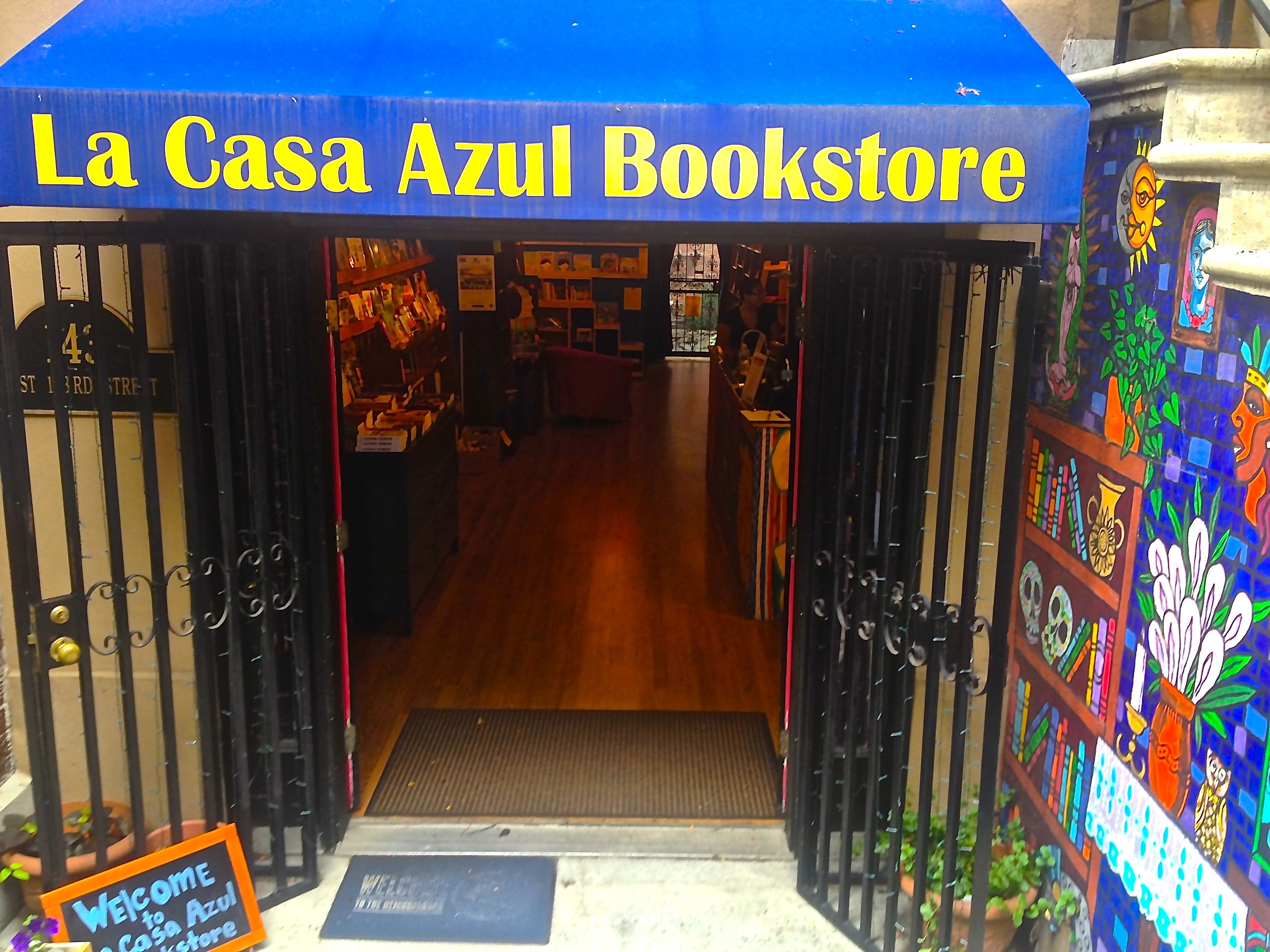
Entrance. Photo by Z.C.


La Casa Azul Vega

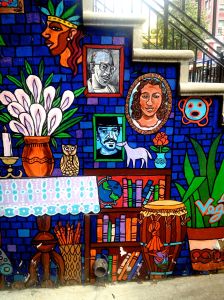
Manny Vega’s mural. Photo Z.C.

El Barrio, or East Harlem, is home to La Casa Azul, named after Frida Khalo’s home-turned-museum. Raising “40k in 40 days” through a crowd-funded campaign, Aurora Anaya-Cerda was able to open the doors to the store in June of 2012. It’s encouraging to see that the public is willing to contribute to bring these projects to life. I remember keeping up with the bookstore’s progress on Lucha Libros. From painting to building shelves, it was exciting to know that this kind of indie was coming to a neighborhood that otherwise doesn’t have access to a wide range of Libros Latinos. In a city that is 28.6% Latino, there is a huge need for access to these books.

La Casa Azul 1

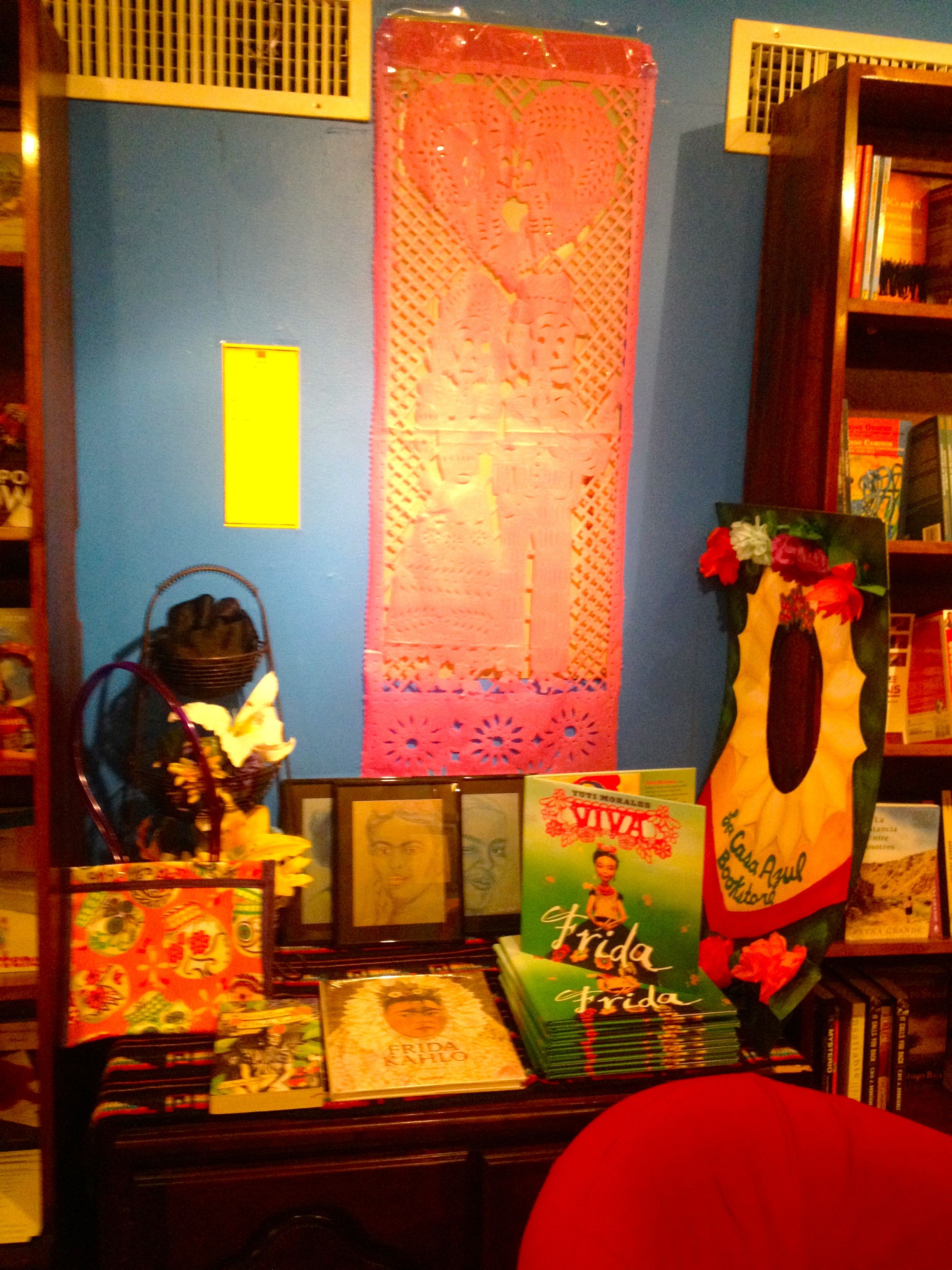
All things Frida Khalo. Photo Z.C.

So, how do you visit? To get to La Casa Azul, take the 6 train to 103rd street in Manhattan. This lets you off onto an area lined with bars, restaurants, bodegas, a botanica, and schoolyards. The neighborhood is also home to El Museo Del Barrio, if you’re in the mood for more art. But first, go to La Casa Azul. Make a left on Lex and a right at a bright blue awning. Down the steps you’re greeted by a gorgeous art installation by Manny Vega. You can see the process of his work here.

Once inside, the bookstore is warm and inviting. Aurora Anaya-Cerda is there with another employee stacking books. Named and inspired by Frida Khalo’s home, La Casa Azul has many references to her that range from paintings, to art books, to art installations. LCA even has its own exhibit/gallery. Their current showcase is called “A Ribbon Around a Bomb,” by Suhaly Bautista, The Earth Warrior. I’m excited to see what the next art display will be.

La Casa Azul 2

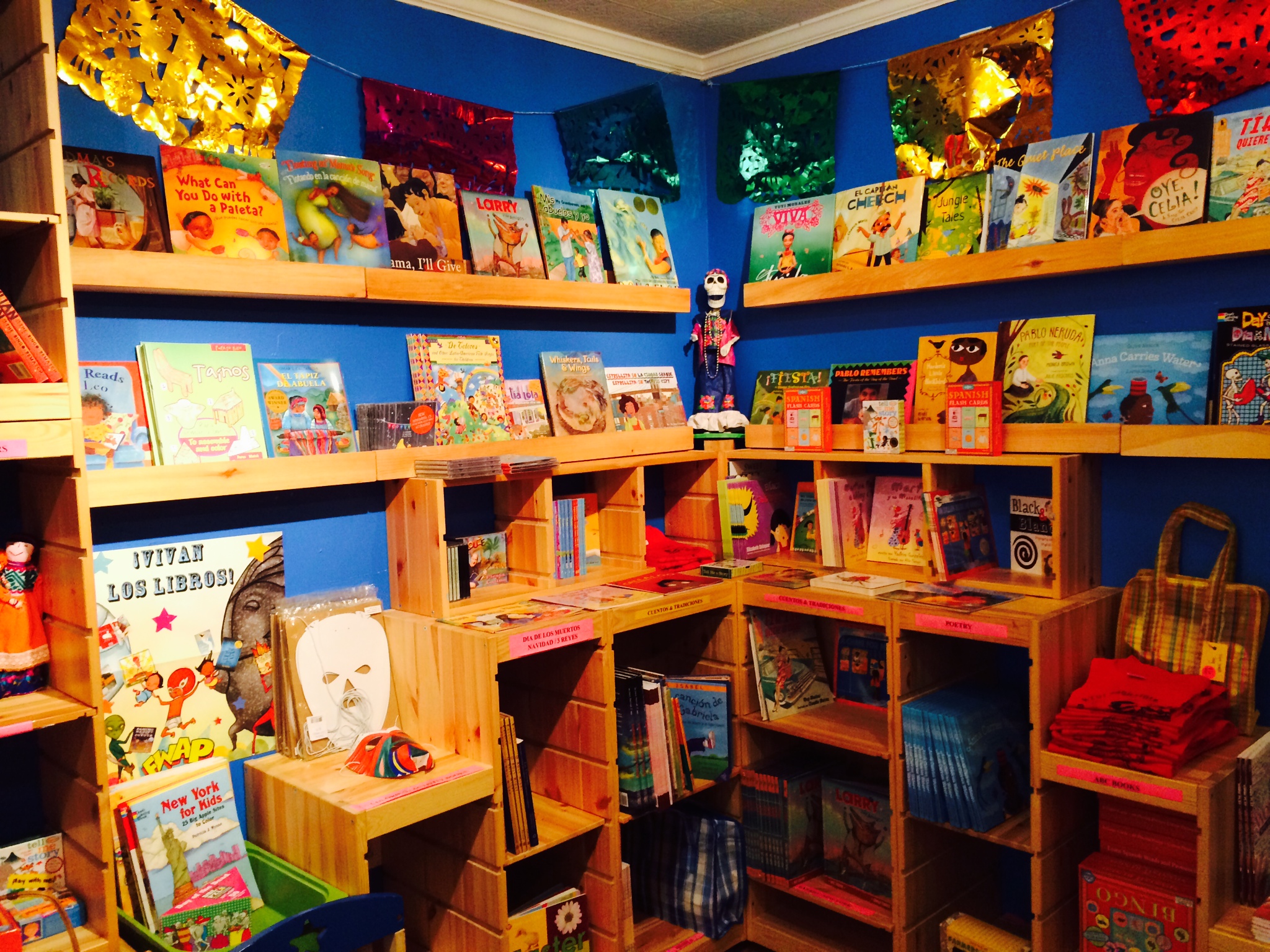
Shelves. Photo Z.C.

The great thing that you can see about La Casa Azul, is that it’s not just about the book events, but about community. Take a look at the events calendar for a wide selection of family-friendly music events, book readings and signings, literary conferences, volunteer outreach, and even BYOB paint parties.  They recently held a book drive for young immigrant children in New York. In addition to these events, La Casa Azul is available for space rental. Because of all of these things, La Casa Azul is important. I’d like to think that the independent bookstore is making a comeback, despite the threat of the digital age. Sure, you can get a book on your smart device or tablet, but there’s something special about being able to congregate in a safe space that embraces Latino culture.

The next time you’re uptown, stop by and pick up a couple of books.

photo

Kid Lit section. Photo by L.L.

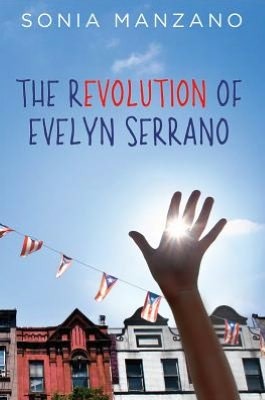
Book Review: The Revolution of Evelyn Serrano by Sonia Manzano

Evelyn overBy Sonia Alejandra Rodriguez

DESCRIPTION FROM THE BOOK JACKET: There are two secrets Evelyn Serrano is keeping from her Mami and Papo: her true feelings about growing up in her Spanish Harlem neighborhood, and her attitude about Abuela, her sassy grandmother who’s come from Puerto Rico to live with them. Then, like an urgent ticking clock, events erupt that change everything. The Young Lords, a Puerto Rican activist group, dump garbage in the street and set it on fire, igniting a powerful protest. When Abuela steps in to take charge, Evelyn is thrust into the action. Tempers flare, loyalties are tested. Through it all, Evelyn learns important truths about her Latino heritage and the history makers who shaped a nation. Infused with actual news accounts from the time period, Sonia Manzano has crafted a gripping work of fiction based on her own life growing up during a fiery, unforgettable time in America, when young Latinos took control of their destinies.

MY TWO CENTS: The Revolution of Evelyn Serrano (a Pura Belpré Author Honor Book) by Sonia Manzano  opens with a frustrated fourteen year old Evelyn getting ready for her summer job at the Five-and-Dime. Her desire to fit in to American society and distance herself from her Puerto Rican heritage is disrupted when her Abuela comes to stay with them. Abuela’s orange hair and bright clothes make her anything but the traditional grandmother Evelyn expected. Abuela taking over Evelyn’s bedroom with makeup, hair rollers, and flashy clothes is only the first of many changes that serves to transform Evelyn’s understanding of her own identity.

While Abuela’s presence creates tension in the Serrano household, a new youth group arrives to challenge discriminations against their neighborhood. The Sanitation Department eventually stops picking up the garbage, and as it continues to accumulate, so does the tension around the Young Lords’ intent to politicize El Barrio. The rise of the Young Lord’s movement gives Abuela and Evelyn an opportunity to discuss the relationship between what is presently happening in their community and the Ponce Massacre (1937) of which Abuela has kept newspaper clippings. The Young Lords organize El Barrio in a way that Evelyn has never experienced, and their demonstrations and marches provide El Barrio with a visibility they later utilize to demand social change. As the political situation intensifies in El Barrio, Evelyn and Abuela become more involved with the Young Lords. Their involvement creates a rift between them and Evelyn’s mother, but it is through all of this process that Evelyn recognizes the importance of her Puerto Rican heritage.

Among many things, Manzano’s The Revolution of Evelyn Serrano is a historical young adult novel. (Re)tellings and (re)imaginings of history are currently a popular strategy in Latina/o Children’s and Young Adult Literature. Like Juan Felipe Herrera’s Downtown Boy (2005) and Bejamin Alire Saenz’s Aristotle and Dante Discover the Secrets of the Universe (2012), Manzano asks that today’s young adult reader travel back to a time when their grandparents and/or parents were children and adolescents.

This literary move to focus on a historical event is brilliant for many reasons. First, it asks Latina/o readers to examine their own background as a way to understand their present identity. In The Revolution of Evelyn Serrano, it is extremely significant that there are moments of reflection that help Evelyn understand that her presence in El Barrio is not coincidence. In other words, Evelyn needed to learn her parents’ and grandparents’ journeys to understand her own identity and her relationship to El Barrio.

Secondly, novels like Manzano’s center stories that have remained marginalized in mainstream history books. Evelyn is such a wonderful character precisely because she sounds and behaves like a typical teenager. At the beginning of the novel, Evelyn wants nothing to do with her parents and their stories. She is embarrassed of them and her community—and this right here is a very honest and common feeling (that too often remains silent) among Latino children and teenagers of (im)migrant parents. Throughout the novel, Evelyn learns to center her Puerto Rican culture as a way to find empowerment rather than to feel embarrassed by it.

Lastly, Manzano’s novels, and others like hers, create intergenerational discussions around issues of discrimination and gender (to name a few themes present in Evelyn Serrano). In other words, novels like these emphasize that significant social change requires a community talking to one another. While the Young Lords were central in the mobilization of El Barrio, it was also with the support of their elders and younger members that they were able to stand strong against the discrimination the community faced.

The Revolution of Evelyn Serrano presents a genuine story of identity formation for a young Latina coming of age at a moment in U.S. history when Latinos are violently forced to assimilate into mainstream society or risk their lives by speaking up and challenging the discrimination they experience.

TEACHING TIPS: When teaching The Revolution of Evelyn Serrano, it will be helpful to provide a historical context for the novel from which to guide student discussion. Manzano provides a bit of this discussion in her afterward where she explains that the events in the novel are based on true events. The Young Lords: A Reader (2010) edited by Darrel Enck-Wanzer and Palante: Voices and Photographs of the Young Lords, 1969-1971 (2011) are excellent resources for educators to learn more about the group’s history, motivations, and outcomes. Pairing the novel with some of the essays in these sources for more advanced or older students can also provide a basis for discussing race, class, and gender both within the party and in the context of the US.

A thematic approach to teaching Manzano’s novel can be one way to broadly discuss the Civil Rights Movement and relating topics. Novels like Rita Williams-Garcia’s One Crazy Summer (2011) about three young African American sisters and their adventures with the Black Panthers and children’s books like Monica Brown’s Side by Side: The Story of Dolores Huerta and Cesar Chavez (2010) about the leaders of the farm workers’ movement can provide rich conversations about the array of issues impacting people of color at this time. Discussing children’s and YA books on the Civil Rights movement not only allows students to learn more about specific racial discrimination and community empowerment but also creates opportunities for students to discuss how those issues impact them now.

Another approach to teaching the novel is to discuss characters and character development. Evelyn’s relationship with her abuela is a complicated one because they have different personalities and because Abuela represents a cultural heritage Evelyn wishes to avoid. Their relationship, however, is central in the novel. Other YA novels like Claudia Guadalupe Martinez’s The Smell of Old Lady Perfume (2008) and Sandra Cisneros’s Caramelo (2003) present similar granddaughter/grandmother relationships wherein both characters engage and learn from one another. Asking students to interview their grandparents or a family elder could be a possible assignment for students of any age to participate in an exercise similar to the character development of the protagonists they read.

AUTHOR (from her website)Sonia Manzano has been a presence on Public Television since the 1970’s. Raised in the South Bronx, she attended the High School of Performing Arts. A scholarship took her to Carnegie Mellon University in Pittsburgh, and in her junior year, she came to New York to star in the original production of the off-Broadway show, Godspell. Within a year Sonia was cast as “Maria” on Sesame Street. After ten years as an actress, Sonia began writing scripts for the series and has fifteen Emmy Awards as part of the Sesame Street writing staff. Sonia also wrote for the Peabody Award winning children’s series, Little Bill, for Nickelodeon and for a short time wrote a parenting column for the Sesame Workshop web site called Talking Outloud. In addition to The Revolution of Evelyn Serrano, Manzano has written two picture books: No Dogs Allowed! and A Box Full of Kittens.

FOR MORE INFORMATION ABOUT The Revolution of Evelyn Serrano visit your local library or bookstore. Also check out worldcat.orgindiebound.orggoodreads.comamazon.com, and barnesandnoble.com.

headshotSonia Alejandra Rodríguez has been an avid reader since childhood. Her literary world was first transformed when she read Rudolfo Anaya’s Bless me, Última as a high school student and then again as a college freshman when she was given a copy of Sandra Cisneros’s The House on Mango Street. Sonia’s academic life and activism are committed to making diverse literature available to children and youth of color. Sonia received her B.A. in English from the University of Illinois at Urbana-Champaign. She is currently a PhD candidate at the University of California, Riverside, where she focuses her dissertation on healing processes in Latina/o Children’s and Young Adult Literature.

Forgive Me My Bluntness: I’m a Writer of Color and I’m Right Here In Front of You: I’m the One Sitting Alone at the Table

By René Saldaña, Jr.

I’ve avoided writing this piece long enough. Number one reason is that politically I’m a conservative, and the last thing I want to do is to appear as though I’m playing the race card. Which I’m not, though it might look like it. Doing so’s a cheap and underhanded thing to do. So I don’t. Second reason: what I’m tossing out there can be dangerous to my career as a writer, I’ve been told, because of who I’m aiming it at: the very folks who buy my books, or won’t due to my brazenness: librarians and fellow educators, my bread and butter. (I trust in the educator, though, enough to know that if we are about anything we are about growth through honest self-reflection; it’s my hope that this piece will serve as a catalyst for such). Third reason: during my own reflection over the last couple of years, mulling over whether I should or shouldn’t put this observation to paper, one of the cons was that maybe it’s just sour grapes I’m dishing. Ultimately, it’s not. Not even just a little.

My sincere desire is to talk from the heart, to share this heavy load I’ve been carrying, and to reciprocate. I’ll do my part to take on the equally heavy burden librarians and educators have been carrying for far too long. To, arm in arm, move in a direction upward when we’re talking about race, in particular race in children’s and YA publishing, a hot topic to be sure.

8334361Let me tell you a story: I’m attending a librarians’ convention. I’ve been asked to sit on a panel or two, and at this point in my story I’ve met those obligations. Like happens at these functions, as a writer with a new book under my belt (best I can remember it’s A Good Long Way published by Piñata Books, an imprint of Arte Público Press), I’m also committed to sit for an hour at a table to sign copies of my latest. This is a very awkward thing for me to do. I really don’t like this part of my job. I mean, really, who am I? I’m not a top-tier author, and so I realize I won’t get the throngs of fans begging for my signature. (I found this out while sitting at another table, this one in D.C. at the National Book Festival in 2005, and I happened to be sitting next to Mary Pope Osborne, whose line was unimaginably long; I had to ask my wife, who was pushing our son in a stroller, and my sister-in-law to act as my line). Talk about eating humble pie. I get it. If a couple of teachers or librarians line up for my signature I count myself the most fortunate writer in the world. This time is no different from other times. I’m resolved to sit my time out, and if I get that librarian or two, I’ll make it a point to let them know how lucky I am to meet them.

I truly feel that way. My love for libraries and librarians goes back a long, long way. Back to when I was checking out the Hardy Boys, Nancy Drew, and Little House on the Prairie during my elementary school years, and later books on UFOs, lost treasures, and the book that kept me in the reading act, Piri Thomas’s Stories from El Barrio during middle school, and throughout high school and college, to this day even, visiting our public library with my children. Along with my parents and a small handful of teachers, I owe librarians the bulk of my reading life. This is why, in the end, I feel I need to write this essay: I owe librarians dearly.

So, back to the story: I’m sitting there with Arte Público’s representative, and I do get the one or two curious librarians who ask about my work. I could tell them that I’ve published three other books with Random House, that I’ve published several short stories in several anthologies edited by Gallo, Springer, and Scieszka, but I don’t. The only book that matters to me is the one I just published. It’s my favorite book. Not my favorite because it is my most recent. It’s really and truly my favorite of all the titles I’ve published to date. I love A Good Long Way for so many reasons, but that’s the stuff for another essay. These librarians are kind and buy a copy for their collections, are already thinking of which students will benefit from this book most (and it’s not just Latino kids they’re telling me about).

From the time I sat, I’ve taken notice of the author two tables down from me. I actually just presented with her. Undeniably a rock star in the field. The kind of author for whom I’d stand in line to get her autograph. I know her personally, too. She’s a genuinely awesome person. I’ve used her work in my graduate adolescent lit classes. My students love her. I understand why these librarians are in line to get her signature and for a chance at a word or two, maybe a picture if time allows.

What I don’t get, though, is that not a one of these librarians in this other author’s line chances to look up in my direction, not that I can tell from my time at the table, anyhow. Not a one notices that just two tables down is another writer, one of color, a conversation that has been pushed to the fore recently? The Myers’ father and son team each wrote brilliant editorials for the New York Times (in the middle of me writing and rewriting this piece, wouldn’t you know it? The world of children’s and YA writing is shaken to the foundation at the news of Walter Dean Myers’ death and among his last acts was to force us to have this difficult conversation, so thanks to him). Others like Monica Olivera have added to that conversation in a blogpost on NBC Latino, The folks over at Lee & Low have ably challenged us to consider the state of children’s and YA publishing regarding race. Lee & Low on Twitter, especially, has rocked that boat. But it was a discussion we were having back then, too. Albeit mostly amongst ourselves, we writers and publishers and teachers and librarians of color. So it’s been brewing a long enough time.

So, what I’ve heard librarians say over the last decade and a half on my visits is that there are so many Latino children, and how unfortunate that there are so few Latino authors publishing books for them. “Just look at how excited these kids get,” they tell me, “to find one of their own publishing books.” It’s true, they do get excited to meet writers of color; I’ve seen it with my own eyes, heard it with my own ears. As a side note: I’ve also seen kids jump for joy at meeting white authors.

Can you tell I’m purposely going off on rabbit trails? I’m avoiding getting to the point again.

But whatever. There’s an urgency. We need to get beyond this hurdle. We need to courageously speak about race. Confront it head on. We’re told this also by U.S. Attorney General Eric Holder in one of his early speeches at the outset of his work for the Obama administration. We must face our shortcomings if we are to get to that place Dr. King dared us to dream about alongside him.

Anyway, these librarians have told me that there is so little of this material, and what there is of it is so hard to find.

Okay, I’m jumping in, confronting, being courageous, mostly trusting my readers to know I’m out for all our best interests, and especially for those we serve, our students: so,

NO! this material is not hard to find.

Simply look up and two tables down from where you’re standing, there I am. At that point in my career I’ve got some six books to my name. There. I. Am.

And if you think I’m an idiot, especially now that I’m telling you this, then do this other thing and you’ll know I’m right: walk up and down those aisles that usually are nowhere near the major publishers, the ones relegated to the edges of the main floor. They’re the small, independent presses. The outliers, in so many ways. You’ll know them because they’re the ones who don’t give out ARCs or free copies of books. Not because they don’t want to but because it’s not in their budgets to do so. Take 20 minutes per stall, look through their catalogues, their titles. For goodness’ sakes, talk to the reps, who are usually the publishers and editors themselves (when it’s not both of them, it’s either Bobby or Lee Byrd of Cinco Puntos Press manning their booth), and these reps will explain clearly what they have for you and your readers. They’re eager, as eager as you and I, to help all children reach their reading potential. Next, buy from them directly. Come ready with cash, checks, or cards. They’ll take any method of payment.

I’m not saying that the Bigs don’t publish authors of color. They obviously do. Random House has me and several other Latinos on their list. So has Dial. Scholastic. Little, Brown. S&S. Etc. They publish Black writers, and Asian writers. The difference is, though, that the smaller presses focus all their attention on writers of color, so they are experts at it. Arte Público Press/Piñata Books is one. Another is Cinco Puntos Press out of El Paso (of Sammy and Juliana in Hollywood fame but before that a picture book titled The Story of Colors by Subcomandante Marcos with magnificent illustrations by Domitila Domínguez, a book I’ve yet to find shelved in the libraries I’ve visited, even in deep South Texas where the majority of the population is Latino, Mexican American, and Mexican to be exact). Lee & Low, that sometime ago acquired Children’s Book Press and that recently started Shen Books, a new imprint that “focuses on introducing young readers to the cultures of Asia,” is yet another. The list of them, admittedly short—nevertheless, these few presses publish nothing but books by and about people of color. For all readers, but in particular readers of color.

The books are there.

All you have to do is to look for them.

And when you think you’ve found them all, look again. Because we’re still writing the books, publishers big and small are still publishing them. All we need is for you to look and look and look again until you can’t look no more, which likely means you’ve retired and you’re no longer pushing books into kids hands formally. But a librarian is a librarian is a librarian. You’ll be giving books to kids any chance you get ’til the day you die.

This is why I know I can write a piece like this, harsh as it might seem: because you’re educators first and foremost. And you’ll forgive me my bluntness. But we are not the focal point of this conversation, our children are. So we are either proactive and talk and then do, or we stand in the way of the progress necessary. Let’s be the former.
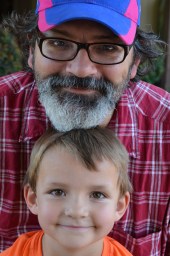
Rene Saldana

René Saldaña, Jr., is the author of the bilingual picture book Dale, dale, dale: Una fiesta de números/Hit It, Hit It, Hit It: A Fiesta of Numbers. He’s an associate professor of Language and Literature in the College of Education at Texas Tech University in West Texas. He’s also the author of several books for young readers, among them The Jumping Tree, Finding Our Way: Stories, The Whole Sky Full of Stars, A Good Long Way, and the bilingual Mickey Rangel detective series. He can be reached at rene.saldana@sbcglobal.net.

The Pitch Fiesta, New Bloggers, and Summer Vacation

We will be on vacation for the month of August, but we’re already planning for our return in September, a month that marks our one year Blogversary and National Hispanic Heritage Month. We’ll tweet past posts through the month for our new followers. Below are news items, plans for our second year, and special thanks to all who have worked with us so far.

What we’re doing with our time off:

Lila: August is catch-up time. My list is miles long and full of mundane things that I’ll relish checking off! Soon after our break, on September 27, I’ll be in Brooklyn at the Comadres y Compadres Writers Conference. If any Latin@s in Kid Lit readers make it there, please come by to say hello. I’d love to meet you! In fact, thanks to this Comadres event, I’ll finally get to exchange an abrazo with Cindy, the founder of this blog!

Sujei: August is also catch-up time! From my never-ending to-read/to-watch lists to starting my dissertation proposal focused in Latino librarianship. Offering occasional bilingual storytimes at my library will also bring joy to my summer break!

Zoraida: August will be my month for major outlining. I am working on my next YA, ENCANTRIX, about a family of Brujas. Also, outlining my next NA romance!

Cindy: I recently finished writing my second YA novel, AESOP’S CURSE (yay!), so I will be using the month of August to read and relax. A week before returning to school, my daughter and I will join friends for a week in Misquamicut, RI. Ahhh!

Blogger news:

stephanie guerra 2012AuthorPhoto500pixels About Me Pic PatrickFS1

The bad news is Stephanie Guerra has decided to leave the blog. She has lots of writing projects in the works, so we will be looking out for those and wishing her luck along the way. Thank you, Stephanie, for helping us to launch the blog!

The good news is Ashley Hope Pérez is returning. She took a break from blogging because of a move, a new job, and a dissertation she had to complete! Soon we will call her Dr. Pérez! She will return to the site in the fall.

The exciting news is that Sujei Lugo, our resident librarian and regular book reviewer, will be blogging about library issues as they relate to Latin@ kid lit. She is planning a regular Q&A feature with fellow librarians to discuss literacy, book challenges, and programming.

We have also secured Patrick Flores-Scott, author of Jumped In, as a regular contributor, so look for his perspective throughout the year.

Wanted:

While we have a great crew of bloggers and planned guest posts, we are always looking for new voices. We would love more regular contributors from anyone in the kid lit world who has the time and desire to write three or four posts a year on anything related to Latin@s in kid lit. If you are interested, please contact us through the form on the blog or by emailing: latinosinkidlit@gmail.com

We would also love to have teens contribute to our Libros Latin@s feature. If you are a parent, teacher, librarian, or someone who is otherwise in touch with teen readers, please let them know that we’d love for them to read books and talk them up on our site. Contact us here.

We are also looking for more agents and editors who want to participate in our first Pitch Fiesta….see next item for more details.

Pitch Fiesta!

Minolta DSCWe want more and more Latin@s in kid lit, so we’re hoping to match writers with agents and editors. Check out the line-up we have so far:

Amy Boggs: agent at the Donald Maass Literary Agency

Laura Dail of the Laura Dail  Literary Agency

Kathleen Ortiz: agent and subrights director at New Leaf Literary

Sara Megibow: agent at the Nelson Literary Agency

Adrienne Rosado: agent at the Nancy Yost Literary Agency

Arte Público Press

If you are an agent or editor looking for manuscripts with Latin@ characters, settings, etc., and you want to participate in our Pitch Fiesta, please contact us here or by emailing latinosinkidlit@gmail.com

Here are the details:

1. Writers who are Latin@ or writers or any ethnicity who have included Latin@ characters, settings, etc. in their manuscripts are eligible to apply.

2. You must have a complete manuscript at the time of the Pitch Fiesta. If an agent or editor is interested, you must have a complete manuscript ready to send. So, writers–get writing! Finish that manuscript! We will start accepting applications in September after we return from vacation.

3. We will post what the agents and editors are looking for in submissions. Please read and consider these before you apply.

4. When we open for applications, you (the writer) will send us your query letter and first pages of your middle grade or young adult novel (10 pages). One of the Latin@ in Kid Lit members will read your work and provide feedback. We will help you to revise and polish the query and/or first pages to prepare for the Pitch Fiesta. Even though we will help you with your pitch and first pages, please send us your best work. We have the right to reject any applications.

5. The actual online event will be in mid-November. Specific date to follow…

Thanks!!

We’d like to thank the following people for contributing to our site in our first year. We’ve had a great start and it wouldn’t have been possible if these authors, editors, illustrators, and librarians had not been willing to share their time, expertise, and opinions. ¡Muchas gracias!

Everyone who is participating in our 2014 Reading Challenge–A HUGE THANK YOU!!!

Sarah Fine

Stephanie Diaz

Steven dos Santos

Estela Bernal

Scholastic’s Club Leo

Joe Cepeda

Zetta Elliott

Margarita Engle

Maria Andreu

Angela Cervantes

Alidis Vincente

Eileen Fontenot

Hannah Gomez

William Hazelgrove

CAKE Literary

Danette Vigilante

Skila Brown

Diana López

René Collato Laínez

Adrienne Rosado

Andrew Karre

Juana Martinez-Neal

Chantel Acevedo

Meg Medina

Yadhira Gonzalez-Taylor

Patrick Flores-Scott

Sonia Alejandra Rodriguez

Guadalupe Garcia McCall

Jenny Torres Sanchez

Have a wonderful rest of the summer! See you in September!

Author Sarah Fine Talks About Hell, Trauma, and Creating Diverse Characters

13482750By Cindy L. Rodriguez

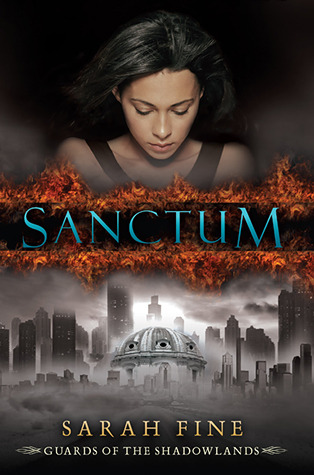
This month, we are taking a look at Latin@s in science fiction and fantasy. Today, we have a Q&A with Sarah Fine, author of Sanctum and Fracture. (Book three is in the works.) Here is a partial description of Sanctum, which features Lela Santos, a Latina main character, a foster child from Rhode Island who has experienced abandonment, neglect, and sexual abuse:

A week ago, seventeen-year-old Lela Santos’s best friend, Nadia, killed herself. Today, thanks to a farewell ritual gone awry, Lela is standing in paradise, looking upon a vast gated city in the distance—hell. No one willingly walks through the Suicide Gates, into a place smothered in darkness and infested with depraved creatures. But Lela isn’t just anyone—she’s determined to save her best friend’s soul, even if it means sacrificing her eternal afterlife.

Cindy: First, let me say that I loved Sanctum. The only part that frustrated me was how long it took for Lela and Malachi to kiss :.)

Sarah: I’m so glad you enjoyed it, and I hope the kiss was worth the wait!

Cindy: The premise of Lela going into hell to retrieve Nadia is similar to the Greek myth Orpheus and Eurydice, but obviously this is not a retelling. How influenced were you by that myth or mythology in general?

Sarah: I actually didn’t think about that particular myth at all as I was generating the idea for this book. When I read that comparison in a review, I was like … you know, that’s actually quite apt! I was a little more influenced by Jewish and Mesopotamian mythology. The Mazikin are mentioned in the Talmud as evil spirits or demons, and the inhuman Guards are very loosely based off protective deities called the lamassu in Mesopotamian myths, where they’re described as half-man, half-bull.

Cindy: Your setting is an interesting kind of hell, with the buildings being alive and able to feed off its inhabitants. How did you create and develop this idea? What kind of research do you do for fantasy world creation?

Sarah: This idea was inspired by the way C.S. Lewis wrote about his version of hell/purgatory in The Great Divorce. The “grey town” is this massive, depressing city where it’s always raining, always twilight—and here’s the part that really got me: people could have whatever they wanted, but it was of low quality. That Grey Town at the very beginning of that book completely inspired the dark city in Sanctum. Obviously, I changed it a lot, including the idea that the city is really one living, breathing entity that grows off the depression of the people residing within, but I give Lewis the credit for the basic idea (and he was clearly influenced by Dante in that work, so he deserves credit as well.)

17667916Cindy: Do you continue to work as a child psychologist? Did your work experiences help you to portray the emotional recovery Lela and the others have to go through in order to heal from trauma?
Sarah: I do, but in a different capacity than I have in the past, when I did a lot of home-based evaluations and therapy. Now I direct programs and supervise clinicians who provide those services to children and adolescents who are at risk for out-of-home placement in psychiatric hospitals or residential treatment facilities. Our goal is to work with families to keep these kids at home and in their communities, where research clearly shows they do best.

My work definitely influences how I see the complexity of trauma and what it takes to heal. A huge percentage of our clients have experienced some type of trauma, and usually not what we think of as single event, “simple” trauma. Though that can be devastating, it’s actually easier to treat than the complex developmental trauma we often see, where the trauma is more chronic and ongoing. This is actually the type of trauma Lela’s experienced—multiple disruptions in attachments, several instances of abuse or neglect. As I show her fragile but growing relationship with Diane, her foster mom, that’s always on my mind. I definitely explore more of that in book three.

Cindy: In addition to the great action scenes, this story focused on the characters’ battles with their personal demons. Thinking about author choices here…because of the issues the characters face, this story could have been developed as a YA contemporary. What led you to decide to develop the story as fantasy instead?

Sarah: I guess it’s a preference thing. There are some brilliant, brilliant authors who have explored these issues with contemporary YA (Nina LaCour, for example), but I wanted to place these characters in an environment where the depression was a tangible, living thing. This fantasy world gave me the chance to explore a lot of philosophical issues, like what is heaven, really, and how could it possibly be the same for everyone? What if you’re not emotionally ready to be there and accept what it offers? To me, that’s not a religious question, but a more concrete way of exploring something very emotional–Can you have some version of that goodness in your life, no matter where you are? What would you have to understand and embrace to receive that?

Cindy: Again with author choices….Obviously you could have created characters of any race, ethnicity, etc. What made you decide to create a Latina MC?

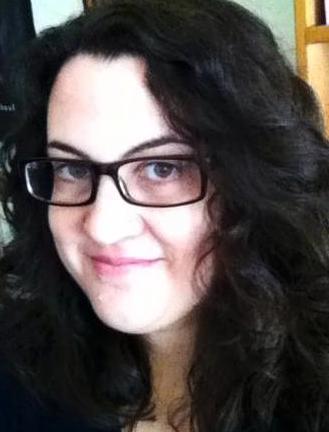
Sarah Fine

Sarah Fine

Sarah: Lela Santos really just materialized to me in that form. However, I will tell you that the majority of the school children in the urban core of Rhode Island, where Lela’s from, are Latino/a. Also, in general, children of color are overrepresented in terms of involvement in the juvenile justice system in this country (with harsher sentences as well—we’ve had court workers outright say that they’re harder on these kids because of the racism they face within society, which is a totally twisted logic that over-penalizes those children and in my opinion perpetuates that racism). Once I considered those facts, it seemed wrong to consider making her anything other than what she was from the beginning.

Cindy: Your secondary characters have interesting back stories as well, which suggests to me that including diversity in your writing is important to you. Some authors shy away from including diverse characters for fear of “getting it wrong.” Did you have any concerns about creating diverse characters? What advice, if any, would you give to fantasy writers about diversity in the genre?

Sarah: This story takes place in the afterlife, and the idea that the only people residing there would be Anglo-American, or any kind of American, is pretty laughable. The world is a BIG place—and the afterlife would be the same, minus the country divisions. Everyone would be there together, right? The dark city where most of Sanctum takes place is where everyone in the world who committed suicide has gone (with some exceptions, I think, but that’s a different interview!). I felt very strongly that having Lela coincidentally meet up with people who were American would just be false and icky.

I did have concerns, of course, because I really wanted these characters to have an impact, and to feel like real people. I did quite a bit of research. I also focused on writing from the inside out, trying to focus on each of those characters as human beings who loved and hoped and despaired in their own ways. I don’t think I’m some kind of expert on this. I’m certain I’ve made mistakes. But I’m curious and always wanting to learn about people who are different from me. And I started from the premise that all those diverse characters—Lela, Malachi, Ana, Takeshi—were on their own profoundly personal journeys, armed only with their intelligence, resilience, perseverance, and the capacity to risk their lives and hearts for a chance at peace. The rest flowed from that.

Check out these other works by Sarah Fine:

17733363  13451410  17303139

Book Review: The Sowing: The Torch Keeper Series, Book Two by Steven Dos Santos

17342414By Eileen Fontenot

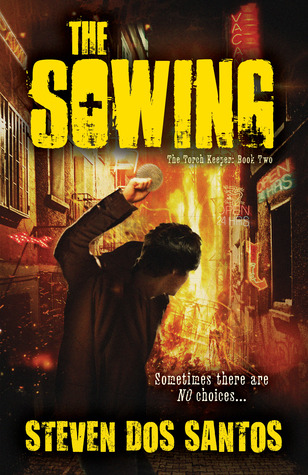
DESCRIPTION FROM THE BOOK JACKET: “This time, there are no choices. Lucian “Lucky” Spark leads a double life. By day, he trains to become one of the Establishment elite. At night, he sabotages his oppressors from within, seeking to avenge the murder of his love, Digory Tycho, and rescue his imprisoned brother. But when he embarks on a risky plot to assassinate members of the Establishment hierarchy, Lucky is thrust into the war between the Establishment and the rebellion, where the lines between friend and foe are blurred beyond recognition. His only chance for survival lies in facing the secrets of the Sowing, a mystery rooted in the ashes of the apocalyptic past that threatens to destroy Lucky’s last hope for the future.”

MY TWO CENTS: Wow. When I say, the action doesn’t stop, well, it just doesn’t stop. The reader is taken immediately to a dramatic fight a couple of months after newly minted Imposer Lucky finishes the trials, portrayed in the first book, The Culling. The series is set in a post-apocalyptic future in which the totalitarian Establishment, led by Cassius Thorn, really enjoys keeping Parish citizens downtrodden.

We continue to view the world through Lucky’s eyes – including struggle to protect his little brother, Cole, and the injustices he must now pretend to participate in, while actively working toward positive change. We can see that Lucky has grown and matured, but is weighed by his constant terror of losing Cole. As he is forced to return to the Trials, this time as an Incentive, he experiences old horrors in new ways – and we learn more about the mysteries of the first book as well. There are a couple shocking twists, that I won’t mention here, but suffice it to say, this is one entertaining read. And readers can see that a bigger story line is building – bound to shake up Lucky’s already precarious situation.

The amazing thing about this series, besides the edge-of-your-seat suspense that gives the reader inventively gory payoffs, is that the sexuality of the LGBTQ characters are treated totally matter of factly. In this horrific version of our future, at least society recognizes that love is love. I think LGBTQ teens who love dystopian thrillers like The Hunger Games will enjoy a similar story that focuses on sympathetic characters that just happen to be gay. Dos Santos doesn’t make a big deal out of his characters’ sexuality. Normalizing this aspect of society is a long time coming; I think today’s teens deserve to envision a future without a closet and this series supports that idea. Although it would be nice if the other parts of the future didn’t go down the drain!

This series would be great as a pick for a LGBTQ teen book group, whether for high school or in a public library. It’s an excellent counterpoint for LGBTQ books that are serious or that focuses on sexuality as the actual story. Teens will also understand Lucky’s growth and his love of family. But, most of all, it’s just a fun read.

AUTHOR: Steven dos Santos was born in New York City and raised in south Florida. He began writing at 7, but didn’t become a professional writer until after graduating with a communications degree and then spending time working in the field of law. The two books of The Torch Keeper series are his first professionally published works, and The Culling has been added to the 2014 ALA GLBTQ’s Rainbow Project Reading List. He’s currently at work writing the final book in The Torch Keeper series.

FOR MORE INFORMATION ABOUT Dos Santos and The Sowing, visit your local library or bookstore. Online he can be found at stevendossantos.com, worldcat.org, goodreads.com, indiebound.org, barnesandnoble.com and amazon.com.

fontenot headshotEileen Fontenot is a recent graduate of Simmons College Graduate School of Library and Information Science in Boston. She works at a public library and is interested in community service and working toward social justice. A sci-fi/fantasy fan, Eileen was formerly a newspaper writer and editor.