Summer Vacation Plans & Giving Thanks

As of today, we are on summer vacation! When we return in September, we’ll celebrate our second Blogversary, the release of Ashley Hope Pérez’s new young adult novel, Out of Darkness, and much more. We’ll keep in touch by tweeting past posts through the summer for our new followers. You please keep in touch, too. If you would like to contribute a blog post or you have a book with Latin@ characters that you’d like listed on our site and/or reviewed, please contact us through the form on the blog or by emailing: latinosinkidlit@gmail.com. We don’t guarantee a review for every book, which will be outlined in our new reviewing policy. Below are news items and special thanks to all who have worked with us so far.

What we’re doing with our time off:

Cindy L. Rodriguez: I will be attending the International Literacy Association conference in St. Louis next weekend for both my day job as a reading specialist and to promote When Reason Breaks. I have a few more book events through the summer, and I plan to read and write as much as possible before school begins again in the fall. In August, I will get away with my daughter and friends, spending a week on the beach in Rhode Island.

Sujei Lugo: As a children’s librarian at a public library I’ll be immersed in our summer reading program, which includes: summer reading bingo, bilingual story time, comics workshop, an art program with Growing up Pedro author and illustrator Matt Tavares, music programs, and more! I also plan to find time to continue writing my dissertation proposal and get ready for my August trip to Puerto Rico to visit my family and friends.

Lila Quintero Weaver: Lila recently wrapped up a big project. She plans to clear her mind by reorganizing closets and computer files. Travel plans are on hold until autumn when Gulf Coast beaches are blissfully quiet.

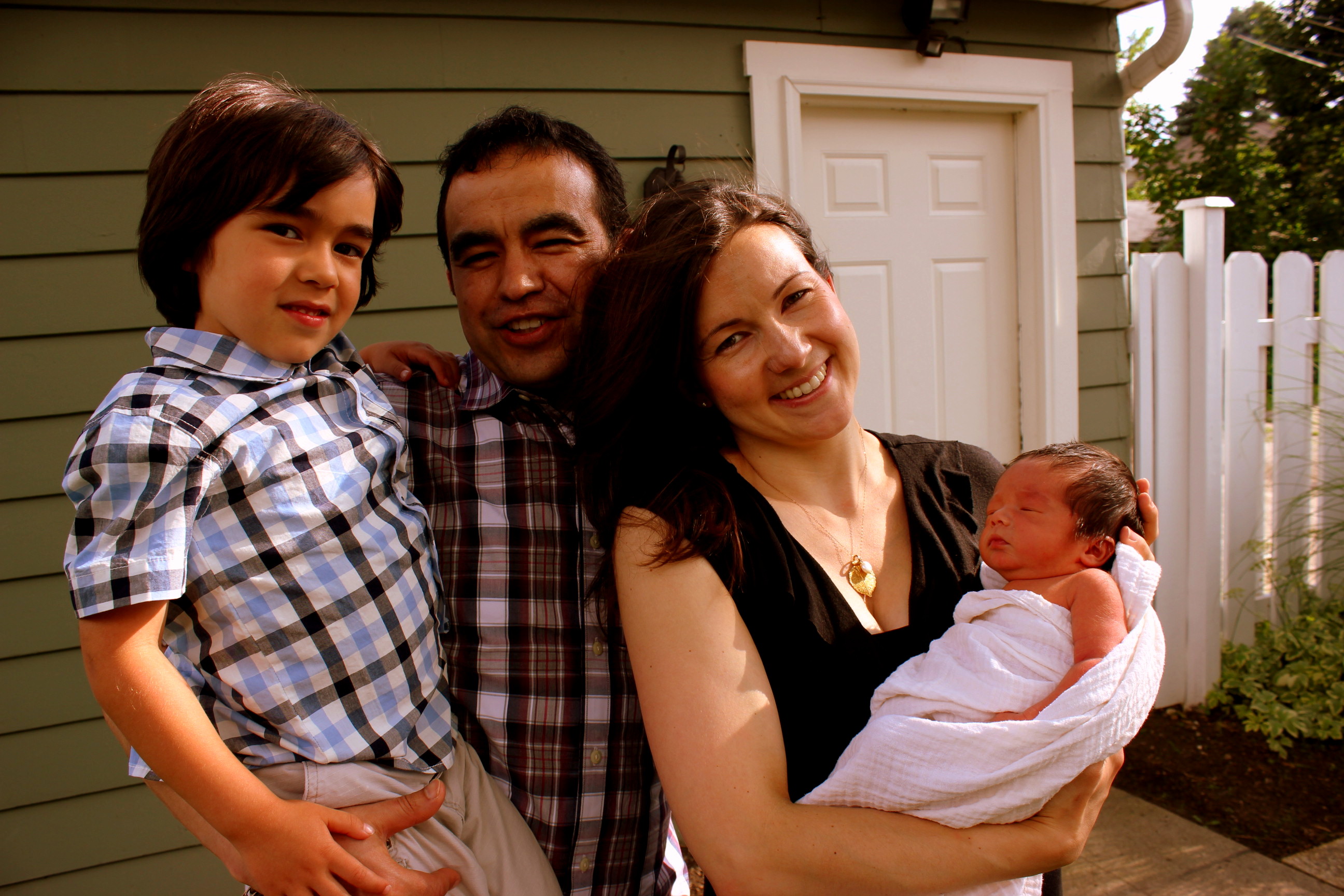
BackYardFamPhotoAshley Hope Pérez is enjoying quality time with her family in Columbus, Ohio, where she, husband Arnulfo, and 5-year-old Liam Miguel welcomed baby Ethan Andrés on June 10. Ashley is spending most of her time nursing the new baby and catching up on YA reading. She’s also looking forward to the release of her third novel, Out of Darkness, in September. Keep an eye out for an August Out of Darkness blog tour!


Zoraida Córdova: This summer I’ll be working on my third romance novel, Life on the Level. Also, I’ll be working on my tan.

Marianne Snow: I’m preparing for my comprehensive exams (three 20-page papers yaaay), attending several weddings, and taking my first ever trip to Canada.  Plus, I’m gearing up to teach a course on children’s literature to undergraduate pre-service teachers in the fall.

Cecilia Cackley: At the moment I’m teaching play writing at a summer camp in Montgomery County, MD and in August I’ll be traveling to Ilobasco, El Salvador and Chichicastenango, Guatemala to teach two weeks of puppetry workshops.

Sonia Alejandra Rodriguez: Having recently completed a PhD in English, Sonia looks forward to relaxing and reading as much as possible. She will also be teaching poetry and spoken word to a group of elementary school students from the Chicago area.

Thanks!!

We’d like to thank the following people for contributing to our site this past year. We appreciate that you took the time to share your expertise and opinions with us as part of our collective effort to celebrate Latin@s in children’s literature. ¡Muchas gracias!

Kimberly Mach

Eileen Fontenot

Adriana Dominguez

Adrienne Rosado

Amy Boggs

Sara Megibow

Kathleen Ortiz

Laura Dail

Arte Público Press

René Saldaña, Jr.

Cathy Camper

Claudia Guadalupe Martinez

Scholastic’s Club Leo en Español

Heather Marie

Kelly Jones

Erin Entrada Kelly

A.L. Sonnichsen

Anna-Marie McLemore

Ronald L. Smith

Kerry O’Malley Cerra

Dhonielle Clayton

Holly Bodger

Kristy Shen and Bryce Leung

Carrie Firestone

Noemi Gamel

Patrick Flores-Scott

Robert Trujillo

Rachel Manija Brown

Sherwood Smith

Mary Louise Sanchez

Heather Harris-Brady

Chris Day

Venessa Ann Schwarz

Tiffany Soriano

Richard Almaraz

Clarissa Hadge

Alex Yuschik

Alexandra Townsend

Marisol La Costa

Monica Sanz

Elizabeth Arroyo

Monica Zepeda

Patricia Toney

Lettycia Terrones

Margarita Engle

Shelley M. Diaz

Libertad Araceli Thomas

Guinevere Zoyana Thomas

Crystal Brunelle

Kimberly Mitchell

Robin Herrera

John Parra

Raúl the Third

Ana Crespo

Jacqueline Jules

José Mélendez

David Bowles

Angie Manfredi

Melissa Grey

Cinco Puntos Press

Diana Lee Santamaria

Kim Baker

Jill Brazier

Anna Banks

Sofia Quintero

Marilisa Jiménez García, Ph.D.

Have a wonderful rest of the summer!

See you in September!


Reflections on the Children’s Literature Association’s Annual Conference


By Marilisa Jiménez García, Ph.D.

The Children’s Literature Association (ChLA) meets for its annual conference every June. Founded in 1973, ChLA seeks to advance scholarship and criticism of children’s and young adult literature, particularly as a field of literary study. Academic associations, journals, and conferences provide scholars with an opportunity to organize and disseminate research. They also provide spaces for rethinking the purpose of a field more broadly with established and up and coming scholars. After years of attending ethnic studies and general literature and literacy conferences, I was invited to form part of a Latin American Children’s Literature panel chaired by Ann González at ChLA 2015 in Richmond, Virginia.

I arrived at ChLA 2015 hoping to reconnect with a group of scholars and educators that inspired my intellectual pursuit of children’s and young adult literature. ChLA 2009 was the first conference I attended as a University of Florida graduate student in Charlotte, North Carolina. My colleagues and professors said I would find a supportive and friendly scholarly community, something I immediately confirmed. I was thrilled to find others who valued the artistic, creative, and historical value of children’s and young adult texts and media, something which might be hard to find in English departments. Yet, from the outset, I also noticed I was one of the only, if not the only, Latino/as at the conference. I was on a panel about language in children’s literature chaired by my dissertation director, Kenneth B. Kidd. By that point, I had found my dissertation research on Puerto Rican children’s literature and its representations of U.S. colonialism, nationalism, race, and gender. After I delivered my paper, “Language Borders and the Case of Puerto Rican Children’s Literature,” which was later published, several people in the audience waited to speak to me about my research. I felt a sense of validation. This was also one of the first times people referred to my research as “brave.” I still wrestle with seeing this as a compliment in terms of the work I do, whether I was brave for presenting Latino/a culture and Spanglish as belonging in a tradition of American writing or if my presence as an underrepresented minority seemed somehow exceptional. Even considering the underrepresentation of Latino/as in American children’s literature and the overall sparse numbers of Latino/a faculty, was I brave for presenting what I knew?
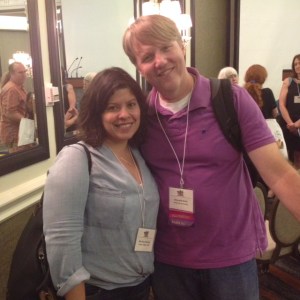
Me and Kenneth Kidd, photo by Ebony Elizabeth Thomas

Me and Kenneth Kidd, photo by Ebony Elizabeth Thomas

Being the only Latina in an academic environment was not a new experience for me, but as someone who studied Victorian and American children’s literature, what was new was my realization of how often the depictions of Anglo-British and Anglo-American children and childhood are presented as central, and even universal. The terms “the child” and “children’s literature” seemed reserved for these portrayals. Progressing into my doctoral career, within the context of groups such as ChLA, I found that my work was often greeted with questions such as, “What does this have to do with children’s literature?” or “How is this about childhood?” In part, my dissertation in 2012, which won an award in Puerto Rican Studies, addressed the centrality of Anglo culture in children’s literature. I now realize that even in my position as a very junior scholar, I was perhaps one of the first to begin probing at the systemic diversity issue in kid lit, which today, though certainly not new predicament, has reached the forefront. Realistically, it was not until Robin Bernstein’s important study Racial Innocence (2013) that the field more holistically and publicly began to underline how representations of childhood and innocence are coded white.

My movement into ethnic studies and organizations like the National Council for Teachers of English (NCTE) provided a space for me to develop the kinds of conversations I wanted to have about race, nationality, and the study of children’s literature in the academy, including its branches into education and library science. Truthfully, those of us who work in Latino/a children’s literature owe a great debt to education scholars, such as Sonia Nieto, whose foundational work on the subject in the 1970s and 1980s parallels with the work of Rudine Sims Bishop in African American children’s literature. Yet, I always kept my eye on ChLA, and was excited to hear that diversity and the lack of minority representation in children’s books would be the theme of ChLA 2014 (“Diverging Diversities: Plurality in Children’s and Young Adult Literature”). I could not attend ChLA 14, though my paper on Latino/a young adult (YA) literature was read by Kidd.

Thursday morning at ChLA 2015 found me a bit anxious. Walking into the Omni Hotel Richmond on the first day of the conference, I was still attempting to process the tragic shooting at a Charleston church the night before. As someone who spent quite a bit of my life in the context of the South and the sway of the Confederate flag, the grim headlines seemed to frame everything I saw, even the 2015 conference theme: “Give Me Liberty, Or Give Me Death.” Once in the reception area, I met a Twitter friend, master’s student, Cristiana Rhodes of Texas A&M University, Corpus Christie, who approaches children’s literature through Chicano/a epistemologies. We discussed our work and perspective on being Latino/a in a field which sometimes struggles to see us as part of “English.” I was so encouraged to see a young Latina chairing a panel at ChLA and presenting her research on resisting stereotypical depictions of the Day of the Dead. Rhodes shared similar feelings to what mine had been as a graduate student. Later on, she said, “As a Latina, one of my primary goals in presenting at any academic conference is visibility–to let other academics know that we’re here and we’re doing good, valuable research. I think our place in ChLA, in particular, is to further solidify that diversity is an integral part of children’s literature, and without diverse perspectives the field would lose something.

“I think children’s lit scholars are beginning to understand that the field shouldn’t just be dominated by (white) hegemonic perspectives, and that’s really encouraging for someone like me who is new to the field. However, I still firmly believe that diversity shouldn’t be tokenized by the association (and I feel it often is) and I feel like the only thing we can do to remedy this is to stay visible and keep our research relevant. That’s my goal as a member of ChLA.”

Rhodes, who plans to pursue a doctorate, also said, “I think, as a whole, the children’s literature community [and ChLA] is really welcoming for new scholars regardless of their race, gender, education-level, etc. I’m always sort of constantly afraid that my age, coupled with my race, will inevitably exclude me from certain spaces within academia, but I’ve never felt left out or ignored because of these things while in the company of other children’s literature scholars.”

Rhodes’ comments continued to impress me as I had lunch with Casey Alane Wilson, Rebekah Fitzsimmons, and Mariko Turk, doctoral students from the University of Florida. Wilson and Fitzsimmons, who presented a paper on the construction of the YA genre, including how YA is used as a platform for diverse writers, helped me see that our field is at a moment of transition and restructuring, a moment in which those of us entering the academy are also questioning the history, structures, and key terms which formed and continue to guide our fields. This urge to question is something we were nurtured as scholars to do. My doctoral training under Kenneth Kidd in particular placed me in a position to think about how children’s literature developed as a field and how it is valued by the different branches, in part because of Kidd’s own against the grain perspective on kid lit. Kidd, a founding member of ChLA’s diversity committee, encouraged me to participate in the membership meeting and the coming year’s diversity committee.

Wilson, who is writing her dissertation on the dynamics of young adult literature, commented on her assurance that ChLA has evolved as a space for confronting these issues, conversations that she said “we, as scholars, have a responsibility to have…But I would also say that I’d like to see more of these conversations that aren’t limited specifically to panels about race — these questions should come up and be discussed in so-called ‘regular’ panels, too.”

The panel I presented on in Latin American children’s literature was well-attended. My panel chair, Gonzalez wrote Resistance and Survival (2011), an important study on Latin American and Caribbean children’s literature, which I highly recommend to anyone interested in learning more about the roots of Latin American cultures and kid lit, including Latino/a. During my presentation on race and nationality in Puerto Rican textbooks, which were used in Puerto Rico and New York City schools during the 1950s, I understood why it was important for me to continue attending ChLA. The research and perspective I brought to ChLA meant that even if Latino/as and people of color in general were underrepresented, my presentation and any conversations it inspired, raised the visibility of these groups in the field. In particular, by retracing the history of Latino/as in children’s literature, I hope to present how people of color form part of the foundation of children’s literature, and not the margins.

In terms of diversity, one of the conference highlights was a panel on Black Lives Matter featuring Katherine Capshaw Smith of the University of Connecticut, Michelle Martin of the University of South Carolina, and Myisha Priest of New York University, and chaired by Richard Flynn of Georgia Southern University, who drew a parallel to the Charleston shooting in his introduction. Together, these scholars underlined the importance of children’s literature and the tensions between innocence and criminality in terms of narrating the public deaths of black children, including Emmit Till, Robert “Yummy” Sandifer, and Kalief Browder. Another panel, “Illustrating African American history,” focused on how race and racism is depicted in children’s literature, and there was a panel titled “American Indians and Indianness,” which I was unable to attend.

Rhodes, Sonia Rodríguez (who could not attend), and I were the only scholars focusing solely on Latino/a children’s literature. Lilian B.W. Feitosa read one paper on Brazilian children’s literature and Renee Lathman read on poverty and marginality in Puerto Rican children’s literature. Also, Rhonda Brock-Servais and Aslyn Kemp from Longwood University delivered a great presentation on gender in Meg Medina’s work. The panel I presented on encompassed my perspective of Latin American and Latino/a children’s literature. In the future, I hope to organize a panel on Latino/a kid lit and hope it will not be seen as a an international panel since Latino/a is indeed a U.S. formation. The international panels at ChLA provide a great opportunity for diverse perspectives on children’s literature, but some scholars, such as Wilson, note that scheduling the international panels concurrently limits the opportunities for exchanges.

ChLA is an organization which has historically been committed to social justice. Overall, I think it would benefit from relationships with scholars doing ethnic studies and education research, an initiative listed in their Diversity Committee Plan 2009-2013. Collaboration with these fields would enable exchanges from the perspective of theories such as critical race theory (CRT) and Latino critical theory (LatCrit). I would also encourage children’s illustrators and authors to attend the conference to see how their work is impacting future frameworks and interpretations. ChLA is still a smaller and more manageable conference than meetings such as American Library Association (ALA), Modern Language Association (MLA), and/or National Council for Teachers of English (NCTE). It’s smaller, welcoming environment perhaps makes it more suitable for increasing the participation of scholars of color through mentoring events or spaces designed to nurture the needs of future faculty. Katherine Slater of Rowan University and chair of the Membership Committee said that ChLA plans to incorporate activities, including panels, speakers, and discussion groups that nurture diversity.

After Saturday’s membership meeting, I spoke to Ebony Elizabeth Thomas of the University of Pennsylvania and Kidd about my intentions to return to ChLA and get more involved in the planning and leadership. I felt incredibly supported during my conversations with Kidd, Thomas, Martin, and Capshaw, and by the ChLA community. Given the social movements and narratives of race overlapping with the narratives of the academy, I also felt that change was impossible to avoid. While preparing this reflection, I spoke with other scholars of color about how entering these spaces where we are the only ones makes us feel overwhelmed at times. Because for us, “diversity” is a term used to describe our lives and very beings, and not a theme. Perhaps, that is why when we choose to come to these places, and in my case return, we seem brave.
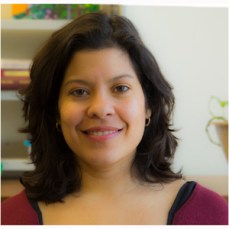
 

Marilisa_Jimenez-Garcia

Marilisa Jiménez García is a research associate at the Center for Puerto Rican Studies, Hunter College, CUNY. She works at the intersections of Latino/a Studies and childhood and children’s literature studies. She is currently working on a book manuscript on the history of Latino/a children’s and young adult literature and an essay on the Latino/a “YA” tradition. She is conducting a survey of NYC teachers on teacher education and the use of diverse lit. in the classroom.

Your 80s Were Not My 80s: Author Sofia Quintero on Race, Class, Place & Hip-Hop in YA Historical Fiction


23395349By Sofia Quintero

Almost immediately after finishing the last round of copyedits on Show and Prove did I find something that conjured my biggest fears about writing a novel set in the 1980s.

I discovered a blog post by a librarian expressing fatigue with the trend in young adult fiction about the 80s. She named a legitimate concern that haunted me throughout the writing of Show and Prove. Was setting the story in that decade integral to its telling or were the 80s just a hook driven by my personal nostalgia?

It’d be dishonest to deny that nostalgia had a role in my writing this novel. Maybe Show and Prove didn’t have to be set in the 80s to tell the stories of Smiles, Nike, Cookie and Sara.

But then I realized, so what?

With the overwhelming majority of young adult fiction set in the 80s centering on white, middle-class and/or suburban experiences, the coming of age of Generation X warrants literary treatment. In fact, those of us who grew up in that decade Black and Brown, low-income or working-class, and/or urban especially in New York City, have stories that contain an imperative richness. Not only do they offer the universal experiences of adolescence that transcends race, class, and place, they also address the important socio-political questions made necessary by the specifics of race, class, and place that we should care about.

In other words, your 80s were my 80s, my 80s were my 80s, but your 80s were not my 80s, and that is precisely why you need to engage my story as much as I need to tell it. When you belong to a community whose cultural productions are constantly devalued until deemed commodifiable, at which point they’re appropriated and your authorship erased, no attempt at historical fiction is gimmicky. It’s resistance.

Krush Groove (1985) PosterThe Smiles and Saras that I grew up with in the South Bronx saw and loved The Breakfast Club and Say Anything. Those movies played in the ‘hood with no doubt that we would relate to them, for white characters to this day are held as the purveyors of universality. But before the solidification of hip-hop as a mainstream commodity, how many white kids got the chance to watch Krush Groove or Beat Street at their local theater?

Not only did we participate in mainstream 80s pop culture, through our creation of hip-hop, we ultimately produced one of the decade’s most enduring phenomenon. Millions of youth across the globe have no concept of life without commercial hip-hop. Moreover, they keep it alive with no knowledge of the oppressive social conditions under which we created it over four decades ago.

Because we experienced the same hopes and anxieties that mark adolescence, young people of any background can connect to a story such as Show and Prove. However, we also had more at stake. We grew up beneath the twin epidemics of HIV/AIDS and crack. Instead of gentrification, we had racist landlords who paid addicts to commit arson, burning our families out of their homes to collect the insurance. If our parents or caretakers were employed, they were likely civil servants having their unions threatened if not crushed.

But if you grew up in the Bronx-is-burning Bronx, you remember something other than the drugs, the garbage, and the gangs. You remember all the colors, the rhythms, the aromas of that time, and some of them were quite beautiful. Innocence and innovation still lived here in underground trains, behind freshly tagged walls, and within the grooves of scratchy cassette tapes. Shootouts didn’t stop us from playing stoop ball.

Amidst all this socio-economic abandonment and oppression, we exhibited tremendous creativity and resilience, and you and your kids should know all about it. In historical fiction for young adults, the decade should be relevant to the story, but when the characters are teens of color in New York City and the decade is the 80s, there is no such thing as irrelevant unless you don’t care about race or class. The street culture we created despite the social, economic, and political hand we were dealt has evolved into a multibillion dollar industry and, at its best, gives voice, comfort, and inspiration to kids and adults worldwide.

Regardless of what you think of the current state of commercial hip-hop, its history deserves preservation in young adult literature since the youth of that time who invented it were not supposed to even survive.

That one fact alone is all the relevance we need.


Sofia QuinteroSofia Quintero has a BA in history-sociology and an MPA from Columbia University. She began her career as a policy analyst and advocate, working for various nonprofit organizations and government agencies, including the Vera Institute of Justice, Hispanic AIDS Forum, and the New York City Independent Budget Office. After years of working on diverse policy issues, however, she heeded her muse to pursue an entertainment career.

Sofia wrote her debut novel Explicit Content under the pen name Black Artemis. Since then, she has authored four more novels and almost twice as many short stories and novellas including her award-winning young adult debut Efrain’s Secret (Knopf 2010.)

She recently earned an MFA in writing and producing TV at the TV Writers Studio of Long Island University and contributed to the children’s anthology What You Wish For, the proceeds of which go to build libraries for Darfuri children in Chad. Her journalistic writings have been published in Urban Latino, New York Post, Ms., Cosmopolitan for Latinas and El Diario/La Prensa.

Show and Prove releases July 14, 2015. Click here to read our recent review of the novel.

Book Review: Finding the Music/En Pos de la Música by Jennifer Torres


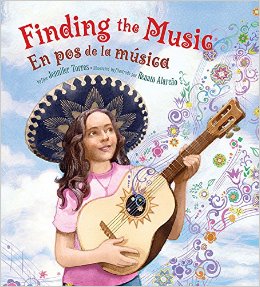
finding the music coverBy Sujei Lugo

DESCRIPTION FROM THE BOOK JACKET: Above Reyna’s favorite booth in her family’s restaurant hangs the old vihuela, a small guitar-like instrument, that belonged to her abuelito when he was in a mariachi band. Reyna has never heard the vihuela played, but her mamá treasures the instrument as a reminder of abuelito and his music. One noisy day in the restaurant, Reyna accidentally damages the vihuela. Determined to get it repaired before Mamá notices, Reyna sets out to search her neighborhood for someone who can help her fix the instrument. Little does Reyna know that along the way she will find herself growing closer to abuelito and to the power of his music.

MY TWO CENTS: From the winner of the 2011 Lee & Low Books New Voices Award, here we have a bilingual story filled with charm that showcases the power of music as an intergenerational unifier.

Every weekend, Reyna hangs out at her mom’s restaurant, Cielito Lindo, reading and enjoying the cast of characters that visit the place. One day, she accidentally breaks her grandfather’s precious vihuela that hanged on one of the restaurant’s walls. Reyna never met her abuelito, but her mother’s tales about him and the way he played the vihuela are near and dear to her. Reyna knows she must embark on a journey to fix her abuelo’s beloved instrument.

This journey will bring her to learn, first hand, about his legacy and the importance of music and the power of community engagement. Throughout each page, and Reyna’s conversation with different community members, her abuelo’s presence can be felt. Jennifer Torres uses Reyna’s journey as a great portrayal of how meaningful everyday life is for a community. The vihuela becomes a powerful artifact that jump-starts the memory of the past, the important history of the community that tends to be invisible but is so essential to understanding the present. The broken vihuela reveals other anecdotes from the past that will help Reyna see the bigger picture of who her abuelo was and how the community remains united through their shared past. And it is through oral history and the passing of this knowledge that Reyna becomes aware of the real importance behind the vihuela and why it was hanging on the wall. The breaking of the vihuela is not a tragedy, but the catalyst for Reyna to better understand where she came from and get closer to her mother and her community.

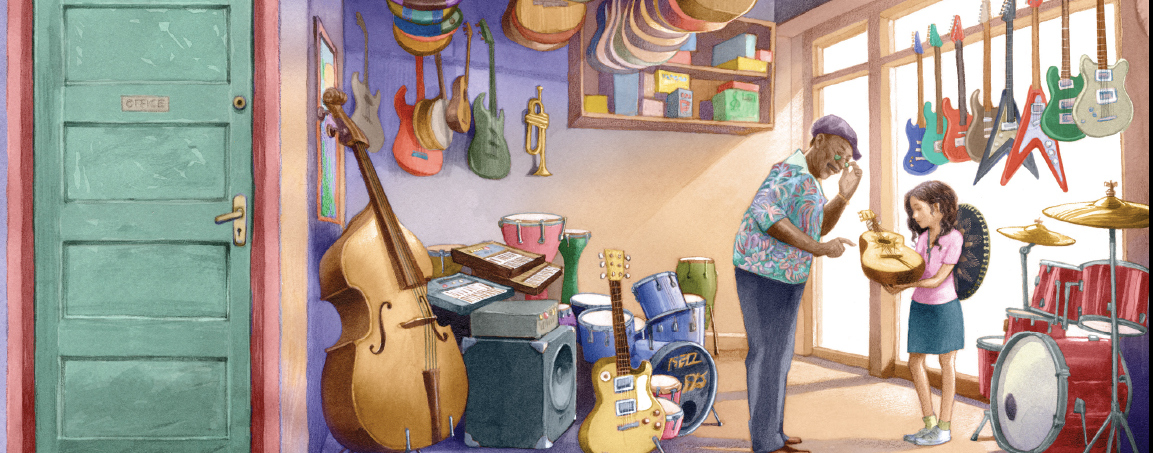
The realistic illustrations by Renato Alarcão, enhance the warmth of the tale and allow readers to see the characters’ expressions and feelings. Each image is filled with pastel colors and a consummated care to portray the connection and relations of the characters. The illustrations really echo a phrase said by Reyna’s mother at the beginning of the story, “these are the sounds of happy lives.” The illustrations truly convey the sounds of these lives.

Torres’s first picture book, Finding the Music/En Pos de la Música, is a solid work that is very much welcomed. The importance of oral history, the unifying qualities of music and the importance of preserving the artifacts that trigger the remembrance of who we were are all important concepts to help spark the curiosity of children among their own families and communities. We are in a constant search of adequate representation and we sometimes fail to see that in our own stories lie strong narratives that empower us and unite us.

*The book includes a glossary and pronunciation guide. The backstory of the Cielito Lindo and author’s note about mariachi music and band are also apprehended. Spanish translation by Alexis Romay.

musicstore
TEACHING TIPS: 
This bilingual picture book is recommended for children ages 4-9, and works well for early readers and as a read aloud with musical interventions as a bonus. Librarians, parents, grandparents, and caregivers can read with the young ones in English, Spanish, or both, while practicing or learning new vocabulary, identifying the different images and community components presented through the illustrations. It’s also a perfect book for a StoryWalk, given that our main character walks around her neighborhood finding some clues and stories about her abuelo. StoryWalk allows people to visit different points (parks, local stores, buildings) around the neighborhood where pages of the books are spread, they would walk to one point to another to follow the story.

Language Arts, Social Studies, Arts, and Music educators can collaborate in the development of different activities: vocabulary and writing activities, discussions and conversations regarding community, neighborhoods and Mexican, Chicano, and Latino history; the incorporation of drawings with writing activities; and the history of Mexican folk music. The author includes helpful activities for the Language Arts classroom: Story Map and Mini-Memoir. On the publisher’s website, you can access teaching guides developed for this book and other resources.

AUTHOR & ILLUSTRATOR:

Jennifer Torres is a freelance journalist, author, and coordinator of a community-wide literacy initiative at University of the Pacific, California. She studied journalism at Northwestern University, Illinois and at University of Westminster, London, England. Torres also worked as reporter for The Record newspaper, covering education, immigration, and other issues related to children and families. FINDING THE MUSIC/EN POS DE LA MÚSICA is her first picture book and her first middle grade novel, STEF SOTO, TACO QUEEN, will be published in Fall 2016.

Renato Alarcão is a graphic designer, illustrator and professor of visual arts. He studied in the Illustration as a Visual Essay program at the School of Visual Arts of New York and at The Center for Book Arts. In addition to his work as an illustrator, Alarcão has collaborated in different youth arts projects and has presented lectures on illustration, creativity, and artistic techniques. He has presented his work in exhibitions at the American Institute for the Graphic Arts, the American Society of Illustrators, the New York Public Library, the Skirball Cultural Center of Los Angeles, the Biennale of Illustrations in Bratislava, where he won the NOMA Prize for Illustrated Book. Some of his illustrated books: RED RIDIN’ IN THE HOOD: AND OTHER CUENTOS by Patricia Santos Marcantonio, SOCCER STAR by Mina Javaherbin, ROBERTO’S TRIP TO THE TOP by John B. Paterson & John Paterson, ELLA ENFEITIÇADA by Gail Carson Levine, Andiana Figueiredo.

FOR MORE INFORMATION ABOUT Finding the Music/En Pos de la Música visit your local library or bookstore. Also, check out WorldCat.orgIndieBound.orgGoodreadsAmazon, and Barnes & Noble.

Book Review: Extraction by Stephanie Diaz

By: Zoraida Córdova

DESCRIPTON FROM GOODREADSExtraction cover

“Welcome to Extraction testing.”

Clementine has spent her whole life preparing for her sixteenth birthday, when she’ll be tested for Extraction in the hopes of being sent from the planet Kiel’s toxic Surface to the much safer Core, where people live without fear or starvation. When she proves promising enough to be “Extracted,” she must leave without Logan, the boy she loves. Torn apart from her only sense of family, Clem promises to come back and save him from brutal Surface life.

What she finds initially in the Core is a utopia compared to the Surface—it’s free of hard labor, gun-wielding officials, and the moon’s lethal acid. But life is anything but safe, and Clementine learns that the planet’s leaders are planning to exterminate Surface dwellers—and that means Logan, too.

Trapped by the steel walls of the underground and the lies that keep her safe, Clementine must find a way to escape and rescue Logan and the rest of the planet. But the planet leaders don’t want her running—they want her subdued.

With intense action scenes and a cast of unforgettable characters,Extraction is a page-turning, gripping read, sure to entertain lovers of Hunger Games and Ender’s Game and leave them breathless for more.

MY TWO CENTS: The world in Extraction is exactly what we (I) fear: pollution has rendered life on the surface practically inhabitable. Here, a shield keeps the lethal acid from the moon from penetrating the surface of the planet Kiel. (The acid is called Moonshine, which really tickled me, btw.) The layers of civilization are Surface, Crust, Mantel, Layer, and Core. While the poor and young live on the Surface and other layers, working till they’re dead or Extracted from this life, the rich have found a way to live in the Core of the earth. Extraction weeds out the intelligent and obedient (key word) hopefuls that could be of better use to Core society. I was instantly drawn into the idea of fearing the sky. Imagine living every day fearing that the heavens are going to rip open and the Moonshine is going to come pouring down on you? Add that with extreme levels of hunger, poverty, and strenuous physical labor, and you’ve got the same problems as Clementine, our narrator.

As Clementine faces Extraction, she also faces the difficult choice that comes with leaving the person you care about. Here, Diaz creates not just a romance, but a love that is rooted in hardship and loneliness. Logan isn’t the typical YA paramour. He’s not just there to rescue her. She does everything she can to save him, which is refreshing. While Clementine wants to stay on the surface with Logan, her options are limited. She could stay and be worked until she dies at 20 because of population control. She could become a breeder, which is part of the initiative to replenish the surface workers. There are so many ways that Clementine could die, but being Extracted means the chance to live.

18625184One of the most poignant passages was when Clementine was waiting to see if her name was selected. It had the feel of the reaping in Hunger Games, but while in the HG the selection is random, in the Extraction, each person is selected by this benevolent Core commander. I loved that Clementine did feel torn in a very human way. Going into the unknown, even if the unknown promises a better life, is extremely terrifying. There’s Logan, and then there’s a better life. There’s Logan, and then there’s the feeling that you don’t want to die. And as Clementine kept saying that she didn’t want to die, I appreciated that she allowed herself to be just a little bit selfish. It’s self-preservation.
And in a world where the odds are against you, you have to have a lot of that.

But, the Core utopia isn’t what it seems. Even though the novel is often pitched as dystopian, it should be recommended as straight up science fiction. Stephanie Diaz has woven a world that is nothing like ours. There are humans, and a deeply corrupt government, but they’re in space. There are lasers. There are ships. There is evolved medicine. There is cool slang. As in, Clementine is a vruxing cool heroine. As I watched her journey start from wanting to escape a terrible life, to wanting to do anything to get top marks in all her trials, to her realization that there is something galactically wrong going on in the Core, I found myself rooting for her despite all the obstacles stacked against her. I will add a trigger warning for the threat of sexual assault from a villain in the book. The girls in the Surface had to endure terrible threats, and in the Core, just because it’s clean and supposedly civilized, doesn’t mean that it’s actually safe. However, Clementine is never a victim. She makes it clear to her biggest foe that she is smarter and better. It’s that defiance that prevents someone like Clementine from bowing down blindly to Core society.

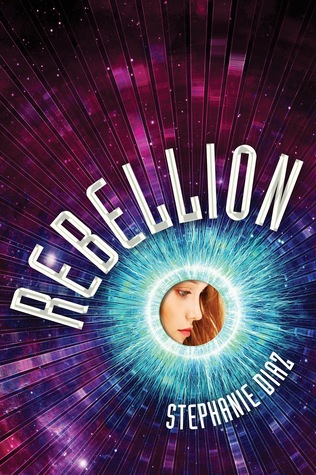
Utopia comes at the loss of individual freedom. At least it does in Kiel. In Extraction, Diaz creates a dynamic heroine, a fast-paced plot, and secrets that unravel with every page. Rebellion is out in store now, so you don’t have to wait to continue Clementine’s adventure as a rebel.

Stephanie Diaz author photoABOUT THE AUTHOR: Stephanie first knew she wanted to be an author when she was in second grade, sitting in a book club drinking tea and reading books like The Egypt Game. She dreamed someday people might drink tea while devouring books she had written. She wrote her first book soon after, a 30-page fantasy story–complete with a hand-drawn map–stapled together and presented to her younger sister for a birthday present.Now twenty-two years old, she lives in San Diego with her family. She graduated from San Diego State University with a degree in film production and a publishing deal for a young adult sci-fi trilogy. She is the author of Extraction, Rebellion, and the forthcoming Evolution.

When she isn’t lost in other worlds, she can be found singing, marveling at the night sky, or fangirling over TV shows.Visit her at www.stephaniediazbooks.com and follow her on twitter.

Shine a Bright Spotlight on Unsold Diverse Books: An Idea Inspired by Hollywood’s Black List

By Patrick Flores-Scott

I’m happy to have the opportunity to be blogging here at Latin@s in Kid Lit!

Once again, I’ve got the We Need Diverse Books movement on my mind.

If you’re reading this post, I’m sure you’re very aware that children’s literature does not reflect the true diversity of this land. And you’re very likely to agree that it must.  And you can explain the myriad reasons why it must. And you’ve most likely asked yourself, How do we fix this? And I bet you’ve got ideas.

It’s going to take many ideas from myriad sources and a lot of people working together in every phase of the publishing industry to make change happen.

I’d like to use this post to throw one possible idea into that mix. For many reasons, I’m not the guy to put this one into action, but I think it’s an idea worthy of consideration, and it would be very cool if someone ran with it.

The idea is stolen from Hollywood. It’s called the Black List. I’m not referring to the mid-last-century process of blacklisting supposed Hollywood communists and those who refused to name names, in an effort to keep them from ever working in this town again. And I’m not referring to NBC’s TV show, The Blacklist. I’m referring to the Black List, which is a list of the best unsold scripts for each calendar year. Simple as that.

The List was started by Franklin Leonard in an effort to bring attention to scripts that otherwise, may never have seen the light of day, and in an attempt to create a path to success for yet-to-be-produced screenwriters.

Check out this link to an interview with Franklin Leonard. It’s is a great introduction to the Black List.

In the interview, Franklin Leonard states that:

“…the more that we can do to shine a very bright spotlight on people doing ambitious and very high quality work, the more likely it is that those scripts get made. I think the role we play is to shine that bright spotlight and say, “Here’s a bunch of stuff that maybe you overlooked, that maybe you loved but you didn’t pull the trigger on for whatever reason; it might be worth taking a second look.”

He goes on to say that’s exactly what happens when the list comes out each year. There are meetings all over Hollywood where executives go over the list and reconsider scripts they’d previously passed on, or they find new scripts that they then request from writers and agents.

Since 2005, over two-hundred films that made it onto a Black List have been produced. Some of them include Argo, American Hustle, The Descendants, Juno, The Wolf of Wall Street, Slumdog Millionaire, The Social Network, and The Wrestler.

In an attempt to start a dialogue, here are some ideas about how the Black List could work in the world of kid lit:

The Kid List (or whatever it’s going to be called) committee would solicit manuscripts from writers from underrepresented backgrounds, or manuscripts with underrepresented main characters, regardless of the writer’s background.

The purpose of The Kid List would be to connect publishers with manuscripts that an esteemed committee would deem worthy of publication. It would also be a vehicle for connecting unrepresented writers with agents. Furthermore, the list could be used as a form of mentorship for writers of promising manuscripts that do not make the list. These writers would be given quality feedback and the opportunity to resubmit to the list the following year.

The manuscripts could be sent from agents or from individuals who do not yet have representation. I picture manuscripts coming from unpublished writers, but I think it’d also be appropriate for a published author to submit a manuscript that has gone through the traditional editorial submission process without garnering a deal.

At the end of the year, the committee would create a list made up of  (whatever number) of manuscripts that they feel are worthy of publication. I picture the list being unveiled by the committee during one of the major book conventions.

The make-up of the selection committee would be crucial to the success of The Kid List. In order to shine that spotlight that Franklin Leonard talks about, the folks on the committee would need to be bright lights in their own right. They should be influential librarians, well-regarded booksellers and big-name authors. It would be a major time commitment—maybe like being a member of the BFYA committee—but I think there are enough big-time players out there who value diversity in children’s literature and who would like to play a role in making that diversity happen.

Recruiting a selection committee, creating its rules and structures… all that, would be a big challenge for some dynamic, driven passionate individuals. Are you one of them?

My big fear would be that the list would come out… and nothing would happen. Editors and agents would greet it with a big whatever. I just don’t think that’d be the case. I truly believe that, for the most part, editors would like to publish more “diverse books.” But change is hard. People need a nudge. They need help. They need to be educated and they need someone they respect telling them it’s okay to go for it. But more than all that, The Kid List would create marketing buzz for books before they’re even sold. What publisher wouldn’t want a piece of that?

I could picture the first Kid List coming out and one book being published off that list. It might not seem like much, but editors and agents would know that a cool book from an unknown author was sold, at least in part, because of The Kid List. They’d check it out a little closer the next year and maybe then a few more books would be published because of The List. From there, it’s not hard seeing a time and place where The Kid List has done for diversity in kid lit what the Black List has done for Hollywood.

And it’s not hard to picture young writers from diverse backgrounds, inspired by the idea that there’s a path that I can take to get a book published. And the characters in that book can look like I do.

There it is. One idea. Let me know what you think. Or don’t, and just go for it.

PatrickFS1Patrick Flores-Scott was, until recently, a long-time public school teacher in Seattle, Washington. He’s now a stay-at-home dad and early morning writer in Ann Arbor, Michigan. Patrick’s first novel, Jumped In, has been named to a YALSA 2014 Best Fiction for Young Adults book, an NCSS/CBC Notable Book for the Social Studies and a Bank Street College Best Book of 2014. He is currently working on his second book, American Road Trip.