Drum Dream Girl Story Walk: A Literary Stroll Around My Neighborhood


By Sujei Lugo

My public library has been collaborating with a local non-profit community organization for more than 10 years, and when I started working there as the children’s librarian earlier this year, one of my plans was to continue building our relationship with this non-profit. This organization offers youth development programs meant to engage young people in a variety of activities including community organizing, advocacy, and educational programs. The majority of the programs focus on Afro-Latino dance, music, and community-theatre workshops and classes. I’ve invited participants, mainly Afro-Latino teens, to offer workshops and put on performances at my library. Such activities help them to develop leadership skills and give them a sense of empowerment and visibility in their community.
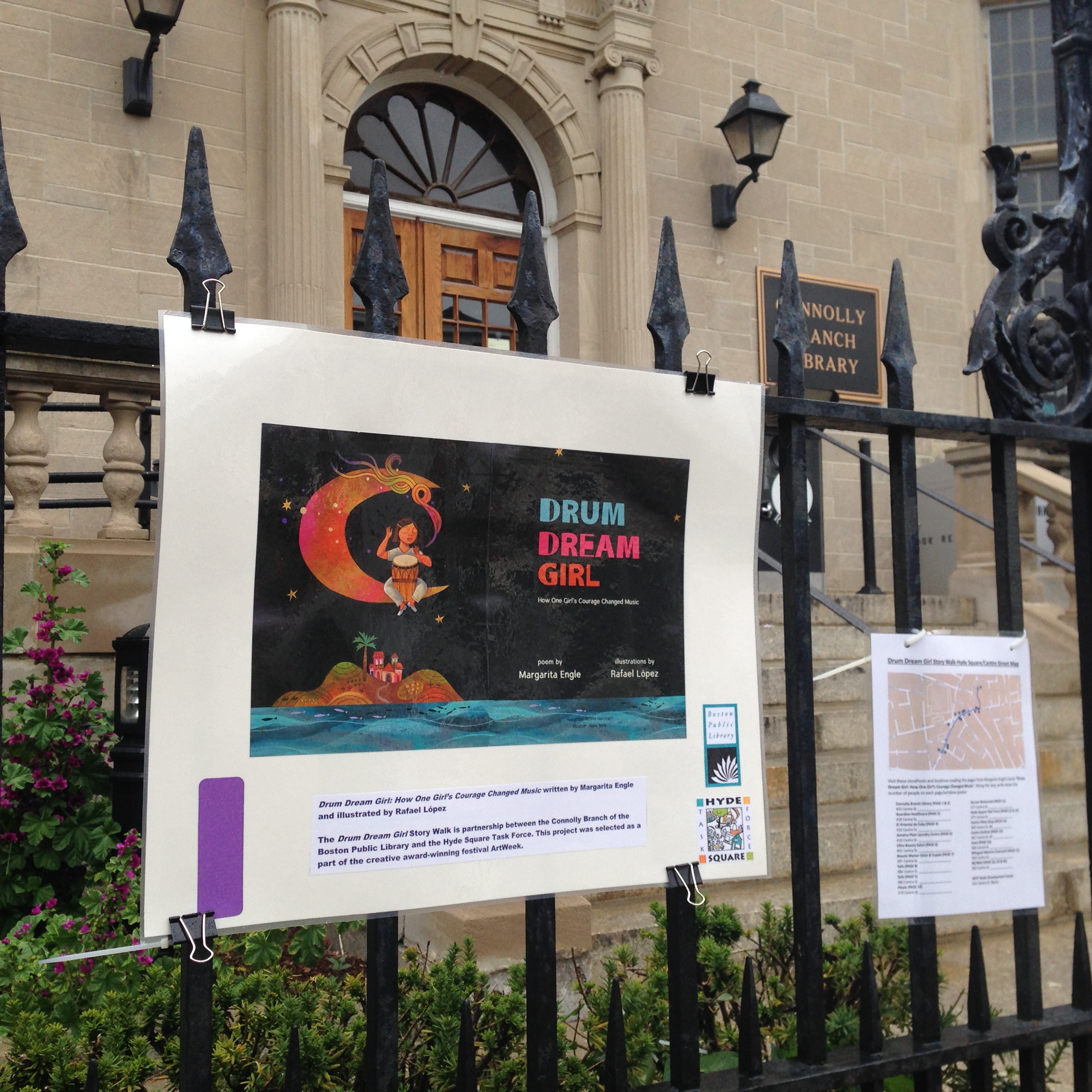
Drum Dream Girl Story Walk page 1 and map located at the library entrance

Drum Dream Girl Story Walk page 1 and map located at the library entrance

A couple of months ago, I contacted their arts and cultural programs director to discuss a great new picture book, Drum Dream Girl: How One Girl’s Courage Changed Music, by Margarita Engle and Rafael López. This book seemed like ideal material to adapt into a play. Not long after that conversation, the organization’s special-projects manager stopped by my library and we had an informal chat about future collaborations. We wanted to work together on programming that would connect my library with their youth community center, located just five blocks away. This is when I shared my idea for a story walk, which seemed like a perfect way to integrate the community, cover the physical area between both buildings, and support literacy initiatives. She loved the idea, and it fit our mutual vision, for the following reasons: A. our community has a huge Latin@ population with lots of Latin@-owned businesses; B. a group of Afro-Latina teen drummers is active in the non-profit; C. my obsession and support for Latino children’s literature; and D. the Cuban restaurants in our neighborhood seemed like a natural tie-in for Drum Dream Girl in the context of a story walk.

Now we needed to move to the fun part: the planning.

First, we identified and contacted local businesses and organizations to talk about our story walk idea and our interest in incorporating them into the program. We explained that we were going to take a picture book, create poster boards for each page, and post them in storefront windows. Participants would walk down the street from the library to the youth community center, and following a Drum Dream Girl Story Walk map, they would read the page displays along the route. Community members responded enthusiastically, from “Eso está genial. Todo sea por la biblioteca y los niñ@s,” to “That’s so cool. Of course we are in.” Using their storefront windows was a great way to integrate them into our story walk. In the neighborhood surrounding the library, 90% of the businesses and organizations are locally owned and they include a significant number of non-profit endeavors. What’s more, 11 out of the 15 storefront participants turned out to be Latin@-owned businesses. Once they agreed to take part in the walk, we created a map containing the street addresses of each storefront and the corresponding page number(s) from the book located at each address.

Next came the creation of the story pages which would be posted in the windows. A successful story walk works best when using a picture book with a simple, easy-to-follow narrative, featuring single page illustrations, and minimal text. In this case, we made allowances for Rafael López, who paints some of the most beautiful illustrations in children’s literature, but which are usually double-page spreads. This posed a bit of a challenge. We first purchased three copies of the book, since we needed to use actual pages and not scans or photocopies. Then, using an X-acto knife, a pair of scissors, and a lot of patience, I carefully separated and cut the pages. This was done using two copies of the book, to ensure the display of all pages, front and back. (The third copy was a backup, in case of errors.) To maintain the look of the full spreads,  I carefully rejoined separated pages with hidden adhesive tape. Using glue sticks, I attached the pages to poster boards and added a prepared label containing the book’s title, the author’s and illustrator’s names, the correct page number, and the names of the sponsoring library and community organization. The final step was to trim and laminate each poster board.
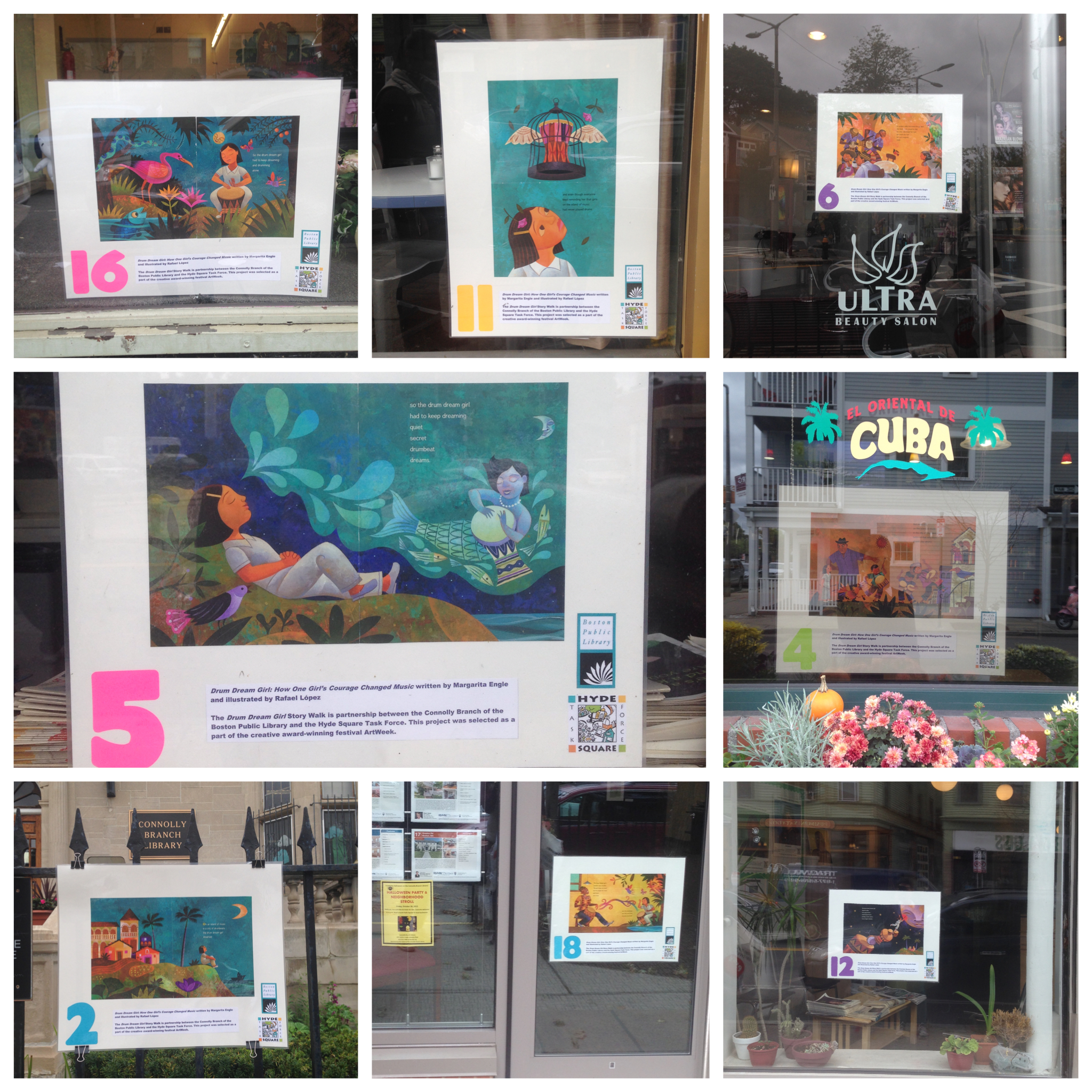
From beauty salons to Cuban restaurants and health centers, the Drum Dream Girl Story Walk boards

From beauty salons to Cuban restaurants and health centers, the Drum Dream Girl Story Walk boards


For our story walk inauguration, we selected a Saturday morning. The actual story walk was designed to be read independently, which allowed families and individuals to follow the story at their own pace. They would pick up a map at the library, walk down the main street reading each story poster, and end up at the youth community center where related activities were being offered. To enhance the reading experience, we encouraged kids to jot down certain details of the story, such as the number of people they saw on each poster, which quickly turned into a game for them and increased their attentiveness. Since this book is about an Afro-Latina drummer, several activities were music-related. At a craft table, children created their own drums, maracas, and other instruments, using recycled materials. In a separate room, story-walk readers had the opportunity to participate in a drumming workshop conducted by Latina teen drummers. These activities brought an already wonderful book to life, and provided a way to celebrate the power of music as well as elements of Latino heritage.  The publisher was kind enough to furnish a few copies of the book, which were given out as prizes to the first kids that finished the story walk.

The Drum Dream Girl Story Walk was up for a two-week period. During this time, patrons stopped by the library to pick up maps, children flocked to the crafts area to make musical instruments, and many picked up a copy of the book, while others shared their excitement about how well the story walk integrated their community. A copy of the map was located outside, at the front of the library, so that even during our closed hours, anyone interested could follow the story on their own. A lot of people who knew nothing about the program enjoyed the story as they passed through the neighborhood, leading to greater awareness about the story walk, the library, the community, and of course, the courageous Cuban girl who changed a piece of music history.
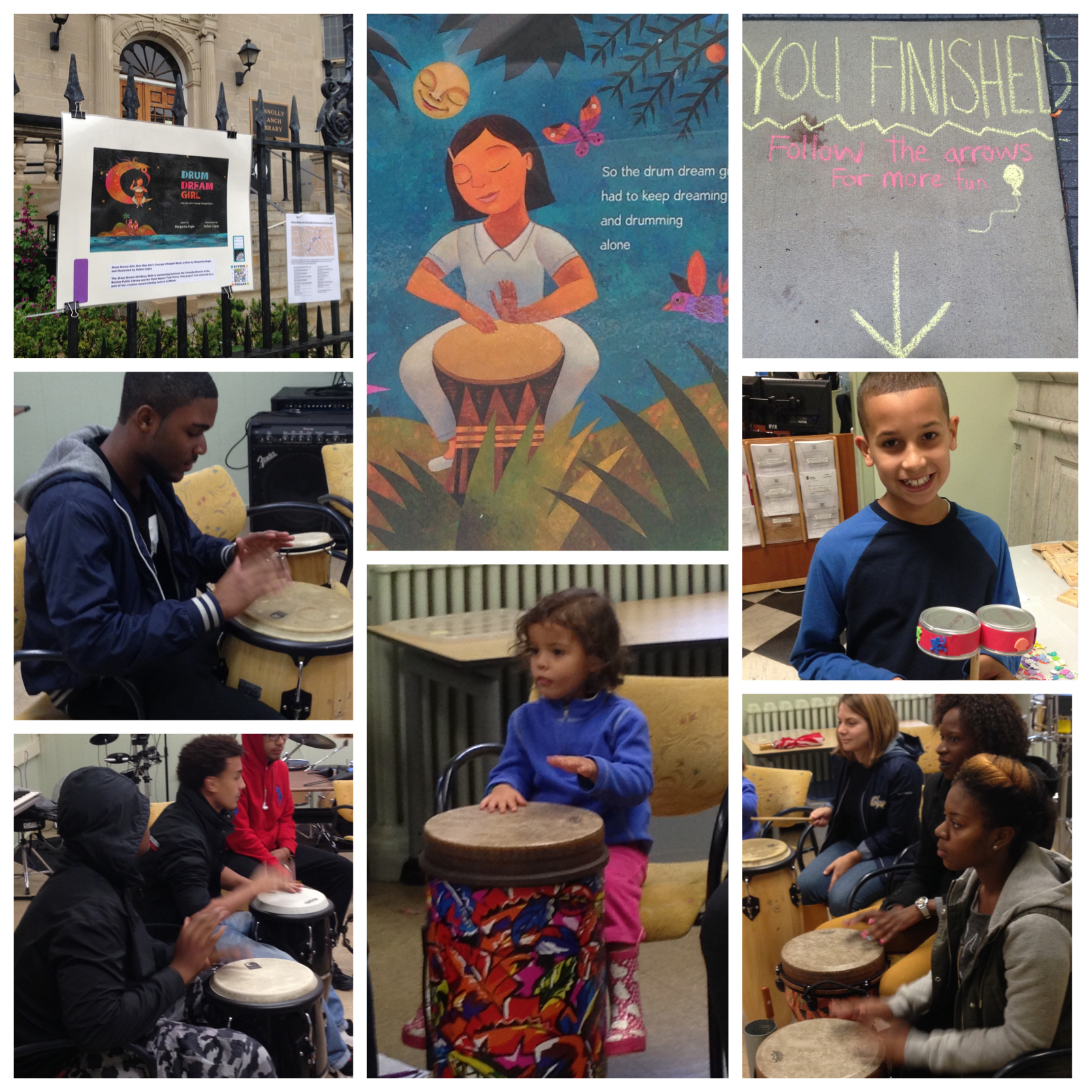
Drum dreamers

Drum dreamers


The Drum Dream Story Walk was a great event to plan and implement in an urban setting, and although it took time and patience to create the poster boards, I would definitely do it again. Alternative programs like this contribute to breaking down the physical barriers that often exist between a library and the community it serves, and also tighten relationships with local groups, businesses, and library patrons. I foresee future story walks in my library work, using diverse picture books and bilingual titles. I also intend to invite school classes and local groups to form story-walk read-alouds. And let’s not forget that music and art-making activities enhance the story-walk experience and help bring a book to life in memorable ways.
 

SujeiLugoSujei Lugo was born in New Jersey and raised in her parents’ rural hometown in Puerto Rico. She earned her Master’s in Library and Information Science degree from the Graduate School of Information Sciences and Technologies at the University of Puerto Rico and is a doctoral candidate in Library and Information Science at Simmons College, focusing her research on Latino librarianship and identity. She has worked as a librarian at the Puerto Rican Collection at the University of Puerto Rico, the Nilita Vientós Gastón House-Library in San Juan, Puerto Rico, and the University of Puerto Rico Elementary School Library. Sujei currently works as a children’s librarian at the Boston Public Library. She is a member ofREFORMA (The National Association to Promote Library Services to Latinos and the Spanish-speaking), American Library Association, and Association of Library Service to Children. She is the editor of Litwin Books/Library Juice Press series on Critical Race Studies and Multiculturalism in LIS. Sujei can also be found on Twitter, Letterboxd and Goodreads.
Taking the week off. See you again Monday.

We are taking the week off since many of us are on deadline, traveling, or getting ready in other ways to enjoy spending time with family and friends. We will be back on Monday!

Enrique Flores-Galbis: Bridge of Words

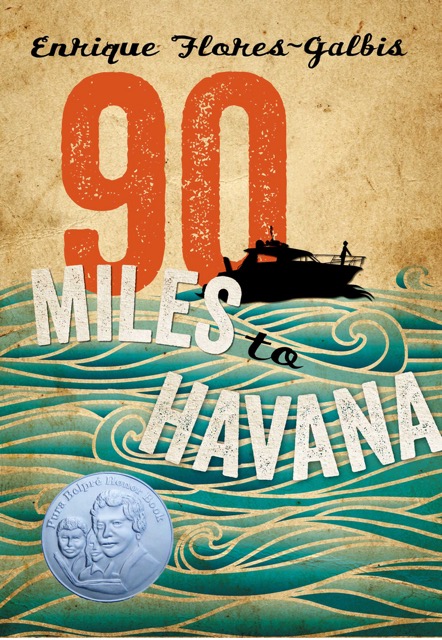
paperback coverAs part of our series on Cuban-American authors, we present an excerpt from a work in progress by Enrique Flores-Galbis, author of the novel 90 Miles to Havana.


One last trip to the well.

I grew up in a house of stories—shared memories, recounted with passion and intensity by those afraid that if they didn’t get their accounts across, the worlds and lives they left behind would disappear, and they would be truly dispossessed.

As a writer I have drawn from these exile stories and benefited from the longing and beauty of their telling, especially those told by my grandmother.

Abuela was the voice of our house. During the day she would sit in her room with the door open. This way, she could track the comings and goings of our large, unruly family, and then broadcast her narratives into the open space at the center of our tall house.

At four in the afternoon she brewed her coffee, rich and strong—the old school way. An old jelly jar, with an embossed design of grape leaves caught the drops of the black liquid oozing from the bottom of the cloth funnel. Stirring two tiny spoonfuls of sugar into her espresso cup she would murmur, “Just enough to sweeten the ninety miles I have to cross,” and then go to her room and close the door.

She would sit in her chair, cup hovering, staring out over the tops of the bare winter trees and then leave. Her body might have been slowly rocking in the chair, but she was gone— she had left the room.

Abuela was a dreamer. She could transcend her self-imposed double exile in Connecticut and return to her home on Obispo street, in Old Havana, at will.

One day, before she closed her door, I asked her, “Abuela, where do you go when you leave?”

Sensing that I was vaguely aware of her travels, she smiled and said, “Havana, of course. Where else would I go?”

It was about this time that our daily ritual of coffee, stories, and my induction into the legion of exile dreamers began.

IMG_4990_1024

Art by Enrique Flores Galbis

Abuela’s stories always started at the large carved doors of her house on Obispo St. and most of them took place on the same day, the day before her world changed. A sip of coffee, a sigh, and she would begin to describe the doors, the blaring light on the buildings, the hushed blue shadows, and the smell from the chocolate shop on the corner. Each detail, a new strand she would weave into her delicate bridge of words. I listened patiently, closely, until the words disappeared, until only their echoes, the images, remained. And then I too crossed the ninety miles of dark water on her bridge of words.

This, the last story she told me, explained her beginnings as a dreamer and led me to the realization that she was just one of many exiles who dreamed their way back to Havana every day.

“The gallego carpenter carved little cat-like creatures among the leaves and berries at the bottom of the doors where only a child would notice. Those big doors opened into a courtyard paved with smooth grey stones, dug up from the Bay of Biscayne and brought as ballast on the first ships. I always kept my windows open so that I could feel the eternal chill of the grey stones and hear the watery song of the fountain in the middle of the courtyard.

“Every day I was left all alone in that room for my afternoon siesta. I never told anyone before, but as long as I can remember, I wished I had a twin, a girl twin, someone I could whisper my secrets to. Then one day she appeared in my siesta dream. I don’t know how it happened, but there she was, just as real as you are right now. The next day I waited for her, but she did not come back.

“Now I was lonelier than ever before, but determined to bring her back. After all, if I dreamed her once I was sure that I could dream her again. So, one siesta at a time, I began to recreate her, to will her back from my memory.

“I don’t remember how long it took or how old I was when I fully willed her into being, but I do remember the first time she entered my room, she brought the songs of the caged birds as a gift.

“We would lie side by side, barely creasing starched pillowcases, holding hands as we slipped out of this world. In that hour of underwater quiet we were free to roam to places unthinkable at any other time. We tore down walls and burst through gates erected to keep a young girl’s imagination cloistered and safe. We created new worlds and then tossed them back and forth until one of us succeeded in fleshing out a vivid scenario, always reserving a place for the other on our dream stage.

“One day, as I walked to my room for my siesta, there was a loud knock on the big doors. I stopped by the fountain.

“The cook, irritated by the interruption, stepped out of the kitchen and stomped across the courtyard. He nudged the door open only a crack, ready to dismiss the beggar or vendor that had so rudely disturbed his preparation of the evening meal.

“The cook hesitated and then took a step back. As the door swung open, the afternoon light sliced into the shady courtyard. Then the cook, a haughty, serious man, did something that I had never seen him do before. He bowed deeply as a small woman, not much older than myself, walked boldly past him. She stopped at the very tip of the shaft of light as if she wanted me to look at her— to see her fully.

“She had high cheekbones and very small dark eyes. Her sun-darkened skin was a rich ochre, the color of the earth in Matanzas. She seemed to be a perfectly balanced mixture of every race that had ever set foot in the Caribbean.

“She slowly stepped toward me and began to recite details from my secret dream lives, descriptions of places my twin and I had traveled to, places only an intimate of our dreams would know.

“’Have we met?’ I asked.

“ ‘Yes, in your siestas. You left a window open,’ she said in a soft conspiratorial tone.

“I immediately understood what she meant. My dreams were open and inviting. I always left room for my twin and, I realized, they were open to all dreamers.

“It didn’t take me long to see that Uva was my guardian-angel. She had come to teach me about the art of dreams, as she called it, always insisting on the importance of her calling, because shared dreams have the power to affect reality.

“Over time the numbers of dreamers grew, but in exile our once sweet dream turned into a bitter, dark cloud casting its half century shadow on our island.

“Now there are not many of us left and I’m too tired to carry on.

“It is time for this dream to end, so that the new one can begin.”

Good bye, Abuela.


Flores GalbisEnrique Flores Galbis is a painter, teacher, lecturer, and novelist. He immigrated to the United States from Cuba at age nine. As a writer, he is best known for the Pura Belpré Honor Book 90 Miles to Havana. His first novel, Raining Sardines,  (Roaring Brook Press 2007)a recipient of America’s Award Author Honors. Learn more about his art and writing on his professional website. Go here to view an illustrated reading by the author from his award-winning novel.

Kickin’ Back With #KidLitCon

By Libertad Araceli Thomas

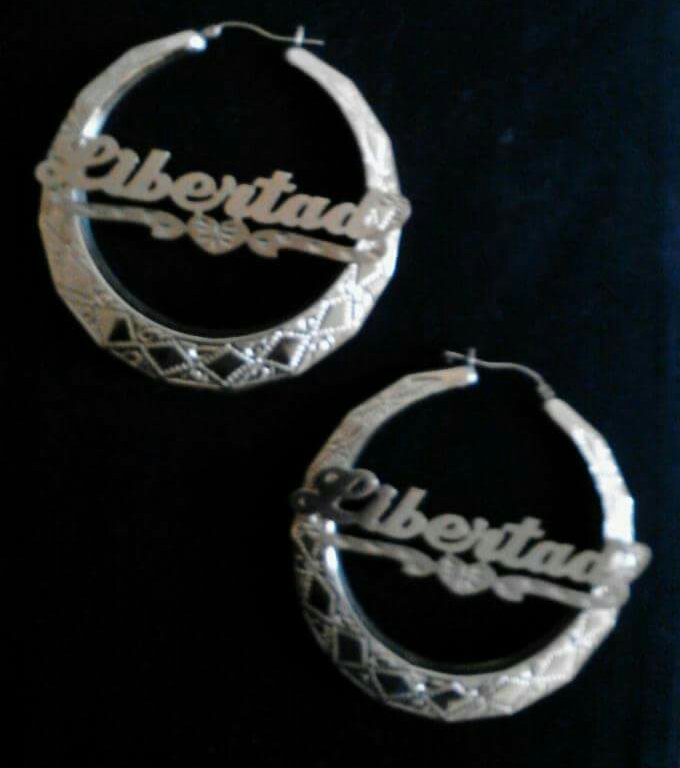
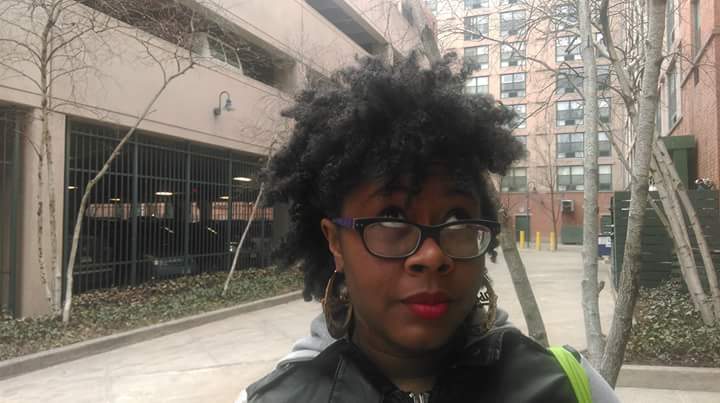
There’s always this anxiety I get when I attend book and writing conferences. While in my everyday non-bookish life I’m pretty extroverted, when I step foot in these places, where most likely, if not for my sister, I’d be one of the few people of color (POC) as well as the only Latina, I shut down and go into hermit mode. I’ll admit the first day was a little tough for me. I did remember a ton of folks from last year, but Kid Lit Con moves around every year, so there’s always tons of new people that you’re not going to know. As I predicted, I closed off. I felt lonely. I thought here are all these people who like books just as much as I do, but I always have this fear that people aren’t going to like me because here I am, this inner city negrita with these big hoop name plate earrings (that I personally cannot live without) and this big hair and very awkward in my own way.

FB_IMG_1444687743048_1

There’s this feeling deep down inside me that I feel awful for admitting being a POC. I have this immense distrust for white people. I’ve never trusted white people to make me feel comfortable. I’ve never trusted them to understand my experiences and worst of all, many opportunities I’ve had to challenge a white person’s way of thinking, I’m almost always shot down, left feeling lesser than and invalidated to the point where sometimes it’s just easier to not say anything at all.

Last year’s theme was a subject very dear to me: Diversity. Sometimes as book bloggers, my sister and I feel very disadvantaged because we’re not blogging about the latest Stephenie Meyer books or the ones that are deemed the next big thing; the books that speak the most to me are books that feature non “default” characters. So I prayed we’d get a chance to bring up diversity before our panel the next day. It unfortunately didn’t happen, so I was feeling a little down on my luck.

My sister and I kept score on how many things had gone wrong with this trip and then the day of our panel, the worst thing in the world happened. Our moderator, Dr. Zetta Elliott, who created this amazing thought provoking presentation, was unable to make it and we’d found out just moments before our scheduled slot.

The show went on with our other lovely panelist/author Mary Fan (who was totally awesome and poised to perfection) reading in Zetta’s place. Our pressing topic?

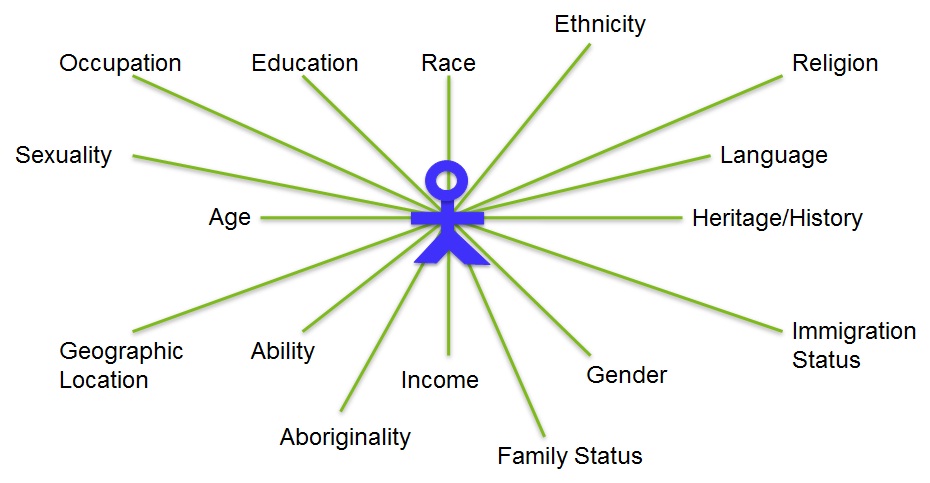
Intersectionality

intersectionality-blueman

Sharing personal stories is hard on paper, but it’s especially hard vocalizing them to a room full of people when you’re on display. A key point I felt passionate about was how perception leads people to believe there’s one way to be something.–one way to be black, one way to be queer, one way to be a person. Being Afro-Latina, Queer and Buddhist, I suffer from a severe case of unicorn syndrome. No one really expects me to be all these things, but I am and there was a librarian named Maureen (who was also Latina, yay!) whose words really stuck out to me: To be Latina is to be intersectional because there is no one identity.

mary fan

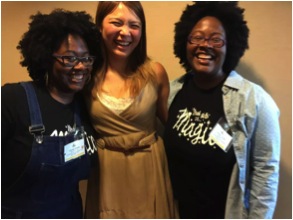
*Guinevere and I with our fellow panelist, Mary Fan*

After our intersectionality panel all the apprehension washed away. One minute, I was feeling like no one saw me and then the next I had an overwhelming amount of people thanking me for challenging their thoughts.

marissa

*Me, Marissa, and Guinevere*

And turns out, we weren’t actually alone. The Latinas were there representing. A young and amazingly beautiful boricua named Marissa (who blogs @Marissa Reads) was just so full of life and loved to read so much that she had to start blogging about books to find others like her!

While our intersectionality panel could have been the very best panel I’ve ever spoke on, I have to say my favorite moment of that day had absolutely nothing to do with any of the panels themselves but a member of the audience during a panel about professional blogging. The father of the young lady we’d met earlier was just so proud of her, filming and taking photos, silently encouraging her love for books.

It brought a tear to my eyes because just a month ago a friend of mine confessed he didn’t push his son to read because “Dominicans don’t read.” Maybe it’s just he doesn’t see Dominican kids in books. Either way, the moment gave me so much hope for the future and plans to incorporate a Dominican character in my next WIP. Just one person’s mind challenged about race, culture, gender, and disability is a battle won in my book. Next year, I pray I won’t be so afraid to tell people my story because my story is one of many that I hope can diversify people’s perceptions about the world we live in today.

4 latinas

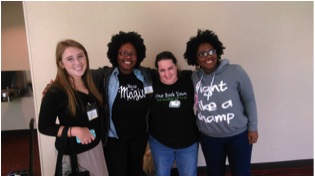
*From left to right Marissa, Guinevere, Maureen and me representing for the Latinas*

FB_IMG_1444688996687

Libertad Araceli Thomas is one half of Twinja Book Reviews, a book blog that celebrates diversity. Between mastering her handstands and perfecting her butterfly kicks, she can be caught reading and promoting a good book! Tweet with her @afrocubansista and @dos_twinjas 

Book Review: Sofi and the Magic, Musical Mural/Sofi y el Mágico Mural Musical


Reviewed by Sujei Lugo

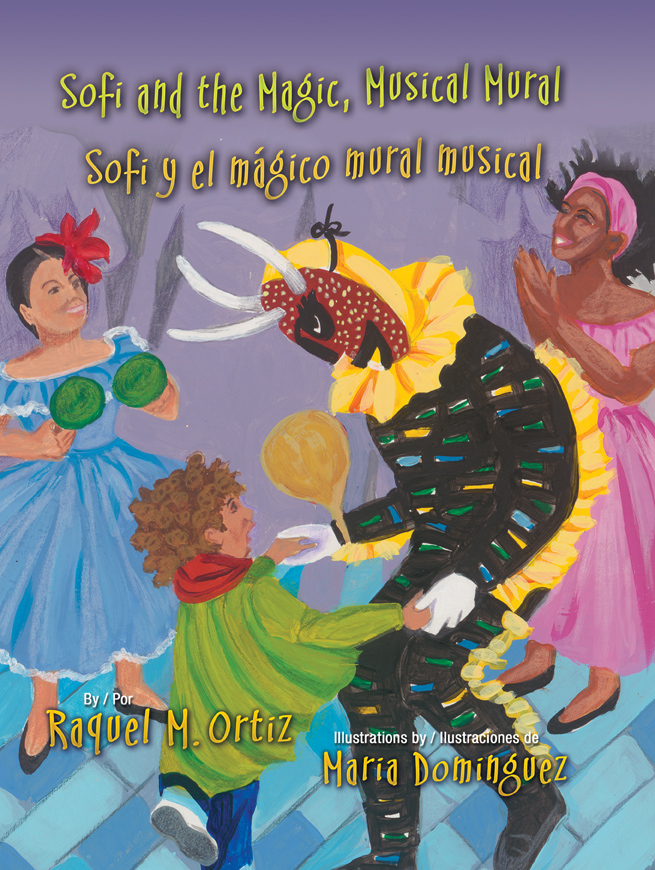
Sofi-and-the-Magic-Musical-MuralDESCRIPTION FROM THE PUBLISHER: When Sofi walks through her barrio to the local store, she always passes a huge mural with images from Puerto Rico: musicians, dancers, tropical flowers and—her least favorite—a vejigante, a character from carnival that wears a scary mask. One day on her way home from the bodega, she stops in front of the mural. Is one of the dancers inviting her to be his partner? “Okay, let’s dance,” Sofi giggles, and suddenly she’s in Old San Juan, surrounded by dancers and musicians playing bongos, tambourines and güiros. She begins to dance and sing with her new friends, but her pleasure turns to fear when the vejigante—wearing a black jumper with yellow fringe and a red, three-horned mask—spins her around and around! What does he want from her? How can she get away?

MY TWO CENTS: In this debut bilingual picture book, author Raquel M. Ortiz and illustrator Maria Dominguez capture the story of an imaginative girl and her magical and musical encounter with a neighborhood mural. Inspired by a mural located in South Bronx, New York, Ortiz and Dominguez give us a story that celebrates Puerto Rican traditions, community-based art, and city life.

Our young protagonist Sofía is lying on her bed feeling pretty bored. Her mom asks her to go to the bodega at the end of the block to get some milk and to remember that she should “not talk to ANYONE!” Sofía gets her scarf and coat, nods to her mom, and embarks on her journey to get the half-gallon of milk. Strolling along the sidewalk, she looks at the huge mural painted on a nearby building. She is stunned by its size and the colorful images of musicians, dancers, amapola flowers, and her least favorite, a vejigante. While returning from the bodega, Sofia can’t help admiring the mural once again. This is when she notices that one of the musicians, a plenero, is extending his hand to her to dance, breaking the wall between reality, art, and imagination. In a heartbeat, Sofía finds herself inside the mural, starting a whimsical experience that will bring her close to her Puerto Rican heritage.

Reading and seeing images of things that I grew up with put a smile on my face. From the plena song “Porque la plena viene de Ponce, viene de barrio de San Antón” to the carnival song “¡Toco-toco, toco-toco! ¡Vejigante come coco!”, I couldn’t help singing along with all the plenas and remembering the presence of plena songs in family gatherings, “navidad” parties, cultural “festivales”, carnivals, and even street protests. No wonder it is known as the  “periódico cantado” (sung newspapers), telling everyday stories all year long.

We also meet the famous vejigante, wearing its colorful outfit and a scary mask made from coconut shell (although some are made from papier-mâché). The vejigante is a mischievous folkloric character that resembles a buffoon or the devil, and which became a symbol of Puerto Rican cultural identity. In the story, Sofi plays and dances with the vejigante that she once saw as scary. She ends up wearing his outfit and flies around the Puerto Rican landscape going through El Yunque rainforest, and landing at the church plaza in Old San Juan. Here the author metaphorically portrays how through art, music, and traditions we can “fly” to the island of Puerto Rico, and demonstrates the deep connections that exist between the Puerto Rican diaspora and the island.

In terms of layout and illustrations, the bilingual text is located on the left side of the book with small illustrations dividing the English and Spanish texts and whole-page illustrations accompanying the text on the right side. The illustrator based her design and images on the original mural and conversations with the students that drew the images for mural. From soft colors for the city and bright and vivid colors for the mural, Dominguez’s paintings transport us from a wintry day in New York City to a sunny day in Puerto Rico.

Using The Pueblo Sings/El Pueblo Cantor mural as an inspiration for this picture book communicates the power of art, music, literature, and images to represent a community and tell its stories of resistance. The 7th- and 8th-grade students that designed the mural embraced the process of community building, public art, and history. It was created with and for the Puerto Rican community that has lived in New York City for decades. The mural’s statement is about the existence of the people and is a representation of their stories. It brings identification to the neighborhood and informs visitors about the living, breathing community located there. It is exciting to see the author centering the narrative on a young Puerto Rican girl who experiences this connection with her culture, traditions, and family, and then back to herself. In so doing, this book gives a powerful testament to how children can experience these connections and embrace them as their own.    

The book includes author and illustrator biographical notes, a glossary, and information about the mural.

TEACHING TIPS: The bilingual picture book is recommended for children ages 4 to 8. It works as a read aloud and for early independent readers. At home or at the library, librarians, parents, grandparents or other caregivers can read the story aloud in English, Spanish, or both, while teaching new words, concepts and discussing the different images. Teachers can include the discussion of Puerto Rican history, traditions, and music in their curriculum. 

IMG_4360-2

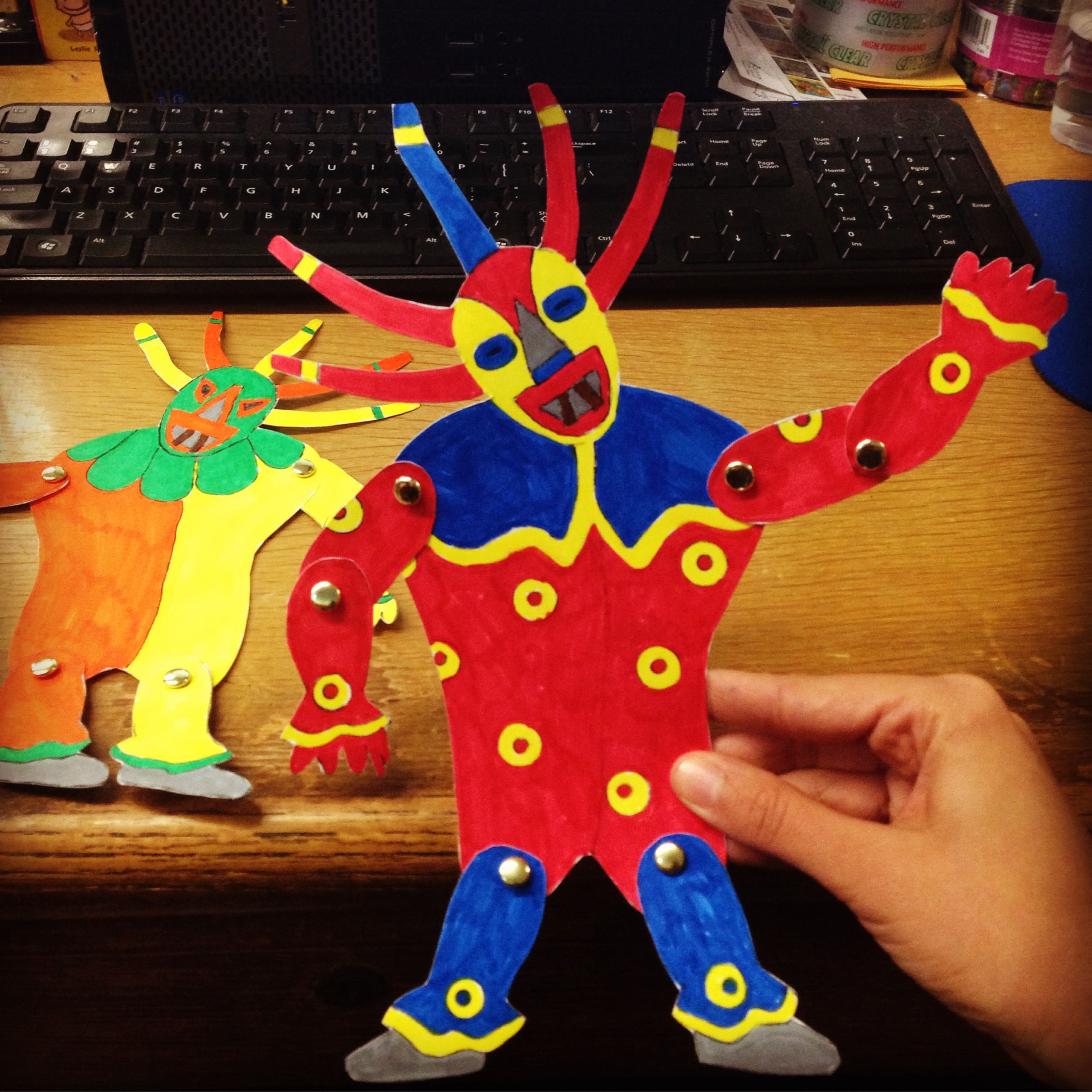
Vejigantes puppets I created for a library program. I explained to the children the meaning of vejigantes and how I grew up seeing them almost everywhere back in Puerto Rico.


Since the main focus of the story and its inspiration is a mural, children can create their own small-scale cardboard murals. Adults should encourage children to use elements from their community or their personal or family stories as inspiration. Moving activities to the street, adults can stroll down the neighborhood with children to view community murals, posing such questions as: Who created this mural? Who is it about? What does it represent? Does it represent the community where it is located? What type of murals should our neighborhood have? This will create a conversation about public art, public space, and community.

AUTHOR & ILLUSTRATOR: Raquel M. Ortiz was born and raised in Lorain, Ohio, and has been making art and telling stories since she was little. She holds a Ph.D. in Social Anthropology from the University of Salamanca and has worked at The Brooklyn Museum, the Allen Memorial Art Museum and El Museo del Barrio. Raquel is the author of El Arte de la Identidad, the documentary Memories of the Wall: Education and Enrichment through Community Murals and textbooks and educational materials for children in Puerto Rico and the United States. She lives in New York City with her family and is a professor at Boricua College.

Maria Dominguez moved from Cataño, Puerto Rico to New York City when she was five year old. She began her artistic career as a muralist with Cityarts in 1982. Over the past twenty-five years, Dominguez has created over twenty public art murals and worked with the Metropolitan Transportation Authority of New York City, Artmaker, Inc. and Brooklyn Connect. The recipient of grants from the National Endowment for the Arts and the New York Foundation for the Arts, she has also headed El Museo del Barrio’s Education Department. She currently teaches art in New York City’s Public School System.

FOR MORE INFORMATION about Sofi and the Magic, Musical Mural/Sofi y el Mágico Mural Musical, check your local public library, your local bookstore or IndieBound. Also, check out GoodreadsAmazon, and Barnes & Noble.


SujeiLugoSujei Lugo was born in New Jersey and raised in her parents’ rural hometown in Puerto Rico. She earned her Master’s in Library and Information Science degree from the Graduate School of Information Sciences and Technologies at the University of Puerto Rico and is a doctoral candidate in Library and Information Science at Simmons College, focusing her research on Latino librarianship and identity. She has worked as a librarian at the Puerto Rican Collection at the University of Puerto Rico, the Nilita Vientós Gastón House-Library in San Juan, Puerto Rico, and the University of Puerto Rico Elementary School Library. Sujei currently works as a children’s librarian at the Boston Public Library. She is a member of REFORMA (The National Association to Promote Library Services to Latinos and the Spanish-speaking), American Library Association, and Association of Library Service to Children. She is the editor of Litwin Books/Library Juice Press series on Critical Race Studies and Multiculturalism in LIS. Sujei can also be found on Twitter, Letterboxd and Goodreads.
Let’s Read Latin@: 73 titles released in 2015


We’re back!

After a short summer break, the Latin@s in Kid Lit crew is back to begin our third year online, celebrating children’s literature by/about/for Latin@s. In December 2014, we had posted a preview of 24 middle grade and young adult releases in 2015. Well, as the year rolled on, we discovered many more! Below, we have posted the covers of 71 picture books, early readers, middle grade, and young adult novels by/for/or about Latin@s that have been or will be released in 2015. If we have missed any, please let us know in the comments.

If we have already highlighted a title on the site, you will be led to that post when you click on the cover. Otherwise, you will be taken to IndieBound.org, Amazon, or GoodReads for more information. We have not read all of these titles–so we cannot vouch for each one–but we plan to read and recommend many of these in addition to 2016 releases. So, go ahead and browse the titles, add them to your to-be-read lists, or buy copies for yourself, friends, and family. With schools opening and holidays around the corner, it’s the perfect time to buy books! If we want to continue to celebrate libros Latin@s, we need to read, buy, and support libros Latin@s! Happy reading!


Picture Books & Early Readers:

22521973   21469072   22750413   22929558      25066557   The Sock Thief   KNIT TOGETHER by Angela Dominguez (Dial) 2/15 -- Picture book   23467663   23467664   23467662   23467661      18528167   22749711   23379443            25779175      FINDING THE MUSIC / EN POS DE LA MUSICA by Jennifer Torres; illustrated by Renato Alarcão (Lee & Low) 5/15 -- Picture book  24753419


Middle Grade:

            24527773   22571259   23282198   24040566   23734473   22504701   22639675   22082059   18938092   23756784      22749539      23309533


Young Adult:

17566703         22718685   23899848   Orange Candy Slices: And Other Secret Tales   22918050   21529626   18625184   20734195   23309551   25317760   20345202   24202275   TAKING HOLD: FROM MIGRANT CHILDHOOD TO COLUMBIA UNIVERSITY by Francisco Jiménez (Houghton Mifflin Harcourt) 4/15 -- YA Memoir   23013839      25077874       22392926   22609306   22295304   25256386   23395349   The House of Hades (The Heroes of Olympus, #4)   WhenReasonBreaks_Comp   22550839   19542841   23202520   NAKED 1600x2400   23281665