Ready for 2018 FIFA World Cup Russia: Fútbol/Soccer Children’s Literature Bibliography


by Sujei Lugo

For the next couple of weeks, the 2018 FIFA World Cup, one of the world’s biggest sports events, will be held in Russia. This international soccer/fútbol competition brings spectators of all kinds together, drawing on their common passion—and this applies to avid fans who follow the sport throughout the year, as well as those who only pay attention every four years when the World Cup is played. Either way, this is the time to catch up with the latest players and root for your favorite team/country.

I live and work in a neighborhood where the caregivers of my library’s kids are often watching fútbol games on their phones, and where once in a while the little ones wear their favorite player’s jersey, or that of their parents’ or grandparents’ national team. It is one of those times when we break down certain barriers of communication with neighbors, family, friends, co-workers, and the people sitting next to us—because we are all speaking fútbol.

Like my fellow children’s librarians, the time for summer reading/learning programs is upon us, and we are always eager to support and encourage recreational and informational reading for our youth. The 2018 FIFA World Cup is a great opportunity to showcase our fútbol/soccer children’s books, and to start or continue conversations with our small patrons—and root (or debate!) together.
DfluFhzXkAAAbZy

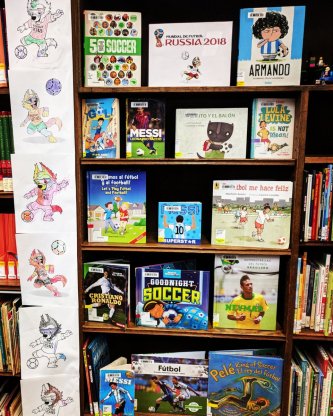
I posted a picture on my social-media accounts of the fútbol children’s books display that I put together at my library, along with coloring sheets of this year’s World Cup mascot, Zabivaka! My great colleagues Angie Manfredi and Cory Eckert suggested that I should assemble a bibliography of these books, and well, here it is! Included here are titles in Spanish and English, as well as bilingual editions, and it contains everything from early readers to graphic novels to chapter books. The majority of these titles are by Latinx or Latin American authors or illustrators. Many feature Latinx or Latin American characters and players, but I also included more general titles about the game and its players. My list focuses on books available at my library branch, but we know there are many more great ones out there! I hope this list inspires you to get your library display going, or perhaps to acquire some of these winners for your library, classroom, or home shelf, all for your favorite little ones!

Fútbol/Soccer Children’s Literature Bibliography

Alexander, Kwame (2016). Booked. Houghton Mifflin Harcourt. [Chapter Book; Novel in Verse]

Apps, Roy; illustrated by Chris King (2015). Dream to Win: Leo Messi. Franklin Watts. [Early Readers; Biography]
61PR6ODMAZL._SX258_BO1,204,203,200_

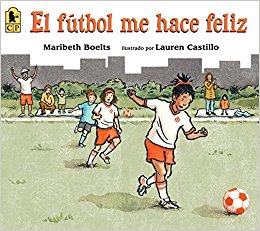
Boelts, Maribeth; illustrated by Lauren Castillo (2015). El fútbol me hace feliz. Candlewick Press. [Picture Book]

Boelts, Maribeth; illustrated by Lauren Castillo (2012). Happy Like Soccer. Candlewick Press. [Picture Book]

Borth, Teddy (2017). Fútbol: grandes momentos, récords y datos. Abdo Kids. [Early Readers]

Brown, Monica; illustrated by Angela Dominguez (2015). Lola Levine is not Mean! Little, Brown and Company. [Early Readers]

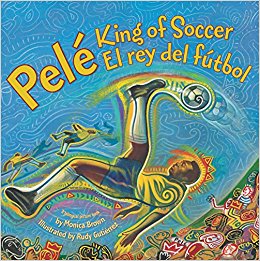
Brown, Monica; illustrated by Rudy Gutiérrez (2009). Pelé: King of Soccer/Pelé: el rey del fútbol. Rayo. [Picture Book; Biography; Bilingual]

Cline-Ransome, Lesa; illustrated by James E. Ransome (2007). Young Pelé: Soccer’s First Star. Schwartz & Wade Books. [Picture Book; Biography]

Colato Laínez, René; illustrated by Lancman Ink (2014). ¡Juguemos al fútbol y al football!/Let’s Play Fútbol and Football! Alfaguara. [Picture Book; Bilingual]

Crespo, Ana; illustrated by Nana Gonzalez (2015). The Sock Thief. Albert Whitman & Company. [Picture Book]

Dahl, Michael; illustrated by Christina Forshay (2018). Goodnight Soccer. Capstone Young Readers. [Picture Book]

Doeden, Matt (2017). Sports All-Stars: Cristiano Ronaldo. Lerner Publications. [Biography]
9789874616364Domínguez, María & Juan Pablo Lombana (2014). El Chavo: El partido de fútbol/The Soccer Match. Scholastic. [Picture Book; Bilingual]

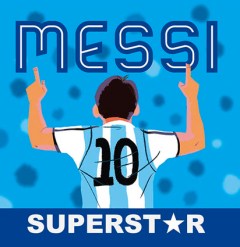
Duopresslabs; illustrated by Jon Stollberg (2016). Messi superstar. ¡Achis! [Biography]

Elzaurdia, Paco (2013). Superestrellas del fútbol mexicano: Rafael Márquez. Mason Crest. [Biography]

Franz Rosell, Joel; illustrated by Constanze v. Kitzing (2012). Gatito y el balón. Kalandraka. [Picture Book]

Garlando, Luigi; illustrated by Stefano Turconi (2012) ¡Gol! Un gran equipo. Vintage Español. [Chapter Book & Comics]

Javaherbin, Mina; illustrated by Renato Alarcão (2014). Soccer Star. Candlewick Press. [Picture Book]

Jökulsson, Illugi (2015). James Rodríguez. Abbeville Press. [Biography]

Jökulsson, Illugi (2015). Stars of Women’s Soccer. Abbeville Press. [Biographies]james-rodriguez

Jökulsson, Illugi (2015). Stars of World Soccer. Abbeville Press. [Biographies]

Lombana, Juan Pablo; illustrated by Zamie Casazola (2014). Soccermania/Futbolmanía. Scholastic, Inc. [Bilingual]

Manushkin, Fran; illustrated by Tammie Lyon (2018). Pedro: el golazo de Pedro. Picture Window Books. [Early Readers]

Morgan, Alex (2016). The Kicks: Settle the Score. Simon & Schuster Books for Young Readers. [Chapter Book]

Nevius, Carol; illustrated by Bill Thomson (2011). Soccer Hour. Marshall Cavendish Children. [Picture Book]

Oldfield, Tom & Matt Oldfield (2017). The Little Genius: Sergio Agüero. Dino. [Biography]

Oldfield, Tom & Matt Oldfield (2016). El pistolero: Luis Suárez. Dino. [Biography]

Paul, Batiste; illustrated by Jacqueline Alcántara (2018). The Field. NorthSouth Books. [Picture Book]

Pelé; illustrated by Frank Morrison (2010). For the Love of Soccer! Disney Hyperion. [Picture Book]

Pérez Hernando, Fernando (2016). Armando. Takatuka. [Picture Book]

Pinkney, Brian (2015). On the Ball. Disney Hyperion. [Picture Book]

downloadRadnedge, Aidan (2018). 50 Things You Should Know About Soccer. Quarto Publishing.

Simon, Eddy; illustrated by Vincent Brascaglia (2017). Pelé: the King of Soccer. First Second. [Graphic Novel]

Teixeira Thiago, Jorge (2013). Superestrellas del fútbol brasilero: Neymar. Mason Crest. [Biography]

Vázquez Lozano, Gustavo A. (2013). Superstars of Soccer Colombia: Iván Córdoba. Mason Crest. [Biography]

Vázquez Lozano, Gustavo A. (2013). Superstars of Soccer Mexico: Javier “Chicharito” Hernández. Mason Crest. [Biography]
61cUUTpvTcL._SX258_BO1,204,203,200_

Quizás Algo Hermoso: Interview with author F. Isabel Campoy


By Sujei Lugo

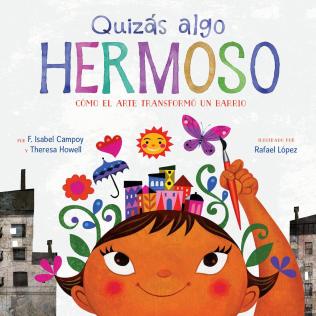
The picture book Maybe Something Beautiful: How Art Transformed a Neighborhood, written by F. Isabel Campoy and Theresa Howell, and illustrated by Rafael López, was published in 2016. Based on a true story about a community art initiative led by Rafael López and his wife, graphic designer and community leader Candice López, the book received rave reviews, won the 2017 Tomás Rivera Book Award, and made our 2016 Favorite Latinx Books list. This inspiring tale, along with its vibrant illustrations, provides tremendous inspiration in the realm of literacy, community, and arts education. Its impact on youth makes it a resource toward engagement and collaboration for teachers, librarians, and community organizers. As a youth librarian, I used Maybe Something Beautiful for a Día de los Niñxs/Día de los Libros program and wrote a post about it, entitled Día Art Bilingual Story Time!    

Last March 2018, a Spanish edition was published under the title Quizás algo hermoso: cómo el arte transformó un barrio. This text is not a translation of the English edition, but a new, original text by F. Isabel Campoy. We had the opportunity to chat with Isabel about Quizás algo hermoso, and we also asked about her work in children’s books and how she stays inspired.

DLkUqfXXcAAlEen

You’ve been publishing children’s books for years. What inspires or fuels you to keep publishing English, Spanish and bilingual titles for our little ones?

The adults who surround the first ten years of any child have complete influence in the development of their intellectual capabilities. The language they hear, the type of interactions they have with their surroundings, the number of experiences they are exposed to, all these are cornerstones in the foundation of their lives. Books do not substitute lived experiences, but they are great complements to them. If a child is read in the language they hear at home. If a child looks at illustrations that invites them to new landscapes, cities, monuments, or people. If children are presented with positive experiences, feelings or actions, those children will grow richer, more capable, more alert and open to learning. That is what fuels me to keep publishing in Spanish, and in English. To give children MORE. More language, more knowledge, more joy. More is always MORE. And children have the amazing ability to build up big brains if we offer them the possibility of learning.

When I was a child, there were very few books published for children, and the ones available had just a few illustrations in black and white. But I had the great fortune to have a father who was subscribed to the National Geographic Magazine since 1940. Those magazines saved me, fueled my imagination, and planted the seed in my heart for knowledge. When I recently published “Alegría, poesía cada día” with National Geographic Magazine I felt that a 70-year circle had been completed. What a joy that was!

I want children to dream the way I did. Very fortunately the book industry now offers many opportunities for great reading experiences.

In 2016 Maybe Something Beautiful: How Art Transformed a Neighborhood published to rave reviews. This year, we have a Spanish edition titled Quizás algo hermoso: cómo el arte transformó un barrio. Why did you choose to write a new, original Spanish text instead of providing a bilingual edition or direct translation?

If you are a balanced bilingual, when you write, in whatever language you are writing, you are being an original writer in that language. Quizás algo hermoso and Maybe Something Beautiful express the same idea in two languages. My co-author Theresa Howell and I worked the manuscript in English for almost three years! Every comma was measured, every expression, every interjection was pondered— while simultaneously I was building its parallel in Spanish. It is a lot of fun!

When a child reads a book, they must find a flawless use of that language, natural expressions, high command on part of the author of the grammar and syntax, a natural flow of meaning. Those are the components of an authentic text.

I wish all children had the opportunity to read and speak more than one language.

All countries in Latin America have speakers in more than one language. In the case of Mexico, for example, over 50 languages other than Spanish are spoken. I find that to be a cultural treasure!

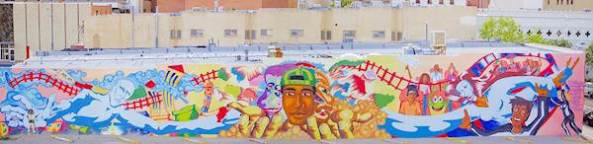
Lead Artist Antonio Lente. Photo by Paul López Albuquerque

Mural in Abuquerque, New Mexico. Lead artist, Antonio Lente. Photo by Paul López


How has the reaction been to both versions of the book by adults and children?

When we chose to write this manuscript, we had one goal: to share a positive community action with readers anywhere. The example set by Rafael and Candice López in San Diego was born out of a true desire for transformation, and they succeeded beautifully. Art was the means and solidarity was the goal. Their example is now being replicated in many places in this country. Rafael’s brushes are magic wands and the world is his canvas!

We have received letters from teachers and their students telling us about how they reacted to the book. There have been real murals painted, and murals on huge brown paper covering school hall walls. There have been little altars with suggestion boxes on how each child imagines the transformation of their environment through art. We have seen pictures of painted river rocks creating paths in gardens, and little paintings, like Mira’s, attached to fences. It is extraordinary what children can imagine, and it is enlightening to listen to them!

Adults have found in this text an example that can be replicated in their own corners of the world. And they are doing it!

Can you talk about the importance of having this story available in Spanish? Do you plan to publish it in other languages?

A couple of months ago we had the great news that the book had been translated into Chinese! That would add at least 300 million possible readers to our book! We are very happy.

I wanted to see this book in Spanish from day one. We were very happy to see it finally printed. The community that the book reflects is a picture of life in many places in the United States. Muralism is a vibrant reflection of Hispanic art. Three internationally known painters in Mexico: Rivera, Orozco and Siqueiros, brought murals to the forefront of artistic expression. Their palette and what they chose to paint reflected the people and the history of Mexico. Writing a book about murals was also paying homage to the lives of our communities, as diverse and multicultural as they are everywhere.

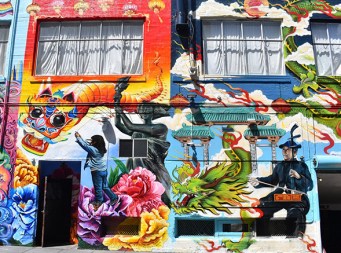
San Francisco

Mural in San Francisco, California. Photo provided by F. Isabel Campoy

Quizás algo hermoso can now be read by parents as well as children whose first language is Spanish. But also, by English-speaking children who are in Dual Language Programs. It is certainly beautiful to see how many more children are becoming bilingual. The two largest languages in this continent, English and Spanish, are embracing each other, providing a better path towards understanding for the new generations.

In your travels, have you seen vivid examples of mural painting that speak to the spirit of a community?

I am drawn to all forms of art. My first visit in every city is to its museums, art galleries, and monuments. In the United States there are famous cities with great murals—for example where I live, in San Francisco. They all depict life in the neighborhood or pride on the diverse cultures of the city. Philadelphia is famous for its murals, and Albuquerque now has miles of fantastic paintings all over the city’s walls. In a book I co-authored with Alma Flor Ada entitled Yes, We Are Latinos!, a book about diversity within the Latino culture, I wrote about the Tower in the Hispanic Cultural Center in Albuquerque, painted by Frederico Vigil. That tower is a fabulous historic overview of Latinos. 

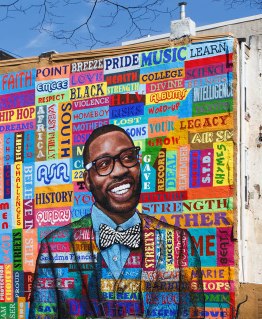
Ernel Martínez. Philadelphiajpg

Mural in Philadelphia, Pennsylvania by artist Ernel Martínez

Also abroad, from El Cairo to London, from Rome to Barcelona, murals are a part of the richness we can find everywhere in the world. You can see some examples on the website for Maybe Something Beautiful www.maybesomethingbeautiful.com.

If you could paint something beautiful, what would it be and in which barrio?

When my friend and children’s book author René Colato Laínez asked this question, I answered: A tree!

Because like them, we have roots that hold us firm in our culture and language, in family and knowledge. Like them, we have a cycle of life, fruits for new generations. Our branches hold the joy of growth; our leaves, the beauty of seasons.

Where is that brush… I’ll start right now!

And about the barrio…. do I need to choose one? Could it be one in every neighborhood where there are people like Rafael and Candice López, ready to transform their reality into something really beautiful?….. Allow me to dream that it is possible!

Thank you very much for inviting me to share with your readers. ¡Un enorme y hermoso abrazo, F. Isabel Campoy! 


Isabel Campoy Headshot

About F. Isabel Campoy: Isabel is the author of over 100 children’s books. She is a recognized scholar devoted to social justice and to promoting diverse books in diverse languages. Isabel is the recipient of the Ramón Santiago and Tomás Rivera Awards, among others. She is a member of the North American Academy of the Spanish Language. www.isabelcampoy.com


Sujei1About Sujei Lugo:  a former elementary school librarian in Puerto Rico, is a children’s librarian at the Boston Public Library, Connolly Branch. She holds an MLIS from the University of Puerto Rico and is currently a doctoral candidate in LIS at Simmons College, focusing on anti-racism and children’s librarianship. She is an active member of REFORMA, ALA and ALSC (newly minted Board of Directors member). Sujei served on the 2018 Newbery Award Committee and as co-chair of the 2018 ALSC Charlemae Rollins President’s Program. A member of the We’re the People Summer Reading Project. Twitter: @sujeilugo
 

Happy Book Birthday to Bruja Born by Zoraida Córdova!

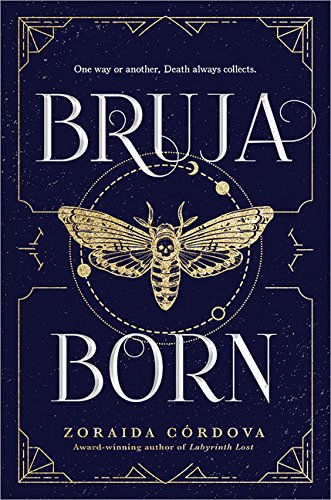
We are especially proud to celebrate the release of the second volume in Zoraida Córdova’s Brooklyn Brujas series, Bruja Born!

Zoraida made a huge splash with Labyrinth Lost, the first book in the series, and we couldn’t be prouder to see her success continue! Just check out what Kirkus and School Library Journal wrote and you’ll see that we’re not the only ones excited about Bruja Born. Plus, don’t miss Zoraida’s cover reveal in Bustle, which includes a tantalizing excerpt of the new novel.

Here’s how the publisher describes BRUJA BORN: 

Three sisters. One spell. Countless dead.

Lula Mortiz feels like an outsider. Her sister’s newfound Encantrix powers have wounded her in ways that Lula’s bruja healing powers can’t fix, and she longs for the comfort her family once brought her. Thank the Deos for Maks, her sweet, steady boyfriend who sees the beauty within her and brings light to her life.

Then a bus crash turns Lula’s world upside down. Her classmates are all dead, including Maks. But Lula was born to heal, to fix. She can bring Maks back, even if it means seeking help from her sisters and defying Death herself. But magic that defies the laws of the deos is dangerous. Unpredictable. And when the dust settles, Maks isn’t the only one who’s been brought back…

***********

Ready to order? Click on this link for buying options!

¡Felicidades, Zoraida!

Zoraida Córdova was born in Ecuador and grew up in Queens, New York. Her previous books include the Vicious Deep trilogy and the On the Verge series. For more information about Brooklyn Brujas and the rest of Zoraida’s books, be sure to visit her author website. She is also on numerous social-media platforms, including Facebook and Twitter.



March and April 2018 Latinx Book Deals


Compiled by Cecilia Cackley

This is a monthly series keeping track of the book deals announced by Latinx writers and illustrators. The purpose of this series is to celebrate book deals by authors and illustrators in our community and to advocate for more of them. If you are an agent and you have a Latinx client who just announced a deal, you can let me know on Twitter, @citymousedc. If you are a Latinx author or illustrator writing for children or young adults, and you just got a book deal, send me a message and we will celebrate with you! Here’s to many more wonderful books in the years to come.

April 26

None.

April 24

Author of Lola Levine chapter book series Monica Brown and 12-year-old star of the music video “Soy Yo” by Bomba Estereo Sarai Gonzalez’s, third book SARAI SAVES THE MUSIC plus a 4th book in the fictional series based on Sarai’s life, again to Marisa Polansky at Scholastic, in a two-book deal, for publication in spring 2019, by Stefanie Von Borstel of Full Circle Literary for Brown and Monica Villarreal and Rick Doorman of Authentic Media for Gonzalez. All four books in the new series will also be available in Spanish editions.


Alvina Ling at Little, Brown has acquired Roseanne Montillo‘s The Atomic Women. The YA nonfiction book tells the stories of the little-known female scientists who were critical to the invention of the atomic bomb and an examination of the moral implications of their work. Publication is planned for fall 2019. Author agent: Rob Weisbach at Rob Weisbach Creative Management.


Zachary Clark at Scholastic has bought Rated, by Girl at Midnight author Melissa Grey, in which teens navigate a hierarchical ranking system in a Black Mirror-esque future. Publication is slated for 2019. Author agent: Catherine Drayton at InkWell Management.

April 19

Hilary Van Dusen at Candlewick Press has bought world rights to Dean Robbins‘s (l.) picture book, ¡Mambo Mucho Mambo!, which tells the story of how Latin jazz music and mambo dancing at New York City’s integrated Palladium Ballroom broke down barriers in the 1950s and set the stage for the civil rights movement. Artist Eric Velasquez will illustrate. Publication is scheduled for fall 2020. Illustrator agent: Rubin Pfeffer at Rubin Pfeffer Content.

April 17

None.

April 12

Kait Feldmann at Scholastic/Levine has acquired world rights to Aida Salazar‘s (l.) debut picture book, Jovita Wore Pants, the story of Jovita Valdovinos, who dressed as a man and commanded a battalion of revolutionaries in a fight for religious freedom in the Mexican sierras. The biographical picture book is based in part on personal accounts told to Salazar, who is related to Valdovinos. Debut picture book artist Molly Mendoza will illustrate. Publication is scheduled for 2020.Author agent: Marietta B. Zacker at the Gallt and Zacker Literary Agency. Illustrator agent: none.


Margaret Raymo at HMH has bought, in a two-book deal, Lowriders in Space illustrator Raúl the Third‘s bilingual picture book, Vamos! Let’s Go to the Market. Inspired in part by Richard Scarry’s Busytown, the book offers a guide to the food, marketplace, games, animals, plants, and more of a U.S./Mexico border town. Publication is set for spring 2019. Agent: Jennifer Laughran at Andrea Brown Literary Agency.

April 10

Jessica Garrison at Dial has acquired Red House, Tree House, Little Bitty Brown Mouse by Jane Godwin (l.), illustrated by Blanca Gomez. The picture book is an exploration of colors and patterns and counting and more, with a tiny mouse hidden on every page. Publication is planned for fall 2019. Illustrator agent: Rebecca Sherman at Writers House sold world rights.


Andrea Welch at S&S/Beach Lane has bought world rights to Here Comes Ocean, a picture book by Meg Fleming (l.) (Ready, Set, Sail), illustrated by Paola Zakimi (Secrets I Know). The book follows a child who discovers that along with every rolling wave comes a new possibility for adventure. Publication is slated for spring 2020. Agent: Emily van Beek at Folio Jr./Folio Literary Management.

April 5

None.

April 3

John Morgan at Macmillan/Imprint has acquired two picture books by Karen Kilpatrick and Luis O. Ramos Jr. (center), illustrated by Germán Blanco. When Pencil Met Eraser depicts the creative journey that brings Pencil and Eraser together. Publication is planned for summer 2019, followed by a second, untitled book. Agent: Deborah Warren at East West Literary.

March 28

Nick Thomas at Scholastic/Levine has acquired, at auction, the first three books in Daniel José Older’s Dactyl Hill Squad, a middle grade historical fantasy series that reimagines the Civil War in a world where dinosaurs roamed alongside humans. In the center of this extraordinary moment is a squad of young people from the Colored Orphan Asylum in New York City, and at their head, a brave and brilliant girl named Magdalys Roca, who wants nothing more than to flee south and rescue her injured brother. Publication of the first book is set for fall 2018, with book two to follow in summer 2019. Author agent: Eddie Schneider at JABberwocky Literary.

March 22

Alexis Orgera and Chad Reynolds at Penny Candy have acquired world rights to Thank You, Crow by Michael Minkovitz (l.), illustrated by Jose Medina. Their debut picture book stars a boy whose act of kindness toward an injured crow leads to friendship and adventure. Publication is slated for fall 2017.

March 20

Kate O’Sullivan at Houghton Mifflin Harcourt has bought world rights to journalist Beth Ferry‘s (l.) picture book, Marsha’s Magnetic, illustrated by Lorena Alvarez. In the book, Marsha uses the scientific method to try and discover just what makes her classmates popular, until she realizes the best way to attract friends is to be yourself. Publication is scheduled for spring 2020. Illustrator agent: Alli Brydon at the Bright Group.

March 15

None.

March 13

Liza Kaplan at Philomel has acquired Jenny Torres Sanchez‘s new novel, By the Water. The book follows sisters Lola and Rosie in the wake of a car accident that landed them at the bottom of a lake, as they struggle to find a new relationship amid brain damage and the lingering fear that the accident wasn’t an accident at all. The book is set for publication in summer 2020. Author agent: Kerry Sparks at Levine Greenberg Rostan.

March 8

None.

March 6

None.

March 1

Erin Clarke at Knopf has bought world rights to Salsa Lullaby, a bilingual picture book by Jen Arena (l.), illustrated by Erika Meza, in which mami, papi, and bebé dance/bailan, sing/cantan, jump/saltan, and more until bebé falls asleep. The book is set for fall 2019. Author agent:   Jill Corcoran at Jill Corcoran Literary Agency. Illustrator agent: Claire Cartey at Holroyde Cartey.


Sylvan Creekmore at Wednesday Books has acquired, in a preempt, S. Gonzales‘s Only Mostly Devastated. Pitched as Simon vs. the Homo Sapiens Agenda meets Clueless, inspired by Grease, the book follows a boy trying to navigate a family crisis and a move to a new school who is quickly adopted by a new group of friends and comes face-to-face with his summer fling—only to discover that the perfect boy he remembers now won’t even look at him. Publication is planned for spring/summer 2019. Author agent: Moe Ferrara at BookEnds Literary.


Reported by Cecilia Cackley, a performing artist and children’s bookseller based in Washington, DC, where she creates puppet theater for adults and teaches playwriting and creative drama to children. Her bilingual children’s plays have been produced by GALA Hispanic Theatre and her interests in bilingual education, literacy, and immigrant advocacy all tend to find their way into her theatrical work. You can find more of her work at www.witsendpuppets.com.
Book Review: Sci-Fu: Kick It Off by Yehudi Mercado


Review by Marcela Peres

Sci-Fu Vol 1 Kick It Off GNDESCRIPTION OF THE BOOK: Thirteen-year-old Wax’s life may not be perfect. But that doesn’t stop him from spinning some of the sickest beats on their Brooklyn block… but he’s a better DJ than he thinks.

One night, while making a mixtape for his crush, Wax scratches the perfect beat and responds to an interstellar challenge that transports him and the entire block to the robot-filled planet of Discopia. Mistaken by the locals for a master of the futuristic, sound-bending martial art known as SCI-FU, Wax finds himself on the wrong side of a showdown against the Five Deadly Dangers and their leader, Choo Choo.

With help from the sci-fu master Kabuki Snowman and Wax’s crew—including his best friend Cooky P, his sister The D, and even his crush, Pirate Polly—Wax has to become a sci-fu master or risk losing Earth forever!

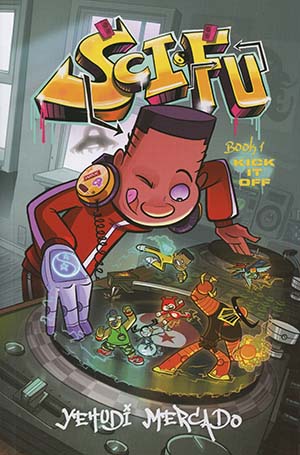
MY TWO CENTS: Sci-Fu is a love letter mixtape to all things 80s hip hop that can be appreciated by middle grade readers and adults alike. It’s a book that demonstrates the power of graphic novels to speak to the senses: the colors and lettering, heavily influenced by graffiti art and 8-bit video game graphics, are so vibrant and kinetic that you can almost hear the music popping off the page. At the end, writer-illustrator Yehudi Mercado includes a link to a Spotify playlist of iconic old school hip hop that will make you want to re-read the book while listening—and actually, I’d recommend it.

Main character Wax moves through his hero’s journey against a psychedelic sci-fi background, first in a diverse, multilingual 1980s Brooklyn alive with cool characters, fashion, and of course, sick beats, and then on to Discopia, the alien robot planet Wax has to save. He dreams of becoming the best DJ in the universe, but also struggles with normal kid problems, like fending off bullies and finding the courage to talk to his crush. Under the tutelage of his alien Sci-Fu sensei, Kabuki Snowman, and support from his friends and family, Wax faces off against a team of fantastical villains that, in classic hip hop fashion, are clearly sampled from some of the best of 80s pop culture. He’ll learn the skills he needs to save the universe and come into his own as a DJ and a person in the process, learning valuable lessons about hard work, friendship, and standing up for oneself.

There is a lot to love about Sci-Fu, especially its cast of interesting supporting characters. Pirate Polly escapes the typical love interest trope with an exciting side plot and destiny, and smart, take-charge little sister The D deserves a spin-off series of her own. Sidekick Cooky P is a loyal friend who pushes Wax to keep improving, and ice cream-truck driving guardian Uncle Rasheed provides some comic relief in the form of dessert-flavored expletives. The villains rap, in a fun twist on typical superhero-fight banter, and bring their own surprise swerves to the storyline and its eventual resolution.

Many elements, from the plot to the characters to the visual style, are clear homages to music, films, and even other comics. Perhaps strongest here is the “boys adventure” plot type, like the classic Stand by Me or modern throwback show Stranger Things. However, refreshingly, here we get a kids adventure with a mix of genders and backgrounds, and a plot firmly rooted in African-American and Afro-Latinx culture. This is not the 1980s of frizzy perms and synthesizer pop. This is tracksuits and sweatbands, Pan-African pendants, chunky hoop earrings and roller skates, and De La Soul. And the best part is, it’s only Book One.

TEACHING TIPS:

  • Writing: Students could be encouraged to write raps (and rhymes) about their own lives in alternating pairs, just like many of the tracks we hear from Wax and Cooky P.
  • Using onomatopoeia to tell stories: Many of the sound effects in Sci-Fu are examples of onomatopoeia (click, BOOM, whing) or in the Sci-Fu martial art, slang words (wiggedy wack) can be used as attacks. Ask students to illustrate scenes using onomatopoeia sound effects to bring their stories to life.
  • Kung-Fu: One aspect of Sci-Fu that could be better explored is the major influence of kung-fu and martial arts. Research the history of kung-fu and martial arts in American culture, especially in film and its impact on Black culture (for example, on breakdancing).
  • History of hip-hop: Learn about the history of hip hop, especially around when Sci-Fu takes place. Visit online collections such as The Cornell Hip Hop Collection and the Hiphop Archive & Research Institute to see examples of early intersections between hip hop and visual culture (graffiti, DJ flyers, zines). Create zines or flyers inspired by these works.


YehudiABOUT THE AUTHOR/ILLUSTRATOR: Yehudi Mercado is a self-proclaimed Pizza Laureate, cartoonist, writer and animator living in Los Angeles by way of Austin, Texas. Yehudi spent many an afternoon in detention during his formative years and credits that “thinking about what you’ve done time” for his unstoppable imagination. As a latchkey kid, Yehudi would choreograph elaborate kung-fu fight scenes set to his Run-D.M.C. and Beastie Boys records, thus providing the foundation for Sci-Fu. His projects as writer-illustrator include Rocket Salvage, Hero Hotel and Pantalones, TX.


MarcelaABOUT THE REVIEWER: Marcela was born in Brazil and moved to the U.S. at the age of three, growing up in South Florida. She is now the Library Director at Lewiston Public Library in Maine. Marcela holds a Master of Library and Information Science degree from the University of Illinois at Urbana-Champaign, where she concentrated on community informatics and library services to teens. She is a copy editor for NoFlyingNoTights.com, has served on the Will Eisner Graphic Novel Grants for Libraries jury, and speaks about comics in libraries at library conferences and comic conventions. She can be found on Twitter @marcelaphane and Goodreads.
 

Book Birthday: What the Wind Can Tell You


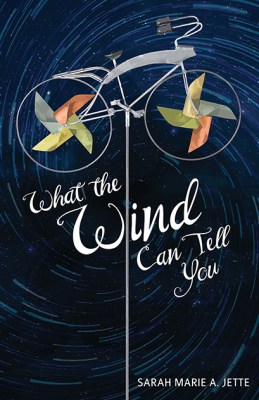
Happy book birthday to What the Wind Can Tell You

(May 15, Islandport Press)

About the book:

In this new middle grade novel by Sarah Marie Aliberti Jette, seventh-grader Isabelle Perez is fascinated by wind. And this year, she’s determined to win the middle school science fair with her wind machine. She’s just as determined to have her brother, Julian, who has a severe form of epilepsy and uses a wheelchair, serve as her assistant. But after Julian has a grand seizure, everything changes.

Isabelle is suddenly granted entry into Las Brisas, a magical world where Julian’s physical limitations disappear, and one, she discovers, that he visits every night. The more Isabelle explores Las Brisas, the more possibilities she sees––for Julian, and for herself––and the more she finds herself at odds with her parents. Debut author Sara Marie A. Jette has told, with remarkable insight, humor, and a touch of magical realism, a powerful story of a family struggling to love without fear.

About the author:

Sarah Marie Jette grew up in Lewiston, Maine, and now lives in Belmont, Massachusetts, but her route from Maine to Massachusetts was anything but a straight line. She got her degree in English and Women’s Studies at Mount Holyoke College, then went halfway around the world to serve in the Peace Corps in Mongolia. She then studied rehabilitation counseling at Boston University’s Sargent College of Rehabilitation before turning to teaching. She now teaches fourth grade at Thompson Elementary School in Arlington, Mass. Somehow, between her students and her own three young children, she finds time to write. “Finding time to write is hard, but necessary,” she says.

  1. How does your heritage affect your writing? Why did you choose to make Isabelle and her family Mexican-American? 

A: When I wrote What the Wind Can Tell You, I made Isabelle Mexican-American because I wanted to write the character I searched for as a child. I spent my childhood searching for characters who looked like me in books. Fairy tale princesses were always ‘fair.’ The books I read described characters with blue eyes and freckles. Whenever I found a character with dark hair or brown eyes, I told myself that they were like me, though, deep inside, I knew that they weren’t. Representation matters—not token characters in the background, but complex and interesting characters from diverse backgrounds that you can fall in love with. I make an effort to fill my classroom library with diverse books. There are more than there used to be, but still not enough.

Q: What was the inspiration for What the Wind Can Tell You?

A: The inspiration for What the Wind Can Tell You was a single lightning bolt. It hit me as I drove home after visiting with friends. I had just held their newborn baby and spent time with the baby’s big brother. On my drive, I imagined the relationship these boys were going to have. I thought about the love between siblings and how special it is. I pulled my car over and wrote my idea down on a paper napkin.

The baby’s big brother has epilepsy, much like my character, Julian. He was diagnosed when he was a few months old. On Sunday mornings, for about two years, I babysat him. I held him, fed him, changed his diapers, soothed him through seizures, and read to him. Sometimes, therapists visited and I learned ways to help him strengthen his muscles or track objects with his eyes. His music therapists were my favorite.

I had been writing for years, but this was the first time I found a story that felt so right. I wrote furiously and completed the first draft in three months. It would be many more years of revising before my story was ready to submit to editors, but my inspiration carried me through.

Q: Do you have any writers or books you most admire and turn to for inspiration? 

A: I admire the writing of Michelle Cuevas. The language in her books is rich and beautiful. She deals with big issues—growing up, identity, and loss—but she is also very playful in her writing. I love reading her books out loud so I can see how my students react to her words. I am also a big fan of Jonathan Auxier. I read his book Peter Nimble and his Fantastic Eyes to my students every year. His stories are unusual, engaging, and a lot of fun.

Best of luck to the brand-new What the Wind Can Tell You