Give Kid Lit Readers a Broad Range with Real Characters


For our first set of posts, each of us will respond to the question: “Why Latin@ Kid Lit?” to address why we created a site dedicated to celebrating books by, for, or about Latin@s.

By Ashley Hope Pérez

Like Stephanie, my personal commitment to Latin@ lit comes from my work with teens. Much of my energy as a high school English teacher in Houston went to finding ways to make reading and writing an authentic, meaningful, and empowering part of my students’ lives.

I spent a lot of time scouring our school library and talking to my reluctant readers about what they wanted in a book. No big surprise: a lot of them wanted a book that reflected their experiences in a way that would ring true. We had plenty of successes, but there were a number of students for whom it seemed that the gateway book—that critical read that would persuade them of all that words can do—was missing.

“I want a book that shows how my life really is,” I heard over and over. “Not just somebody brown, but somebody real,” one student insisted. And, “please, I can’t stand it when they make it seem like if you just get into college, you’ve got it made.” That last bit came from one of my top-performing seniors, an impressive scholar by all accounts but also a young woman who had few illusions about the conflicting demands she would be facing in the coming years.
My students—aware of my aspirations to “one day” write a novel—began to recommend (okay, insist, pester, badger) that I write the book that they were looking for, and they were both my inspiration and the first readers of What Can’t Wait. Similarly, The Knife and the Butterfly began with writing exercises I was using to give a group of freshmen in a summer school English class a way of responding to the news coverage of a deadly gang fight a few miles away. In my third novel (watch for it in 2015 from Carolrhoda Lab), I take my concern with Latin@ experiences in a new direction by bringing them to the history of my native East Texas. I explore Hispanic experiences in the primarily black-and-white world of 1930s East Texas through the story of a school explosion, family secrets, an interracial romance between a Mexican American girl and a black boy, and the pressures created by Texas’s three-fold segregation system (black, white, and “Mexican” schools existed in many places). The third novel is going to be something different from my contemporary fiction, for sure, but it’s still written with my students in mind. I like to think that it’s the kind of book that would persuade my students to think about how past experiences scar the present—and what we do to mark loss and begin healing.

It matters quite a lot to me that Latin@ lit avoid the trap of making an “issue” of ethnicity, as Zoraida pointed out. Ethnicity was a non-issue for my students, not because they lived in such a multicultural world (Zoraida’s experience) but in fact because their world was relatively homogeneous; most of the kids in the Southeast Houston neighborhood where I taught were from working class families with roots in Mexico. Even my students who weren’t bilingual regularly heard Spanish and had strategies for managing the interconnections of Spanish and English in their community.

I don’t include glossaries in my novels, as I discuss here, because my books are first and foremost for my kids—and because I believe in the resourcefulness of other readers who come along. All of that to say: writing for my kids felt urgent back when I started What Can’t Wait, and it still does today. But Latin@s in Kid Lit has a broader mission than featuring Latin@ YA: we’re about highlighting awesomeness by, for, and about Latin@s for kids of all ages, including younger readers.

When I have the chance to talk with librarians or teachers about book selection, I often beg them first to make sure their collection goes well beyond the default “diversity” titles. Book selections for younger children should go beyond portrayals of special holidays, for example. I often caution teachers about resorting too quickly to the “minority celebrity” of the hour when attempting to diversify their reading lists.

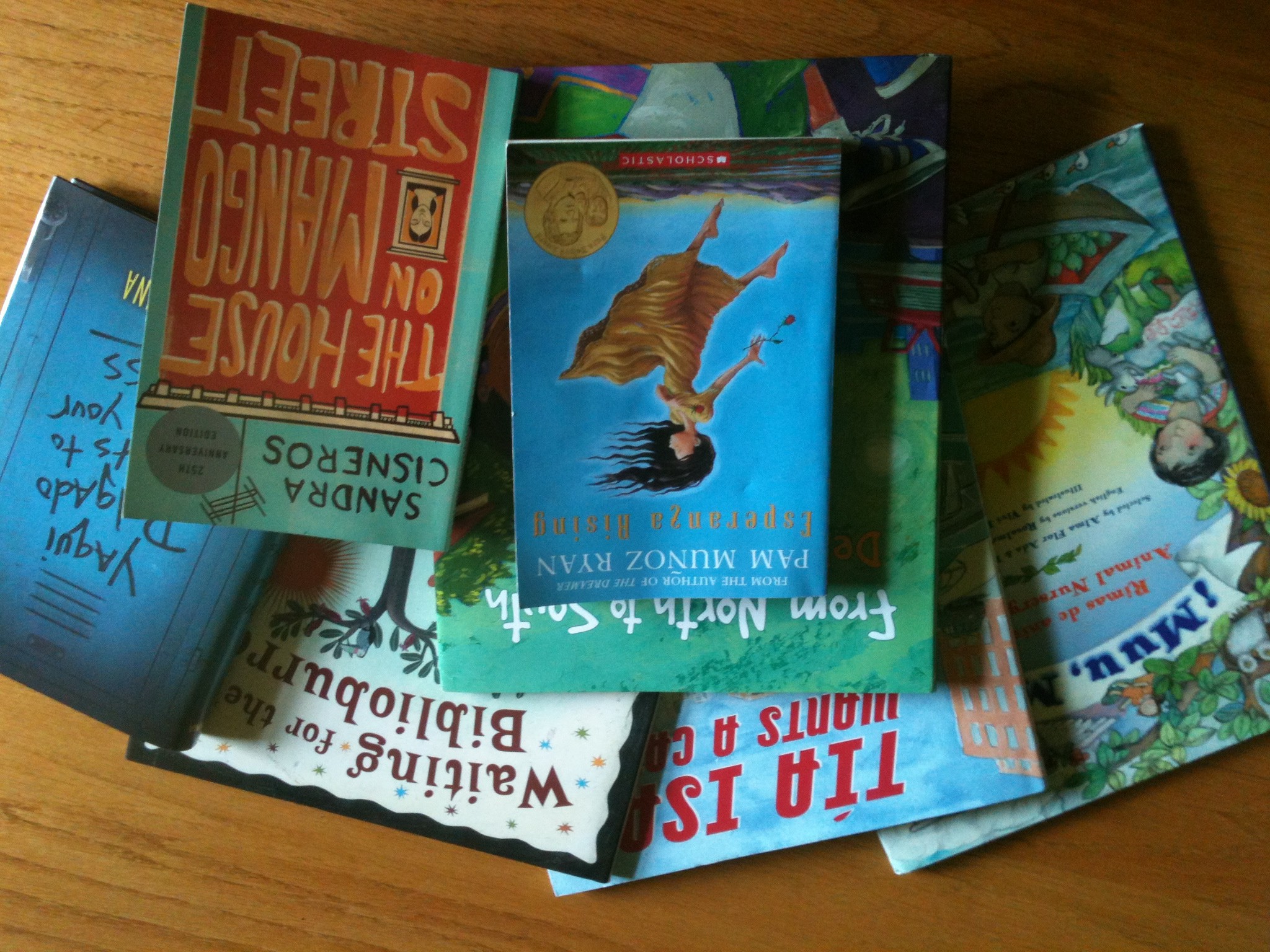
By the time my (mostly Latin@) students reached my senior English class, most of them had read The House on Mango Street—in part or in whole—a half dozen times. That was because Cisneros’ (wonderful!) and widely discussed book had become synonymous with “Latino experience” in the minds of well-meaning teachers who had little additional knowledge of Latin@ lit, and they didn’t look beyond it when making choices for their classrooms.

The absence of a broad selection of diverse titles can reinforce students’ feelings of exclusion and general disengagement from the world of books. By contrast, offering students (whatever their background) a broad range of literature can generate a lot of excitement.

I, for one, am all for excitement! In future posts, I hope to contribute to the conversation by offering my two cents on what’s happening in the world of Latin@ YA and also by highlighting some of my Latin@ kidlit reading adventures with my son, Liam Miguel.

More from me soon!

Ashley

P.S. Since I talk a lot about how I came to focus on Latin@ experiences in my fiction, I’ve cribbed some of this post from a past feature I did at STACKED , another blog that YA fans and librarians should have on their radar.

Writing and Reading Latino/a Kid Lit is for Everyone, Not Just Latin@s


For our first set of posts, each of us will respond to the question: “Why Latin@ Kid Lit?” to address why we created a site dedicated to celebrating books by, for, or about Latin@s.

By Stephanie Guerra

I teach children’s literature at Seattle University, and each quarter, my students discuss issues of voice and agency in children’s literature. We take up questions such as: What constitutes authenticity in multicultural children’s literature? Who has the “right” to write from various cultural, racial, gender, or ethnic perspectives? It’s wonderful and fascinating to see the debates that arise. Some of my students argue that for literature to be “authentic,” authors should be insiders of the groups they’re portraying. Others feel that intermarriage or long-term residency within a given group is adequate. Still others believe that fiction should be judged on its own merits, apart from the qualifications or attributes of the author.

by Stephanie Guerra

by Stephanie Guerra

I’m in the “fiction should be judged on its own merits” category, and my first novel (TORN, 2012), is written from the perspective of a biracial Latina teen. I’m not Latina. I married into this last name, which migrated from Spain to Italy so many centuries ago that the Guerra family (my husband’s) identifies as Italian. I am of Italian, Irish, Croatian, and German descent. I chose to attempt a Latina character in honor of a dear friend who expressed to me some of the complexities of her biracial identity.

While each reader must be his or her own judge of whether I captured the biracial experience, the writing itself was a joy, and many teens have expressed that the book meant something to them. In crafting characters from other cultural, ethnic, and racial groups, I believe we’re called to expand our understanding and love of the people we’re trying to depict. It worked this way for me. So this is half of my answer to Why Latin@ Kid Lit?: because I believe writing it and reading it is for everyone, not just Latin@s.

The second reason I care to promote Latin@ Kid Lit is because of my work with incarcerated teens. My academic research is focused on building literacy with at-risk teens, and I’ve encountered study after study demonstrating that readers need the chance to “see themselves” in at least some of the books they read.

I teach creative writing at a juvenile correctional facility, and my students are largely black, white, and Latin@. They respond enthusiastically to fiction about Latin@ characters and culture, and I would love to find more of this material, especially books which are accessible, fast-paced, and of high literary quality. In particular, I’d like to see more Latin@ fiction that falls outside the street lit category. (Street lit, also called urban lit, gangsta lit, and hip-hop lit, is edgy fiction set in urban neighborhoods and featuring gritty topics like drug use, prostitution, gangs, etc.)

In this blog, I hope to provide resources for the many teachers and librarians serving Latin@ teens. I especially want to speak to non-Latin@ adults. I know how it feels to be a cultural outsider teaching cultural insiders. It’s easy to feel awkward or presumptuous discussing racial and cultural issues with students of color, but I don’t think it’s the best way to serve our students. We can and should connect with them on this issue, especially if they indicate a desire to do so. We should work to find literature that speaks to them, and we should find ways to talk about that literature—or to listen respectfully. Latin@ kid lit is a gift we can give children, teens, and ourselves.

Future of Latino/a Lit Is Being Written Now

For our first set of posts, each of us will respond to the question: “Why Latin@ Kid Lit?” to address why we created a site dedicated to celebrating books by, for, or about Latin@s.

By Zoraida Córdova

Why Latin@ Kid Lit?

Well, why not?

Growing up in Hollis, Queens, I never thought of myself as a minority. Personally, I think that word is crap. Are we minor things? Less-than things? Not at all, but this is what they (the proverbial they) call it.

I had my friends, some fourth-generation Irish, some Filipino immigrants, some Guyanese, Jamaican, Mexican, Mexican-Haitian, and the list goes on and on. But this is NYC and diversity is not foreign to us.

This same diversity was not reflected in the television I watched or books I read. My favorite shows were Charmed, Buffy the Vampire Slayer, and Dawson’s Creek. My favorite books were by Sarah Dessen. I was a freshman in high school and I had encountered zero characters who look like me, as I recently noted over at Diversity in YA.

The House on Mango StreetI’d like to think that Latino Lit has come in waves. First, THE HOUSE ON MANGO STREET by Sandra Cisneros and HOW THE GARCIA GIRLS LOST THEIR ACCENTS by Julia Alvarez, and while those stories are still relevant, they might not pertain to the kids who have already assimilated. I moved to New York when I was six; this Fall I will be celebrating 20 years here. While I most definitely know where I come from, my identity very much belongs to New York.

I want to see myself in the books I read.

Junot Diaz says, “Every single immigrant we have, undocumented or documented, is a future American. That’s just the truth of it.” And he’s 100% right. The future of Latin@ Lit is being written right now. I believe that not every book with a Hispanic or Latin@ character has to be an “issue” book. Not all of us have issues with our heritage. We just are.

Some good examples of this are GOING BOVINE by Libbra Bray,  SEAN GRISWOLD’S HEAD by Lindsay Leavitt,  and YAQUI DELGADO WANTS TO KICK YOUR ASS by Meg Medina. Each of these novels has Latin@ characters, but the story is not centered on being Latin@.

Going BovineSean Griswold's HeadYaqui Delgado Wants to Kick Your Ass

In GOING BOVINE, Paul Ignacio “Gonzo” Gonzales is a video-game-playing hypochondriac who has an overbearing Mexican mother. He’s dealing with lots of issues, but being Latino doesn’t seem to be one of them. The MC in SEAN GRISWOLD’S HEAD, Payton Gritas, is half-Colombian. Hers is a story of family and first love. Along the way, her ethnicity is mentioned, but it’s not the center of the narrative. In Medina’s novel, the MC is a Cuban-American–the new girl in school who is bullied by another Latina. Of course, the story includes plenty of background and action that touches upon Latin@ culture, but the central issue is not about racial or ethnic discovery.

We need stories that are as diverse as the Latin@ community, stories about Latin@s like me who are as American as they are Latin@. This is one of the things I want to explore in this blog with wonderful writers and readers like yourself.

Happy reading,

Zoraida

(Zor-eye-duh)

Welcome to Latinos/as in Kid Lit

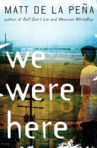
We Were HereLuis was a high school freshman who hadn’t read a novel independently for so long he couldn’t remember the title or year it happened. During the first semester of high school Reading, Luis read We Were Here by Matt de la Peña in anticipation of an author visit. After the visit, Luis asked for “another book like this one,” which was his way of saying, “a book written recently that doesn’t bore me and has characters who look, talk, and act like me.”

With the help of enthusiastic teachers and librarians, Luis read more books “like that one.” It took just one story that spoke to his identity as a Hispanic male to begin his engagement with literature.

Luis’s story is borne out by research. When youths “see” themselves in terms of race, culture, and lived experiences in the literature they read, they benefit academically, personally, and socially (Bishop, 1992; Diamond & Moore, 1995; Mason & Au, 1991). More broadly, culturally responsive teaching or “using the cultural knowledge, prior experiences, frames of reference, and performance styles of ethnically diverse students to make learning encounters more relevant to them” (Gay, 2000, p. 29) results in increased student engagement and positive gains in achievement (Chapman, 1994; Foster, 1995; Hollins, 1996; Krater, Zeni, & Cason, 1994; Ladson-Billings, 1994, 1995a, 1995b; Sheets, 1995).

Luis, and others like him, stand to gain a great deal from reading books that speak to their cultural identities. Sometimes a love for reading is kick-started by a single book with a main character who faces the same issues the reader does or lives in a place like the reader’s own neighborhood. This is true for all of us. We connect with stories for varied reasons, including the simple one that something in the narrative is familiar.

The statistics in publishing, however, have been against teens and children like Luis, who specifically want to read books that feature ethnic or racial minorities. Recent news stories have highlighted the fact that minority children in the United States don’t often see themselves reflected in books. Also, a study by the Cooperative Children’s Book Center reported the number of children’s books with multicultural content has not increased in 18 years. (See also this post by Lee & Low Books about the study.)

So, why focus on Latin@ Lit? Because 53 million Hispanics live in the U.S. according to the 2012 census. Hispanics are the second largest race or ethnic group (behind non-Hispanic whites), representing about 17 percent of the total population. Everyone–not just Latin@s–should be able to read books with characters that represent our diverse population.

While several excellent resources for Latin@ Literature exist online, we had yet to find a site that was dedicated to Latin@ children’s literature and created by Kid Lit writers.

So, here we are!  Welcome to Latin@s in Kid Lit!

We’re launching our site at the start of National Hispanic Heritage Month to underscore our mission to provide a closer, more sustained sense of what’s happening in Latin@ children’s literature.

Our vision is to:

  • engage with works about, for, and/or by Latin@s;

  • offer a broad forum on Latin@ children’s, MG, and YA books;

  • promote literacy and the love of books within the Latin@ community;

  • examine the historical and contemporary state of Latin@ characters;

  • encourage interest in Latin@ children’s, MG, and YA literature among non-Latin@ readers;

  • share perspectives and resources that can be of use to writers, authors, illustrators, librarians, parents, teachers, scholars, and other stakeholders in literacy and publishing.

On this site, you’ll find:

  • posts about Latin@s in children’s literature;

  • book lists. This is a work in progress. Please send us titles that should be included. We are looking for books by Latin@ writers in any genre and books by non-Latin@ writers with Latin@ characters, settings, etc.;

  • book talks, where we’ll highlight books we’re reading and explain why you should be reading them, too;

  • interviews with writers and illustrators about their creative journeys;

  • interviews with agents and editors about the publishing process;

  • teaching ideas;

  • articles and news links aimed at writers and others involved in literacy and publishing;

  • guest posts. Please write to us if you have an idea for a post.

Like you, we’re passionate about serving a burgeoning community of young readers. That’s why we want to offer this as a welcoming space where you can share your ideas, too. We believe that Latin@ children’s literature is for everybody. We hope you’ll follow us and explore the ways it can enrich young people’s lives.

¡Bienvenidos!

Books1

We don’t want to overwhelm you with research, but if you’re interested in learning more about the ways multicultural literature benefits young readers, the following books and studies are a good place to start.

Brozo, W. (2002). To be a boy, to be a reader: Engaging teen and preteen boys in active literacy. Newark, DE: International Reading Association

Deci, E., Vallerand, R., Pelletier, L., & Ryan, R. (1991). Motivation and education: The self-determination perspective. Educational Psychologist, 26(34), 325-346.

Diamond, B.J., & Moore, M.A. (1995). Multicultural literacy: Mirroring the reality of the classroom. New York: Longman.

Gay, G. (2000). Culturally responsive teaching: Research, theory and practice. New York: Teachers College Press.

Guerra, S. (2012). Using Urban Fiction to Engage At-Risk and Incarcerated Youth in Literacy Instruction, Journal of Adolescent and Adult Literacy (55)5, p 385-394.

Hill, M.L., Pérez, B., & Irby, D.J. (2008). Street fiction: What is it and what does it mean for English teachers? English Journal, 97(3), 76–82.

Hughes-Hassel, S., & Pradnya, R. (2007). The leisure reading habits of urban adolescents. Journal of Adolescent & Adult Literacy, 51(1), 22

Ladson-Billings, G. (1995a). But that’s just good teaching! The case for culturally relevant pedagogy. Theory Into Practice, 34(3), 159-165.

Ladson-Billings, G. (1995b). Toward a theory of culturally relevant pedagogy. American Educational Research Journal, 32(3), 465-491.

Morris, V., Hughes-Hassell, S., Agosto, D., & Cottman, D. (2006). Street lit: Emptying teen fiction bookshelves in Philadelphia public libraries. YALS: Young Adult Library Services, 5(1), 16-23.