Author Angela Cervantes On Publishing & Her Animal-Loving Latina Protagonist

By Cindy L. Rodriguez

Today, we are thrilled to have a Q&A with author Angela Cervantes, who talks about her debut novel, Gaby, Lost and Found (Scholastic), her advice for pre-published writers, and a little about how she crafted a wonderful middle grade novel that’s both funny and heartbreaking. Angela is also super generous and is offering a signed book, a poster, and a T-shirt to one lucky winner. Click on the Rafflecopter link here or at the end of the post to enter!

Gaby Lost and FoundCR: Since this is your debut novel, can you tell us about your publishing journey. Were there any things you did in particular that, in hindsight, you think were particularly helpful as you pursued an agent and book deal? What advice would you give to pre-published writers?

AC: My middle grade novel, Gaby, Lost and Found has been out almost 10 months now, and I’m still learning things about myself and the publishing journey. In the beginning, when I was a simple wanna-be-Kid Lit author with a manuscript, the idea of facing the publishing industry was scary.If you had met me then, I would have told you that I’d rather pick up a hitchhiker with face tattoos than have to face the world of slush piles and soul-less rejection letters.

Eventually, I realized that if I loved my book enough, I had to be willing to take on rejection. After all, the worst things they can do to you is ignore you completely or reject your work. Tough, but big deal. Every writer in the history of the written world has received a rejection or been passed up at some point, right? If they rejected my work, I was in good company.

I could go on and on with advice for pre-published writers. Never pick up hitchhikers with face tattoos! Really, I’ve learned so much. First, I would start with the very basic: If you’re going to go the traditional publishing route, like I did, then you must finish that manuscript. You have to show the agent something fast when they ask for a partial or full manuscript. My second advice is to take that completed manuscript to a writing critique group. Feedback is crucial. I belong to a critique group called the Firehouse Five (although we are six now) and we meet monthly to provide critique to each other’s work. It’s priceless. My final advice, take your writing-group-critiqued and completed manuscript to a local writers’ conference and sign up for a pitch or first pages sessions with an agent. I met my agent through a writer’s conference. She liked my pitch, but made it very clear there was plenty of work to be done on my manuscript before she’d offer representation. I did the work and I was signed. With her guidance, I made more revisions and it was sent off for submission. Soon, the first rejection arrived. It didn’t kill me. A week or so later, I received an offer for my first novel. Yay!
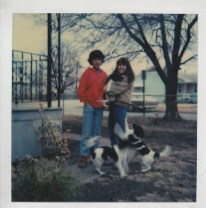
Angela C and brother

From her website: Angela, age 10, with her brother Enrique and their dogs, which were the inspiration for Spike in the novel.

CR: I love how you mixed Gaby’s story with the animals’ stories, how they were both in new situations and looking for new homes. How did you get the idea to address the subject of immigration for a MG audience, using homeless animals as a link to Gaby’s situation?

Thanks, I’m glad you enjoyed it. I really didn’t start with the idea to address the subject of immigration. I’m character-driven in my writing so I started with just Gaby, a funny, smart, and brave girl who is also a serious animal lover like her mom. I think if I had started out subject-driven with the intention to write a book on the issue of immigration, it would have been a much different novel. It would have come across as more lecturing and I don’t like to lecture or be on the receiving end of a lecture. No thank you. And kids don’t want to be lectured to either. At school visits, kids always ask me about deportation, but more in the context of why or how this happened to Gaby. They always tell me that they want Gaby and her mom to be together. They’re invested in Gaby’s happiness. It’s precious.

CR: Even though Gaby is dealing with the serious issue of her mother being away, she is also a “typical” MG girl, laughing and doing silly things with her male and female friends. Was this a conscious decision on your part, to show a range of emotions and not have it be an “issue” book or overly depressing?

AC: It’s funny that you ask that because my original drafts were even more depressing! I pulled a lot out during the revision process because the story was going in all sorts of directions. What got me back on track was again focusing on Gaby and who she was and not what she was going through. Gaby is an eleven year old girl. She loves animals. She loves glitter. She can climb trees and beat the boys at a water balloon fight. Would Gaby be defeated by bullying at school, the loss of her mom, the neglect of her father, and poverty? Or would this young girl rise up, even if she responds with some missteps, and show us what she’s made of? For me that was the only conscious decision on my part in writing this novel. I had to be true to Gaby and not define her by what she was going through, but show where she was going.

CR: Are you an animal lover? Did you have to do any particular research about animal shelters or spend time at one to capture what happens there?

AC: Besides my many years of experience as an animal lover and pet owner, I did visit several local animal shelters for information and inspiration. At the animal shelters, I asked tons of questions, held a lot of cats, wrote a lot of notes and pet a lot of dogs for this book. Why can’t all research be that much fun?

CR: What are you working on now? Can you share what’s next for you?

AC: Sure! I’ve completed my second middle-grade novel and I am now in the throes of revision. Fun stuff! Wish me luck.
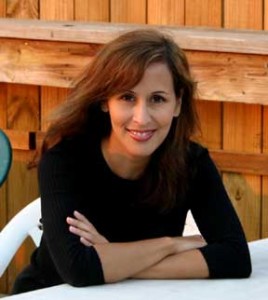
Angela Cervantes

Angela Cervantes was born and raised in Kansas, with most of her childhood spent in Topeka in the Mexican-American community of Oakland. Angela has a degree in English and an MBA, and she is the co-founder of Las Poetas, a Chicana poetry group that has developed into the Latino Writers Collective. In 2005, her short story, “Pork Chop Sandwiches,” was published in Chicken Soup for the Latino Soul. In  2007, she won third place for Creative Nonfiction in the Missouri Review’s audio competition for her story “House of Women” and Kansas City Voices’ Best of Prose Award for her short story, “Ten Hail Marys.” In 2008, she was recognized as one of Kansas City’s Emerging Writers by the Kansas City Star Magazine.

Gaby, Lost and Found is her first novel.

Click HERE to enter the giveaway. One winner will receive a signed copy of Gaby, Lost and Found, a poster, and a T-shirt. You can enter for free once each day. A winner will be chosen on Saturday, 5/24/14. Good luck!!
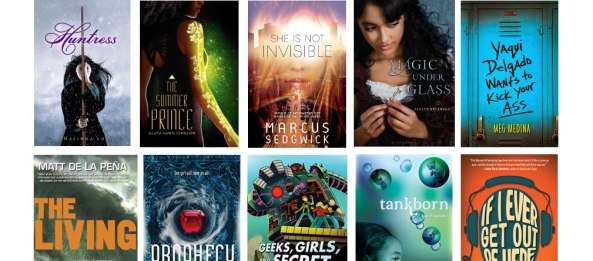
Let’s All Make the #WeNeedDiverseBooks Campaign an Ongoing Movement

By Patrick Flores-Scott

#WeNeedDiverseBooks. The trending hashtag is a channel for conversation around the huge problem of a lack of diversity in children’s literature. The problem has been noted in many recent articles and so have the reasons we need more books by diverse authors and books with complex, real diverse characters.

For many years I was lucky to be a public school teacher in very diverse schools. At different points I was both a general education classroom teacher and a reading specialist. As a classroom teacher, I was able to seek and find the books I wanted my class to hear and read. More often than not, these books had main characters of color. I had the time, energy, resources, and relationships that helped me find great books that my students loved.

My students, however, especially my reluctant readers, were not going to work so hard to find a book that would reflect the cultural, racial, socio-economic realities of their community. They were going to pick the available book, the one closest to their hand when it was time to leave the library, or the trendy book that made them look like they were in the reading “know.”

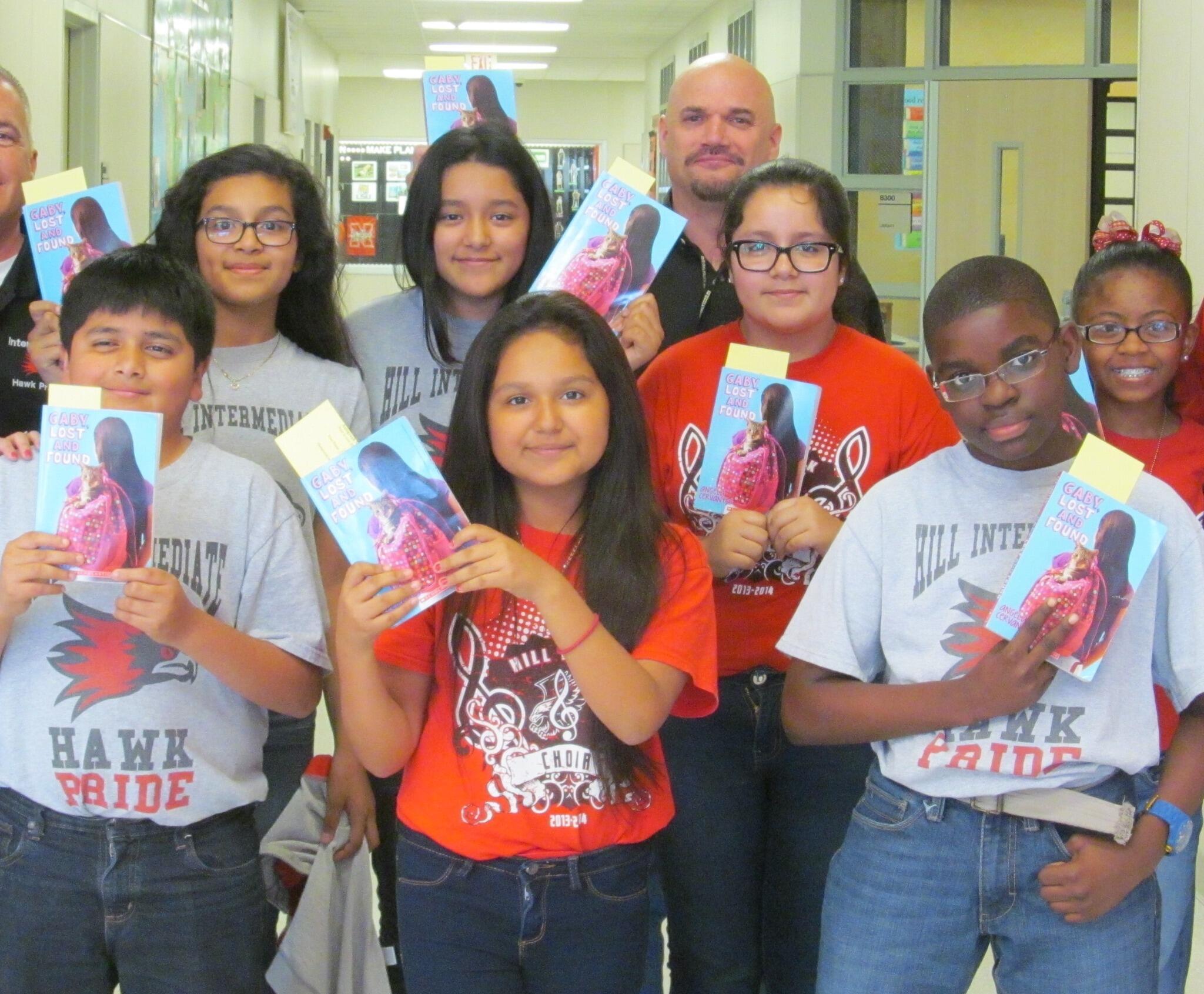
Embedded image permalink

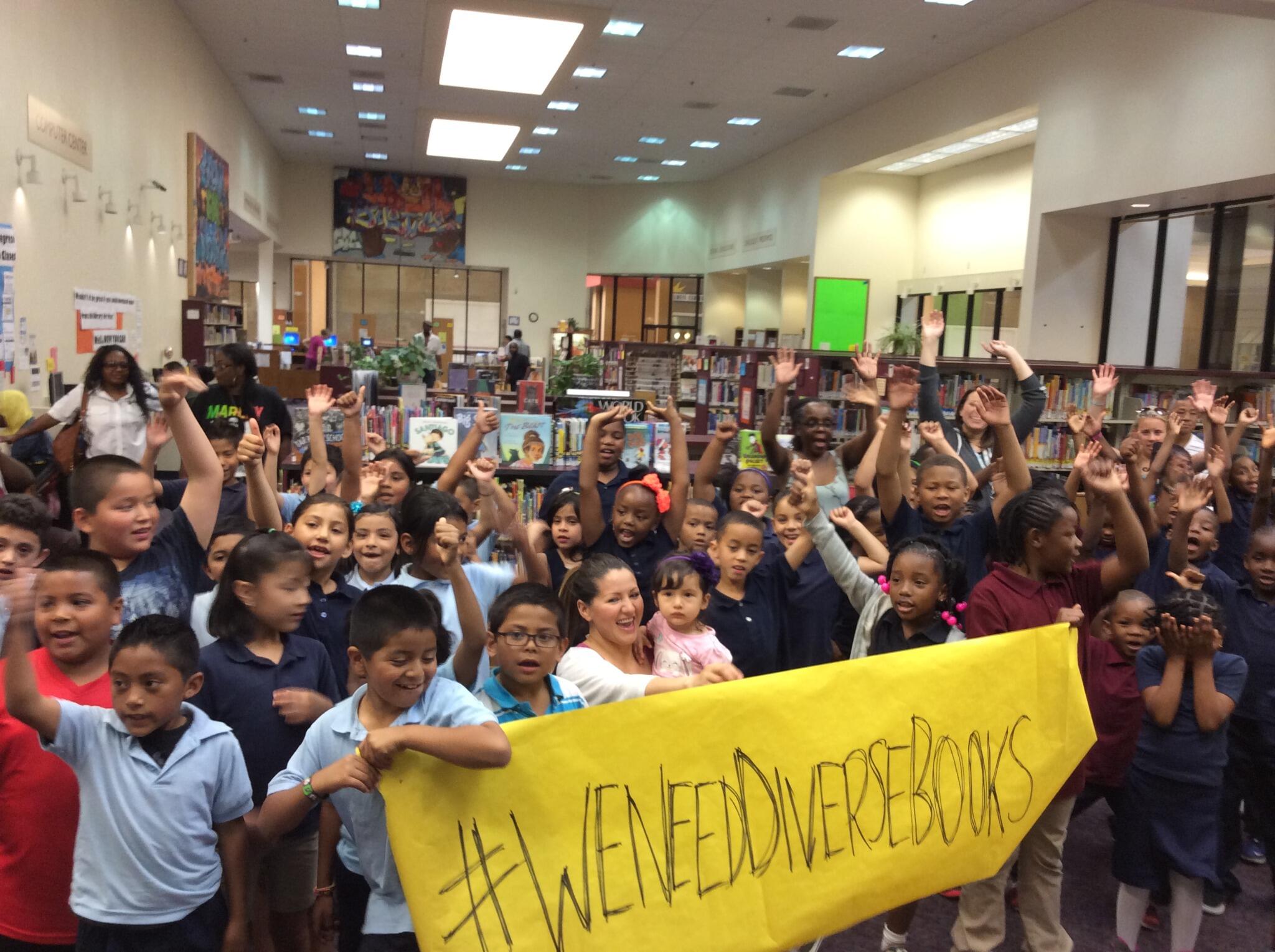
Author Angela Cervantes posted this picture on Twitter during the #WeNeedDiverseBooks Campaign.

Students need to be able to accidentally stumble their way into a great book that reflects their own background or one that opens their eyes to new characters and communities. They shouldn’t have to work for it. They shouldn’t have to fight for it. Kids have enough on their plate. Yes, some students are going to research authors, seek out new books and reading experiences, challenge their school librarian and make demands. Most fifth graders, however, are just struggling to make it through the day. They end up with the default book… and given the math of the situation, they’re going to walk out with another book by a white author with a white main character. Is this a tragedy? In the moment, no. That default book might be a great one. But this scene takes place over and over each day in most schools in the country and that great book–if the student is lucky–may just be another in a long line of books that reinforces the notion that great books are written by white authors and that white kids are the ones worthy of books written about them.  This notion is a toxic one, regardless of a student’s background.

Children’s books are a piece of a larger pie. A lack of diversity in film and television reinforces the notion that white stories are more relevant than non-white stories. The make-up the Senate (97 out 0f 100 are white) reinforces the notion that non-whites do not have a role in the highest levels of politics. Yes, there is the President, but his cabinet is made up of 70% white males. Kids see this. They see thousands of African American college athletes and they know that, in the vast majority of cases, these athletes are led to battle by white coaches. They know that the percentages of Black and Latino men in prison are crazily out of proportion with the population of Black and Latino men. Kids see all this. They take it in. The perceptions become realities for them.

My wife and I are the proud, exhausted parents of two rambunctious little boys. Their grandparents are Mexican-American on their mom’s side. My parents are white. My dad is from the U.S., my mom a Spanish-speaking Latina from South America. We will raise our boys to be proud of all that they are and proud of all the Latino, Caucasian, African-American, Asian and mixes of the aforementioned that make up their diverse extended family. While we will do our best to teach that the content of one’s character, not the color of one’s skin (one’s gender, sexual orientation, physical ability) is what is important, television, our political and judicial systems, sports…. And even the make-up of CHILDREN’S BOOKS, will send messages that complicate, skew, and even deem our parental message well-meaning, but just wrong.

Embedded image permalink

The Oakland Public Library in California posted lots of great pictures like this one on Twitter during the #WeNeedDiverseBooks Campaign.

What do we do about it? The #WeNeedDiverseBooks Movement (Can it please be a movement? We need more movements around here.) is a potentially very important call for change in the children’s book world. Now, we need to push for intentionality. Gatekeepers need to have their feet held to the fire. The Movement (!) needs to push publishers to set goals that trend their books in a more realistically diverse direction. It needs to push the industry to hire editors from diverse backgrounds and to hire and support diverse interns and entry-level assistants who can have the power to move books off the pile and into editors’ hands. The Movement needs to hold publishers accountable.

Institutions which support writers and illustrators, like my beloved SCBWI, need to recruit underrepresented writers to their conferences. (And to check out the percentage of white male panelists and speakers compared to the percentage of white male attendees.) Groups like SCBWI need to be pushed to intentionally foster and mentor a more diverse writing community.

The movement needs to push us published authors of all colors and stripes, to mentor diverse up-and-comers, to include pro-bono school visits to underfunded schools, and to write real, complex, fallible diverse characters who live the entirety of the American experience.

Members of The Movement need to request diverse books at their bookstores and libraries. We need to post reviews on Amazon and Goodreads and library websites. Members of the Movement need to advise book bloggers and to follow and support blogs like this one. We need to give diverse books as birthday presents and to talk about our favorites on the bus, at work, in line at the bookstore…

Members of The Movement need to push our political leaders to support the health, education and welfare of our future readers and writers.

Publishers, agents, bookstore workers, librarians, teachers, authors… there are bunches these folks out there doing the positive stuff that will make change possible. The Movement needs to support them and it needs to push for intentionality in those who mean well, but have not yet made the move to change.

PatrickFS1Patrick Flores-Scott was, until recently, a long-time public school teacher in Seattle, Washington. He’s now a stay-at-home dad and early morning writer in Ann Arbor, Michigan. Patrick’s first novel, Jumped In, has been named to a YALSA 2014 Best Fiction for Young Adults book, an NCSS/CBC Notable Book for the Social Studies and a Bank Street College Best Book of 2014. He is currently working on his second book, American Road Trip.

Jumped In was featured in Libros Latin@s on Thursday. Click here to see the overview.


Guest Post: CAKE Literary on Writing Diversity, Finding Your Flavor

By Sona Charaipotra

Have you ever cried in class? I have. And no, I’m not talking about kindergarten. I’m in my 30s, and yes, I shed actual tears during a workshop during my writing for children creative writing MFA program at the New School two years ago.

No, it wasn’t a particularly harsh critique. I have to say, I have an incredibly thick skin. Most of the time.

But this particular workshop was a safe space. Taught by the stunningly smart and super-nurturing Andrea Davis Pinkney, this one focused on a topic too frequently neglected by both the academy and publishing: diversity. Specifically, we were talking about diversity in kidlit and YA, and addressing why it is important.

And though it’s been a long time since I was a kid or even a teenager, the wound was still fresh. Because we still haven’t gotten there.

Growing up as a little brown girl – one of the few, back then – in small-town, suburban central New Jersey, books were my escape. I caused a ruckus alongside little Anne in Avonlea; I mourned Beth along with her sisters in the harsh winter of Maine; I honed my grand ambitions like Kristy and her babysitters’ club; I even swooned alongside Elena over the brothers Salvatore when the Vampire Diaries was originally released. (Yes, I am that old.)

CAKE logo+2.7.12But if you’ll note: in all those books and the hundreds of others I devoured, I never really saw myself, or anyone remotely like me. The majority of characters in books for kids and teens in the ’80s and ’90s were white. And according to Christopher Myers in his recent New York Times piece, “The Apartheid of Children’s Literature,” the majority still are today, by quite a landslide.

Why is this worth discussing? Because it hurts. A lot. It’s a hit to a kid’s self-esteem to be told – silently, but oh so clearly – that their story is not worth telling, that their voice is not important.

As Myers notes in his piece, it leaves you with “a gap in the much-written-about sense of self-love that comes from recognizing oneself in a text, from the understanding that your life and lives of people like you are worthy of being told, thought about, discussed and even celebrated.”

Honestly, it’s a punch to the gut. It kills me that, 30 years later, kids are still feeling this way. That my daughter, all of four now and already shaping up to be a voracious reader, will still feel that pinch.

That’s why I cried that day in class. And that’s why, with my writing partner Dhonielle Clayton, whom I met on the first day of my MFA program, I co-founded CAKE Literary, a literary development company that focuses on high concept fiction with a strong commitment to diversity.

I know what you’re thinking: silly thing to bank a personal fortune (however small) on, right? We all know diversity doesn’t sell.

Well, Dhonielle and I would like to call bullshit on that. Done the right way, diversity can bring a richness and flavor to any manuscript. After all, so much about a great read is in the details – the scent and sizzle of freshly-fried samosas wafting up from her mama’s kitchen, the ferocious whip of the wind on an icy February morning, the ashy knees she keeps hidden under too-long skirts, the blush that climbs up her throat and to her cheeks when she flirts with her crush for the first time. The details give texture and color, a sense of time and place and, most importantly, character. The details define worldview and fill out voice.

But the main thing is the big picture – and what our company will do is focus on BIG pictures. Smart, sophisticated storytelling that’s full of flavor – books where the diversity is a major part of the character, but not the central focus of the character.

Case in point: our debut novel, Tiny Pretty Things, which is due next summer. Set in a cutthroat New York City ballet academy, the book centers on three characters, one white, one black, and one half-Korean. And while their backgrounds definitely inform the characters’ worldviews and experiences, the book is not about skin color. It has a plot – a juicy, riveting and ultimately relatable story that we’re hoping will leave readers wanting more.

That’s what we’ll do with each of our projects: tell a fun, delicious story that readers want to read, but incorporate real-life flavor – meaningful diversity – in a natural, relevant way. We’re all about keeping it real, so part of our mission will be to connect vibrant, authentic voices with the stories we’re crafting.

What exactly does CAKE do? We’re not an agency or publisher, but rather a book packager – a YA and middle grade think tank of sorts. We come up with sharp multimedia concepts that we then develop into a detailed outline. Once the idea is fleshed out, we hire a writer to work with us on several chapters or a complete manuscript, which we then package to take to publishers. Once the project sells, the writer stays on board to complete the project. Some book packagers get a bad rap for being notoriously stingy. But CAKE’s aim is to be very writer friendly, because, after all, we’re writers, too. So when we work with a writer on a project, they get paid a flat fee on signing, on delivery, and then, when the project sells, they get a cut of those proceeds as well. The other thing that sets CAKE apart is our commitment to diversity, which is an integral part of every CAKE project.

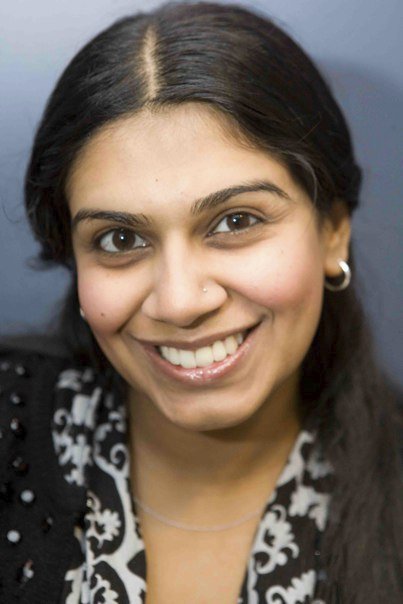
Dhonielle Clayton

Dhonielle Clayton

Sona Charaipotra

Sona Charaipotra

Interested in learning more? We’ll be looking to hire writers beginning this spring, so connect with us on CAKELiterary.com or via CakeLiterarySubmissions@gmail.com. You can also follow us on Twitter @CAKELiterary.


What We Talk About When We Talk About Diversity in YA

Or, what does that even mean?


By Zoraida Córdova

Brace yourselves. Here’s another blog post on the lack of diversity in YA. When we bring up these topics the common words I see are FEAR, UNCOMFORTABLE, GUILT.  If a white person brings up the subject then, “who are they to talk about it?” If a POC does it, we’ll be seen as a bunch of angry people. So, Catch 22. I get it. Writing these posts is HARD, but they should be written. Recently one of my favorite authors ever, Jenny Han, tweeted about diversity in YA. The thing is, we need to feel uncomfortable, and like Jenny said, “that’s the risk.”

Screenshot 2014-03-26 16.39.47

ecsaHere’s what you need to know about me. I was born in Ecuador. I moved to Queens, NY when I was 6. Being in America for 20 years makes me American. My public school experience is American. Yet, when people look at me and hear me speak, they are perplexed. Why? You got me.  The “Your English is so good!” “What are you?” “My friend is from Ecuador, do you know LUIS PABLO ESTEBAN SANTIAGO?” Spoiler alert: I don’t.

This difference wasn’t apparent to me from the beginning. Between grades 1-4, I was in bilingual classes. (My Little Mermaid Spanish didn’t get me to the top of the class right away.) All of my classmates had either emigrated from a Latin American country or had Latin American parents. Salvadorian, Peruvian, Puerto Rican, you name it. Guess what, we spoke English. We listened to the Spice Girls. We cut up our bangs like Lindsay Lohan in The Parent Trap. We watched TRL and taped the music videos. We learned the awesome moves to Christina Aguilera’s Genie in a Bottle (She’s half Ecuadorian, BTW). At home, sometimes I’d eat Chef Boyardi ravioli, sometimes I’d have rice and steak and beans.

So when I got to 5th grade, I was placed into the “regular” kids class. English only. Suddenly my friends also included Guyanese, Jamaican, African-American. Guess what, we still listened to shitty New photo 4 (1)Millennium pop and idolized Harriet the Spy.
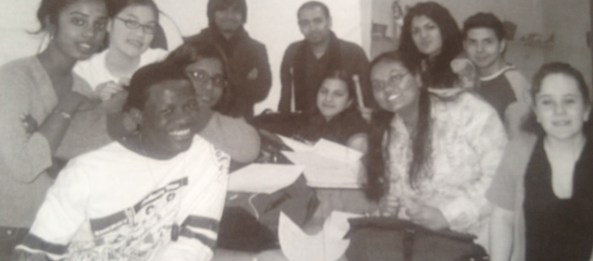
Junior high school and high school were also the same thing. Look at all the shades of brownness! Here are some pictures from my high school yearbook. Spoiler alert: I am still a nerd.

My experience growing up in neighborhoods that are already diverse gives me a different perspective. Could I have used more diverse characters in my current books? Yes. My trilogy centers around a white merman from Brooklyn. His love interest is mixed. His friends are mixed. Merpeople in my world come in all shades. But the answer is still yes. You can always add diverse characters into your books.

photo 3 (1)When people say they’re “afraid” they’re not going to give their “Other” character justice by writing from an experience other than an Anglo-American experience, I call bull. It is scary writing about an experience other than yours. However, unless your character has just moved to Kentucky from a remote town in Panama, then why are you afraid to write the experience of an otherwise straightforward character? Your character can still be named Danilo Cordova and the only research you have to do is “What does a teenage boy like?”

If your character is Nuyorican, then you’d have to do more research. Stereotypes need not apply. Because, here’s a little known secret, not all Latin experiences are the same. No matter where we were born, when we immigrated, where we were raised, we can’t be lumped into the same experience. This is not to say that every YA author should write a novel about how hard it is to grow up being brown, because I did it and my adolescence was pretty “average.”

If you’re writing a fantasy/sci-fi novel and there is not a single non-white person to be found, then my only question is “how come?” Here you have a chance to create a whole new world, where our carefully constructed American ideal of white-only beauty need not apply. When I read YA fantasy novels and the only time race is mentioned is when a new character comes in and has “chocolate” or “earth colored” skin, I just cringe. This mean everyone else I’ve been reading about is white. Not only is that lazy writing, it’s a limited way of thinking about a world that is supposed to be fantastical.

Screenshot 2014-03-26 17.01.57

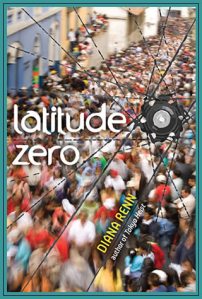
So how do we fix this? Well, lets talk about it. Let’s be friends. Reach out to someone who has a different experience as you. READ. I  to this date have yet to read a YA about a teenage Ecuadorian girl. Not even a slice of life story about a girl who falls in love and there’s a nice cover of them at the beach, or lying down on a lawn. I am, however, excited about Diana Renn’s upcoming YA thriller Latitude ZeroThe book takes place in Boston and in Ecuador. Diana is not Ecuadorian, but she wrote an exciting novel with diverse characters. She reached out and did her research. latitudecover

Here we go back to this FEAR concept. If you throw in a character named Chiquita Bonita in the middle of the scene, and she has hoop earrings and says “Ay, mami,” then you should be afraid because you’re propagating a stereotype. If you describe your Latina girl as “exotic,” “curvaceous,” “spicy,” or “saucy” then you are propagating a stereotype, or making gumbo IDK. If you’re like Britney Spears and equate a Latin male with “the bad boy type,” then you should be afraid because you’re propagating a stereotype. If you as an author can go on Google and research “how to kill someone and get away with it” because “your protagonist needs to know” then you can also try Googling about other American communities that are not your own.

There is a difference between being afraid to write about a culture that is not your own, and consciously creating a two dimensional stereotypical character.

Romeo and Juliet0001

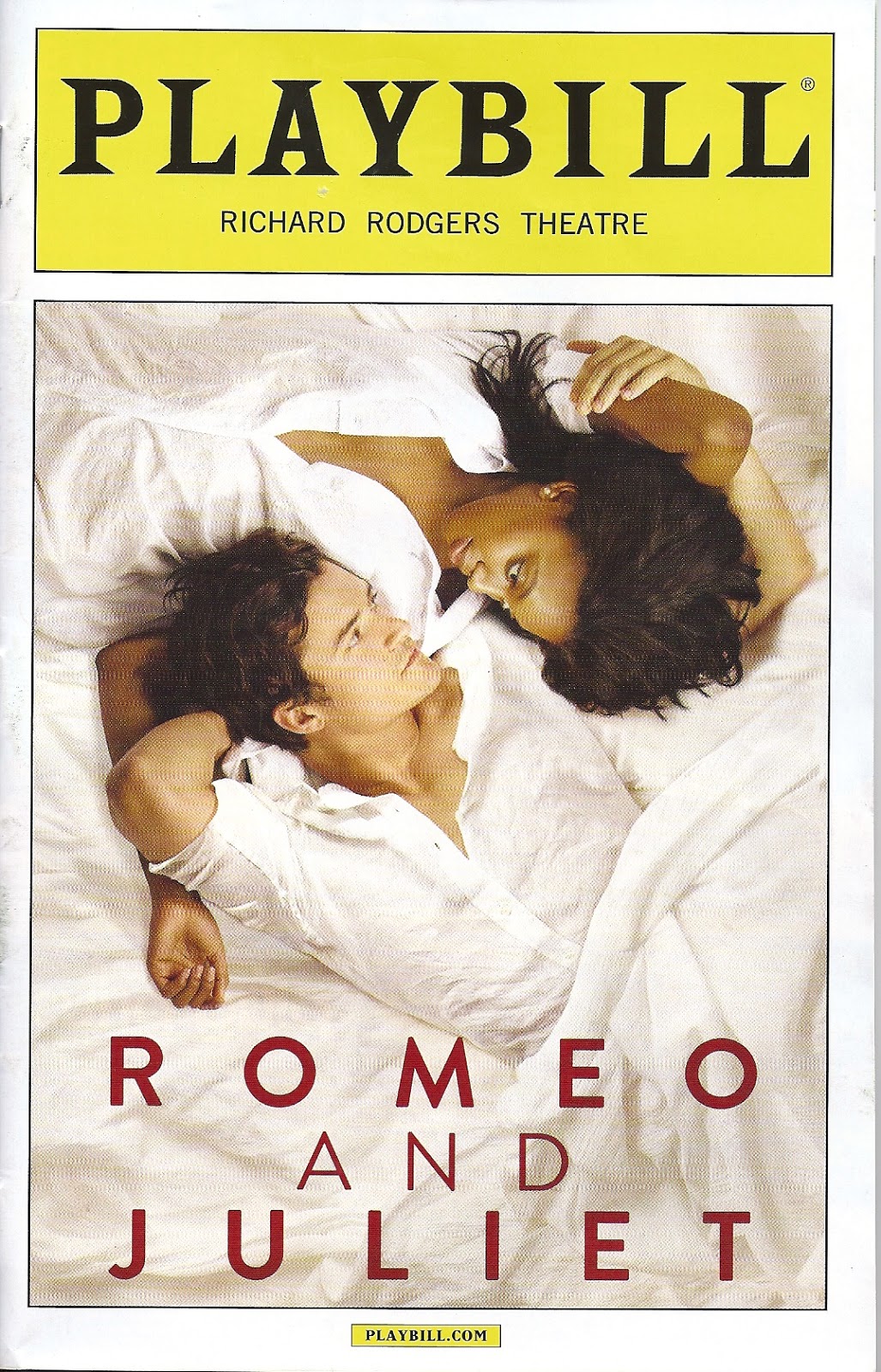
One of my favorite retellings of Romeo & Juliet is the most recent one on Broadway, partially because Orlando Bloom is shirtless but also because Juliet is black. They aren’t divided because of their skin color. This isn’t West Side Story. It’s not that one is brown and from the wrong side of the tracks, and the other one is nice and white, so they can’t be together. This is a story of feuding families that have been feuding so long they can’t even remember why or how it started. It’s that simple.

If you’re worried you’re still propagating a stereotype, then reach out. You’ll make a friend. You’ll learn something new. I am extremely lucky to have had diverse friends. I know that’s not the case for everyone and I know that if you’re not in a big city, chances are the POC in you neighborhood are marginalized. I’m not in Arizona where they’re trying to wipe out Mexican studies. I’m not in a tiny town in Ohio where there is one black kid in the class. I’m in NYC, which isn’t perfect and has a history of putting away their low income minorities to make room for gentrification. But my eyes are extremely open (and I got new glasses today) as to the future we need to create for Young Adult literature. It’s a team effort.

Maybe if we keep making it a point, when we talk about diverse characters in the coming years, it will be more than just a trend; it’ll be the new norm.


Edited: 3/31/14

*** Representation of Latin@s in media has been a personal focus for me.  This is not to say that “diversity” to me means only adding Latin@s to literature. The conversation extends to all marginalized people. Like I said, lets talk about it.

A Note For Authors on Jumping Genres

By Stephanie Guerra

Writing in a new genre after successfully publishing a book (or books) can be intimidating; why change what works? Some agents and publishers actively discourage genre-hopping, while others are interested in quality rather than consistency or brand-building.

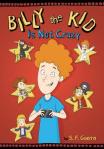
TORNI debuted in 2012 as a YA author of realistic fiction (Torn) and followed up in 2013 with a 90-degree turn to humorous, heavily-illustrated middle grade: Billy the Kid is Not Crazy. I have two more YA coming out next year and I’m finishing a picture book.

If you’re a writer drawn to similar genre shifts, I encourage you to follow your gut. The process can be both freeing and useful in developing range. You may have to rebuild your audience from scratch, which is intimidating. But you’ll end up with a broader audience, a reward in itself.

Billy the KidYou’ll also need to adjust your voice and mentality for your new audience. Transitioning from YA to MG, I had to get in touch with my booger-fart-joke side (it wasn’t that hard) and cut all edge out of my writing (a touch harder). Again, the work builds its own reward: increased range.

But I want to focus a spotlight on the positives, which I believe are the real essence of shifting genres. It’s a form of creative stretching, a way to access a different age or voice inside you, and a way to reengage with the “play” of writing. A YA author may discover a new sense of fun in MG or picture books. An MG author may find freedom in exploring the romance or more mature content possible in YA. A picture book author used to practicing economy with words may relish stretching out into a luxurious novel.

Consider one of the most beloved Latin@ authors of our times, Gary Soto. He’s produced excellent picture books, poetry, middle grade and YA novels, short stories, and adult works. Pam Muñoz Ryan, another Latin@ star, has ranged from picture books to award-winning YA. Jack Gantos, my personal hero, has created picture books, delightful middle-grade (Joey Pigza!), adult novels, and urban memoir.

Some other marvelous children’s authors who’ve changed genres: Madeleine L’Engle, Mark Twain, Roald Dahl, and Laurie Halse Anderson. Literary superheroes like E. B. White jumped from Charlotte’s Web to One Man’s Meat. Roald Dahl dabbled in memoir, adult short stories, suspense, erotica, and of course, children’s fiction. And C. S. Lewis wrote everything short of picture books. What better models could we have?

I like to view jumping genres, too, as an act of defiance to The Market. Conventional wisdom has it that it’s savvy to develop a brand and stick with it, to build an audience and churn out book-clones at the rate of one per year. Many authors do this very successfully, and there’s nothing wrong with it, if it’s fulfilling to the artist in question. But I’m unsettled by branding as a lens for the arts and as a concept imposed on authors by publishers. Branding seems to compete with the essence of what art is or should be. So I advocate stretching the brand. Or better yet, losing the term altogether.

I’d like to share a short (30 second) video of a really articulate 11-year-old reviewing my MG. Thank you, Garrison. Your review gives me confidence that jumping genres was the right choice.

The 2014 International Latino Book Awards Finalists!

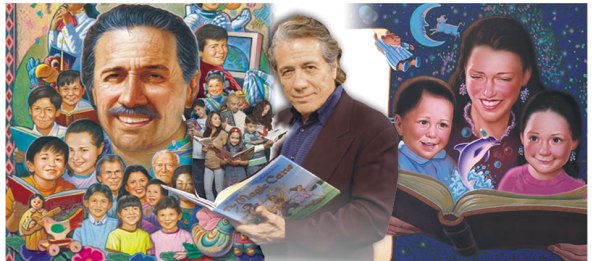
Below are the 2014 finalists for the 16th Annual International Latino Book Awards in the children’s, youth, and young adult categories. If you click on the images, you will be taken to Goodreads, Barnes and Noble, or Amazon for more information. The Awards are produced by Latino Literacy Now, an organization co-founded by Edward James Olmos and Kirk Whisler, and co-presented by Las Comadres para las Americas and Reforma, the National Association to Promote Library and Information Services to Latinos. The Awards themselves will be June 28 in Las Vegas as part of the ALA Conference. For the complete list, which includes adult fiction and nonfiction, check out the Latina Book Club site. Congratulations and good luck to all of the finalists!

Best Latino Focused Children’s Picture Book: English

18296043  15791044

Best Latino Focused Children’s Book: Spanish or Bilingual

17265250  19483940  An Honest Boy Un hombre sincero

Best Children’s Fiction Book: English

18492598  15842628  The Box of Holes  

Best Children’s Fiction Picture Book: Bilingual

17267265  17940785  15938471  16000381

Best Children’s Fiction Picture Book: Spanish

20948920  17802285  16457293  18406769  20454675

Best Children’s Nonfiction Picture Book

13610203  An Honest Boy Un hombre sincero  The Dog That Became a Lion

Best Educational Children’s Picture Book: English

17465058  18296043  15791044

Best Educational Children’s Picture Book: Spanish or Bilingual

  19483940  Hola! Gracias! Adios!  18126680  Embedded image permalink

Most inspirational Children’s Picture Book: English

18371476

Most inspirational Children’s Picture Book: Spanish or Bilingual

18198024  9542372  Embedded image permalink  Pink Firetrucks  18406693

Best Youth Latino Focused Chapter Book

10436183  16670129  Front Cover

Best Youth Chapter Fiction Book: English

16131067  17166339  16059385

Best Youth Chapter Fiction Book: Spanish or Bilingual

10162585    

Best Youth Chapter Nonfiction Book

Most inspirational Chapter Book

Front Cover  The Adventures of Chubby Cheeks: The Pro Quest

Best Young Adult Latino Focused Book: English

Insurgency: 1968 Aztec Walkout by Victor Gonzalez

17274543  15769992  Stars of the Savanna

Best Young Adult Latino Focused Book: Spanish or Bilingual

Los Pájaros No Tienen Fronteras by Edna Iturralde

18208087

Best Young Adult Fiction Book: English

17184137  12154323  15814459  15798660  A Girl Named Nina

Best Young Adult Fiction Book: Spanish or Bilingual

La Guarida de las Lechuzas by Antonio Ramos Revillas

Best Young Adult Nonfiction Book


Best Educational Young Adult Book

18462053  Stars of the Savanna  

Most Inspirational Young Adult Book

15769992  12352685  Stars of the Savanna

Best Book Written by a Youth: English

15020431  15874623

Best Book Written by a Youth: Spanish or Bilingual

  Serendipity, Poems About Love in High School

Best Children’s Picture Book Translation: Spanish to English

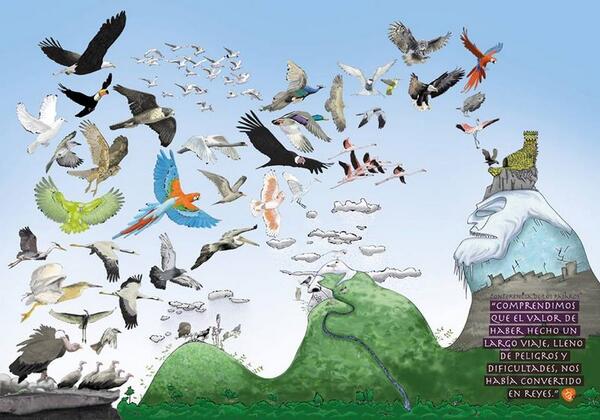
Avian Kingdom Feathered Tales: Birds Of A Feather  Avian Kingdom Feathered Tales: Pelican Sky  Avian Kingdom Feathered Tales: Two Hoots and a Holler  17465058

Best Children’s Picture Book Translation: English to Spanish

El Día Maravilloso de Hacer Tamales que Tuvo Sofia by Albert Monreal Quihuis; translator: Veronica Lamanes

Best Chapter/Young Adult Book Translation: English to Spanish

El Gusano de Tequila

Best First Book: Children’s and Youth

Stars of the Savanna  An Honest Boy Un hombre sincero