Book Review: Yum! ¡MmMm! ¡Qué Rico!: Americas’ Sproutings by Pat Mora

largeBy Sujei Lugo

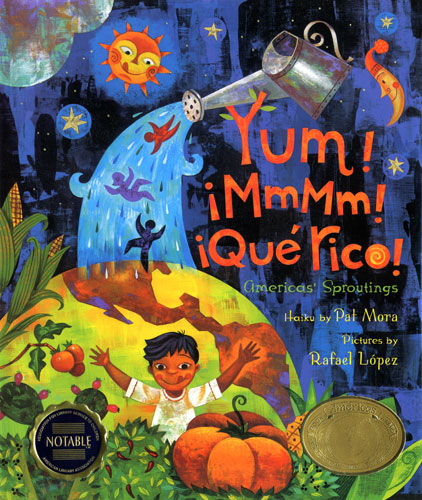
DESCRIPTION FROM THE BOOK JACKET: Peanuts, blueberries, corn, potatoes, tomatoes, and more—here is a luscious collection of haiku celebrating foods native to the Americas. Brimming with imagination and fun, these poems capture the tasty essence of foods that have delighted, united, and enriched our lives for centuries. Exuberant illustrations bring to life the delicious spirit of the haiku, making Yum! ¡MmMm! ¡Qué Rico! an eye-popping, mouth-watering treat.

MY TWO CENTS: Beware: This book will make you feel hungry!

Through Pat Mora’s wonderful haikus (a traditional and very popular form of Japanese poetry) and Rafael López’s vivid illustrations, we are introduced to a wide variety of foods from the Americas. From blueberries and papaya, to pumpkin and vanilla, readers will have the opportunity to discover and learn about crops that have been growing in our lands for centuries.

Mora uses this opportunity to present us with 14 different types of foods accompanied by a haiku, an illustration, and an informational paragraph for each. This combination effectively makes this book a fun, poetic, and informational read. Mora’s short poems strive to capture the various feelings and sensory experiences we encounter when we eat and enjoy these foods. The informational paragraph provides us with the etymology, origin and uses for each food, and some of them even include national holidays across the region that celebrate them.

Even though food is the main character of the book, children and nature are presented throughout each page, as they interact with the food that is being discussed. Through cheerful and colorful illustrations, López supports Mora’s words with lively anthropomorphic foods, suns and moons, friendly animals, and picturesque landscapes. The book also embraces the real diversity of the Americas, giving us multiethnic and multiracial children and their families enjoying and being part of this magic realism journey of foods and words.

Among the food, colors, and haikus there is an important aspect that is constant throughout Yum! ¡Mmmm! ¡Qué rico!, although featured discreetly: a strong sense of how vital sharing is–sharing the land with nature, humans, and animals, as well as sharing the products of our land with others. It stresses the need to understand the importance of a non-exploitative relationship with nature and our role in taking care of our land. We can see this aspect clearly with López’s constant use of images of children and families, seen either eating or preparing food together, planting seeds, and picking crops, as well as images of nature watering our soil. There’s no doubt that this book will encourage children to eat fruit, vegetables, and other natural foods. At the same time, it will help them to recognize the work that needs to happen to enjoy those foods.

Yum! ¡Mmm! ¡Qué Rico! America’s Sproutings was the first collaboration between Pat Mora and Rafael López. Published in 2007, the book won several awards such as Bank Street Children’s Books of the Year (2008), Américas Award (2007) and American Library Association (ALA) Notable Books (2008). It was also included in the Texas Bluebonnet Award Master List (2008-2009), Great Lakes Great Books Award Master List (2008-2009) and ALA’s Top Ten Quick Picks for Reluctant Young Adult Readers. 

TEACHING TIPS: The book works well for children in grades K-6. At home, kids can read it with adults and learn about haikus and how to incorporate some of the foods into their diet. They can do fun cooking activities, such as making fruit faces or fruit kabobs, and even make ice cream, like in this activity shared by the book’s publisher Lee and Low Books.

The content of the book provides librarians, teachers and educators the opportunity to create cross-curricular activities in subjects such as language arts, social studies, art, and health. Students may even become inspired by Pat Mora’s haikus and write their own pieces about the foods they’ve just learned about, and how they feel by eating them or sharing them. The book incorporates a few words in Spanish, such as luna and dulces, teaching children new words as well as showing them they can incorporate words in other languages in their writing. For activities related to social students, art, and health, Lee and Low Books provides a great classroom guide.

LEXILE: AD970L

AUTHOR & ILLUSTRATOR: Pat Mora (author) is a writer, speaker, multicultural literacy advocate, and founder of Día de los Niños/Día de los Libros (Children’s Day/Book Day). A former teacher, university administrator and consultant, Mora has dedicated her life to spread her “bookjoy” to children and adults. She is the recipient of various awards and honors such as Honorary Doctorates from North Carolina State University and SUNY Buffalo, Kellogg National Leadership Fellowship, National Endowment of the Arts Poetry Fellowship, Civitella Ranieri Fellowship, Honorary Membership in the American Library Association, Lifetime Membership in the United States Board on Books for Young People and several Southwest Book Awards.

She was written books of poetry, fiction and nonfiction for children and adults. Some of her children’s books are: Listen to the Desert/Oye al Desierto (1994); Tomás and the Library Lady (1997), winner of the 1998 Tomás Rivera Mexican American Children’s Book Award; The Bakery Lady (2001); Doña Flor: A Tall Tale about a Giant Woman with a Great Big Heart (2005), winner of the Pura Belpré Author Honor and Illustrator Awards (2006) and Golden Kite Award from the Society of Children’s Book Writers and Illustrators; Book Fiesta!: Celebrate Children’s Day/Book Day/Celebremos El Día de los Niños/El Día de Los Libros (2009), a Junior Library Guild selection and Pura Belpré Illustrator Award (2010) winner; Gracias/Thanks (2009), recipient of the Pura Belpré Illustrator Honor (2010); A Piñata in a Pine Tree: A Latino Twelve Days of Christmas (2009), Dizzy in Your Eyes: Poems about Love (2010) and The Beautiful Lady: Our Lady of Guadalupe (2012).

Rafael López (illustrator): Rafael López is a Mexican award-winning illustrator and artist, whose work is influenced by his cultural heritage, colors of Mexican street life, and Mexican surrealism. In addition to children’s books, Rafael López has created illustrated posters and United States Postal Service stamps such as the Latin Music Legends series. He also launched street art projects to revitalize urban neighborhoods such as the Urban Art Trail Project.

He is the recipient of various Pura Belpré Honor for Illustration awards, for books such as: My Name is Celia: The Life of Celia Cruz/Me Llamo Celia: La Vida de Celia Cruz (2006), Book Fiesta!: Celebrate Children’s Day/Book Day/ Celebremos El Día de los Niños/El Día de Los Libros (2010), The Cazuela That the Farm Maiden Stirred (2012) and Tito Puente: Mambo King/Rey del Mambo (2013). He also received two Américas Awards for Children’s and Young Adult Literature for My Name is Celia (2006) and Yum! ¡Mmmm! ¡Qué Rico! Americas’ Sproutings (2007).

FOR MORE INFORMATION about Yum! ¡MmMm! ¡Qué Rico!: Americas’ Sproutings (2007) visit your local library or bookstore. Also, check out worldcat.orgindiebound.orggoodreads.comamazon.comleeandlow.com.

Celebrate National Poetry Month with Animals and Latin American Art

By Concetta Gleason
editorial assistant/admin coordinator for Scholastic’s Club Leo en Español

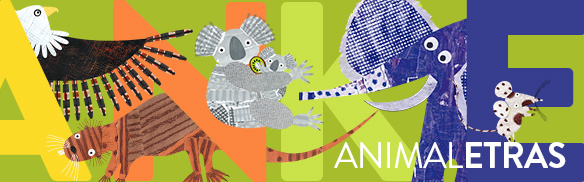
Animaletras by Chilean author Francisca Palacios is the ideal book to read during National Poetry Month. Animaletras is an alphabet book that teaches young learners about the animal kingdom, describing each animal in beautiful verse that includes useful facts about habits and habitats. The vibrant illustrations beautifully encapsulate the playfulness and vitality so common in Latin American art. One of our favorite letter-and-animal pairs is A for Águila (Eagle):

 A a 

Con el águila en el cielo
bien montada en cada ala
la a vuela, aventurera,
por los vientos inflamada.

With the eagle in the sky
saddled closely to each wing
the a takes flight, adventurous,
enflamed by the winds.

For bilingual classrooms, Animaletras opens up a world of fun creative writing exercises in Spanish and English. One great writing exercise is the acrostic, where you spell out a word vertically and use each letter as the first letter of a new word that relates to the original word. Below are acrostic poems in Spanish and English foráguila and eagle.

Águila

Ágil

Glorioso

Único

Increíble

Líder

Aplomo

Eagle

Enormous

Agile

Grand

Lovely

Elegant

What words and rhymes can you create in English and Spanish for National Poetry Month?

Author’s Note: Club Leo en Español supports your classroom with fun and affordable books that connect children’s home language and learning. Our books include amazing series, original titles, and winners of the Pura Belpré Award, which celebrates the remarkable contributions of artists who give voice to the Latino community through children’s literature.

Club Leo en Español apoya tu salón de clases con libros divertidos y asequibles que conectan la lengua materna y el aprendizaje de los niños. Nuestra colección incluye increíbles series, títulos originales y ganadores del Premio Pura Belpré, que celebra los extraordinarios aportes de artistas que dan voz a la comunidad latina a través de la literatura infantil.

2014 Reading Challenge: March

We continue to be blown away by the number of books being read each month by participants of our 2014 Latin@s in Kid Lit Challenge. Thank you to everyone for participating in the challenge and purposely selecting books by/about/for Latin@s. Remember, you can join the challenge any time during the year, and you’re not required to review–only read and enjoy! If you do post a review somewhere, we will link it to the book covers below. If you choose not to review, we will link the covers to Goodreads. This month, we’d like to stand up and applaud Elisabeth Ellison and Cecelia Cackley for their vigorous reading (13 books total!) And since April is National Poetry Month, we suggest you try some novels in verse this month!

A note to participants: As you complete books, please send us the information, so we can share what you’re reading each month.

13515320  6603032  15814459  5982454  10564957  18079822  15798660  11431896  1294347  14342632  13501282  1816693511438326  1016493  18938127 18318638  6098251  255189  9373385  1372657  1807231  18651917  15937128  6673243  1065256  1076237  18318005  8220585  652180  7095181  15818046  1028659  18249428

Scholastic Book Club Celebrates Cesar Chavez Day With “Harvesting Hope”

Latin@s in Kid Lit is excited to have the opportunity to cross-post with Scholastic’s Club Leo en Español, the largest Spanish school book club in the country offering Spanish, English, and bilingual books and educational materials to children in grades Pre K-8.

On Monday, May 31, the Scholastic site celebrated Cesar Chavez Day by highlighting Pura Belpré Honoree Harvesting Hope! Click here to see the original post, which has been reblogged below.

By Concetta Gleason
editorial assistant/admin coordinator for Club Leo

“Kindness and compassion towards all living things is a mark of a civilized society.…Only when we have become nonviolent towards all life will we have learned to live well ourselves.”

—Cesar Chavez, co-founder of United Farm Workers

Today is Cesar Chavez Day, and to celebrate we are revisiting Harvesting Hope by Kathleen Krull and Yuyi Morales. Harvesting Hope chronicles Chavez’s life as an advocate for the rights of migrant farm workers and laborers.

Cesar Chavez was born on March 31, 1927, in Yuma, Arizona. His parents, who were Mexican immigrants, prospered as business owners and farmers. However, the Great Depression crushed the family’s financial prospects, as it did to so many Americans. In 1937, Chavez’s family moved to California to find employment as migrant workers. Chavez was only ten years old when he experienced the inhumane conditions migrant workers were forced to endure as they worked long hours in the fields for meager pay. From this difficult experience Chavez learned the enduring importance of human dignity and compassion, which would fundamentally inform his leadership as an adult.

In Harvesting Hope, Krull maintains the delicate balance between showing and telling, providing significant historical background while taking the reader on a journey from Chavez’s idyllic childhood in Arizona to his hard-won victory over a corporate giant to ensure the legal rights of farm workers. Morales’s illustrations imbue the book with a dreamlike quality. Her figures command the page with grace and her use of colors shows the richness of Cesar’s emotional life and the depth of his plight as a migrant worker. This book is a worthy tribute to such a noble historical figure, and in 2004 it won the Pura Belpré Illustrator Honor.

As a leader, Chavez refused to engage in bullying tactics that dehumanized others and he is revered for being a catalyst of social change. Cesar Chavez Day is an official state holiday in California, Colorado, and Texas that is dedicated to acts of community service. Join us as we celebrate Cesar Chavez’s life works and some excellent Latino children’s literature!

Author’s Note: Club Leo en Español supports your classroom with fun and affordable books that connect children’s home language and learning. Our books include amazing series, original titles, and winners of the Pura Belpré Award, which celebrates the remarkable contributions of artists who give voice to the Latino community through children’s literature.

Club Leo en Español apoya tu salón de clases con libros divertidos y asequibles que conectan la lengua materna y el aprendizaje de los niños. Nuestra colección incluye increíbles series, títulos originales y ganadores del Premio Pura Belpré, que celebra los extraordinarios aportes de artistas que dan voz a la comunidad latina a través de la literatura infantil.

The 2014 International Latino Book Awards Finalists!

Below are the 2014 finalists for the 16th Annual International Latino Book Awards in the children’s, youth, and young adult categories. If you click on the images, you will be taken to Goodreads, Barnes and Noble, or Amazon for more information. The Awards are produced by Latino Literacy Now, an organization co-founded by Edward James Olmos and Kirk Whisler, and co-presented by Las Comadres para las Americas and Reforma, the National Association to Promote Library and Information Services to Latinos. The Awards themselves will be June 28 in Las Vegas as part of the ALA Conference. For the complete list, which includes adult fiction and nonfiction, check out the Latina Book Club site. Congratulations and good luck to all of the finalists!

Best Latino Focused Children’s Picture Book: English

18296043  15791044

Best Latino Focused Children’s Book: Spanish or Bilingual

17265250  19483940  An Honest Boy Un hombre sincero

Best Children’s Fiction Book: English

18492598  15842628  The Box of Holes  

Best Children’s Fiction Picture Book: Bilingual

17267265  17940785  15938471  16000381

Best Children’s Fiction Picture Book: Spanish

20948920  17802285  16457293  18406769  20454675

Best Children’s Nonfiction Picture Book

13610203  An Honest Boy Un hombre sincero  The Dog That Became a Lion

Best Educational Children’s Picture Book: English

17465058  18296043  15791044

Best Educational Children’s Picture Book: Spanish or Bilingual

  19483940  Hola! Gracias! Adios!  18126680  Embedded image permalink

Most inspirational Children’s Picture Book: English

18371476

Most inspirational Children’s Picture Book: Spanish or Bilingual

18198024  9542372  Embedded image permalink  Pink Firetrucks  18406693

Best Youth Latino Focused Chapter Book

10436183  16670129  Front Cover

Best Youth Chapter Fiction Book: English

16131067  17166339  16059385

Best Youth Chapter Fiction Book: Spanish or Bilingual

10162585    

Best Youth Chapter Nonfiction Book

Most inspirational Chapter Book

Front Cover  The Adventures of Chubby Cheeks: The Pro Quest

Best Young Adult Latino Focused Book: English

Insurgency: 1968 Aztec Walkout by Victor Gonzalez

17274543  15769992  Stars of the Savanna

Best Young Adult Latino Focused Book: Spanish or Bilingual

Los Pájaros No Tienen Fronteras by Edna Iturralde

18208087

Best Young Adult Fiction Book: English

17184137  12154323  15814459  15798660  A Girl Named Nina

Best Young Adult Fiction Book: Spanish or Bilingual

La Guarida de las Lechuzas by Antonio Ramos Revillas

Best Young Adult Nonfiction Book


Best Educational Young Adult Book

18462053  Stars of the Savanna  

Most Inspirational Young Adult Book

15769992  12352685  Stars of the Savanna

Best Book Written by a Youth: English

15020431  15874623

Best Book Written by a Youth: Spanish or Bilingual

  Serendipity, Poems About Love in High School

Best Children’s Picture Book Translation: Spanish to English

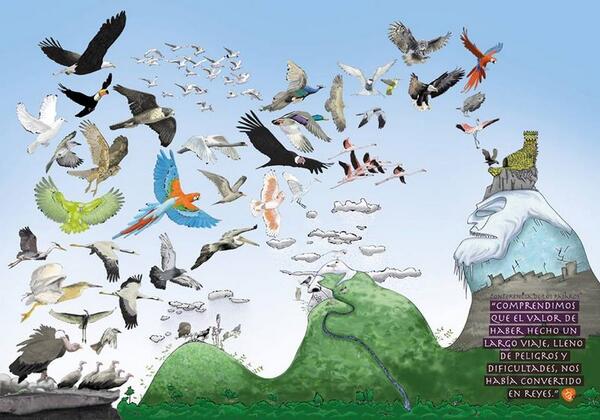
Avian Kingdom Feathered Tales: Birds Of A Feather  Avian Kingdom Feathered Tales: Pelican Sky  Avian Kingdom Feathered Tales: Two Hoots and a Holler  17465058

Best Children’s Picture Book Translation: English to Spanish

El Día Maravilloso de Hacer Tamales que Tuvo Sofia by Albert Monreal Quihuis; translator: Veronica Lamanes

Best Chapter/Young Adult Book Translation: English to Spanish

El Gusano de Tequila

Best First Book: Children’s and Youth

Stars of the Savanna  An Honest Boy Un hombre sincero  

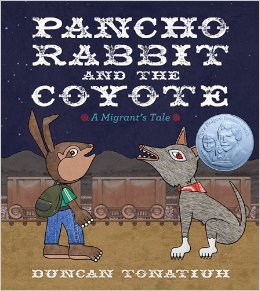
Book Review: Pancho Rabbit and the Coyote: A Migrant’s Tale by Duncan Tonatiuh

Pancho Rabbit coverBy Lila Quintero Weaver

DESCRIPTION FROM THE BOOK JACKET: A young rabbit named Pancho eagerly awaits his papa’s return. Papa Rabbit left two years ago to travel far away north to find work in the great lettuce and carrot fields to earn money for his family. When Papa does not return home on the designated day, Pancho sets out to find him. He packs Papa’s favorite meal—mole, rice and beans, a heap of still-warm tortillas and a jug full of fresh aguamiel—and heads north. He soon meets a coyote, who offers to help Pancho in exchange for some of Papa’s favorite foods. They travel together until the food is gone and the coyote decides he is still hungry…for Pancho!
Award-winning author and illustrator Duncan Tonatiuh brings to light the hardship and struggles facing families who seek to make better lives for themselves by illegally crossing the borders.

MY TWO CENTSWho does not love a fable, beautifully told? Pancho Rabbit and the Coyote is an allegory of migration, simplified for young children and illustrated with highly original art adapted from the style of Mixtec codices.

The adventure begins when Papa and his migrant companions, Señors Ram and Rooster, fail to return at the appointed time. Pancho sneaks off at night to find him. Perils along the journey provide appropriate levels of tension for early readers, but each danger that Pancho faces has a factual counterpart in the experiences of many undocumented Latino immigrants. First, there is—pardon the expression—a wily coyote who promises to guide Pancho to his father.  Children will instinctively realize that this coyote isn’t a true friend. Plus, physical dangers lurk at every turn—snakes, hunger, thirst, a river crossing, a dark tunnel, and a ride on the roof of a train. Most young children will accept these scary moments as tropes of fable and nothing more, helped by the fact that Tonatiuh softens each danger appropriately. For example, when Pancho nearly loses his balance on the roof of the train, the range of dire consequences implied by a fall will escape a child’s notice.

Pancho is a sturdy soul, driven to press through by his burning desire to reunite with Papa. As time goes by, the coyote demands more food from Pancho—food intended for Papa. This mirrors the exploitative nature of many human coyotes, infamous for charging exorbitant sums for their services and not always delivering on their promises. At last, Pancho and the coyote cross the border and spend the night in a hut. When the coyote discovers that Pancho’s food stores are depleted, things go from bad to very bad. “‘In that case,’ said the coyote, ‘I will roast you in the fire and eat you!’” As Pancho cowers in a corner, the huge shadow of a long-fanged coyote looms over him. Shades of Little Red Riding Hood! Just in time, Papa, Señor Rooster and Señor Ram burst into the hut, and the treacherous coyote runs off into the night.

Why were the returning farm workers delayed? “‘A gang of crows attacked us,’ said Señor Rooster. ‘They took the money and gifts we were bringing back to our families and left us stranded in the desert.’” This introduces yet another parallel to reality, the bandits that prey on defenseless immigrants. Back at the rancho, the welcome fiesta goes off without a hitch. The rabbit children beg their father to never leave them again, but he cannot guarantee it. “‘If it doesn’t rain again next year and if there is no food or work on the rancho, what else can I do?’” The children insist they will go with him, but Mamá has a more practical wish. “‘Let’s hope it rains.’”

No discussion of this book can be complete without delving into the art. In a video linked below, Duncan Tonatiuh explains the origins of his style and how meeting immigrants of Mixtec heritage prompted him to adapt the art for contemporary illustration.

Let’s review a few characteristics of Mixtec art:

  • Strong outlines of external and internal shapes
  • Flat colors within those shapes
  • Faces of humans and animals represented in profile
  • Stylized perspective—rugs, tables, other flat surfaces do not recede in space, but appear vertically placed

All of these characteristics are present in Tonatiuh’s art, along with notable adaptations:

  • Modern settings
  • Elements of collage
  • Textured surfaces, sometimes with photographic fidelity
  • Facial expressions that raise emotional content

To elaborate on facial expressions, take note of how variations in characters’ eyes, ears, lips and posture are used to denote sadness, fear, determination, and joy.

To learn more about ancient Mixtec people and their elaborately illustrated manuscripts, see this site

TEACHING TIPSAn author’s note addresses the human issues allegorized in the story of Pancho Rabbit and the rest of the animal characters. There is also a glossary of Spanish terms.

Pancho Rabbit and the Coyote is a fable that can be read on two levels. The average young child will relate to it exactly as it appears on the surface—an enchanting story with animal characters that embark on an adventure. Parents and teachers will have to decide how much to reveal to unsuspecting children about the characters’ human counterparts. Children who have firsthand experience or family stories that parallel the perilous journeys of Pancho Rabbit are much more likely to catch the story’s underlying meaning. A wise teacher will take this into account.

Many young children will be fascinated by the art, which is unique among picture books. Since Tonatiuh has incorporated rich textures into the illustrations, kids may enjoy a treasure hunt based on specific textures. Here is a list of those represented: ram’s wool, coyote and rabbit fur, denim and other textiles, dried chiles, wood grain, brick, corrugated metal roofing, prickly cacti, straw matting, gravel, rubber tire, snakeskin, topsoil, and feathers.

Just because it’s a picture book, there’s no reason that Pancho can’t be enjoyed by older kids, especially artistic teens. If they seem reluctant, show them Duncan Tonatiuh’s TED Talk video, “Life on the Other Side,” embedded in his website. Many teens will conclude that he’s a pretty cool dude, one worth emulating. You’ll also find a touching multi-voice poem recorded by fourth-graders in Texas. It models an excellent approach to getting young migrants or second-generation immigrants talking about their experiences and feelings.

THE AUTHORDuncan Tonatiuh was born in San Miguel de Allende, Mexico. His deep interest in the plight of undocumented immigrants originates in childhood friendships in Mexico and associations he has formed in New York, where he studied art and lives. He is the author-illustrator of other award-winning books, including Diego Rivera: His World and Ours, Dear Primo: A Letter to My Cousin, and a forthcoming book on Sylvia Mendez.

Duncan has earned a chest full of medals and awards for Pancho Rabbit and the Coyote, including:

  • Pura Belpré Author and Illustrator Honor book 2014
  • New York Public Library’s annual Children’s Books list: 100 Titles for Reading and Sharing 2013
  • Kirkus Best Books of 2013
  • Best Multicultural Children’s Books 2013 (Center for the Study of Multicultural Children’s Literature)
  • Notable Children’s Books from ALSC 2014
  • Notable Books for a Global Society Book Award 2014