Celebrating Pura Belpré Winners: Spotlight on Doña Flor, illustrated by Raul Colón

PuraBelpreAwardThe Pura Belpré Awards turns 20 this year! The milestone will be marked on Sunday, June 26, from 1:00-3:00 p.m. during the 2016 ALA Annual Conference in Orlando, FL. According to the award’s site, the celebration will feature speeches by the 2016 Pura Belpré award-winning authors and illustrators, book signings, light snacks, and entertainment. The event will also feature a silent auction of original artwork by Belpré award-winning illustrators, sales of the new commemorative book The Pura Belpré Award: Twenty Years of Outstanding Latino Children’s Literature, and a presentation by keynote speaker Carmen Agra Deedy

Leading up to the event, we will be highlighting the winners of the narrative and illustration awards. Today’s spotlight is on Raul Colón, the winner of the 2006 Pura Belpré Illustration Award for Doña Flor: A Tall Tale About a Giant Woman with a Great Big Heart. Colón also received Pura Belpré Illustration Honors for Portraits of Hispanic American Heroes and My Name is Gabito: The Life of Gabriel García Márquez/Me llamo Gabito: la vida de Gabriel García Márquez.

Review by Sonia Alejandra Rodriguez
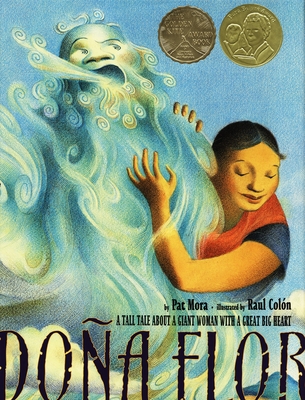
DESCRIPTION FROM THE PUBLISHER: Doña Flor is a giant lady who lives in a tiny village in the American Southwest. Popular with her neighbors, she lets the children use her flowers as trumpets and her leftover tortillas as rafts. Flor loves to read, too, and she can often be found reading aloud to the children.

One day, all the villagers hear a terrifying noise: it sounds like a huge animal bellowing just outside their village. Everyone is afraid, but not Flor. She wants to protect her beloved neighbors, so with the help of her animal friends, she sets off for the highest mesa to find the creature. Soon enough, though, the joke is on Flor and her friends, who come to rescue her, as she discovers the small secret behind that great big noise.

The creators of Tomás and the Library Lady, Pat Mora and Raul Colón, have once again joined together. This time they present a heartwarming and humorous original tall tale—peppered with Spanish words and phrases—about a giant lady with a great big heart.

MY TWO CENTS: Doña Flor, written by Pat Mora and illustrated by Raul Colón, tells the story of a giant woman that sleeps on clouds and makes piles of big tortillas. She protects her village from harm and she must do just that when the villagers inform her that a giant mountain lion threatens their safety. The biography of Raul Colón included on the dust jacket describes his illustrations as “an intriguing combination of watercolor washes, etching, and colored and litho pencils.”

When I look at Colón’s illustrations, the etchings remind me of fingerprints. The loops, the arches, the whorls, and all the lines that we might associate with fingerprints are visible in Colón’s illustrations. I am not familiar with techniques or the technicalities of etching and in saying that the illustrations remind me of fingerprints I do not mean to devalue the art in any way. My favorite illustration in this story is of Doña Flor using her thumb to carve out a riverbed in the village. Doña Flor is in a squatting position with her white skirt covering her thighs, and she has used her thumb to make a squiggly path for the water while the villagers look on. The riverbed has the details I associated with the fingerprints which, in this case, could be Doña Flor’s own prints.

Colón’s illustrations are beautiful, colorful, and magical. That I saw fingerprints when I looked closely at his illustrations speaks to the uniqueness of his art. While Doña Flor wears a blue shirt in most of the illustrations sometimes the shirt looks like it is embroidered and sometimes it looks like a plain T-shirt. The clouds on one page look round and fluffy and in the illustration where she’s made her bed of clouds it appears like she’s left her own fingerprints on the clouds she has gathered. Despite the uniqueness I see in his illustrations, there is certainly a sense of cohesion throughout the story. I’ve decided to focus on the etchings, the lines, and how much they appear like fingerprints because as I examined his illustrations, I also got the thought that our stories are as unique as our fingerprints. Colón’s illustrations in Doña Flor affirmed that for me. I couldn’t help but connect the details I saw in his art to the significance of the Pura Belpré award and the necessity for more Latinx children’s and young adult literature by and for Latinx.

TEACHING TIPS:

  • For younger readers: Ask younger readers to pick their favorite illustration and to pick a part of the image they’d like to recreate. For example, in the illustration with Doña Flor making the river, students can attempt to recreate the river, the clouds, the trees and hills, etc. Ask students to outline their chosen part and to fill it in by dabbing their fingerprints. This will recreate the etching effect they see in the illustrations.
  • For middle grade readers: Discuss with students the effect and affect of etching. Does the etching force the reader to focus in a certain direction or a certain part of the page? How do the illustrations make you feel? For example, in the illustration where Doña Flor hugs the wind the lines of the etchings point in the same direction, making it appear like she is floating away with the wind.
  • For young adult readers: By the end of the story Doña Flor learns that the loud roaring frightening the village is coming from a small puma roaring into a hollow log. Discuss with students the importance of perceptions and misconceptions. How might we connect the villagers’ fear and the puma’s amplified roars to racial/ethnic stereotypes?
 

FullSizeRender (1)Dr. Sonia Alejandra Rodriguez’s research focuses on the various roles that healing plays in Latinx children’s and young adult literature. She currently teaches composition and literature at a community college in Chicago. She also teaches poetry to 6th graders and drama to 2nd graders as a teaching artist through a local arts organization. She is working on her middle grade book. Follow Sonia on Instagram @latinxkidlit
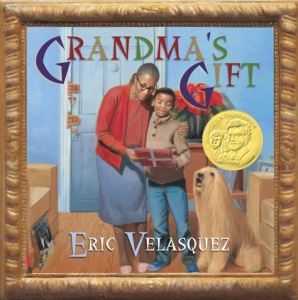
Celebrating Pura Belpré Winners: Spotlight on Grandma’s Gift by Eric Velasquez

PuraBelpreAward

The Pura Belpré Awards turns 20 this year! The milestone will be marked on Sunday, June 26, from 1:00-3:00 p.m. during the 2016 ALA Annual Conference in Orlando, FL. According to the award’s site, the celebration will feature speeches by the 2016 Pura Belpré award-winning authors and illustrators, book signings, light snacks, and entertainment. The event will also feature a silent auction of original artwork by Belpré award-winning illustrators, sales of the new commemorative book The Pura Belpré Award: Twenty Years of Outstanding Latino Children’s Literature, and a presentation by keynote speaker Carmen Agra Deedy.

Leading up to the event, we will be highlighting the winners of the narrative and illustration awards. Today’s spotlight is on Eric Velasquez, the winner of the 2011 Pura Belpré Illustrator Award for Grandma’s Gift.


Review by Lila Quintero Weaver

Grandma's GiftDESCRIPTION FROM THE BOOK JACKET: Every year, Eric spends his winter break with his grandmother in El Barrio while his parents are at work. There’s much to do to prepare for Christmas, including buying all the ingredients for Grandma’s famous pasteles, a special Puerto Rican holiday dish.
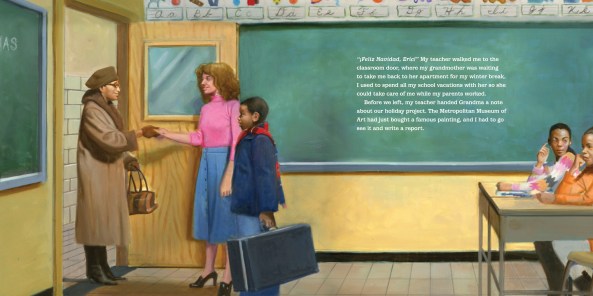
But Eric also has an assignment for school that requires a trip to the Metropolitan Museum of Art to see a new painting. Grandma and Eric are nervous about leaving El Barrio but are amazed by the museum and what they see in the painting—a familiar face in a work of art by the great painter Diego Velázquez. That day Eric’s world opens wider, and Grandma knows the perfect gift to start him on his new journey.

In this prequel to Grandma’s Records, Eric Velasquez brings readers back to a special day spent with his grandmother that would change his life forever.

MY TWO CENTS: Eric Velasquez is the award-winning illustrator of more than 25 children’s books, including three that he wrote. In Grandma’s Gift and Grandma’s Records, reviewed here, Eric brings to life childhood moments that illuminate the warm and meaningful relationship he enjoyed with his grandmother, a native of Puerto Rico and resident of El Barrio, a predominantly Puerto Rican neighborhood in East Harlem.

In a category where such books are woefully rare, both of Velasquez’s Grandma stories represent positive images of Afro-Latinx children and their families.

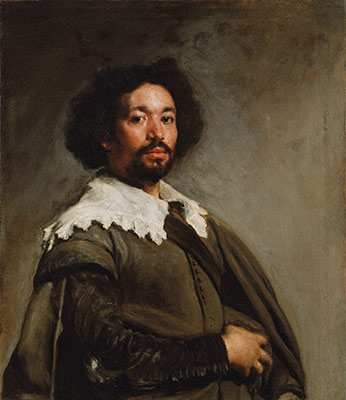
Although the story in Grandma’s Gift takes place inside a few square miles of contemporary New York City, it also casts a spotlight on a long-ago historical figure. Juan de Pareja was an enslaved man of African descent who worked in the studio of 17th-century Spanish master Diego Velázquez and who became a painter in his own right. When Eric was a boy, Velázquez’s luminous portrait of de Pareja was acquired by the Metropolitan Museum of Art for a price exceeding $5 million.

Grandma’s Gift contains two additional distinguishing aspects: elements of Puerto Rican culture preserved and passed down by the boy’s grandmother, and contrasting views between two physically proximate but culturally distant worlds, represented by El Barrio and the Metropolitan Museum of Art.

Used by permission from Bloomsbury Publishing, Inc.

Used by permission from Bloomsbury Publishing, Inc.

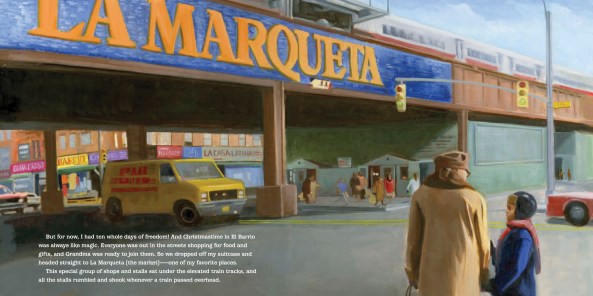
At the story’s beginning, Eric is leaving school for Christmas break, in the company of his grandmother. His school assignment, to be completed during the holidays, is a visit to the Velázquez exhibit. But first, grandmother and grandson go shopping at La Marqueta, once a central feature of El Barrio, composed of bustling shops tucked under a railroad trestle. At La Marqueta, it’s evident that Eric’s grandmother is a respected and beloved member of the community. Not only do butchers and greengrocers call her by title and name—Doña Carmen—they are also familiar with the high standards she expects from every cut of meat and vegetable she purchases. When the shopping is done, Eric and his grandmother return to her apartment, where she launches an elaborate preparation of traditional Puerto Rican holiday dishes. Here, she is clearly in her element, deftly handling each step of the cooking, filling, and rolling of the pasteles, much to the admiration of young Eric.

Used by permission from Bloomsbury Publishing, Inc.

Used by permission from Bloomsbury Publishing, Inc.

Nearly all of Doña Carmen’s dialogue is parenthetically translated into English, immediately behind her Spanish words. While this solution is not particularly elegant, it reflects the challenge that authors and publishers face in including authentic representations of a Spanish-speaking environment within an English text. The story translates greetings in Spanish by shopkeepers, words of wisdom spoken by the grandmother, and details relevant to the story, such as the names of the root vegetables used in making pasteles: calabaz, yautía, plátanos verdes, guineos verdes, papas.

El Barrio is a place that Eric’s grandmother comfortably navigates day after day. Here, her native tongue predominates, and everyone is a shade of brown. But when she and Eric head for the museum, a short bus ride away, they leave behind that familiar environment and land before the facade of the Metropolitan, cloaked in cultural status and imposing architecture. As Eric notes, there’s no one “from Puerto Rico on the streets and no one was speaking in Spanish.” At this point, Eric becomes her guide in this English-speaking world, translating the signs and captions that they encounter, stepping into a role that second- or third-generation immigrant children often play in their elders’ lives.

Juan de Pareja, by Diego Velázquez

Juan de Pareja, by Diego Velázquez

The highlight of the story arrives when Eric comes face to face with the portrait of Juan de Pareja, hanging in its gilded frame in one of the august exhibition halls of the museum. As a young person of color in the 1970s, he has never seen a member of his own people elevated to such a status: “He seemed so real—much like someone we might see walking around El Barrio. I couldn’t believe that this was a painting in a museum.” Eric is amazed and proud to learn that Juan de Pareja eventually achieved freedom and became a painter in his own right. For Eric, this discovery is a revelation that sparks artistic fire. On Christmas Eve, after everyone enjoys a traditional holiday dinner, Eric sits under the Christmas tree and opens his grandmother’s gift. It’s a sketchbook and a set of colored pencils. He immediately begins to draw a self-portrait. Through this gift, Eric’s grandmother expresses a clear vote of confidence in her grandson’s dreams, underscoring that he, too—a child of El Barrio, an Afro Latino—can follow in the footsteps of Juan de Pareja.

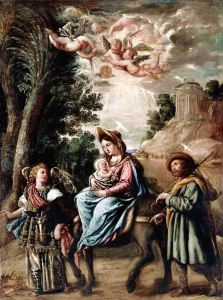
Flight into Egypt, by Juan de Pareja

Flight into Egypt, by Juan de Pareja

This touching, autobiographical story is richly illustrated in Velasquez’s photorealistic style, which authentically depicts settings and brings dimension to each character. Eric imbues his subjects with individually distinct physical characteristics, lending to each an air of nobility. He lovingly paints his grandmother as a lady of dignified bearing and warmth, usually dressed in subdued colors. But he often lavishes this humanizing treatment even on background characters, such as fellow passengers on the train and a nameless guard at the museum. In most of the illustrations, Eric employs a wide and vivid range of hues, but like Diego Velázquez, he sometimes falls back on a deliberately limited palette. When the boy and his grandmother stand before the portrait of Juan de Pareja, the rich browns of the ancient oil painting harmoniously come together with the rich browns of the grandmother’s clothing, as well as the skin tones of all three figures. He puts this deft touch with a monochromatic palette to great effect in the story’s electric moment of revelation, as the child Eric looks on the portrait of Juan de Pareja and grasps a new possibility for his future.

Eric VelasquezABOUT THE AUTHOR-ILLUSTRATOR: Eric Velasquez is an Afro-Puerto Rican illustrator born in Spanish Harlem. He attended the High School of Art and Design, the School of Visual Arts, and the famous Art Students League in New York City. As a children’s book illustrator, Velasquez has collaborated with many writers, receiving a nomination for the 1999 NAACP Image Award in Children’s Literature and the 1999 Coretta Scott King/John Steptoe Award for New Talent for The Piano Man. For more information, and to view a gallery of his beautiful book covers, visit his official website.


ADDITIONAL RESOURCES:

Learn more about El Barrio from the definitive museum that bears the same name.

After decades of decline, La Marqueta is attempting a comeback. (This article is in Spanish.)

Here, a resident of El Barrio relates her memories of La Marqueta during its heyday.

See the official page for the Juan de Pareja portrait on The Met’s website.


Lila Quintero Weaver is the author-illustrator of Darkroom: A Memoir in Black & White. She was born in Buenos Aires, Argentina. Darkroom recounts her family’s immigrant experience in small-town Alabama during the tumultuous 1960s. It is her first major publication. Lila is a graduate of the University of Alabama. She and her husband, Paul, are the parents of three grown children. She can also be found on her own websiteFacebookTwitter and Goodreads.


Celebrating Pura Belpré Winners: Spotlight on Illustrator Susan Guevara

PuraBelpreAward

The Pura Belpré Awards turns 20 this year! The milestone will be marked on Sunday, June 26, from 1:00-3:00 p.m. during the 2016 ALA Annual Conference in Orlando, FL. According to the award’s site, the celebration will feature speeches by the 2016 Pura Belpré award-winning authors and illustrators, book signings, light snacks, and entertainment. The event will also feature a silent auction of original artwork by Belpré award-winning illustrators, sales of the new commemorative book The Pura Belpré Award: Twenty Years of Outstanding Latino Children’s Literature, and a presentation by keynote speaker Carmen Agra Deedy

Leading up to the event, we will be highlighting the winners of the narrative and illustration awards. Today’s spotlight is on Susan Guevara, the winner of the 1996 Pura Belpré Illustration Award for Chato’s Kitchen and the 2001 Pura Belpré Illustration Award for Chato and the Party Animals.

Review by Sonia Alejandra Rodriguez

DESCRIPTION FROM THE PUBLISHER:

Chato’s Kitchen: Chato can’t believe his luck. Not only is he the coolest low-riding cat in East L.A., but his brand-new neighbors are the plumpest, juciest, tastiest-looking family of mice to move into the barrio in a long time. So Chato and his best friend, Novio Boy, get out the pots and pans, the tortillas and the beans–everything you’d need for a welcoming feast, except for the main dish, and the guests of honor. Of course, in Chato’s mind they are one and the same thing. But the mice are bringing a surprise guest of their own, who may be more than a cool cat can swallow.

Chato and the Party Animals: Chato, the coolest cat in el barrio, loves to party–but not his best buddy, Novio Boy. Birthday parties always make him blue. “I’m from the pound,” he tells Chato. “I don’t know when I was born. I never knew my mami. I never even had a birthday party, or nothing.”So Chato plans the coolest surprise party for Novio Boy, inviting all of el barrio, and cooking up a storm. But he forgets the most important thing–inviting Novio Boy! Luckily, just as everyone starts remembering all the things they used to love about their long-lost friend, the birthday boy arrives with his own surprise–himself! In a starred review, Publishers Weekly called Chato’s Kitchen “Wickedly funny…Guevara’s cats are delicious send-ups of barrio characters, and Soto’s words glisten with wit. Salud to this magical pairing of talents.”

Chato's Kitchen   854821

MY TWO CENTS: Susan Guevara won the Pura Belpré award for illustration in 1996 and 2001 for her work with Gary Soto in Chato’s Kitchen (1995) and Chato and the Party Animals (2000). Soto introduces readers to the coolest cat in the East Los barrio. In Chato’s Kitchen, Chato plans an elaborate scheme to get some delicious ratoncitos to come over for dinner and serve as the main course. Chato’s plan is foiled when his invited guests bring their friend Chorizo, a low-riding dog, to dinner with them. In Chato and the Party Animals, Chato throws an amazing birthday bash for his best cat friend Novio Boy, who has never had a birthday party of his own because he doesn’t know his date of birth since he’s from the pound. Through her illustrations, Guevara gives life to Soto’s sueve characters.

Guevara’s illustrations depict Chato as the cool cat Soto created him to be. Guevara draws Chato with a green baseball hat worn to the back, a single gold hoop earring, a gold tooth, a thin mustache, and a goatee. Guevara also creates a barrio full of hip vatos, carnales, and homeboys. Novio Boy wears a red wrapped bandana around his head with a seemingly plaid shirt only buttoned at the first button with a white plain shirt underneath. Papá ratoncito wears what appears to be a guayabera and Mamá ratoncito wears a traditional white rebozo with rose appliques. These seemingly minute details give the story a genuine East Los Angeles feel that might resonate with many barrios across the country.

Guevara’s personification of Chato and his friends make it easy for readers to connect with the characters specifically because these characters’ traits resemble that which we might see in our own relatives and neighbors. Pachuco, Chicano, and cholo histories are significant cultural aspects of Mexican/Mexican-Americans in Los Angeles. This is evident in the aesthetics, like fashion, language, and mannerisms, which have been passed on from generation to generation that are characteristic of Mexican/Mexican-American/Chicano culture. That is, Guevara’s illustrations signal an extensive history of Mexican/Mexican-American/Chicano identity in East Los Angeles through the characters’ fashion and gestures. Furthermore, Guevara’s artistic choices to illustrate the characters wearing clothing that have been represented by society as having cultural attributes, that have also been read as criminal, also indicates a history of resistance evident through fashion.

Scholar Catherine Ramirez calls this resistance “style politics[1]” as a way to demonstrate that fashion can serve as tool to challenge oppressive systems. In other words, while the backwards hat, piercings, bandanas, baggy pants, pompadours, etc. have cultural and historical significance and attachment to Mexican/Mexican-American/Chicano people, in this case, these same fashion choices have also been maligned by dominant society to represent criminality, deviancy, and otherness. The prevalence of these fashion statements today despite their negative associations and Soto and Guevara’s representations of these markers in their stories are indicators of resistance against dominant narratives.

Resistance is an evident theme in Guevara’s illustrations. While this resistance may be subtle for readers quickly glancing through the illustrations, they have a great impact once we realize that these moments are there. For example, in Chato’s Kitchen there’s a scene where Chato is illustrated kissing his fruits and vegetables as he prepares dinner for his guests. Guevara makes the bowl holding the food the center of this illustration with Chato on the side. The banana has a sticker that reads “Sangre de Honduras.” Stickers on bananas normally promote the brand or company associated with it. Through this detail on the banana, Guevara points out the violent role the US has played in Central America as made evident by the introduction of banana republics and banana wars.

Another example of resistance in the illustrations is seen in Chato and the Party Animals during the scene when Chato and his friends are looking for Novio Boy to take him to his surprise birthday party. Guevara gives us a bird’s-eye view of a Chato’s barrio and with careful attention the reader can see that there are murals on some of the buildings. One of the buildings has a mural of Che Guevara with the quote “We are not a minority” next to it, a quote that appears in the next scene as Chorizo howls and the quote is seen throughout the sky. Another wall depicts a cat with a cap and gown with the words “Si Se Puede.” There is also a mural of la Virgen de Guadalupe. The tiny murals represented in these books serve as a source of empowerment because they challenge dominant narratives that seek to oppress barrios similar to Chato’s.

Guevara’s illustrations in the Chato books have several layers that might be missed during the first read of the story that are definitely worth returning to and taking the time to notice all the important details. A reader can get lost just looking at Guevara’s illustrations, and that’s certainly a sign of a great artist.

TEACHING TIPS:

  • For younger readers: After having read the story, ask younger readers to choose their favorite illustration. Have them look at the illustration and make a list of all the items and characters they see on the page. This can be done individually, in small groups, or as a class. Have them share their reason for choosing their illustration and their list of items they found. See if anyone notices the ninja turtles in the mercado or if they notice that Baby ratoncito’s stuffed animal is a black cat.
  • For middle grade readers: Ask middle grade readers to choose an illustration and create a new story based on what they see. Encourage them to change the character’s name and his purpose. In illustrations with more than one character, encourage them to create a dialogue or exchange of sorts. Have a discussion with students about the significance of illustration in children’s picture books. Ask them to consider the benefits and challenges of reading stories, like children’s illustrated books, that offer both written and visual perspectives.
  • For young adult readers: Ask young adult readers to discuss Chato and his friend’s fashion sense. Deconstruct stereotypes associated with clothing like the zoot suit, baggy clothes, hoodies, etc. Ask them to contemplate their fashion choices as a form of resistance. Ask them to consider if what they wear or what they post online is a form of resistance. If it is, what are they resisting and how? If it is not, then why? What does resistance look like? Consider asking them if selfies, for example, can be a form of resistance.

[1] Ramirez explores the concept  of “style politics” in her book The Woman in the Zoot Suit: Gender, Nationalism, and the Cultural Politics of Memory (2009) and while she analyzes this form of resistance as it relates to women donning the traditional Pachuco Zoot suit in the 1940s and 1950s, it also has relevance in Soto’s and Guevara’s representation of Chato.

Photo by Norman Mauskopf

Photo by Norman Mauskopf

ABOUT THE ILLUSTRATOR (from her website): Susan Guevara is a visual storyteller. She tells her tales with illustrations, paintings, drawings and sculptures. For 27 years her work as a children’s picture book illustrator has been recognized many times, often for its contribution to literature set in Latino culture. Her recognition includes a 2005 New York Times Ten Best Illustrated books of the Year recipient, a two time Pura Belpré Illustrator Award winner, the first Tomás Rivera Award winner and most recently, a Pura Belpré Honor Award winner for her last book, “Little Roja Riding Hood” by Susan Middleton Elya. Her illustrations for “Chato’s Kitchen” by Gary Soto contributed to the book being recognized as one of the Best 100 Books of the Last 100 Years by the New York Public Library.


FullSizeRender (1)Dr. Sonia Alejandra Rodriguez’s research focuses on the various roles that healing plays in Latinx children’s and young adult literature. She currently teaches composition and literature at a community college in Chicago. She also teaches poetry to 6th graders and drama to 2nd graders as a teaching artist through a local arts organization. She is working on her middle grade book. Follow Sonia on Instagram @latinxkidlit
Maybe Something Beautiful: Día Art Bilingual Story Time


By Sujei Lugo

This year marks the 20th anniversary of Día de los Niños, Día de los Libros, a celebration of children, books, cultures, languages, and community. Throughout the United States and Puerto Rico, various public libraries, school libraries, academic libraries, schools, universities, and community centers planned and held different programs to share the celebration and “bookjoy” with children, families, and community members. Once again, I decided to join the “Día Turns 20” party and held three programs at my public library: a frame art workshop using as inspiration Frida Kahlo’s “El Marco” (1938) self-portrait, a “Rhythms Heard Around the World” drumming and storytelling program, and an art bilingual story time.

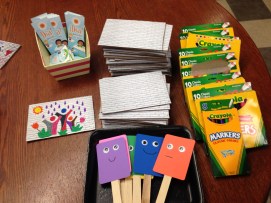
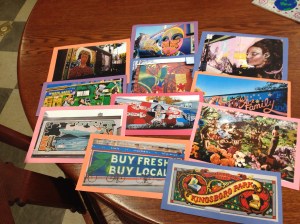
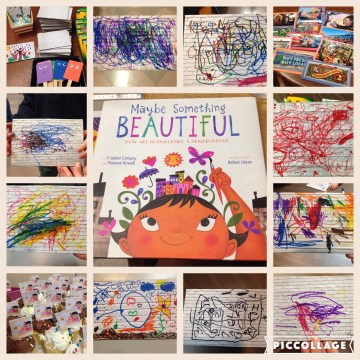
Mini-murals, markers, story time props, and Día bookmarks.

Mini-murals, markers, story time props, and Día bookmarks

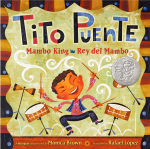
I want to focus this post on the art bilingual story time, as a way to bring attention to how to incorporate your community and neighborhood into your program while bringing a picture book to life. Last year I did a musical bilingual story time where I read Tito Puente, Mambo King/Tito Puente, Rey del Mambo written by Monica Brown and illustrated by Rafael López, used guajiras, rumbas, and mambos songs, and each child made and decorated small timbales made out of tuna cans. So which Latinx picture book published in the last 12 months would inspire me to offer a great bilingual story time, along with activities and a craft inspired by it t? At the American Library Association Midwinter Conference held at the beginning of the year, I saw and read a display copy of the picture book Maybe Something Beautiful: How Art Transformed A Neighborhood written by F. Isabel Campoy and Theresa Howell, and illustrated by Rafael López, and, right there and then, I knew I had found the perfect match.  

Through an inspiring tale and vibrant illustrations, Maybe Something Beautiful introduces readers to Mira, a girl who lives “in the heart of a gray city” and who enjoys doodling, drawing, coloring, and painting. She considered herself an artist and liked to gift her illustrations to people from her neighborhood. She even taped and “gifted” one of her paints to a dark wall around her block. One day she meets a muralist, and learns the magic of painting murals, and the power of bringing together the whole community to create something beautiful. The book is based on a true story about an initiative by Rafael López, the illustrator of the book, and his wife Candice López, a graphic designer and community leader, as a way to bring people together and transform their neighborhood into a vibrant one.

Photos of the murals found around my neighborhood

Photos of the murals located near my library and neighborhood.

After reading the book, I immediately thought of the different murals around my neighborhood and how they are reflective of its people: different generations of Latinx communities, artists and activists, local businesses, streets, and heterogeneity. But also a community facing gentrification, fighting for housing, economic, and racial justice. A neighborhood with a sense of community, like the one I saw in Maybe Something Beautiful and one I wanted to show to my toddlers at story time. 

I started the Día Art Bilingual Story Time by welcoming everyone, giving Día stickers to each child, and explaining how this was a special bilingual story time because we were celebrating the 20th Anniversary of Día. I explained what Día was, how it started, and how we were joining a nationwide celebration. I introduced my special guest, a local artist and art teacher, who was going to read with me and who was going to serve as the art facilitator. As a warm-up I sang a couple of songs: Buenos Días, ¿Cómo Estás?; Wake Up [different body parts]; and If You Are Wearing [insert color] Today, Say Hooray! Then we started with Book Fiesta! Celebrate Children’s Day/Book Day; Celebremos El Día De Los Niños/Día de Los Libros written by Pat Mora and illustrated by Rafael López, where I read the Spanish text and the special guest the English one. I followed with more songs: Everyone Can March; Colors, Colors Everywhere; and Where is [insert color name in Spanish]? Once we finished singing and everyone got back to their spot, I read Maybe Something Beautiful while the art facilitator was setting up the tables for the craft.

After reading the book, I talked a little bit about our neighborhood and murals and did a guessing game with them. I printed out pictures I took of the different murals around our neighborhood and children and adults (adults were really into this) started guessing where the murals were located. Some of them were tricky, but with others, children were excited to shout where they were. I always like to leave the craft as a sort of final surprise and ask them what they think we are going to do. The craft was a mini-mural made out of 4” x 8” cardboard with a brick or wood wall pattern to simulate a real wall they will paint on. At first, I thought of giving them watercolors or tempera, but finally opted for markers because they are less messy for the 0-4 crowd. Children had fun painting their mini-murals and proudly showed their creation to everyone in the room.IMG_7856

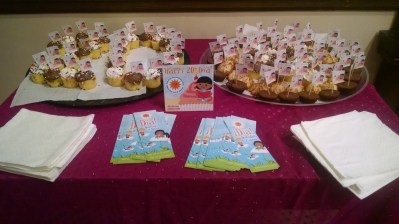
We ended the program sharing mini cupcakes, brownies, and coconut macaroons (with vegan, gluten-free, sugar-free options) and all of them had mini flags with the “Día Turns 20” Logo. They all gathered together to enjoy the special treats, to chat with one another, and show each other their mini-murals. Some parents and caregivers reached out to me and expressed how much fun they and their child had. Others used the opportunity to tell me how their child likes to draw on their wall at home, and others told me how now they were worried their child would get inspired to draw and paint on their walls. Rest assured, the kids and adults got together to recognize the power of community and how paintings on the walls do bind us together in a communal experience of recognition. In that sense, any drawing on the house wall is a potential future of community building. Be it a mess or something more detailed, the drawings on the wall are definitely something beautiful.

Día Turns 20!

Día Turns 20!


SujeiLugoSujei Lugo was born in New Jersey and raised in her parents’ rural hometown in Puerto Rico. She earned her Master’s in Library and Information Science degree from the Graduate School of Information Sciences and Technologies at the University of Puerto Rico and is a doctoral candidate in Library and Information Science at Simmons College, focusing her research on Latino librarianship and identity. She has worked as a librarian at the Puerto Rican Collection at the University of Puerto Rico, the Nilita Vientós Gastón House-Library in San Juan, Puerto Rico, and the University of Puerto Rico Elementary School Library. Sujei currently works as a children’s librarian at the Boston Public Library. She is a member ofREFORMA (The National Association to Promote Library Services to Latinos and the Spanish-speaking), American Library Association, and Association of Library Service to Children. She is the editor of Litwin Books/Library Juice Press series on Critical Race Studies and Multiculturalism in LIS. Sujei can also be found on Twitter, Letterboxd and Goodreads.

Celebrating Pura Belpré Winners: Spotlight on Rafael López


PuraBelpreAwardThe Pura Belpré Awards turns 20 this year! The milestone will be marked on Sunday, June 26, from 1:00-3:00 p.m. during the 2016 ALA Annual Conference in Orlando, FL. According to the award’s site, the celebration will feature speeches by the 2016 Pura Belpré award-winning authors and illustrators, book signings, light snacks, and entertainment. The event will also feature a silent auction of original artwork by Belpré award-winning illustrators, sales of the new commemorative book The Pura Belpré Award: Twenty Years of Outstanding Latino Children’s Literature, and a presentation by keynote speaker Carmen Agra Deedy.

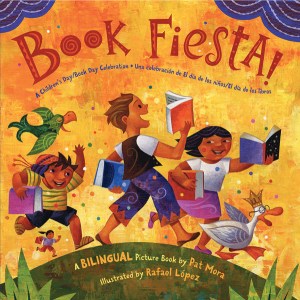
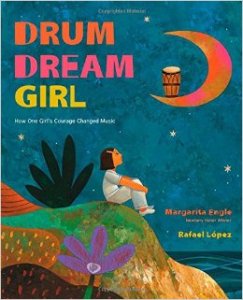
hires-cover-fiesta  Drum Dream GirlLeading up to the event, we will be highlighting the winners of the narrative and illustration awards. Today’s spotlight is on Rafael López, the winner of the 2010 Pura Belpré Illustration Award for Book Fiesta! Celebrate Children’s Day/Book Day, Celebremos El dia de lo niños/El día de los libros, written by Pat Mora, and the 2016 Pura Belpré Illustration Award for Drum Dream Girl, written by Margarita Engle. We featured Drum Dream Girl in a book talk and in a special report about a library event.
Tito book  Cazuela  Celia

Rafael also received a Pura Belpré Illustration Honor three times: In 2014, for Tito Puente: Mambo King/Rey de Mambo, written by Monica Brown; in 2012, for The Cazuela that the Farm Maiden Stirred, written by Samantha R. Vamos; in 2006, for My Name is Celia/Me Llamo Celia: The Life of Celia Cruz/ La Vida de Celia Cruz, written by Monica Brown.

Book Fiesta!

Illustration Review by Lila Quintero Weaver

Book Fiesta! Celebrate Children’s Day/Book Day/ Celebremos El día de los niños/El Día de los libros, written by Pat Mora and illustrated by Rafael López, is a gem of a picture book that offers its wonders in two languages, English and Spanish.

Book Fiesta! exuberantly proclaims the joys of reading and introduces the concept of Día, an annual celebration of literature for children, founded by Pat Mora in 1996, and observed through special events by many libraries nationwide.

What Mexican painter, muralist, and illustrator Rafael López brings to a picture book must be seen and not just read about. His mastery as an illustrator extends to every aspect of the art: a strong concept, dynamic design, brilliant execution, and irresistible charm. It’s no wonder that the Pura Belpré committee recognized his work. Let’s take a closer look.

BookFiests_03

Used by permission from HarperCollins Children’s Books.

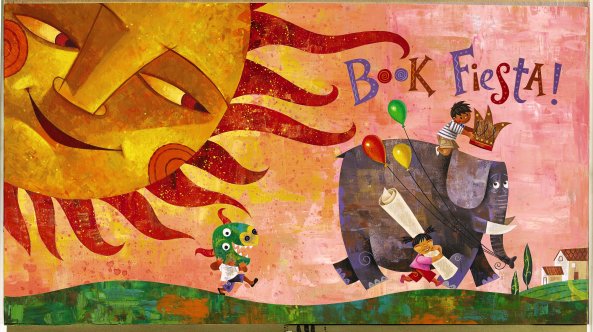
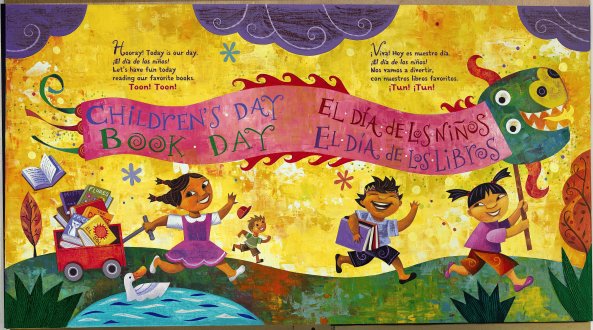
You don’t have to be an artist to appreciate López’s expert techniques, including his winning combination of hard-edged shapes and saturated colors, delivered through heavily textured paint and splashy accents, and supported by a golden undertone that unifies all of the spreads. In the pages above, a huge, friendly sun smiles down on the children, accompanied by a trotting elephant. Such charm!

BookFiests_06

Used by permission from HarperCollins Children’s Books.

López champions diversity in his illustrations. Here, a parade of children follows a Chinese dragon whose tail doubles as a banner, announcing Día to one and all. Note the diversity represented in the races of the children. One child pulls a wagon full of books bearing titles in English and Spanish.

BookFiests_08

Used by permission from HarperCollins Children’s Books.

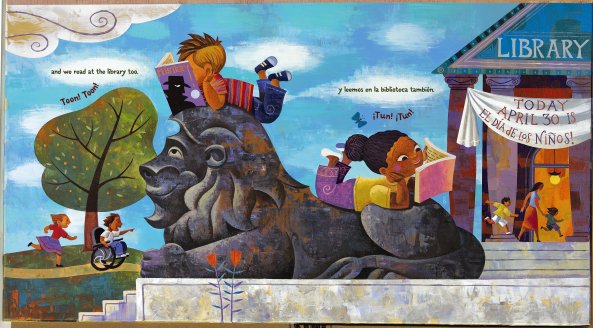
Outside the library, even the stone lion looks pleased to take part in Día. The children relaxing on the marble beast are immersed in their books. In the background, a boy in a wheelchair eagerly makes his way to the library—another evidence of the illustrator’s awareness of diverse representation.

BookFiests_15

Used by permission from HarperCollins Children’s Books.

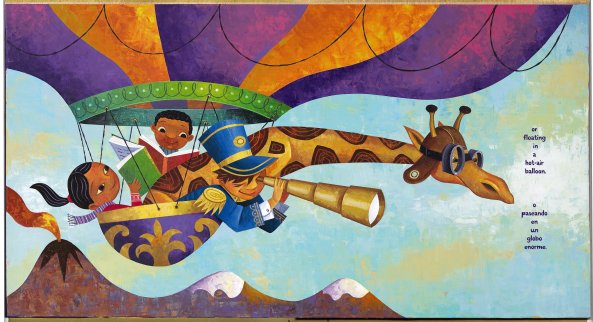
López amplifies Pat Mora’s words through many inventive means. Here, in a depiction of the glorious adventures made possible by reading, a hot-air balloon floats over a mountainous backdrop, complete with a smoking volcano. The pilot is a giraffe in old-fashioned aviator goggles. Elsewhere, books transport children by other means: on an airplane, a train, an automobile, a rowboat, on the back of an elephant, and even in a submarine. Simply put, stories hold the power to magically ferry readers to far-away places and imaginary lands. López brings this virtual travel to life through an enthralling variety of presentations and an engaging level of detail.

Fiesta_25

Used by permission from HarperCollins Children’s Books.

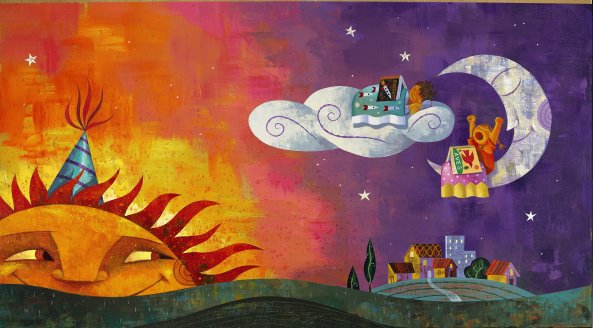
Reading in bed—what better way is there to top off a busy day? In a color-drenched scene, López presents two children indulging in this lovely pastime. One child, floating on a bed of clouds, has already fallen asleep, while the other is midway through a yawn. Her bed is supported by the curve of a crescent moon. López’s trademark brushwork fills the sky with vivid sunset hues that transition to the deep violet of late evening. It’s all grounded by rolling hills, painted in shades of teal, a color appropriate to the dying light. In the distance, the windows of buildings twinkle with warmly lit interiors, while cutout stars punctuate the heavens. Dreamy.

The richness of each spread in Book Fiesta! invites long looks and repeated views that reward readers with the new discoveries. Every page turn reveals a refreshing surprise, backgrounded by a palette that spans the rainbow. Thanks to Pat Mora’s wonderful vision and Rafael López’s dynamic illustrations, this picture book offers a perennial delight to readers of all ages.

Book Fiesta! Celebrate Children’s Day/Book Day; Celebremos el día de los niños/el día de lo libros. Text copyright ©2009 Pat Mora. Illustration copyright ©2009 Rafael López. Images used by permission of HarperCollins Children’s Books.

RafaelAbout the illustrator:

Raised in Mexico City, Rafael López makes his home part of the year in San Miguel de Allende, Mexico, as well as in San Diego, California. He credits Mexican surrealism as a major artistic influence. Besides his Pura Belpré medals and honors, Rafael is also a double recipient of the Américas Award. For more about his work, including poster illustrations and a mural project in San Diego that is the subject of a new picture book, Maybe Something Beautiful, visit his official website.

TEACHING TIPS:

  • Lead children in an imagination exercise based on the reading spots depicted in Book Fiesta. What are some places that you can take a book to? What are some places that a book takes you to? Ask students to include real-life and imaginary destinations.
  •  Devise a book parade, featuring wagons loaded with books, masks or disguises based on favorite characters, and banners heralding Día, or another book-related holiday or theme.
  • Invite children to create illustrations based on López’s style. This can include painted backdrops and cutout figures, with an emphasis on strong shapes and bright colors.

Watch Rafael López’s thank you video for his most recent Pura Belpré medal, for Drum Dream Girl:


Celebrating Pura Belpré Winners: Spotlight on Writer & Illustrator Yuyi Morales


PuraBelpreAwardThe Pura Belpré Awards turns 20 this year! The milestone will be marked on Sunday, June 26, from 1:00-3:00 p.m. during the 2016 ALA Annual Conference in Orlando, FL. According to the award’s site, the celebration will feature speeches by the 2016 Pura Belpré award-winning authors and illustrators, book signings, light snacks, and entertainment. The event will also feature a silent auction of original artwork by Belpré award-winning illustrators, sales of the new commemorative book The Pura Belpré Award: Twenty Years of Outstanding Latino Children’s Literature, and a presentation by keynote speaker Carmen Agra Deedy

Leading up to the event, we will be highlighting the winners of the narrative and illustration awards. Today’s spotlight is on Yuyi Morales, winner of the 2015 Pura Belpré Illustration Award for Viva Frida, the 2014 Illustration Award for Niño Wrestles the World, the 2009 Illustration Award for Just in Case, the 2008 Award for Illustration for Los Gatos Black on Halloween, and the 2004 Illustration Award for Just a Minute: A Trickster Tale and Counting Book.

We have already covered Viva Frida and Niño Wrestles the World. Below, we highlight the others:


Reviews by Cecilia Cackley

Descriptions (all from Goodreads): Los Gatos Black on Halloween: Under October’s luna, full and bright, the monsters are throwing a ball in the Haunted Hall. Las brujas come on their broomsticks. Los muertos rise from their coffins to join in the fun. Los esqueletos rattle their bones as they dance through the door. And the scariest creatures of all aren’t even there yet! This lively bilingual Halloween poem introduces young readers to a spooky array of Spanish words that will open their ojos to the chilling delights of the season.

Just a Minute: A Trickster Tale and Counting Book: In this original trickster tale, Señor Calavera arrives unexpectedly at Grandma Beetle’s door. He requests that she leave with him right away. “Just a minute,” Grandma Beetle tells him. She still has one house to sweep, two pots of tea to boil, three pounds of corn to make into tortillas — and that’s just the start! Using both Spanish and English words to tally the party preparations, Grandma Beetle cleverly delays her trip and spends her birthday with a table full of grandchildren and her surprise guest. This spirited tribute to the rich traditions of Mexican culture is the perfect introduction to counting in both English and Spanish. The vivacious illustrations and universal depiction of a family celebration are sure to be adored by young readers everywhere.

Just in Case: Yuyi Morales takes us on a new journey with Señor Calvera, the skeleton from Day of the Dead celebrations. Señor Calvera is worried. He can’t figure out what to give Grandma Beetle for her birthday. Misunderstanding the advice of Zelmiro the Ghost, Señor Calvera decides not to get her one gift, but instead one gift for every letter of the alphabet, just in case. Una Acordéon: An accordion for her to dance to. Bigotes: A mustache because she has none. Cosquillas: Tickles to make her laugh… only to find out at the end of the alphabet that the best gift of all is seeing her friends.

MY TWO CENTS: First of all, I want to take a moment and talk about just how much of a force Yuyi Morales is in picture book illustration. She has won a third of the 15 Pura Belpré Medals for illustration that have been awarded since 1996. In addition, she has won two illustration honors and one narrative honor, bringing her total to eight awards, nearly twice as many as any other artist and all since 2004. That is a huge achievement, and a testament to the vision, craft, and beauty that Morales puts into her work. There is no one quite like her working in picture books today.

All three of these picture books feature Morales’ acrylic paintings, with touches of the mixed-media that has become more prominent in her recent work. Each also has a fantastical element, from the various monster creatures in Los Gatos Black on Halloween to Señor Calavera in Just a Minute and Just in Case.

In Los Gatos Black on Halloween, the colors are layered, allowing some characters to be visible through the transparent ghosts and building up as more and more ghostly characters join what eventually becomes the monster ball in an old abandoned house. The color palette is dark and rich, contrasting the glowing moon and night sky with colored tombstones and the interior of the old mansion. Morales plays with scale and perspective to lend an otherworldly look to the spreads; sometimes we only see a pair of legs dangling over a broomstick or the round face of a ghost as its tail extends right off the page.


The colors in Just a Minute are brighter and the spreads less crowded than Los Gatos Black on Halloween, but the story they tell is just as dynamic. This was Morales’ first project as both author and artist, and she keeps the story moving at a fast pace as Grandma goes from cleaning to cooking, to decorating. Subtle touches of color make Señor Calavera a less scary figure for the youngest readers, including the flowers for eyeballs and the expressive mouth that finally turns into a smile. As befits a heroine who is using action to delay Señor Calavera, Grandma Beetle’s poses are precise and sharp, whether she is placing cheese in a frying pan or leaning over to put pots in the oven. Grandma’s eyes and face express her cleverness and care as she watches Señor Calavera from across the room or gives a wink while chopping up fruit. Perspective shifts reinforce the upside-down nature of this story; the floor of Grandma’s house seems to tilt as we first see Señor Calavera in close-up, peeking over her shoulder and then far away in the corner of the room, stamping his foot in frustration. The little cat’s reactions to Señor Calavera are a humorous touch, and readers will enjoy finding it on each spread, looking curious, tentative or scared, depending on the page. Readers will love the final note left by Señor Calavera and cheer for Grandma Beetle, who was so resourceful in buying herself a little more time on Earth.

Morales brings more texture and mixed media to the illustrations in Just in Case, her second effort as both author and artist. Perhaps because most of the action in the book takes place in the cemetery, rather than in Grandma’s house, the backgrounds are looser and the characters float around on the page. The new character Zelmiro the ghost blends in with the background color on each spread as he advises Señor Calavera on what to give Grandma Beetle for her birthday. The list of presents grows with the alphabet, and Morales keeps things interesting by not just including objects such as the accordion but also actions such as cosquillas (tickles) and natural phenomena like niebla (fog). One of my favorite things about this book is that it follows the Spanish, rather than the English alphabet, including letters I learned as a child, like ‘Ch’, ‘Ll’ and ‘Ñ’. Depending on where you are in the Spanish-speaking world, ‘ch’ and ‘ll’ aren’t taught as separate letters anymore, so it was nice to see them here! Some of the presents are words commonly taught in Spanish classes, such as ‘escalera’ or ‘semilla,’ but others are more colloquial and region-specific like ‘granizado’ and ‘ombligo.’ The specificity in both language and image are lovely. Careful readers will note that the historieta (comic book) that Señor Calavera gives Grandma is a handmade version of Morales’ earlier book Just a Minute and will also find the reason for the spectacular bicycle crash that ruins all the presents.

From ghosts to skeletons to grandmothers cooking elaborate birthday feasts, these three picture books showcase Morales’ talents at depicting both the light and dark in Latino culture.

TEACHING TIPS: Los Gatos Black on Halloween is a wonderful choice for a storytime, especially events connected to the holiday. Both Just a Minute and Just in Case are also perfect for reading aloud, as well as excellent teaching tools for counting and the alphabet. Morales has various activities for mask and puppet making on her website and the actions of Just a Minute in particular are perfect for acting out with younger readers. Just in Case is an excellent mentor text for classes working on writing their own culture-specific alphabet books. Just a Minute could also be used as a writing tool, with students inventing their own ways of making Death wait just a little longer.

ABOUT THE AUTHOR:
Yuyi Morales
is a Mexican author, illustrator, artist, and puppet maker. She has a bachelor’s degree in Psychology and Physical Education from the University of Xalapa, México and used to host her own Spanish-language radio program for children in San Francisco, California.She has won numerous awards for her children’s books, including the Caldecott Honor for Viva Frida, Tomás Rivera Mexican American Children’s Book Award for Just a Minute: A Trickster Tale and Counting Book (2004) and Los Gatos Black on Halloween (2008), the Pura Belpré Author Honor for Just in Case: A Trickster Tale and Spanish Alphabet Book (2009), the Pura Belpré Illustrator Award for Viva Frida (2015), Niño Wrestles the World (2014) Just a Minute: A Trickster Tale and Counting Book (2004), Just in Case: A Trickster Tale and Spanish Alphabet Book (2009) and Los Gatos Black on Halloween (2008), and Pura Belpré Illustrator Honor for My Abuelita (2010) and Harvesting Hope: The Story of Cesar Chavez (2004). Morales divides her time between the San Francisco area and Veracruz, Mexico. Her next picture book, Thunder Boy Jr. (written by Sherman Alexie), will be published in May 2016.

RESOURCES:

Activities with Señor Calavera on Morales’ website: http://www.yuyimorales.com/muerte.htm

Teacher’s Guide from Chronicle: http://www.chroniclebooks.com/landing-pages/pdfs/Just_A_min.pdf

Americas Award resources: http://www.lindakreft.com/Americas/pdf/voices_minute.pdf

Elementary lesson on culture using Just in Case: http://team33culture.weebly.com/uploads/8/9/8/4/8984769/lesson_plan.pdf

Vamos a Leer blog on Los Gatos Black on Halloween: https://teachinglatinamericathroughliterature.wordpress.com/2014/10/22/en-la-clase-los-gatos-black-on-halloween-2/

Recent PW interview: http://www.publishersweekly.com/pw/by-topic/childrens/childrens-authors/article/63359-yuyi-morales.html

And as a bonus, here is a video from Yuyi about why she loves picture books:


Cackley_headshotCecilia Cackley is a performing artist and children’s bookseller based in Washington DC where she creates puppet theater for adults and teaches playwriting and creative drama to children. Her bilingual children’s plays have been produced by GALA Hispanic Theatre and her interests in bilingual education, literacy, and immigrant advocacy all tend to find their way into her theatrical work. You can find more of her work at www.witsendpuppets.com.