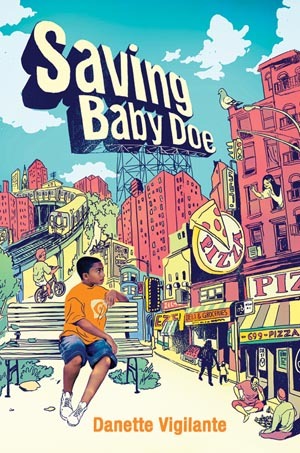
Book Review: Saving Baby Doe by Danette Vigilante

Saving Baby DoeBy Cindy L. Rodriguez
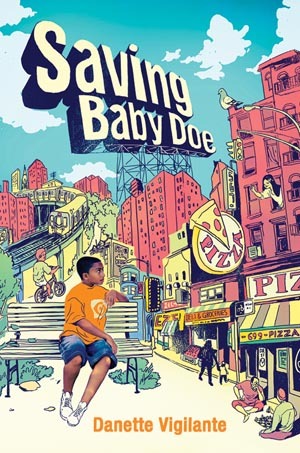
On Monday, author Danette Vigilante wrote about dream seeds and how she turned a teacher’s comment into a challgenge to become a better reader. Today, we celebrate her latest novel Saving Baby Doe.

DESCRIPTION FROM THE BOOK JACKET: Lionel and Anisa are the best of friends and have seen each other through some pretty tough times–Anisa’s dad died and Lionel’s dad left, which is like a death for Lionel. They stick together no matter what. So when Lionel suggests a detour through a local construction site on their way home one day, Anisa doesn’t say no. And that’s where Lionel and Anisa make a startling discovery–a baby abandoned in a Porta-Potti. Anisa and Lionel spring into action. And in Saving Baby Doe, they end up saving so much more.

MY TWO CENTS: Danette Vigilante pulls the reader right into this novel from the opening scene of a scared young woman is giving birth to her child in a Porta-Potti on a construction site. Soon after, Lionel and Anisa discover the baby, after playing in the closed-off site, and they decide to save “Baby Doe.” This is a middle grade novel that addresses some tough issues. In addition to the abandoned baby, the author explores the effects on children of absentee fathers and drug dealing. At the heart of it all is Lionel, who tries to do the right thing in the worst of situations.

While the issues are serious, Lionel responds to them as only a middle-schooler would. The real possibility of severe consequences doesn’t prevent him from launching into an ill-conceived plan to retrieve the baby from the hospital so that she doesn’t end up in foster care. While reading, I caught myself thinking, “Lionel, what are you doing? This is a bad idea!” Of course, he knows this, too, but he goes ahead anyway. In this way, Vigilante perfectly captures the middle school mind and creates tension through the narrative.

Then, there’s the end of Chapter 10, which I totally did not see coming. I probably should have, but I was wrapped up in Lionel’s plan to steal the baby and sell drugs to support her and then…chapter 10! Whoa! Well played! I’m not going to spoil it, but the story takes an important turn. That’s all I’ll say about that.

One of the many things I loved about this novel was the diversity within Lionel’s community. They all struggle financially, but they’re all individually-drawn people. Some work hard at “regular” jobs, while others choose quick money. Some are ultra-religious, while others are not. Some of the kids go to public school, while others go to the “genius” private school. Characters vary in terms of age, race, ethnicity, and experience, all of which creates a rich, real setting for Lionel and Anisa story to unfold.

TEACHING TIPS: In addition to all of the expected language arts lessons, this novel would work well in a health class since it deals with sex education (a lecture given by Lionel’s mom), child birth, the possible results of not seeking medical care, and the Safe Haven laws. Fiction is often reserved for language arts classes, but this type of realistic novel is ideal for blending fiction and nonfiction in health, where teachers and students tackle these serious issues.

LEXILE: N/A

Danette_Vigilante_head_shot_high_resAUTHORDanette Vigilante grew up in the Red Hook Houses in Brooklyn, New York. She now resides in Staten Island with her husband, two daughters, two puppies and a cat with a bad attitude. Danette is the author of THE TROUBLE WITH HALF A MOON, a 2012-2013 Sunshine State Young Readers award nominee, and SAVING BABY DOE.

FOR MORE INFORMATION about Saving Baby Doevisit your local library or book store. Also, check out IndieBound.org,  GoodreadsAmazon.com, and Barnes and Noble.com.


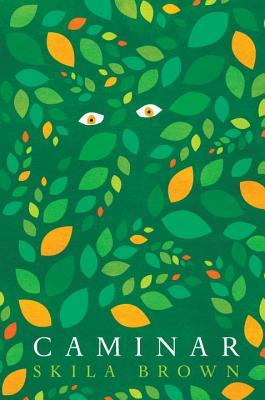
Book Review: Caminar by Skila Brown

Caminar

By Cindy L. Rodriguez

On Monday, we interviewed first-time author Skila Brown about her novel in verse, Caminar. Check out the Q&A for information about her research and writing and her decision to tackle a subject outside her own racial/ethnic experience. Today, we celebrate her debut.

DESCRIPTION FROM THE BOOK JACKET: Carlos knows that when the soldiers arrive with warnings about the Communist rebels, it is time to be a man and defend the village, keep everyone safe. But Mama tells him not yet–he’s still her quiet moonfaced boy. The soldiers laugh at the villagers, and before they move on, a neighbor is found dangling from a tree, a sign on his neck: Communist.

Mama tells Carlos to run and hide, then try to find her…Numb and alone, he must join a band of guerillas as they trek to the top of the mountain where Carlos’s abuela lives. Will he be in time, and brave enough, to warn them about the soldiers? What will he do then? A novel in verse inspired by actual events during Guatemala’s civil war, Caminar is the moving story of a boy who loses nearly everything before discovering who he really is.

MY TWO CENTS: Skila Brown’s debut novel in verse tells the heartbreaking story of Carlos, who is forced from his devastated village and treks up a mountainside to save his grandmother and her neighbors from a similar fate.

One thing that struck me most was Brown’s ability to create a touching coming-of-age narrative set in such tragic events. The novel is not graphic, although the topic is brutal. And while it is a civil war, fueled by politics, Brown does not support or condemn any side. Instead, more than anything, it’s about the ability of the human spirit to survive and persevere even after an unexpected, horrific loss.

A moment that grabbed me by the heart was when Mama tells Carlos to go into the woods and then find her later. He does so, obediently, but we just know there won’t be a later, that this is her last protective act as his mother. Another was when the children wave at the passing helicopter, as children will do when they see something interesting, but they don’t grasp the imminent danger signaled by this flying machine’s presence. From the novel:

They flew

over our village many times, searching the mountains for

something. We didn’t care,

just reached our arms as high as we could, stretched

toward the sky, wanting

to be seen.

We did not know to be

afraid, did not know they were a storm

of death, searching

for a place to rain.

Brown brilliantly combines history, fiction, and poetry in this novel, which she dedicates to the “memory of the more than 200,000 people who were killed or disappeared in Guatemala between 1960 and 1996.” These numbers are staggering, and I often questioned while reading Caminar why I didn’t know more about this 36-year civil war. This is definitely a book I will have on my classroom shelf and recommend to my middle school social studies and language arts teacher-friends.

TEACHING TIPS: Caminar would fit perfectly into a middle school social studies or language arts curriculum. Students could read this in addition to nonfiction articles or essays about the war and its effects on Guatemalan villages. Students could then compare the nonfiction pieces to Caminar to determine what’s history in the novel and what’s fiction.

In a social studies class, this book could be used in a unit about the causes of war and its effects on a country. Students could read other, similar novels or essays and compare the experiences.

Any of the individual poems could be read closely multiple times to discuss word choice and the use of figurative language in poetry.

Students could write a short story in poems to learn first hand the difficulty involved with writing individual poems that also tell a story when read together.

LEXILE: N/A

skilaAUTHOR: Skila Brown has an MFA in writing for children and young adults from Vermont College of Fine Arts. Caminar is her debut novel. She lives in Indiana with her husband and their three children.

FOR MORE INFORMATION about Caminar, visit your local library or book store. Also, check out Candlewick PressIndieBound.org,  GoodreadsAmazon.com, and Barnes and Noble.com.


We are giving away two copies of Caminar!! Go to a Rafflecopter giveaway to enter for free. You can enter once per day through this week. Two winners will be selected Saturday morning.

Debut Author Skila Brown’s Novel in Verse Centers on Guatemalan Civil War

By Cindy L. Rodriguez

CaminarI recently interviewed debut author Skila Brown for the Fearless Fifteeners site, which helps to highlight our debut author friends in the OneFour KidLit group. Most of the interview is reprinted here, but I added the final question in particular because of our audience and our mission. Skila is not Guatemalan, yet she wrote a moving narrative about a young Guatemalan boy in 1981 caught in civil war. The last question addresses the concern about writing with authenticity outside of one’s own ethnic/racial experiences.

First, a little about her novel, Caminar, which was released March 26.

Carlos knows that when the soldiers arrive with warnings about the Communist rebels, it is time to be a man and defend the village, keep everyone safe. But Mama tells him not yet—he’s still her quiet moonfaced boy. The soldiers laugh at the villagers, and before they move on, a neighbor is found dangling from a tree, a sign on his neck: Communist.

Mama tells Carlos to run and hide, then try to find her. . . . Numb and alone, he must join a band of guerillas as they trek to the top of the mountain where Carlos’s abuela lives. Will he be in time, and brave enough, to warn them about the soldiers? What will he do then? A novel in verse inspired by actual events during Guatemala’s civil war, Caminar is the moving story of a boy who loses nearly everything before discovering who he really is.

“Exquisitely crafted poems are the basis of an unusually fine verse novel…”

–Horn Book, starred review

“…a much-needed addition to Latin American-themed middle grade fiction.”

–School Library Journal, starred review

Me: Your bio says you lived in Guatemala for a bit. Did your experience there spark interest in this topic? Did anything else inspire you to write this particular story?

Skila: We moved to Guatemala after I’d finished the novel, though I revised it some while we were there. This novel actually came out, reluctantly and painfully, after I’d spent about a decade reading about Guatemala’s history, especially the history of the violence there that peaked in the early 80s. I had no intention of writing about it, but that’s what ended up happening. I certainly felt inspired by accounts of survival that I read, but also felt a real desire to make sure other people knew about what had happened there.

Me: How extensive was your research? Did you run into any roadblocks when seeking information?

Skila: My research started out very organically—I was reading for pleasure and interest, not with the intention of gathering facts to write a story. When the story began, I had some pointed research to do, specific questions about language and geography and other details that I hadn’t already absorbed. It was hard to track down first person accounts of rural Guatemala during this time.

Right away I faced a tough decision about language. Although Carlos would have spoken Spanish in school, it wouldn’t have been his first language; it’s not what he would have spoken at home with his mother. In an earlier draft I envisioned using an indigenous language in the text, as well as Spanish—which would have likely been the way that Carlos could have spoken to someone like Paco, for example—but I was worried about being able to maintain accuracy and authenticity if I wrote the story that culturally specific. I also felt that an English speaking reader might struggle with the mixture of over four different languages in the same story. Definitely trying to balance authenticity with a reader’s connection was a constant struggle.

Me: Is your protagonist Carlos linked to anyone you came across during your research or does he represent the young men who survived that time?

Skila: Carlos isn’t based on any one person. In fact, I had the story down before I had a character at all, but I knew early on the main character was a child, that this was really, at its core, a coming of age story. In violent conflicts all over the world, it’s not uncommon for a handful of people to survive an attack on a village such as this, having scattered away during the chaos. I’d read about children who survived and felt really drawn to that story—how scary it must for a child to be on his or her own, how resourceful that child would have to be.

Me: The physical layout of the poems adds to the narrative. I’m glad I read this one on paper instead of listening to it on audio. The visual really complements the content. Is that something you consider in the writing phase or is that developed in editing?

Skila: This was something I worked a lot on in revision. I wrote this story while I was a grad student and while I was working with poets Julie Larios and Sharon Darrow. Sharon, in particular, encouraged me to play around with shape and the placement of lines on a page. White space is a poet’s tool, and I liked thinking about how I could use it. Typically I draft a poem by hand and it has no shape or form in the beginning, I’m just thinking about the content and the words themselves. But as I revise that poem and before I’m ready to put it into the computer, I try to think about what shape would serve it best. It’s easy to play around with form and shape; it’s harder to use those both deliberately.

Me: Tell us about your publication journey. Some people get deals while still in grad school, while others query for years. What’s your story?

Skila: While I was in grad school, Candlewick was kind enough to offer me a scholarship award for a picture book text I wrote called Slickety Quick. It’s a non-fiction/poetry blend about sharks and it’s scheduled to be out with them in 2016. This really opened a door for me with them, as they also asked to see my novel. I think the key for writers is to submit away—but then put it out of your mind and dive into the next project. Good news comes faster when you’re looking the other way.

Me: Did you have any additional considerations while writing about something outside your racial/ethnic experience? Did you do anything in particular to “get it right” or did you approach it the same way you’d approach any other book project?

Skila: I was very concerned about this, Cindy. This concern kept the story in my head for two years, before I felt brave enough to put it on paper. This concern kept the finished manuscript on my computer for some time before I was ready to send it out to query. It’s something I’m concerned about still. Writing outside our cultures is a very risky thing for writers to do because it’s so easy to get it wrong.

However. Everyone this month is talking about The Study. And if only 6% of books published for kids in 2013 starred a character of color, then it’s past time for us to think about how to remedy that. If writers are going to play our part in addressing this problem, we need to look hard at how we can do this responsibly.

I approached this with a lot of research, a goal of authenticity, and a strong dose of humility. I had multiple people vet my story and offer suggestions. I thought hard about stereotypes and language and how best to portray the story with the most respect I could give it. I also tried to balance the “otherness” of Carlos with what will connect him to a reader today, what makes him the same as a twelve year old boy, reading this story in Chicago, for example. As adults we tend to notice the differences in characters and cultures, but kids are great about finding what’s the same and really connecting to the character. I hope they are able to do that with Carlos.
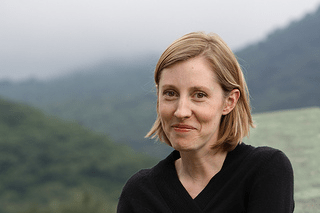
skilaSkila Brown holds an MFA from Vermont College of Fine Arts. She grew up in Kentucky and Tennessee, lived for a bit in Guatemala, and now resides with her family in Indiana.

Come back on Thursday, when we will spotlight Caminar in our Libros Latin@s section!

We are giving away two copies of Caminar!! Go to a Rafflecopter giveaway to enter for free. You can enter once per day through this week. Two winners will be selected Saturday morning.

2014 Reading Challenge: March

We continue to be blown away by the number of books being read each month by participants of our 2014 Latin@s in Kid Lit Challenge. Thank you to everyone for participating in the challenge and purposely selecting books by/about/for Latin@s. Remember, you can join the challenge any time during the year, and you’re not required to review–only read and enjoy! If you do post a review somewhere, we will link it to the book covers below. If you choose not to review, we will link the covers to Goodreads. This month, we’d like to stand up and applaud Elisabeth Ellison and Cecelia Cackley for their vigorous reading (13 books total!) And since April is National Poetry Month, we suggest you try some novels in verse this month!

A note to participants: As you complete books, please send us the information, so we can share what you’re reading each month.

13515320  6603032  15814459  5982454  10564957  18079822  15798660  11431896  1294347  14342632  13501282  1816693511438326  1016493  18938127 18318638  6098251  255189  9373385  1372657  1807231  18651917  15937128  6673243  1065256  1076237  18318005  8220585  652180  7095181  15818046  1028659  18249428

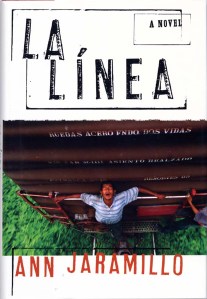
Book Review: La Línea by Ann Jaramillo

La Linea imageBy Lila Quintero Weaver

DESCRIPTION FROM THE BOOK JACKET: When fifteen-year-old Miguel leaves his rancho deep in Mexico to migrate to California across la línea, the border, his life is about to begin. Or so he thinks.

MY TWO CENTS“It’s been six years, eleven months and twelve days since I left to go north across la línea. It’s time for you to come.” So reads the note that Miguel receives from his father on his fifteenth birthday. During the long separation (his mother has also emigrated), Miguel, his grandmother, and sister, Elena, 13, eke out a meager existence in drought-stricken San Jacinto, Mexico. Surely life holds more than this! In the note, Papá instructs Miguel to pay a visit to Don Clemente, the wealthy patrón of the area. Years back, Papá rescued Don Clemente from a house fire. Now the old man repays that debt by funding Miguel’s flight to El Norte.

The arduous journey across la línea involves several modes of travel: by bus, riding the roof of a freight train, and crossing the desert on foot. Miguel encounters a wide array of obstacles en route, including the unwelcome surprise that Elena is along for the journey, too. Despite a series of setbacks, the siblings and a helpful new acquaintance named Javier press on toward their dream. At one point, bandits decimate their resources. At another, Mexican officials send them packing south— all the way to the Guatemalan border, in fact. Next, the trio sneaks a ride north by clambering on the roof of a freight train. The risks involved can’t be overstated. Nicknamed mata gente (people killer), such trains are responsible for dismemberments and deaths, not to mention exposure to cold, heat, and roving bands of ruthless gangs. I won’t even begin to list the perils they encounter in the next leg of the journey, the desert.

I respect the authoritative voice behind this novel. Ann Jaramillo is an ESL instructor with many years’ exposure to the true, and often harrowing, stories of border crossings by Mexicans and Central Americans. Her depiction of the mechanics involved is well informed. She describes life before and during the flight to the United States effectively, and highlights the poverty and bleak opportunities on the Mexican side with convincing detail, within age-appropriate limits.

Readers will encounter frequent terms and phrases in Spanish, not always translated, but whose meanings are usually discernible through context.

TEACHING TIPSTeaching Books offers a detailed curriculum guide for La Línea.

Miguel and Elena’s immigrant journey reflects recent and ongoing sociopolitical conditions. More importantly, they add faces and human emotions to related current events. Students can use this novel as a jumping-off point for the investigation of true immigration stories. They can achieve better understanding of what motivates people to emigrate/immigrate by researching their own family histories, or by comparing the characters’ experiences with that of other Latino and non-Latino settlers of the Americas.

This is a good text for enhancing Spanish vocabulary. It can also be used to increase awareness of rural Mexican customs.

LEXILE: 650

AUTHOR: Ann Jaramillo lives in Salinas, California. La Línea is her first novel. Ms. Jaramillo’s intimate knowledge of the Mexican-American immigrant journey comes through her work as an instructor of English as a Second Language, and her marriage of many years to Luis Jaramillo, a lawyer of Mexican-American heritage who has served migrant farmworkers for decades. In the author’s note, she explains that the inspiration for writing La Línea came from accounts of perilous crossings that her middle-grade students shared with her.

For more information about La Línea visit your local library or bookstore. Also check out WorldCat.orgIndiebound.orgGoodreadsAmazon and Barnes and Noble.

A Note For Authors on Jumping Genres

By Stephanie Guerra

Writing in a new genre after successfully publishing a book (or books) can be intimidating; why change what works? Some agents and publishers actively discourage genre-hopping, while others are interested in quality rather than consistency or brand-building.

TORNI debuted in 2012 as a YA author of realistic fiction (Torn) and followed up in 2013 with a 90-degree turn to humorous, heavily-illustrated middle grade: Billy the Kid is Not Crazy. I have two more YA coming out next year and I’m finishing a picture book.

If you’re a writer drawn to similar genre shifts, I encourage you to follow your gut. The process can be both freeing and useful in developing range. You may have to rebuild your audience from scratch, which is intimidating. But you’ll end up with a broader audience, a reward in itself.

Billy the KidYou’ll also need to adjust your voice and mentality for your new audience. Transitioning from YA to MG, I had to get in touch with my booger-fart-joke side (it wasn’t that hard) and cut all edge out of my writing (a touch harder). Again, the work builds its own reward: increased range.

But I want to focus a spotlight on the positives, which I believe are the real essence of shifting genres. It’s a form of creative stretching, a way to access a different age or voice inside you, and a way to reengage with the “play” of writing. A YA author may discover a new sense of fun in MG or picture books. An MG author may find freedom in exploring the romance or more mature content possible in YA. A picture book author used to practicing economy with words may relish stretching out into a luxurious novel.

Consider one of the most beloved Latin@ authors of our times, Gary Soto. He’s produced excellent picture books, poetry, middle grade and YA novels, short stories, and adult works. Pam Muñoz Ryan, another Latin@ star, has ranged from picture books to award-winning YA. Jack Gantos, my personal hero, has created picture books, delightful middle-grade (Joey Pigza!), adult novels, and urban memoir.

Some other marvelous children’s authors who’ve changed genres: Madeleine L’Engle, Mark Twain, Roald Dahl, and Laurie Halse Anderson. Literary superheroes like E. B. White jumped from Charlotte’s Web to One Man’s Meat. Roald Dahl dabbled in memoir, adult short stories, suspense, erotica, and of course, children’s fiction. And C. S. Lewis wrote everything short of picture books. What better models could we have?

I like to view jumping genres, too, as an act of defiance to The Market. Conventional wisdom has it that it’s savvy to develop a brand and stick with it, to build an audience and churn out book-clones at the rate of one per year. Many authors do this very successfully, and there’s nothing wrong with it, if it’s fulfilling to the artist in question. But I’m unsettled by branding as a lens for the arts and as a concept imposed on authors by publishers. Branding seems to compete with the essence of what art is or should be. So I advocate stretching the brand. Or better yet, losing the term altogether.

I’d like to share a short (30 second) video of a really articulate 11-year-old reviewing my MG. Thank you, Garrison. Your review gives me confidence that jumping genres was the right choice.