
By Tracey Flores
“A woman who writes has power, and a woman with power is feared.” ~Gloria Anzaldúa
On an overcast and windy day in May, ten young girls and women–daughters, sisters, mothers and teachers–gathered in Mrs. Gonzalez’s 7th grade classroom for an afternoon of sharing, writing and storytelling. Nibbling on pepperoni pizza and pink frosted cookies, desks arranged in a small circle in the front of the room, we sat with folders, notebook paper, and pencils, writing a letter to our sisters or mothers. This letter was the culminating writing of an afternoon of drawing self portraits and writing how we see ourselves and how we see our sisters and mothers.
As the the pencils stopped and everyone came to their closing thoughts, I invited everyone to turn to their sister or mother and read the letter they had just written to them. As I walked around the room to lean in and listen, with permission, I noticed that these handwritten letters were filled with words of advice, encouragement, and promises. They were filled with the words that many times we are too shy or afraid to share for fear of ridicule or embarrassment.
Alexandria read, “Dear Mom, An advice I want to share with you is ‘Live life to the fullest.’”
Dede read to her older sister, “…I believe in you whatever you do.”
Estefania read to her daughter, “…my sweet little miss…just know everything you do big or small I am proud of you everyday.”
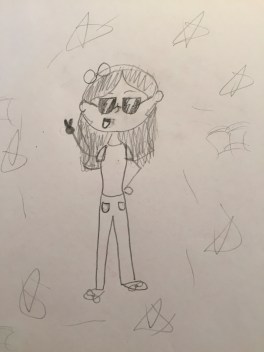
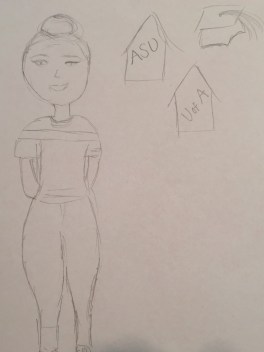
This vignette of an after-school writing workshop for middle school girls and their families illustrates the transformative power of creating space with and for our students and their families that honors their lived experiences and ways of knowing. For two weeks, we gathered in Mrs. Gonzalez’s room to engage in discussion, reflection, and storytelling on topics such as creating positive self-definitions, family, and education. Although our time together was brief, we created a supportive community of writers.
As a classroom teacher, and now as a PhD candidate, I have the privilege of working with families in after-school bilingual writing workshops, like the one in the vignette. In these writing workshops, students, their siblings and grandparents work side-by-side to tell, draw, write and share stories from their lived experiences. It is an opportunity for families to enter the classroom as experts and draw upon their cultural and linguistic resources to reflect on their lived experience through storytelling, drawing, and writing.
These bilingual family writing workshops are designed within a writing workshop framework, with a mini-lesson, writing time, sharing time, and a closing reflection. Each workshop begins with the reading and discussion of a bilingual picture book, poem, or short memoir. This text is carefully selected and serves multiple purposes. First, it is selected to introduce families to the theme of the workshop. Second, the topic of the text is considered in how families may relate to it or connect it to their own experiences, if the book is culturally relevant or rather recreates negative stereotypes. Lastly, the topics, writing, text structure, and organization are considered in how they might provide families with a powerful mentor text (Fletcher, 2011) for their own writing.
After the opening text is shared and discussed, I model my own writing by talking through what I am doing and thinking as I put drawing and writing on chart paper. Sometimes I model my brainstorm and other times I just draw and write. Then, I invite families to draw and write their own stories or poems. This is my favorite part, watching students and their families write and share their stories, many times for the first time with one another.
Over the years, in these workshops, families shared stories of celebrating Las Posadas with their family and community, stories of ranchos that stretched over acres in rural parts of México where they learned to tend the animals and to cherish all the resources of the tierra, and stories of special abuelitas who embraced them and loved them in that special way only an abuelita loves you.
As I wrote earlier in this post, in preparation for working with families in workshops, I always gather several texts in a variety of genres to use as mentor texts. Below is a short list that I have used as mentor texts in bilingual writing workshops with Latinx families in schools and community centers across Phoenix and Glendale in Arizona.
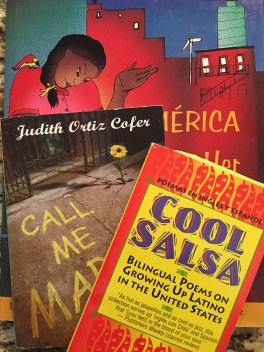 Alarcón, F. (2005). Poems to Dream Together/Poemas para sonar juntos. Illustrations by Paula Barragán. Lee & Low Books.
Carlson, L.M. (2013). Cool Salsa: Bilingual Poems on Growing Up Latino in the United States. Square Fish.
Cisneros, S. (1994). Hairs/Pelitos: A Story in English and Spanish from The House on Mango Street. Dragonfly Books.
Cisneros, S. (1994). La Casa en Mango Street. Translated by Elena Poniatowska. Vintage Books.
Cisneros, S. (1991). The House on Mango Street. Vintage Books
Costales, A. (2007). Abuelita full of life/Abuelita llena de vida. Illustrations by Martha Aviles. Cooper Square Publishing.
Fanelli, Sara. (1995). My Map Book. HarperCollins.
Garza, C.L. (2005). Family Pictures/Cuadros de familia. Children’s Book Press.
Garza, C.L. (1996). In My Family/En mi familia. Children’s Book Press.
González, L. (2008). The Storyteller’s Candle/La velita de los cuentos. Illustrations by Lulu Delacre. Children’s Book Press.
Herrera, J.F. (1998). Laughing Out Loud, I Fly: Poems in English and Spanish. HarperCollins.
Lyon, G.E. (1999). Where I’m From: Where Poems Come From. Absey & Co.
Medina, J. (2004). The Dream on Blanca’s Wall: Poems in English and Spanish/ El sueño pegado en la pared de Blanca: Poemas en ingles y español. Illustrations by Robert Casilla. Wordsong/Boyds Mills Press.
Ortiz Cofer, J. (2004). Call Me María. Scholastic Inc
Ortiz, A. (2015). Rant. Chant. Chisme. Wings Press.
Rodríguez, L. (1998). América is her name. Illustrations by Carlos Vasquez. Curbstone Books.
Soto, G. (2005). Neighborhood Odes. Harcourt.
Note: This summer, I will be collaborating with three teachers to facilitate a second series of bilingual writing workshops for Latina middle school students and their mothers. Stay tuned for an upcoming blog post with stories and learnings from these writing workshops
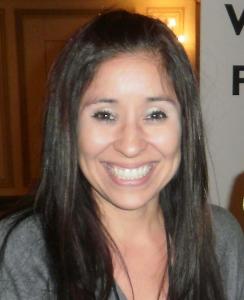 Tracey Flores is a former English Language Development (ELD) and Language Arts teacher who worked in elementary classrooms for eight years. She currently serves as the director of El Día de los Niños, El Día de los Libros and is a teacher consultant with the Central Arizona Writing Project (CAWP) at Arizona State University (ASU). Currently, Tracey is a PhD Candidate in English Education in the Department of English at ASU. Her research focuses on adolescent Latina girls and mothers’ language and literacy practices and on using family literacy as a springboard for advocacy, empowerment, and transformation for students, families, and teachers. In her free time she enjoys writing, reading Young Adult (YA) literature, drinking coffee, running, practicing yoga and spending time with her 8 month old daughter.
 By Laura Shovan and Patricia Bejarano Fisher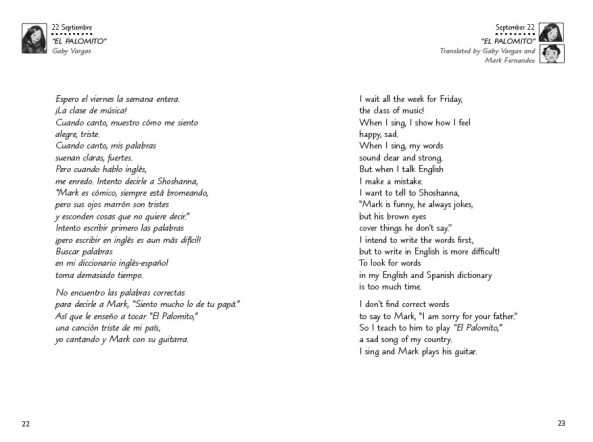
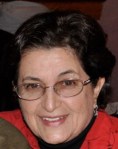 Patricia Bejarano Fisher was born in Bogotá, Colombia. A language and linguistics graduate of the University of Pittsburgh and S.U.N.Y. at Buffalo, she has lived in Columbia, MD for 33 years. She has worked as a Spanish teacher, translator and language-learning materials developer for many years but she now focuses exclusively on poetry translation. Her work includes South Pole/Polo Sur (Settlement House, 2012) and From the Diary of Mme Mao (publisher TBD), both poem collections by Venezuelan poet Maria Teresa Ogliastri, which she co-translated with Yvette Neisser Moreno. She’s an avid reader of Spanish, French, Italian, and Portuguese literatures and of all languages in translation. More poems translated by Pat can be found
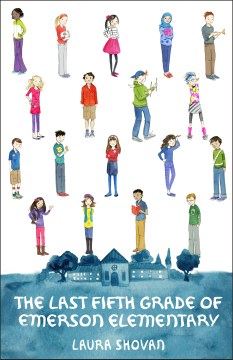
 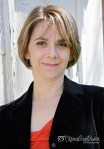 Laura Shovan is former editor of Little Patuxent Review and editor of two poetry anthologies. Her chapbook, Mountain, Log, Salt and Stone, won the inaugural Harriss Poetry Prize. Laura works with children as a poet-in-the-schools and was Howard County Poetry and Literary Society’s 2015-2016 Writer in Residence. The Last Fifth Grade of Emerson Elementary is her debut novel-in-verse for children (Wendy Lamb Books/Random House). Learn more at
 DESCRIPTION (from Goodreads): Neftali finds beauty and wonder everywhere: in the oily colors of mud puddles; a lost glove, sailing on the wind; the music of birds and language. He loves to collect treasures, daydream, and write–pastimes his authoritarian father thinks are for fools. Against all odds, Neftali prevails against his father’s cruelty and his own crippling shyness to become one of the most widely read poets in the world, Pablo Neruda. This moving story about the birth of an artist is also a celebration of childhood, imagination, and the strength of the creative spirit.
 With the question poems, I had students discuss them in small groups and then create a dramatic presentation of their poem in any way they chose. If you want to share more of Neruda’s objects with a class, the
 Cecilia Cackley is a performing artist and children’s bookseller based in Washington DC where she creates puppet theater for adults and teaches playwriting and creative drama to children. Her bilingual children’s plays have been produced by GALA Hispanic Theatre and her interests in bilingual education, literacy, and immigrant advocacy all tend to find their way into her theatrical work. You can find more of her work at
  My husband, Gene, inspired me. I wouldn’t know the first thing about magic if it weren’t for him. He’s an aficionado with a great collection of magic books, props, and videos. Over the years, I’ve been a tagalong at magic lectures and conventions, including the TAOM convention that I write about. Magicians are so creative, and if you think about a magic performance, you’ll realize that it’s just another form of storytelling. How could I resist? I had to write this book! And I had so much fun finding magic tricks that resonated with the characters’ personal lives. This is what stories do—give us tools for coping and for celebrating life.


 Marianne Snow Campbell


 The
The  DESCRIPTION FROM THE PUBLISHER: Anita de la Torre never questioned her freedom living in the Dominican Republic. But by her 12th birthday in 1960, most of her relatives have emigrated to the United States, her Tío Toni has disappeared without a trace, and the government’s secret police terrorize her remaining family because of their suspected opposition of el Trujillo’s dictatorship.
 DESCRIPTION FROM THE PUBLISHER: After Tyler’s father is injured in a tractor accident, his family is forced to hire migrant Mexican workers to help save their Vermont farm from foreclosure. Tyler isn’t sure what to make of these workers. Are they undocumented? And what about the three daughters, particularly Mari, the oldest, who is proud of her Mexican heritage but also increasingly connected to her American life. Her family lives in constant fear of being discovered by the authorities and sent back to the poverty they left behind in Mexico. Can Tyler and Mari find a way to be friends despite their differences?
 ABOUT THE AUTHOR:
  Latinxs in Kid Lit