Book Review: Pancho Rabbit and the Coyote: A Migrant’s Tale by Duncan Tonatiuh

Pancho Rabbit coverBy Lila Quintero Weaver

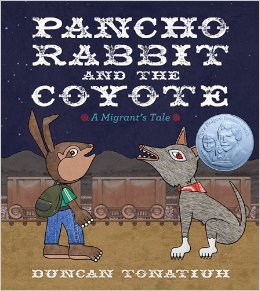
DESCRIPTION FROM THE BOOK JACKET: A young rabbit named Pancho eagerly awaits his papa’s return. Papa Rabbit left two years ago to travel far away north to find work in the great lettuce and carrot fields to earn money for his family. When Papa does not return home on the designated day, Pancho sets out to find him. He packs Papa’s favorite meal—mole, rice and beans, a heap of still-warm tortillas and a jug full of fresh aguamiel—and heads north. He soon meets a coyote, who offers to help Pancho in exchange for some of Papa’s favorite foods. They travel together until the food is gone and the coyote decides he is still hungry…for Pancho!

Award-winning author and illustrator Duncan Tonatiuh brings to light the hardship and struggles facing families who seek to make better lives for themselves by illegally crossing the borders.

MY TWO CENTSWho does not love a fable, beautifully told? Pancho Rabbit and the Coyote is an allegory of migration, simplified for young children and illustrated with highly original art adapted from the style of Mixtec codices.

The adventure begins when Papa and his migrant companions, Señors Ram and Rooster, fail to return at the appointed time. Pancho sneaks off at night to find him. Perils along the journey provide appropriate levels of tension for early readers, but each danger that Pancho faces has a factual counterpart in the experiences of many undocumented Latino immigrants. First, there is—pardon the expression—a wily coyote who promises to guide Pancho to his father.  Children will instinctively realize that this coyote isn’t a true friend. Plus, physical dangers lurk at every turn—snakes, hunger, thirst, a river crossing, a dark tunnel, and a ride on the roof of a train. Most young children will accept these scary moments as tropes of fable and nothing more, helped by the fact that Tonatiuh softens each danger appropriately. For example, when Pancho nearly loses his balance on the roof of the train, the range of dire consequences implied by a fall will escape a child’s notice.

Pancho is a sturdy soul, driven to press through by his burning desire to reunite with Papa. As time goes by, the coyote demands more food from Pancho—food intended for Papa. This mirrors the exploitative nature of many human coyotes, infamous for charging exorbitant sums for their services and not always delivering on their promises. At last, Pancho and the coyote cross the border and spend the night in a hut. When the coyote discovers that Pancho’s food stores are depleted, things go from bad to very bad. “‘In that case,’ said the coyote, ‘I will roast you in the fire and eat you!’” As Pancho cowers in a corner, the huge shadow of a long-fanged coyote looms over him. Shades of Little Red Riding Hood! Just in time, Papa, Señor Rooster and Señor Ram burst into the hut, and the treacherous coyote runs off into the night.

Why were the returning farm workers delayed? “‘A gang of crows attacked us,’ said Señor Rooster. ‘They took the money and gifts we were bringing back to our families and left us stranded in the desert.’” This introduces yet another parallel to reality, the bandits that prey on defenseless immigrants. Back at the rancho, the welcome fiesta goes off without a hitch. The rabbit children beg their father to never leave them again, but he cannot guarantee it. “‘If it doesn’t rain again next year and if there is no food or work on the rancho, what else can I do?’” The children insist they will go with him, but Mamá has a more practical wish. “‘Let’s hope it rains.’”

No discussion of this book can be complete without delving into the art. In a video linked below, Duncan Tonatiuh explains the origins of his style and how meeting immigrants of Mixtec heritage prompted him to adapt the art for contemporary illustration.

Let’s review a few characteristics of Mixtec art:

  • Strong outlines of external and internal shapes
  • Flat colors within those shapes
  • Faces of humans and animals represented in profile
  • Stylized perspective—rugs, tables, other flat surfaces do not recede in space, but appear vertically placed

All of these characteristics are present in Tonatiuh’s art, along with notable adaptations:

  • Modern settings
  • Elements of collage
  • Textured surfaces, sometimes with photographic fidelity
  • Facial expressions that raise emotional content

To elaborate on facial expressions, take note of how variations in characters’ eyes, ears, lips and posture are used to denote sadness, fear, determination, and joy.

To learn more about ancient Mixtec people and their elaborately illustrated manuscripts, see this site

TEACHING TIPSAn author’s note addresses the human issues allegorized in the story of Pancho Rabbit and the rest of the animal characters. There is also a glossary of Spanish terms.

Pancho Rabbit and the Coyote is a fable that can be read on two levels. The average young child will relate to it exactly as it appears on the surface—an enchanting story with animal characters that embark on an adventure. Parents and teachers will have to decide how much to reveal to unsuspecting children about the characters’ human counterparts. Children who have firsthand experience or family stories that parallel the perilous journeys of Pancho Rabbit are much more likely to catch the story’s underlying meaning. A wise teacher will take this into account.

Many young children will be fascinated by the art, which is unique among picture books. Since Tonatiuh has incorporated rich textures into the illustrations, kids may enjoy a treasure hunt based on specific textures. Here is a list of those represented: ram’s wool, coyote and rabbit fur, denim and other textiles, dried chiles, wood grain, brick, corrugated metal roofing, prickly cacti, straw matting, gravel, rubber tire, snakeskin, topsoil, and feathers.

Just because it’s a picture book, there’s no reason that Pancho can’t be enjoyed by older kids, especially artistic teens. If they seem reluctant, show them Duncan Tonatiuh’s TED Talk video, “Life on the Other Side,” embedded in his website. Many teens will conclude that he’s a pretty cool dude, one worth emulating. You’ll also find a touching multi-voice poem recorded by fourth-graders in Texas. It models an excellent approach to getting young migrants or second-generation immigrants talking about their experiences and feelings.

THE AUTHORDuncan Tonatiuh was born in San Miguel de Allende, Mexico. His deep interest in the plight of undocumented immigrants originates in childhood friendships in Mexico and associations he has formed in New York, where he studied art and lives. He is the author-illustrator of other award-winning books, including Diego Rivera: His World and Ours, Dear Primo: A Letter to My Cousin, and a forthcoming book on Sylvia Mendez.

Duncan has earned a chest full of medals and awards for Pancho Rabbit and the Coyote, including:

  • Pura Belpré Author and Illustrator Honor book 2014
  • New York Public Library’s annual Children’s Books list: 100 Titles for Reading and Sharing 2013
  • Kirkus Best Books of 2013
  • Best Multicultural Children’s Books 2013 (Center for the Study of Multicultural Children’s Literature)
  • Notable Children’s Books from ALSC 2014
  • Notable Books for a Global Society Book Award 2014

Diversity in Kid Lit was ‘On Fire’ at National Latino Children’s Literature Conference

My signed conference poster! The gorgeous artwork comes from Laura Lacamara's new book, Dalia's Wondrous Hair.

My signed conference poster! The gorgeous artwork comes from Laura Lacamara’s new book, Dalia’s Wondrous Hair.

By Lila Quintero Weaver

Let me float down to earth, grab a keyboard and pound out a report about the National Latino Children’s Literature Conference. That was my self-talk on March 15. The two-day conference, held at the University of Alabama and headed by mover-and-shaker Dr. Jamie Naidoo, had wrapped up at 4 pm the previous day.

Sixteen hours later, my whole being still felt tingly with the residual vibrations of what we’d experienced: great dialogue, stimulating talks, and warm connections with people passionate about the same thing, increasing diversity in children’s books. And it’s amazing how many presentations referenced last year’s incendiary New York Times article on minority characters in kid lit. The conference stirred my juices, but before I could touch my keyboard to write about it, Marianne Snow posted a great recap on her blog. There’s no way that I could improve on her account. 

That’s not the end of the story. Over the same weekend, The New York Times published a pair of essays from prize-winning YA author Walter Dean Myers and his son Christopher, an author-illustrator of note, on the scarcity of characters of color in children’s books. Spine tingling, timely, and powerful. Clearly, diversity in children’s books is a topic on fire!

And now, back to the conference. Since Marianne’s recap covers only the second day, here are select quotes and highlights from the first day:

NLCLC LogoLiterary agent Adriana Dominguez outlined some of the challenges facing Latin@ children’s literature: “Many editors think about Latino books as niche or institutional.” Neither of these spells the huge sales figures that the industry has become hungry for. She pointed to the Harry Potter phenomenon as a watershed moment in children’s publishing. Previously, marketing departments targeted libraries and schools, but the commercial success of Harry Potter and other blockbusters has shifted the dynamics.

Members of the audience asked how to best advocate for Latin@ children’s literature. Librarians can push these books, Dominguez said. She cited the late Rose Treviño as a personal mentor and a role model in the field of library services to children. Ms. Treviño was a beloved Houston public librarian who served the local Latin@ community and brought Latin@ books to the attention of a wider audience. Her passionate advocacy was captured in this extensive interview by Cynthia Leitich Smith.

Someone else asked, would more Latinos on the “inside” of publishing help to balance the equation? Yes, Dominguez said, because “you’re a stronger advocate for something you truly believe in.” She pointed out that graduate programs in publishing are recruiting zones for the “big five.”

In her keynote, recent Pura Belpré winner Meg Medina raised the topic of universal themes, those that address the experiences of all children, regardless of demographic labels. She reminded us that “Latino” is a uniquely American concept. Many Latin@ children grapple with the additional challenges of biculturalism. She shared that in her work, she strives to present a range of Latin@ characters, a “whole tapestry,” not merely those that the public has come to expect. (In her Monday post, Meg offered a terrific conference recap of her own.)

7789203Author-illustrator Laura Lacámara gave the day’s final keynote. Her journey into publishing has taken some interesting turns. She was first an illustrator of children’s books. Then came her debut as a writer, Floating on Mama’s Song, a story inspired by her mother’s devotion to opera. But Laura didn’t illustrate it; Yuyi Morales did. Now, hot off the presses is Laura’s newest book, her first to write and illustrate, the delightful Dalia’s Wondrous Hair (see the conference poster image, above). Count on a book talk in the near future!

The variety of breakout sessions boggled the mind. Thursday, I sat in on Lettycia Terrones’s illuminating talk on image-making in Latin@ children’s literature, followed by Araceli Esparza’s “Roots of Race in Chicano/Latino Picture Books,” another enriching experience. The next day, I heard an expert presentation by Catalina Lara on the Latin@ child and language.

Social media is an excellent tool, but let’s not forget the value of face-to-face meetings. They spark connections like nothing else. Next time you hear about a conference that addresses diversity or Latin@ children’s books, consider attending.

Book Review: My Little Car by Gary Soto

MyLittleCarCoverBy Sujei Lugo

DESCRIPTION FROM THE BOOK JACKET: Teresa’s grandfather—her abuelo—gives her a fantastic little car for her birthday and she can’t wait to show it off to everybody. The car is so cool that the other bikes on the sidewalk part for her and even grown-ups turn their heads as she goes by. Teresa promises she’ll always take care of her beautiful carrito, but some promises are hard to keep. When Teresa’s abuelo comes to visit, will he even recognize his beautiful present?

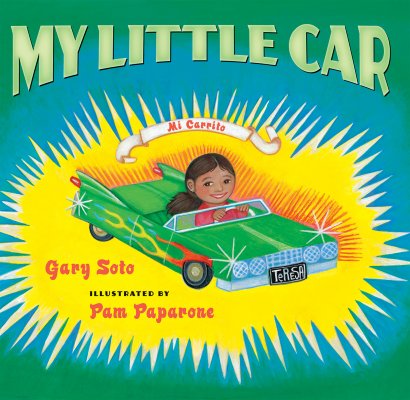
MY TWO CENTS: Through a shiny book cover of a girl riding a little car with a big smile, Gary Soto and Pam Paparone introduce us to a Chicana first-grader named Teresa. Her confidence and pride are enhanced when she receives a toy lowrider for her birthday, a customized car originated by Chicanos in California. Paparone’s bright acrylic illustrations strongly complement Soto’s words to project the subculture surrounding lowriders and other features distinctive of some Chicano and Latino neighborhoods and their communities.

When we first meet Teresa she is feeling embarrassed by her tricycle, thinking that it was a toy for “little kids.” For her birthday, she receives a beautiful lowrider with a personalized plate from her abuelito, giving her an immediate sense of independence and the confidence of being recognized as a big girl. Through this gift and Teresa’s relationship to it, Soto presents us with two important themes: the obvious one is the importance of taking responsibility and care of your belongings and the second one is presented in a more nuanced way, and perhaps silently aimed to parents: how easy it is to break the “gendering” of toys and roles.

Once Teresa receives her carrito, she pedals non-stop down the sidewalk, around her neighborhood, and she even takes it to the playground car show, where she wins first place. But as the days pass, she becomes careless with her carrito: she leaves it out in the rain, it gets pooped on by birds, it’s crushed by her dad’s truck, and it even gets sticky from spilled soda. Her mother and grandfather get preachy and stern while teaching Teresa the importance of taking responsibility of her belongings and the preaching works: in the end she learns her lesson.

Interestingly, the book never gets preachy when dealing with the gender stereotyping of toys. We live in a society where we are constantly presented with gender-stereotyped toys in books, movies, TV shows, commercials, and stores. In this book we have a Chicana girl who disrupts the gender norms around cars as toys solely for boys, and who challenges the machismo present in Latino communities. Gary Soto shows formidable restraint by not including a single line in the book that says that girls should or shouldn’t do certain things. He just provides us with a story that normalizes girls liking toy cars by showing Teresa being happy with her gift and using it without any limits. Surely this portrayal is one that car-loving kids from any gender will identify with.

TEACHING TIPS: This picture book works well as a read aloud for parents, guardians, and librarians. It can be used to teach about responsibility and ownership, while at the same time, children can learn some words in Spanish. The book includes a glossary of the few words in Spanish incorporated throughout the story.

Spanish and Language Arts teachers (Pre-K-2nd grade) can use the text to not only teach Spanish words, but also to develop classroom activities, such as sequence of events, vocabulary, and alternate endings to the story. It is also useful to incorporate Mexican-American Studies to elementary school classrooms.

LEXILE: N/A

AUTHOR: Gary Soto is a Mexican-American author, who has written picture books, chapter books, poetry collections, young adult books, plays and novels. Soto, raised in Fresno, California, has a B.A. in English from Cal State and a M.F.A. from the University of California, Irvine. He has received several awards, including the 1977 Bess Hokin Prize, the Levinson Award, the Literature Award from the Hispanic Heritage Foundation, the American Book Award from the Before Columbus Foundation, the Andrew Carnegie Medal from the American Library Association and the Beatty Award for his book, Baseball in April. He is also the recipient of fellowships from the California Arts Council, the Guggenheim Foundation and the National Endowment for the Arts. In addition to his work as a writer, Gary Soto has taught English to Spanish-speakers as a volunteer. He divides his time between Berkeley, California and his hometown of Fresno.

Some of his selected books are: The Skirt, Pacific Crossing, Chato and the Party Animals, Baseball in April and Other Stories, Neighborhood Odes, Too Many Tamales, Chato’s Kitchen, Taking Sides, Off and Running, Cat’s Meow and Chato Goes Cruisin’.

ILLUSTRATOR: Pam Paparone is an illustrator of many books for children, such as: Raindrop Plop by Wendy Cheyette Lewison, I Like Cats by Patricia Hubbell, Flip, Float, Fly: Seeds on the Move by JoAnn Early Macken, The Tattletale by Lynn Downey and Of Number and Stars: The Story of Hypatia by D. Anne Love. She is also the author and illustrator of Cinco Patitos/Five Little Ducks and Who Built the Ark?  Her paintings have appeared on the cover of The New Yorker. Pam Paparone lives in Philadelphia, Pennsylvania.

My Little Car was one of commended titles of the 2007 Américas Award for Children’s and Young Adult Literature. For more information about My Little Car visit your local library or bookstore. Also check out WorldCat.org, Indiebound.org, Goodreads, Amazon and Barnes and Noble.

Book Review: Confetti Girl by Diana López

By Cindy L. Rodriguez

Confetti GirlDESCRIPTION FROM THE BOOK JACKET: Apolonia “Lina” Flores is a sock enthusiast, a volleyball player, a science lover, and a girl who is looking for answers. Even though her house is crammed full of her dad’s books, she’s having trouble figuring out some big questions, like why her father keeps retreating into his reading, why her best friend is changing their old rules, and, most of all, why her mother had to die last year. Like colors in cascarones, Lina’s life is a rainbow of people, interests, and unexpected changes.

MY TWO CENTS: In Confetti Girl, López masterfully blends serious middle school issues, like friendships and first kisses, with the even more serious issues middle schoolers face, such as the death of one parent and the paralyzing grief of the other. Apolonia “Lina” Flores is an easily lovable character with her crazy socks and desire to do well on the volleyball court and in the classroom. But everything starts to unravel as Lina’s dad gets lost in books and her best friend, Vanessa, gets lost in Carlos’s dreamy eyes. With her relationships already strained, Lina’s situation gets worse when she’s benched for failing grades.

What makes Confetti Girl not only an awesome middle grade read but also a great novel about Latin@s is how López seamlessly weaves in cultural details. She talks about how she decided to include certain details here. By using such things as cascarones and dichos throughout the novel, López introduces cultural specifics to readers without being preachy or teacher-like. In other words, I could see young readers responding with, “Cool, let’s make those,” or “Yup, my mom says things like that all the time,” instead of “Oh, that’s a Latin thing” (closes book). The Kirkus review of this novel put it this way: “An appealing coming-of-age novel set in a traditional Mexican-American town, in which Hispanic teachers, students and parents celebrate traditional American holidays such as Thanksgiving alongside such traditional Mexican observances as el Día de los Muertos and a Quinceañera.” Click here for the full review.

Confetti Girl, López’s first middle grade novel, was a winner of the William Allen White Award and named to New York Library’s “100 Titles for Reading and Sharing.” It was a commended title for the 2010 Américas Award for Children’s and Young Adult Literature, and Latinidad’s “Top Latino Book of the Year” for Middle Grade Category. It was also a Scholastic Book Club and Book Fair Selection.

TEACHING TIPS: Lots of great teaching tips, including discussion questions and activities, can be found on the author’s website. Click here for her “Teacher Resource” page and here for a PDF of a Teacher’s Guide for Confetti Girl.

Also, to align with the Common Core State Standards, teachers could easily mix this fictional novel with nonfiction articles that range from cascarones to the grieving process. Teachers could also bring in Watership Down by Richard Adams since it plays a significant role in Confetti Girl. Students could read Watership Down first and then read Confetti Girl to truly understand how the classic novel helps Lina to make sense of her own life.

LEXILE: 660

AUTHORDiana López is the author of the adult novella, Sofia’s Saints and the middle grade novels, Confetti Girl, Choke, and the recently released Ask My Mood Ring How I Feel. She is also featured in the anthologies Hecho en Tejas and You Don’t Have a Clue. She has been a guest on NPR’s Latino USA and is the winner of the 2004 Alfredo Cisneros del Moral Award. Diana teaches English and works with the organization, CentroVictoria, at the University of Houston Victoria.

For more information about Confetti Girl visit your local library or bookstore. Also check out GoodreadsIndieBound.orgWorldCat.orgLittle Brown Books for Young ReadersScholasticAmazon, and Barnes and Noble.

You can also click here for a book trailer of Confetti Girl featuring the author!

Diana can also be found on the site Read to Write Stories, where she blogs about how to create conflict with subtext.

Book Review: The Tooth Fairy Meets El Ratón Pérez by René Colato Laínez

By Lila Quintero Weaver  the tooth fairy meets el raton perez

DESCRIPTION FROM RANDOM HOUSEThe Tooth Fairy has some competition. Meet El Ratón Pérez, the charming and adventurous mouse who collects children’s teeth in Spain and Latin America.

When both the Tooth Fairy and El Ratón Pérez arrive to claim Miguelito’s tooth, sparks fly under the Mexican-American boy’s pillow. Who will rightfully claim his tooth?
This magical tale introduces a legendary Latino character to a new audience and provides a fresh take on the familiar childhood experience of losing one’s tooth.

MY TWO CENTSWhat happens when beloved cultural traditions clash? Rene Colato Lainez’s flair for bilingual storytelling and Tom Lintern’s eye-popping illustrations combine in a winning picture book that addresses this question. Children will rejoice over the conclusion: there is no need to choose between the two!

The story revolves around double claims on Miguelito’s lost tooth.  Now that he lives in the United States, he’s inside the Tooth Fairy’s jurisdiction. But her Hispanic counterpart, El Ratón Pérez, is not ready to relinquish his duty to Latino children, even when they move across the border. One night in Miguelito’s bedroom, there’s a showdown between the rivals. Never fear—the tussle is well spiced with humor. Still, things get out of hand and Miguelito’s tooth lands on a high shelf, out of reach. It takes cooperation between the fairy and the ratón to retrieve the tooth, and this convinces them that future conflict is not necessary. From now on, Miguelito and other children can enjoy the toothy traditions of both cultures.

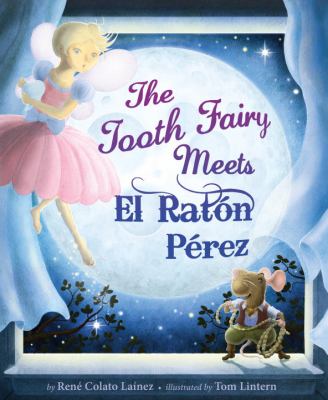
Like all picture books, the fun of this story is in repeated readings. Children will enjoy comparing the working methods and backdrops of these tiny tooth warriors. The rich color illustrations reinforce such observations. The Tooth Fairy lives in a castle. El Ratón Pérez makes his home in a cave. She searches the skies for a twinkling star that signals when a tooth is ready for retrieval. The signal he looks for is a moonbeam. Each has his or her tool of the trade; hers is a wand, his is a rope.

This is a wonderful text for children in transition between two cultures. It emphasizes the value of preserving old traditions and the joy of adding new ones.  The same lesson can be applied to other customs across nationalities, such as how birthdays and holidays are celebrated.

Spanish words and phrases are sprinkled throughout the book, always paired with the English translation. The publisher has provided a glossary.

TEACHING TIPSWe can do no better than the website dedicated to The Tooth Fairy Meets El Ratón Pérez that the author, a kindergarten teacher, has already put together! It includes a curriculum guide, creator interviews and other helpful features.

Here are a few additional resources.

The Centro Virtual Cervantes published a gallery of 79 illustrations featuring El Ratón Pérez.

Here are some craft ideas related to the Tooth Fairy.

An adorable tooth fairy pillow from MmmCrafts. And here’s another from the always reliable Martha Stewart.

Plus, how about a cute box for the tooth?

If you know where to find craft instructions for high quality El Ratón Pérez projects, please let us know!

AUTHOR: René Colato Laínez is a native of El Salvador who has written many books for young children. He teaches kindergarten in California. Want to learn more about him? Check out his interview on this blog!  

ILLUSTRATORTom Lintern is a storyboard artist, commercial illustrator and occasional illustrator of children’s books. View his impressive portfolio and more on his official site

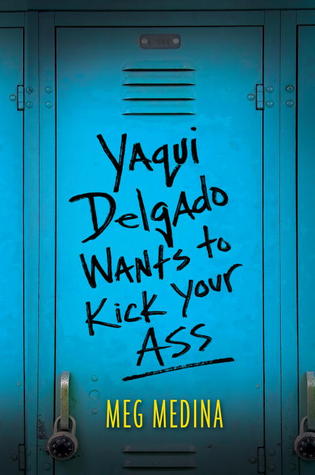
Book Review: Yaqui Delgado Wants to Kick Your Ass by Meg Medina

By Edith Campbell

YaquiMeg Medina is an accomplished author who has won awards for Tia Isa Wants a Car and The Girl Who Could Silence the Wind. Her latest book, Yaqui Dalgado Wants to Kick Your Ass is acquiring a growing list of recognition, including the Pura Belpré (a complete list of awards is at the bottom of this post). By the title, you might think that Yaqui is the main character in this realistic YA novel, but she’s not. This is Piadad “Piddy” Sanchez’s story. Just like with any bully, Yaqui seems to have taken things over.

When the novel begins, Piddy has just moved, leaving behind the school and neighborhood where she’s always felt at home. Medina quickly paints the picture of the new territory this young Latina must navigate, one where skin tone, country of origin, accent and ability to speak Spanish define where you sit as well as your place in the pecking order. Piddy shakes her hips in ways that unintentionally get too much attention and it’s on: Yaqui Delgado wants to kick her ass. Piddy’s mom can just look at Yaqui and know she’s up to no good. While Piddy’s mom may have no use for tough girls like Yaqui, Piddy cannot avoid them in her new school.

Piddy’s at that awkward age where she’s no longer a child, but not quite grown, either. She still cherishes the elephant necklace she got a few birthdays ago, but now even though she likes the idea, she knows she’s too old to celebrate her birthday like she did that time at the zoo. If she were still a little girl she could take her problems to her mom and could probably still do so if she were just a bit more mature. But Piddy doesn’t fully trust herself, and she’s also got this bully frightening her so much that—before long—she doesn’t even recognize herself.

When Piddy begins to have problems at school, she reaches out to her mother’s friend, Lila. Lila is like an aunt to Piddy. She’s the fun one who taught Piddy to dance and how to wear makeup, and she’s the one Piddy turns to when she wants to find out what really happened to her father.

Lila is part of the community in which Piddy’s story is grounded. Lila, her boyfriend Raul, the women at the beauty shop, and even the Ortegas provide spaces of comfort and familiarity for Piddy, and they nurture her as she struggles to find out who she is becoming. Piddy has two problems: she wants to know about her dad, and she can’t get Yaqui out of her head. For solutions, Piddy turns first to Lila and then to her old friend, Mitzi Ortega, who has recently moved to another area. These women are her touchstones as she moves from girl to woman. She wants to face Yaqui, but not even the support of Lila, Mitzi, and the others is enough to make that happen. We know that no one can give you this kind of strength; it comes from inside.

In her coming of age, Piddy finds Joey, a neighborhood boy who has had a very tough life. Medina writes their relationship as one that gives Piddy room to explore. While his character is not thoroughly developed, it is complete enough for the story, and their relationship helps us see a special tenderness in Piddy. Medina captures Piddy’s feelings and emotions in ways that will be immediately recognizable to anyone who has been the new kid or the kid who has been picked on. Piddy becomes a victim, losing any idea of who she is or for what she stands. Readers become part of the community that supports Piddy and wants her to stand up to Yaqui.

I’ve heard many shy away from this book, afraid of how rough it may be or turned off by the title. This is not a rough story! Despite the “ass” in the title, there’s no profanity, no drugs or alcohol, and only one scene of adolescent petting that is quite effective and touching. Piddy is a good student who wants to be a scientist and she comes from a thriving community. The novel illustrates that bullying can (and does) happen in any community, and in this book, the victim happens to be Piddy. Being a victim is rough, but Piddy is not a rough girl.

So, put the tape of the cover if you must, but put the book in your library. There are reasons for all the awards and recognition!

LEXILE: HL670

Edith Campbell

Edith Campbell is a mother, librarian, educator and quilter. She received her B.A. in Economics from the University of Cincinnati and MLS from Indiana University.  Her passion is promoting literacy in all its many forms to teens and she does this through her blog, CrazyQuiltEdi and in her work as an Education  Librarian at Indiana State University in Terre Haute, Indiana. Edith currently serves as the IN State Ambassador for the United States Board on Books for Young People and is a past member of YALSA’s Best Fiction for Young Adults selection committee.