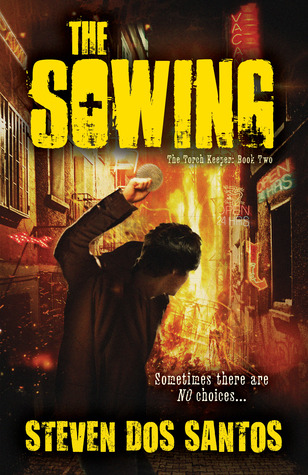
Book Review: The Sowing: The Torch Keeper Series, Book Two by Steven Dos Santos

17342414By Eileen Fontenot

DESCRIPTION FROM THE BOOK JACKET: “This time, there are no choices. Lucian “Lucky” Spark leads a double life. By day, he trains to become one of the Establishment elite. At night, he sabotages his oppressors from within, seeking to avenge the murder of his love, Digory Tycho, and rescue his imprisoned brother. But when he embarks on a risky plot to assassinate members of the Establishment hierarchy, Lucky is thrust into the war between the Establishment and the rebellion, where the lines between friend and foe are blurred beyond recognition. His only chance for survival lies in facing the secrets of the Sowing, a mystery rooted in the ashes of the apocalyptic past that threatens to destroy Lucky’s last hope for the future.”

MY TWO CENTS: Wow. When I say, the action doesn’t stop, well, it just doesn’t stop. The reader is taken immediately to a dramatic fight a couple of months after newly minted Imposer Lucky finishes the trials, portrayed in the first book, The Culling. The series is set in a post-apocalyptic future in which the totalitarian Establishment, led by Cassius Thorn, really enjoys keeping Parish citizens downtrodden.

We continue to view the world through Lucky’s eyes – including struggle to protect his little brother, Cole, and the injustices he must now pretend to participate in, while actively working toward positive change. We can see that Lucky has grown and matured, but is weighed by his constant terror of losing Cole. As he is forced to return to the Trials, this time as an Incentive, he experiences old horrors in new ways – and we learn more about the mysteries of the first book as well. There are a couple shocking twists, that I won’t mention here, but suffice it to say, this is one entertaining read. And readers can see that a bigger story line is building – bound to shake up Lucky’s already precarious situation.

The amazing thing about this series, besides the edge-of-your-seat suspense that gives the reader inventively gory payoffs, is that the sexuality of the LGBTQ characters are treated totally matter of factly. In this horrific version of our future, at least society recognizes that love is love. I think LGBTQ teens who love dystopian thrillers like The Hunger Games will enjoy a similar story that focuses on sympathetic characters that just happen to be gay. Dos Santos doesn’t make a big deal out of his characters’ sexuality. Normalizing this aspect of society is a long time coming; I think today’s teens deserve to envision a future without a closet and this series supports that idea. Although it would be nice if the other parts of the future didn’t go down the drain!

This series would be great as a pick for a LGBTQ teen book group, whether for high school or in a public library. It’s an excellent counterpoint for LGBTQ books that are serious or that focuses on sexuality as the actual story. Teens will also understand Lucky’s growth and his love of family. But, most of all, it’s just a fun read.

AUTHOR: Steven dos Santos was born in New York City and raised in south Florida. He began writing at 7, but didn’t become a professional writer until after graduating with a communications degree and then spending time working in the field of law. The two books of The Torch Keeper series are his first professionally published works, and The Culling has been added to the 2014 ALA GLBTQ’s Rainbow Project Reading List. He’s currently at work writing the final book in The Torch Keeper series.

FOR MORE INFORMATION ABOUT Dos Santos and The Sowing, visit your local library or bookstore. Online he can be found at stevendossantos.com, worldcat.org, goodreads.com, indiebound.org, barnesandnoble.com and amazon.com.
fontenot headshotEileen Fontenot is a recent graduate of Simmons College Graduate School of Library and Information Science in Boston. She works at a public library and is interested in community service and working toward social justice. A sci-fi/fantasy fan, Eileen was formerly a newspaper writer and editor.
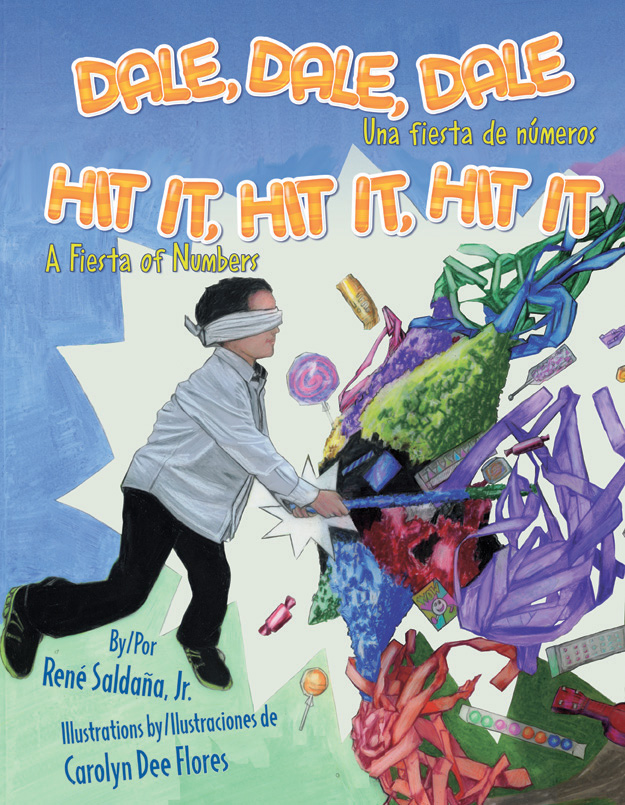
Book Review: Dale, Dale, Dale: Una fiesta de números/Hit it, Hit it, Hit it: A fiesta of numbers by René Saldaña, Jr.

By Sujei Lugo

DaleDaleDaleCoverDESCRIPTION FROM THE BOOK (provided by publisher): In this bilingual counting picture book, a young boy counts to twelve in anticipation of his birthday party: one piñata filled with candy; two hours until the party; three tables set for all the guests, etc.

MY TWO CENTS: Using simple text interwoven with a birthday party theme, René Saldaña, Jr. creates a fun bilingual counting book that makes us want to join the party. Carolyn Dee Flores’s illustrations are filled with photorealism and vibrant colors, supporting Saldaña’s words, and they successfully capture the excitement of children’s birthday parties. In what is definitely a welcomed surprise, Dale, Dale, Dale/ Hit it, Hit it, Hit it not only illustrates an adequate counting story, but decides to tell a good tale about sharing and enjoying a special day with your loved ones.

Our young protagonist is Mateo, a boy who anxiously awaits his birthday party and who uses this opportunity to practice counting throughout his special day. From “one piñata filled with candy” to “twelve children ready to swing at the piñata,” readers can count along with Mateo in Spanish and English. The items that the boy chooses to count include party supplies, colorful toys, lucha libre masks, musical instruments, and his own cousins. The picture book doesn’t limit readers to count only Mateo’s choices, but places other elements that can be counted throughout each page.

This bilingual book provides simple sentences in Spanish and English, which early readers, whether in one language or both, can easily follow. Although the translation of some words is problematic for language learners, for example, niños/guests, it isn’t a limitation to learn and practice words in two different languages.

As a picture book, the photorealistic illustrations can be seen by some as a weakness at the moment to capture children’s attention. But Flores plays well with vibrant colors to encourage young readers to focus on the story and stimulate them, not only to count, but also to identify different colors displayed on every page. The educational content of the book will inspire children to count everything around them and will motivate them to be even more excited to have their own birthday party.

TEACHING TIPS: As early readers or as a read aloud, this bilingual picture book works well for children ages 4-6. Parents, caregivers, and librarians can read in Spanish, English, or both, while encouraging young ones to practice their counting skills and color identification. Children can also point out what they like about birthday parties and collaborate to plan their next one. A song is included in the story, which can be useful if you include a piñata in your party.

Teachers can plan learning activities to combine math and language arts. Students can learn new vocabulary words, numbers, colors, and Spanish-English language meaning. Activities that develop memory and concentration can be done with second graders, including sequence of events and pairing numbers with items mentioned in the book.

AUTHOR & ILLUSTRATOR: René Saldaña, Jr. is a Latino young adult and children’s books writer and Language and Literacy professor at Texas Tech University. He holds a B.A. from Bob Jones University, a M.A. from Clemson University, and a Ph.D. in English and Creative Writing from Georgia State University.

He is the author of several books, including his semi-autobiographical novel The Jumping Tree (2001), Finding Our Way: Stories (2003), the Junior Library Guild selection The Whole Sky Full of Stars (2007),  A Good Long Way (2010), the collection of short stories Dancing with the Devil and Other Tales from Beyond/Bailando con el Diablo y otros cuentos del más allá (2012), and the bilingual Mickey Rangel mystery series.

Carolyn Dee Flores, a former computer analyst, is a writer, illustrator, musician, and composer. She attended the International School of Bangkok, Thailand and Naha, Okinawa, Japan, and Trinity University, where she studied Engineering, Philosophy and Art. Flores began her painting career as a muralist and oil painter, before switching over to children’s books illustration.

She has illustrated several other children’s books, including Canta, Rana, Canta/Sing, Froggie, Sing (2013), Peggy Caravantes’s Daughter of Two Nations (2013).

For more information about Dale, Dale, Dale: Una fiesta de números/Hit it, Hit it, Hit it: A fiesta of numbers (2014), visit your local library or bookstore. Also check out worldcat.org, goodreads.com, indiebound.org, and Arte Público Press.


Book Review: Dalia’s Wondrous Hair/El Cabello Maravilloso de Dalia by Laura Lacámara

By Sujei Lugo

18654384DESCRIPTION FROM THE BOOK: A Cuban girl transforms her long and unruly hair into a garden.

MY TWO CENTS: In this bilingual picture book, with a Spanish translation by Gabriela Baeza Ventura, Laura Lacámara brings us a whimsical Caribbean tale of a young Cuban girl and her luxuriant hair. Lacámara’s colorful illustrations express the joyful spirit of the main character and transport us to the sunny, tropical Caribbean.

The story introduces us to Dalia, a young girl who one day wakes up and finds out that her hair has grown straight up and as tall as a Cuban royal palm tree. Many children would panic with such news, but Dalia can’t hold the excitement of her new wondrous hair. She then embarks on a journey to add to her hair different natural elements of a Caribbean tropical island, such as wild tamarind, coontie plant, and violet leaves. Her purpose is to show her mother the different types of “trees” she can recreate using her hair, ending with a beautiful and unique one.

What stands out in this picture book is Lacámara’s ability to portray through her paintings the endearing relationship between Dalia and her mother and their lives in harmony with nature. The expressions on their faces capture the happiness and warmth of a loving mother and daughter bond. Other characters in the book, Señora Dominguez, Señora Soledad and Soledad’s daughters, all play supporting roles to Dalia’s “hairy” journey and to their connection to the natural world. Through this all-women set of characters, we see a growing sense of community and a sympathetic portrayal of peculiar characters we can encounter in a rural neighborhood.

By situating their home in rural Cuba, the author incorporates the Caribbean’s particular flora and fauna into the story. Through beautiful landscapes that fill the book with a graphical sense of the fresh air and natural environment of this tropical island, the book introduces young readers to different components of the natural world: royal palms, sugar cane fields, wild tamarinds, moonflowers, coontie plants, wild violets, caterpillars, birds, fireflies, ponds, and the ocean. Even the characters’ clothing are filled with flowers and leaf patterns, giving us powerful images that convey a reverence to the natural world.

According to a statement on the first page, the publication of Dalia’s Wondrous Hair/El Cabello Maravilloso de Dalia was funded by a grant from the city of Houston through the Houston Arts Alliance and published by Piñata Books, the children’s literature imprint of Arte Público Press. We should acknowledge their efforts, along with other great publishers,  to continuously provide a space for the publication of Latino/a authors and illustrators.

TEACHING TIPS: This bilingual picture book is recommended for children ages 4-7. It works well as a read aloud and for early readers. At home or at the library, librarians, parents, grandparents, family members or guardians can read with their young ones in English, Spanish or both, while teaching new words and identifying different colors, animals, and plants. The author provides a guide to create your own butterfly garden at home, a fun activity for everyone to enjoy.

Language Arts, Science, and Art teachers can create different activities where students can learn new words, identify adjectives mentioned throughout the story, and learn about different types of plants, trees, and animals. The book includes notes of Cuban natural world references (in English and Spanish) that are part of their stories, with a description. Art teachers can use this book to incorporate science to their classrooms. Students can draw, paint, or use different materials to create their own version of Dalia’s hair, using as reference words learned and natural elements of the story. 

AUTHOR: Laura Lacámara is a Cuban-born children’s books author and illustrator. Lacámara holds a Bachelor of Fine Arts in Drawing and Painting from California State University, Long Beach and studied printmaking at Self Help Graphics in East Los Angeles. Her love for writing and illustrating children’s books grew when she signed up for a children’s book illustration class at Otis College of Art and Design in Los Angeles, California.

She is the author of Floating on Mama’s Song/Flotando en la Canción de Mamá (Junior Library Guild Selection, Fall 2010 & Tejas Star Book Award finalist 2011-12) and illustrator of The Runaway Piggy/El Cochinito Fugitivo (winner of 2012 Tejas Star Book Award) and Alicia’s Fruity Drinks/Las Aguas Frescas de Alicia.

Laura Lacámara is an active member of the Society of Children’s Book Writers and Illustrators (SCBWI) and frequently serves as a presenter at conferences, book festivals, and schools. She currently lives in Southern California.

FOR MORE INFORMATION ABOUT Dalia’s Wondrous Hair/El Cabello Maravilloso de Dalia, visit your local library or bookstore. Also check out worldcat.org, indiebound.orggoodreads.comamazon.com, and barnesandnoble.com.

Book Review: I Lived on Butterfly Hill by Marjorie Agosin

By Sarah Hannah Gómez

18048909DESCRIPTION FROM THE BOOK JACKET: Celeste Marconi is a dreamer. She lives peacefully among friends and neighbors and family in the idyllic town of Valparaiso, Chile–until the time comes when even Celeste, with her head in the clouds, can’t deny the political unrest that is sweeping through the country. Warships are spotted in the harbor and schoolmates disappear from class without a word. Celeste doesn’t quite know what is happening, but one thing is clear: no one is safe, not anymore.

The country has been taken over by a government that declares artists, protestors, and anyone who helps the needy to be considered “subversive” and dangerous to Chile’s future. So Celeste’s parents–her educated, generous, kind parents–must go into hiding before they, too, “disappear.” To protect their daughter, they send her to America.

As Celeste adapts to her new life in Maine, she never stops dreaming of Chile. But even after democracy is restored to her home country, questions remain: Will her parents reemerge from hiding? Will she ever be truly safe again?

Accented with interior artwork, steeped in the history of Pinochet’s catastrophic takeover of Chile, and based on many true events, this multicultural ode to the power of revolution, words, and love is both indelibly brave and heartwrenchingly graceful.

MY TWO CENTS: This reads like a pretty classic middle grade novel in the tradition of Sharon Creech or Patricia Reilly Giff. Celeste has a very sweet and thoughtful way about her, and she narrates the day-to-day of her life with the eye of a girl who is young but observant. There is some beautiful scene setting in her house, where her grandmother, nanny, mother, and father dote on her; and at school, where she has a great teacher and the usual smattering of fun, doofy, and snobbish classmates. She has an idyllic life and loves it—until the president is assassinated and the dictator takes over.

Agosín does a good job of showing how this type of takeover happens gradually and all at once, and Celeste observes different things happening – like some classmates not showing up for school or the adults in her life all of a sudden being worried about her safety – and only slowly begins to put them together as being related to the same thing. When she moves to Maine, Celeste remains very observant and thoughtful about everything. Her descriptions are just beautiful.

But that’s also a weakness in the book – Celeste is so thoughtful that it doesn’t always feel like she has any emotion. Her parents have to go into hiding and she says she’s sad, but you don’t necessarily see it – the quality and style of her narration and her observations don’t change much depending on her mood. And it doesn’t help that the last quarter of the book goes from lyrical and fairly realistic to a totally Disney TV movie ending.

That said, there is plenty of good in this book. Latin@s? Check. And, unlike any books I remember reading from my childhood or much during my adulthood, Celeste’s family is also Jewish – her grandmother speaks to her in German and reminisces about escaping the Holocaust by coming to Chile. That parallel is what really gives the book its emotional impact. Celeste is very attached to her grandmother, and knowing that the grandmother is watching a country unravel for the second time is poignant. Acknowledging that part of Latin American history and giving Jewish-Latinas a heroine to root for is a great strength of this book, especially since it manages to use Spanish, Chilean cultural traditions, and Jewish traditions in a way that neither over explains to those of us who know it already nor under explains to those who are unfamiliar.

I would hand this book to any little girl who is already a fan of classic middle grade characters who love to write, like Betsy Ray or Harriet M. Welsch, or to fans of books by Julia Alvarez or Jeanne Birdsall.

AUTHOR: Marjorie Agosín was born in Maryland and raised in Chile. She and her parents, Moises and Frida Agosín, moved to the United States due to the overthrow of the Chilean government by General Pinochet’s military coup. Coming from a South American country and being Jewish, Agosín’s writings demonstrate a unique blending of these cultures. Agosín is well known as a poet, critic, and human activist. She is also a well-known spokesperson for the plight and priorities of women in Third World countries. Her deep social concerns and accomplishments have earned her many awards and recognitions, and she has gained an international reputation among contemporary women of color.

FOR MORE INFORMATION ABOUT I Lived on Butterfly Hill, visit your local library or bookstore. Also check out worldcat.org, indiebound.org, goodreads.com, amazon.com, and barnesandnoble.com.


HannahSarah Hannah Gómez is a school librarian in Northern California with a passion for promoting diverse literature to tweens and teens of all colors. She has an MA from the Center for the Study of Children’s Literature and an MS in library and information science from Simmons College. She blogs at her own website and at YALSA’s The Hub. She is working on a novel and a screenplay.

Illustrator Joe Cepeda Talks to Latin@s in Kid Lit, Part 2

By Lila Quintero Weaver

We’re continuing a fascinating conversation with acclaimed illustrator Joe Cepeda. His work graces many Latin@-themed children’s books. Did you miss the first installment? Go here.

Lila: When did your interest in art begin? How did you train for a career in illustration?

Joe: When I was young, I enjoyed drawing enough that my mom enrolled me at the Los Angeles Music and Art School in East Los Angeles, a small jewel of a place where I first tried painting. By my teens, though, I stopped going and after graduating high school found myself headed to college to study engineering. It took me awhile before I changed all of that. Initially, I thought I’d be an editorial cartoonist, but as soon as I got a brush back in my hand, I realized I wanted to do something that had an artfulness to it as well. Illustration afforded the perfect combination of content and creative articulation for me.

swing_leopoldo1

To be honest, my training was largely guided toward editorial work. I sort of fell into children’s books. Creating a piece for a magazine article is much like doing work for a cover. There is a certain amount of seduction employed in influencing a magazine reader to stop and read an article, much the way you’d want someone to pick up a book off a shelf. A combination of abstraction, mystery, emotion, and information might play a role in creating that single image that will lure the audience in.

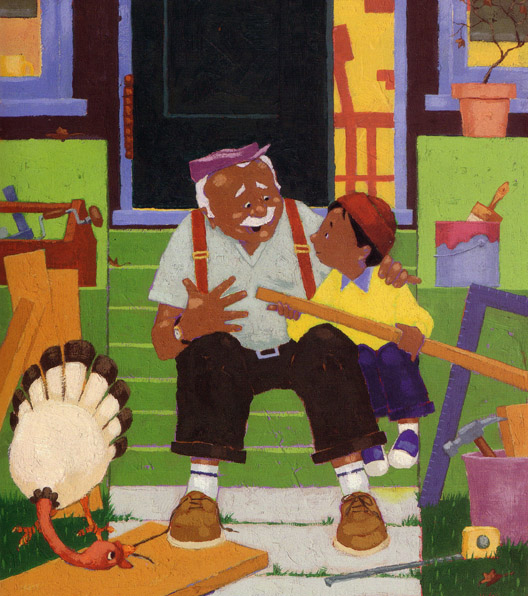
From the books I’ve illustrated, I pretty much taught myself sequential image-making and continue to do that. With a portfolio largely lacking any real samples that reflected page-turning sensibilities, it was very fortunate that I was signed up to illustrate those first books. I believe that it was an inclination to write a picture as much as illustrate one that may have been evident to my first editors and art directors. They seem to have responded to that and took a risk. I’m grateful to them for doing so.

GraciasGrandfather_72cropped

Lila: Most of us have no idea how an illustrator goes about his work. Can you give us a tour of the process?

Joe: In many ways, the real work is done throughout the sketch phase. For editorial work, I usually create a few alternate ideas for a director to choose from. The sketches need to be tight enough for the director to envision the finished art.

For books, the sketch process is more comprehensive. The first sketches are thumbnails in which I mostly brainstorm, trying to find the basic rhythm, character introduction, action, choreography of the story, etc. The second phase of sketches, laid out as a dummy (a design/template that allows you to see the whole book planned out) focuses on the essential content of the story, as well as soundly composing the images. This is the working plan to be shared with editors and art directors. It’s important to understand that this design is as much for others as it is for oneself. This is where mistakes are caught.

Finally, in the last draft of sketches, details are included to a more specific degree. The emotions of your images many times are expressed in the details of your illustrations. It’s where things become funny, scary, thrilling, suspenseful, etc. This shouldn’t be confused with complexity—a simple picture has as much power as an ornate one. Once the dummy is okayed, it’s on to the finished work. Almost all of my books have been executed as oil paintings over acrylic under-paintings on illustration board. A recent book I illustrated was delivered as digitally rendered finishes. Whatever your medium of choice, the more confident you are of your plan, the more enjoyable the last part of the process will be. I leave color out of the initial plans because I prefer to be responsive when it comes to that, leaving a level of spontaneity for the end.

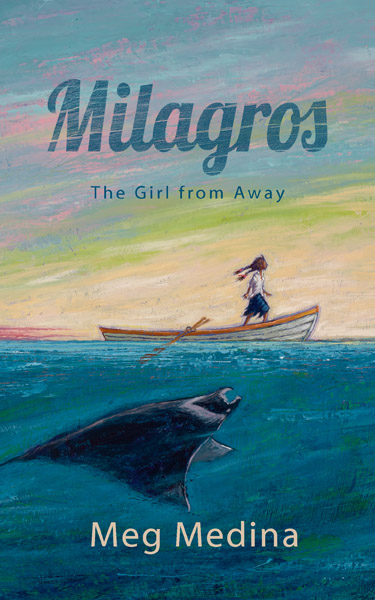
Milagros_jacket_finish72Lila: Let’s close out this conversation by returning to a book cover, the one you recently did for the e-book version of Meg Medina’s Milagros: A Girl from Away. It’s breathtaking, truly exceptional. I know Meg was thrilled with it!

Joe: Thanks for the kind words. Milagros is a great story and it was a wonderful opportunity to illustrate the cover of the e-book. After reading the manuscript, I couldn’t help responding to Milagros as a girl between two worlds. It’s the “between” part that intrigued me as a source for creating a provocative image. Milagros is not only traveling from one place to another, as she does in the story, she’s also between the clarity of a wide-open sky and the deep mystery and profundity of the ocean. The magical realism of the story, in my mind, calls for a more symbolic and open-ended image. Alternative ideas depicted Milagros closer to the viewer, larger in the design. This would emphasize Milagros more. A reader might respond to that kind of image, “That girl looks like me, i want to read about her.” It’s certainly popular to create covers that are more character-based, but, I’m glad that we decided to go the other way, that is, emphasizing the mystery, the peril of the journey, and the hopefulness and optimism of Milagros’ spirit. A reader here might ask, “Where is that girl going? What is she facing? Is she lost? Is she on her way somewhere? Is she safe? Will she get there? What will she find? Keeping her small in the design also helps the reader ask, “Who is she?” My first sketches didn’t include the manta ray, inclined to depict Milagros navigating her way alone, but, as we discussed, it’s a central part of the story. I’m glad mantas are such mysterious and, perhaps, very poetic creatures. I wanted it to have an ambiguous posture… is it a threat to her, or is it a witness, or, even something more? For me, the more questions you ask when looking at a cover, the better a cover does its job.

“““““““`

To learn more about Joe’s craftsmanship and illustration technique, see this extensive interview by Kathleen Temean.

Want to see Joe in his studio and hear more of his story? Here’s a video interview, worth the double click-through!

http://www.youtube.com/watch?v=ExxVgkZeX0o


Illustrator Joe Cepeda Talks to Latin@s in Kid Lit, Part 1

By Lila Quintero Weaver

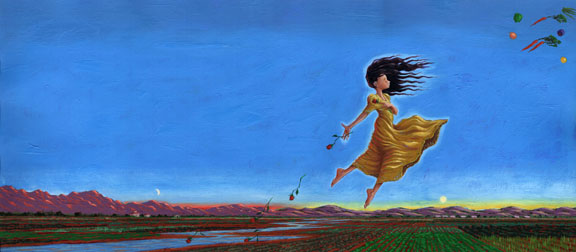
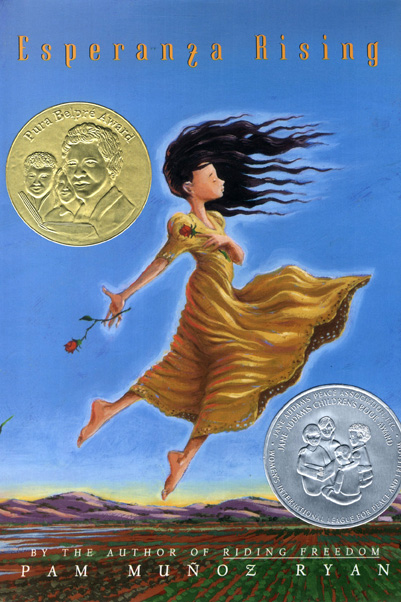
Long before I met Joe Cepeda at the National Latino Children’s Literature Conference in 2012, a post card of the cover illustration of Pam Muñoz Ryan’s Esperanza Rising was tacked to my then-11-year-old daughter’s bedroom wall. Every time I glanced at that soaring figure, my spirits lifted. Surely part of the book’s enormous success can be traced back to Joe’s luminous cover painting of Esperanza floating above the California earth, but that’s hardly the end of his contribution to children’s literature.

Lila: Welcome to Latin@s in Kid Lit, Joe! Thank you for taking time out of your busy schedule to talk art and books. Let’s start our conversation with Esperanza Rising. How did you come up with the concept?

Joe: After seeing the title, it wasn’t too difficult to imagine young Esperanza in the air. My first sketch depicted Esperanza with her hair and dress floating behind her as if she were flying. Almost immediately, however, I changed it and flipped her dress and pretty dark tresses to sweep in front of her. What I realized is that I didn’t want to show Esperanza as if she were navigating in the air on her own. I wanted her to be swept away by the wind. Everyone who has read the book knows that Esperanza’s life changes from one day to the next and I wanted the image to reflect that life-altering event, as well as the hopefulness her story and name literally implies.

EsperanzaJacket72 copy 2Lila: What does it mean to you to have your work as the cover of such a powerful story?

Joe: A great deal. It’s never a bad thing to have your work associated with a story that has such resonance. In contrast to doing an illustration for a magazine, which has a very short life, a book hangs around longer. A book that continues to reach so many readers, year after year, is wonderful for the life of the image as well. Beyond that, one is always striving to create work that might emotively uplift the reader. It’s a beautiful story and if the cover helps to do just that, it’s very gratifying.

Lila: Your list of children’s books includes quite a few with Latino or African American characters. Does being Latino influence your development of minority characters and the worlds they inhabit? SideBySide_04_72

Joe: This is always a bit of a difficult question to answer, perhaps because I think very little about it when I’m illustrating books about people of color. I’d say the books that I see that seem to miss the mark ethnically/culturally seem to overthink it. There are a lot of things I may consider in developing a character before I get to their ethnic depiction. Does she wear glasses? Is she thin? Short? Should he be neat or a bit of a slob? Is he forgetful? Would he wear a hat? Many of the of the character’s inclinations and look are not included in the manuscript. By the time I get to the character’s cultural look, it kind of takes care of itself.

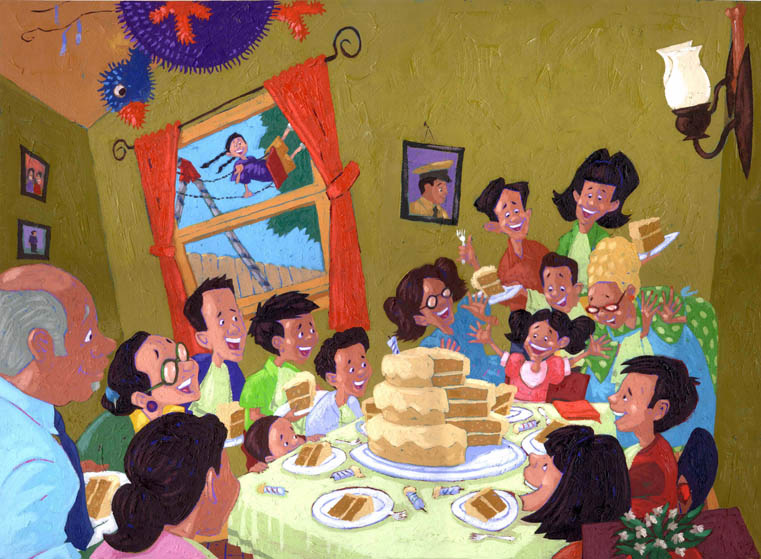
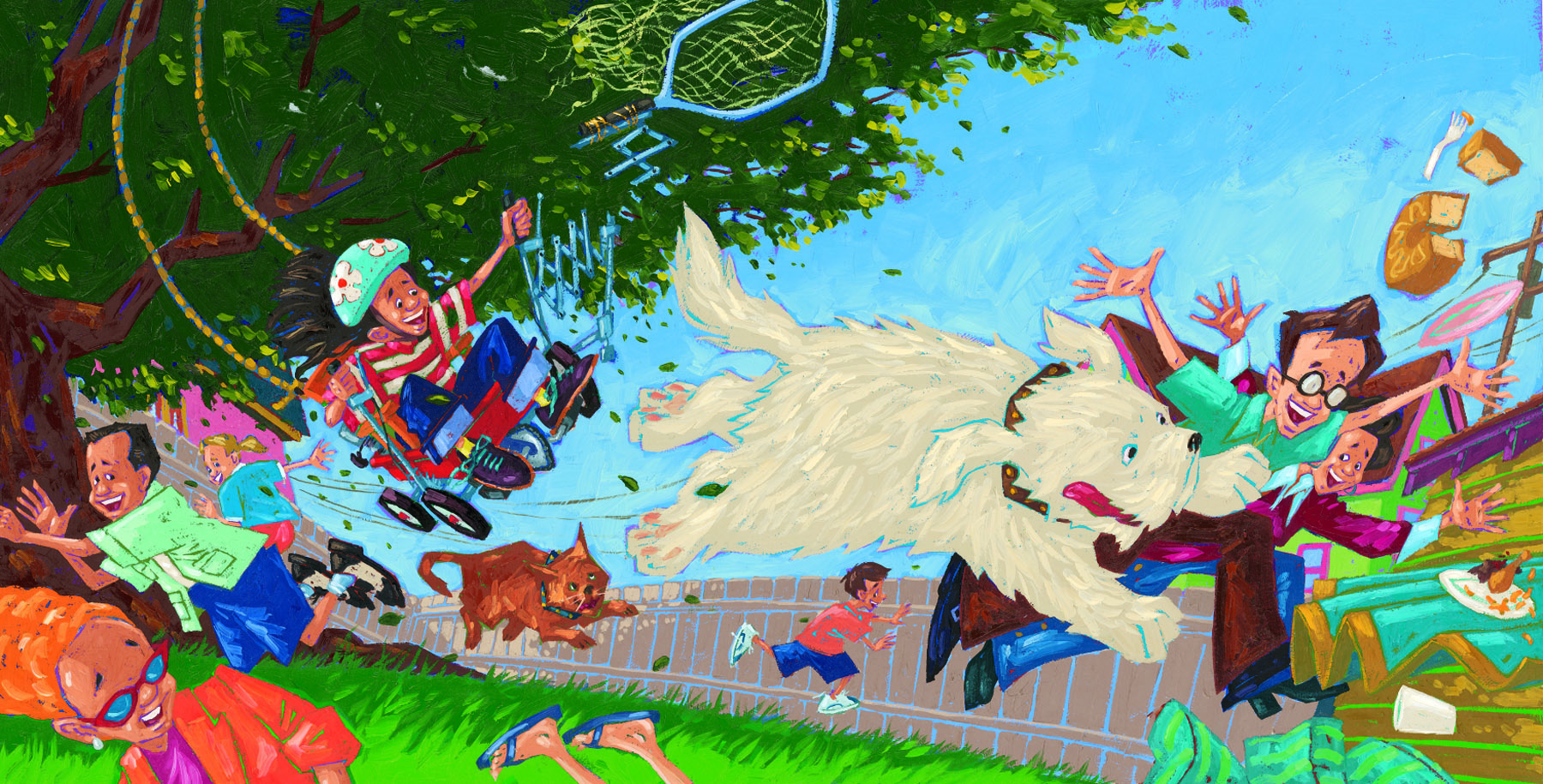
I wrote a story, The Swing, that took place in a neighborhood just like the street I grew up on. I’m Chicano, and I could write and illustrate that story about Chicano neighbors from a very immediate and intimate place. East Los Angeles isn’t Spanish Harlem, though, nor is it Little Havana. It seems to me illustrating stories about those Latino communities wouldn’t be all that different than illustrating a story about Inuits in the Arctic, Mongolians living in Yurts, or a story set in the Deep South. I’m respectful of the content and information that presents itself in illustrating stories of people of color, but I don’t live there that long. My preference is not to develop minority characters as much as illuminate the story that’s being told. For me, every step toward “development” is one toward information, accuracy and specificity, which is all fine and good, but it might also be one more step away from grandness and magic… and the informal joy of uncertainty and open-endedness.

MiceAndBeans4_75 copy

Lila: What’s on your drawing board right now?

Joe: Starting a new bilingual book based on a kid’s song. Writing a story for a picture book. Lunch.

 ——————-

And that’s not the end of Joe’s fascinating interview. Please stay tuned for tomorrow’s  follow-up post!

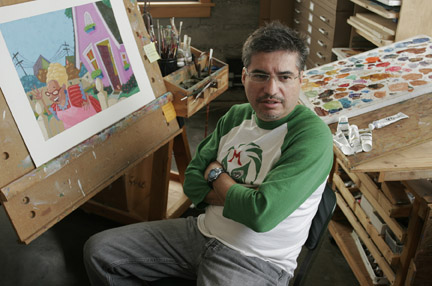
 second_pic_4x6_72Joe Cepeda is an award-winning illustrator of children’s books who also works in magazine illustration. He lives in California and serves as president of the Society of Illustrators of Los Angeles. For more information, visit his website.