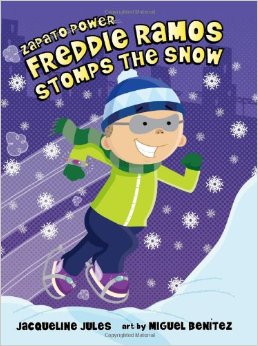
Book Review: Freddie Ramos Stomps the Snow by Jacqueline Jules

By Ashley Hope Pérez

FreddieRamosDESCRIPTION FROM THE BOOK JACKET: The snow’s no match for zapato power! A blizzard in March? It’s happening in Starwood Park! Luckily there’s a snow day at school because Freddie’s helping Mr. Vaslov clear the sidewalks with his latest invention—zapatos made just for the snow!

The weather can’t stop a thief from causing trouble in the neighborhood, though. Freddie wants to catch the culprit, and he can’t do it alone! But will the meanest kid in Starwood Park be Freddie’s crime-fighting partner?

MY TWO CENTS: Written by Jacqueline Jules and illustrated by Miguel Benítez, Freddie Ramos Stomps the Snow is the fifth of the Zapato Power books. This sweet, playful tale centers on the special experiences around a school snow day, as experienced by the protagonist of the series, Freddie Ramos. Freddie has super zapatos thanks to a special neighbor, who helps him transform his usual sneakers into super snowshoes to help his neighbors. What sets Freddie Ramos apart is how the story strikes a positive note while accurately reflecting the experiences of kids from a range of backgrounds.

The setting for Freddie Ramos opens up possibilities for subtly engaging with experiences that are relatively neglected in the sunny tales targeted at the primary grades. Despite the fact that many students live in apartments and know some financial hardships, the vast majority of books for children feature middle-class families living in single-family homes. It is refreshing, then, to follow the escapades of Freddie Ramos and his friends at the Starwood Park apartment community.

Financial concerns are a reality for Freddie and his friends, but Freddie Ramos also suggests that even young kids can take positive actions in response to difficult circumstances. Freddie worries about not having snow boots, and we learn that most of his shoes and clothes are hand-me-downs from a friend’s older brother. Importantly, Freddie frames this fact in a way that shows a focus on the positive in his community: “At Starwood Park, people shared.” Attentiveness to the needs of others is prominent in the book, and later, we see how Freddie enacts generosity. In addition to his work cleaning paths for neighbors, when he notices that most of the kids don’t have a sled, he proposes a strategy for sharing that allows all the kids in the complex to have a turn going down the big hill. The Starwood bully, Erika, appears in a more vulnerable light when her grandmother’s purse is stolen with their rent money inside.

Yet these more serious elements do not weigh down the buoyant narrative. My son (age 4) loved the special zapatos and the watch that Freddie uses to turn them on. I enjoyed the casual, untranslated incorporation of Spanish. (For why I think it’s so important that books not gloss these phrases, see this post.)

Jacqueline Jules also deftly handles the social terrain of elementary school. Like many sweet kids, Freddie finds it easier to protect his friends from bullies than to help the bully herself. But his character stretches, ultimately rising to the challenge of being kind to an unlovable classmate. Readers see that Freddie’s greatest superpower is the generosity and kindness he has learned from his community.

TEACHING TIPS: Geared toward readers in grades 1-3, the Zapato Power series would be at home on a bookshelf next to the Flat Stanley and Captain Underpants books and is a great read-alike option for students who have enjoyed these. If used for reading groups or as a class read-aloud title, Freddie Ramos Stomps the Snow offers some great opportunities for reading-writing connections. Offering a range of prompts is a great way to differentiate for students with varied writing proficiencies and interests. Try some of the following prompts with students. Younger children may be asked to draw a picture that responds to a similar prompt.

  • What would you do on a snow day?
  • Mr. Vladek is always designing new inventions for Freddie Ramos to try out. If you could turn one piece of clothing into a superhero tool, what would it be and how would it work?
  • Write a diary entry from Erika’s perspective to show how she feels about Freddie Ramos after the purse thief is caught.
  • We don’t find out much about the purse thief. Write his confession. Why does he commit these crimes?
JJ2Additional Zapato Power activities are available on Jacqueline Jules’s website here. And check out the trailer below for a closer look at Miguel Benítez’s adorable drawings.

Jacqueline Jules is the award-winning author of more than twenty children’s books, many of which were inspired by her work as a teacher and librarian. She is also an accomplished poet. When not reading, writing, or teaching, Jacqueline enjoys taking long walks, attending the theater, and spending time with her family. She lives in Northern Virginia.
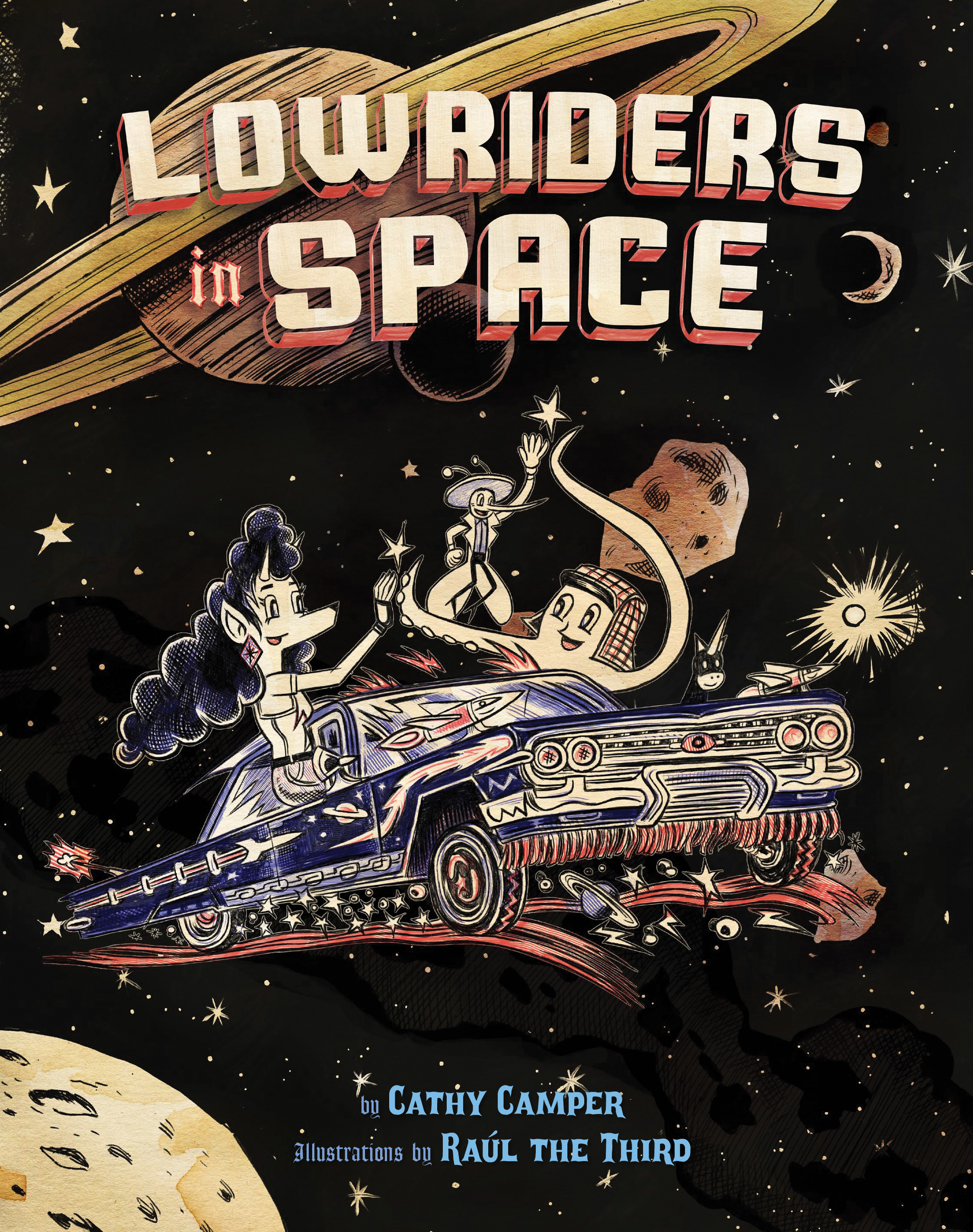
Book Review: Lowriders in Space by Cathy Camper, illustrated by Raúl the Third

Lowriders in Space_FC_HiResBy Lila Quintero Weaver

This book talk is based on an advance review copy. Quotes and details may vary in the final version.

DESCRIPTION FROM THE BOOK JACKET: Lupe Impala, El Chavo Flapjack and Elirio Malaria love working with cars. You name it, they can fix it. But the team’s favorite cars of all are lowriders—cars that hip and hop, dip and drop, go low and slow, bajito y suavecito. The stars align when a contest for the best car around offers a prize of a trunkful of cash for the best car around—just what the team needs to open their own shop! ¡Ay chihuahua! What will it take to transform a junker into the best car in the universe? Striking, unparalleled art from debut illustrator Raúl the Third recalls ballpoint-pen-and-Sharpie desk-drawn doodles, while the story is sketched with Spanish, inked with science facts, and colored with true friendship. With a glossary at the back to provides definitions for Spanish and science terms, this delightful book will educate and entertain in equal measure.

MY TWO CENTS: Look in the children’s section for graphic novels from the Latino perspective and you’ll find precious few choices. Look there for books about lowriders and your choices will be still slimmer. Here is Lowriders in Space, ready to fill both spots with a joyous, celebratory tale. You don’t need deep knowledge of the lowrider culture to appreciate this middle-grade graphic novel, brought to you by the author-illustrator team of Cathy Camper and Raúl the Third.

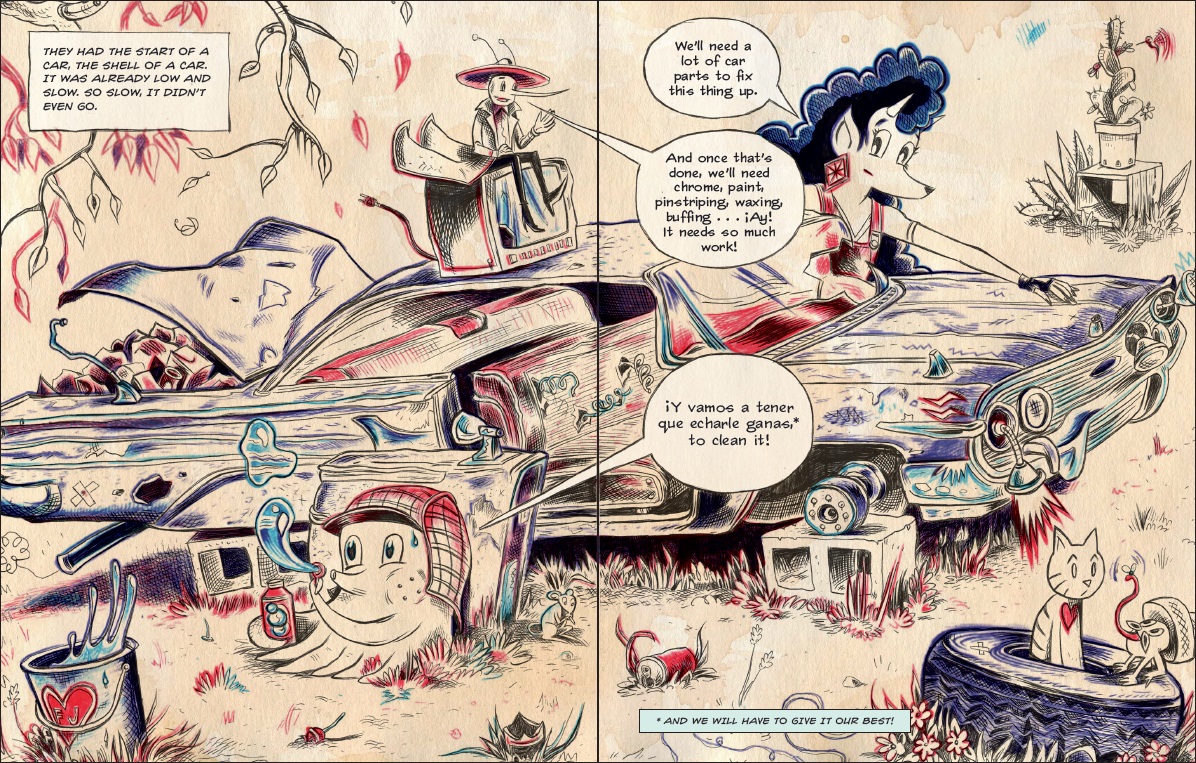
Lowriders In Space_Int_3In the opening pages, we meet three animal characters with Spanish names, all of whom work for a car-repair shop. The shop is called Cartinflas, and this is just one of many playful allusions and verbal jokes in this book. (Cartinflas plays on the name of the famous Mexican comic actor, Cantinflas.) Lupe Impala, (a wolf) busts gender stereotypes as a female lead who knows her way around car engines. Her sidekicks, the octopus El Chavo Flapjack and the mosquito Elirio Malaria, each specialize in key aspects of automobile revamping in the lowrider style. Elirio’s fine-tip proboscis doubles as a paintbrush that turns out the sweetest racing stripes and airbrushed scenes you could imagine. El Chavo’s eight tentacles go to work washing, polishing and buffing cars to a high sheen.

The trio dream of going into business for themselves, but where will they find start-up money? A car competition with a hefty cash prize gives them hope, but there are tough challenges to meet. First, they must find a car to work their magic on. They settle for a rusty heap sitting on cinder blocks. Now for car parts. At an abandoned airplane factory, they pick up mini air compressors and a box of rocket equipment. After attaching the parts, they’re in for a surprise when Lupe cranks the engine and it launches the car into the stratosphere. High above the earth, the car gears down into bajito-y-suavecito mode, low and slow: this is the cruising speed that lets low riders see and be seen. While the transformed auto travels outer space, it takes on loads of flash and bling borrowed from stars, asteroids and others elements of the galactic realm.

There’s much to love in this kid-friendly graphic novel. The story arc follows a familiar trajectory: the protagonists meet every challenge successfully and win the sought-after prize. Kid readers will be cheering. But my hat’s off to Cathy Camper for elevating the storyline above the predictable. She does this through original settings and characters, including the lowrider car itself, and with the inventive twists of space travel and comical astronomy. Her text engages the ear with musical language that includes alliteration, onomatopoeia, and bursts of G-rated street slang in English, Spanish, and Spanglish.

Kids will eat up the comics-style art. Every page offers levels of visual puns and charming details that invite readers to study panels closely. The color scheme and the drawings give off a retro historieta vibe, fitting for a story about lowrider culture, which was born in the 1950s and is rooted in the Mexican American community. I’m not familiar with the ballpoint-pen doodle style that Raúl the Third credits as his inspiration, but I dig it!

TEACHING TIPS: The back of the book contains a glossary of Spanish phrases, factual information on the tongue-in-cheek astronomy that appears in the story, and a thumbnail summary of lowrider history.

One bonus of graphic novels is their appeal to devoted bookworms and reluctant readers. Kids seem to instinctively grasp the multiple levels of interaction offered through their blend of text and images. Teachers may want to approach Lowriders in Space—and any graphic novel—in two steps. Read through it once purely for the story. Revisit it at a slower pace to more fully absorb the images. Raúl the Third’s art is rich with details, charming secondary characters, and visual puns that sharp-eyed kids will relish hunting down. These may not be central to the story, but they sure contribute to the fun. For example, it’s one thing to read that there’s a fast-food joint called Sapo Bell in the background of one scene—it’s another to spy the goofy sapo sitting out front. Middle-grade readers are sure to love such hidden gems.

Lowriders in Space encourages kids to celebrate a fun aspect of Mexican American culture that should be respected, not ridiculed or stigmatized. Too often when lowriders appear in popular culture, they’re thrown in for kitsch points. This usually results in stereotyping and negative connotations. Teachers can use this text to combat the lazy disregard involved in stereotypical usage and replace it with the dignity that comes with cross-cultural appreciation.

If you’d like to learn more about lowrider history culture, here are some suggested resources:

“Lowriding: This Culture is About More Than Cars.”

“Low and Slow: The History of Lowriders.” 

Be sure to read Cathy’s guest post on Latin@s in Kid Lit!

Cathy Camper_headshot_photo (c) Jayson Colomby_smCathy Camper is a librarian focusing on outreach to schools and children in grades K-12. She lives in Portland, Oregon. Raúl the Third teaches classes on  drawing and comics for kids at the Museum of Fine Arts and the Institute of Contemporary Art. He lives in Boston, Massachusetts.          

   Raul the Third (credit Elaine Bay)


And now for a big treat, the official book trailer for Lowriders in Space!


Seven Things I’m Looking Forward to at Comadres & Compadres Writers Conference

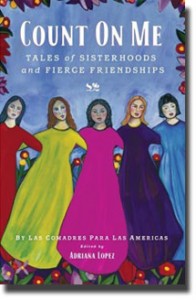
Count on Me

by Lila Quintero Weaver

Soon, I’m jetting off to New York for the 3rd Annual Comadres y Compadres Writers Conference, held at Medgar Evers College in Brooklyn on Saturday, September 27. Will you join me?  It’s going to be fabuloso! It’s not too late to register. Here’s where you can learn more.

And now a quick list of seven things I’m looking forward to at the conference.

  1. Meeting Latin@ writers, readers, librarians, agents, editors and mover-shakers from all over! Exchanging contact info.
  2. Hearing the maravillosa Esmeralda Santiago deliver a keynote!
  3. Sharing a lunch table with up-and-coming Latin@ writers, lending encouragement and tips wherever I can.
  4. Attending Meg Medina’s craft workshop on children’s books.
  5. Learning about the work of other Latin@ writers, because there are always gems waiting to be discovered.
  6. Exchanging abrazos with readers of Latin@s in Kid Lit and meeting Cindy L. Rodriguez, the blog’s founder, at long last!
  7. Gathering inspiration for future creative projects and blog posts.


Guest Post by Author Cathy Camper: Lowriders in Space Blast Off!

Cathy Camper_headshot_photo (c) Jayson Colomby_smBy Cathy Camper

Elirio Malaria (a mosquito), Flapjack Octopus and Lupe Impala work at a car dealership six days a week. Lupe’s the mechanic, Flapjack washes and buffs the cars, and Elirio details the cars with his beak. Their dream is to have a garage and a lowrider of their own:

            They’d seen some cars blast by fast,

             And others that could shift and drift,

            But they wanted a car that would go low and slow.

            Bajito y suavecito.

            A universal car contest gives them that opportunity. But not until their car gets customized by outer space! Pinstripes from Saturn, pompom asteroids, and star-capped hubcaps make their car an interstellar phenomena!

That’s how I pitched my graphic novel Lowriders in Space at Pitchapalooza in Portland, Oregon. Back when the book was just a manuscript and a vision in my head, I’d exhausted the list of graphic novel agents, and so winning this contest was like a dream come true. The prize was the advice of The Book Doctors, a husband-wife team who connected my project with an agent and eventually, an editor and publisher.

I’m a writer, artist and a youth services outreach librarian. I wrote Lowriders in Space because as an Arab American, I was fed up with the inability of mainstream comics and books to represent the diversity of kids I see everyday, kids who like me, don’t see themselves in books. When I first sent the script to the book’s artist, Raúl III, who is Latino, he told me, “This is the book I wanted to read as a child,” and he was as excited as I was to create it, and for the same reasons. Our editor at Chronicle Books, Ginee Seo, is Korean American, and she gets it too—like us she wants to give kids a book that meets them where they are.

I’d been working on the book since 2006, and was thrilled when the #WeNeedDiverseBooks campaign launched in May 2014. We’re hoping that when Lowriders comes out this fall, it kicks a big hole in the wall of racism of kids’ books, welcoming kids of all backgrounds to read it. We hope it encourages publishers to create more books by new authors and illustrators of color, and to inspire kids via reading our book, to become creators, too.

By 2050, one third of the US will live in English-Spanish speaking households—that’s our audience! The book’s also aimed at boys, because the literacy rate of boys is dropping, and like Jon Scieszka (who sponsors the Guys Read website), we want boys to read. We also envision that kids struggling to read, for whatever reasons, might find our book inviting. And it looks like adults are loving it, too, from all the reviews that have been popping up online.

Since I’m not Latina, it was crucial to me that our book was culturally correct. I did tons of research, read books, watched films, went to the Lowrider Magazine’s car show, and interviewed people. I’m also fortunate and forever grateful to have the help of many Latino friends and library co-workers, who read the manuscript, offered suggestions, and helped fine-tune the Spanish. One of the cartoonists I admire most is cartoon journalist Joe Sacco. His ability to go into places of high conflict, like Palestine and the Bosnian war and create detailed drawn and written records out of chaos humbles me. When I heard him speak, he mentioned that one of the things he tries to do is set his ego aside, and put the stories of those he’s writing about, up front. When I wrote Lowriders, I tried my best to emulate this goal, and to fight for, as best I could, what would make the story culturally relevant.

This goal included having the right illustrations. Traditionally in children’s books, the writer doesn’t choose an illustrator for the manuscript (though this is different in comics creation). I was warned along the way, “Choosing your own illustrator may work against you.” However, I felt it was crucial that Raúl illustrate this book, not only because he’s a brilliant artist (and if we’re saying we need more diverse kids books, we also need more diverse creators), but because his art added just the right touch of both cultural relevancy and the retro-nuevo feel the text demanded. Raúl told me that much of the setting and landscape is based on his childhood in El Paso, Texas. When he started sketching Flapjack Octopus, he said he couldn’t help but think of him in his pail as El Chavo del Ocho, sitting in his barrel—and so we changed Flappy’s name and look to reflect that.

Lowriders In Space_Int_2

Just as Raúl was able to make contributions to the text, I sometimes added context to the drawings. For example, it was important to me that our lowriders’ car had the Big Dipper on it. For the lowrider diaspora of Latinos and African Americans whom the book celebrates, the Big Dipper represents the path north, and more broadly, the path to freedom. What better symbol to have on a flying car’s license plate? Our book celebrates the influence of older comics, art, pop culture and car references that Raúl and I both love and wanted to share, including George Herriman’s Krazy Kat, the Hernandez BrothersLove and Rockets, Mad Magazine and Big Daddy Roth’s cars.

And then there’s the science – I love science! My first book Bugs Before Time was about giant prehistoric insects – including a sea scorpion as big as your mom. Why wouldn’t our graphic novel include science, when there really are things as wondrous as flapjack octopuses and braided rings of Saturn? The technology of cars is part of science, too, whether it’s learning how cars are buffed and painted, how air compressors make lowriders hop, or what vulcanizing does to make rubber tires strong.

We think Lowriders is going to read like something brand new, because of the unique, aligned intent of author, illustrator, and publisher and because of the crazy mix of culture, comics, and science our combined imaginations dreamed up. We hope you love it and it makes you laugh, and that you share your excitement with all the kids out there that might love it, too. When Lowriders in Space blasts off this fall, our real destination isn’t the outer galaxies, it’s to land in the hands of kids who deserve to see themselves in what they read, and to be read by everyone else so they experience how rich a culture of color can be.

Cathy Camper is a librarian focusing on outreach to schools and children in grades K-12. She lives in Portland, Oregon. Follow the book’s Facebook page for more news.

Coming soon on Latin@s in Kid Lit: A book talk on Lowriders in Space with more story details and more peeks at interior pages!

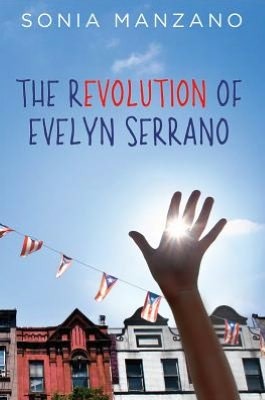
Book Review: The Revolution of Evelyn Serrano by Sonia Manzano

Evelyn overBy Sonia Alejandra Rodriguez

DESCRIPTION FROM THE BOOK JACKET: There are two secrets Evelyn Serrano is keeping from her Mami and Papo: her true feelings about growing up in her Spanish Harlem neighborhood, and her attitude about Abuela, her sassy grandmother who’s come from Puerto Rico to live with them. Then, like an urgent ticking clock, events erupt that change everything. The Young Lords, a Puerto Rican activist group, dump garbage in the street and set it on fire, igniting a powerful protest. When Abuela steps in to take charge, Evelyn is thrust into the action. Tempers flare, loyalties are tested. Through it all, Evelyn learns important truths about her Latino heritage and the history makers who shaped a nation. Infused with actual news accounts from the time period, Sonia Manzano has crafted a gripping work of fiction based on her own life growing up during a fiery, unforgettable time in America, when young Latinos took control of their destinies.

MY TWO CENTS: The Revolution of Evelyn Serrano (a Pura Belpré Author Honor Book) by Sonia Manzano  opens with a frustrated fourteen year old Evelyn getting ready for her summer job at the Five-and-Dime. Her desire to fit in to American society and distance herself from her Puerto Rican heritage is disrupted when her Abuela comes to stay with them. Abuela’s orange hair and bright clothes make her anything but the traditional grandmother Evelyn expected. Abuela taking over Evelyn’s bedroom with makeup, hair rollers, and flashy clothes is only the first of many changes that serves to transform Evelyn’s understanding of her own identity.

While Abuela’s presence creates tension in the Serrano household, a new youth group arrives to challenge discriminations against their neighborhood. The Sanitation Department eventually stops picking up the garbage, and as it continues to accumulate, so does the tension around the Young Lords’ intent to politicize El Barrio. The rise of the Young Lord’s movement gives Abuela and Evelyn an opportunity to discuss the relationship between what is presently happening in their community and the Ponce Massacre (1937) of which Abuela has kept newspaper clippings. The Young Lords organize El Barrio in a way that Evelyn has never experienced, and their demonstrations and marches provide El Barrio with a visibility they later utilize to demand social change. As the political situation intensifies in El Barrio, Evelyn and Abuela become more involved with the Young Lords. Their involvement creates a rift between them and Evelyn’s mother, but it is through all of this process that Evelyn recognizes the importance of her Puerto Rican heritage.

Among many things, Manzano’s The Revolution of Evelyn Serrano is a historical young adult novel. (Re)tellings and (re)imaginings of history are currently a popular strategy in Latina/o Children’s and Young Adult Literature. Like Juan Felipe Herrera’s Downtown Boy (2005) and Bejamin Alire Saenz’s Aristotle and Dante Discover the Secrets of the Universe (2012), Manzano asks that today’s young adult reader travel back to a time when their grandparents and/or parents were children and adolescents.

This literary move to focus on a historical event is brilliant for many reasons. First, it asks Latina/o readers to examine their own background as a way to understand their present identity. In The Revolution of Evelyn Serrano, it is extremely significant that there are moments of reflection that help Evelyn understand that her presence in El Barrio is not coincidence. In other words, Evelyn needed to learn her parents’ and grandparents’ journeys to understand her own identity and her relationship to El Barrio.

Secondly, novels like Manzano’s center stories that have remained marginalized in mainstream history books. Evelyn is such a wonderful character precisely because she sounds and behaves like a typical teenager. At the beginning of the novel, Evelyn wants nothing to do with her parents and their stories. She is embarrassed of them and her community—and this right here is a very honest and common feeling (that too often remains silent) among Latino children and teenagers of (im)migrant parents. Throughout the novel, Evelyn learns to center her Puerto Rican culture as a way to find empowerment rather than to feel embarrassed by it.

Lastly, Manzano’s novels, and others like hers, create intergenerational discussions around issues of discrimination and gender (to name a few themes present in Evelyn Serrano). In other words, novels like these emphasize that significant social change requires a community talking to one another. While the Young Lords were central in the mobilization of El Barrio, it was also with the support of their elders and younger members that they were able to stand strong against the discrimination the community faced.

The Revolution of Evelyn Serrano presents a genuine story of identity formation for a young Latina coming of age at a moment in U.S. history when Latinos are violently forced to assimilate into mainstream society or risk their lives by speaking up and challenging the discrimination they experience.

TEACHING TIPS: When teaching The Revolution of Evelyn Serrano, it will be helpful to provide a historical context for the novel from which to guide student discussion. Manzano provides a bit of this discussion in her afterward where she explains that the events in the novel are based on true events. The Young Lords: A Reader (2010) edited by Darrel Enck-Wanzer and Palante: Voices and Photographs of the Young Lords, 1969-1971 (2011) are excellent resources for educators to learn more about the group’s history, motivations, and outcomes. Pairing the novel with some of the essays in these sources for more advanced or older students can also provide a basis for discussing race, class, and gender both within the party and in the context of the US.

A thematic approach to teaching Manzano’s novel can be one way to broadly discuss the Civil Rights Movement and relating topics. Novels like Rita Williams-Garcia’s One Crazy Summer (2011) about three young African American sisters and their adventures with the Black Panthers and children’s books like Monica Brown’s Side by Side: The Story of Dolores Huerta and Cesar Chavez (2010) about the leaders of the farm workers’ movement can provide rich conversations about the array of issues impacting people of color at this time. Discussing children’s and YA books on the Civil Rights movement not only allows students to learn more about specific racial discrimination and community empowerment but also creates opportunities for students to discuss how those issues impact them now.

Another approach to teaching the novel is to discuss characters and character development. Evelyn’s relationship with her abuela is a complicated one because they have different personalities and because Abuela represents a cultural heritage Evelyn wishes to avoid. Their relationship, however, is central in the novel. Other YA novels like Claudia Guadalupe Martinez’s The Smell of Old Lady Perfume (2008) and Sandra Cisneros’s Caramelo (2003) present similar granddaughter/grandmother relationships wherein both characters engage and learn from one another. Asking students to interview their grandparents or a family elder could be a possible assignment for students of any age to participate in an exercise similar to the character development of the protagonists they read.

AUTHOR (from her website)Sonia Manzano has been a presence on Public Television since the 1970’s. Raised in the South Bronx, she attended the High School of Performing Arts. A scholarship took her to Carnegie Mellon University in Pittsburgh, and in her junior year, she came to New York to star in the original production of the off-Broadway show, Godspell. Within a year Sonia was cast as “Maria” on Sesame Street. After ten years as an actress, Sonia began writing scripts for the series and has fifteen Emmy Awards as part of the Sesame Street writing staff. Sonia also wrote for the Peabody Award winning children’s series, Little Bill, for Nickelodeon and for a short time wrote a parenting column for the Sesame Workshop web site called Talking Outloud. In addition to The Revolution of Evelyn Serrano, Manzano has written two picture books: No Dogs Allowed! and A Box Full of Kittens.

FOR MORE INFORMATION ABOUT The Revolution of Evelyn Serrano visit your local library or bookstore. Also check out worldcat.orgindiebound.orggoodreads.comamazon.com, and barnesandnoble.com.

headshotSonia Alejandra Rodríguez has been an avid reader since childhood. Her literary world was first transformed when she read Rudolfo Anaya’s Bless me, Última as a high school student and then again as a college freshman when she was given a copy of Sandra Cisneros’s The House on Mango Street. Sonia’s academic life and activism are committed to making diverse literature available to children and youth of color. Sonia received her B.A. in English from the University of Illinois at Urbana-Champaign. She is currently a PhD candidate at the University of California, Riverside, where she focuses her dissertation on healing processes in Latina/o Children’s and Young Adult Literature.

Latin@s in Kid Lit is Now on Pinterest!

Pinterest-logoGood news! Latin@s in Kid Lit is on Pinterest!

Come have a look at our just-hatched boards. They’re growing day by day!

Please follow us and share our pins. If you have boards on Pinterest related to Latin@ kid lit, we’d love to follow you too and re-pin from your wealth of book covers, author highlights, writing tips, and literacy promotions, just to name a few categories. This is one more way that we can help each other widen the reach of Latin@ kid books!

Pinterest Screen Grab