In the Studio with Illustrator John Parra

by Lila Quintero Weaver

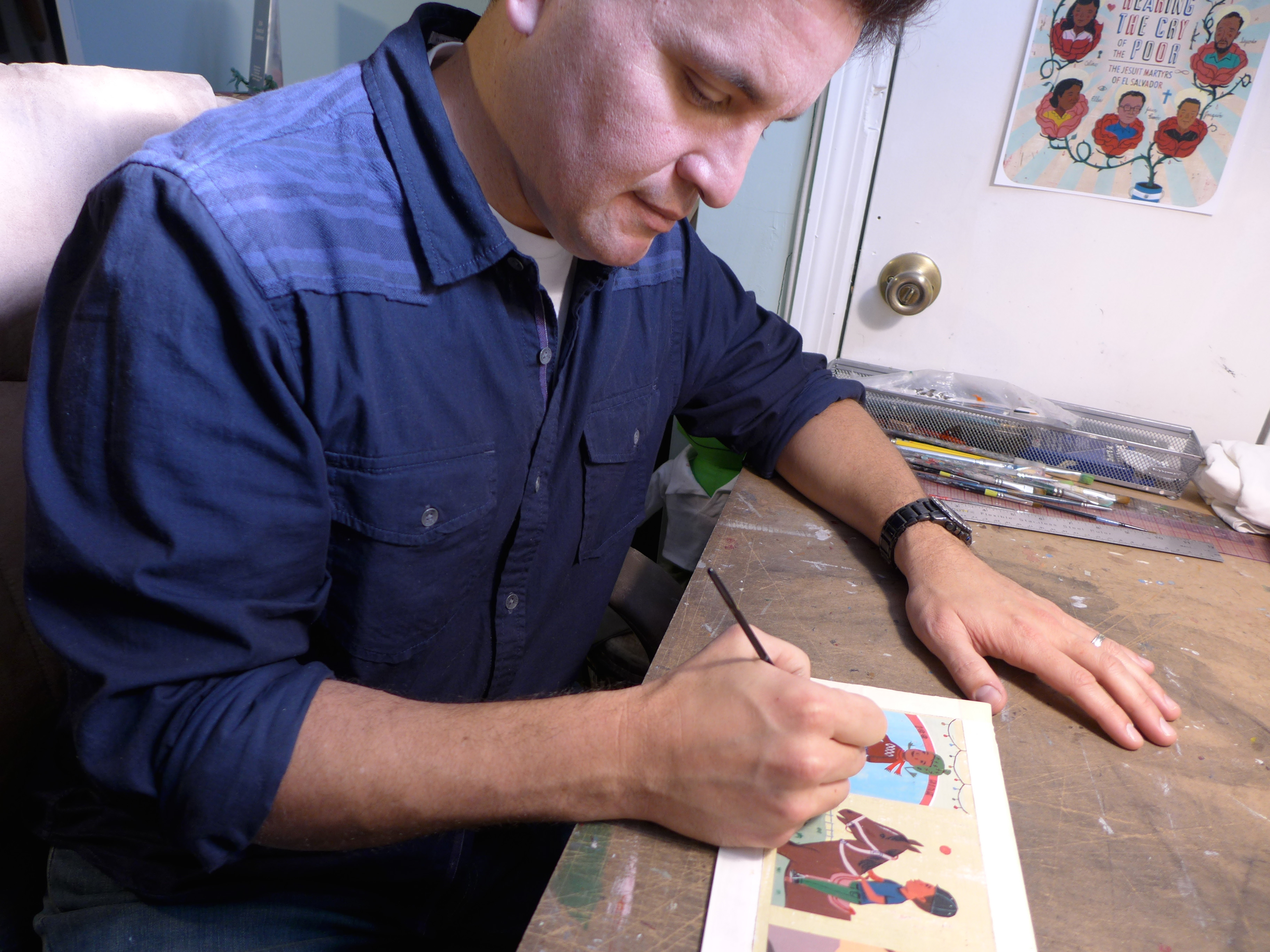
Parra in the studio

John Parra in his studio in Queens, NY. All photos by Caitlin C. Weaver
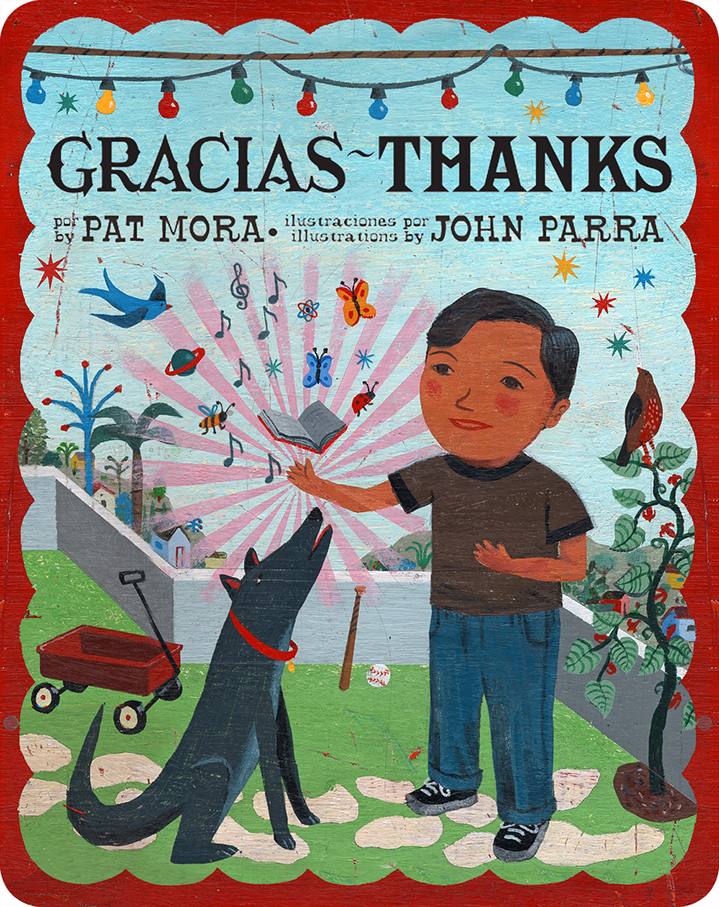
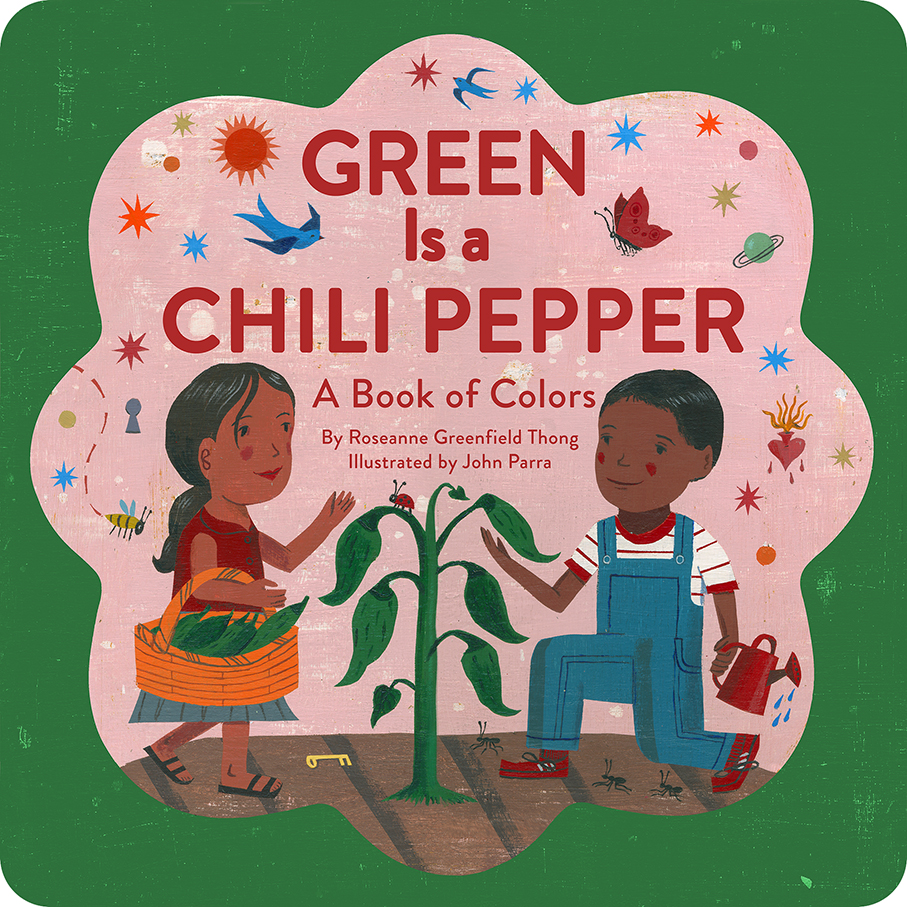
8-1/2"x11" jacket mech.  Green is a Chile Pepper.Cover

Magic flows from the paintbrushes of John Parra, the award-winning illustrator of a growing number of Latino-themed picture books and other illustration work. Here at Latin@s in Kid Lit, we’re ardent fans of John’s art, drenched as it is in color and rich detail, and affirming in its depiction of positive community and family life within Latino settings. Plus, it’s gorgeous—plain and simple—and we can’t resist wondering what’s behind the magic. John invited us into his studio and we had questions.

Waiting for the Biblioburro.Cover

Lila: Every children’s book you’ve illustrated bears your unmistakable stamp. Developing a personal style doesn’t happen overnight. What’s the story behind yours? 

John: My art style really came together in my final year of attending art school. I was fortunate early in my art training to have some amazing teachers and mentors who taught me the traditional fine art techniques of realism, perspective, color theory, and composition. During my mid-college years, I began experimenting more with techniques, such as mixed media, collage, and printmaking. These techniques enabled me to open up and develop a more unique and distinctive visual palette and approach in my work. I also began studying different styles of art genres. I fell in love with folk and outsider art. However, I still felt something was missing as far as an emotional connection to the work I was creating. That changed after a conversation I had with a visiting artist to our school named Salomón Huerta. He was a graduate of our school whose work reflected his Hispanic background and culture. Immediately I felt a connection and a light bulb went off in my head that I, too, could infuse my background, culture, and personality into my work. The first project I did was a series of paintings based on El Dia de los Muertos. I was so excited about the project that I just never stopped. As years have gone by, my work has gradually been updated but still holds on to those inspirational roots from that earlier period.
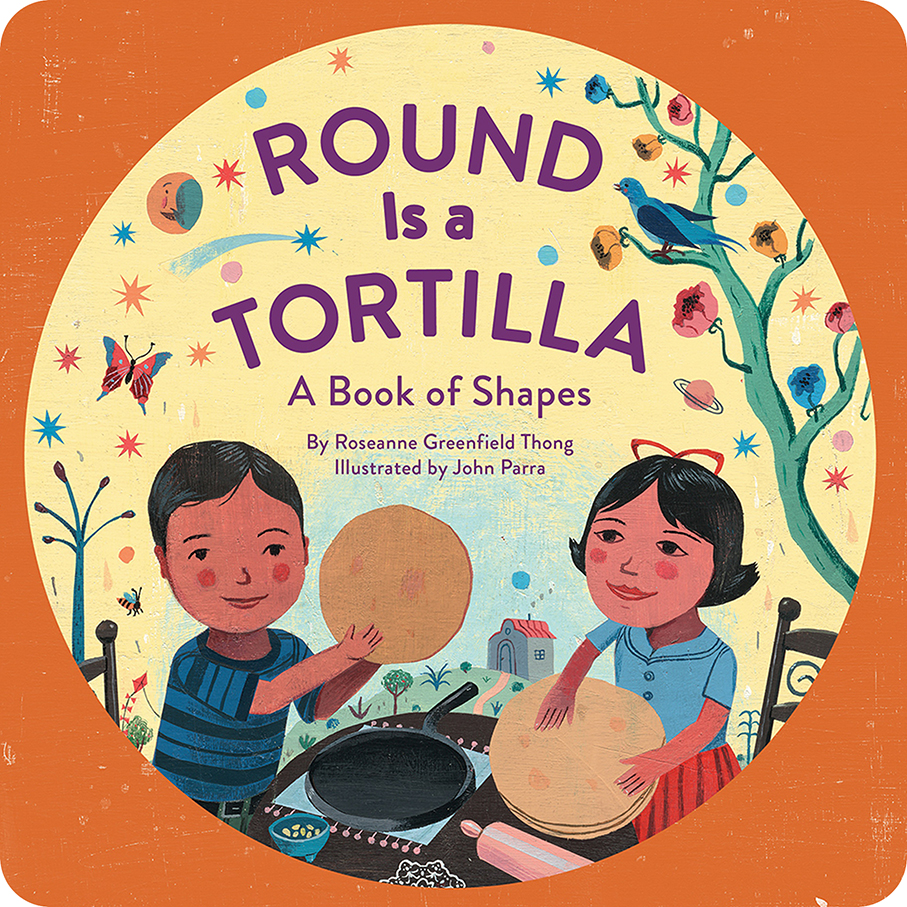
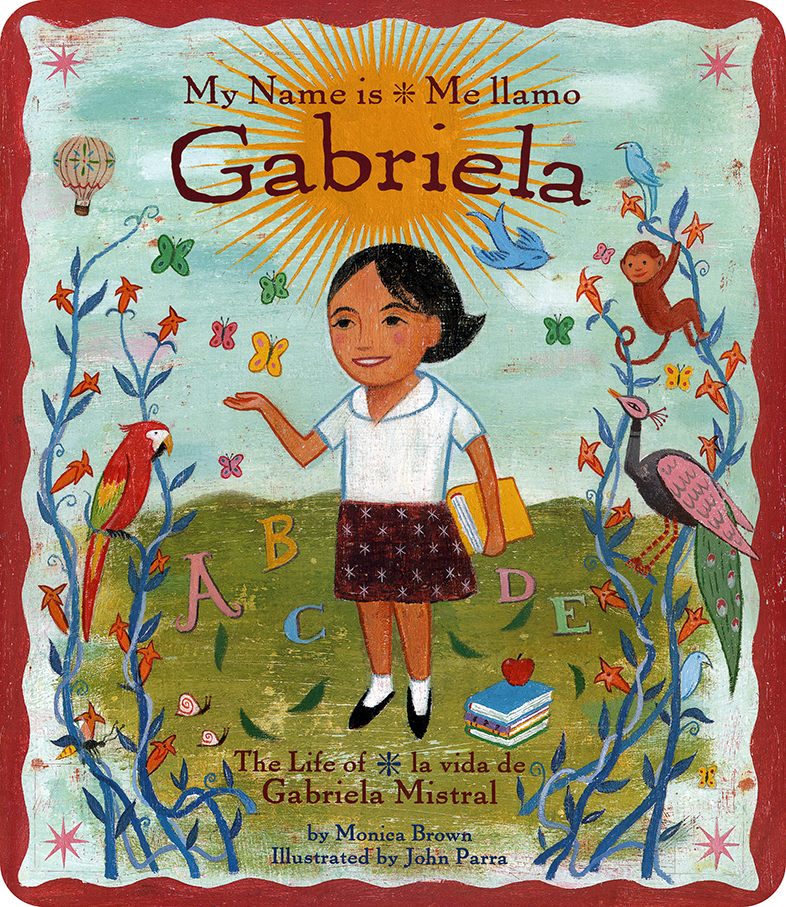
Round is a Tortilla.Cover    My Name is Gabriela.Cover

Lila: It must take scads of research to achieve the “rings true” effect of your illustrations. For example, in P is for Piñata, the illustrations cover a wide range of subject matter, from Aztec deities to cacao pods to folkloric dance. What is your research process like? 
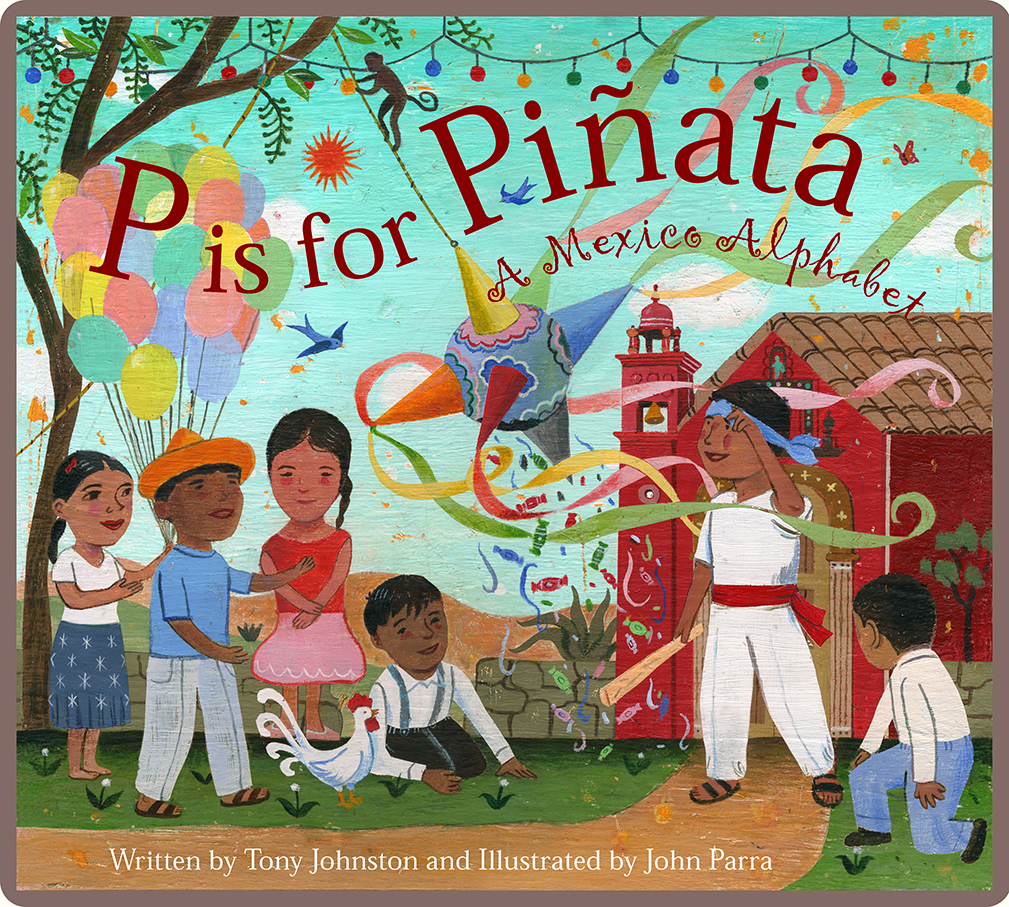
P is for Pinata.CoverJohn: The first step I do when beginning a project is researching for visual photo references, first through the web, then in books in my library. I tend to look for images not just about the main subject but also in its regional geography, architecture, plants, animals, and anything else that could be related and connected to the issue. I then may delve in and read historical and background info through articles and books. Sometimes there is a good documentary on the topic to gain some insight as well. If possible, speaking to someone with firsthand knowledge of the subject can also bring a wealth of ideas. To me it is very important to be true to the source material when working on a project. I feel blessed to be creating this art, but it is a responsibility to accurately portray the content, otherwise you might fall into stereotypes or misleading subject matters.
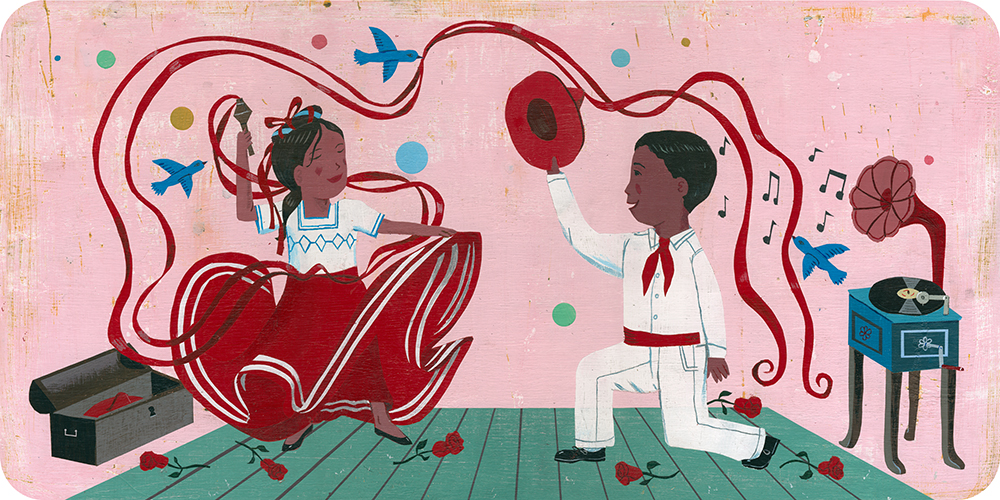
Folklorico Dance

Lila: The characters in your scenes include a wide range of skin tones, an important acknowledgment of ethnic diversity within Latino populations–kudos to you for that!  

John:. Growing up, I always had a diverse group of family and friends. To me, it seems pretty normal to extend that into my work. I also just enjoy seeing diversity. I think it’s important that all people are represented and as we say, invited to the party.
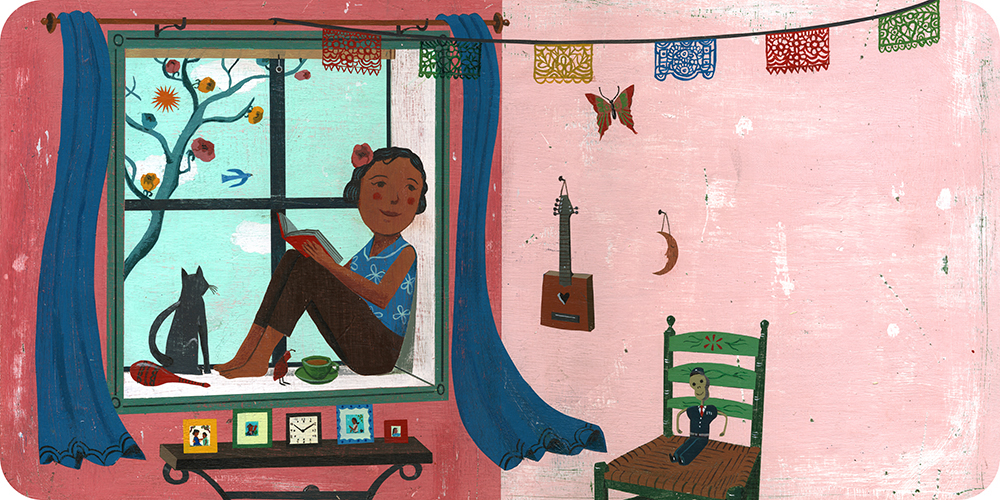
pg5.Ventanas

Lila: One fascinating component to your book illustration is the practice of hiding  “Easter eggs.” Please elaborate! 

John: I often add funny or inside references in my work for my family and friends to find. One example of this is that I always include a self-portrait character, representing myself as a child, in all my books. I will not give away which character it is, it will be up to the viewer now to find and guess.

Skeleton Dance

Lila: The world of publishing needs more highly skilled Latin@ creators. Based on your experience, what advice would you give to a young person considering illustration as a career? 

John: You could probably devote a series of articles to just this one question. Starting out as a new artist can be challenging, with many artistic directions and choices to make. Based on my experience working in the field of freelance illustration, I recommend developing the following four areas.

1. Focus on your artwork and make it as exceptional as possible. It should be a reflection of what you like and have interest in. Create your own voice and style that connects the work to you.

2. Use print promotion and social media to display your work. It is very important to get your art out there in the public. Your artwork should be easily accessible to view online. Blogs, Facebook, and illustration annual competitions can be very helpful for ideas, as well as for showcasing your work. Be consistent, announce successes, and bring awareness to your projects.

3. Include a group of artist friends and colleagues to meet with regularly.  This way, you can discuss ideas and potential projects to work on, perhaps even collaborative ones.

4. The business side: Learn as much as possible about contracts and billing. Whether or not you have someone to represent you, it is always important to read as best you can about what you are getting into.
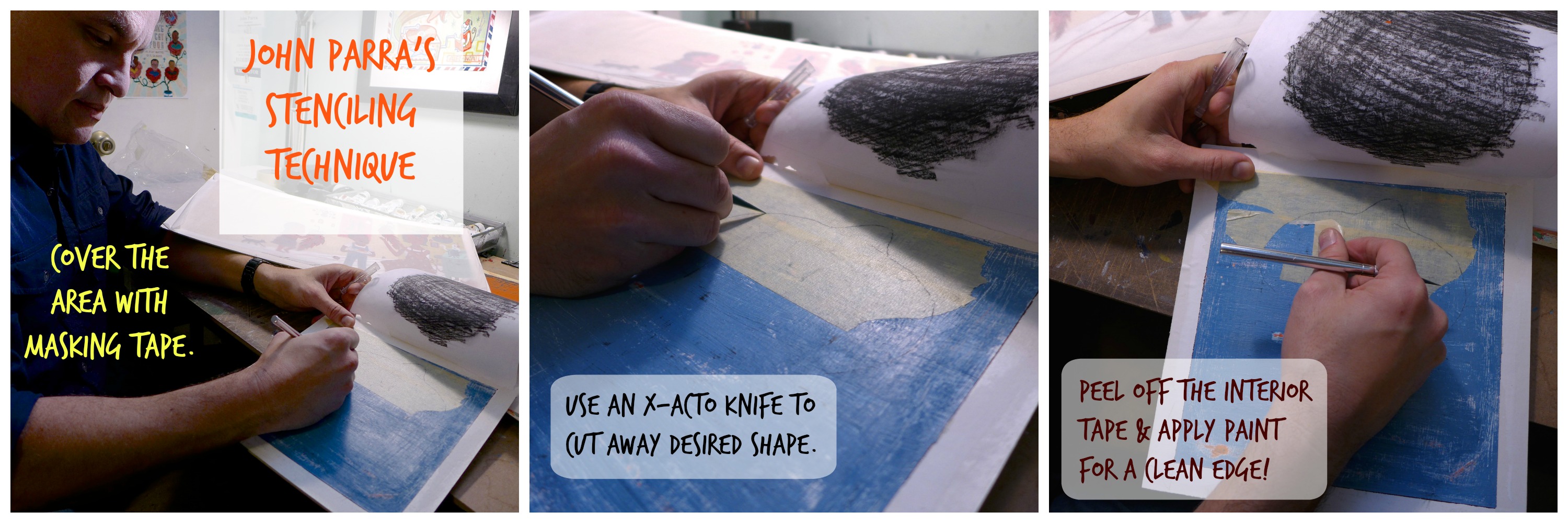
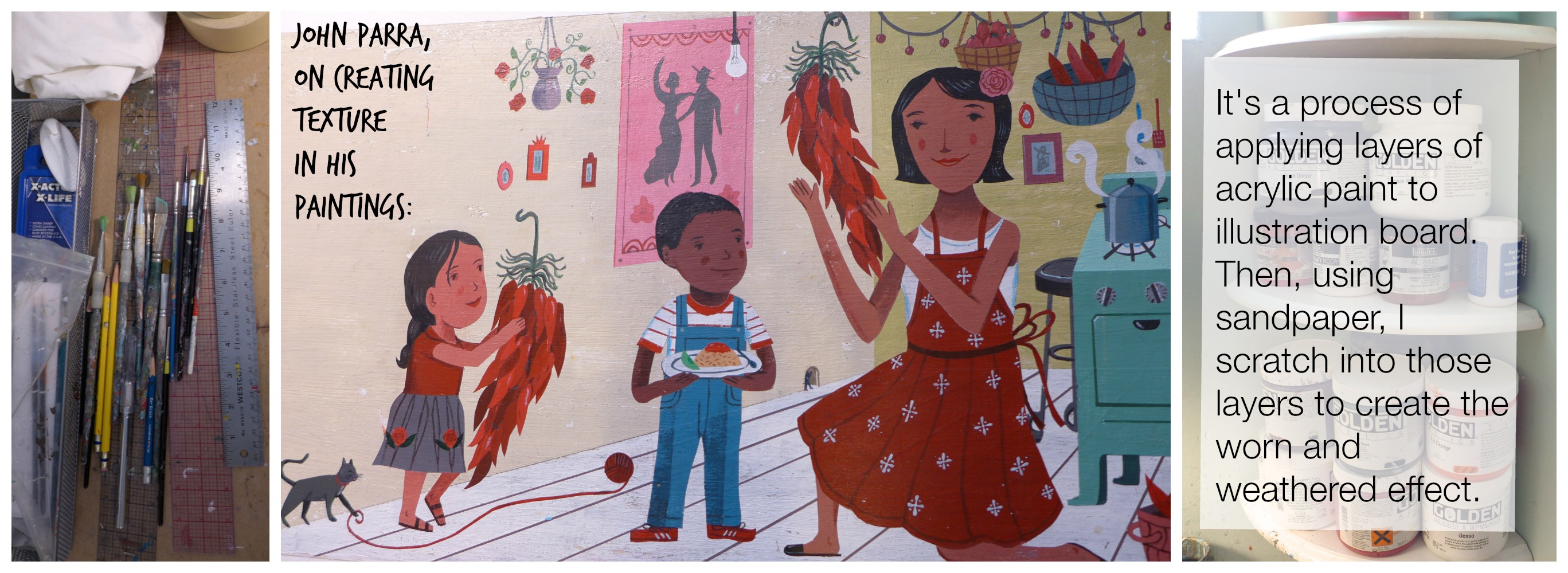
Parra Stenciling Technique


Weathered effect CollageLila: If you could sit down for a long session of shoptalk with one or more illustrators, living or dead, who would they be, and what would you ask?

John: I am a fan of other illustrators as well as anyone else who loves the genre. One of the perks of my job is that I have been able to meet so many other artists whose work I have admired for many years. There are, however, two artists who have passed on whom I would have loved to have sat down and talked shop with. They are Virginia Lee Burton and Maurice Sendak. Both had such an impact on me at an early age, since their books were part of the first illustrations introduced to me. I would love to ask their ideas and intentions when they were working on their most famous stories, plus to see their studio space and how they worked would be wonderfully inspirational.
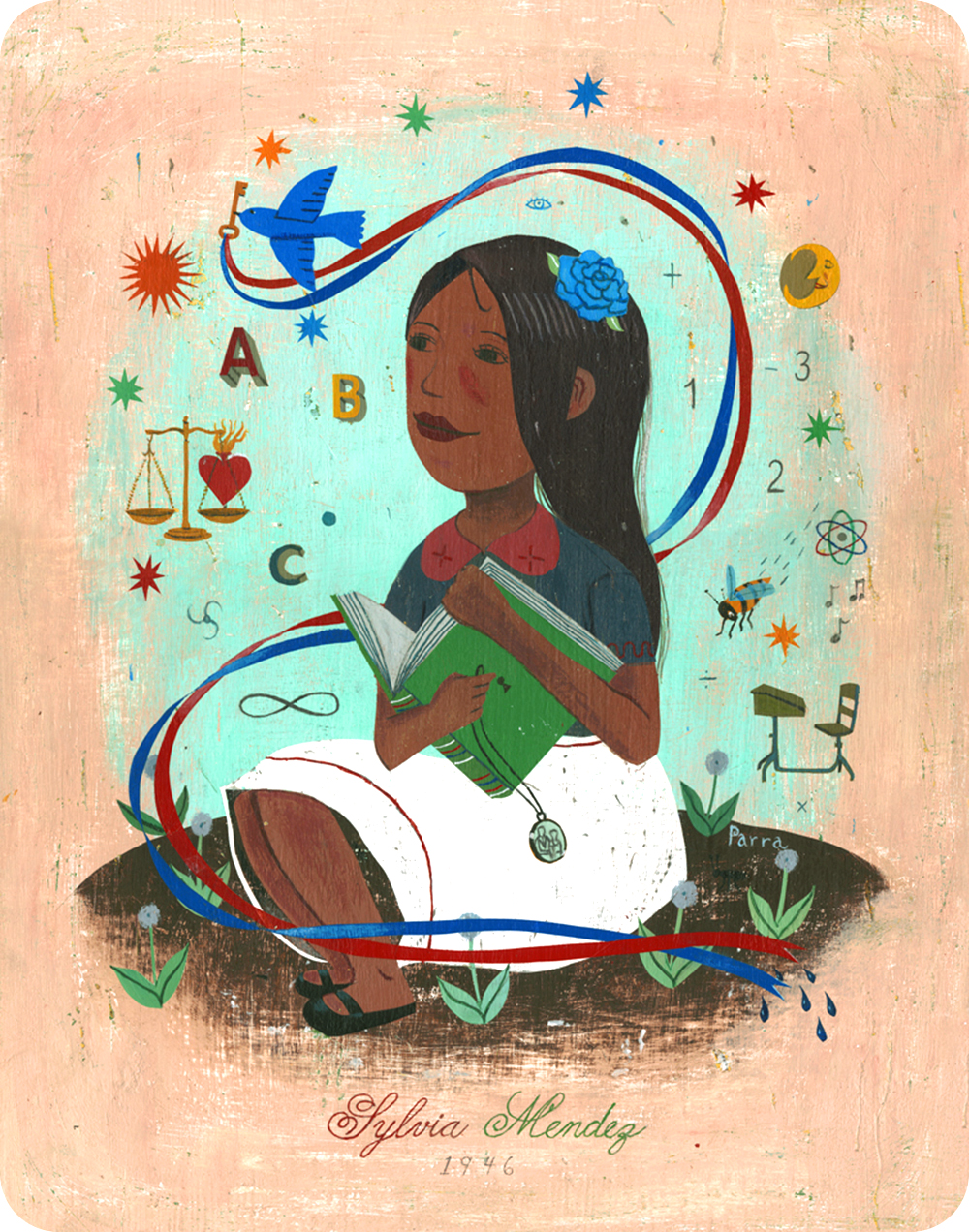
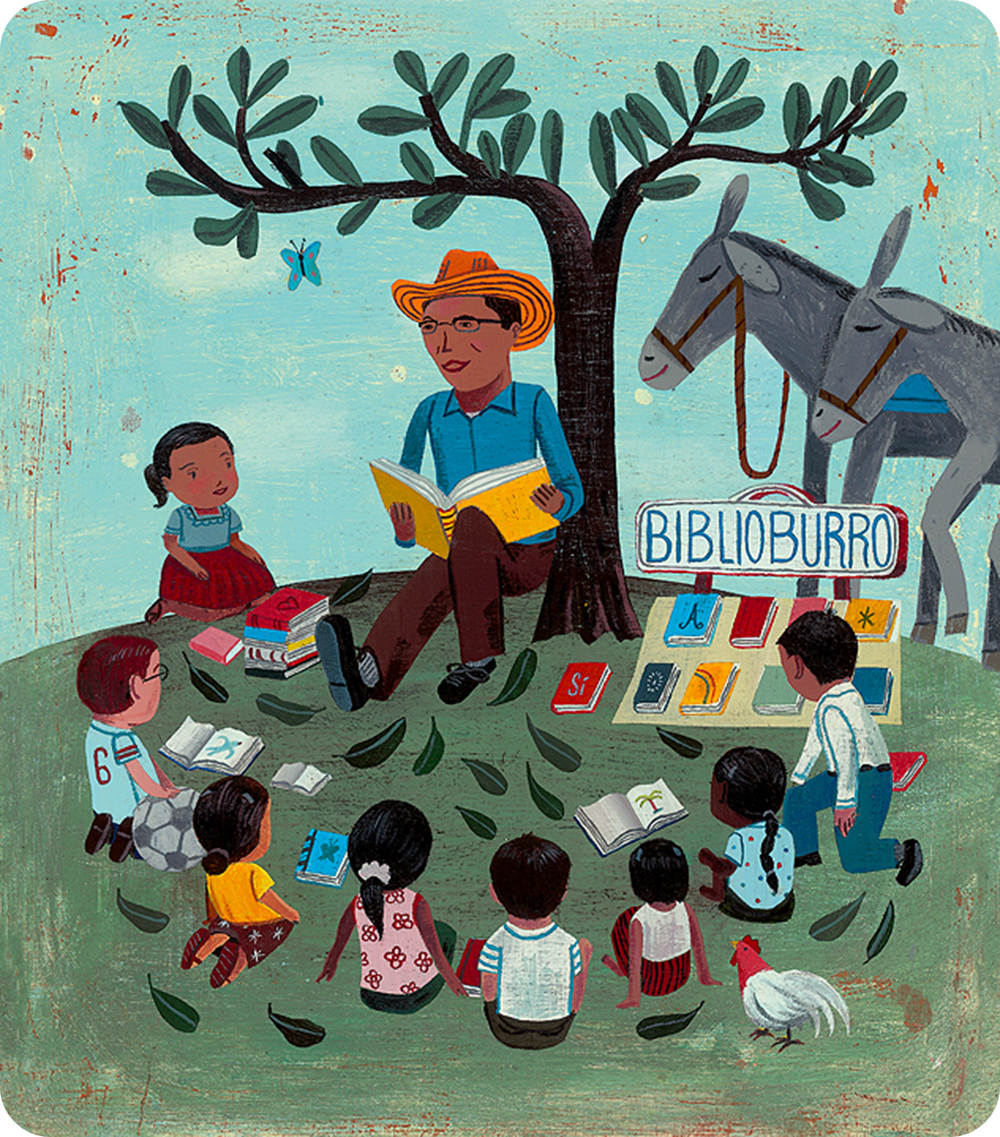
SylviaMendezVer.2  BiblioBurro.Reading2Kids

Lila: As you know, the diversity movement in children’s publishing picked up significant steam in 2014. What were opportunities like for Latin@ illustrators when you started your career? Have you seen changes? 

John: I believe the We Need Diverse Books initiative and Walter Dean Myers’ essay in the The New York Times came at a turning point in bringing awareness to examining and appreciating the beauty and diversity in multicultural books. When I began as an illustrator eighteen years ago, there did not seem to be as many projects geared to a diverse population. Over the last few years I have seen progress and greater opportunities for artists with varied voices and backgrounds to shine. I look forward to seeing even more done as we continue to expand and celebrate these wonderful talents.
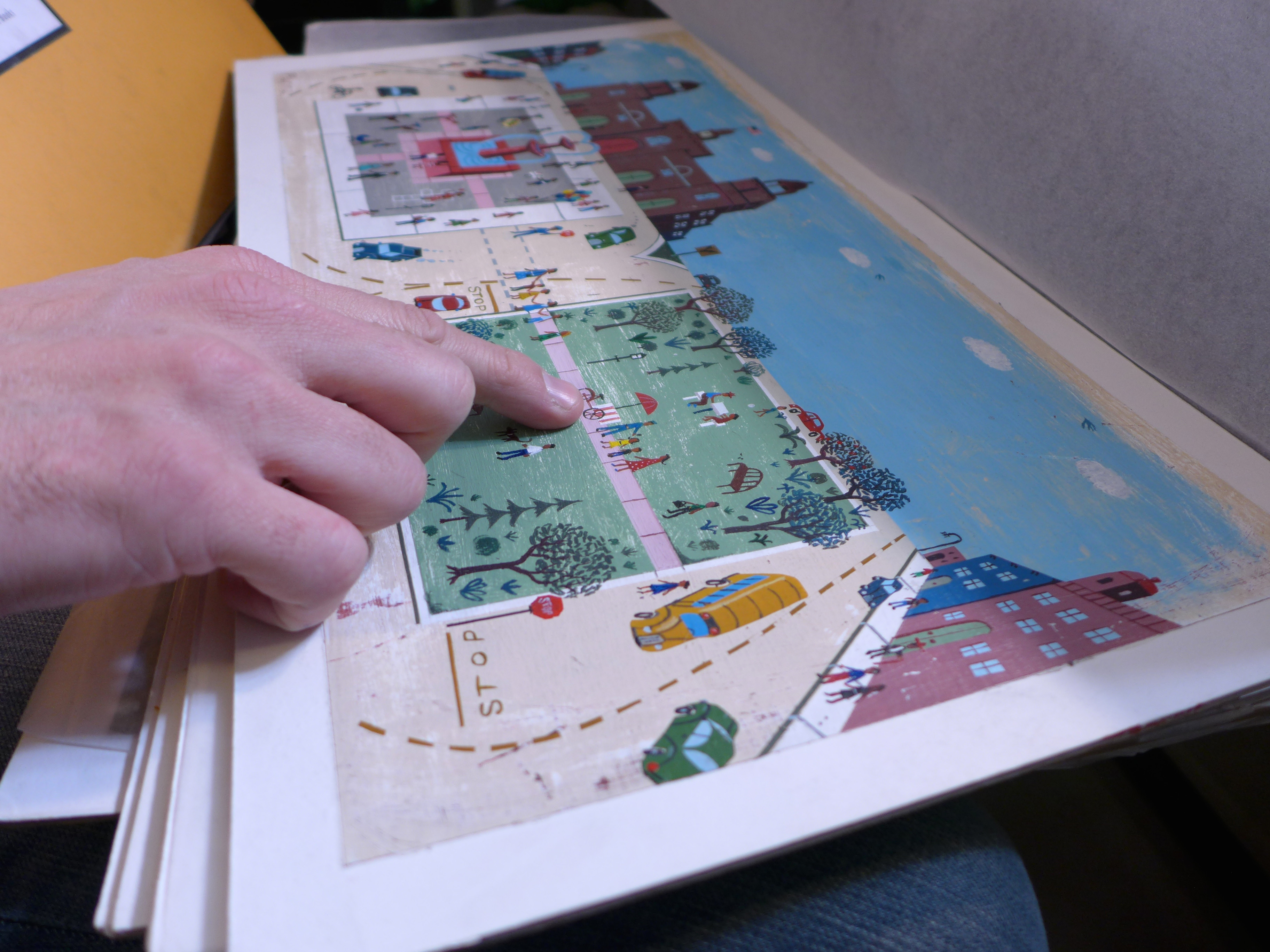
Parra page layout

Printer markings indicate page borders. John often uses a limited palette of hues, individually selected for each book.

Lila: Not long ago, I came upon a museum exhibit of Mexican retablos and ex-votos. Is it my imagination, or does your art contain echoes of this beautiful sub-genre of naive art? 

Yes! I am a big fan of retablos and ex-votos art. These paintings have that wonderful folk-art tradition of weaving in harrowing stories and miraculous tales.  Many of them actually weave text right into the works themselves. A favorite of mine is Mexican retablo artist Alfredo Vilchis. You can find many of his pieces in a great little book entitled: Infinitas Gracias: Contemporary Mexican Votive Painting.

Lila: We’re looking forward to the next John Parra book! What’s in the pipeline? 
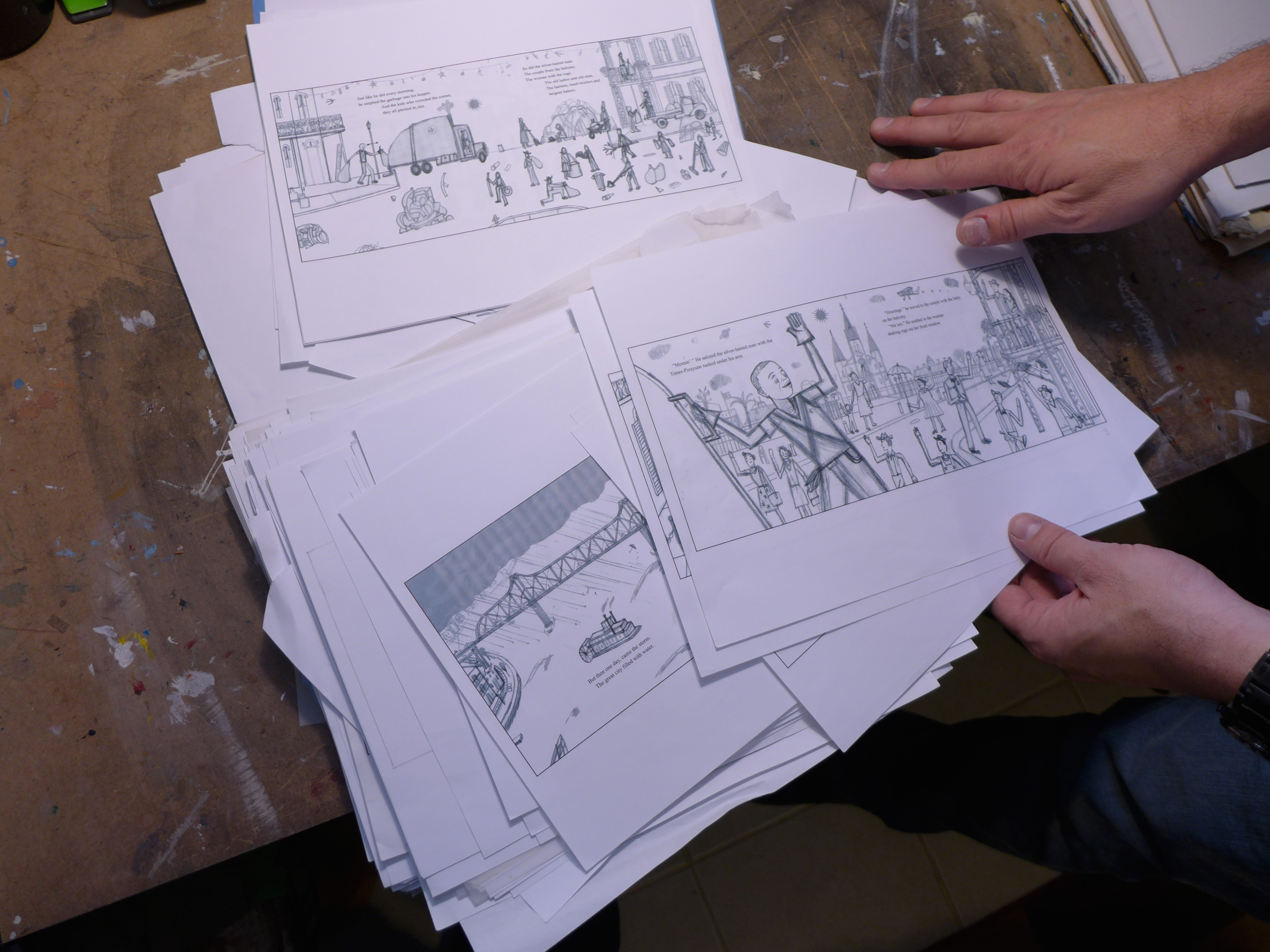
Parra sketches

Sketches from John’s newest project., Marvelous Cornelius.

John: I do have a new children’s book that I finished recently coming out this summer (2015) with Chronicle Books. It is titled: Marvelous Cornelius: Hurricane Katrina and the Spirit of New Orleans, written by Phil Bildner. The story is about a real-life gentleman named Cornelius Washington, a sanitation worker in New Orleans. He was considered a local folk hero and known in the neighborhood and the French Quarter by his positive and charismatic personality. As the book develops, the story goes into the events of Hurricane Katrina. We then see the effects on Cornelius and his neighborhood, as he reacts and resolves what to do after the storm.
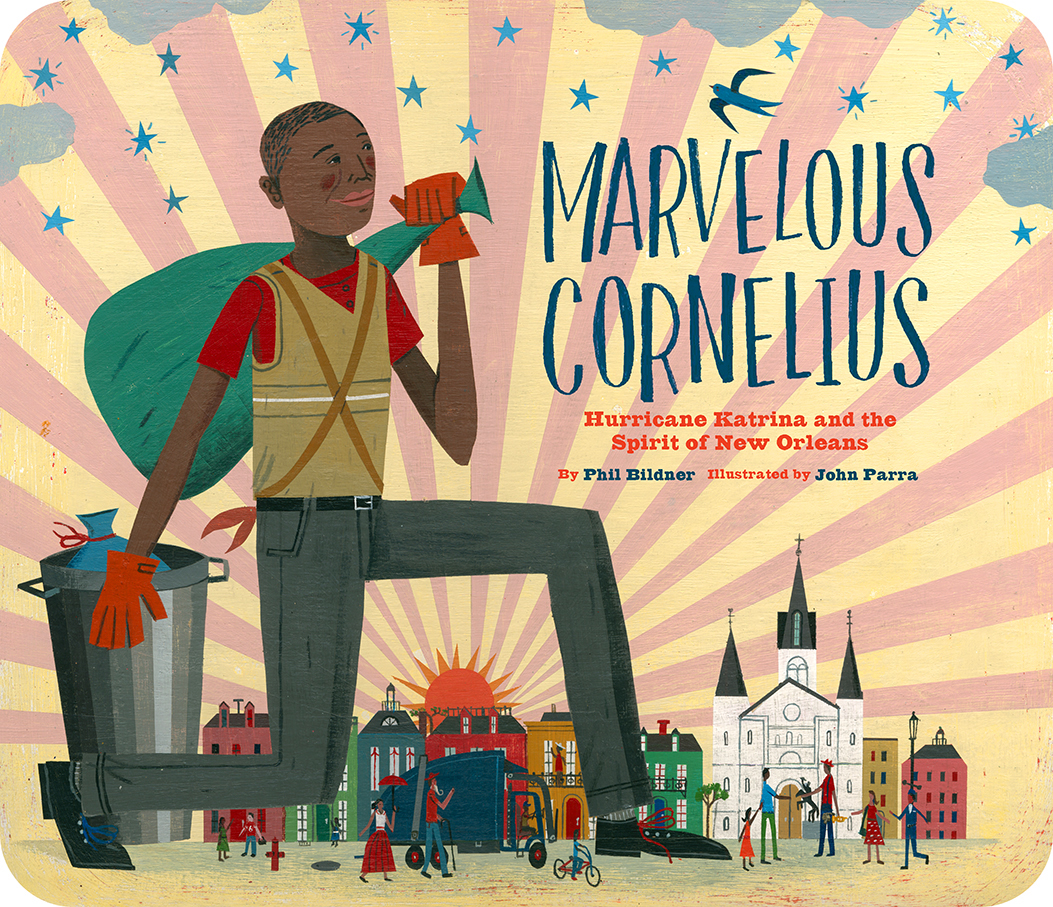
Marvelous Cornelius 1.Cover[Note: Catch more views from Marvelous Cornelius on the Latin@s in Kid Lit Pinterest boards!]

John: Another exciting event will be an artist presentation scheduled this coming year in June. It will be an artist lecture, workshop, and book signing at The Metropolitan Museum of Art here in New York City. I am really looking forward to it. It is a dream to be a part of such an amazing and historic institution.

As for new work, I am also starting a big new illustration project with details that I hope to share soon.
Parra paintbrushJohn Parra is an acclaimed illustrator, fine artist, designer and educator. His children’s book illustrations have  received many awards, among them, The Golden Kite Award from The Society of Children’s Book Writers and Illustrators; The Pura Belpré Honor Award; The Américas Book Award; Commended Title from CLASP, The International Latino Book Award; The Christopher Award. John grew up in Santa Barbara, California, where his artistic life began. He now resides in Queens, NY, with his wife, Maria. Keep up with John’s work through his website.

Studio views

Views of the studio reveal original pieces, as well as John’s guitars from a band he played with in California. Although he holds on to a few illustrations that he feels especially attached to, many are sold in galleries or through his website. A recent exhibit of originals in Brazil sold out!


Book Review: Last Night I Sang to the Monster by Benjamin Alire Sáenz

6413788By Sonia Alejandra Rodriguez

DESCRIPTION OF THE BOOK: Zach is eighteen. He is bright and articulate. He’s also an alcoholic and in rehab instead of high school, but he doesn’t remember how he got there. He’s not sure he wants to remember. Something bad must have happened. Something really, really bad. Remembering sucks and being alive – well, what’s up with that? 

MY TWO CENTS: Benjamin Alire Saenz’s Last Night I Sang to the Monster (2009) is a powerful and heart-wrenching story of a young man’s encounter with trauma and violence and his journey toward healing. Eighteen-year-old Zach wakes up in a rehabilitation center far from his home in El Paso, TX for what he thinks is his abuse of alcohol, but in reality, he cannot remember why he’s there or how he got there. Throughout the narrative, Zach reflects on moments in his life that might have led to his arrival at a rehabilitation center. His therapist/counselor, Adam, encourages him to remember the event that landed him at the center so that he can begin healing; however, the pain is too great and Zach remains emotionally paralyzed for much of the novel. At the center, Zach meets a diverse group of people that struggle with addiction and mental illness, and he is forced to contend with his own struggles; however, his refusal to remember leaves him more vulnerable to pain. He meets an older man, Rafael, who is at the center seeking treatment for his alcoholism, which worsened after the death of his son. Zach looks at Rafael as a father figure, and in return, Rafael provides advice and guidance for processing pain and trauma. Rafael shares with Zach that one of the ways to get the “monster” to stop hurting is to sing to it. When Rafael leaves the center, Zach is distraught and appears to be spiraling down again. Zach must learn to sing to the monster if he wishes to find healing and one day leave the center.

Last Night I Sang to the Monster is a beautiful novel. Through Saenz’s prose the reader is privy to Zach’s inner pain and struggle. Saenz’s captures the complex relationship between addiction and trauma in such a way that the reader cannot escape until we know that Zach will be okay. It is obvious through Zach’s memories that varying forms of violence have always been a part of his upbringing, and it is once they culminate into a catastrophic event, that he is forced to deal with it. The importance of remembering is palpable throughout the novel. As a reader, I begged Zach to remember so that I could understand why he’s at the rehabilitation center; however, as Zach recounted his story, I felt that maybe remembering would be too painful. The reader’s investment in a character is a sign of an incredible author and remarkable story. Last Night addresses an abundance of issues ranging from alcoholism, abuse, and death to think about ways of healing and living differently. As a part of Latina/o young adult literature, Saenz’s novel stands out not only because of its wonderful prose but because the issue of addiction and its consequences on the self and others is a conversation that requires more attention.  Overall, Last Night I Sang to the Monster demands to be read multiple times in order to really appreciate Zach’s healing process and Saenz’s marvelous words.

One of the aspects of the novel that I find most appealing is the discussions of how trauma and healing affect families. Zach’s alcoholism extends from a much longer history of abuse in his family, and he is forced to contend with this reality when his brother murders his parents. Saenz captures the perplexity of surviving a traumatic event and suggests that such survival does not always mean one has healed. Zach’s healing process is far from linear, and at times, it feels as if he is not moving or is instead regressing. However, it is precisely these movements or lack thereof that make the novel feel that much more real. Dealing with trauma on an individual, familial, and communal level is an on-going process. Zach’s often refusal and fear to face his monster further reveals how difficult healing can be. That the title itself suggests that Zach eventually sings to the monster simultaneously sheds light on the role that hope plays in healing processes. A few other Latina/o young adult texts that deal with issues of healing, trauma, addiction, and/or illness include Isabel Quintero’s Gabi A Girl in Pieces, Juan Felipe Herrera’s Downtown Boy, E.E. Charlon-Trujillo’s Fat Angie, and Gloria Velazquez’s Tyrone’s Betrayal.

AUTHOR: Benjamin Alire Sáenz is an award-winning American poet, novelist and writer of children’s books. He was born at Old Picacho, New Mexico, the fourth of seven children, and was raised on a small farm near Mesilla, New Mexico. He graduated from Las Cruces High School in 1972. That fall, he entered St. Thomas Seminary in Denver, Colorado where he received a B.A. degree in Humanities and Philosophy in 1977. He studied Theology at the University of Louvain in Leuven, Belgium from 1977 to 1981. He was a priest for a few years in El Paso, Texas before leaving the order. In 1985, he returned to school, and studied English and Creative Writing at the University of Texas at El Paso where he earned an M.A. degree in Creative Writing. He studied as a PhD student at the University of Iowa and Stanford University. Before completing his Ph.D., he moved back to the border and began teaching at the University of Texas at El Paso in the bilingual MFA program. He continues to teach in the Creative Writing Department at the University of Texas at El Paso.

FOR MORE INFORMATION about Last Night I Sang to the Monster, visit your local library or bookstore. Also check out worldcat.org, indiebound,org, goodreads.com, barnesandnoble.com, and amazon.com.

headshotSonia Alejandra Rodríguez has been an avid reader since childhood. Her literary world was first transformed when she read Rudolfo Anaya’s Bless Me, Última as a high school student and then again as a college freshman when she was given a copy of Sandra Cisneros’s The House on Mango Street. Sonia’s academic life and activism are committed to making diverse literature available to children and youth of color. Sonia received her B.A. in English from the University of Illinois at Urbana-Champaign. She is currently a PhD candidate at the University of California, Riverside, where she focuses her dissertation on healing processes in Latina/o Children’s and Young Adult Literature.

A Holiday Sampler of Treasured Memories

By Lila Quintero Weaver

Come in from the cold! Childhood memories bring warmth to almost everything we do during the holidays, no matter how we choose to celebrate. As adults, we’re often in charge of enlivening the season for the children we love, as well as the child still within us. For extra inspiration, we’ve called on some favorite people with connections to Latin@ kid lit.  Here’s the question we posed to Jacqueline Jules, Margarita Engle, Danette Vigilante, Angela Cervantes, and Tracy López:

The holiday season often reflects the wide diversity within the Latin@ community. Would you share a childhood memory of your Hanukkah or Christmas past, or simply a special winter memory?

And here’s how they answered:

JACQUELINE JULES 

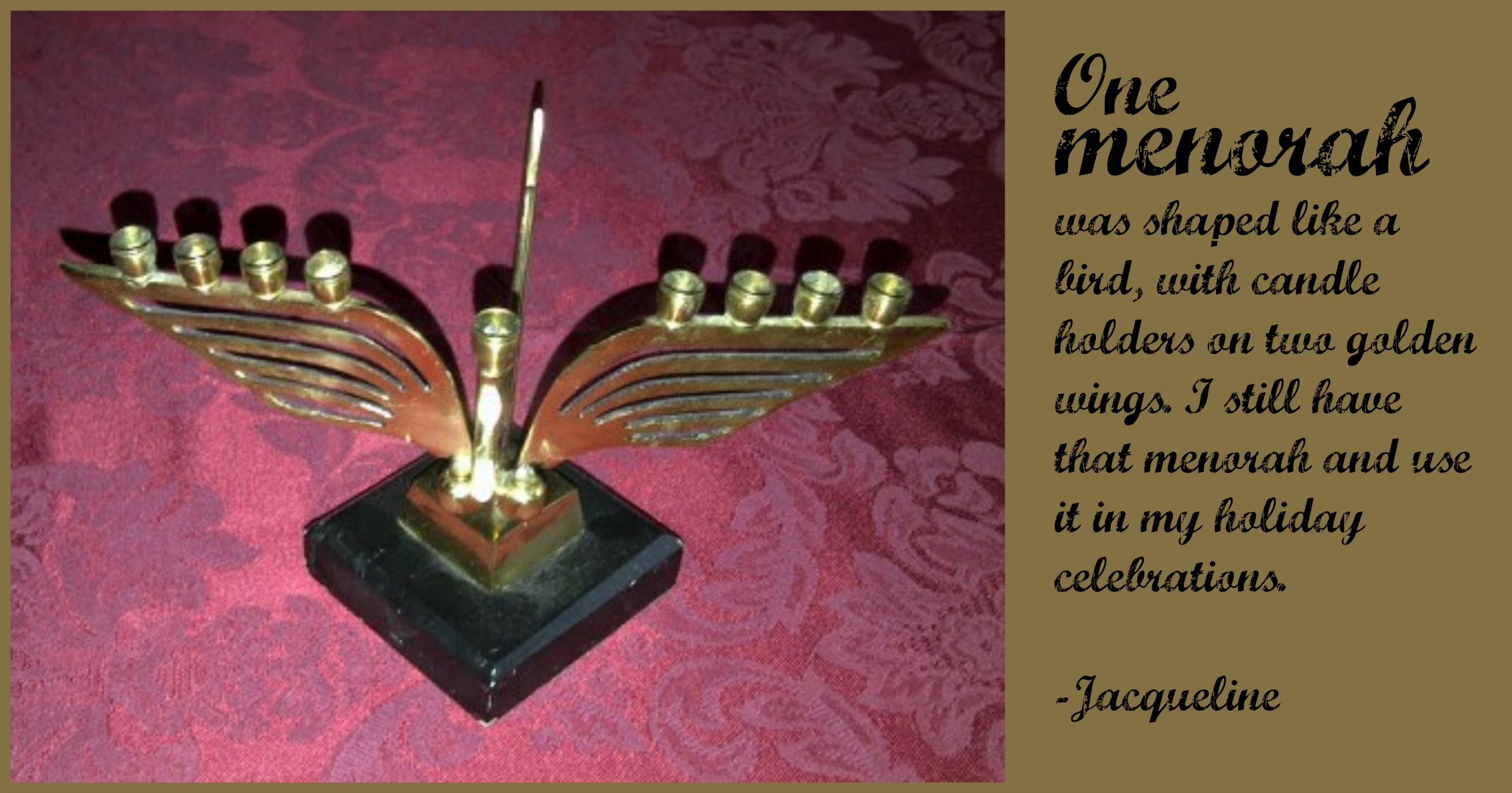
Menorah collage

Hanukkah, like all Jewish holidays, follows a lunar calendar. It generally occurs at least a week (if not two or three) before Christmas. As a child, not having to wait till December 25th  was a great bonus for me. I loved getting presents before everyone else at school. The year I remember most is when I received a mezuzah necklace. A mezuzah contains a parchment with the Sh’ma prayer, the central tenant of the Jewish faith. My parents gave me a small cylindrical pendant on a sterling silver chain. It was a requested gift and my first real piece of jewelry.

Growing up in a small southern town, my religion made me an outsider. But wearing a symbol of my faith was still important to me. It is an integral part of who I am. My parents raised me to treasure my own celebrations. Hanukkah is a minor holiday of far less importance than the Jewish high holidays in the fall or Passover in the spring. We gave gifts in our nuclear family, but we never tried to make it a Jewish equivalent of Christmas. After a first night with a special present, the other nights were less about gifts and more about the candle-lighting ceremony. My parents owned several Hanukkah menorahs and we would light them all, creating a beautiful row of glowing candles on our dining room table. One menorah was shaped like a bird with candle holders on two golden wings. I still have that menorah and use it in my holiday celebrations.

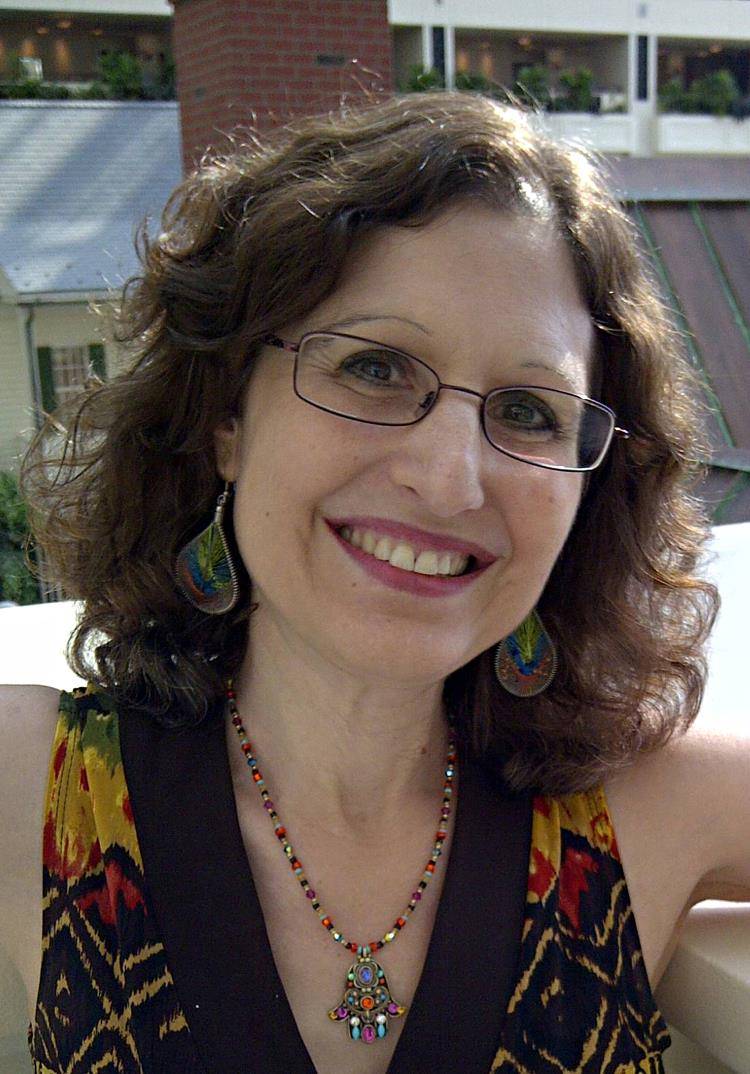
JJulesWebPic

Jacqueline Jules is the award-winning author of more than twenty children’s books, includes the fabulous Zapato Power series. Great news: she’s busy creating even more fun books for kids! At the bottom of this post, check out her Hanukkah-inspired titles.


MARGARITA ENGLE

Pretending w Text

Hermanas

Family time is the greatest gift offered by any holiday, no matter which religion or season is being celebrated. One of my fondest December memories is the way my sister and I always surprised each other with identical gifts, even though our mother took us shopping separately. Adventure stories, animal tales, and nonfiction natural history books were our inevitable choices. One year, we gave each other the same dinosaur identification chart. We saw ourselves as explorers-in-training, our shared interests a preview of lifelong curiosity about the world. Those shared interests became an even more lasting memory than baking cookies, or admiring the colorful cheer of holiday lights.

MargaritaMargarita Engle is the author of many acclaimed young adult and children’s novels, including The Surrender Tree, which received a Newbery Honor. Her newest picture book is Tiny Rabbit’s Big Wish, and more publications are in the works, including a memoir we can’t wait to read! Here’s her latest guest post for this blog.


DANETTE VIGILANTE

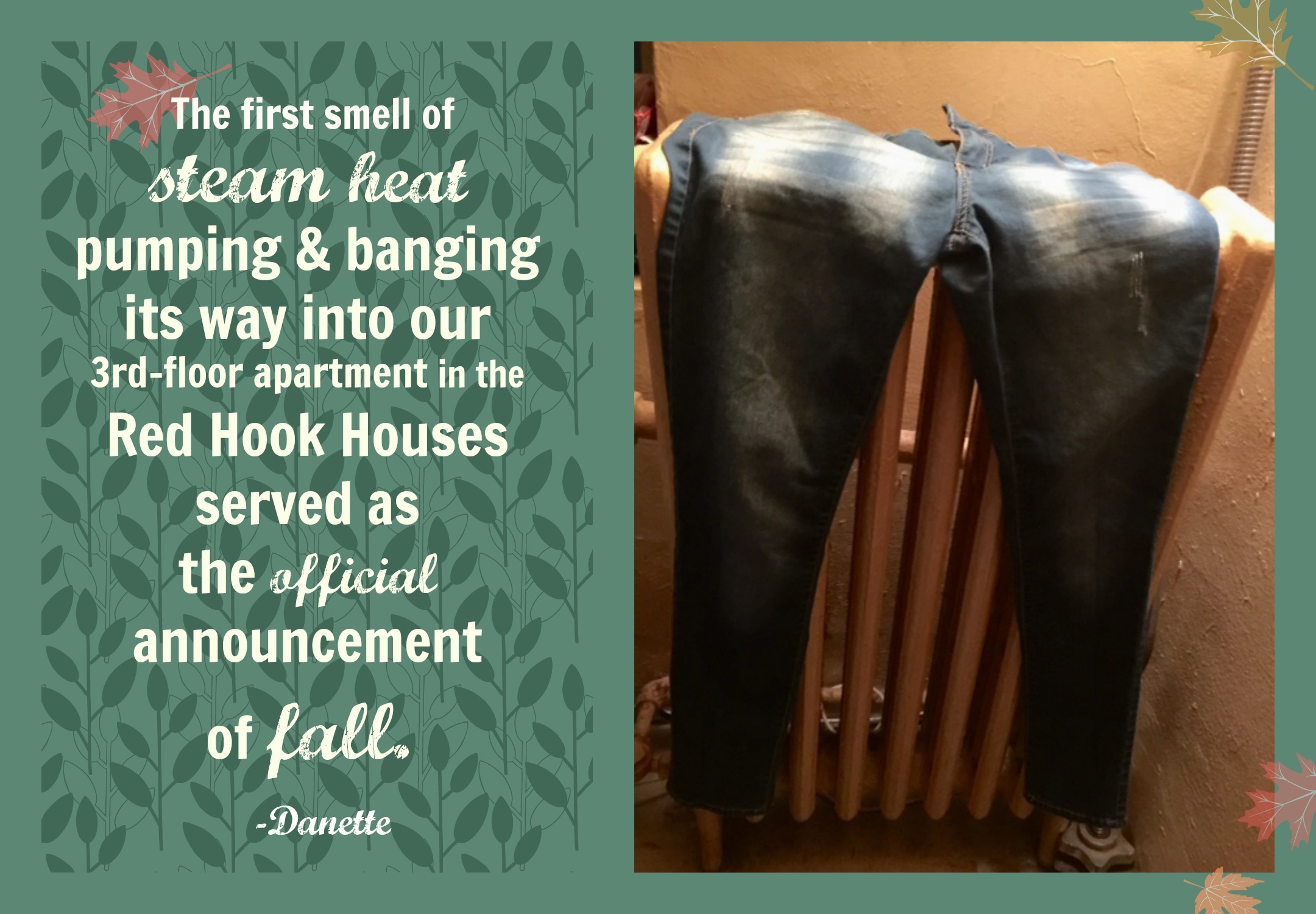
Danette CollageThe first smell of steam heat pumping and banging its way into our third-floor apartment in the Red Hook Houses served as the official announcement of fall.

The radiators in our apartment were used for more than just keeping us warm, though. Mom placed orange skins on top of their steel bones, giving the air a sweet citrus scent. When we needed to dry our winter gear after playing in the snow, to the radiator it all went. When I absolutely had to wear a certain pair of jeans soon after they had been washed, the radiator served as a quick dry cycle. They came off a bit stiff and practically able to stand on their own, but that was a small price to pay. Besides, after a few deep knee bends, all was well. My little sister had her own important use for the radiators— heating up squares of Now and Later candies until they were soft and gooey.

Every year, after the Thanksgiving dishes had been washed and dried, my best friend’s mom did something that excited the kids living in nearby buildings; she’d officially welcome Christmas by decorating her second floor windows in twinkling multicolored lights–a Christmas tree dressed in its best, standing proudly in the center of it all.

A door had been swung open, and one by one, every window from the first through sixth floors, had followed suit. Our drab brick buildings had finally come alive! The magic of the winter season, with its good cheer and best wishes, had entered our hearts, filling us with hope, gratitude and joy.

Danette_Vigilante_head_shot_high_resDanette Vigilante is the award-winning author of two children’s books, The Trouble with Half a Moon and Saving Baby Doe. She lives in New York with her husband, two daughters, two puppies and a cat with an attitude! Don’t miss her inspiring guest post, “Danette Vigilante on the Importance of Dream Seeds.


ANGELA CERVANTES

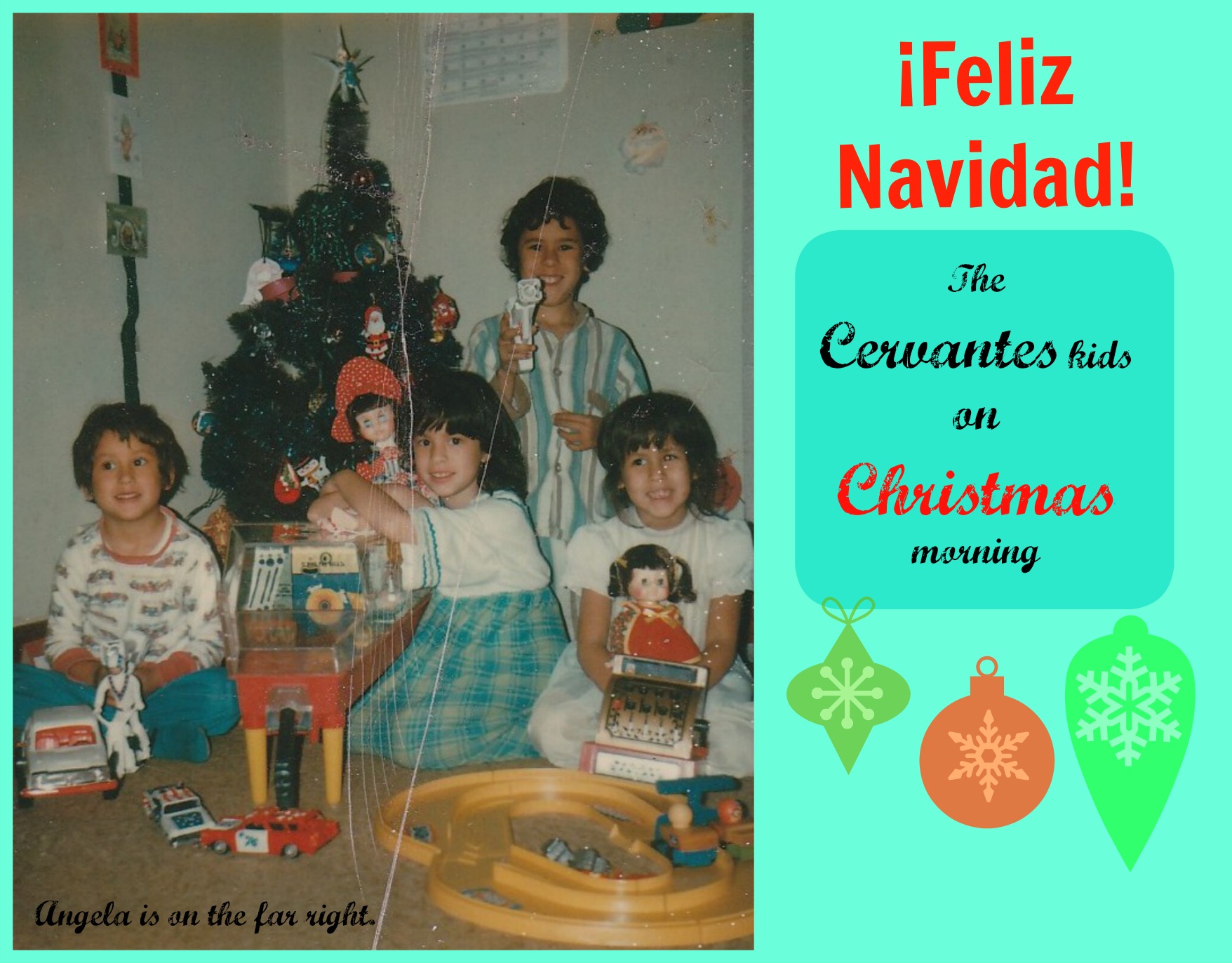
Feliz NavidadOne Christmas, my family was visiting my brother at the army base in Fort Sill. On Christmas Eve, some soldiers were making their way through the neighborhood, house-by-house, Christmas caroling. They came to our doorstep and sang a lively version of Jingle bells and then went on their merry way to the next house. A few minutes later, my sister, Rio, asked me to go out to the car with her to help bring in the rest of the gifts. As we headed to her car, parked curbside, the soldiers were standing in the middle of the street seeming unsure of where to go next. My sister and I grabbed the gifts out of the trunk and when we turned around, the soldiers were standing in front of us. They started singing “Joy to the World.” We couldn’t believe it.

 It was a real serenata!

When they finished, Rio gave me this look and I knew what we had to do. We put our gifts down. At Rio’s count of three we belted out, “Feliz Navidad” with as much glorious Jose Feliciano-ness we could muster. Rio snapped her fingers and shook her hips. I pretended that I had maracas and shimmied around. The soldiers sang along and bopped their heads. “I want to wish you a Merry Christmas from the bottom of my heart.” When we finished, one of the soldiers said, “That was cool. No one has sung back to us the entire night.”

What can I say? Leave it to the Cervantes girls to keep it real on Christmas Eve!

Angela CervantesAngela Cervantes is an award-winning author whose debut novel, Gaby, Lost and Found, has been named Best Youth Chapter book by the International Latino Book Awards and a Bank Street College of Education’s Best Books of 2014. Angela’s second novel, a spin-off of Gaby, Lost and Found, will be released by Scholastic Press in 2016.  Read about what inspired Angela to write Gaby in this Latin@s in Kid Lit interview.  


TRACY LÓPEZ

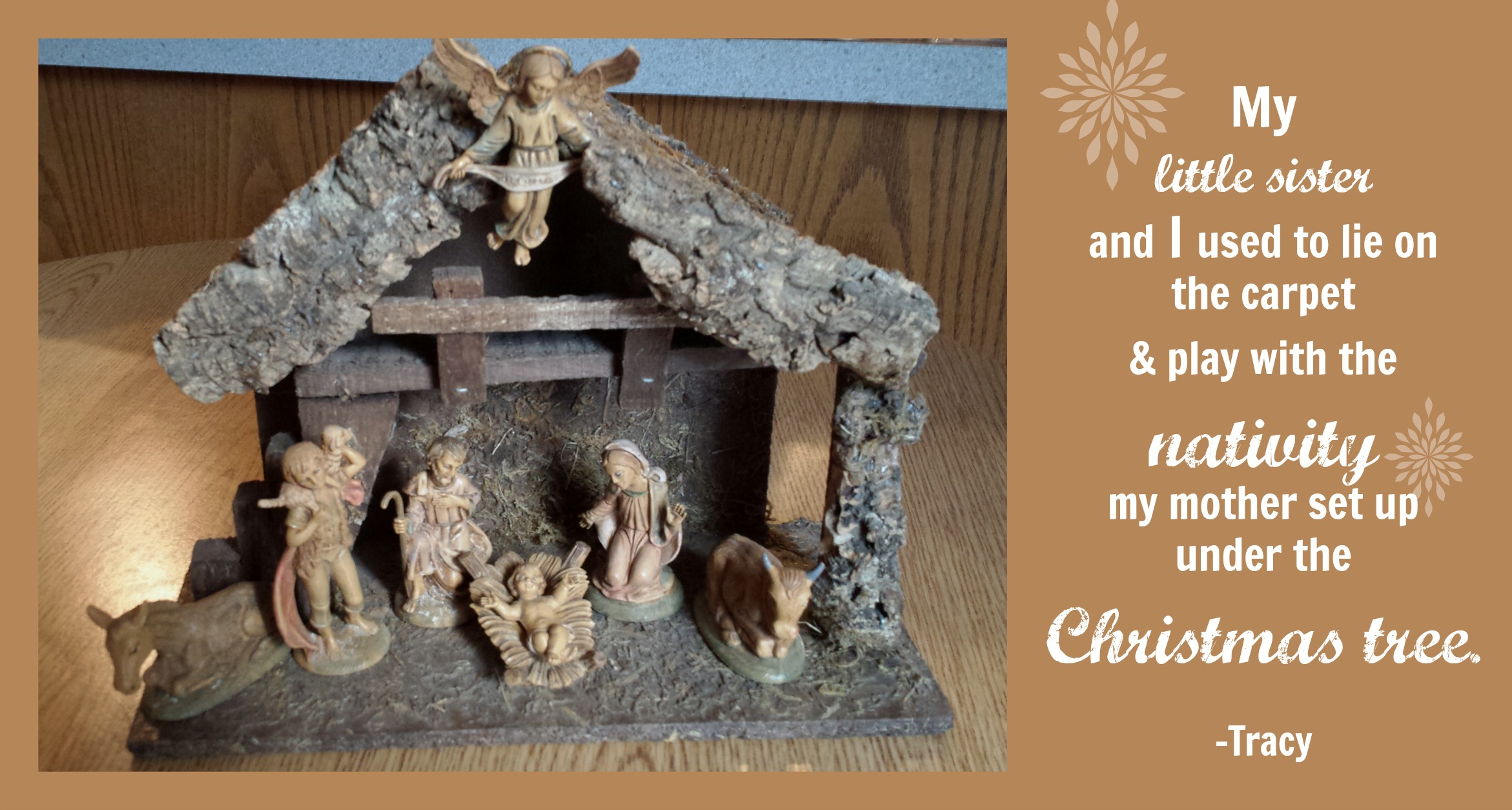
Tracy's NativityOne of my favorite childhood memories is when my little sister and I used to lie on the carpet and play with the nativity my mother set up under the Christmas tree. It was a typical, simple nativity with a moss-covered manger made of wood and plastic figures representing Joseph, Mary, baby Jesus, the angel, a shepherd with a lamb hefted onto his shoulders, and a few barnyard animals. The nativity scene was actually a gift to my mother from my father, who grew up in a Jewish home; my parents say he won it on a radio show when I was really little. That same nativity is still put on display each Christmas at my parents’ house. Although I’m an adult with two teenage sons, I’m always tempted to play with the little figures when I see it set up, which horrifies my husband, Carlos. He’s Salvadoran and in El Salvador the nativity (or “nacimiento”) is much more spectacular than my mother’s humble display. A Salvadoran nativity can take up an entire room and features entire villages of people, but kids are definitely not allowed to play with it!

Tracy LopezTracy López is a freelance writer, blogger and novelist. Her work has appeared in Fox News Latino, Mamiverse, SpanglishBaby and many other print and online publications. She is Owner/Editor-in-Chief of the influential blog Latinaish.com, and is a member of the team of We Need Diverse Books.


HOLIDAY BOOKSHELVES

We wouldn’t be doing our cheerful duty if we didn’t top off this glorious stroll down memory lane with book recommendations related to the season. Here’s a round-up of titles we think you and your young readers will relish this winter holiday.

Happy Hanukkah Lights    Christmas Makes me Think

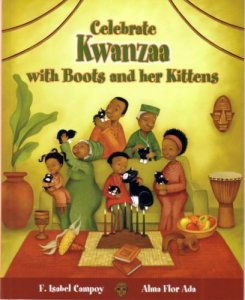
HanukkahZiz    Kwanzaa with Boots

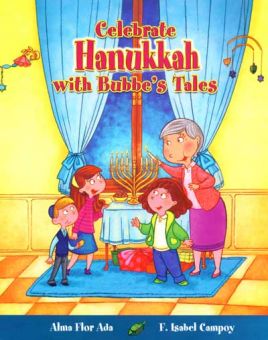
Celebrate Hanukkah    Twas Nochebuena

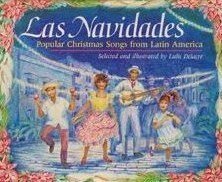
Piñata in a Pine tree    Las Navidades

Seven Candles for Kwanzaa    Green Christmas

And for older readers:

Las Christmas


HAPPY HOLIDAYS TO ALL! WE’LL SEE YOU IN 2015!


Book Review: Yes! We Are Latinos by Alma Flor Ada and F. Isabel Campoy

Reviewed by Lila Quintero Weaver

Yes We Are LatinosDESCRIPTION FROM THE PUBLISHER: Juanita lives in New York and is Mexican. Felipe lives in Chicago and is Panamanian, Venezuelan, and black. Michiko lives in Los Angeles and is Peruvian and Japanese. Each of them is also Latino.
Thirteen young Latinos and Latinas living in America are introduced in this book celebrating the rich diversity of the Latino and Latina experience in the United States. Free-verse fictional narratives from the perspective of each youth provide specific stories and circumstances for the reader to better understand the Latino people’s quest for identity. Each profile is followed by nonfiction prose that further clarifies the character’s background and history, touching upon important events in the history of the Latino American people, such as the Spanish Civil War, immigration to the US, and the internment of Latinos with Japanese ancestry during World War II.

Alma Flor Ada and F. Isabel Campoy’s informational yet heartwarming text provides a resource for young Latino readers to see themselves, while also encouraging non-Latino children to understand the breadth and depth of the contributions made by Latinos in the US.

Yes! We Are Latinos stands alone in its presentation of the broad spectrum of Latino culture and will appeal to readers of fiction and nonfiction.

MY TWO CENTS:  Yes! We are Latinos belongs on every essential reading list of Latino children’s literature, as is often true of books co-authored by the acclaimed duo of Alma Flor Ada and Isabel Campoy. No single work can cover every expression of Latino life in the United States, yet this book for middle-grade readers provides a generous glimpse of historical, cultural, ethnic, and linguistic aspects of the community. The authors’ approach pairs thirteen character vignettes, written as monologues in free verse, with matching expository sections of historical and cultural information. Collectively, the alternating sections deliver vivid, easily digestible insights into what is meant by Latino. There is no single Latino identity, the characters seem to say, and each of us is worthy of your attention.

The authors’ commitment to showing a wide representation of Latino life comes through in the vignettes. The featured characters reflect a generous range of ethnic and regional groups, some of which speak no Spanish, mirroring the fact that many Latinos come from bicultural and transnational families. In one vignette, we meet Susana, a Sephardic girl who lives in San Francisco. In another, we’re introduced to Dominican-born Santiago, who now calls Detroit home.

Sometimes young Latin@s would love nothing better than to break away from traditions they consider too confining. The story of Gladys, a Puerto Rican living in Philadelphia, is the best example of this. She watches the preparations for her sister’s quinceañera, expecting that before long her mother will want to start planning Gladys’s “quinces.” But Gladys’s dreams are pulling her in another direction, toward college.

Julio is from a farm migrant family originating in Teotitlán del Valle, a village in Oaxaca, Mexico. Like other members of his original indigenous community, Julio speaks Zapotec. When his family moves to Stockton, California, he must navigate two foreign languages, English and Spanish, in order to function in a primarily Spanish-speaking Chicano community, within a mainstream American setting. He’s adjusting to life in the new country, but still looks back on his homeland with longing and pride, recalling the beautiful and prized tapestries that Teotitlán’s weaving looms are known for.

In one pair of monologues, two Latinas with Asian backgrounds form a friendship. Lili is a Guatemalan of Chinese descent, whereas Mikito’s heritage is Japanese and Peruvian. The families of both girls passed through multiple immigration journeys. In the educational follow-up, we learn about waves of Asian immigrants that landed on the shores of South and Central American countries and the descendants of these immigrants who eventually drifted northward. The section on Japanese Latinos reveals a troubling detail of American history: Wartime internment camps built to contain Japanese Americans also held Japanese families who were deported at the urging of the United States by the Latin American countries where they resided. In these internment camps, Japanese Latinos often found themselves socially isolated, since they spoke only Spanish and few others in the camp could communicate with them.

The factual sections that follow the monologues highlight each character’s nation of origin. In Santiago’s case, it’s the Dominican Republic. A brief review of the island-nation’s history includes important facts about the Trujillo dictatorship, although the achievements of outstanding Dominicans receive greater attention. These include acclaimed novelists Julia Alvarez and Junot Díaz, haute-couture fashion designer Oscar de la Renta, and professional baseball players David Ortiz and Manny Ramirez.

Outmoded characterizations of Latino life give everyone the same background, the same history, the same traditions and tastes. This book’s emphasis counteracts generalizations and brings forward Latinos’ complexity. In each vignette, the authors touch on multiple elements, including the scattered geographic settings where the characters live, the varied occupations their parents work in, and the traditions their families celebrate. Yes! We Are Latinos offers an important and long overdue contribution to children’s literature.

TEACHING TIPSYes! We Are Latinos is the work of educators and seems custom-made for later elementary and middle school classrooms. The poetic narratives bring life to the informational sections, which in turn invite further exploration of the countries and histories they feature. Teachers may want to assign students paired sections to expand upon through written reports or artistic responses. For example, students could design posters depicting specific Latino cultures. Another idea is to have students compose poetic vignettes of imaginary characters reflecting geographic regions not covered in the book.

ESL instructors are likely to appreciate the book’s short, digestible sections, which contain not only interesting stories, but also broad vocabulary.

Older readers may want to dive into Cristina Henriquez’s recent novel, The Book of Unknown Americans, reviewed here by Ashley Hope Pérez.

For additional resources:


Alma Flor AdaALMA FLOR ADA

A native of Cuba, Alma Flor Ada is an award-winning author, poet, storyteller and scholar of literature. She has published more than 200 books for children, many of them in partnership with Isabel Campoy.

In this interview, Alma Flor Ada discusses the development of Yes! We Are Latinos and other topics, including poetry and bilingualism.


Isabel CampoyISABEL CAMPOY

Isabel Campoy is a Spanish storyteller, poet, playwright, songwriter and educator in literacy and language acquisition. She is fluent in multiple languages and her work in the field of publishing includes translation. She is an award-winning author and a frequent writing partner of Alma Flor Ada.


Video visits with the authors:

Alma Flor on literacy, stories, family connections, teaching, and writing books:

Isabel discusses stories and recites lines in Spanish:

Isabel talks about her life and work:


Overflowing with Thanks, Bookwise

WNDB_ButtonThis is the week when we as bloggers pause to give thanks, starting with the fact that we have so many amazing readers–readers who care about Latin@ kid lit as much as we do! We appreciate each one of your clicks, comments, social-media shares, and other forms of participation. If you’ve been silent up to now, let us hear from you soon. We value your partnership.

Another thing we’re super grateful for this Thanksgiving is the emergence and explosive growth of the We Need Diverse Books campaign. Ceilings are cracking under the pressure of this push and all of us stand to benefit, so thank you to the bright minds that dreamed it up.

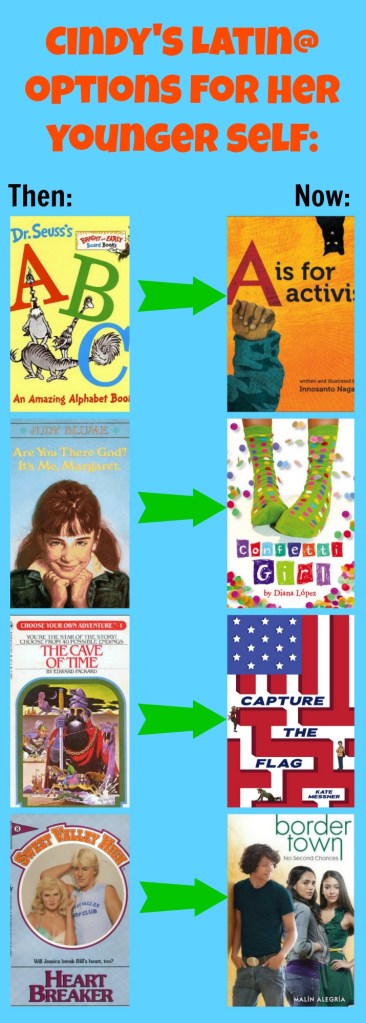
Another reason to feel grateful in 2014 is that Latin@ kid lit is in much better shape than it was in years past. As we reflect back on our own or our children’s bookshelves, we’re delighted that kids today have a growing number of Latino options.

To demonstrate this point, check out a few of Cindy‘s beloved titles from her childhood, matched by current Latino options.

Cindy's Latino Option Collage

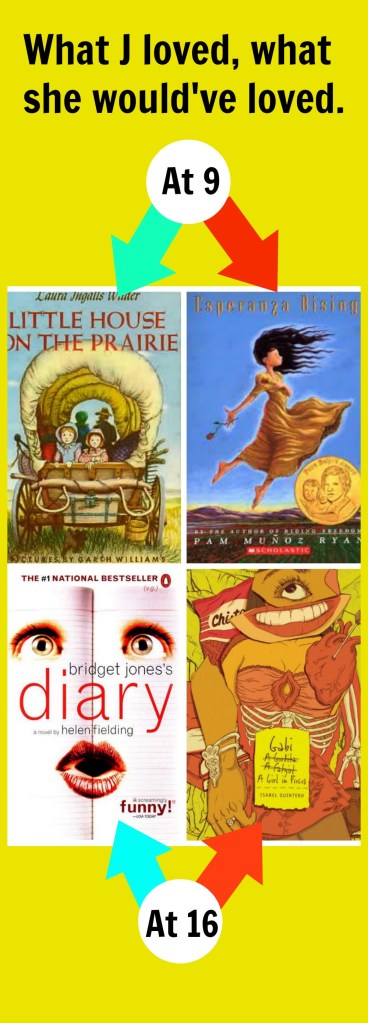
I, Lila, decided to frame this comparison through my oldest daughter’s experience. “J” was a 1980s baby who read late into the night by the light of her digital alarm clock, so you know she was crazy about books. Here are a couple of J’s favorites, matched with contemporary Latino options she would’ve loved.

What She Loved Collage

Now for expressions of thanks from two other members of the team.

Zoraida

2014 has been crazy for me. I work full time, launched the last book in my trilogy, wrote, sold and launched a New Adult romance. And I’m still not done yet. Despite a crazy work schedule, I am thankful that I do have a support system that allows me to find time to write. I have a wonderful network of friends and a boyfriend who knows me extremely well. I’m thankful that I get to be part of a wonderful group of writers here at Latin@s in Kid Lit, but most importantly that we’re getting the conversation rolling about issues dear to our hearts. I hope the next year brings even better things for us all.

LOTL.v3

Sujei

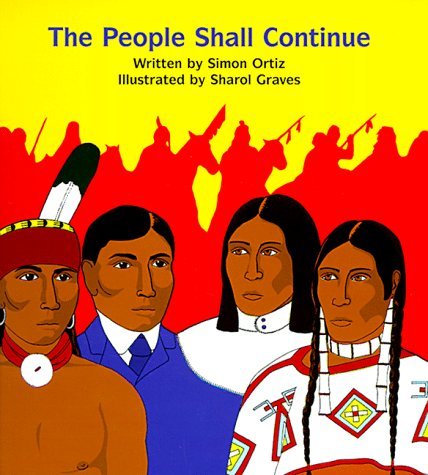
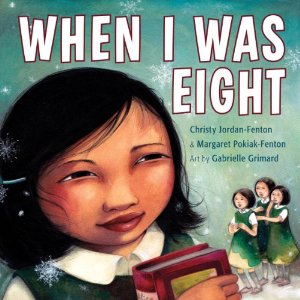
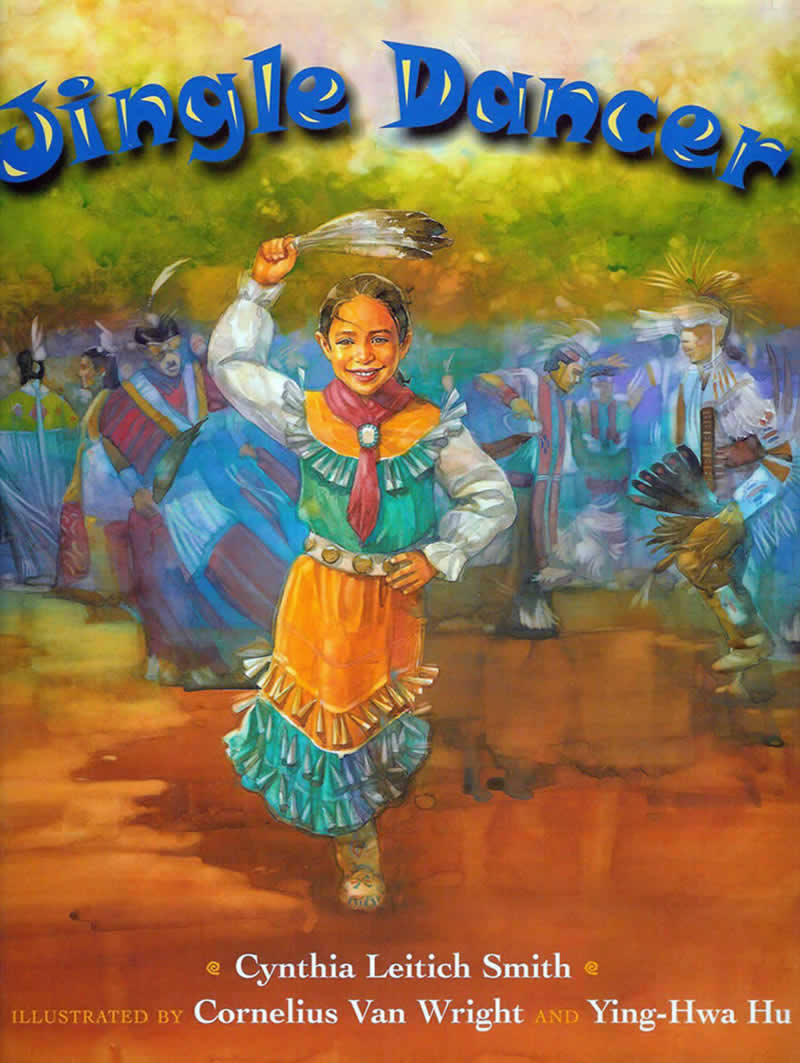
Growing up in Puerto Rico, Thanksgiving in my family seemed like “Eating Turkey with Fried Plantains Day.” Considering that November is Native American Heritage Month, I find deeper reasons to feel thankful. In my late teens, I started questioning the impact of this “first meal,” and saw it more as the beginning of genocide, colonialism, and the suffering of our indigenous people and ancestors. I’m thankful for books that teach us the real story and those that talk about Native people in the present tense and show us that they live everyday lives. Books that highlight these realities disrupt the narrative of old-school texts, which often historicize and stereotype indigenous people.

Here are three of Sujei’s recommendations for children’s books that honor the experiences and history of Native Americans.

People Shall Continue When I was 8 JingleCover_hi-res

Our mission is to promote diversity in children’s books, specifically Latin@ books and creators. So when you’re thinking about ways to diversify your kid lit bookshelves, explore our archives for reviews and posts. We’re so thankful that you care about Latino representation in children’s and teen’s books, and we want to continue serving those interests.

Happy Thanksgiving!

Book Review: Stranger (The Change #1) by Rachel Manija Brown and Sherwood Smith

By Eileen Fontenot

16034526DESCRIPTION FROM GOODREADS: Many generations ago, a mysterious cataclysm struck the world. Governments collapsed and people scattered, to rebuild where they could. A mutation, “the Change,” arose, granting some people unique powers. Though the area once called Los Angeles retains its cultural diversity, its technological marvels have faded into legend. “Las Anclas” now resembles a Wild West frontier town… where the Sheriff possesses superhuman strength, the doctor can warp time to heal his patients, and the distant ruins of an ancient city bristle with deadly crystalline trees that take their jewel-like colors from the clothes of the people they killed.
Teenage prospector Ross Juarez’s best find ever – an ancient book he doesn’t know how to read – nearly costs him his life when a bounty hunter is set on him to kill him and steal the book. Ross barely makes it to Las Anclas, bringing with him a precious artifact, a power no one has ever had before, and a whole lot of trouble.

MY TWO CENTS: After finishing an ARC of this book, which was officially released 11/13/14, I was pleasantly surprised to realize that unlike many sci-fi/fantasy books I enjoy so much, this one left a very pleasant feeling and hope for the future and not a lurking doom cloud of worry about what humanity will be like once we destroy the environment/bomb ourselves silly/let computers take over. Yes, there are terrible creatures lurking in the desert, but Las Anclas has an abundance of people who are working together to protect each other from those dangers.

But yes, there is still bigotry among certain people in power against those with “the Change,” but all does not seem completely hopeless. There are some teenagers with their own Changes – along with respected adults – who are fighting for acceptance. As for non-traditional male/female relationships, the people of Las Anclas are quite easy going; being gay or considering polyamory is very normalized behavior. In addition to the variety of relationships and differences among the characters that contemporary readers would recognize, the racial diversity of the cast of characters is not tokenized and does not feel forced in any way.

Teens who may not see themselves represented very often in sci-fi/fantasy novels can surely find a character that speaks to them – whether they are in a non-traditional romantic relationship, physically disabled, or experiencing mental illness. Or just feeling out of place and out of step with the so-called “normals” favored in society.

TEACHING TIPS: Youth services/teen librarians and high school teachers and librarians can encourage readers to write their own short stories and experiment with different points of view, like this book does. Teens and their instructors can discuss what using this narrative technique does to a plot, setting, and character development.

For teachers with an artistic bent, get the teens to draw or write about the flora and fauna of the future. A good tie-in would be a conversation about the ecological implications of war and how that would change what animals and plants look like and how they would behave. The drawings and ideas can range from silly to serious.

And finally, it would be interesting to find out what teens felt about building a positive society in the face of such challenges – a kind of positive utopia that existed in this novel. What would they do to become effective leaders in a harsh world, with little resources? What compromises would they be willing to make?

AUTHORS: From Goodreads: Rachel Manija Brown is the author of all sorts of stories in all sorts of genres. She has also written television, plays, video games, and a comic strip meant to be silk-screened on to a scarf. In her other identity, she is a trauma/PTSD therapist. She writes urban fantasy for adults under the name of Lia Silver.

From cahreviews.blogspot.com: Sherwood Smith began her publishing career in 1986, writing mostly for young adults and children. Smith studied in Austria for a year, earning a masters in history. She worked many jobs, from bartender to the film industry, then turned to teaching for twenty years, working with children from second grade to high school. To date she’s published over forty books and been nominated for several awards, including the Nebula, the Mythopoeic Fantasy Award, and an Anne Lindbergh Honor Book.

FOR MORE INFORMATION ABOUT Stranger (The Change #1) visit your local public library, your local bookstore, barnesandnoble.com, amazon.com, goodreads.com or indiebound.com.


Eileenfontenot headshot Fontenot is a recent graduate of Simmons College Graduate School of Library and Information Science in Boston. She works at a public library and is interested in community service and working toward social justice. A sci-fi/fantasy fan, Eileen was formerly a newspaper writer and editor.