Book Review: Joyride by Anna Banks


22718685By Cindy L. Rodriguez

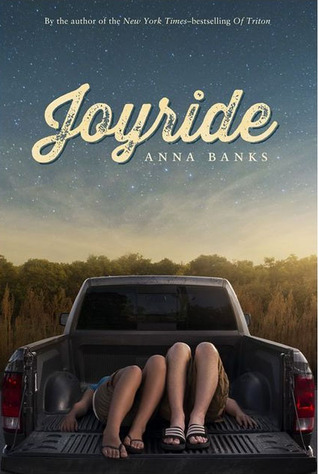
PUBLISHER’S DESCRIPTIONA popular guy and a shy girl with a secret become unlikely accomplices for midnight pranking, and are soon in over their heads—with the law and with each other—in this sparkling standalone from NYT-bestselling author Anna Banks.

It’s been years since Carly Vega’s parents were deported. She lives with her brother, studies hard, and works at a convenience store to contribute to getting her parents back from Mexico.

Arden Moss used to be the star quarterback at school. He dated popular blondes and had fun with his older sister, Amber. But now Amber’s dead, and Arden blames his father, the town sheriff who wouldn’t acknowledge Amber’s mental illness. Arden refuses to fulfill whatever his conservative father expects.

All Carly wants is to stay under the radar and do what her family expects. All Arden wants is to NOT do what his family expects. When their paths cross, they each realize they’ve been living according to others. Carly and Arden’s journey toward their true hearts—and one another—is funny, romantic, and sometimes harsh.

MY TWO CENTS: In Joyride, Anna Banks creates two easily likable, sympathetic characters who are struggling between wanting to have normal, fun teenage lives and dealing with serious family issues.

Carly Vega is a smart, hard working Mexican-American teen who juggles going to school and working, sometimes until the early morning hours at a convenient store, to help raise enough money to bring her deported, undocumented parents back to the U.S.

Arden is a popular former football star who battles with his violent father in the wake of his sister’s suicide, which has left his mother heavily medicated and despondent.

In the opening scene, Arden pretends to hold up his uncle, Mr. Shackelford, outside the convenient store in an attempt to get him to stop driving drunk. Carly, who is working when this happens, responds by pulling out the store owner’s shotgun and chasing the masked bandit (Arden) off. Arden knows then that Carly is the perfect candidate to be his pranking buddy, a position once held by his sister. Love blossoms as the two spend more time together doing funny, gross things around town that are risky because Arden’s father is the racist local sheriff responsible for deporting Carly’s parents.

Throughout the novel, Carly struggles with competing desires. She wants her family to be intact again and wants to do all she can to help raise the thousands of dollars needed to help them cross the border again. She also wants, however, to do what normal teen girls do, like hang out with her boyfriend and use her money to buy things like new clothes and a laptop computer.

Without giving too much away, I’ll say that this YA contemporary, which tackles serious issues and has heavy doses of romance and humor, also has a plot twist that adds a whole new exciting vibe to the story. Carly and Arden’s relationship is threatened and they end up in a dangerous situation involving law enforcement and the illegal smuggling operation that promises to bring her parents home.

Told in alternating points of view–Carly’s is first person and Arden’s is third–Anna Banks’s Joyride is a page-turner filled with interesting, complex characters who fall in love and find common ground despite economic, racial, and cultural differences.

TEACHING TIPS: Joyride could be an option when teaching about immigration. I’m sure students would have lots of questions about the issues brought up with this book around Carly’s family’s situation. Do people really pay someone to escort loved ones across the border? What are the risks? Is it really that expensive? What happens if they get caught again? How often are American born teens separated from parents who are deported? Reading this novel as a companion to non-fiction research on these issues could offer multiple perspectives and make Carly Vega seem even more “real,” in that her situation is a common one.

ABOUT THE AUTHOR (from her website): NYT Bestselling YA author of The Syrena Legacy series: OF POSEIDON (2012) OF TRITON (2013) OF NEPTUNE (2014). Repped by rockstar Lucy Carson of the Friedrich Agency. I live with my husband and daughter in the Florida Panhandle. I have a southern accent compared to New Yorkers, and I enjoy food cooked with real fat. I can’t walk in high heels, but I’m very good at holding still in them. If you put chocolate in front of me, you must not have wanted it in the first place.


FOR MORE INFORMATION ABOUT Joyride visit your local library or bookstore. Also, check out WorldCat.orgIndieBound.orgGoodreadsAmazon, and Barnes & Noble.

Also, check out the Q&A we did with Anna Banks earlier this week.


Book Review: Marcelo in the Real World by Francisco X. Stork

Reviewed by Lila Quintero Weaver

marcelo_coverFROM THE PUBLISHER:

The term “cognitive disorder” implies there is something wrong with the way I think or the way I perceive reality. I perceive reality just fine. Sometimes I perceive more of reality than others.

Marcelo Sandoval hears music that nobody else can hear — part of an autism-like condition that no doctor has been able to identify. But his father has never fully believed in the music or Marcelo’s differences, and he challenges Marcelo to work in the mailroom of his law firm for the summer . . . to join “the real world.”

There Marcelo meets Jasmine, his beautiful and surprising coworker, and Wendell, the son of another partner in the firm. He learns about competition and jealousy, anger and desire. But it’s a picture he finds in a file — a picture of a girl with half a face — that truly connects him with the real world: its suffering, its injustice, and what he can do to fight.

Reminiscent of The Curious Incident of the Dog in the Night-Time in the intensity and purity of its voice, this extraordinary novel is a love story, a legal drama, and a celebration of the music each of us hears inside.

MY TWO CENTS: Certain quirks cause 17-year-old Marcelo Sandoval to stand out from the crowd. He fastens his shirt all the way to the top button, even when he’s not wearing a necktie. His speech can be overly formal, and he often refers to himself in the third person. Don’t ask him to catch the meaning of an eye roll or a smirk because his brain isn’t wired to interpret subtler forms of nonverbal language. Plus, he hears music that no one else can hear. Marcelo was born with a cognitive disorder resembling Asperger syndrome, a category of autism spectrum disorder often considered “high-functioning.” The syndrome’s most recognizable traits are difficulty with social interactions and the tendency to become preoccupied with special areas of interest. In Marcelo’s case, this is the study of religion.

Marcelo attends Paterson, a school for kids with disabilities. The summer before his senior year, he’s supposed to work at the school’s stables, helping with the therapeutic ponies, but his father, a lawyer, has a different plan. Arturo Sandoval thinks it’s time for his son to experience “the real world,” in the form of a summer job at the law firm. If Marcelo manages the job satisfactorily, he’ll be allowed to choose which school to attend in the fall—the safe and friendly Paterson he knows well, or Oak Ridge High, a regular school not structured around the needs of students with disabilities.

What Marcelo encounters on the job is far more complex and morally ambiguous than the simple mailroom duties he’s hired to carry out. The law firm’s other partner has a college-age son, Wendell, who is also working at the office over the summer. Arturo considers Wendell a good role model for Marcelo. Little does he know that Wendell is much more interested in checking out the female employees than in getting any work done, and Jasmine, Marcelo’s supervisor, is the main object of his lust. At first, Marcelo tries to ingratiate himself to Wendell, who holds considerable power in assessing Marcelo’s performance, but it becomes apparent that Wendell is a jerk who mocks Marcelo, objectifies women, and disregards Arturo as a “minority hire.”

Other workplace quandaries pop up. Marcelo discovers a photograph of a girl badly injured in a car crash, due to the failure of a windshield manufactured by one of the law firm’s most important clients. He begins to wonder about his father’s decision to protect wealthy corporations, instead of those who’ve been harmed by the corporation’s negligence and can’t afford legal help.

But this YA novel isn’t a legal thriller per se. It’s a variation on the coming of age story, one that visits romantic love and sexual intimacy, and repeatedly explores the idea of what is real. There’s the real music that everyone can hear and the internal music heard only by Marcelo. There’s the real world of the law firm and Oak Ridge High School, and the protected world of Paterson. And how about the distinction between a happy smile and a sarcastic smile, or the literal words that people use and the actual meanings behind them? Plus, who is the real Arturo: the father that Marcelo knows, or the lawyer who may have wandered into less than noble choices? Reality is tough to decode.

I am not qualified to comment in depth on Stork’s depiction of Marcelo’s cognitive disorder. As I read, I kept myself alert for any signals that the author had romanticized the character’s condition or imbued him with magical or savant abilities, as is often the case in cultural portrayals of people with autism spectrum disorders. I saw nothing approaching those errors. Luckily, Disability in Kidlit, a blog devoted to reviewing books about characters with disabilities, has also published a review of Marcelo in the Real World. Read S.E. Smith’s fine analysis here.

Stork presents the Sandovals as a cohesive, but realistic Latino family, with flaws intact. They stand apart from the most prevalent depictions of Latino families in fiction and film, where poverty, domestic violence, and trouble with immigration issues crop up frequently. Marcelo’s mother, Aurora, is a registered nurse. She and Arturo are educated, upper-middle class professionals of Mexican heritage who can afford to send their son to a specialized private school. Their other child, Yolanda, is enrolled at an Ivy League university. Judging by their achievements, the Sandovals are living the American Dream, but crass remarks by Wendell convincingly show the darker side of reaching the Dream, that even successful Latinos are subject to derisive questions about their legitimacy.

Francisco Stork is a brilliant writer. His characters breathe, his dialogue sings, and his depiction of Marcelo’s interior life sparkles with beautiful insights and revelations. In writing his main character as a Latino with a developmental disorder, he gives readers the rare opportunity to experience two seldom combined, yet richly portrayed worlds. In Stork’s hands, this intersection of culture and cognitive challenge becomes suffused with poetic tenderness, and the result is an unforgettable novel.

francisco_storkFrancisco X. Stork was born in Monterrey, Mexico, and moved to the United States at age nine. He studied at Spring Hill College, Harvard University and Columbia University, where he completed a law degree. Stork’s five published novels have received awards, honors and high praise from reviewers. Keep up with publishing news and events at his official author site.


TEACHING RESOURCES:

Autistic Self-Advocacy Network

Autism Society of America

The official site of the autistic professor, speaker and author Temple Grandin

Equine Therapy Programs

Navigating Love and Autism,” a profile in The New York Times

In this video clip, comedian DL Hughley shares a touching story about his adult son with Asperger syndrome.

Book Review: Max Loves Muñecas! by Zetta Elliott

Reviewed by Ashley Hope Pérez MaxLovesMunecasCOVER

PUBLISHER’S DESCRIPTION: Max wants to visit a beautiful boutique that sells handmade dolls, but he worries that other children will tease him. When he finally finds the courage to enter the store, Max meets Señor Pepe who has been making dolls since he was a boy in Honduras. Señor Pepe shares his story with Max and reminds him that, “There is no shame in making something beautiful with your hands. Sewing is a skill—just like hitting a baseball or fixing a car.” 

MY TWO CENTS: Max Loves Muñecas interweaves a number of topics: resisting the constraints of traditional gender roles, child homelessness, resourcefulness and resilience, and the value of cooperation and generosity. In the hands of a lesser writer, these many focal points might overpower a slim chapter book of 72 pages, but Zetta Elliott creates a richly textured narrative world and situations that give readers opportunities to pause, consider their own lives, and reflect on the power of individual choices.

The first and last chapters of the book focus on Max, a young American boy intrigued by the intricacy and beauty of the dolls in a neighborhood shop run by Señor Pepe. Despite his interest, Max fears teasing by his classmates; in fact, the book’s title comes from the teasing he endures. By the end of this book, however, Zetta Elliott turns “Max loves muñecas!” from a taunt into an affirmation as Señor Pepe invites Max to work as his apprentice. Although “Max loves muñecas!” powerfully captures a key shift in the book, it is somewhat misleading as a title because Max’s story serves primarily as a frame for Señor Pepe’s telling of his own experiences as a young boy in Honduras, which are the focus of the eight central chapters of the book.

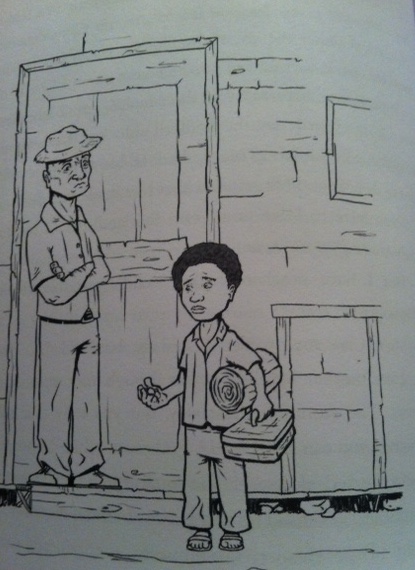
MaxLovesMunecasImage1We first learn of Pepe’s life as a poor but happy boy living with a loving grandmother who earns money by cleaning a wealthy family’s home and selling rag dolls to tourists. When Pepe’s grandmother passes away, neighbors make arrangements and send a telegram, but no one comes to get him. After three days, the landlord sends him away. With nothing but a blanket, his grandmother’s sewing basket, and a handful of coins, Pepe strikes out on his own.

He briefly joins a band of street boys living under an overpass where each has a special skill he contributes to the group, but he remembers his grandmother’s admonitions: “You are not a street boy. You do not drift from place to place like a weed in the sea” (15). After a night on the streets, Pepe stops to help an elderly woman struggling to open the shutters to her doll shop. So begins his relationship with Señora Beatriz, who cautiously invites him into her shop, intrigued by his delight at the beauty of her dolls and impressed with his good manners and facility with simple sewing tasks. Pepe finds a place in her heart—and her home—and continues to develop his love for making beautiful things.

But of course there are bumps along the way, a number of which center on the difficulty of balaMaxLovesMunecasImage2ncing good intentions and generosity to others with responsibility and a concern for appearances. When Señora Beatriz sends Pepe out for lunch on their first day together, Melky, one of the street boys, recognizes him and runs over to join him. Pepe becomes preoccupied with Melky’s disheveled appearance, worrying that the señora might think he is a street boy, too, if she sees him with Melky. Pepe understands the boy’s hungry glances at the lunch bag, but his fear over damaging his opportunity with Señora Beatriz is what drives him to share his food: “If I give you some of my lunch, you have to promise to go away. You can’t let the señora see you—ever!” (33).
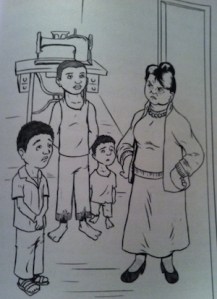
Later, when the señora goes out of town for the night, Pepe’s desire to surprise her leads him to attempt to finish a wedding dress using her cantankerous sewing machine. When it jams, his efforts to fix it result in a broken piece. Fearing a return to the streets if the señora discovers his disobedience and damage of the machine, he searches out Primo, the leader of the street boys, who is also an expert tinkerer. Primo can’t repair the broken piece without seeing the whole machine, and a new round of dilemmas opens up for Pepe as Melky and Primo follow him back to the señora’s house. He knows the señora would not want strangers in her house and worries that the street boys might get up to mischief, but he can’t see any way out of his problem without help. Far from wanting to steal from the señora, Primo and Melky fall in lMaxLovesMunecasImage3ove with the beautiful fabrics and deck themselves out in tiaras and veils. Primo succeeds at fixing the sewing machine, but the boys are so tired from their efforts they fall asleep at the kitchen table.


Once Señora Beatriz’s initial displeasure wears off, she is impressed by Primo’s technical abilities, charmed by young Melky, and pleased with the initiative and cooperation of all three boys. Ultimately, although only little Melky goes to school, all three boys gain the chance for a better life through their work for Señora Beatriz.

TEACHING TIPS: Max Loves Muñecas! is a good choice for upper elementary readers to explore on their own, and it would make an excellent read-aloud text (one chapter per session) for students across the elementary grades. The story highlights the boys’ spontaneous interest in dolls and fine fabrics, and it shows how following one’s passions can open doors. Max Loves Muñecas! also creates openings for students to discuss differences regarding schooling and child poverty in different communities and at different times. Finally, the book offers a number of scenarios where the “right” choice is relatively ambiguous, and these scenarios are ripe for exploration in conversation, journaling, drawing, or reenactment.

Although the handful of simple illustrations scattered through the book help provide a visual reference point for Pepe and Max’s adventures, there is still plenty of room for imagining and recreating scenes from the story. Students may especially benefit from guided exercises to help them imagine perspectives and experiences different from their own. Start with questions like, “What do you think Melky feels when Pepe makes him promise to never come to the señora’s shop?” or “Why is the señora disappointed when she first returns from her trip?” but take time exploring the other perspectives involved in a given moment in the narrative. When supported, even young children can stretch their capacity for empathy and perspective-taking beyond identifying with the protagonist.

MaxLovesMunecas_Zetta Zetta Elliott is the award-winning author of stories for children, YA novels, and poetry, plays, and essays for adults. Born and raised in Canada, she has lived in the US for 20 years and earned a PhD in American Studies from NYU in 2003. Her picture book, Bird, won the Honor Award in Lee & Low Books’ New Voices Contest and the Paterson Prize for Books for Young Readers. Her latest YA novel, The Deep, was published in November 2013. She is an advocate for greater diversity and equity in publishing, and to this end she has published several illustrated books for younger readers—including Max Loves Muñecas—under her own imprint, Rosetta Press. She currently lives in Brooklyn. Visit her online at www.zettaelliott.com

MaxLovesMunecas_MauricioPhotoMauricio J. Flores was born in 1988 in Tegucigalpa, Honduras, where he currently resides. Trained as an architect, he has worked extensively as a freelance illustrator and web designer. When he’s not drawing, he enjoys listening to a vast spectrum of music genres, studying languages, and reading epic fantasy novels and comics. Visit him at http://mjflores.visioncomicshn.com/.

Book Review: Pickle: The (Formerly) Anonymous Prank Club of Fountain Point Middle School by Kim Baker


13170031By Kimberly Mach

DESCRIPTION FROM THE BACK OF THE BOOK:

Dear Parents and Teachers:

This is a work of fiction. There is no Prank and Trick Association at Fountain Point Middle School. And you absolutely will not find instructions on how to log in to a top-secret prank instruction website anywhere on these pages. All we do is make pickles. OK?

Sincerely,

Ben Diaz

President, The League of Pickle Makers

MY TWO CENTS: Now, if the description above won’t get a child to pick up a book, I’m not sure what will.

Kim Baker had me laughing from the first page. The book opens with this line: Can I trust you? She had me hooked right there, with all that the question implies.

There are so many ways to talk about Pickle because it really is a perfect middle-grade novel. Kids will laugh out loud, and they may even go scrambling to create their own prank clubs. Beyond the laughter, they will identify with the ever-changing landscape of middle school friendships. Ben Diaz, the main character, creates a Prank Club, under the guise of a Pickle Makers Club. Due to an earlier incident, Ben does not invite his best friend Oliver into the club. (Oliver’s grandmother is the school principal and Oliver, well, Ben thinks Oliver just can’t be trusted to keep the secret.) Reading it, I found myself wondering what the halls of my school would look like if there were bubbles in the fountains or impromptu parties in the classrooms. Throughout the mayhem, lessons are woven in. Ben learns about himself, his new friends, and just how ‘off’ we can be when we try to label each other, but most of all he learns what kind of friendship he and Oliver really have. Spoiler alert: It’s made of the strong stuff. There are lessons here in action and reaction, consequences and the impact of our decisions, and they are all told masterfully through the eyes and comedy of young Ben Diaz.

As an adult reader, what resonated with me was the very real problem of what isn’t in our history books. For Pioneer Day, Ben and his friends have to present something pickled for the Pioneer Fair. If they don’t, they will lose their funding from the PTA and that will be the end of the Pickle Club and the secret Prank Club.

What to do? Ben turns to his family. They frequently serve escabeche, or pickled vegetables, at their Mexican restaurant. Ben sees that escabeche can be their entry for the fair. Then Ben hesitates. He asks the kind of question that many of our children who do not see themselves reflected on the pages of history books wonder about: Were there Mexican pioneers?

Ben goes on to say: “I’ve never seen any in the pictures. It’s always just a bunch of white guys.” And then later, the realization that, “It doesn’t mean they weren’t there.” Ben begins searching.

The time period for our children is different from that of my youth. In my youth, we may have asked the question, but because of available resources, we probably could not have answered it, at least not in a timely fashion. The internet has allowed people and organizations to post information and share resources in a much more efficient manner. When Ben wonders about pioneers from Mexico, he does not have to go far to find that reliable source. Instead of spending an afternoon at the town hall archives, he can answer it with the click of a button. As an adult, I could not escape the implications of Ben’s memory when he recalls being criticized in kindergarten for using the brown paper to make his Pilgrims for Thanksgiving. There are so many who were skimmed over in the history books, but the information is there if we ask the questions. Step one is teaching our children to ask. Where are the women in this picture? Who worked in the factories? Why does this city have a Spanish name? What happened when native peoples went to reservations? Ben chooses to share an authentic pickling recipe from Mexico. It may not be the pickle recipe people were expecting at the fair, but it is delicious and the scene, of course, is memorable. Trust me, you’ll be cheering for him when he has a conversation with Principal Lebonsky about traditional recipes.

TEACHING TIPS: This book would be an excellent read-aloud in the classroom, appropriate for grades 3-6. It can be enjoyed for the humor and story, or a teacher can choose to take the lessons further.

Language Arts: Life-size character sketches are one extension idea. Brief descriptions of each character are on the front jacket of the book. Many children will see themselves reflected in the personalities and the ethnicities of Ben and his friends. Traits can be filled in as readers follow the story, with life-size versions being presented at the end.

Social Studies: Many upper elementary and early middle school grades study pioneer days as part of their curriculum. Reading Pickle may encourage students to ask the important questions and to look more deeply at the pictures of people in their own state and communities.

The escabeche could be the beginning to a small unit on preserving food both in the past and now. Compare and contrast, how did Native Americans preserve food? When were other methods introduced?  What are traditional foods of the region? How are they preserved today?  The possibilities are endless here.

Enjoy the book. Readers of all ages will love it. When you are done, visit Kim Baker’s website at http://kimbakerbooks.com/ and enjoy her voice and humor there.

Pickle is Kim Baker’s debut novel and has already received five awards including the Louisiana Young Reader’s Choice 2015 nominee, 2014-2015 Texas Blue Bonnet Award Nominee, and the 2013 SCBWI West Crystal Kite award.

FOR MORE INFORMATION ABOUT Pickle visit your local library or bookstore. Also, check out WorldCat.orgIndieBound.orgGoodreadsAmazon, and Barnes & Noble.


Kimberly Mach has been teaching for sixteen years and holds two teaching certificates in elementary and secondary education. Her teaching experience ranges from grades five to twelve, but she currently teaches Language Arts to middle school students. It is a job she loves. The opportunity to share good books with students is one that every teacher should have. She feels privileged to be able to share them on a daily basis.

Debut Celebration for The Girl at Midnight by Melissa Grey!

By Zoraida Córdova

I am super excited to have Melissa Grey with us at Latin@s in Kid Lit! I love fantasy, and I especially love when Latinas write fantasy. The Girl at Midnight has already received wonderful praise and starred reviews from Kirkus and Booklist! To celebrate tomorrow’s launch of The Girl at Midnight, we are going to get to know the magic behind Melissa.


“Grey’s energetic debut offers a strong protagonist…[and the] well-built world, vivid characters, and perfect blend of action and amour should have readers eagerly seeking the sequel.” — Kirkus Reviews, Starred


Zoraida: Tell me about The Girl at Midnight and your inspiration for it.

Melissa: In The Girl at Midnight, there’s a magical race of creatures that live beneath the streets of New York called the Avicen. They have feathers for hair and their existence is very much a secret, but they take in a human girl who goes by the name of Echo. Echo has run away from a bad home life and finds a new family in the Avicen, so when they’re threatened by a centuries-old war, she takes it upon herself to find the firebird, a mythical entity prophesied to end the conflict once and for a all.

The book really started with Echo and the firebird. I’m a huge fan of the ballet and the legend behind it, so my research into the folklore involving the firebird gave me a lot to think about when I was developing the plot. Echo was the first character to exist and she kind of predated the story. I came up with her first and eventually found a world for her to inhabit.

What is the best writing advice you’ve ever gotten?

It’s not specifically writing advice, but it can be applied to writing. When I was at art school, one of my professors told me not to be precious with my work. It was the first time I’d ever heard the saying “Kill your darlings” and it really stuck with me. I can be a perfectionist, so not treating my work as something delicate and inviolable was an eye-opening change of strategy. To me, it means not being afraid of scrapping drafts or whole chapters or even characters that aren’t working to the benefit of the work as a whole.

What was the hardest scene in your novel (if it’s not too spoilery)?

The last chapter was a struggle. I’m not a huge fan of cliffhangers, but as a writer, you do want to leave people wanting more, especially if you’re writing a series like I am, so I tried very hard to strike a balance between giving readers closure and enticing them to come back for the sequel.

How does your culture play a part in your fantasy (if at all)?

Well, I’m Puerto Rican and food is a huge part of that culture. I don’t include Spanish food specifically in the book, but Echo’s life pretty much revolves around food. It’s the foundation of a lot of her relationships, which is definitely something I can relate to.

Where would be your dream writing location?

A secluded little cabin in the Scottish Highlands.

Are there any lessons you learned while writing TGaM, and how is that helping you with book 2?

I learned that I have to trust my gut while not giving into my inner perfectionist. I also learned that I didn’t need to take every single criticism I received on the manuscript as gospel because sometimes my writing partners (and even my agent and editor) didn’t agree, so I had to trust my instincts.  

What books are you reading right now?

Right now, I’m reading The Archived by Victoria Schwab (it’s amazing), The Walls Around Us by Nova Ren Suma (also amazing), and Get in Trouble by Kelly Link (amazing as well).

What do you wish to see more in YA?

That’s tough because I can only comment on what I’ve read and I don’t want to make it sound like I think YA as a whole (which is a super broad categorization) is lacking, but I will say that I love seeing books like Laura Ruby’s Bone Gap and Renee Ahdieh’s The Wrath and the Dawn that deal with the gray areas of morality and are peopled by characters that aren’t necessarily likable but are still deeply compelling.

Who would attend your magical fantasy tea party?

Echo, naturally. And some of her friends from TGaM. If it’s a magical fantasy, I assume I can invite anyone, real or fictional, so I’ll say Hermione Granger (Harry and Ron can come, too), Door from Neverwhere, Kell and Lila from A Darker Shade of Magic (Rhys can come, too), Tana and Gavriel from The Coldest Girl in Coldtown, and Finn, Petey, Roza, and Sean from Bone Gap. Oh, and all of the Raven Boys.

What is your favorite line from your book? (Or a couple of favorite lines. I know it’s hard to choose.)

At one point, Echo is backed into a corner and she basically has to bullshit her way out of it so she says to herself, “When in doubt, bravado.” I feel like that idea has carried me through life pretty well.


The Girl at Midnight debuts tomorrowApril 28th, 2015!

ORDER A SIGNED COPY FROM BOOKS OF WONDER

Amazon * B&N * Kobo * IndieBound * Powells

Find Melissa on Goodreads.


Praise for THE GIRL AT MIDNIGHT:

“Grey’s energetic debut offers a strong protagonist…[and the] well-built world, vivid characters, and perfect blend of action and amour should have readers eagerly seeking the sequel.” — Kirkus Reviews, Starred

“Sparks fly…This first novel will please fans of Cassandra Clare and Game of Thrones watchers with its remarkable world building; richly developed characters…[and] a breathtaking climax that…cannot come soon enough!”—Booklist starred review

“Inventive, gorgeous, and epic—Grey dazzles in her debut.” — Danielle Paige, New York Times bestselling author of Dorothy Must Die

“A stunning debut. Equal parts atmosphere and adventure … positively divine.” – Victoria Schwab, author of A Darker Shade of Magic


About THE GIRL AT MIDNIGHT:

For readers of Cassandra Clare’s City of Bones and Leigh Bardugo’s Shadow and BoneThe Girl at Midnight is the story of a modern girl caught in an ancient war.

Beneath the streets of New York City live the Avicen, an ancient race of people with feathers for hair and magic running through their veins. Age-old enchantments keep them hidden from humans. All but one. Echo is a runaway pickpocket who survives by selling stolen treasures on the black market, and the Avicen are the only family she’s ever known.

Echo is clever and daring, and at times she can be brash, but above all else she’s fiercely loyal. So when a centuries-old war crests on the borders of her home, she decides it’s time to act.

Legend has it that there is a way to end the conflict once and for all: find the Firebird, a mythical entity believed to possess power the likes of which the world has never seen. It will be no easy task, but if life as a thief has taught Echo anything, it’s how to hunt down what she wants … and how to take it.

But some jobs aren’t as straightforward as they seem. And this one might just set the world on fire.


ABOUT THE AUTHOR:
Melissa Grey was born and raised in New York City. She wrote her first short story at the age of twelve and hasn’t stopped writing since. After earning a degree in fine arts at Yale University, she traveled the world, then returned to New York City where she currently works as a freelance journalist. To learn more about Melissa, visit melissa-grey.com and follow @meligrey on Twitter.

Book Review: Salsa: Un poema para cocinar / Salsa: A Cooking Poem by Jorge Argueta


By Marianne Snow

DESCRIPTION (from Goodreads): In this new cooking poem, Jorge Argueta brings us a fun and easy recipe for a yummy salsa. A young boy and his sister gather the ingredients and grind them up in a molcajete, just like their ancestors used to do, singing and dancing all the while. The children imagine that their ingredients are different parts of an orchestra — the tomatoes are bongos and kettledrums, the onion, a maraca, the cloves of garlic, trumpets, and the cilantro, the conductor. They chop and then grind these ingredients in the molcajete, along with red chili peppers for the “hotness” that is so delicious, finally adding a squeeze of lime and a sprinkle of salt. When they are finished, their mother warms tortillas and their father lays out plates, as the whole family, including the cat and dog, dance salsa in mouth-watering anticipation.

Winner of the International Latino Book Award for Guacamole, Jorge Argueta‘s text is complemented by the rich, earthy illustrations of Duncan Tonatiuh, winner of the Pura Belpré Award. His interest in honoring the art of the past in contemporary contexts is evident in these wonderful illustrations, which evoke the pre-Columbian Mixtec codex.

MY TWO CENTS: Here’s another Jorge Argueta picture book that’ll make you hungry! Argueta has created several bilingual poetry books that celebrate traditional Latin American dishes – including Guacamole, Sopa de frijoles / Bean Soup, and Arroz con leche / Rice Pudding – and Salsa is just as mouth-watering. I love how he uses beautiful language to stir the senses, appealing to readers’ taste and smell with scrumptious descriptions of vegetables and herbs; sound by drawing comparisons between ingredients and musical instruments; and touch by weaving together the acts of cooking and dancing.

As a lover of spicy food, I particularly enjoy Argueta’s ode to hot chiles, complete with imagery that clearly evokes the crackly, wrinkled skin and the tingly burn of the peppers. Here’s a little taste:

Hay chiles con cara de abuelo

y chiles con cara de abuela.

Hay chiles rojos

como llamitas.

Al morderlos nos calientan la lengua

como si tuviéramos en la boca una lucecita.


There are chilies with faces like a grandfather

and chilies with faces like a grandmother.

There are red chilies

like little flames.

When we bite one our tongue gets hot,

as if we had a tiny light on in our mouth.


I really wish I had some salsa right now.

Meanwhile, Duncan Tonatiuh’s signature illustration style, which hearkens back to pre-Columbian Mixtec art, captures readers’ sense of sight and beautifully reminds us of Mexico and Central America’s past while celebrating a contemporary family coming together to prepare a meal. Inviting Tonatiuh to illustrate this book is a perfect choice, since his historically inspired images reflect Argueta’s description of the history of the molcajete, the mortar and pestle crafted from volcanic rock that people have long used to grind vegetables and spices. This connection of the past and present through both words and illustrations makes Salsa an especially delicious dish for me.

(My much loved molcajete.)

TEACHING TIPS: This book is an invitation for several meaningful hands-on learning activities. Students and teachers can write up bilingual recipes for salsa using the ingredients Argueta presents in the poem and then make a tasty, healthy snack to eat and share with others at school. If children have family members or friends who have experience using a molcajete to make salsa, teachers can invite these special guests to demonstrate their techniques – a perfect opportunity to welcome students’ home lives and funds of knowledge into the classroom. Afterwards, everyone can write their own food poems utilizing some of the various literary devices – similes, metaphors, rich imagery, synesthesia – that Argueta employs.

Additionally, Salsa is an excellent springboard for a science lesson about composting and plant growth. When the family in the poem finishes making their salsa, the son takes leftover lime seeds and vegetable peels outside and buries them in a hole in the ground:

Las entierro para que se conviertan en abono,

Children can do the same when they finish their own salsa, making hypotheses about what will happen to the seeds and foods scraps and then observing the changes that occur as weeks pass. Will the vegetable matter decompose and turn into soil? Will new plants emerge from the seeds? You’ll have to try it and see!

ABOUT THE AUTHOR (from Salsa’s book jacket): Jorge Argueta is an award-winning author of picture books and poetry for young children. He has won the International Latino Book Award, the Américas Book Award, the NAPPA Gold Award, and the Independent Publisher Book Award for Multicultural Fiction for Juveniles. His books have also been named Américas Award Commended Titles, USBBY Outstanding International Books, Kirkus Reviews Best Children’s Books, and Cooperative Children’s Book Center Choices. A native Salvadoran and Pipil Nahua Indian, Jorge spent much of his life in rural El Salvador. He now lives in San Francisco.

LINKS / OTHER INFO: Here are a couple of fascinating videos that teachers can use to supplement the book:

https://www.youtube.com/watch?v=Za_2VWD4nU4

FOR MORE INFORMATION ABOUT Salsa visit your local library or bookstore. Also, check out WorldCat.orgIndieBound.orgGoodreadsAmazon, and Barnes & Noble.


MarianneMarianne Snow is a doctoral student at the University of Georgia, where she researches Latin@ picture books, representations of Latin@ people in nonfiction children’s texts, and library services for Spanish-speaking children and families. Before moving to Georgia, she taught Pre-K and Kindergarten in her home state of Texas and got her master’s degree in Teaching English to Speakers of Other Languages (TESOL) at Texas A&M University. In her spare time, she enjoys obnoxiously pining for Texas, exploring Georgia, re-learning Spanish, and blogging at Critical Children’s Lit.