MG Latinx Characters & Their (Sometimes) Complicated Relationships with Spanish


by Lila Quintero Weaver, with Cris Rhodes, Ph.D.

According to the Pew Research Center, broken Spanish (or no Spanish at all) is a reality lived by a growing number of Latinx, especially youth.

Although many Latinx children and teens tackle Spanish confidently and with smooth results, others are not so lucky. As speakers, they fumble for the right words and grammatical constructions. As listeners, they miss out on idioms, inside jokes, and culturally buried subtexts. Often these scenarios take place within family settings, where older members may speak limited English or no English at all.

How do such language gaps affect a young person’s connection to family and community? What is the impact on their sense of cultural belonging or ethnic identity, and on the pride they feel in claiming Latinidad?

Connection, belonging, knowing who you are and where you come from: These things deeply matter, which is why the Spanish-language journey of Latinx youth deserves authentic representation in children’s literature.

Fortunately, middle-grade fiction is addressing the many shades of Spanish proficiency that exist out there, and the most compelling examples come from Latinx authors, whose personal experiences and finely-tuned observations collectively yield a rich and varied picture of how young people in the Latinx community navigate the language gaps they encounter.

Below is a list of recently published middle-grade novels featuring Latinx characters whose Spanish is less than perfect. 

*Note: Although this post addresses the role of Spanish in Latinx youth literature, it’s critical to acknowledge that many people connected to the Latinx community speak indigenous languages, whether exclusively or in addition to Spanish. Furthermore, Latinx youth of Brazilian origin are likely to face similar issues with Portuguese.

Recommended Reading

Listed Alphabetically by Author
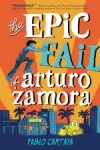
The Epic Fall of Arturo Zamora by Pablo Cartaya  

This is the story of how 13-year-old Arturo’s world is set ablaze by love and activism. It happens during a summer in Miami, when a real-estate developer threatens the future of the restaurant run by Arturo’s grandmother, simultaneously affecting the neighborhood’s other businesses and residents. These are the people who become Arturo’s extended “family.” During this momentous summer, he also navigates a heavy crush on Carmen, a girl who brings poetry into his life. With respect to Arturo’s command of Spanish, our reviewer writes: “Growing up in the U.S. has resulted in Arturo’s imperfect Spanish, and yet, he ‘sometimes used Spanish words when English words couldn’t fully explain what I needed to say.’” Read the full review by Jessica Agudelo here.
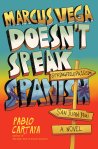
Marcus Vega Doesn’t Speak Spanish by Pablo Cartaya

Marcus Vega’s at-school hustle using his towering height and bulk to protect smaller kids from bullies comes to screeching halt when Marcus punches a bully for calling his little brother, Charlie, a derogatory term related to Charlie’s Down syndrome. Fearing that Marcus needs a break, Marcus’s mother resolves to take Charlie and Marcus to Puerto Rico–the home of their absent father. To Marcus, Puerto Rico is a land of mystery, paralleling the mystery of the father whom he doesn’t know. Marcus’s inability to speak Spanish doesn’t prove so much a barrier on the island, where he’s pleased to learn many of his relatives speak English in addition to Spanish, but he is shocked upon arrival on the island that his mother is fluent, having studied Spanish in college. This revelation spurs Marcus to realize his own Spanish isn’t as bad as he’d first thought, as he reads signs and listens to conversations, pleased that he understands even a little of the language. Even as his father’s continued absence makes Marcus feel disjointed, the trip to Puerto Rico helps him realize a connection to his heritage, his paternal language, and his familia. –Summary by Dr. Cris Rhodes
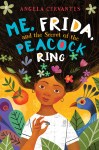
Me, Frida, and the Secret of the Peacock Ring by Angela Cervantes

When 7th-grader Paloma Marquez heads to Mexico City to spend a month, it’s not exactly by choice. Tagging along on her mom’s business trip, Paloma arrives knowing little Spanish. Although she packs a Spanish phrase book, she resists the idea that she should learn more. Almost immediately, she’s caught up in a mystery at La Casa Azul, the former home of the famous painter Frida Kahlo, which has been converted to a museum. Also hanging out at the museum are local twins Gael and Lizzie. They become Paloma’s intercambio partners. In exchange for tutoring Paloma in Spanish, the twins refine their grasp of colloquial English, with Paloma’s help. Soon the three kids are swept into the story’s central quest involving a missing peacock ring and some sketchy characters with dangerous schemes. Learn more about this rollicking adventure from our review by Jessica Agudelo.
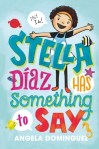
Stella Díaz Has Something to Say by Adriana Dominguez

Stella is shy. When she and her best friend, Jenny, are assigned different teachers, Stella loses the built-in comfort of a ready ally. Forced to make new friends, Stella hopes to find someone who speaks Spanish. How interesting that she specifies this preference, because Stella’s hold on Spanish isn’t solid. In her review, Jessica Agudelo writes: “At school, when Stella feels nervous, she jumbles her Spanish and English, but worries that others will perceive it as weird. When her relatives visit from Mexico, her limited Spanish makes her feel timid because ‘here, around my family, I just don’t have the words to say everything I want to say.’ Stella’s imperfection in each language makes her feel out of sync with both identities. Although it is not uncommon nowadays to proudly refer to this dance between cultures through language as ‘code switching’ or speaking ‘Spanglish,’ Stella’s insecurities reflect a familiar struggle for many first- and second-generation Latinxs growing up in the US.” Read Jessica’s full review of Stella Díaz here.
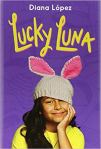
Lucky Luna by Diana López

Luna Ramos is an endearing character with a mischievous bent. She’s part of a huge and loving Mexican-American family based in Corpus Christi, Texas. At school, Luna is flunking fifth-grade Spanish. How can this be when her last name is Ramos, she asks herself? But growing up in a home where Spanish isn’t spoken, Luna doesn’t have ready access to the in’s and out’s of Spanish. Teachers and family members keep insisting that the person best suited to tutor her is cousin Claudia, a fluent speaker. Trouble is, Claudia is pushy, meddlesome, prone to tattling, and often a thorn in Luna’s side. Initially, Luna figures she’d be better off getting help from a different cousin. Hm, maybe not! Young readers will get a kick out of the hilarious miscommunications that ensue along the cousin grapevine. Will Luna manage to make peace with Spanish? 

Love Sugar Magic: A Dash of Trouble by Anna Meriano

Talk about feeling left out! Unlike her older sisters, 11-year-old Leo Logroño doesn’t speak more than a few words of Spanish. The oldest two Logroño girls learned at Abuela’s knee, while the middle two have enrolled in Spanish courses at school and are far ahead of Leo. The family owns a bakery, the Amor y Azucar Panadería, famous for its Day of the Dead pastries and for hosting an annual festival celebrating that holiday. In the lead-up to the festival, mysterious events at the bakery put Leo on high alert. Just what are her mom and sisters up to, she asks herself?  Leo’s eavesdropping could’ve yielded better results, if only she’d learned more Spanish. For further insights, check out Cecilia Cackley’s review of the novel here. I also recommend this interview with the author, which includes personal reflections on the role of Spanish.
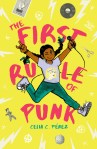
The First Rule of Punk by Celia C. Pérez

María Luisa, better known as Malú, is an aficionado of punk rock, thanks to her dad’s influence. When Malú moves with her mom from north Florida to Chicago, her exposure to Spanish intensifies. But although her mom is a scholar of Mexican culture, Malú does not feel competent or comfortable in speaking Spanish. At school, she’s surprised to be admitted into the class section designated for fluent speakers. One of the students in that class sneers at Malú’s Spanish and labels her a “coconut,” a derogatory term that implies Malú is brown only on the outside. Malú’s emotional journey finds expression in punk music and zines, and both lead her to embrace Spanish more fully. See our full review by Lettycia Terrones.

My Year in the Middle by Lila Quintero Weaver

Echoing my own immigrant experience in small-town Alabama, this novel takes place in 1970 and features 12-year-old Lu Olivera. Lu’s challenges include becoming a better runner. She also faces unfolding conflicts related to school desegregation, as well as a gubernatorial election that turns racist and nasty. Lu’s state of Spanish is rusty, but passable. She manages to interpret Spanish conversations for English-only speakers, and even helps a Cuban neighbor conduct a banking errand, although not without trepidation over unfamiliar terms. On the school bus, a bully delights in teasing Lu about her South American origins, calling her native language “spinach.” Here’s what teen reviewer Corina Isabel Villena-Aldama wrote on our blog about My Year in the Middle.

Readers, this list is far from comprehensive! I hope to add more titles as I learn about them, and I welcome your feedback.

CONSIDERATIONS FOR TEACHERS

Here are some points to ponder regarding Latinx characters and their encounters with Spanish:  

  • Within a single story, characters’ experiences may reflect multiple levels of Spanish-language literacy, comprehension, and verbal fluency.
  • Some characters are raised in homes where no Spanish is spoken or where only one parental figure is fluent enough to speak it. This includes families in which one partner is Latinx, while the other is not.
  • Although around 70% of Latinx parents encourage their kids to speak Spanish at home, there are also those who discourage it, perhaps fearing their children will not master English. Such parents are often anxious to shelter their children from racism, while some calculate that limiting Spanish will ease their way in an English-dominant world.
  • Parents, grandparents, teachers, and neighbors vary widely in how supportive, coercive, or judgmental they are regarding a character’s level of Spanish.
  • In some settings, such as schools and communities, Spanish is prevalent; in others, it’s less common or even rare.
  • Characters express a broad range of positive-to-negative feelings about using Spanish or improving the Spanish skills they possess.
  • The immigration histories of characters’ families vary widely.
  • Some characters also struggle with defining their ethnic identity, and sometimes this is tied to their Spanish-language skills.
  • Further complicating the language struggle, narratives sometimes engage with representations of colorism, internal oppression, white supremacy, and racist bullying.
  • Spanish words, sentences, and expressions often appear in these stories. Translations are rarely provided within the text–a rapidly fading practice we are happy to see go. Even so, English-only readers will be able to intuit meanings through context.

Relevant articles to explore:

Consider these findings by the Pew Research Center: “Overall, about 40 million people in the U.S. speak Spanish at home, making it the country’s second-most spoken language. At the same time, growth in the number of Spanish-speaking Hispanics has slowed, according to the Center’s analysis of U.S. Census Bureau data. As a result, the share of Hispanics who speak Spanish at home has declined, while the share that speaks only English at home has increased, especially among children.” [Emphasis mine]

From the Center for Applied Linguistics, this FAQ addresses the subject of heritage speakers and language-learning programs designed specifically to help them.

Reprinted in TIME magazine, Daniel José Older’s “I Rejected Spanish as a Kid. Now I Wish We’d Embrace Our Native Languages” is an essay that originally appeared in the anthology The Good Immigrant: 26 Writers Reflect on America.

Here’s a poignant reflection by Kevin Garcia on the NPR website, entitled “Can You Lose a Language You Never Knew?”

12 Reasons People Are Told They’re Not Latino Enough” is a fascinating exploration of Latinx community metrics by Tanisha Love Ramirez. Reason No. 2 is all about imperfect Spanish.  

Don’t miss these videos:


Do You Have to Speak Spanish to Be Latino?


“When You’re Latino and You Suck at Spanish.” Humorous–and lightly profane!
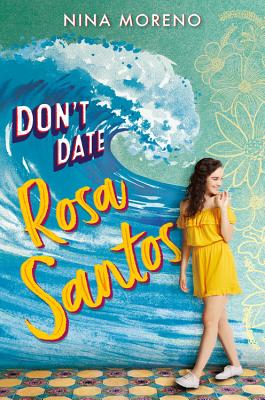
 

Book Review: Don’t Date Rosa Santos by Nina Moreno


Reviewed by Mimi Rankin

DESCRIPTION OF THE BOOK: Rosa Santos is cursed by the sea—at least, that’s what they say. Dating her is bad news, especially if you’re a boy with a boat.

But Rosa feels more caught than cursed. Caught between cultures and choices. Between her abuela, a beloved healer and pillar of their community, and her mother, an artist who crashes in and out of her life like a hurricane. Between Port Coral, the quirky South Florida town they call home, and Cuba, the island her abuela refuses to talk about.

As her college decision looms, Rosa collides—literally—with Alex Aquino, the mysterious boy with tattoos of the ocean whose family owns the marina. With her heart, her family, and her future on the line, can Rosa break a curse and find her place beyond the horizon?

Don’t Date Rosa Santos releases Tuesday, May 14, 2019.

MY TWO CENTS: I had seen this book circulating the Latinx KidLit Twittersphere (Thanks Las Musas! @lasmusasbooks) and couldn’t wait to get my hands on it at ALA Midwinter (Thanks Dina at Disney!). I had an inkling I would like this seemingly sweet YA romance with a Latinx heroine, but the weight this story carries is far greater than a springtime young love. Rosa is a fierce, brilliant, Type A goal chaser, and I am completely here for her. She is unapologetic in figuring out not just what she wants, but is realistic in how to get there. As a former college admissions counselor, I was very proud of Rosa for dually enrolling in a community college and looking into Study Abroad programs while still in high school. So, yes, Rosa is an awesome lead. I laughed out loud at Moreno’s far-too-relatable scenes of awkward first dates and embarrassing parents. If you want an impeccably written YA novel that reads much older and more “real,” this is the perfect spring break read.

Still, Don’t Date Rosa Santos is just the first story in a new narrative for young Cuban-Americans. With the embargo lifted in the last few years, young people of Cuban descent are finally able to see where they come from, where their own narrative began. I myself am of Puerto Rican descent, so while our islands are not super far from each other, our stories are worlds apart. Since all of my relatives are American citizens, they have never had a problem popping back and forth between San Juan and Texas, Louisiana, or Florida. For Cubans, they had to make a decision so much bigger than just “moving”; it was fleeing, knowing that returning was not an option. Now, young Cuban-Americans have the option to visit the island of their people, but it is not without the weighted guilt of knowing the fear of their ancestors. Moreno beautifully illustrates this feeling of being torn that I’m sure many young Cuban-Americans feel: the desire to visit Cuba while battling abuelos y abuelas who still remember the horrors they escaped. This new reality is sure to bring up hard conversations within families—can you be Cuban without taking the chance to experience Cuba? To those who faced exile, is the Cuba they remember the Cuba of today?

Sometimes characters were introduced in a way that felt abrupt and confusing, but the confusion was usually alleviated quickly. Parts of the last few chapters felt slightly rushed in the plot, but Moreno tied up the story in a very lovely manner that was not at all cliché. I am so excited to watch how this story contributes to a very specific Latinx Children’s Literature conversation.


ninamorenophotoABOUT THE AUTHOR: Nina Moreno is a YA writer whose prose is somewhere between Southern fiction and a telenovela. She graduated from the University of Florida with a B.A. in English Don’t Date Rosa Santos is her first novel.


file-2ABOUT THE REVIEWERMimi Rankin received her Master’s Degree with distinction in Children’s Literature from the University of Reading. Her thesis, on which she received a rating of First, centered around claims to cultural authenticity and representation in Hispanic Children’s Literature. She currently works in the publishing industry as a marketing manager for over 20 international children’s publishers. Her reviews do not reflect the opinions of her employer or clients. She currently lives in Nashville, Tennessee.


A Writer Belongs Everywhere: Stories from a Writing Workshop for Middle School Girls


By Tracey T. Flores, Ph.D.

On a hot evening in June, four Latina girls, Rocky, Reyna, Blanca and Elizabeth, entering ninth and tenth grade, and their parents, Valente, Samuel, Alma and Rose, gather at the local university for an evening of drawing, writing and sharing. In the small meeting room, sitting side-by-side at tables, girls and their parents busily sketch, in pencil and crayon, a drawing in response to the question: “Where are you from? / ¿De dónde eres?”

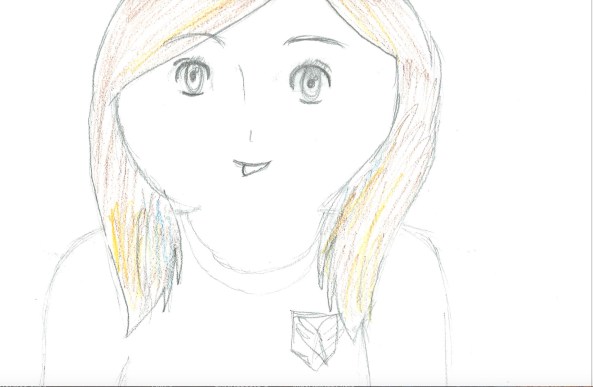
Walking around the room, I notice many different sketches. Rocky sketches a self-portrait of herself with wavy brown hair and blonde highlights. With a blue crayon, her father, Valente, sketches the flag of Honduras. Alma shows her daughter a sketch of the world with México at the center, as Blanca sketches a large brick house with two small girls with braids smiling in front of it. Rose colors the hair on her stick figure black, while her daughter, Elizabeth, draws a girl looking into a small mirror while putting makeup on her face. Samuel finishes his sketch of the U.S. flag and the flag of México, intersecting the shape of a heart between them, while his daughter, Reyna, colors the red tongue of the small dog she has sketched.

Rocky’s self-portrait

As families finish their sketches and begin sharing, the room becomes alive with stories. They share stories of family camping adventures, cherished memories of times spent with abuelitos, inside jokes shared between hermanas and of childhoods growing up in México y Honduras. Listening to each other, they nod in agreement, ask questions and connect through the collective telling and sharing of stories and histories.

Tonight is the first night that these Latina girls and their parents have come together to write and draw stories from their lived experiences. Over the next six weeks, as they participate in Somos Escritores/We are Writers, we will read and discuss a variety of bilingual (English/Spanish) print and digital texts, explore our experiences and histories, and use drawing, writing and oral storytelling as tools for self-expression and self-reflection. Somos Escritores is a writing workshop that brings Latina girls (grades 6-12) and their parents together for the intergenerational exchange of stories and knowledge through drawing, writing and oral storytelling.

After sharing our sketches, we read and discuss two poems, Where I’m From by George Ella Lyon and De Donde Yo Soy by Levi Romero. In these poems, poets explore their histories and describe through vivid language and detail all the people, places, moments and memories that shape who they are and how they walk in the world. These poems serve as an invitation for girls and their parents to further explore their lives while considering the ways their familial, cultural and linguistic histories shape who they are and who they are becoming. Finally, girls and their parents take their drawing to writing, using these poems as inspiration for crafting their own Where I’m From / De Donde Soy Yo poems.

Reyna wrote, “I’m from the family of whom love me very much. I’m from the land of the proud and brave. I’m from who I made myself to be.”

Samuel reads, “I am from a humble family, who lived poor but was rich in love.”

Blanca wrote, “I am from a not so perfect family, but from a family who is perfect in its own way.”

Holding her picture up, Alma shares, “Yo soy de un lugar cerca de la tierra y el amor de la galaxia.”

Alma’s sketch

As a facilitator and writer alongside girls and their parents in Somos Escritores, I have the honor and privilege of bearing witness to their lived experiences through our collective sharing of stories. Their stories welcome me into their lives, allowing me to learn about their experiences and realities in their own words. Through their stories, I learn about who they truly are, as Latinx girls, women and men, what matters most to them and what they envision for their futures.

I learn that Rocky, Reyna, Blanca and Elizabeth are fighting to be seen and heard. They are socially conscious girls who are aware of the negative stereotypes that society places upon them, as Latina girls. Through their actions and words, they are speaking to society in powerfully loud ways by excelling in school, cultivating their many passions and setting goals for their future selves. These girls refuse to be defined by society’s narrow definitions and views of who they are and what they are capable of achieving. Collectively they are working to be the change, the voice that our world needs.

I learn that Valente, Samuel, Alma and Rose are courageous, supportive and loving mothers and fathers. These parents provide their daughters with a solid foundation to pursue their passions and accomplish their goals. They work tirelessly, both on the job and at home, to meet their daughters’ personal, social, and academic needs.

At the close of our first workshop, I ask girls and parents to reflect upon why we must write and share our stories. Each girl and parent writes and shares their reflection, speaking to the importance of hearing different perspectives, realizing they are not alone and learning valuable life lessons. Finally, Valente is the last to share his reflection with the group. He reads, “I have to write because I want to be an example for my daughter and let her know my story and that I’m here.”

Note: Somos Escritores/We Are Writers was imagined from my work alongside my 2nd grade students in family writing workshops. This project is part of my dissertation work and has evolved into a writing workshop for Latina girls (grades 6-12). Twitter: @Las_Escritoras

Tracey T. Flores is an assistant professor of language and literacy in the Department of Curriculum and Instruction at the University of Texas at Austin. She is a former English Language Development (ELD) and English Language Arts (ELA) teacher, working for eight years alongside culturally and linguistically diverse students and families in schools throughout Glendale and Phoenix Arizona. Her research interests include Latina girls’ language and literacy practices, family and community literacies and the writing instruction and development of Latinx youth. Tracey can be reached at: tflores@austin.utexas.edu
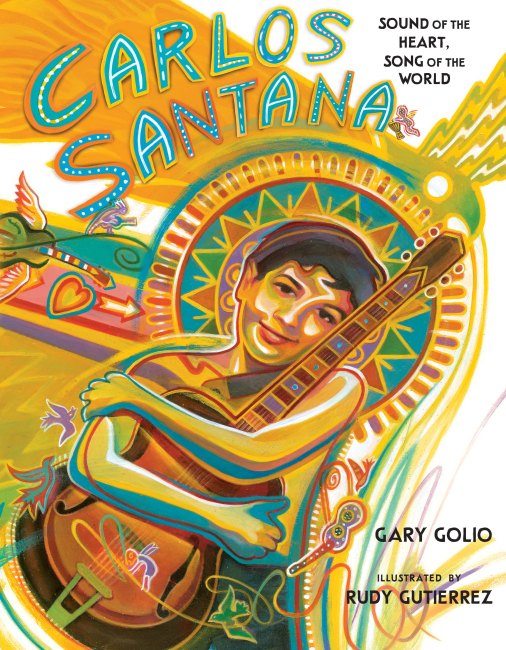


Book Review: Carlos Santana: Sound of the Heart, Song of the World by Gary Golio, illustrated by Rudy Gutierrez


Review by Lila Quintero Weaver

DESCRIPTION OF THE  BOOK: Carlos Santana grew up surrounded by music. Carlos’s father, a beloved mariachi performer, begins teaching his son how to play violin at an early age. But when Carlos later discovers American blues, he is captivated by the raw honesty of the music. Unable to think of anything else, he loses all interest in the violin and for a time, loses his way as well. Only after receiving an electric guitar of his own does he find his true life’s path.

From his early exposure to mariachi music to his successful fusing of rock, blues, jazz, and Latin influences, here is the childhood story of a legendary musician.

MY TWO CENTS: The magazine Rolling Stone places Carlos Santana within the pantheon of rock music’s greatest guitarists. But to put some perspective on his contribution as a Chicano, he was among the first to fuse blues-rock with Latinx instruments and rhythms, sometimes accompanied by lyrics in Spanish. In the mostly white world of rock and roll, Santana’s Latinidad stood in sharp relief, and his rise came at a time when Latinx performing artists rarely achieved notoriety on a national scale. Santana broke through this wall of invisibility. He did it by offering the world a sound that could not be ignored.

How did it all begin?

A captivating picture-book biography for readers of any age, Carlos Santana: Sound of the Heart, Song of the World brings us the background story. Told in poetic prose, the narrative opens in the subject’s infancy and follows the early years of his musical development, culminating in the moment when his love for blues-rock ignites.

One of this book’s greatest strengths is the art of Rudy Gutierrez, whose high-powered illustrations explode with movement and color. Page spreads vibrate with psychedelic swirls, suggesting the fluidity and intensity in Santana’s music.

Born in 1947 in Autlán de Navarro, Jalisco, Mexico—a town of “dirt roads and mud houses”—Santana’s humble beginnings do not hold him back for long. Thanks to wise and loving parents, he receives rich exposure to music. His father, José Santana, is a bandleader in the mariachi tradition. Carlos seems destined to follow his father’s career path, but then discovers a musical expression that speaks to him far more convincingly.

As a child, Carlos looks on his father with great admiration. “When Papá plays the violin, even little Carlos can see how people’s eyes light up, filled with el espíritu de la vida. Everyone wants José Santana to entertain them on their special days, and Carlos believes his father is an angel, flying on a bicycle with his golden harp as he rides to play in the church orchestra.”

At home, José is the younger Santana’s violin instructor. Unfortunately, “Carlos doesn’t really like the violin, and the smell of wood, held close to his face, gives him no pleasure.” In an effort to expand his son’s possibilities, José takes Carlos to the cantinas where he plays, offering the budding violinist time on the stage. Yet for Carlos, something important is missing in these occasions: joy.

But everything changes once he hears American blues guitarists on the radio. “Names like Muddy Waters and B.B. King seem magical, their songs raw and honest.” After this critical discovery, clashes between father and son become more frequent, especially when Carlos tries to sneak a bit of blues-style improvisation into a mariachi performance. Eventually, José leaves Mexico to pursue better paying gigs in the United States. With his father gone, Carlos finds a bit of breathing room to indulge his musical tastes.

Then, unexpectedly, a package arrives from San Francisco. It’s a used electric guitar! Coming from his father, this gift sends a profoundly affirming message. “There will be no turning back. Now [Carlos] can start to play the song inside him, the one that has been there all along.”

The book’s closing paragraph hints at the brilliant career that lies beyond the scope of this story. “Young Carlos Santana will create a new flavor of rock and roll, charged with Latin passion and the raw honesty of American blues.”

TEACHING TIPS: For a broader understanding of Santana’s significance in the history of rock and roll, check the back pages of the book, which include a “More About Carlos Santana” section, a brief list of discography, as well as Internet and print sources for further information. See also this article on the PBS website.


ABOUT THE AUTHOR: Gary Golio is a visual artist, a child therapist, and the author of numerous other picture-book biographies, whose subjects include Billie Holiday, Jimi Hendrix, Bob Dylan, and John Coltrane. Learn more about his work on his official website.


ABOUT THE ILLUSTRATOR: Rudy Gutierrez is the distinguished creator behind the cover art for Santana’s multiplatinum album Shaman and the recently released In Search of Mona Lisa. He also illustrated a U.S. postage stamp in commemoration of Jimi Hendrix. Learn more about Gutierrez in this interview.



ABOUT THE REVIEWER: Lila Quintero Weaver is the author of My Year in the Middle, a middle-grade novel published in 2018 by Candlewick Press. She’s also the writer-illustrator of Darkroom: A Memoir in Black & WhiteDarkroom recounts Lila’s experiences as a child immigrant from Argentina to Alabama during the tumultuous 1960s. The Spanish edition is now available, under the title Cuarto oscuro: Recuerdos en blanco y negro.  Learn more about Lila on her website, and follow her on Twitter and Goodreads.

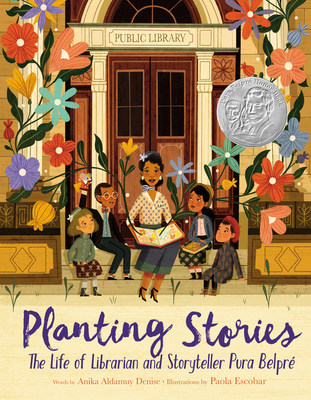
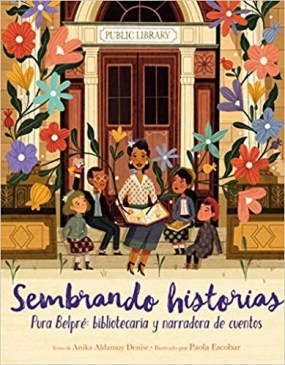
Book Review: Planting Stories: The Life of Librarian and Storyteller Pura Belpré / Sembrando Historias: Pura Belpré bibliotecaria y narradora de cuentos


  Planting in Spanish

Review by Dora M. Guzmán

DESCRIPTION OF THE BOOK: Follow la vida y el legado of Pura Belpré, the first Puerto Rican librarian in New York City.

When she came to America in 1921, Pura carried the cuentos folkloricos of her Puerto Rican homeland. Finding a new home at the New York Public Library as a bilingual assistant, she turned her popular retellings into libros and spread seeds across the land. Today, these seeds have grown into a lush landscape as generations of children and storytellers continue to share her tales and celebrate Pura’s legacy.

This portrait of the influential librarian, author, and puppeteer reminds us of the power of storytelling and the extraordinary woman who opened doors and championed bilingual literature.

MY TWO CENTS: Another bilingual favorite to add to the informational biography shelf! Pura Belpré is widely known for the book award created in her honor through the American Library Association. Every year, the Pura Belpré Award is one that recognizes Latinx authors and illustrators that reflect the Latinx culture in their picture books or novels.

Pura Belpré had seeds of determination and passion that followed her from Puerto Rico. That same blessing led her to work in a library and share her stories with children, however, she quickly discovered that many of her own stories, reflective of her Puerto Rican culture, were not readily available to the community. Therefore, she begins to share her stories with children and then begins to write down all her stories for others to read. Soon after, she is telling her stories all around the world. This biographical account of Pura’s life story and life’s work is nothing short of inspirational. Pura unequivocally shares her passion for storytelling to all so that her stories and culture are not lost. Despite losing her best friend and husband, she returns to the library scene while also inspiring others, and sees her seeds of storytelling and Latinx culture, come to fruition.

The sentence structures are concise but impactful as they tell the story, almost in a poetic form, of inspiration and passion as Pura moves to a role within the library. The reader is mesmerized in her storytelling and how certain words stand out with the use of a brushstroke. Words and phrases in Spanish are realistically embraced within the narrative structure, so much that it flows and might go unnoticed. The sharp, bold, multicolored background brings life to the determining force behind Pura’s life and purpose with books and libraries. The illustrator perfectly captures the authenticity of the story through its detailed illustrations and placement of characters and scenes. The illustrations dance around the entire page, which keeps the reader involved as the story progresses. Certain illustrations, like the simple flowers and musical notes, follow Pura as she shares her stories across the pages. The additional final pages also provide extensive references to text and film for further research in Pura’s lifework, as well as Latinx culture, especially the Puerto Rican culture.

Overall, a perfect addition, in both English and Spanish, to your biography shelf, especially highlighting the power of small, yet meaningful actions and how it evolves into a movement across Latinx and book cultures.

TEACHING TIPS: Many of these teaching moments can be implemented in a grades K-5 setting, with a focus on the primary grades.

  • Teaching descriptive vocabulary words and phrases
  • Focus on character traits, especially traits describing Pura throughout the story
  • Focus on the illustrator’s purpose of using certain colors or placement of illustrations to convey meaning
  • This book can also be combined in a biographical unit of inspirational storytellers or librarians.
  • Students can also be invited to research more of Pura Belpré’s lifework, as well as the impact of the Pura Belpré award on books.

To learn more about the Pura Belpré Medal and find the latest winners and honors, check out the ALA’s Pura Belpré Award home page.

Anika Denise Author Hi-res PhotoABOUT THE AUTHOR: Anika Aldamuy Denise first heard the stories of Pura Belpré from her titi Rose, who, like Pura’s family, enjoyed sharing the treasured folklore of Puerto Rico. Today, Anika is the celebrated author of several picture books, including Starring Carmen!, Lights, Camera, Carmen!, and Monster Trucks. She lives with her husband and three daughters in Rhode Island. Other new titles coming in 2019 include The Best Part of Middle illustrated by Christopher Denise, and The Love Letter illustrated by Lucy Ruth Cummins.Visit her online at www.anikadenise.com.


ABOUT THE ILLUSTRATOR: Paola Escobar grew up traveling from town to town in Colombia. From a very young age she liked to draw the stories her grandmother Clara told about her ancestors, the countryside, and animals. Today, Paola is an illustrator who is passionate about telling stories of her own, having published with SM Spain, Planeta, Norma, and more. She lives very happily in Bogota, Colombia, with her husband and their dog, Flora. Follow her on Instagram here!


img_0160ABOUT THE REVIEWER: Dora M. Guzmán is a bilingual reading specialist for grades K-3 and also teaches an undergraduate college course in Children’s Literature. When she is not sharing her love of reading with her students, you can find her in the nearest library, bookstore, or online, finding more great reads to add to her never ending “to read” pile!
 

Book review: Por ahí viene el huracán: Una aventura de Isa y Mau


We don’t often publish reviews or articles exclusively in Spanish, but since the picture book reviewed below is not yet available in English, it seems sensible to direct this post to readers of Spanish. To be clear, we do hope for an eventual English edition. After all, Por ahí viene el huracán is an authentic depiction of a child’s experience of Hurricane María, written and illustrated by Puerto Ricans with close knowledge of what the storm did to their island and their people. We hope it will find expression in multiple languages!
Readers on the mainland may order copies of this edition at Libros787.com. 

Reseña por Sujei Lugo y Lila Quintero Weaver

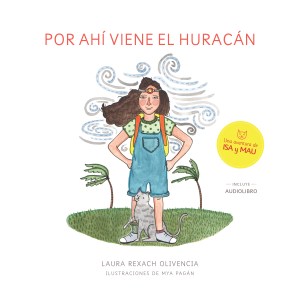
POR AHÍ VIENE EL HURACÁN: Una aventura de Isa y Mau es escrito por Laura Rexach Olivencia e ilustrado por Mya Pagán. (Editorial Destellos, 2018)

El impacto del Huracán María el pasado septiembre de 2017, marcó fuertemente la vida y experiencias de diversas comunidades en Puerto Rico y la diáspora. Lxs niñxs no estuvieron exentos del impacto psicológico, físico, natural, y social del fenómeno atmosférico y sus vidas y experiencias son igual de válidas. Varias personas se han dado la tarea de documentar y representar el paso e impacto del huracán a través de las letras, la música y el arte. Entre estos tenemos varios libros de literatura infantil y juvenil. Uno de ellos lo es Por ahí viene el huracán escrito por Laura Rexach Olivencia e ilustrado por Mya Pagán.

Aunque el nombre del huracán no es mencionado, detalles dentro de la historia y la fecha de publicación nos pueden indicar que se trata del Huracán María. “El último no vino. Pero dicen que este sí que viene.” Frase que se repetía luego del Huracán Irma y a la llegada del Huracán María.

La historia es contada desde la perspectiva de una niña llamada Isa y sus conversaciones con su gato Mau. Isa espera con ansias la hora de salida ya que al otro día no habría clase debido al posible paso de un huracán. Al llegar a la casa, Isa conversa como su gato Mau sobre la necesidad de prepararse ante el posible impacto del huracán. Toda la familia está trabajando para preparar la casa, sus pertenencias y organizar los suplidos necesarios. Isa observa cómo los vecinos y la comunidad anda de lado a lado comprando materiales, alimentos, artículos de primera necesidad y como todos cargan las mismas cosas, baterías, agua, latas, velas y linternas. La abuela también los acompaña en la casa y todos se quedarán en el mismo cuarto, algo que le emociona a Isa porque cree que es un “pijama party”, sensación que muchos también sentimos durante nuestra niñez.

Tan pronto comienzan los vientos, se va la luz, lo que causa que muchos en la casa despierten por el calor, el ruido del viento o simplemente, ansiedad. Su abuela Lela, como cariñosamente la llama Isa, intenta calmar a la niña pero Isa no logra recuperar el sueño. La familia de Isa tuvo que levantarse para reforzar los paneles en las ventanas debido a los fuertes vientos y lluvia. Los ruidos que se escuchaban eran aterradores, que hasta los adultos del hogar siente miedo, algo que Isa nunca había visto a su padre sentir. ¡Qué eternidad!, expresan. Sentimiento que fue expresado constantemente al describir el huracán. Recuerdo mensajes recibidos y leídos de lo “eterno que se sentía”, “esto no para”, “esto es el día más largo de mi vida”.   

Al otro día el sonido del viento fue disminuyendo y la calma fue regresando. Isa ayuda en la casa secando y controlando el agua que está entrando a la misma. El barrio y los caminos están clausurados por troncos de árboles, postes caídos, puentes derrumbados y pasan seis días atrapados, muy cercano a la realidad vivida en Puerto Rico. Una imagen presenta un camión de la Guardia Nacional o Fuerzas Armadas, y el texto narra cómo un grupo de soldados llegaron a su vecindario a ayudar, algo que no muchas personas vivieron post Huracán María.

El libro ilustrado es bastante certero en plasmar lo que se vivió luego de María, las filas interminables para agua, gasolina, alimentos. El desespero que se vivió y que algunos aún viven. Muchas personas perdieron sus hogares, familiares, trabajos y cotidianidad, que fueron desplazados y se trasladaron a vivir a los Estados Unidos. Isa observa que su amigo Nico, es uno de los miles de niños que tuvieron que mudarse e Isa siente una tristeza sobre algunas de las consecuencias del impacto del huracán.

“Llega el mes de noviembre y la escuela del pueblo sigue cerrada porque aún no llega la electricidad”. Las escuelas fueron unos de los lugares más impactados por María, algunos aún funcionaban como refugio, otros como cocinas y espacios comunitarios, otras sufrieron daños en la infraestructura y otras fueron eventualmente cerradas. Al igual que Isa, muchas familias y comunidades crearon “una nueva rutina diaria.” Isa reflexiona sobre su amigo Nico que tuvo que irse, sobre el cierre de su escuela y como está deseosa que tanto Nico y la escuela vuelvan a su vida. Entre preocupación y esperanza, Isa vuelve a sentir vida en su barrio.

El texto es simple, honesto y captura la esencia de los personajes, el ambiente que reina antes, durante y luego de un fenómeno atmosférico sin ser condescendiente con los lectores. Se puede sentir la voz y experiencia de las personas que realmente pasaron por este desastre natural y proveen una visión auténtica de la historia. Los detalles, el vocabulario, la vestimenta y otras imágenes capturan algunas de las experiencias y realidades puertorriqueñas.

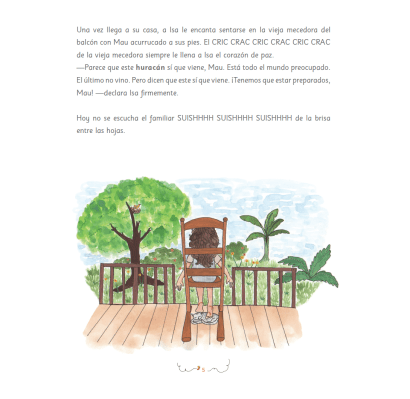
La autora incorpora el uso de onomatopeyas de diversos sonidos como el desagüe en la bañera, la vieja mecedora, el silencio, los martillazos en la pared, los zapatos caminando, el sonido aterrador del viento, los ladridos del perro, los cuchillos para cortar vegetales, el suave cantar de la brisa y el cantar del coquí. A través de las onomatopeyas y las expresiones faciales de los personas, se captura el progreso gradual de las emociones y labores antes, durante y después del paso de un huracán.

El diseño del libro y yuxtaposición del texto, las ilustraciones y los espacios en blanco proveen una cierta calma dentro una historia que puede hacer recordar a algunos lectores los malos recuerdos, emociones y experiencias vividas.  El libro incluye un glosario de palabras que pueden ser nuevas para los pequeños lectores y que están resaltadas en negrillas (bold) dentro del texto a lo largo de la historia.

El arte consiste de ilustraciones sencillas presentadas con aire de inocencia. Pintados de acuarela, los dibujos resaltan, gracias a una gama amplia de colores y tonos. Además se utilizan bordes bien definidos, semejantes en estilo a los de los comics. Aunque se nota que los paisajes naturales suelen inclinarse a lo sobresimplificado, la mayoría de las ilustraciones emparejan a la historia perfectamente.

Más que nada, la ilustradora brilla en sus representaciones de los personajes. Las caras son distintas, como también son los detalles de la ropa, los zapatos, los sombreros, los peinados, las gafas de sol, y otros artículos. Es una fiesta para los ojos. El efecto visual es encantador y sirve bien para entretener a los lectores de cualquier edad.

Una nota de la autora y/o la ilustradora hubiera ayudado a brindar un poco de contexto a la historia y para los lectores no familiarizados con huracanes o el Huracán María. Pero también puede verse como una historia que puede plasmarse y presentarse en relación a otros huracanes, desastres naturales y experiencias.


Laura Rexach Olivencia es consultora en filantropía estratégica y combina su perspectiva de madre puertorriqueña con su experiencia en negocios y pasión por la educación para ayuda a adelantar proyectos que inspiran. Vive en San Juan, Puerto Rico con su esposo y tres hijos pequeños.



Mya Pagán es una ilustradora puertorriqueña. Completó un Bachillerato en Lenguas Extranjeras de la UPR de Río Piedras con concentración en francés e italiano. Además de su pasión por los idiomas, siempre le ha encantado dibujar y traducir lo que la rodea y lo que siente a papel. Actualmente trabaja como ilustradora a tiempo completo y ha trabajado con varias agencias.