Illustrator Joe Cepeda Talks to Latin@s in Kid Lit, Part 2

By Lila Quintero Weaver

We’re continuing a fascinating conversation with acclaimed illustrator Joe Cepeda. His work graces many Latin@-themed children’s books. Did you miss the first installment? Go here.

Lila: When did your interest in art begin? How did you train for a career in illustration?

Joe: When I was young, I enjoyed drawing enough that my mom enrolled me at the Los Angeles Music and Art School in East Los Angeles, a small jewel of a place where I first tried painting. By my teens, though, I stopped going and after graduating high school found myself headed to college to study engineering. It took me awhile before I changed all of that. Initially, I thought I’d be an editorial cartoonist, but as soon as I got a brush back in my hand, I realized I wanted to do something that had an artfulness to it as well. Illustration afforded the perfect combination of content and creative articulation for me.
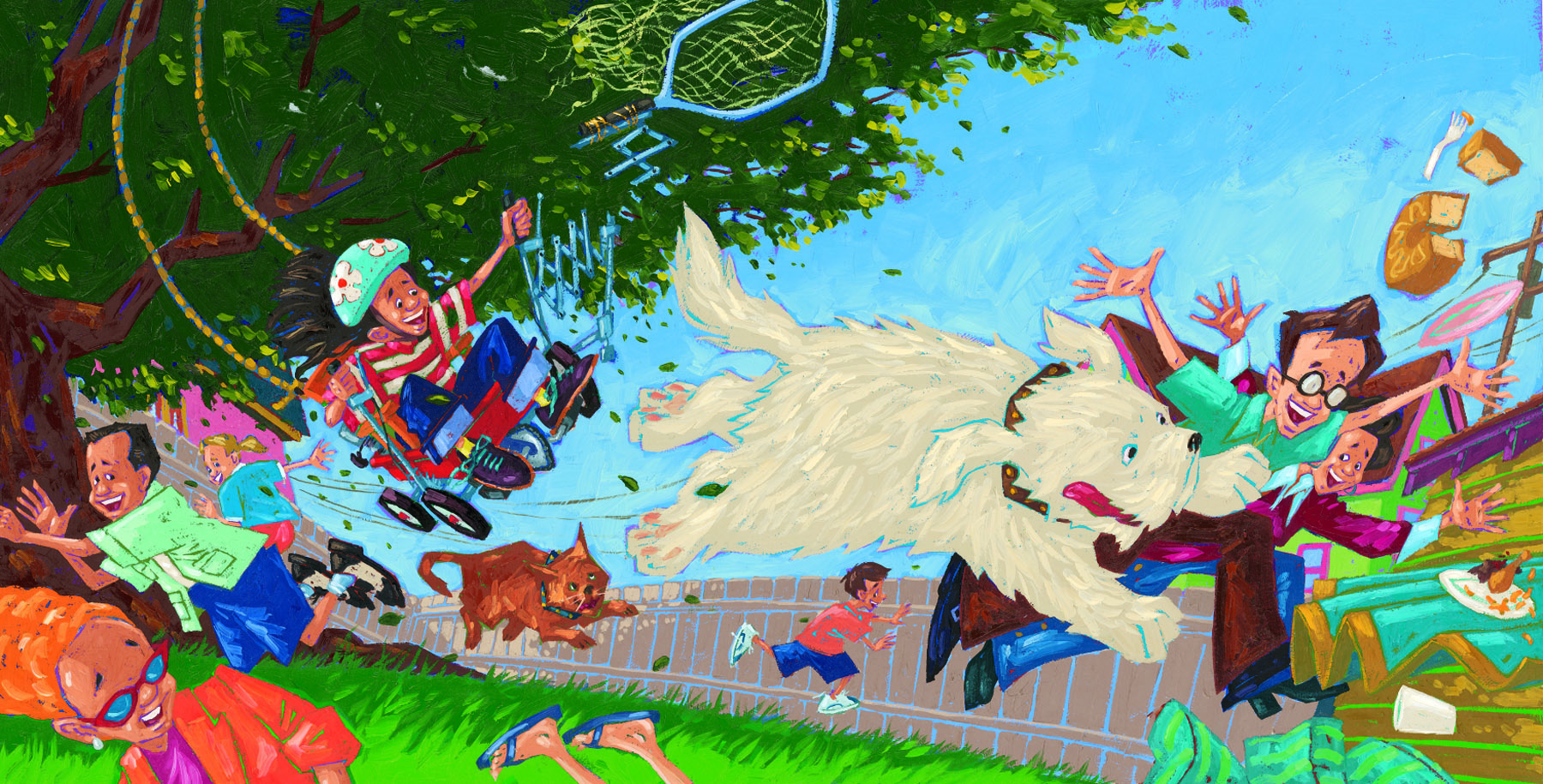
swing_leopoldo1

To be honest, my training was largely guided toward editorial work. I sort of fell into children’s books. Creating a piece for a magazine article is much like doing work for a cover. There is a certain amount of seduction employed in influencing a magazine reader to stop and read an article, much the way you’d want someone to pick up a book off a shelf. A combination of abstraction, mystery, emotion, and information might play a role in creating that single image that will lure the audience in.

From the books I’ve illustrated, I pretty much taught myself sequential image-making and continue to do that. With a portfolio largely lacking any real samples that reflected page-turning sensibilities, it was very fortunate that I was signed up to illustrate those first books. I believe that it was an inclination to write a picture as much as illustrate one that may have been evident to my first editors and art directors. They seem to have responded to that and took a risk. I’m grateful to them for doing so.
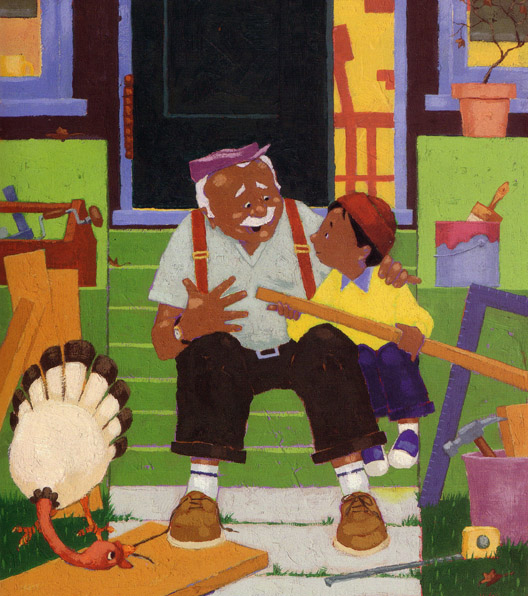
GraciasGrandfather_72cropped

Lila: Most of us have no idea how an illustrator goes about his work. Can you give us a tour of the process?

Joe: In many ways, the real work is done throughout the sketch phase. For editorial work, I usually create a few alternate ideas for a director to choose from. The sketches need to be tight enough for the director to envision the finished art.

For books, the sketch process is more comprehensive. The first sketches are thumbnails in which I mostly brainstorm, trying to find the basic rhythm, character introduction, action, choreography of the story, etc. The second phase of sketches, laid out as a dummy (a design/template that allows you to see the whole book planned out) focuses on the essential content of the story, as well as soundly composing the images. This is the working plan to be shared with editors and art directors. It’s important to understand that this design is as much for others as it is for oneself. This is where mistakes are caught.

Finally, in the last draft of sketches, details are included to a more specific degree. The emotions of your images many times are expressed in the details of your illustrations. It’s where things become funny, scary, thrilling, suspenseful, etc. This shouldn’t be confused with complexity—a simple picture has as much power as an ornate one. Once the dummy is okayed, it’s on to the finished work. Almost all of my books have been executed as oil paintings over acrylic under-paintings on illustration board. A recent book I illustrated was delivered as digitally rendered finishes. Whatever your medium of choice, the more confident you are of your plan, the more enjoyable the last part of the process will be. I leave color out of the initial plans because I prefer to be responsive when it comes to that, leaving a level of spontaneity for the end.
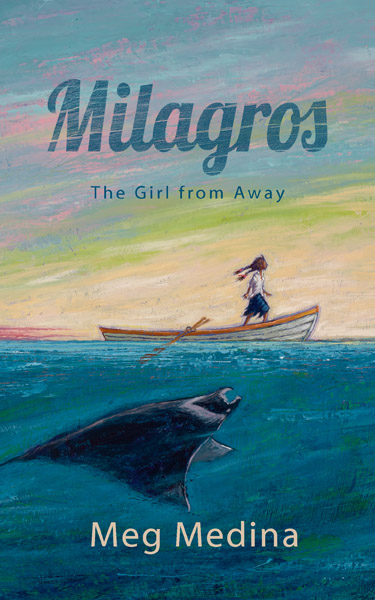
Milagros_jacket_finish72Lila: Let’s close out this conversation by returning to a book cover, the one you recently did for the e-book version of Meg Medina’s Milagros: A Girl from Away. It’s breathtaking, truly exceptional. I know Meg was thrilled with it!

Joe: Thanks for the kind words. Milagros is a great story and it was a wonderful opportunity to illustrate the cover of the e-book. After reading the manuscript, I couldn’t help responding to Milagros as a girl between two worlds. It’s the “between” part that intrigued me as a source for creating a provocative image. Milagros is not only traveling from one place to another, as she does in the story, she’s also between the clarity of a wide-open sky and the deep mystery and profundity of the ocean. The magical realism of the story, in my mind, calls for a more symbolic and open-ended image. Alternative ideas depicted Milagros closer to the viewer, larger in the design. This would emphasize Milagros more. A reader might respond to that kind of image, “That girl looks like me, i want to read about her.” It’s certainly popular to create covers that are more character-based, but, I’m glad that we decided to go the other way, that is, emphasizing the mystery, the peril of the journey, and the hopefulness and optimism of Milagros’ spirit. A reader here might ask, “Where is that girl going? What is she facing? Is she lost? Is she on her way somewhere? Is she safe? Will she get there? What will she find? Keeping her small in the design also helps the reader ask, “Who is she?” My first sketches didn’t include the manta ray, inclined to depict Milagros navigating her way alone, but, as we discussed, it’s a central part of the story. I’m glad mantas are such mysterious and, perhaps, very poetic creatures. I wanted it to have an ambiguous posture… is it a threat to her, or is it a witness, or, even something more? For me, the more questions you ask when looking at a cover, the better a cover does its job.

“““““““`

To learn more about Joe’s craftsmanship and illustration technique, see this extensive interview by Kathleen Temean.

Want to see Joe in his studio and hear more of his story? Here’s a video interview, worth the double click-through!
 

Illustrator Joe Cepeda Talks to Latin@s in Kid Lit, Part 1

By Lila Quintero Weaver

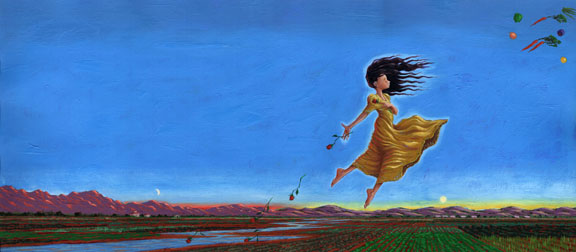
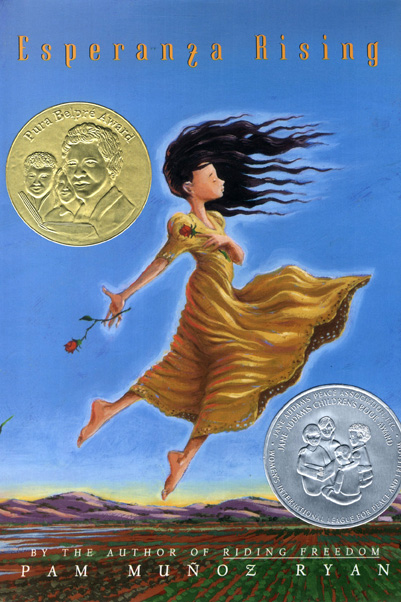
Long before I met Joe Cepeda at the National Latino Children’s Literature Conference in 2012, a post card of the cover illustration of Pam Muñoz Ryan’s Esperanza Rising was tacked to my then-11-year-old daughter’s bedroom wall. Every time I glanced at that soaring figure, my spirits lifted. Surely part of the book’s enormous success can be traced back to Joe’s luminous cover painting of Esperanza floating above the California earth, but that’s hardly the end of his contribution to children’s literature.

Lila: Welcome to Latin@s in Kid Lit, Joe! Thank you for taking time out of your busy schedule to talk art and books. Let’s start our conversation with Esperanza Rising. How did you come up with the concept?

Joe: After seeing the title, it wasn’t too difficult to imagine young Esperanza in the air. My first sketch depicted Esperanza with her hair and dress floating behind her as if she were flying. Almost immediately, however, I changed it and flipped her dress and pretty dark tresses to sweep in front of her. What I realized is that I didn’t want to show Esperanza as if she were navigating in the air on her own. I wanted her to be swept away by the wind. Everyone who has read the book knows that Esperanza’s life changes from one day to the next and I wanted the image to reflect that life-altering event, as well as the hopefulness her story and name literally implies.

EsperanzaJacket72 copy 2Lila: What does it mean to you to have your work as the cover of such a powerful story?

Joe: A great deal. It’s never a bad thing to have your work associated with a story that has such resonance. In contrast to doing an illustration for a magazine, which has a very short life, a book hangs around longer. A book that continues to reach so many readers, year after year, is wonderful for the life of the image as well. Beyond that, one is always striving to create work that might emotively uplift the reader. It’s a beautiful story and if the cover helps to do just that, it’s very gratifying.

Lila: Your list of children’s books includes quite a few with Latino or African American characters. Does being Latino influence your development of minority characters and the worlds they inhabit? SideBySide_04_72

Joe: This is always a bit of a difficult question to answer, perhaps because I think very little about it when I’m illustrating books about people of color. I’d say the books that I see that seem to miss the mark ethnically/culturally seem to overthink it. There are a lot of things I may consider in developing a character before I get to their ethnic depiction. Does she wear glasses? Is she thin? Short? Should he be neat or a bit of a slob? Is he forgetful? Would he wear a hat? Many of the of the character’s inclinations and look are not included in the manuscript. By the time I get to the character’s cultural look, it kind of takes care of itself.

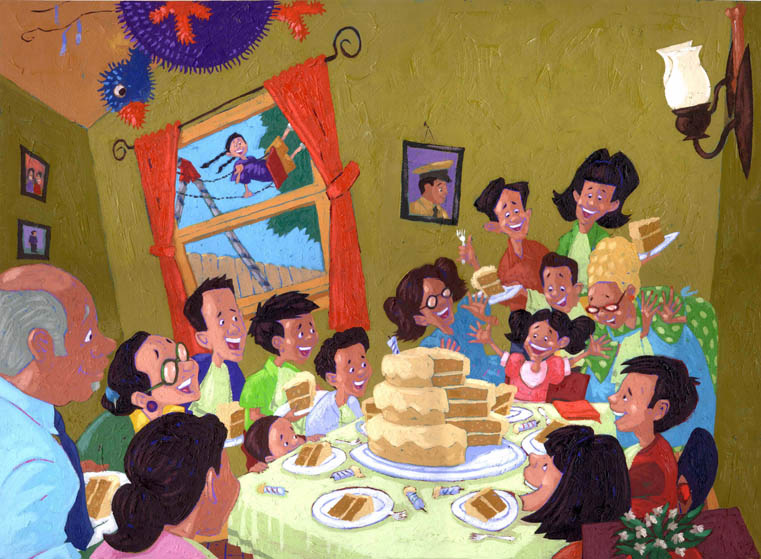
I wrote a story, The Swing, that took place in a neighborhood just like the street I grew up on. I’m Chicano, and I could write and illustrate that story about Chicano neighbors from a very immediate and intimate place. East Los Angeles isn’t Spanish Harlem, though, nor is it Little Havana. It seems to me illustrating stories about those Latino communities wouldn’t be all that different than illustrating a story about Inuits in the Arctic, Mongolians living in Yurts, or a story set in the Deep South. I’m respectful of the content and information that presents itself in illustrating stories of people of color, but I don’t live there that long. My preference is not to develop minority characters as much as illuminate the story that’s being told. For me, every step toward “development” is one toward information, accuracy and specificity, which is all fine and good, but it might also be one more step away from grandness and magic… and the informal joy of uncertainty and open-endedness.

MiceAndBeans4_75 copy

Lila: What’s on your drawing board right now?

Joe: Starting a new bilingual book based on a kid’s song. Writing a story for a picture book. Lunch.

 ——————-

And that’s not the end of Joe’s fascinating interview. Please stay tuned for tomorrow’s  follow-up post!

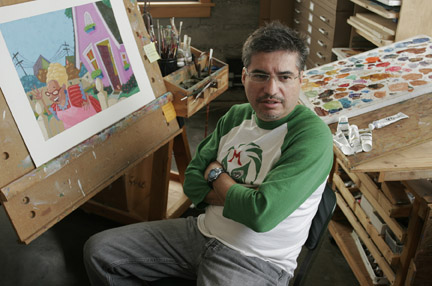
 second_pic_4x6_72Joe Cepeda is an award-winning illustrator of children’s books who also works in magazine illustration. He lives in California and serves as president of the Society of Illustrators of Los Angeles. For more information, visit his website.

Guest Post: Self-Publishing Often the Only Recourse for Writers of Color

By Zetta Elliott 

“I am an immigrant.” When I visit schools, I always start my presentation with these words. Next, I ask the students to guess my country of origin. Their answers are often predictable and sometimes surprising: the Dominican Republic, Puerto Rico, Mexico—Italy! When I tell them that I don’t speak Spanish but I do speak a little French, they call out a different list of countries until someone gets it right: Canada.

I open with my immigrant status in part because I once had a Latina approach me at the end of a presentation in Brooklyn and say, “I hate that word.” I didn’t ask about her status, but it was clear that she felt there was something shameful about being an immigrant. So I announce my own status with pride and use my presentation to demonstrate how my early years in Canada helped to shape the writer I became after I migrated to the US twenty years ago.

Immigration is a charged issue here, and though Canadians aren’t generally mentioned in the national debate, there’s still a pretty good chance I could run into trouble in Arizona. As a mixed-race woman of African descent, I often get read as Latina. Here, in New York City, I walk with my driver’s license, my passport, and my green card at all times because my Afro-Caribbean father taught me that some protections are reserved for citizens only (and only those citizens who aren’t brown like me). My father also urged me not to get involved in social justice movements, but I chose to disregard that advice.

I’m a black feminist—or what my father would call “a troublemaker.” I began to write for children over a decade ago because I couldn’t find culturally relevant material to use with my black students. I came to the US to attend graduate school, and there I developed a deeper understanding of intersectionality and invisibility. The title of one black feminist anthology encapsulates this perfectly: All the Women are White, All the Blacks are Men, But Some of Us Are Brave. Black women too often find themselves erased from discussions of racism and sexism, and when it comes to children’s literature, it can be just as easy for Afro-Latin@ kids to fall through the cracks.

Published by Skyscape, 2010

In 2000, I started a book club for the girls in my building. They were all black and we had been meeting for weeks before I realized that half the girls in the group were Panamanian. When they were with me, they spoke the black vernacular of their African American peers, but at home they spoke Spanish. When I wrote my YA time-travel novel A Wish After Midnight, I decided to give my protagonist a hybrid identity—Genna Colon’s mother is African American but her father is an Afro-Panamanian immigrant. When her father leaves the family to return to Panama, Genna yearns for a connection to her Latino heritage, but her jaded mother insists that race trumps ethnicity: “in America, it doesn’t matter where you’re from or what language you speak. Black is black and you might as well get used to it.”

Such a simplistic understanding of race is not uncommon, but many scholars, activists, and artists advocate for an appreciation of multiplicity—recognizing and respecting the specificity of blackness instead of reducing it to a single generic identity. As a black feminist writer, one of my goals is to counter the marginalization of black children in literature by writing stories about kids who are silenced and/or rendered invisible. I try to avoid the all too familiar “types” that seem to show up over and over again. Hakeem Diallo is a gifted basketball player but he’s also Muslim, biracial (black and South Asian), and he dreams of becoming a chef one day. Dmitri is a bird-watching math whiz who loses his mother to cancer and so lives with his elderly white foster mother. Judah is a Rastafarian teen from Jamaica who dreams of moving to Africa.

munecas_front_covercorrected

Self-published through CreateSpace under Rosetta Press

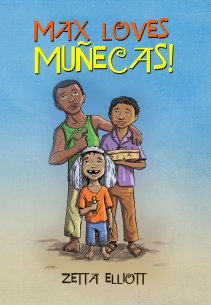
In 2009, I went to see the film adaptation of Neil Gaiman’s novella Coraline. I had some issues with the representation of women in the film, and went home thinking of a way to write a story about black boys and dolls. The end result was Max Loves Muñecas!—one of four chapter books that I self-published in May. The story follows three homeless boys in 1950s Honduras who are taken in by a kind woman who makes dolls. I was inspired by my father’s childhood in the Caribbean. He was raised by his grandmother on the island of Nevis, and with no money to spare, my father learned to make his own toys out of recycled materials. They were poor but my great-grandmother made sure my father was always presentable and well behaved. Respectability meant a lot since the family had so little.

I knew I wanted my story to take place within the Caribbean basin, but I had limited knowledge of Latin America. I chose Honduras for the setting of Max Loves Muñecas! because the best doll maker I know is Afro-Honduran designer Cozbi Cabrera. Also my community college student Saira, a Garífuna woman, gave a presentation in class about the murder rate in Honduras—the highest in the world. This is due, in part, to street violence fueled by gang members who have been deported from the US. My story isn’t set in contemporary Honduras, but the book does challenge gender norms and exposes the tender, creative side so many boys are forced to conceal.

I often write about boys because I have seen firsthand how expressive, sensitive boys shut down as they mature and assume the hard, unfeeling posture of a young “thug.” Boys around the world are socialized in a way that leaves them unable to reveal their authentic selves and the consequences can be devastating—especially for girls, but for boys and men as well. As a feminist I realize that if I want to end violence against women and girls, I have to start paying more attention to boys.

These issues mean a lot to me, but social justice is not generally a priority for the children’s publishing industry. For the past five years I have written essays and given talks about the glaring inequality within publishing, and the issue has garnered more attention recently thanks to the social media campaign #WeNeedDiverseBooks. Several editors rejected Max Loves Muñecas! (the last one wrote, “Zetta is such a lovely writer and I did enjoy this story – but I just don’t think we can find a big enough market for it”) and so the story sat on my hard drive for five years until I finally decided to self-publish it. I found a Honduran illustrator, Mauricio J. Flores, on Elance; he completed ten black and white illustrations and I used the print-on-demand site CreateSpace to publish the book.

The biggest challenge with self-publishing is finding a way to connect your books with readers. The Brown Bookshelf recently ran a series called “Making Our Own Market,” and I contributed a guest post in which I shared my core objectives:

  1. To generate culturally relevant stories that center children who have been marginalized, misrepresented, and/or rendered invisible in children’s literature.
  2. To produce affordable, high-quality books so that families—regardless of income—can build home libraries that will enhance their children’s academic success.
  3. To produce a steady supply of compelling, diverse stories that will nourish the imagination and excite even reluctant readers.

If these objectives resonate with you, I hope you’ll give my books a chance. The bias against self-published books is hard to overcome; major outlets refuse to review them, and only a few book bloggers are willing to give self-published books a chance (thank you, Latin@s in Kid Lit). Many are poorly written and shoddily produced, but when publishing gatekeepers exclude so many talented writers of color, self-publishing is often our only recourse. If we wait for the industry to change, another generation of children will grow up as I did—without the “books-as-mirrors” they need and deserve.


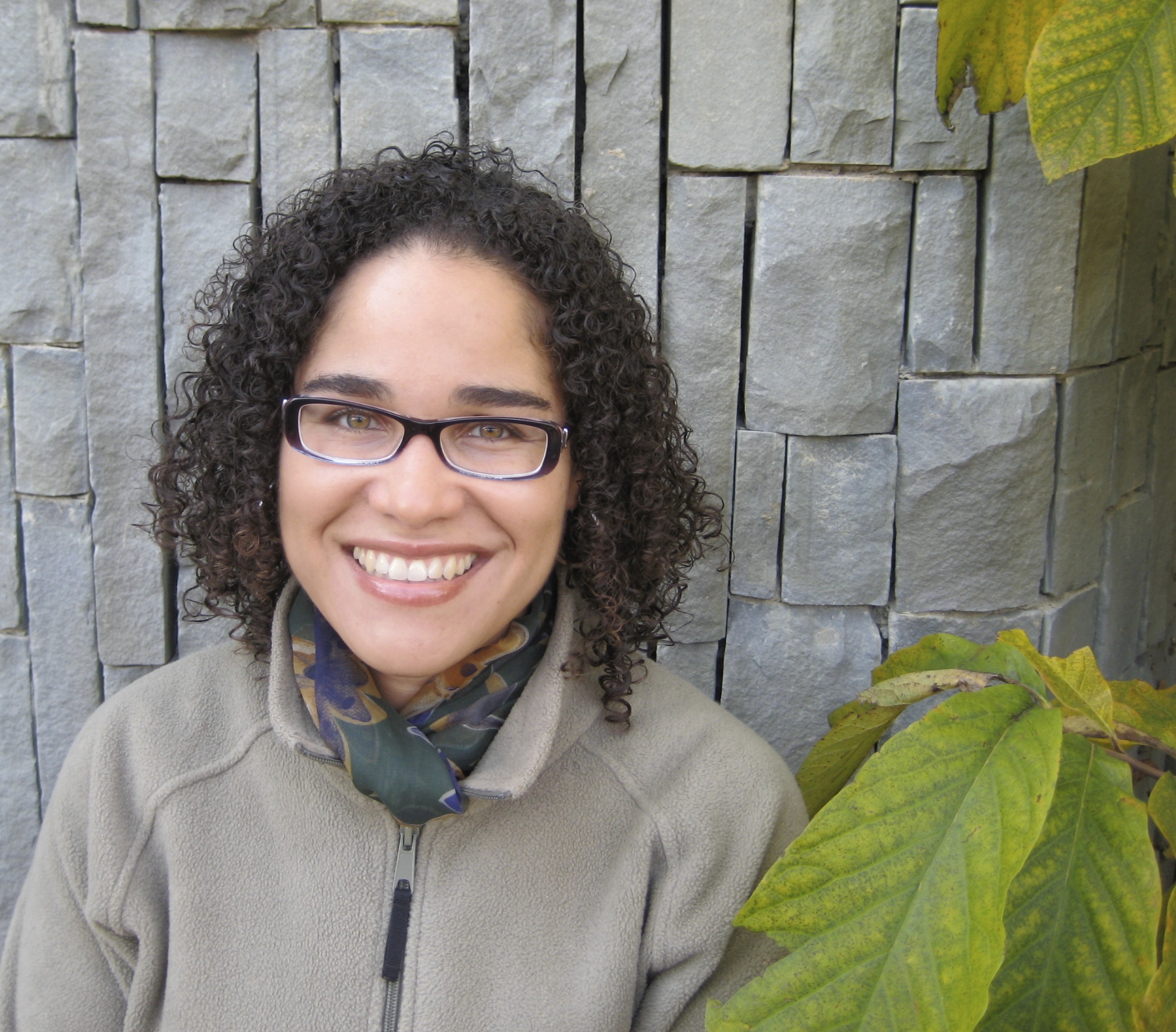
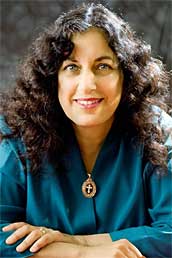
IMG_1198Born in Canada, Zetta Elliott earned her PhD in American Studies at NYU. Her poetry has been published in several anthologies, and her plays have been staged in New York and Chicago. Her essays have appeared in Horn Book MagazineSchool Library Journal, and The Huffington Post. Her picture book, Bird, won the Honor Award in Lee & Low Books’ New Voices Contest and the Paterson Prize for Books for Young Readers. Elliott’s young adult novel, A Wish After Midnight, has been called “a revelation…vivid, violent and impressive history.” Ship of Souls, published in February 2012, was included in Booklist’s Top Ten Sci-fi/Fantasy Titles for Youth and was a finalist for the Phillis Wheatley Book Award. Her third novel, The Deep, was published in November 2013. She currently lives in Brooklyn.

Other books by Zetta Elliot. For a full list, visit her blog.

Published by Lee and Low, 2008

Published by Skyscape, 2012

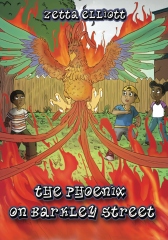
The Phoenix on Barkley Street

One of four kids books self-published, 2014


Book Review: The Lightning Dreamer by Margarita Engle

By Lila Quintero WeaverLightning Dreamer notable

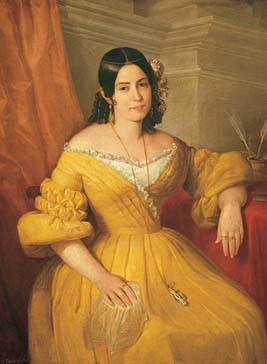
DESCRIPTION FROM THE BOOK JACKET: Tula is a girl who yearns for words, who falls in love with stories, but in Cuba, girls are not allowed an education. No, Tula is expected to marry well—even though she’s filled with guilt at the thought of the slaves Mamá will buy with the money gained by marrying Tula to the highest bidder.

Then one day, hidden in the dusty corner of a convent library, Tula discovers the banned books of a rebel poet. The poems speak to the deepest part of her soul, giving her a language with which to write of the injustice around her. In a country that isn’t free, the most daring abolitionists are poets who can veil their work with metaphors, and Tula becomes just that.

In powerful, haunting verses of her own, Margarita Engle evokes the voice of Gertrudis Gómez de Avellaneda, known as Tula, a young woman who was brave enough to speak up for those who could not.

MY TWO CENTS: The novel begins in 1827. Tula’s mother, who twice made the mistake of marrying for love, is desperate to prevent her thirteen-year-old daughter from taking a similar path. Mamá’s motivations are clear-cut. A wealthy connection through Tula is the family’s only hope for propping up their shaky economic status. In 19th-century colonial Cuba, arranged marriages are the social norm, but Tula’s mother worries that a girl who buries her nose in books will not attract the right kind of husband–a rich one.

Who is Tula? Margarita Engle is acclaimed for novels in verse that bring to life history’s outliers, young men and women from previous centuries who thought and acted in surprisingly modern ways, and Tula stands tall among them. She’s based on Gertrudis Gómez de Avellaneda, a Cuban poet who championed liberty for all humans and wrote Sab, an abolitionist novel, the first of its kind in Spanish. Sab predated Uncle Tom’s Cabin, the Harriet Beecher Stowe classic, by eleven years. Avellaneda’s importance as an abolitionist and feminist writer is not widely known in English-speaking America. The Lightning Dreamer corrects this oversight and imagines Avellaneda’s formative years, just as she began to discover the life-changing force of poetry.

Marriageability is not the only issue that arises from Tula’s penchant for reading. She happens upon the forbidden poetry of José María Heredia, whose sharp observations awaken Tula’s passion for justice. In colonial Cuba, injustice is everywhere. Her eyes take in the plight of African slaves, biracial babies abandoned to the convent, lovers kept apart by miscegenation taboos, and girls like herself, doomed to business arrangements thinly masquerading as marriages. Tula expresses her ardor for justice through poetry, which she burns to keep her mother from discovering.

When Tula refuses the marriage that her grandfather arranges, she must rise to meet a string of new challenges. The inheritance is lost and her family is condemned to relative poverty. For a while, Tula finds refuge in a storyteller’s community, where she becomes entangled in an unrequited love. She moves away from the countryside to Havana, where she supports herself through tutoring. In 1836, her brother, Manuel, warns her that their mother is cooking up another arranged match. Tula flees for Spain, expecting to find greater social and creative freedom there.

The Lightning Dreamer is written in free verse and is voiced through multiple characters. Tula is the most frequent speaker. Short segments provide other characters’ point of view. A partial list includes Tula’s mother; Manuel; Caridad, the freed slave who works for the family; the nuns who offer Tula space to read and write in peace; and Sab. Each character speaks in first person. I imagine them as a series of stage players delivering brief and sometimes prejudicial monologues reflecting on Tula’s choices. This approach perfectly suits the fictionalized treatment of a young poet. The language is spare and often stunning, capturing vivid images and profound interiority, as in this excerpt:

When we visit my grandfather

on his sugar plantation,

I see how luxurious

my mother’s childhood

must have been,

surrounded by beautiful

emerald green sugar fields

harvested

by row after row

of sweating slaves.

How can one place

be so lovely

and so sorrowful

all at the same time?

READING LEVEL: 12 and up

TEACHING TIPSThe Lightning Dreamer is an ideal jumping off point for exploring a wide array of subjects suggested in the novel. These range from colonialism, to New World slavery and racism, to patriarchal societies and the history of women’s political movements. At the back of the book, extensive notes provide comparisons between the historical Avellaneda and Tula, her fictionalized counterpart. This section also includes Spanish and translated excerpts of Avellaneda’s poetry and a bibliography of related sources.

Margarita contributed a guest post to Latin@s in Kid Lit that illuminates her love of biographical writing.

Henry Louis Gates’ PBS series, Black in Latin America, may be of interest for classroom use, in conjunction with the reading of The Lightning Dreamer. The episode “Cuba: The Next Revolution” focuses on the ongoing struggle by Afro Cubans to overcome centuries of racism. There’s no mention of Avellaneda in this one-hour documentary film; nevertheless, interviews and scenery enriched my reading. The film is particularly effective in its treatment of Cuba’s history of slavery and the role of freed slaves in the protracted battle for independence from Spain. The ruins of sugar plantations dating back to the book’s era starkly reminded me of Tula’s world.

RECOGNITION FOR THE LIGHTNING DREAMER: Awards and honors continue to flood in. They include:

2014 Pura Belpré Honor Book

School Library Journal’s Top Ten Latino-themed Books for 2013

YALSA 2014 Best Fiction for Young Adults

For a full list of awards and more information, please visit Margarita’s author website. I also recommend following her on Facebook, where she frequently posts updates on appearances, interviews and release dates for new books.

MargaritaTHE AUTHOR: Margarita Engle is a native of California and the author of many children’s and young adult books. She is the daughter of an American father and a Cuban mother. Childhood visits to her extended family in Cuba influenced her interest in tropical nature, leading to her formal study of agronomy and botany. She is the winner of the first Newbery Honor ever awarded to a Latino/a. Her award winning young adult novels in verse include The Surrender Tree, The Poet Slave of Cuba, Tropical Secrets, and The Firefly Letters.

FOR MORE INFORMATION ABOUT The Lightning Dreamer, visit your local library or bookstore. Also check out worldcat.org, indiebound.org, goodreads.com, amazon.com, barnesandnoble.com, and Houghton Mifflin/Harcourt.


2014 Reading Challenge: May Update

Students are counting down the days to the end of the school year, but teachers and librarians are making sure they don’t leave the building without summer reading lists. Although educators offer suggestions, be sure to review the lists of titles with an eye out for diversity. If the lists lack a wide range of topics and diverse characters, then seek out those books. Below are some suggestions from readers participating in our 2014 Latin@ in Kid Lit Reading Challenge. Thank you to everyone for participating in the challenge and purposely selecting books by/about/for Latin@s. Remember, you can join the challenge any time during the year, and you’re not required to review–only read and enjoy! If you do post a review somewhere, we will link it to the book covers below. If you choose not to review, we will link the covers to Goodreads.

Also, keep in mind that June is National Caribbean-American Heritage Month! Here are a few suggestions of authors known to write about people from the Caribbean: Julia Alvarez (Dominican Republic), Margarita Engle (Cuba), Eric Velazquez (Puerto Rico), Christina Diaz Gonzalez (Cuba), Lynn Joseph (Dominican Republic, Trinidad), Judith Ortiz Cofer (Puerto Rico), and Nancy Osa (Cuba). Happy reading!

A note to participants: As you complete books, please send us the information, so we can share what you’re reading each month.

18405521  13591731  18106361  13231279  2871746  13436375  16670129  437996  18603687  6603032  17290403  7972118  16667896  1011825  1370646  1016493  15893258  6098251  349744  1260346  8101398  15791044  18296043    1660305  1630309  16073069  

Guest Post: Margarita Engle’s Passion for Writing About Hope and Forgotten Heroes

.

By Margarita Engle

Recently, I was asked what “legacy” I hope to leave by writing. Legacy is an intimidating word, but at least one portion of the answer is fairly simple. I love writing about independent thinkers who have been forgotten by history. These lost heroes might have been celebrated in their own times, or they may have worked in such obscurity that their names are unknown. Many are famous in their countries of origin, but have never been introduced to readers in the U.S.

Just a few years ago, any library search for children’s books about Latinos would have revealed little more than a series of shamefully inaccurate works glorifying brutal conquistadores. During the interim, excellent biographies of César Chávez and Sonia Sotomayor have been added, along with a handful of beautiful picture books about artists, writers, and musicians.

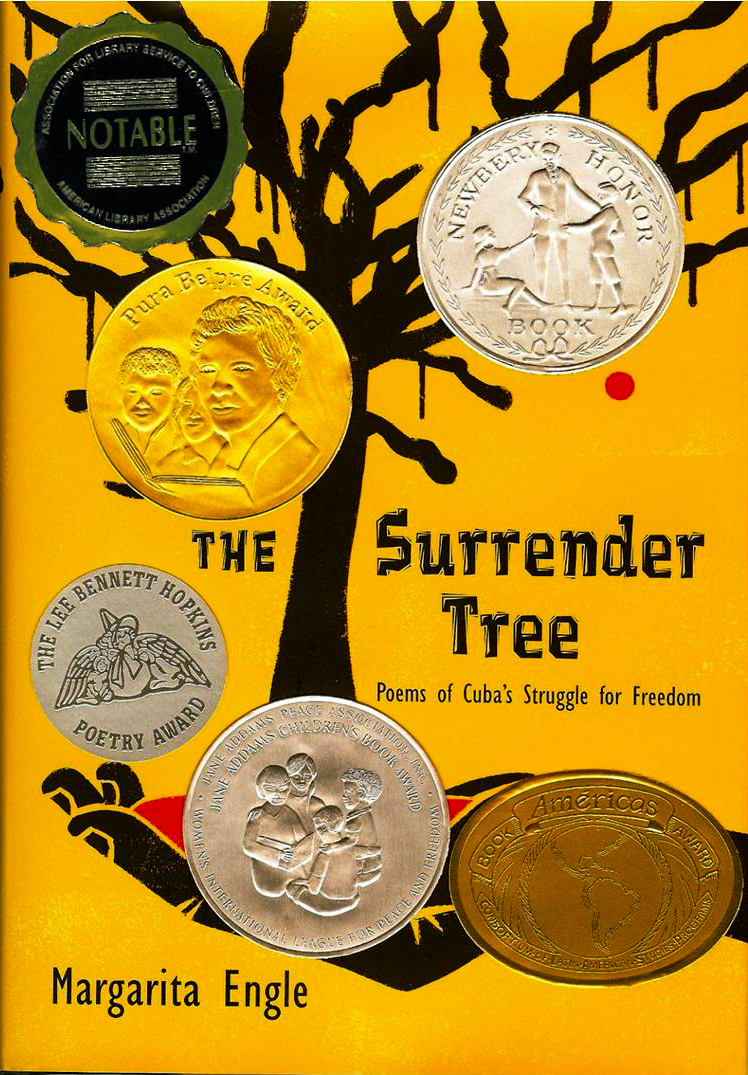
Surrende TreeThe work of reclaiming lost heroes has barely begun. My own approach is not strictly biographical because I love writing verse novels, and I also love writing first person interpretations of historical events. I often mix historical figures with fictional characters. In other words, I feel free to explore, experiment, and imagine. It’s a process that feels like time travel. Diaries, letters, and journals are my most important research materials, because they contain the emotional essence of history, along with the meticulous details of daily life. When I wrote The Poet Slave of Cuba, I was fortunate to have access to Juan Francisco Manzano’s autobiographical notes, which had been smuggled off the island by British abolitionists. For The Surrender Tree, I could not find anything written by Rosa la Bayamesa or any of Cuba’s other courageous wartime nurses, so I read the diaries of rebel soldiers, as well as interviews with reconcentration camp survivors. The Lightning Dreamer is based on the poetry and prose of Gertrudis Gómez de Avellaneda, who wrote a groundbreaking interracial romance novel that was published more than a decade before Uncle Tom’s Cabin. Not only was Sab far more daring, it was also more influential in Europe and Latin America. So why don’t North Americans know Avellaneda’s name? Does it make sense to learn only about our own little corners of the world?

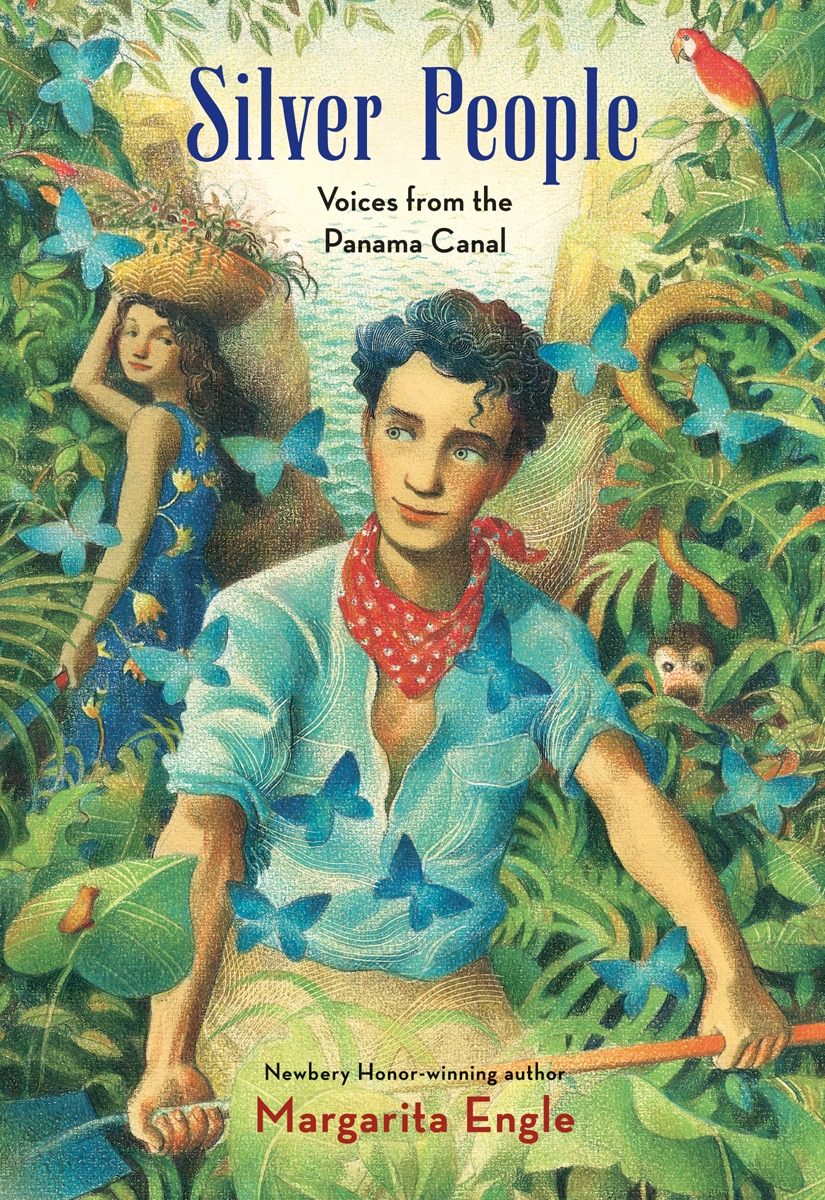
Hope is at the heart of every topic I choose. I love to write about people I admire. In general, I admire them because they were independent thinkers, far ahead of their times, or because their courage took the form of kindness. I don’t see history as a series of wars, with dates of battles to memorize and names of generals who are automatically assumed to be heroic. My heroes are the ordinary people who made hopeful choices in times that must have seemed hopeless. Tropical Secrets and Silver People are examples of topics so huge—the Holocaust, and construction of the Panama Canal—that I chose to write primarily in the voices of fictional composite characters, rather than individual historical figures. For Hurricane Dancers, the absence of first person indigenous Cuban accounts of the Conquest forced me to rely on a combination of legends, imagination, and the diaries of priests. I read the journals of conquistadores with skepticism, because they were written with a specific agenda—trying to make themselves look heroic, so that they could apply for additional funds from the Spanish Crown.

final Silver People cover-1Lightning Dreamer notable-1

Not all of my books are verse novels, and not all are for young adults. One of my favorite challenges is writing picture books about people who are not considered “famous enough” for biographical works. This limitation has actually helped me present my historical picture book manuscripts simply as inspiring stories, instead of struggling to make the subjects seem more famous than they are. Some are not famous at all, simply because Latinos, other minorities, and women, have generally been omitted from earlier historical writings. Sadly, recent history books tend to copy the earlier ones. The result is an entire segment of classroom curricula and pleasure reading with no representation of forgotten groups.

At present, I have several biographical picture books already in the publishing pipeline, and several that are still searching for publishers. None of them are about easily recognized names, if you live in the U.S. Thankfully, with the help of wonderful editors and fantastic illustrators, I hope that these picture books will inspire young readers. Drum Dream Girl (Harcourt, 2015) is being illustrated by the amazing Rafael López, whose gorgeous art will help illuminate the life of a ten-year-old Chinese-African-Cuban girl who broke the island’s taboo against female drummers. The Sky Painter (Two Lions, 2015) will have beautiful, scientifically accurate illustrations by Aliona Bereghici, to show how a boy of Puerto Rican origin became the world’s greatest bird artist, by allowing birds to live, instead of following Audubon’s tradition of killing and posing them.

If children have heard Latin jazz or visited New York’s Natural History Museum, they’ve heard and seen the results of Millo Castro’s courage and Louis Agassiz Fuertes’ kindness, even though they are unlikely to have seen those names in a library or classroom. I firmly believe that it is time to make room for books about the lives of people who should be famous, rather than limiting young readers to books about people who are already famous.

No discussion of biographical writing is complete without the subject of autobiography. Writing a childhood memoir has been the greatest challenge of my life. It is strictly nonfiction—no imagining, only remembering. Certain memories are excruciatingly painful. I love recalling childhood trips to visit my extended family in Cuba, but I dread remembering the October 1962 Missile Crisis that ended those journeys. Enchanted Air, a Cold War Memoir (Atheneum, 2015) combines the two. Positive and negative. Joy and sorrow. Despair and hope. With a powerful cover illustration by one of the world’s greatest artists, Edel Rodríguez, this memoir already feels like my life’s work. It is a book that helps me reclaim the separated half of my family, and along with them, the half of my identity that was almost destroyed by politicians.

Writing about lives is a process of exploration, so even though the memoir feels like my life’s work, I’ve already found other people I hope to depict in verse novels and picture books. I’ve returned to the research stage, reading history, and deciding which parts of history have not yet been honestly portrayed.

****

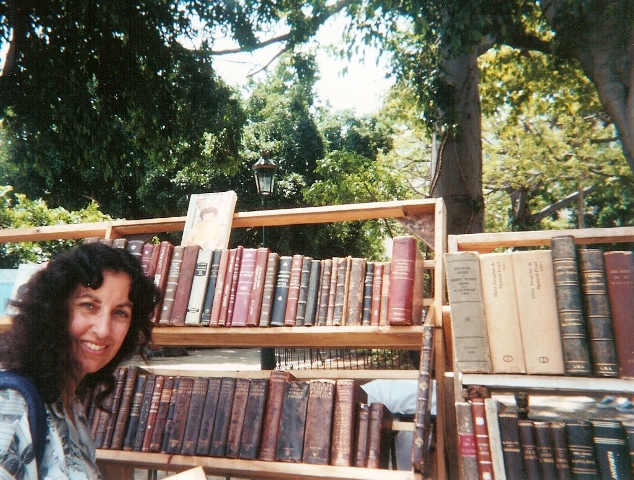
Margarita-HavanaMargarita Engle is the Cuban-American author of many young adult verse novels, including The Surrender Tree, which received the first Newbery Honor ever awarded to a Latino/a. Her books have also received multiple Pura Belpré Awards and Honors, as well as three Américas Awards and the Jane Addams Peace Award. Margarita’s newest verse novel is Silver People, Voices From the Panama Canal, and her newest picture book is Tiny Rabbit’s Big WishShe lives in central California, where she enjoys hiding in the forest to help train her husband’s wilderness search and rescue dogs. For more information, visit her author site and enjoy interviews by Caroline Starr Rose  and Robyn Hood Black.