
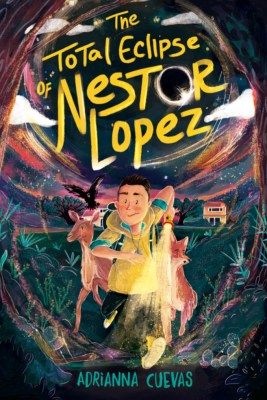
By Adrianna Cuevas
In my debut middle grade novel, The Total Eclipse of Nestor Lopez (Publication date: 5/12/20, FSG/Macmillan), military kid Nestor Lopez moves houses so much, he loses his sense of place. He finds a home trading books with his deployed dad, father and son writing notes and questions in the page margins while artistic Nestor adds illustrations. Stories connect him to his dad stationed thousands of miles away.
When Nestor reads a book with his father, he’s able to explore his dad’s military experiences in a new way and the book enables conversations service members are often reluctant to engage in. As Nestor explains:
“I flip through the pages of this book, Sunrise Over Fallujah by Walter Dean Myers, and stop the first time I see Dad’s handwriting. I press my fingers over his words, closing my eyes and imagining him sitting in his rack, reading. I flip through each page, looking for his handwriting, scanning for evidence of the life he lives when he’s away from us.”
Stories connect Nestor to those around him and deepen his relationships—particularly important for a boy who feels that home is something impermanent and unreliable.
Not all young readers will relate to Nestor’s constant moves. Not all will connect with the concept of a parent who is far away. But regardless of their current situation, readers can see books as a home. A place to retreat. A place to feel seen and accepted.
Growing up, that’s what books were to me.
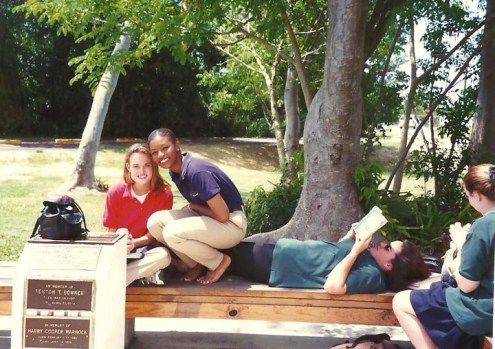
My teenage social life summed up in one photo
As a child, I devoured any story I could get my hands on. With parents and a sister who were all avid readers, trips to the library to fill up bags of books and evenings spent browsing bookstore shelves were as expected as pastelitos for Nochebuena and Celia Cruz on the radio. I knew the bookstore and library at the University of Miami, where my dad was a professor, as well as my own house.
The books of my childhood transported me to places I’d never been. As a Florida girl, I was obsessed with the snowy wilderness in Jack London short stories. A solitary introvert, I marveled at the friendships in the Babysitters Club series. My early thirst for the gruesome and grim was satisfied by an illustrated edition of Edgar Allan Poe’s short stories and poems. I didn’t think I needed books with Cuban-American main characters because my culture was all around me in Miami—in the food, the language, the music.
It wasn’t until I moved to the Midwest for college that I realized what a haven books can be for readers. I’d never lived anywhere so homogenous, both culturally and ideologically. In Miami, I was allowed to be a book-obsessed hockey fan who was bad at sports and loved to travel. In my new surroundings, I was Latina, nothing more and always less. I was complimented on my mastery of the English language, even though I didn’t speak Spanish fluently until I was in my twenties. Despite receiving an academic college scholarship, I was required to attend seminars about how not to get pregnant and drop out, the expectation for minority students. I was met with confused stares when I confessed that I didn’t like spicy foods because don’t all Mexicans like that? No longer able to see my culture or myself in my environment, I turned once again to my reliable home—books.
I shielded myself from ignorance and microaggressions I had never before experienced by diving into books by Sandra Cisneros, Julia Alvarez, Margarita Engle, and Isabel Allende. Their words were familiar, a hand on my shoulder telling me I wasn’t alone. In their stories, I saw loud, boisterous families that mirrored my own. I read mouthwatering descriptions of the food I missed, whose ingredients weren’t even available to me anymore. My language was presented as something beautiful and poetic, not something to be overcome and unlearned. I had never understood the importance of seeing yourself represented in stories until I wasn’t represented in the society around me.
In Total Eclipse, Nestor moves from a place where he is seen and accepted to a place where he is misunderstood and othered. For the first time in his life, he lives off-post and experiences what it’s like to live away from a military base.
“Fort Hood had a Whataburger, a video arcade, and a comic book shop… Most kids at school had parents in the military, so everyone understood if you didn’t want to talk in the middle of science because your dad had flown across an ocean the night before. Now Mom’s moved me to a town where I’m a circus freak. An alien from a distant planet. My only comfort is knowing I might not be here long.”
Unfortunately, Nestor doesn’t have the option like I did to dive into stories and see himself in books, as military family representation, especially Latinx families, is incredibly small in children’s literature. How much would it have meant to him to have books like Pablo Cartaya’s Each Tiny Spark to help him while his father is deployed?
Similarly, my choices when I moved to the Midwest were limited and it was difficult to find books that reflected my Cuban-American experience. Twenty years ago, the catalog of stories featuring characters like me was microscopic. How much more at home would I have felt with Nina Moreno’s Don’t Date Rosa Santos or Laura Taylor Namey’s The Library of Lost Things at my disposal when I was an awkward freshman? I would have taken Celia Perez’s The First Rule of Punk and Strange Birds, as well as Carlos Hernandez’s Sal and Gabi Break the Universe to college with me, turning to them when I felt othered and isolated.
Children deserve to see themselves in stories, not just as caricatures of their culture, but as representatives of the diversity that exists within a culture and as humans with all their quirks and flaws. Nestor Lopez isn’t just a Cuban-American kid who scarfs down his abuela’s croquetas de jamón and plays dominos with his abuelo. He loves dart gun battles, Pokémon cards, and random animal trivia. He’s quick with a snarky remark and his fingers are constantly smudged with pencil lead from sketching. It is my hope that in Nestor, young readers will find a friend they can relate to who shares their eccentricities and hopes.
In a world increasingly antagonistic toward Latinx people, our words as authors have the opportunity to whisper to children, “You are not alone.” Our books can serve as a blanket that warms them when they’re surrounded by the coldness of indifference and ignorance. Our characters can show them they can be heroes.
Our stories can welcome them home.
 Adrianna Cuevas is a first-generation Cuban-American originally from Miami, Florida. After teaching Spanish and ESOL for sixteen years, she decided to pursue her passion for storytelling. Adriana currently resides outside of Austin, Texas, with her husband and son, where they enjoy hiking, traveling, and cooking lots of Cuban food. Learn more about Adrianna on her website. And be sure to follow her on Twitter!
 Q. Who or what inspired you to become a writer?
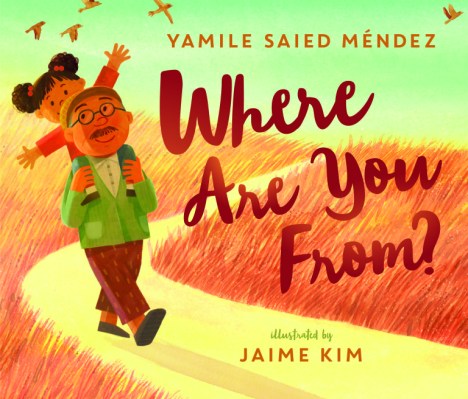
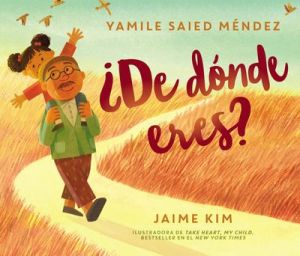 Released simultaneously in English and Spanish, WHERE ARE YOU FROM? joins a slate of high quality Latinx books dealing with identity and belonging. Additionally, it is one of very few picture books depicting Latinx characters from the Southern Cone.
 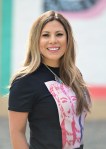 About the author: Yamile Saied Méndez is an Argentine-American who lives in Utah with her Puerto Rican husband and their five kids. An inaugural Walter Dean Myers Grant recipient, she’s also a graduate of Voices of Our Nations (
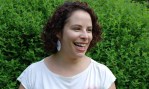 About the reviewer: Romy Natalia Goldberg is a Paraguayan-American travel and kid lit author with a love for stories about culture and communication. Her guidebook to Paraguay, OTHER PLACES TRAVEL GUIDE TO PARAGUAY, was published in 2012 and 2017 and led to work with “Anthony Bourdain: Parts Unknown,” and The Guardian. She is an active SCBWI member and co-runs Kidlit Latinx, a Facebook support group for Latinx children’s book authors and illustrators.
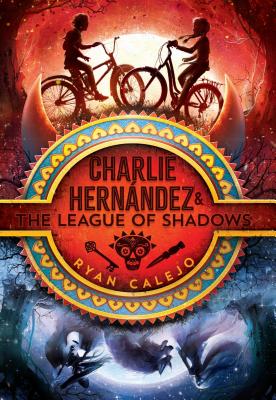 DESCRIPTION FROM THE PUBLISHER:
 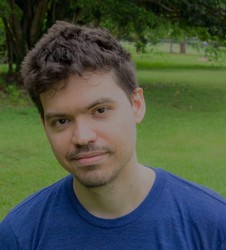 ABOUT THE AUTHOR:
 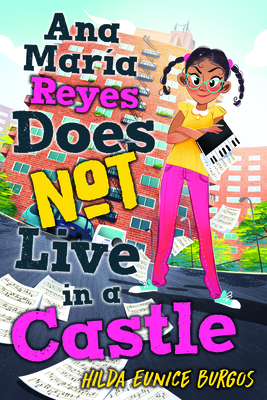 DESCRIPTION FROM THE PUBLISHER:
  ABOUT THE AUTHOR: Hilda Eunice Burgos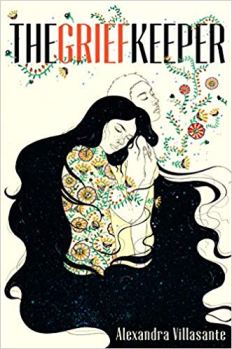
 About the author: Alexandra Villasante holds a BFA in Painting and an MA in Combined Media. She was born in New Jersey to immigrant parents and now lives in Pennsylvania. Learn more about Alexandra’s work and appearances on her
  About the reviewer: Cris Rhodes is a regular contributor to Latinxs in KId Lit. At Texas A&M, she recently completed a Ph.D. in English with an emphasis on Latinx children’s literature. Her research explores the intersections between childhood activism and Latinx identities. In the fall, she will begin an assistant professorship at Shippensburg University.
 Latinxs in Kid Lit