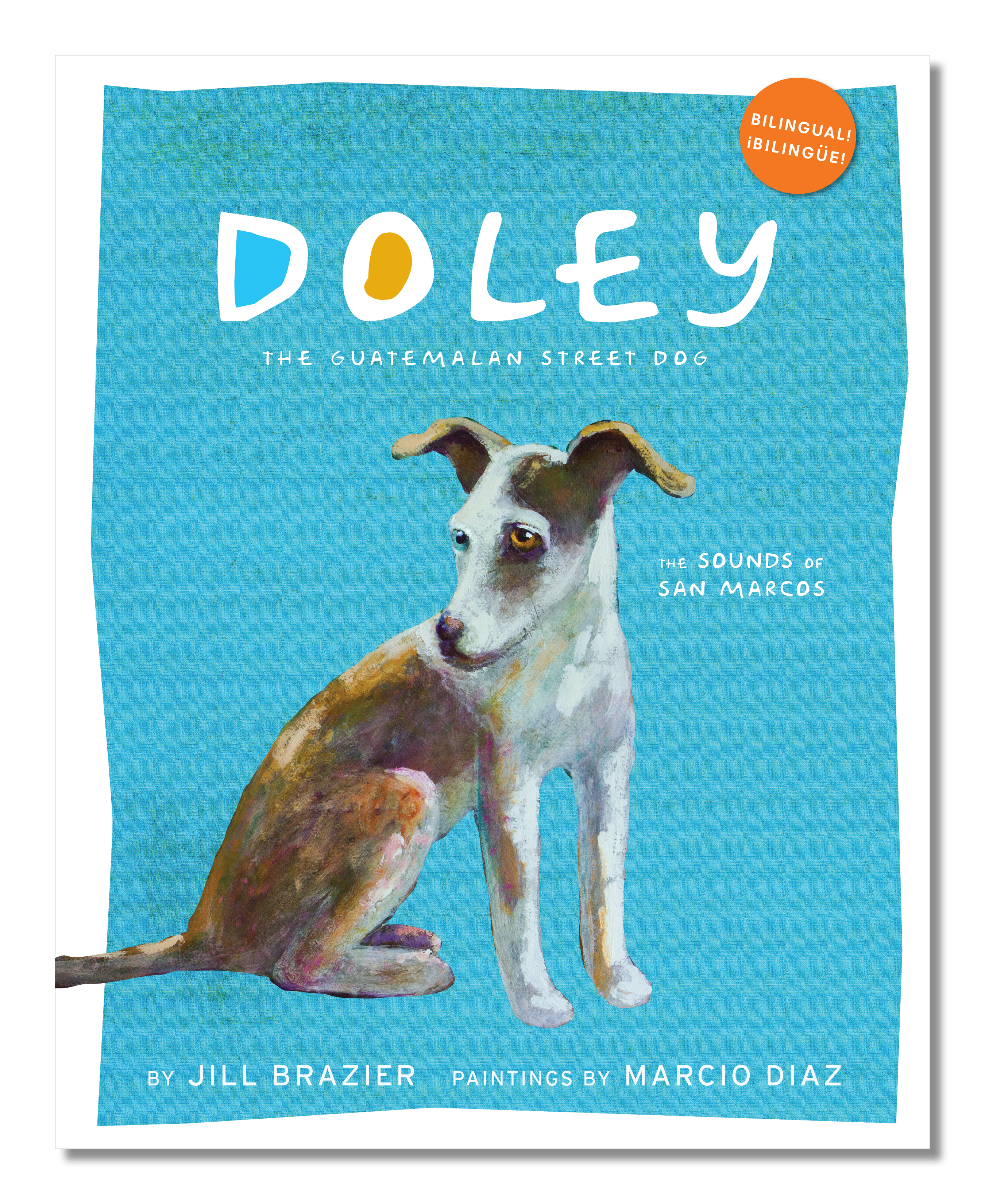
Guest Post: How My Life With a Guatemelan Street Dog Became a Children’s Book

DOLEY Cover PRINTBy Jill Brazier

Use your senses and pay attention to what’s around you. You never know where inspiration might strike! These are two of the lessons that I focus on when presenting my bilingual children’s book, Doley the Guatemalan Street Dog: The Sounds of San Marcos, to students. I never would have imagined that my time living in a treehouse above Lake Atitlan in Guatemala, and my special friendship with a starving little street dog, would direct the course of my life for years to come.

At 20 years old, I traveled by land from Seattle to Guatemala. The trip took over a year, with stops along the way to find work when the money ran out. Guatemala was never on my list, but I loved my time in Mexico and wanted to continue south. I joined up with a traveling companion for a long, bumpy, chicken-bus ride from Chiapas, Mexico, to Panajachel, Guatemala. An immediate and special feeling for this country struck me. I was determined to find a way to stay in this beautiful land.

I found a work/trade in a meditation center in the little village of San Marcos La Laguna, one of twelve villages around Lake Atitlan. There was no electricity there at the time. We lit our way with candles, stars and moonlight. My home was a simple bamboo treehouse with one room, a doorway, two windows, and gauze curtains for privacy. At night, I would sit in my treehouse and listen to the many sounds of San Marcos. The breeze blew in, offering constant connection with the lush natural environment.

One day, I was preparing a meal in the community kitchen when a tiny, frantic puppy ran in and looked at me with desperation. She had one bright blue eye and one brown eye. After I instinctively gave her a tiny piece of bread, this little puppy visited me daily. She had mange, a belly full of worms, layers of ticks in her ears, and malformed legs which made it difficult for her to walk. I took care of all of these problems, one by one. I wrapped half an ace bandage around each of her legs so that she could walk without her legs buckling, and fed her eggshells to strengthen her bones. Over time, she healed and followed me everywhere I went. Soon, this Guatemalan street dog had a name: Doley. This was the beginning of our fourteen-year friendship as best friends and travel companions.TenderHowling
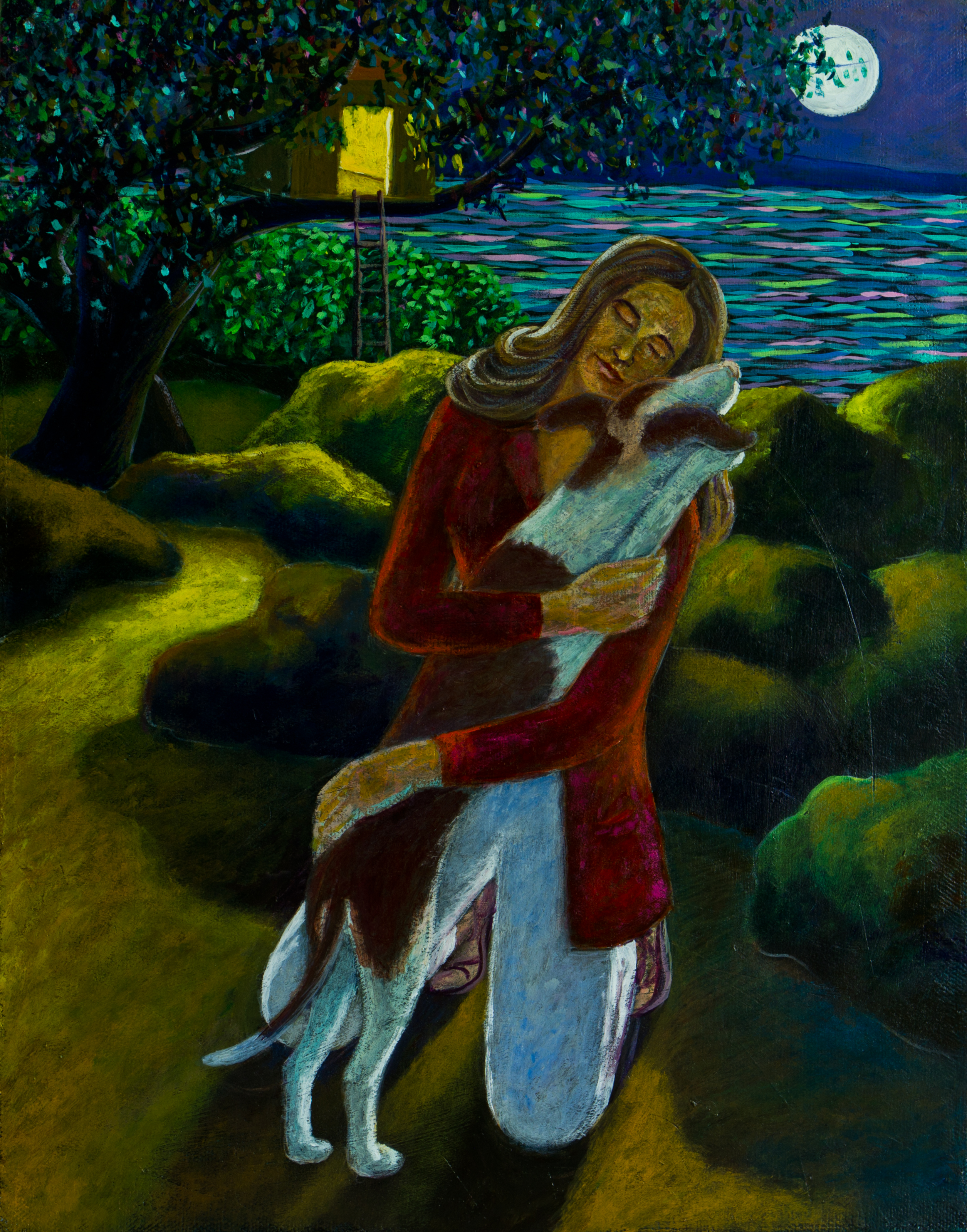
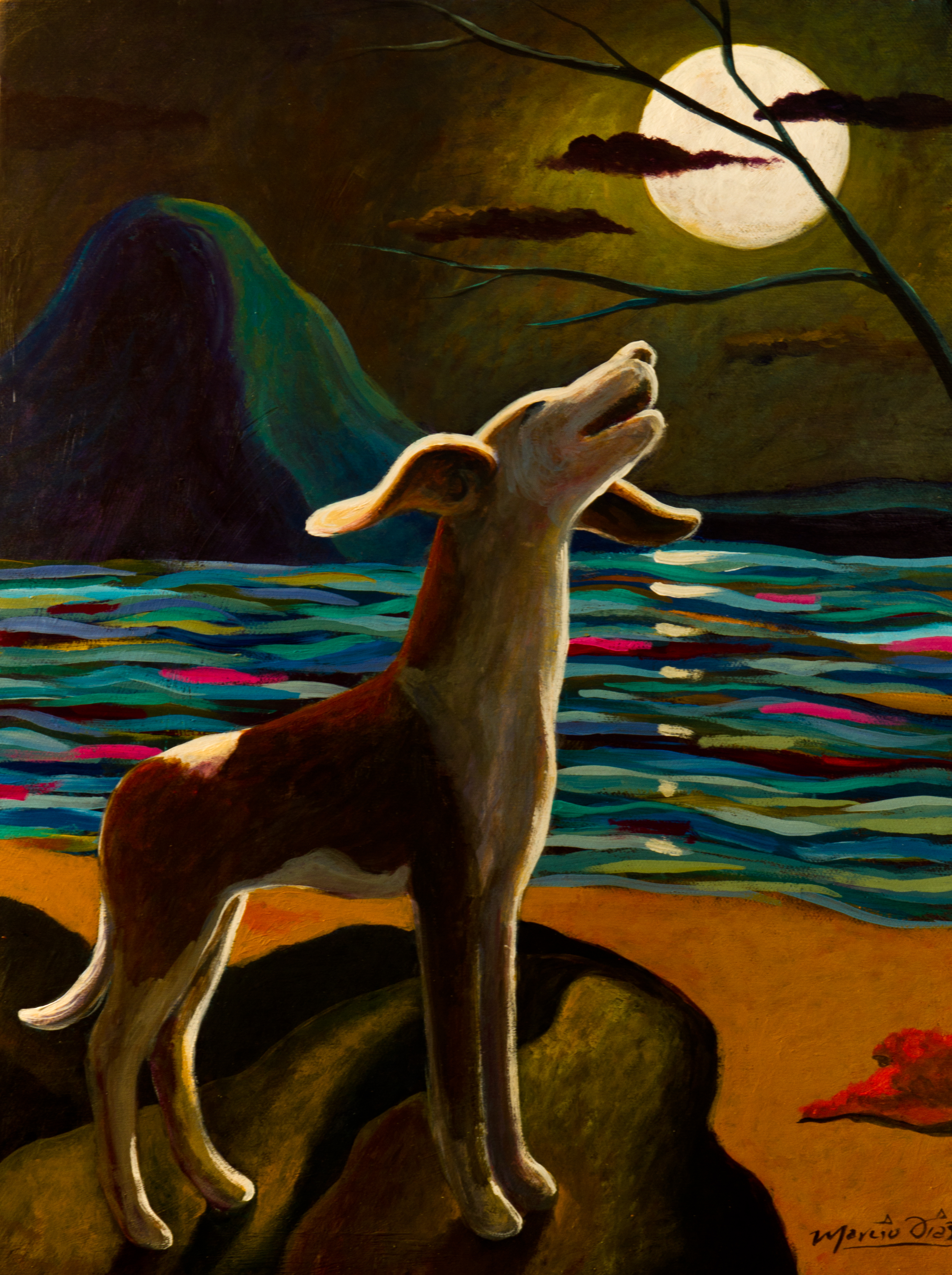
Doley would sleep in the treehouse with me at night, cuddling right into the crook of my stomach. Often, she would wake up to the sound of other street dogs howling and barking, and insist on being taken down from the treehouse, to run and howl with the other dogs. All of these real life experiences, which Doley and I shared during our time together in Guatemala, appear in the book.

The Sounds of San Marcos, was released independently in 2012. The theme of sounds emerged as I wrote the story and reflected on Doley’s acute sensory awareness of everything around her as a street dog, and our rich, sensory experience of living a treehouse in Guatemala. Readers learn the importance of listening – a vital lesson for students and young people! I further developed the idea to make Doley a series based on the five senses.

With beautiful artwork by Nicaraguan artist Marcio Diaz, the story comes to life in the vivid color of Guatemalan and Latin American culture. After looking for the right artist for many years, I finally discovered Marcio, whose ability to express profound feeling with bold color evokes the look and feel that I wanted. Marcio says, “In the brushstrokes of a painter, lays the history of his people.”
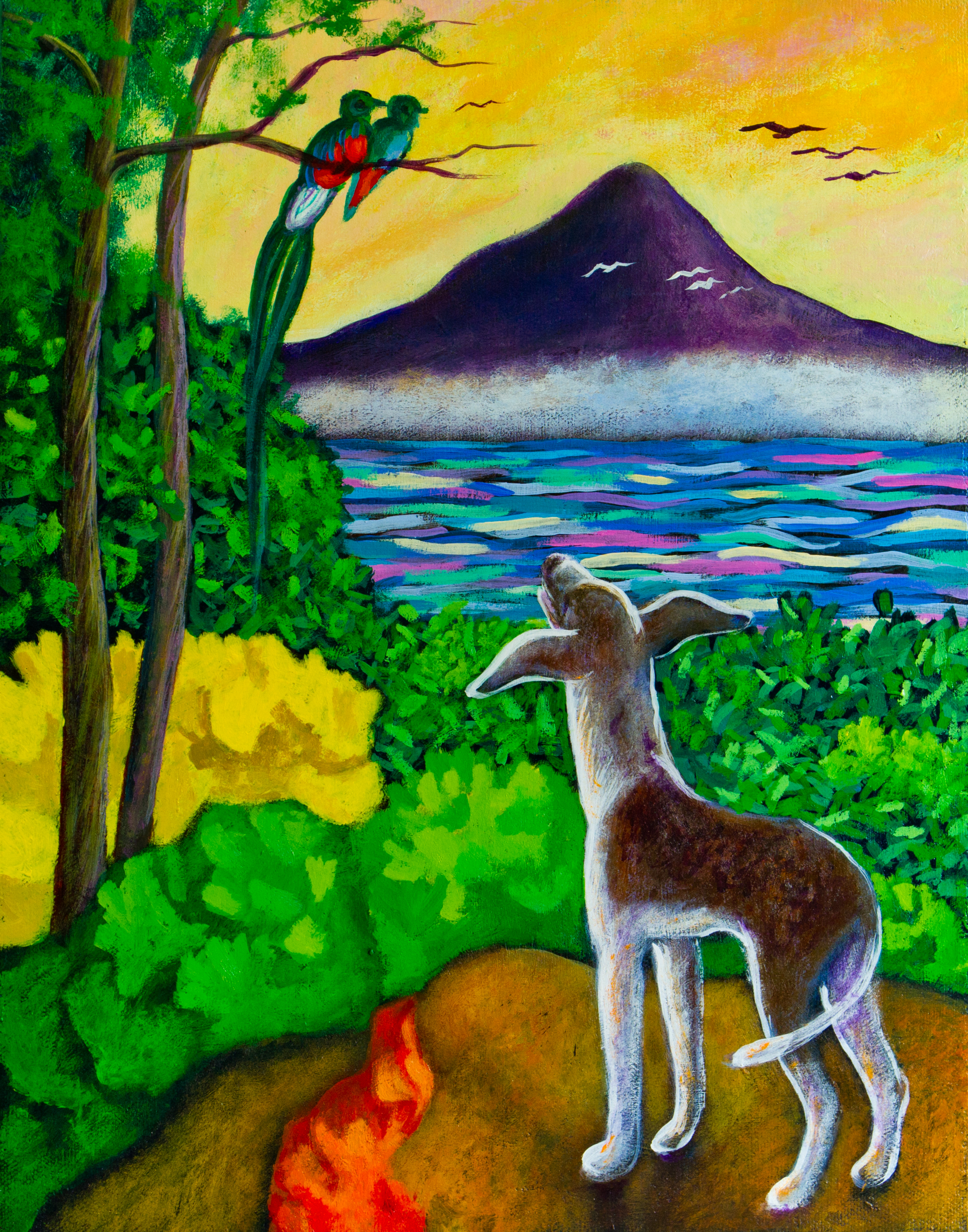
I want to FlyIt can feel like a daunting task to create something new and find a place for it in the world! There are many ways to share our stories and creative visions. For this project, I chose to publish independently in order to create the books in exactly the look and feel that I wanted. There are many ways to publish these days, and advantages and disadvantages to each. Artists and authors can choose which path to take according to the particular project, goals, intentions, budget, and timeline.

Publishing independently was the right place to start for Doley, and I am thrilled with the result. Everything about it is true to my vision and meets my standards of excellence. Moving forward, I will find a strategic partner to maximize the potential of the Doley series and accompanying reading guides.
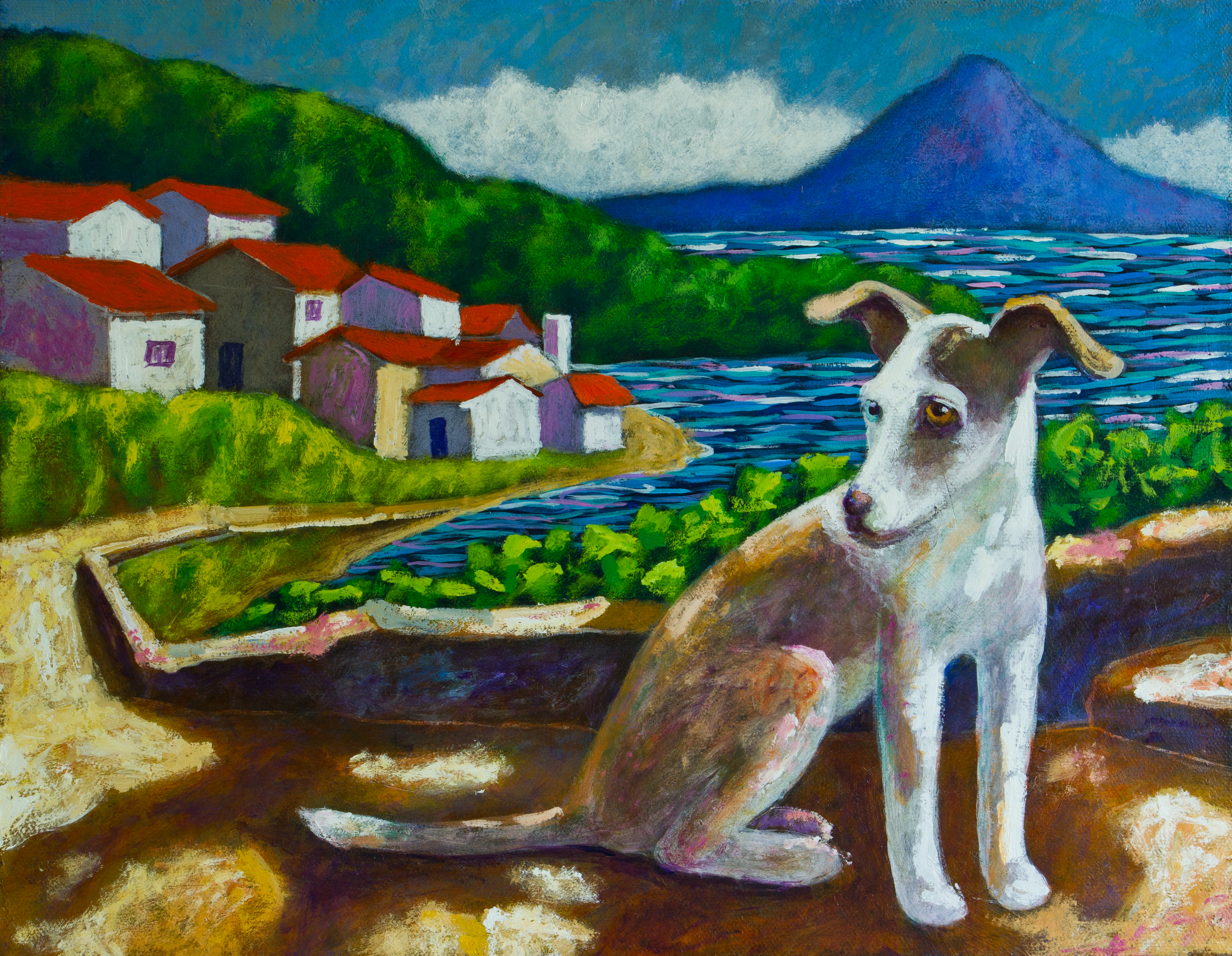
Brown and BlueThe Read with Doley Reading Guide, developed according to the National Common Core Standards (K-2 Literature), consists of 134 bilingual questions and answers, designed to engage students in language learning and encourage them to think beyond the text, and is available to download for free on my website. Doley believes in education!

The next book in the series, Doley the Guatemalan Street Dog: The Caravan of Colors, will be released in September 2015 and also features the remarkable artwork of Marcio Diaz, along with its own reading guide. The story is inspired by some traveling performers I met in Guatemala and my own love of trapeze. The Caravan of Colors gives Doley the chance to explore the world around her through the sense of sight, and provides lessons about perseverance and friendship along the way.

It is always a joy to share Doley and the inspiration for the book with students – and to remind them to listen carefully and pay attention. You never know where inspiration will strike or where it may lead you! I am so grateful for where inspiration has taken me.

For purchasing options, and additional information, please visit Jill’s website,

JillWhen Jill Brazier isn’t writing about Doley, she works at a charming Italian restaurant in Seattle. She is a traveler, fitness enthusiast, yoga practitioner, and amateur trapeze artist. After Doley, Jill’s heart belonged to a 12-year old abandoned Husky. They spent three happy years together until she passed away at the age of 15. Jill remains without a dog for now, until the next one chooses her.
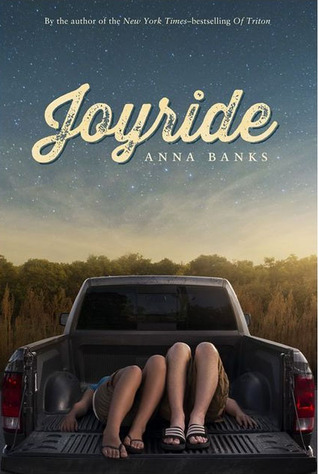
 

Book Review: Joyride by Anna Banks


22718685By Cindy L. Rodriguez

PUBLISHER’S DESCRIPTIONA popular guy and a shy girl with a secret become unlikely accomplices for midnight pranking, and are soon in over their heads—with the law and with each other—in this sparkling standalone from NYT-bestselling author Anna Banks.

It’s been years since Carly Vega’s parents were deported. She lives with her brother, studies hard, and works at a convenience store to contribute to getting her parents back from Mexico.

Arden Moss used to be the star quarterback at school. He dated popular blondes and had fun with his older sister, Amber. But now Amber’s dead, and Arden blames his father, the town sheriff who wouldn’t acknowledge Amber’s mental illness. Arden refuses to fulfill whatever his conservative father expects.

All Carly wants is to stay under the radar and do what her family expects. All Arden wants is to NOT do what his family expects. When their paths cross, they each realize they’ve been living according to others. Carly and Arden’s journey toward their true hearts—and one another—is funny, romantic, and sometimes harsh.

MY TWO CENTS: In Joyride, Anna Banks creates two easily likable, sympathetic characters who are struggling between wanting to have normal, fun teenage lives and dealing with serious family issues.

Carly Vega is a smart, hard working Mexican-American teen who juggles going to school and working, sometimes until the early morning hours at a convenient store, to help raise enough money to bring her deported, undocumented parents back to the U.S.

Arden is a popular former football star who battles with his violent father in the wake of his sister’s suicide, which has left his mother heavily medicated and despondent.

In the opening scene, Arden pretends to hold up his uncle, Mr. Shackelford, outside the convenient store in an attempt to get him to stop driving drunk. Carly, who is working when this happens, responds by pulling out the store owner’s shotgun and chasing the masked bandit (Arden) off. Arden knows then that Carly is the perfect candidate to be his pranking buddy, a position once held by his sister. Love blossoms as the two spend more time together doing funny, gross things around town that are risky because Arden’s father is the racist local sheriff responsible for deporting Carly’s parents.

Throughout the novel, Carly struggles with competing desires. She wants her family to be intact again and wants to do all she can to help raise the thousands of dollars needed to help them cross the border again. She also wants, however, to do what normal teen girls do, like hang out with her boyfriend and use her money to buy things like new clothes and a laptop computer.

Without giving too much away, I’ll say that this YA contemporary, which tackles serious issues and has heavy doses of romance and humor, also has a plot twist that adds a whole new exciting vibe to the story. Carly and Arden’s relationship is threatened and they end up in a dangerous situation involving law enforcement and the illegal smuggling operation that promises to bring her parents home.

Told in alternating points of view–Carly’s is first person and Arden’s is third–Anna Banks’s Joyride is a page-turner filled with interesting, complex characters who fall in love and find common ground despite economic, racial, and cultural differences.

TEACHING TIPS: Joyride could be an option when teaching about immigration. I’m sure students would have lots of questions about the issues brought up with this book around Carly’s family’s situation. Do people really pay someone to escort loved ones across the border? What are the risks? Is it really that expensive? What happens if they get caught again? How often are American born teens separated from parents who are deported? Reading this novel as a companion to non-fiction research on these issues could offer multiple perspectives and make Carly Vega seem even more “real,” in that her situation is a common one.

ABOUT THE AUTHOR (from her website): NYT Bestselling YA author of The Syrena Legacy series: OF POSEIDON (2012) OF TRITON (2013) OF NEPTUNE (2014). Repped by rockstar Lucy Carson of the Friedrich Agency. I live with my husband and daughter in the Florida Panhandle. I have a southern accent compared to New Yorkers, and I enjoy food cooked with real fat. I can’t walk in high heels, but I’m very good at holding still in them. If you put chocolate in front of me, you must not have wanted it in the first place.


FOR MORE INFORMATION ABOUT Joyride visit your local library or bookstore. Also, check out WorldCat.orgIndieBound.orgGoodreadsAmazon, and Barnes & Noble.

Also, check out the Q&A we did with Anna Banks earlier this week.


Q&A with NYTimes Bestselling Author Anna Banks About JOYRIDE


22718685By Cindy L. Rodriguez

The latest novel by Anna Banks, the New York Times Bestselling Author of the The Syrena Legacy series: OF POSEIDON (2012) OF TRITON (2013) OF NEPTUNE (2014), releases today. JOYRIDE, a contemporary with a Mexican-American main character, is a change for Banks, but you’ll see that she was ready to cleanse her fantasy palette and that the seeds for this particular story were planted years ago.

First, here is a description of the book:

A popular guy and a shy girl with a secret become unlikely accomplices for midnight pranking, and are soon in over their heads—with the law and with each other—in this sparkling standalone from NYT-bestselling author Anna Banks.

It’s been years since Carly Vega’s parents were deported. She lives with her brother, studies hard, and works at a convenience store to contribute to getting her parents back from Mexico.

Arden Moss used to be the star quarterback at school. He dated popular blondes and had fun with his older sister, Amber. But now Amber’s dead, and Arden blames his father, the town sheriff who wouldn’t acknowledge Amber’s mental illness. Arden refuses to fulfill whatever his conservative father expects.

All Carly wants is to stay under the radar and do what her family expects. All Arden wants is to NOT do what his family expects. When their paths cross, they each realize they’ve been living according to others. Carly and Arden’s journey toward their true hearts—and one another—is funny, romantic, and sometimes harsh.

CINDY: This is a genre shift for you after the very successful Syrena Legacy Trilogy. What sparked you to shift gears and write contemporary fiction?

ANNA: Before we begin, I just want to say it is my pleasure and an honor to be here today. Thank you so much for thinking of me. I enjoy your website and am very supportive of its goals and focuses.

JOYRIDE was sort of a palette cleanser between fantasy worlds. I was ready to write a standalone for once, and Carly’s story kept haunting me at night. To be honest, writing something in the real world was more of a challenge because I had stricter boundaries to abide by, and my characters had only their natural abilities to use to get them out of situations. But it was also a pleasure to have those boundaries, because writing characters who had to use their natural resources, to me, made them stronger and more realistic.

CINDY: And while we’re talking genre, JOYRIDE really is a mix of realistic, romance, and thriller. Was this intentional while you were plotting? Did you want to have some twists that are not always typical with a straight contemporary, or is that just where the story went as you were planning?

ANNA: While I was writing JOYRIDE, I didn’t realize I was writing so many twists in it. To me, it seemed like the natural way things would have to go. Of course, I’ve never written contemporary before (and if I’m being honest I don’t read much of it either), so I wasn’t aware there were sort of “rules” to writing a straight contemporary. Now I realize I’ve written this steroidal hybrid, and I hope contemporary readers can move past that and embrace it. Pretty please? :.)

CINDY: Let’s talk about craft for a bit next. You have a dual narrative, but you use a first-person point of view for Carly and a close third-person for Arden. As both a reader and writer, I’m always curious about these kinds of decisions. Why did you decide on this format instead of a dual first-person?

ANNA: This is me recognizing a weakness I have in writing. I can write a strong female heroine in first person, but for the hero, I need to take a step back and put some distance between myself and him, to distinguish my voice from his voice. I don’t want readers as familiar with my hero and his most inner feelings and thoughts in the way writing in first person would give them access to. In fact, I considered writing JOYRIDE from only Carly’s perspective, but Arden was just too funny to put behind stage.

CINDY: The topic of immigration and deportation are complex, often contentious, social and political issues. What made you want to write about the life of a Mexican-American girl whose parents were deported? What kind of research did you have to do? Was it difficult to write outside of your cultural experience?

ANNA: Living in the Florida panhandle, I live and work and play among many Mexican immigrants—both documented and undocumented. When I was a teenager in particular, I worked at a restaurant where there were some undocumented immigrants, and as we became friends, they told me their stories. They told me their anxiety about being deported, about missing their family, about the fear of being separated from the family they’ve established in the United States. It really left an impression on me. As a teen, I wondered what I would do if my parents were deported, if I was here all alone. I guess Carly was planted in my head all those years ago and I didn’t even know it.

I didn’t have much research to do, because I learned it first hand from my friends and coworkers. That you didn’t want to get pulled over because instead of a speeding ticket, you’d get deported. That you didn’t want to attract attention to yourself. That you sent money home as often as you could. That there were people they called coyotes who helped them cross the border and desert, who demanded large sums of money to help them get set up in the United States. That when you cross the border, you cross with what you can carry, and that’s it.

I’m white, and so writing outside my own cultural experience was terrifying. I wanted to do it respectfully and realistically, because I deeply respect the work ethic and the family values of immigrants, and I wanted to share their plight with the world. But sometimes in writing it, I did wonder if it was my place to do so. But I had a story to tell, and I felt it was an important one, so I kept going.

CINDY: Do you plan to write more contemporary YA? Any projects in the works that you can tell us about?

ANNA: Right now I’m working on an Egyptian based fantasy called NEMESIS and its sequel, ALLY. It’s about a princess who possesses the power to create energy who escapes her father, who wishes to weaponzie it, only to be captured by an enemy kingdom where she discovers her powers could be used to fight a terrible plague.

I write when I have a story to tell, and usually my muse takes me across a lot of different genres. As for writing contemporary again—sure, why not? But I have to have a story to tell. If I find myself wanting to add time travel or wormholes in the contemporary, I’d better just set it aside. :.)

Book Review: Marcelo in the Real World by Francisco X. Stork

Reviewed by Lila Quintero Weaver

marcelo_coverFROM THE PUBLISHER:
The term “cognitive disorder” implies there is something wrong with the way I think or the way I perceive reality. I perceive reality just fine. Sometimes I perceive more of reality than others.

Marcelo Sandoval hears music that nobody else can hear — part of an autism-like condition that no doctor has been able to identify. But his father has never fully believed in the music or Marcelo’s differences, and he challenges Marcelo to work in the mailroom of his law firm for the summer . . . to join “the real world.”

There Marcelo meets Jasmine, his beautiful and surprising coworker, and Wendell, the son of another partner in the firm. He learns about competition and jealousy, anger and desire. But it’s a picture he finds in a file — a picture of a girl with half a face — that truly connects him with the real world: its suffering, its injustice, and what he can do to fight.

Reminiscent of The Curious Incident of the Dog in the Night-Time in the intensity and purity of its voice, this extraordinary novel is a love story, a legal drama, and a celebration of the music each of us hears inside.

MY TWO CENTS: Certain quirks cause 17-year-old Marcelo Sandoval to stand out from the crowd. He fastens his shirt all the way to the top button, even when he’s not wearing a necktie. His speech can be overly formal, and he often refers to himself in the third person. Don’t ask him to catch the meaning of an eye roll or a smirk because his brain isn’t wired to interpret subtler forms of nonverbal language. Plus, he hears music that no one else can hear. Marcelo was born with a cognitive disorder resembling Asperger syndrome, a category of autism spectrum disorder often considered “high-functioning.” The syndrome’s most recognizable traits are difficulty with social interactions and the tendency to become preoccupied with special areas of interest. In Marcelo’s case, this is the study of religion.

Marcelo attends Paterson, a school for kids with disabilities. The summer before his senior year, he’s supposed to work at the school’s stables, helping with the therapeutic ponies, but his father, a lawyer, has a different plan. Arturo Sandoval thinks it’s time for his son to experience “the real world,” in the form of a summer job at the law firm. If Marcelo manages the job satisfactorily, he’ll be allowed to choose which school to attend in the fall—the safe and friendly Paterson he knows well, or Oak Ridge High, a regular school not structured around the needs of students with disabilities.

What Marcelo encounters on the job is far more complex and morally ambiguous than the simple mailroom duties he’s hired to carry out. The law firm’s other partner has a college-age son, Wendell, who is also working at the office over the summer. Arturo considers Wendell a good role model for Marcelo. Little does he know that Wendell is much more interested in checking out the female employees than in getting any work done, and Jasmine, Marcelo’s supervisor, is the main object of his lust. At first, Marcelo tries to ingratiate himself to Wendell, who holds considerable power in assessing Marcelo’s performance, but it becomes apparent that Wendell is a jerk who mocks Marcelo, objectifies women, and disregards Arturo as a “minority hire.”

Other workplace quandaries pop up. Marcelo discovers a photograph of a girl badly injured in a car crash, due to the failure of a windshield manufactured by one of the law firm’s most important clients. He begins to wonder about his father’s decision to protect wealthy corporations, instead of those who’ve been harmed by the corporation’s negligence and can’t afford legal help.

But this YA novel isn’t a legal thriller per se. It’s a variation on the coming of age story, one that visits romantic love and sexual intimacy, and repeatedly explores the idea of what is real. There’s the real music that everyone can hear and the internal music heard only by Marcelo. There’s the real world of the law firm and Oak Ridge High School, and the protected world of Paterson. And how about the distinction between a happy smile and a sarcastic smile, or the literal words that people use and the actual meanings behind them? Plus, who is the real Arturo: the father that Marcelo knows, or the lawyer who may have wandered into less than noble choices? Reality is tough to decode.

I am not qualified to comment in depth on Stork’s depiction of Marcelo’s cognitive disorder. As I read, I kept myself alert for any signals that the author had romanticized the character’s condition or imbued him with magical or savant abilities, as is often the case in cultural portrayals of people with autism spectrum disorders. I saw nothing approaching those errors. Luckily, Disability in Kidlit, a blog devoted to reviewing books about characters with disabilities, has also published a review of Marcelo in the Real World. Read S.E. Smith’s fine analysis here.

Stork presents the Sandovals as a cohesive, but realistic Latino family, with flaws intact. They stand apart from the most prevalent depictions of Latino families in fiction and film, where poverty, domestic violence, and trouble with immigration issues crop up frequently. Marcelo’s mother, Aurora, is a registered nurse. She and Arturo are educated, upper-middle class professionals of Mexican heritage who can afford to send their son to a specialized private school. Their other child, Yolanda, is enrolled at an Ivy League university. Judging by their achievements, the Sandovals are living the American Dream, but crass remarks by Wendell convincingly show the darker side of reaching the Dream, that even successful Latinos are subject to derisive questions about their legitimacy.

Francisco Stork is a brilliant writer. His characters breathe, his dialogue sings, and his depiction of Marcelo’s interior life sparkles with beautiful insights and revelations. In writing his main character as a Latino with a developmental disorder, he gives readers the rare opportunity to experience two seldom combined, yet richly portrayed worlds. In Stork’s hands, this intersection of culture and cognitive challenge becomes suffused with poetic tenderness, and the result is an unforgettable novel.

francisco_storkFrancisco X. Stork was born in Monterrey, Mexico, and moved to the United States at age nine. He studied at Spring Hill College, Harvard University and Columbia University, where he completed a law degree. Stork’s five published novels have received awards, honors and high praise from reviewers. Keep up with publishing news and events at his official author site.


TEACHING RESOURCES:

Autistic Self-Advocacy Network

Autism Society of America

The official site of the autistic professor, speaker and author Temple Grandin

Equine Therapy Programs

Navigating Love and Autism,” a profile in The New York Times

In this video clip, comedian DL Hughley shares a touching story about his adult son with Asperger syndrome.

The 2015 International Latino Book Awards Finalists!

Below are the 2015 finalists for the 17th Annual International Latino Book Awards in the children’s, youth, and young adult categories. If you click on the images, you will be taken to Indiebound, Barnes and Noble, or Amazon for more information. The Awards are produced by Latino Literacy Now, an organization co-founded by Edward James Olmos and Kirk Whisler, and co-presented by Las Comadres para las Americas and Reforma, the National Association to Promote Library and Information Services to Latinos. The Awards themselves will be June 27 in San Francisco as part of the ALA Conference. Click here for the complete list, which includes adult fiction and nonfiction. Congratulations and good luck to all of the finalists!

Best Latino Focused Children’s Picture Book: English

cover-maria  18465502

Best Latino Focused Children’s Picture Book: Spanish or Bilingual

23242348  20640741  23058499

Best Children’s Fiction Picture Book: English

20759593    20262585  18106361  20763795  18209399

Best Children’s Fiction Picture Book: Bilingual

The Dance Recital by Jill Barletti

18654384  20837127  23218636  20763960

Best Children’s Fiction Picture Book: Spanish

22929028  25246378  22750429

Best Children’s Nonfiction Picture Book: English

boy Zorro for New Books  18405521  18465502

Best Children’s Nonfiction Picture Book: Spanish or Bilingual


Best Educational Children’s Picture Book: English

    18465502

Best Educational Children’s Picture Book

23218636  23173378  18009252

Best Educational Children’s Picture Book: Spanish or Bilingual

Esto es mio!    

Most Inspirational Children’s Picture Book: English

18465502

Most inspirational Children’s Picture Book: Spanish or Bilingual

23058499  20837127  

Best Youth Latino Focused Chapter Book

21928995  

Best Youth Chapter Fiction Book

17571252  18166935  

Best Educational Youth Chapter Book


Most Inspirational Youth Chapter Book


Best Young Adult Latino Focused Book: English

IslandCover.png  22620580

Best Young Adult Latino Focused Book: Spanish or Bilingual

 Micaela, Adalucía, Cholita Prints and Publishing Company

Best Young Adult Fiction Book: English

18048909  22715444  18222731  22097606  13515320  18079898

Best Young Adult Fiction Book: Spanish or Bilingual

 Micaela, Adalucía, Cholita Prints and Publishing Company

Best Young Adult Nonfiction Book

Best Educational Young Adult Book

 Barrio Writers: Empowering Teens Through Creative Writing

 Micaela, Adalucía, Cholita Prints and Publishing Company

Most Inspirational Young Adult Book

Dream to Achieve: 15 Key Skills That Empower You to Succeed in Today's Challenging World  The Sparrow and The Frog

Best Book Written by a Youth

Best Children’s Picture Book Translation: Spanish to English

Best Children’s Picture Book Translation: English to Spanish


Best First Book: Children’s and Youth: English

  19505581  22174131  23756784

Best First Book: Children’s and Youth: Spanish or Bilingual

18832549  

Mixed Up: Author Kim Baker Navigates a Bicultural Narrative

By Kim Baker

I’m bicultural. My grandparents on my mom’s side eloped and migrated from Mexico to New Mexico where they had babies and my grandpa worked in the coal mines until, lungs destroyed, they moved again to East Los Angeles for better weather. My uncle can tell you about how cramped it was with all the kids in the backseat. Sunshine couldn’t save my grandpa, but most of my family is still around the area. My dad is Anglo and from Texas. His side of the family has been in the states so long, nobody knows for sure from where they originally migrated. So, like lots of people, I’ve got a mixed ethnicity. Culture is a weird thing. It’s shared customs and distinct experiences. I’m ridiculously pale, and I have my husband’s surname so people are often surprised to hear about my Mexican heritage. When people do find out (and I’m pretty open about it), sometimes we play stereotype bingo and they ask questions to see if I meet their preconceived qualifications (Do I have a big family? Yes. Do I like spicy foods? …Yes. Do I listen to mariachi? Please stop.).

I consider myself Latina, and proud. This is me, the grouchy one covering her face in front, with a small portion of my family. My cousin Joey is mortified that I share this picture because he is self-conscious about how much leg he’s showing in those cutoffs.

Maciasfamily

Now I feel guilty about sharing it, so I will also tell you that later that day I threw up an Orange Julius at the mall and tried to hide it under a t-shirt rack. That’s worse than knobby knees.

When I was a lonely kid, books were my escape. I never really saw myself in books until I was older. There’d be bits in stories here and there (e.g. A kid in the book loved horses, and I was a horse nut. Harriet was overly curious about people? Me, too!). And maybe, in part, because of how I didn’t see myself as a whole in books as a kid, I often feel different and separate from those around me. Feeling abnormal in itself is a pretty shared understanding (We’re ALL weirdos!), but having a bicultural identity certainly magnifies the experience. Granted, I was getting most of my books from a Wyoming library that underestimated its Latino population by at least a few, so there were probably more stories out there than I wasn’t finding.

I grew up in Wyoming, where I could count the other non-Anglo kids at my school on one hand. My mom missed her family, missed the sunshine, missed seeing people like her, so we’d drive to East L.A. in the summertime to visit. My grandma and aunts would make all of the foods we couldn’t get in Wyoming and bring my favorite orejas from the panadería. Some of my cousins would tease me about my pale skin (I look just like my dad.), so I’d sit on the porch and watch my also shy uncle tend his jasmine and geraniums while the rest of the family visited inside. You could hear them laughing all the way down the block. We’d go back to Wyoming and I’d ride horses, trudge through snow, and eat American foods. The taco shells and beans in my hometown grocery store were labeled as “Spanish Foods.” I always felt a bit disconnected and different, no matter where I was. My parents split up and I lived with my mom in New Mexico and California. I was in primarily Latino communities, but still stood apart because of my Anglo features. Kids called me gringa and worse. I read more. My school didn’t have a library, the town didn’t have a bookstore, and the public library’s shelves were pretty spare, but I found what I could. I identified with S.E. Hinton’s The Outsiders being from the wrong side of the tracks, but found nothing about Mexican-American kids or mixed culture kids. I would have been overjoyed to find Isabel Quintero’s Gabi, A Girl in Pieces as a teen.

13170031The protagonist in my first book, Pickle, is straight up Mexican American. The main character in my next novel is a mixed Latino like me, and writing has been a little bit more of a personal journey. I’ve taken a little longer with it, because I want to do it right. There’s so much I want to include, and I’m still working on how much serves the story. I know that there are other writers out there who balance between environments and depend on cultural code-switching to find their way. And there are kids that are looking for those stories, that need them. Books are touchstones. Identity, displacement, and belonging are important themes in middle grade and YA fiction that can reach all readers. The crazy thing about the loneliness of feeling different from our peers is that it’s probably one of our most communal traits. So, as a writer, I’ll continue to write about Latino kids and put little pieces of myself and my world in there. I implore you to do the same. And putting your truth into stories isn’t necessarily autobiographical. I think the best stories come from combining what you love with what you wish there was a story about.

Every kid should be able to find mirrors on the bookshelves, and it’s especially crucial for those of us who might struggle to fit into their worlds. Let’s put more stories out there, because you can’t always tell who might need them.


BakerBWheadshotKim’s debut middle grade novel, Pickle (Macmillan), was a finalist for the 2013 Children’s Choice Awards, Book of the Year (5th and 6th grade), one of Mamiverse’s Top 50 Latino Children’s Books You Should Know, and the recipient of the 2013 SCBWI Crystal Kite West award. She lives with her family in Seattle and can often be found in the woods, despite a chronic fear of bears. Find out more at www.kimbakerbooks.com.