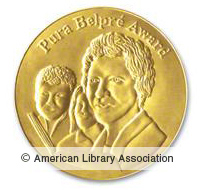
Spotlight on Pura Belpré Winners: Illustrator Stephanie Garcia for Snapshots from the Wedding


PuraBelpreAward
This year marks the 20th anniversary of the Pura Belpé Awards. Starting in the spring, we began shining a spotlight on the winners. This post features the beautiful and imaginative illustration work of Stephanie Garcia for Snapshots from the Wedding, a delightful picture book written by Gary Soto, and the winner of the 1998 Pura Belpré Illustration Award.


Review by Lila Quintero Weaver
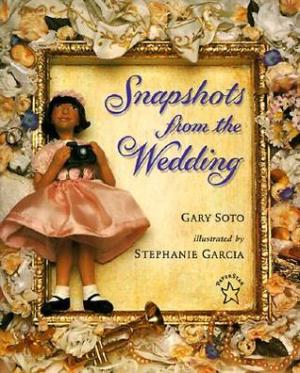
snapshots-cover-2DESCRIPTION FROM THE BOOK JACKET: Meet Maya, Isabel’s flower girl, as she describes in vivid detail the exciting wedding day. Maya introduces us to Danny, the ring bearer; Aunt Marta, crying big tears; Uncle Trino, jump-starting a car in his tuxedo; and Rafael, the groom, with a cast on his arm. Of course, the big day also includes games, dancing, cake, and a mariachi band that plays long into an evening no one will ever forget.

Snapshots from the Wedding captures the unique moments of a special occasion—the big scenes as well as the little ones—that together form a rich family mosaic.

MY TWO CENTS: Snapshots from the Wedding is a lightly humorous story told through the eyes of a young girl named Maya. Gary Soto delivers this joyous narrative of a traditional Mexican boda in lyrical and rhythmic language.

By casting Maya in the role of narrator, Soto allows the reader the same view of the festivities as a member of the wedding party. From her position, Maya observes and comments on the assembled guests, the bridal procession, the photographer at work, and the moment when the couple exchanges vows at the altar. Afterward, at the reception, Maya revels in the mariachi band, the pinning of paper money to the bride’s skirt, and the couple’s departure beneath a shower of rice. As her gaze travels across each scene, she stops to focus on details ranging from the ring bearer’s slicked-back hair, to a boy whose tongue wiggles through the space left by newly lost baby teeth, and to the eye-popping spectacle of a towering wedding cake.

In Soto’s words, “Here’s the wedding cake, seventh wonder of the world, from Blanco’s Bakery, with more frosting than a mountain of snow, with more roses than mi abuela’s back yard, with more swirls than a hundred turns on a merry-go-round.”

Stephanie Garcia, the Pura Belpré-winning illustrator, depicts Maya’s wide-eyed experience of the wedding as something remembered through a series of winsome snapshots. Yet, in one of the most surprising and original aspects of this book, Garcia brings the scenes into sharp relief through exquisitely constructed dioramas that defy all expectations for a story conceived around the idea of photographs.

Each of the three-dimensional illustrations is a miniature stage that sits within a shallow wooden box. The overall effect is that of a dollhouse whose rooms brim with texture and engaging detail, and which cry out to be touched and played with, in order to fully appreciate the tactile gifts they offer. Using a wide range of materials that includes fabric, clay, paint, and found objects, Garcia populates her scenes with individually rendered characters, furnishings, and backdrops. Fashioned from Sculpy clay, each human figure bears distinct facial features and expressions. The skin tones come in varied shades of brown, and each is dressed in clothing suitable for that person’s role in the wedding.

By leaving the diorama’s rough wooden edges in full view and by dressing some of the wedding guests in homespun fabrics, the book hints at the deeper, economic realities of life in a working-class Mexican community. Yet, the momentous social importance of weddings often leads families to go all out for the occasion, evidenced here by the elaborate costumes of the mariachi band and the satin-and-lace gowns of the bridal party.

In nearly every spread, Garcia employs a clever frame-within-a-frame concept that plays with the passage of time. In these instances, select characters appear inside a gilt-edged frame, like mannequins propped in a store window, even as the activity of the moment continues to swirl around them. This approach suggests a future glimpse of the photos being taken. Appropriately, the photographer himself appears in one of the dioramas, snapping his shutter just as the bride and groom are about to kiss.

Garcia’s attention to individual characters complements Soto’s depictions. In one of my favorite vignettes, little Maya and another young lady try their best to snare the bouquet as the bride tosses it. But the bouquet is “caught by the tallest woman there, my cousin Virginia, a college basketball player, with a three-foot vertical leap.” Garcia gives Virginia a mint-green bridesmaid’s dress, with low-heel pumps dyed to match, and a long reach that ensures her effortless catch. We can easily imagine Virginia in a basketball uniform, putting her vertical leap to good use in a different context.

With such singular moments, Soto and Garcia illuminate a range of experiences not often captured in portrayals of Mexican culture. Through its engaging text and rich dioramas, this picture book offers charming views of an important social occasion as seen through the delighted eyes of a little girl who feels at home within this community. And this wedding is an occasion she’ll remember for years to come through its album of snapshots.

Note: We were not able to secure permission from the publisher to share images from the book’s interior pages. Please locate a copy and see them for yourself! 

Portrait of Stephanie GarciaABOUT THE ILLUSTRATOR: Stephanie Garcia is an illustrator, graphic designer, art director, and design consultant, with a wealth of experience in the corporate world and the classroom, where she shares her knowledge with others. Learn more about her in this publisher profile.


Image result for GARY SOTOABOUT THE AUTHOR: Gary Soto is the author of multiple picture books, including the Chato series, which won the Pura Belpré illustrator award for Susan Guevara. He also published many novels for youth, as well as books of short stories for young readers, and collections of essays and poems. His awards include the prestigious Guggenheim Fellowship, the Andrew Carnegie Medal, and the National Book Award. Learn more at his official website. See some of our coverage of Soto’s work in this review and in a post about his decision to stop publishing children’s literature.


Lila Quintero Weaver is the author-illustrator of Darkroom: A Memoir in Black & White. She was born in Buenos Aires, Argentina. Darkroom recounts her family’s immigrant experience in small-town Alabama during the tumultuous 1960s. It is her first major publication. Her next book is a middle-grade novel scheduled for release in 2018 (Candlewick). Lila is a graduate of the University of Alabama. She and her husband, Paul, are the parents of three grown children. She can also be found on her own websiteFacebookTwitter and Goodreads.

The Powerful Role of Coach in the Latinx Community: A Guest Post by Author Claudia Meléndez Salinas


By Claudia Meléndez Salinas

It’s Monday evening and more than 200 youngsters pour into the gym of Alisal High, a school located in the heart of one of the poorest neighborhoods in California’s central coast. The children, most dressed in the gold and black colors of the Gil Basketball Academy, are not high school students: they’re as young as four years old, some of them hardly big enough to pick up the basketballs.

After the initial chaos, the children settle into a series of warm up exercises you can tell they know by heart: run forward, stop midway and run backward; run twisting your body; leap sideways and stop to touch the ground, repeat.

From the edge of the gym, Coach Jose Gil watches the action and directs the children into their next moves. It’s a task that he can’t do alone – especially when he has to stop to provide direct instruction to kids who can’t seem to get a handle on the ball. So he relies on the assistance of other coaches, men and women who, like him, mostly offer their services on a volunteer basis.

“The word ‘Coach’ is powerful beyond belief,” Gil says. “Some think it’s easy and want to sometimes judge or criticize us for in-game situations, but at the end of the day, if coaching kids was that easy, everyone would be doing it. Endless hours, sleepless nights, responsibility beyond belief, challenges dealing with a variety of talents and skill levels etc… It boils down to the process at hand, are you willing to sacrifice your alone time to help others?”

“Coaches” or “mentors” have been crucial for the development of mankind since time immemorial. Older or wiser men and women took young wards under their wings to teach them hunting and gathering edible plants, or to pass down traditions important for survival. The concept was crystallized in ancient Greece, when Mentor, a friend of King Odysseus, stayed behind to take care of the king’s son, Telemachus. The boy and Mentor developed a trusted friendship, one whose importance can be observed in centuries of literature and movies. Think Arthur and Merlin. Leonardo Da Vinci and Raphael Sanzio. Or Daniel and Mr. Miyagi.

In places like the Alisal, where the population is 90 percent Latinx and 33 percent of the residents live in poverty, coaches and mentors are not a matter of legend, they’re a matter of survival. Parents who must work long hours in minimum wage jobs to put food on the table have to rely on the kindness of strangers to look after their broods. In the absence of trusted adults who can guide youngsters through the difficult passage through adolescence, some fall prey to the gangs.

Latinxs are a young population. While more than 30 percent of Latinxs are under 18 years old, the same is true for 20 percent of whites. Nearly half of U.S. born Latinxs are younger than 18.

At the same time, more than 23 percent of Latinxs live in poverty – second only to African Americans. Thirty-seven percent of all the children in the United States who live in poverty are Latinxs.

For four of the last five years, Monterey County has led California in youth homicide rate. In 2013, 22 young people were slain in the county, also the fourth largest agricultural area in the Golden State. While parents are picking lettuce, their children are picking fights.

This is why people like Jose Gil are vital – and luckily, there are a few. You can see them most afternoons in the soccer field, or in classrooms teaching painting, or dance, or music. They’re not just coaches: they’re role models, mentors,  friends. They’re the glue of after-school programs, the difference between wholesome entertainment and life in the streets.

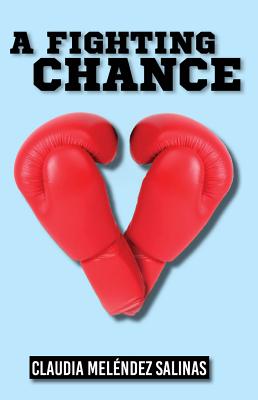
A Fighting Chance CoverOne of the reasons why I wrote A Fighting Chance was to pay homage to these unsung heroes. Under the stern gaze of Coach, Miguel Ángel, the 17-year-old main character, trains to be a champion boxer. Not only is the sport keeping him away from gangs, but it’s also his ticket out of poverty. Coach’s importance to Miguel Ángel, like that of dozens of Coaches and mentors in the Alisal, cannot be overstated.

“We have a huge responsibility to make the place we live in a better one,” Jose Gil muses. In his view, prospective coaches have to ask themselves: “Can you work and mold these young kids to make right choices and decisions in life? Are you a great enough example for others to follow? What is your passion or belief about life and the community you live in? Are you willing to invest time into changing the community one child at a time? Do you even think our community can be improved?

“I love it when people are willing to volunteer to coach in our academy because that just challenges me to coach and mentor them so that they can in return help our youth. We grow our own from within which makes me proud and keeps me hungry.”

And that’s how Coach Gil not only keeps hundreds of kids off the street, but inspires a new crop of coaches to do the same.


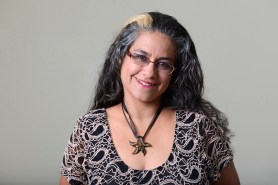
Writer Claudia Melendez in Monterey on Monday January 5, 2015. Photo www.davidroyal.net

Writer Claudia Melendez in Monterey on Monday January 5, 2015. Photo http://www.davidroyal.net

Claudia Meléndez Salinas is an award-winning multi-media journalist now working for the Monterey County Herald, a daily newspaper in California’s Central Coast. She has nearly two decades of experience covering politics, education, and immigration both in Mexico and the United States. She holds a master’s in specialized journalism from the University of Southern California, and a bachelor’s in Latin American and Latino Studies from the University of California, Santa Cruz. Her journalistic work has been published in Mexico’s El Financiero and La Jornada; in Latina and El Andar magazines in the United States, and numerous newspapers.

A Fighting Chance, Meléndez’s first book, is a young adult novel that narrates the struggles of a Mexican-American boy trying to stay away from gangs as he trains to become a champion boxer. She’s been named as one the Latino authors to watch in 2016 from LatinoStories.com.

The Chupacabra Ate the Candelabra: A Cover Reveal!


We are excited to participate in the cover reveal of  The Chupacabra Ate the Candelabra, an upcoming picture book written by Marc Tyler Nobleman and illustrated by Ana Aranda!

With a title like that, you can tell how much fun kid readers are in for, as this early review makes clear: “A nervous herd of goats tries to convince the legendary chupacabra, a monster that allegedly eats goats, that there are other culinary surprises he may enjoy.”                                –Publishers Weekly.

Here is the book description from Nancy Paulsen Books, an imprint of Penguin Young Readers Group:

With its hilarious dialogue, trio of bumbling goats, and fantastically zany villain, this unique, laugh-out-loud story based on a legendary monster is sure to crack up kids and grown-ups alike.  Like most goats, Jayna, Bumsie, and Pep’s greatest fear is being eaten for dinner by the legendary chupacabra—it’s common knowledge that goats are a chupacabra’s favorite food! One night, tired of living in fear, the impetuous goats whip out their trusty candelabra and head off to find the beast and scare it away before it can find them. Little do they know that candelabras are the chupacabra’s third-favorite food . . . and he isn’t about to stop there. This chupacabra has quite the appetite, and the goats are in for a big surprise!


Intrigued? So are we. The release date is March 7, 2017. While we patiently wait to see the book in person, let’s feast our eyes on the fabulous cover created by Ana Aranda, a bright new star in the field of children’s illustration, and one we’re proud to claim as a Latinx creator!  You met Aranda in an illustrator round-up we featured earlier this year.

Ana ArandaAna writes: “This cover design was created in watercolor, inks and gouache. I’m so happy to share with everyone the face of an unknown, mysterious and mischievous creature: the chupacabra!”
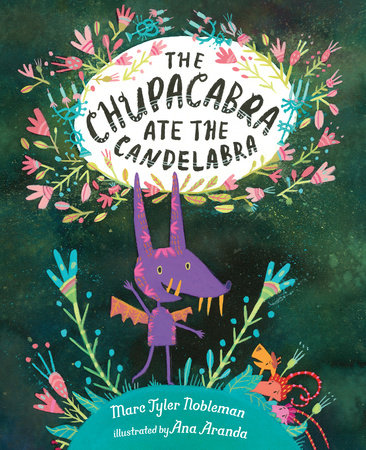
We look forward to reading the full story and enjoying all of Ana’s adorable illustrations!


Here we go….

Scroll…

Scroll…

Scroll…

Ta da!!


cover-the-chupacabra-ate-the-candelabra

Why Write Books About Luchadores? A Guest Post by Author-Illustrator Xavier Garza

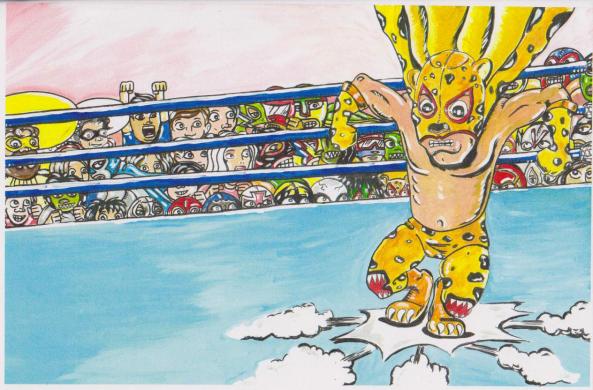
The Great and Mighty Nikko - El JaguarBy Xavier Garza

Why write books about luchadores? I remember being asked that question by a librarian one time at a book signing. I answered her that one of the reasons was its obvious appeal to boys, who can be reluctant readers at times. Lucha libre readily lends itself to create the type of action-packed stories boys just love.

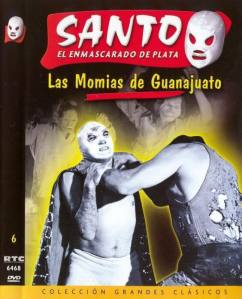
1970 El santo contra las momias de GuanajuatoBut there was another reason I wrote books about luchadores, dating back to when I was a seven-year-old child going to the movies with my dad. It was the summer of 1974 when my father took me to the H&H Drive-In in my hometown of Rio Grande City, Texas. The marquee heralded a double-feature matinee that consisted of a Japanese monster movie and an action-thriller flick from the world of Mexican cinema. The second film was titled Santo contra las momias de Guanajuato (The Saint versus the Mummies of Guanajuato). I was all too familiar with radioactive fire-breathing Japanese Kaijua monster movies of the Godzilla variety, but up until that night, I had not yet been introduced to the masked heroes and villains of lucha libre.
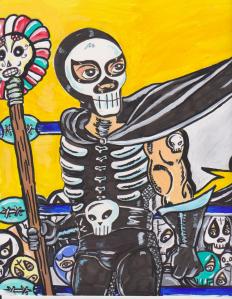
As the second feature began, I watched as the masked villain made his grand entrance. Heralded as a resurrected evil prince from a civilization long lost, he now sought dominion over the earth. But standing in his way was the direct descendant of his adversary from centuries past. I watched in awe as this mysterious new hero donned the legendary silver mask and cape of his ancestor and stood ready to do battle against the resurrected evil prince. I remember at that point asking my dad who was this silver masked man on the movie screen? My dad turned to look at me and smiled. “That’s El Santo, mijo… the Saint. They say he is the greatest luchador that has ever lived.”

The author-illustrator Xavier Garza as a child.

The author-illustrator Xavier Garza as a child.

My dad’s words echoed in my mind:  the greatest luchador that has ever lived. It was at that moment that I was hooked. I would be a fan of both El Santo and lucha libre for the rest of my life.

My father’s words served to spark in me a love for the sport of lucha libre that I carry with me to this day. I was in awe of the fact that these luchadores had the power to put on a mask and become something bigger than themselves. The minute they donned that mask and cape they ceased to be people with names like Rodolfo Guzman Huerta, Alejandro Marquez, or Teresa Lopez. They were transformed into the bigger-than-life personalities that lived in the world of lucha libre. They became heroes and villains with names like the evil Medical Assassin, the rabid Dogman Aguayo, and the heroic Masked Damsel. They were the living and breathing depictions of ancient heroes, cultural stereotypes, monsters, and in some cases… gods, themselves.

Their appeal was simply irresistible to a seven-year-old boy with an intense love of comic book super heroes. Except that these were no mere drawings in a comic book, oh no. These were flesh and blood individuals that nobody ever saw without their masks. To be seen or photographed without their masks was taboo, utterly forbidden. As such, it could be literally anybody underneath that mask. The person buying a gallon of milk at the grocery store could secretly be a masked luchador and you would never even know it. Was the Medical Assassin secretly your uncle? Was the Guardian Angel perhaps your local priest that gave mass at your church each and every Sunday? When it came to lucha libre, there was no way to truly know for sure.

The Great and Mighty Nikko! 7  La Tabla Marina

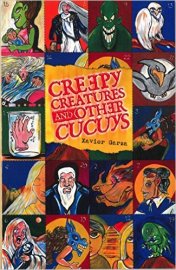
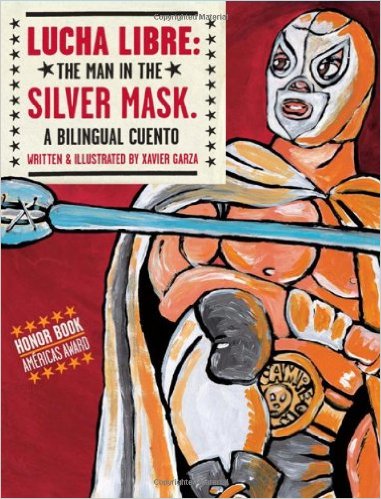
It was that sense of mystery that made lucha libre so appealing and would influence me for years to come. As I grew older, I dreamt of becoming both an artist and an author, and wouldn’t you know it that these luchadores found their way into my work. After nearly ten years of trying to get published, it would finally happen after a conversation with Dr. Nicholas Kanellos, president of Arte CucuysPúblico Press. In 2004, they would publish my first book, titled Creepy Creatures and other Cucuys, and it served as the foundation for many books to come. Among those books would be my first lucha libre book, published by Cinco Puntos Press in 2007, Lucha Libre: The Man in the Silver Mask, A Bilingual Cuento. In many ways this book was a labor of love for me. It was my great big thank-you to all those masked heroes and villains that had filled my head as a child and given wings to my imagination.

One night as I was working on illustration ideas for the book, my then-three-year-old son walked into the studio and asked me who was the silver-masked luchador that I was drawing. I instantly flashed back to that night at the movie drive-in with my father, his words echoing in my mind. I answered my son the only way I knew how. “That’s El Santo mijo… the Saint. They say he is the greatest luchador that has ever lived.”

Lucha

Don’t miss our review of Xavier Garza’s The Great and Mighty Nikko.


Xavier Garza hi resolution imageXavier Garza is an author, teacher, artist, and storyteller whose work is a lively documentation of life, dreams, superstitions, and heroes in the bigger-than-life world of South Texas. Xavier has exhibited his art and performed his stories in venues throughout Texas, Arizona, and New Mexico. He is the author of several books for children and young adults. His Maxmilian and the Mystery of the Guardian Angel: A Bilingual Lucha Libre Thriller received a 2012 Pura Belpré Honor designation. Follow Xavier’s adventures on Twitter (his handle is @CharroClaus) and Facebook.
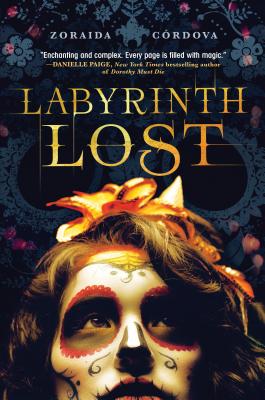


Book Review: Labyrinth Lost (Brooklyn Brujas #1) by Zoraida Córdova


Reviewed by Cindy L. Rodriguez and Cecilia Cackley; ARC received from Sourcebooks Fire.

Labyrinth Lost CoverDESCRIPTION FROM THE PUBLISHER:  Nothing says Happy Birthday like summoning the spirits of your dead relatives.
Alex is a bruja, the most powerful witch in a generation…and she hates magic. At her Deathday celebration, Alex performs a spell to rid herself of her power. But it backfires. Her whole family vanishes into thin air, leaving her alone with Nova, a brujo boy she can’t trust. A boy whose intentions are as dark as the strange marks on his skin.

The only way to get her family back is to travel with Nova to Los Lagos, a land in-between, as dark as Limbo and as strange as Wonderland…

OUR TWO CENTS: We’re thrilled to kick off our new blogging year with a celebration of Labyrinth Lost, an action-packed, urban, portal fantasy with a powerful, complex Latina main character. This novel tackles family, friendship, love, survival, and self-acceptance all while Alejandra Mortiz and her friends Nova and Rishi fight for their lives in a dangerous underworld.

Alex, a 16-year-old Ecuadorian-Puerto Rican, has been fighting against her magical powers for years, feeling her growing abilities are more of a burden than a blessing. She believes her magic is responsible for her father’s disappearance, and she fears more harm will come to herself and her family if she wholly embraces her magic during her Deathday ceremony. Alex, therefore, sabotages the ceremony, which causes her family to be kidnapped from their Brooklyn home to Los Lagos, where they may die at the hands of The Devourer, an evil, power-hungry bruja who’s happy to destroy anyone who gets in her way. The first few chapters really establish Alex’s character and her position in her family so that you understand and care about how conflicted and guilty she is about her family’s disappearance. The stakes could not be higher, and you want Alex to succeed.

Labyrinth 1Alex’s journey through Los Lagos feels very classic. The different communities she encounters, each with its own history and strengths and weaknesses, may remind readers of classic adventures like The Odyssey, Dante’s Inferno, and Alice in Wonderland. Every new area of Los Lagos brings a ton of action. Not every writer can create battle scenes so the reader can clearly visualize them without having to re-read. Zoraida is GREAT at this.

For those who like some romance with their action-adventure story, Labyrinth Lost delivers there as well. Alex has feelings for both Nova and Rishi throughout the narrative, making her one of the few bisexual Latinas in young adult fiction. We especially love that neither Alex’s bisexuality nor her bruja lifestyle are depicted as “issues” or morally problematic. Alex struggles to accept the responsibility and consequences of her magic and her place within her immediate family and the larger bruja community with its deep history and traditions. But, neither her cultural identities or sexual preferences are depicted as “the problems,” thank the Deos.

Labyrinth Lost, the first in a series, ends in a way that will leave you hungry for the sequel with promises of further family complications and more development of secondary characters, Nova and Rishi. We can’t wait!

TEACHING TIPS: 

  • compare/contrast inhabitants of Los Lagos with creatures from other folklore traditions and classical mythology
  • research Santeria and other traditions listed in the author note–which is amazing and a must-read
  • re-write a key scene from the point of view of Nova or Rishi
  • include this novel in a study of the supernatural, and witches specifically, in literature, along with titles such as MacBeth.

    Zoraida 3      Zoraida 2

AND NOW FOR TONS OF AWESOME BONUS STUFF, including Chapter 1, the book trailer, and a giveaway!!

FIRST, you’ve got to see this:

NOW, you’ve got to read this:

Chapter 1:

Follow our voices, sister.

Tell us the secret of your death.

—-Resurrection Canto,
Book of Cantos
The second time I saw my dead aunt Rosaria, she was dancing.

Earlier that day, my mom had warned me, pressing a long, red fingernail on the tip of my nose, “Alejandra, don’t go downstairs when the Circle arrives.”

But I was seven and asked too many questions. Every Sunday, cars piled up in our driveway, down the street, and around the corner of our old, narrow house in Sunset Park, Brooklyn. Mom’s Circle usually brought cellophane–wrapped dishes and jars of dirt and tubs of brackish water that made the Hudson River look clean. This time, they carried something more.

When my sisters started snoring, I threw off my covers and crept down the stairs. The floorboards were uneven and creaky, but I was good at not being seen. Fuzzy, yellow streetlight shone through our attic window and followed me down every flight until I reached the basement.

A soft hum made its way through the thin walls. I remember thinking I should listen to my mom’s warning and go back upstairs. But our house had been restless all week, and Lula, Rose, and I were shoved into the attic, out of the way while the grown–ups prepared the funeral. I wanted out. I wanted to see.

The night was moonless and cold one week after the Witch’s New Year, when Aunt Rosaria died of a sickness that made her skin yellow like hundred–year–old paper and her nails turn black as coal. We tried to make her beautiful again. My sisters and I spent all day weaving good luck charms from peonies, corn husks, and string—-one loop over, under, two loops over, under. Not even the morticians, the Magos de Muerte, could fix her once–lovely face.

Aunt Rosaria was dead. I was there when we mourned her. I was there when we buried her. Then, I watched my father and two others shoulder a dirty cloth bundle into the house, and I knew I couldn’t stay in bed, no matter what my mother said.

So I opened the basement door.

Red light bathed the steep stairs. I leaned my head toward the light, toward the beating sound of drums and sharp plucks of fat, nylon guitar strings.

A soft mew followed by whiskers against my arm made my heart jump to the back of my rib cage. I bit my tongue to stop the scream. It was just my cat, Miluna. She stared at me with her white, glowing eyes and hissed a warning, as if telling me to turn back. But Aunt Rosaria was my godmother, my family, my friend. And I wanted to see her again.

“Sh!” I brushed the cat’s head back.

Miluna nudged my leg, then ran away as the singing started.

I took my first step down, into the warm, red light. Raspy voices called out to our gods, the Deos, asking for blessings beyond the veil of our worlds. Their melody pulled me step by step until I was crouched at the bottom of the landing.

They were dancing.

Brujas and brujos were dressed in mourning white, their faces painted in the aspects of the dead, white clay and black coal to trace the bones. They danced in two circles—-the outer ring going clockwise, the inner counterclockwise—hands clasped tight, voices vibrating to the pulsing drums.

And in the middle was Aunt Rosaria.

Her body jerked upward. Her black hair pooled in the air like she was suspended in water. There was still dirt on her skin. The white skirt we buried her in billowed around her slender legs. Black smoke slithered out of her open mouth. It weaved in and out of the circle—-one loop over, under, two loops over, under. It tugged Aunt Rosaria higher and higher, matching the rhythm of the canto.

Then, the black smoke perked up and changed its target. It could smell me. I tried to backpedal, but the tiles were slick, and I slid toward the circle. My head smacked the tiles. Pain splintered my skull, and a broken scream lodged in my throat.

The music stopped. Heavy, tired breaths filled the silence of the pulsing red dark. The enchantment was broken. Aunt Rosaria’s reanimated corpse turned to me. Her body purged black smoke, lowering her back to the ground. Her ankles cracked where the bone was brittle, but still she took a step. Her dead eyes gaped at me. Her wrinkled mouth growled my name: Alejandra.

She took another step. Her ankle turned and broke at the joint, sending her flying forward. She landed on top of me. The rot of her skin filled my nose, and grave dirt fell into my eyes.

Tongues clucked against crooked teeth. The voices of the circle hissed, “What’s the girl doing out of bed?”

There was the scent of extinguished candles and melting wax. Decay and perfume oil smothered me until they pulled the body away.

My mother jerked me up by the ear, pulling me up two flights of stairs until I was back in my bed, the scream stuck in my throat like a stone.

Never,” she said. “You hear me, Alejandra? Never break a Circle.”

I lay still. So still that after a while, she brushed my hair, thinking I had fallen asleep.

I wasn’t. How could I ever sleep again? Blood and rot and smoke and whispers filled my head.

“One day you’ll learn,” she whispered.

Then she went back down the street–lit stairs, down into the warm red light and to Aunt Rosaria’s body. My mother clapped her hands, drums beat, strings plucked, and she said, “Again.”

AND NOW, you’ve got to get this:

To find Labyrinth Lost, check your local public library, your local bookstore, or IndieBound. Also, check out GoodreadsAmazon, and Barnes & Noble. You can also…..

CLICK HERE FOR A RAFFLECOPTER GIVEAWAY

317988_632439229822_92623787_nABOUT THE AUTHOR: Zoraida Córdova was born in Ecuador and raised in Queens, New York. She is the author of The Vicious Deep trilogy, the On the Verge series, and Labyrinth Lost. She loves black coffee, snark, and still believes in magic.

Author Website: http://www.zoraidacordova.com/

Labyrinth Lost Website: http://books.sourcebooks.com/labyrinth-lost/

Facebook: https://www.facebook.com/CordovaBooks

Twitter:  @zlikeinzorro

Instagram: https://www.instagram.com/wanderwheel/

Author Tumblr: http://wanderlands.tumblr.com/

Labyrinth Lost Tumblr: http://labyrinthlostbooks.tumblr.com/

YouTube: https://www.youtube.com/user/ZoraidaLand

Labyrinth Lost Coloring Page: http://www.sourcebooks.com/images/LabyrinthLost-ColoringPage.pdf

Celebrating Pura Belpré Award Winners: Spotlight on Margarita Engle

PuraBelpreAward

The Pura Belpré Awards turns 20 this year! The milestone was marked on Sunday, June 26, during the 2016 ALA Annual Conference in Orlando, FL. In honor of the award’s anniversary, we have been highlighting the winners of the narrative and illustration awards. Today’s spotlight is on Margarita Engle, the winner of the Pura Belpré Narrative Medal for The Poet Slave of Cuba (2008), The Surrender Tree (2009), and Enchanted Air (2016). Margarita has also won Pura Belpré Honors for The Lightning Dreamer (2014), Hurricane Dancers: The First Caribbean Pirate Shipwreck (2012), and The Firefly Letters: A Suffragette’s Journey to Cuba (2011). 

Reviews of The Poet Slave of Cuba and Enchanted Air by Dr. Sonia Alejandra Rodríguez

Review of The Surrender Tree by Cindy L. Rodriguez

THE POET SLAVE OF CUBA

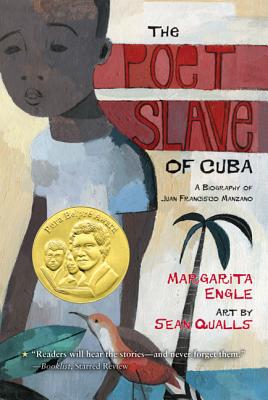
DESCRIPTION FROM THE PUBLISHER:The Poet Slave of Cuba Cover A lyrical biography of a Cuban slave who escaped to become a celebrated poet.
Born into the household of a wealthy slave owner in Cuba in 1797, Juan Francisco Manzano spent his early years by the side of a woman who made him call her Mama, even though he had a mama of his own. Denied an education, young Juan still showed an exceptional talent for poetry. His verses reflect the beauty of his world, but they also expose its hideous cruelty.

Powerful, haunting poems and breathtaking illustrations create a portrait of a life in which even the pain of slavery could not extinguish the capacity for hope.

The Poet Slave of Cuba is the winner of the 2008 Pura Belpre Medal for Narrative and a 2007 Bank Street – Best Children’s Book of the Year.

MY TWO CENTS: In The Poet Slave of Cuba: A Biography of Juan Francisco Manzano, Margarita Engle beautifully captures the life of Juanito, a slave in Cuba with a talent and passion for words. Juanito is smart. He can memorize verses, songs, plays simply by listening. He can then recite them off the top of his head. His owner, Doña Beatriz, keeps him as an entertaining pet. The other slave owners call him the “Golden Beak” because of his amazing ability to recite from memory. After Doña Beatriz dies, Juanito is given to La Marquesa de Prado Ameno, a woman who does not find him amusing and is instead bent on punishing him. Juanito’s family is given freedom, but he remains enslaved. The violence he endures eventually forces him to escape. Throughout all the time, Juanito’s love for words never wavered, but instead, he taught himself to read and write.

Juan Francisco Manzano’s biography in verse is an important contribution to the retelling of Latin American history. At first, his owners found his recitations entertaining because they did not believe that he understood what he repeated, but eventually Manzano learned the power of words and would construct his own poems and stories. However, this new understanding of words led to many years of physical and emotional abuse. Engle does not romanticize slavery in this text. Her verses help readers feel Juanito’s innocence and his genuine interest for words. At the same time, Engle’s verses feel painful when Juanito gets whipped. Juanito’s life story is told through the voices of those in his life. The different voices paint a bigger picture of Juanito’s life. His mother’s death is more sorrowful, for example, because their voices formed a part in telling Juanito’s story. Engle’s verses are accompanied by artwork by Sean Qualls. There is something about the art that is also beautiful and sad.

The Poet Slave of Cuba broaches the subject of slavery in Latin America unlike any other text I’ve come across in Latinx children’s and young adult literature. Engle’s verses helps put a human face to those that were oppressed, abused, and killed by slavery. Through her verses, Engle has immortalized Manzano’s story, and, at least in this one way, readers of this text can begin or continue to have conversations about slavery in Latin America.


THE SURRENDER TREE

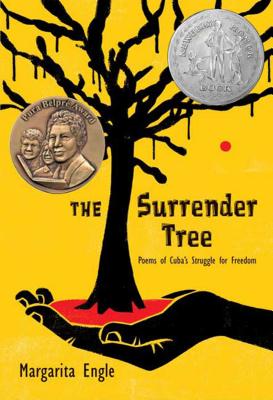
DESCRIPTION FROM THE PUBLISHERThe Surrender Tree CoverIt is 1896. Cuba has fought three wars for independence and still is not free. People have been rounded up in reconcentration camps with too little food and too much illness. Rosa is a nurse, but she dares not go to the camps. So she turns hidden caves into hospitals for those who know how to find her.
Black, white, Cuban, Spanish―Rosa does her best for everyone. Yet who can heal a country so torn apart by war? Acclaimed poet Margarita Engle has created another breathtaking portrait of Cuba.

The Surrender Tree is a 2009 Newbery Honor Book, the winner of the 2009 Pura Belpré Medal for Narrative and the 2009 Bank Street – Claudia Lewis Award, and a 2009 Bank Street – Best Children’s Book of the Year.

MY TWO CENTS: In The Surrender Tree: Poems of Cuba’s Struggle for Freedom, which was was the first novel by a Latinx to receive a Newbery Honor, Engle portrays almost 50 years of the life of Rosario Castellanos, known as Rosa la Bayamesa, who grows from a slave, a “witch-child” learning about nature as medicine, to an iconic herbalist war nurse who treated anyone–friend or enemy–and never asked for money. Engle’s novel in verse follows Rosa from 1850-1899, through the Ten Years War, the Little War, and the War of Independence. After all of that fighting, the novel ends with Spain’s surrender to the United States. With Cuba still not free, the characters are left with mixed feelings of disappointment and hopeful anticipation for a better future.

Engle’s poems alternate among five perspectives, those of Rosa, her husband José, a slavehunter known as Lieutenant Death, Captain-General Valeriano Weyler y Nicolau, Marquis of Tenerife, Empire of Spain, and a young girl named Silvia. By including these voices, Engle captures different war experiences and interesting intersections. For example, Rosa meets Lieutenant Death early on, heals him later, and then becomes his target, since Rosa has become a powerful, elusive wartime figure. Also, later in the novel Silvia, an eleven-year-old girl, leaves her farm with her ailing mother and young twin brothers because of the mandatory order for peasants to enter reconcentration camps. Silvia’s grandmother had been healed by Rosa in a previous war, and now Silvia believes Rosa is her only hope for survival.

As in The Poet Slave of Cuba, Engle does not shy away from the brutalities of slavery and war. She explains that the ear of a runaway slave, proof that the slave died resisting capture, earns the hunter four pesos. Later, Rosa notes that “some of the ears come from people whose names and faces I know.” Other times, Engle captures the exhaustion, fear, loneliness, heartbreak, and confusion of the men, women, and children hiding in caves. For example, she writes through Rosa:

The Little War?

How can there be

a little war?

Are some deaths

smaller than others,

leaving mothers

who weep

a little less?

And yet, throughout the novel, the characters also express feelings of pride and hope and a constant sense of purpose that leads to perseverance. While reading, it was easy to see why The Surrender Tree is one of Engle’s many highly-acclaimed and decorated novels.


ENCHANTED AIR

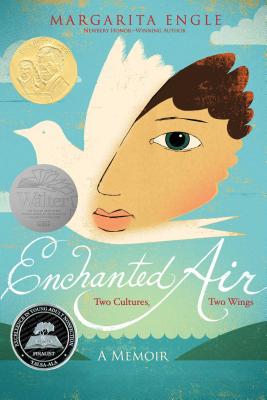
DESCRIPTION FROM THE PUBLISHEREnchanted Air CoverIn this poetic memoir, which won the Pura Belpré Narrative Award, was a YALSA Nonfiction Finalist, and was named a Walter Dean Myers Award Honoree, acclaimed author Margarita Engle tells of growing up as a child of two cultures during the Cold War.

Margarita is a girl from two worlds. Her heart lies in Cuba, her mother’s tropical island country, a place so lush with vibrant life that it seems like a fairy tale kingdom. But most of the time she lives in Los Angeles, lonely in the noisy city and dreaming of the summers when she can take a plane through the enchanted air to her beloved island. Words and images are her constant companions, friendly and comforting when the children at school are not.

Then a revolution breaks out in Cuba. Margarita fears for her far-away family. When the hostility between Cuba and the United States erupts at the Bay of Pigs Invasion, Margarita’s worlds collide in the worst way possible. How can the two countries she loves hate each other so much? And will she ever get to visit her beautiful island again?

MY TWO CENTS: Margarita Engle’s non-fiction memoir in verse, Enchanted Air: Two Cultures, Two Wings, tells of her upbringing in Los Angeles during the Cold War era, learning about the Bay of Pigs invasion, and the palpable fear she felt for her family in Cuba. Engle describes the challenges of growing up with two cultures and always longing for one place while in another. Young Margarita finds herself in words when it feels like she belongs to both culture and neither at the same time. Enchanted Air is the outstanding memoir of a truly amazing writer.

Engle’s memoir in verse is a timely story. War and violence continue to separate many children and their family in one country from their families in another country. Engle describes the isolation she felt due to her different culture when she left Cuba for the U.S. The freedom to roam about as she did in Cuba was not always very realistic in the U.S. She notes that even her mother changed a bit. Engle further recounts the fear and anxiety she felt when she learned that her two countries did not get along.  Engle found solace in libraries and the stories they contained. Poetry gave her the wings to soar again. Her memoir stops in 1965 with her childhood hope that she will one day be able to return to Cuba. Now that relations with Cuba have been renewed and commercial flights to Cuba might soon be available there are probably many that are also glad they will be able to reacquaint themselves with the island of their childhood.

TEACHING TIPS: Both The Poet Slave of Cuba and Enchanted Air tell of the importance of poetry as a tool for empowerment. Ask students to discuss the significance of words in Manzano’s and Engle’s childhood. Explaining the historical context of each text will be important so that students don’t conflate one experience with the other. In other words, slavery and the Cold War are not the same experiences and should be differentiated. Ask students to consider the circumstances that left Manzano or Engle feeling voiceless. How did they each use words (i.e. poetry and stories) to empower themselves?

Storytelling is another common thread in both texts. Ask students to discuss the memoirs, autobiographies, and biographies as genres. What are their cultural significance? In other words, why do people write their or other’s life story? Ask student to journal about whose biography they might write. Encourage students to consider someone in their family or in their community as the potential subject of their biography.

Since almost all of the characters in The Surrender Tree were real people, students could research one of the historical figures and any of the wars outlined in the novel. Another interesting exercise would be to closely examine the ending, when the American soldiers arrive and, while they are met with hospitality, they are at one point called “a foreign tyrant” rather than saviors. Students should be encouraged to read the text closely through the eyes of the Cuban characters to understand the mixed emotions at the end, when the U.S. flag is raised instead of the Cuban flag.

For more ideas on these and other books by Engle, check out her “for teachers” page on her website.

MargaritaABOUT THE AUTHOR (from her website): Margarita Engle is the Cuban-American author of many verse books, including a Newbery Honor winner, The Surrender Tree, a PEN USA Award winner, The Lightning Dreamer, and a verse memoir, Enchanted Air, winner of many awards, including an inaugural Walter Dean Myers Award Honor, the inaugural Arnold Adoff Teen Poetry Award, and the Lee Bennett Hopkins Poetry Award. Margarita’s books have also received three Pura Belpré Awards and four Américas Awards, as well as a Jane Addams Award, International Reading Association Award, and Claudia Lewis Poetry Award. Books for younger children include Mountain Dog, Summer Birds, and the Charlotte Zolotow Award winning picture book, Drum Dream Girl.

Margarita grew up in Los Angeles, but developed a deep attachment to her mother’s homeland during summers with her extended family in Cuba. She was trained as a botanist and agronomist before becoming a full-time poet and novelist. She lives in Central California, where she enjoys hiding in the wilderness to help train her husband’s search and rescue dog.


FullSizeRender (1)Dr. Sonia Alejandra Rodríguez’s research focuses on the various roles that healing plays in Latinx children’s and young adult literature. She currently teaches composition and literature at a community college in Chicago. She also teaches poetry to 6th graders and drama to 2nd graders as a teaching artist through a local arts organization. She is working on her middle grade book. Follow Sonia on Instagram @latinxkidlit



photo by Saryna A. JonesCindy L. Rodriguez is a former journalist turned public school teacher and fiction writer. She was born in Chicago; her father is from Puerto Rico and her mother is from Brazil. She has degrees from UConn and CCSU and has worked as a reporter at The Hartford Courant and researcher at The Boston Globe. She and her daughter live in Connecticut, where she teaches middle school reading and college-level composition. Her debut contemporary YA novel, When Reason Breaks, released with Bloomsbury Children’s Books on 2/10/2015. She can also be found on FacebookTwitter, and Goodreads.