
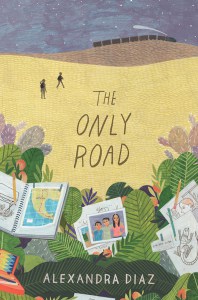
Reviewed by Cris Rhodes
DESCRIPTION FROM THE BOOK JACKET: Jaime is sitting on his bed drawing when he hears a scream. Instantly he knows: Miguel, his cousin and best friend, is dead.
Everyone in Jaime’s small town in Guatemala knows someone who has been killed by the Alphas, a powerful gang that’s known for violence and drug trafficking. Anyone who refuses to work for them is hurt or killed—like Miguel. With Miguel gone, Jaime fears that he is next. There’s only one choice: Accompanied by his cousin Ángela, Jaime must flee his home to live with his older brother in the United States.
Inspired by true incidents, The Only Road tells an individual story of a boy who feels that leaving his home and risking everything is his only chance for a better life. It is a story of fear and bravery, love and loss, strangers becoming family, and one boy’s treacherous and life-changing journey.
MY TWO CENTS: A recipient of a Pura Belpré honor, Alexandra Diaz’s The Only Road is chilling and heart-wrenching in the best possible way. From the moment that Jaime’s beloved cousin Miguel is killed by a local gang, the Alphas, it is evident that this book is going to take its reader on a perilous journey, tagging along with Jaime as he flees his small town in Guatemala for the United States.
As the novel opens, gang members—angered by Miguel and Jaime’s refusal to submit to the capricious whims of the Alphas—brutally beat Miguel to death in a park that the boys had once considered safe. Jaime, spared a similar fate because he’d stayed home sick that day, soon discovers that Miguel’s murder is just the beginning of the Alphas’ reign of terror. Not only do they intend to force Ángela, Miguel’s sister, to be the ‘girlfriend’ of one of the gang members, but they also plan to make Jaime one of their thugs. The nightmare of such a desolate future under the rule of the Alphas spurs Jaime and Ángela to travel north—and as is true for many undocumented children, the promise of a better future on the other side of the border far outweighs the terrible risks of the journey.
Marketed as a middle-grade novel, this story may lead some to question whether Diaz went too far in portraying the dangers of undocumented immigration and whether such knowledge is appropriate for pre-teen readers. To those concerned, I argue that Diaz’s book is a must-read because of its grittiness. Considering how divided our country is over issues of immigration, seeing undocumented immigrants as humans and understanding the horrible realities that they are escaping seems vital for readers of all ages. As undocumented minors, Ángela and Jaime face unique trials and tribulations along their journey, and Diaz strives to make their story as realistic as possible. She explains in her Author’s Note that though “Jaime and Ángela are fictitious characters, their story is similar to millions of real immigrants,” since “in recent years there has been a huge wave of children traveling alone from Central America” (280). In support of this, Diaz includes a bibliography of the sources that informed her book. This bibliography includes multiple articles about the rise of undocumented and unaccompanied minors crossing the border.
Jamie and Ángela’s experiences may be unapologetically realistic, but they also demonstrate the resiliency of the human spirit. Ultimately, these cousins and the other adolescent border-crossers they meet along the way “‘want the freedom to make [their] own choices and to be in control of [their] future’” (92). As informed readers, we recognize that that future is tenuous; even if these characters successfully enter the U.S., there is no guarantee that they will elude detection and manage to thrive in such a new and foreign environment.
Though much of this story may be new terrain for its readers, Diaz tempers this foreignness with familiar stylistic choices and tropes of children’s and middle-grade texts. From its large print and short chapters, to the straightforward, albeit lyrical language, this text remains easily accessible to young readers. Moreover, Diaz plays upon the trope of an animal helper/guide by including a dog, Vida, who accompanies Jaime and Ángela on their journey. After rescuing her from a fighting ring, Jaime and Ángela nurse the aptly named Vida back to health, and Vida repays their devotion by saving them on multiple occasions. After they get separated from their group of traveling companions, it’s Vida who finds them. Later, she alerts them to the presence of la migra, and even distracts an ICE helicopter while Jaime and Ángela attempt the dangerous swim across the Rio Bravo. The inclusion of Vida often serves as a relief to Jaime and Ángela’s tragic circumstances. The vivaciousness and tenacity that this dog demonstrates act as a beacon of hope for Jaime and Ángela, who emulate her will to survive.
After Jaime and Ángela cross the Rio Bravo, Diaz leaves her ending relatively ambiguous, which left me conflicted. I wanted to know what happens to Jaime and Ángela after their journey, yet felt overall pleased with the open-endedness of this narrative and the hope that it represents. I recognized that we do not need all of the answers—and Diaz’s narrative is better because she does not artificially create some great happily-ever-after for Jaime and Ángela.
Regardless, perhaps the most captivating motif of The Only Road was Jaime’s artistic abilities. Initially, Jaime regards his craft and beloved sketchbook as a connection to home, but as the novel unfolds, they become so much more. Containing images of Miguel, his parents and abuela, and other scenes from Guatemala, the sketchbook acts as Jaime’s catharsis and savior. During a confrontation with la migra, the sketchbook is seized by an intimidating officer. Jaime fears that his art will identify him as an undesirable Guatemalan immigrant, but the officer is too preoccupied with the wonder of Jaime’s skill to question his nation of origin, and merely rips out a sketch of a lizard before walking away. In moments like these, the sketchbook becomes Jaime’s social currency; and when he and Ángela need more money to pay a coyote to get them across the Rio Bravo and into Texas, Jaime sells sketches to white tourists. Art is such a strong analogy for freedom and self-representation; but, most importantly, art becomes integral to Jaime’s very existence. When he almost loses his sketchbook during the crossing of the Rio Bravo, Ángela scolds him; but he explains, “‘It’s not just a book. It’s my life’” (259). In writing the experiences of these children, Diaz explores ways in which art becomes integral to defining the worth of one’s life, and by elevating the journey of these characters, Diaz makes clear that their lives–and the lives of those like them—truly matter.
To put it simply, The Only Road is a must-read. It is beautiful and heartbreaking and so timely. Diaz’s characters are tremendously dynamic and sympathetic; watching them grow as the story progresses made this book difficult to put down, and I found myself staying up way past my bedtime to finish it. Fair warning: if you are a crier, like me, you might want to keep tissues handy while reading! Though the story ends on a bright note, it bears the weight of so many undocumented immigrants whose journeys were less successful—a weight that will leave you breathless even long after the book is finished.
TEACHING TIPS: The Only Road contains multiple supplemental materials that could be used as teaching tools. Diaz includes a glossary of Spanish terms (along with definitions and connotations for “the language enthusiasts”); a list of “Further Reading for All Ages,” which includes children’s and young adult book recommendations about undocumented border crossings and the Latinx experience; as well as a bibliography of her resources, which she cautions some “may not be suitable for young readers” (283, 309). However, these materials could be useful to parents, teachers, and librarians in helping young readers understand the complex issues faced by undocumented immigrants—primarily, those coming from Central and South American countries. Incidentally, Diaz’s research model for this text may be a good way to introduce students to in-depth research for larger projects.
Cultural contexts portrayed in The Only Road could also prove useful toward enhancing appreciation for the ethnic richness that exists across Central America. As this novel shows, Central Americans are not monolithic, and The Only Road does a good job of illuminating distinctions between mestizo and indigenous Central Americans, as well as other variables that mark the countries of this region. For advanced Spanish classes, The Only Road could be used to illustrate variances in Spanish as it is spoken throughout Central and South America, particularly by paying close attention to colloquialisms. Teachers of Spanish may prefer the Spanish-language version, which is available under the title El Único Destino.
ABOUT THE AUTHOR:  Alexandra Diaz is a Cuban American writer with half a dozen young adult novels to her credit, including the Pura Belpré Honor book reviewed here, as well as Good Girls Don’t Lie, the Roller Girl series, and When We Were. Alexandra has lived in England, New Mexico, and other parts of the U.S. Learn more about her work by visiting her official author site.
 ABOUT THE REVIEWER: Cris Rhodes is a doctoral student at Texas A&M University – Commerce. She received a M.A. in English with an emphasis in borderlands literature and culture from Texas A&M – Corpus Christi, and a B.A. in English with a minor in children’s literature from Longwood University in her home state of Virginia. Cris recently completed a Master’s thesis project on the construction of identity in Chicana young adult literature.
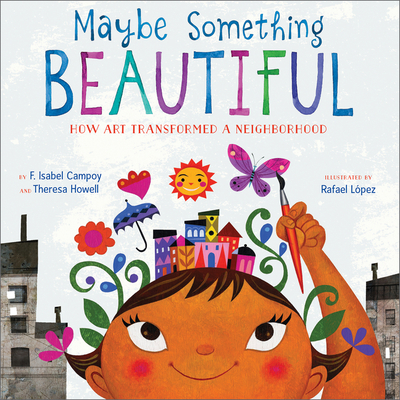 DESCRIPTION OF THE BOOK: What good can a splash of color do in a community of gray? As Mira and her neighbors discover, more than you might ever imagine! Based on the true story of the Urban Art Trail in San Diego, California, Maybe Something Beautiful reveals how art can inspire transformation—and how even the smallest artists can accomplish something big. Pick up a paintbrush and join the celebration!
 ABOUT THE AUTHORS (from the book):
  Theresa Howell
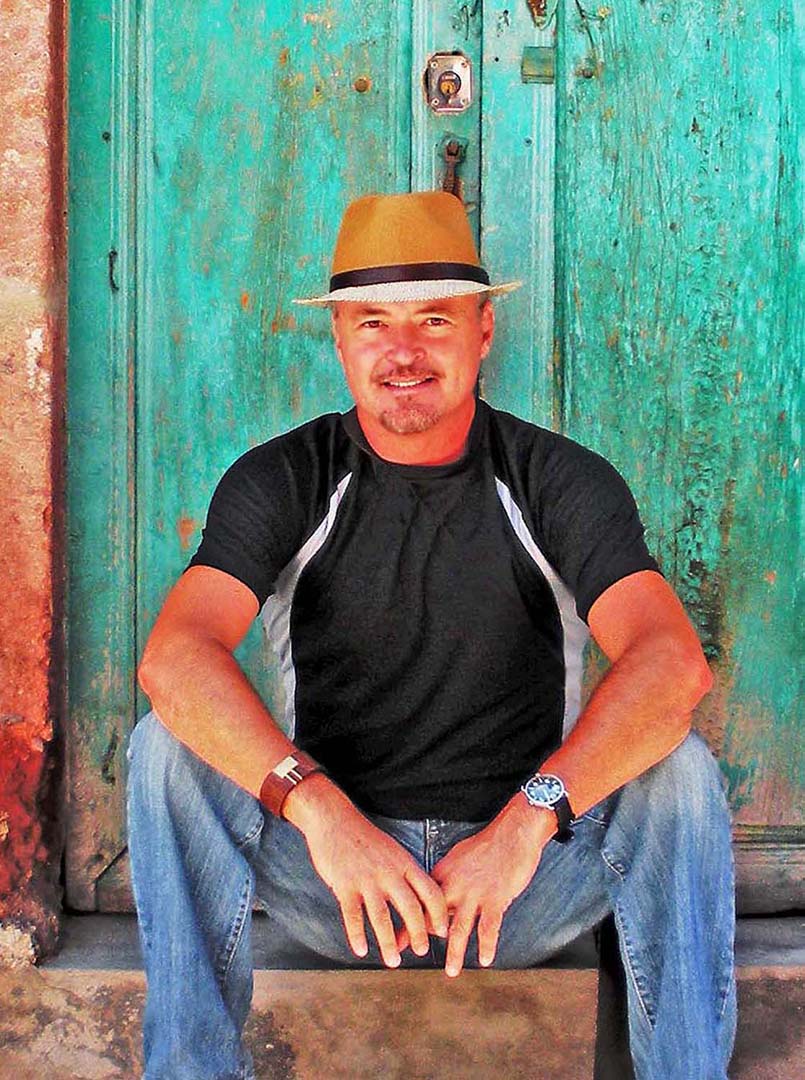 ABOUT THE ILLUSTRATOR:
 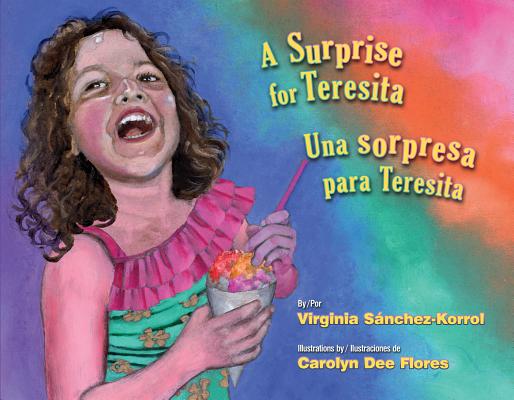 DESCRIPTION OF THE BOOK: In this bilingual picture book for young children, seven-year-old Teresita anxiously awaits her Tio Ramon, who has promised her a special surprise for her birthday.
 ABOUT THE AUTHOR: Virginia Sánchez-Korrol is a Professor Emerita at Brooklyn College, CUNY. She is co-editor of the three volume Latinas in the United States and when she is not working on history brooks, she writes a blog for the Huffington Post.
 ABOUT THE ILLUSTRATOR:
 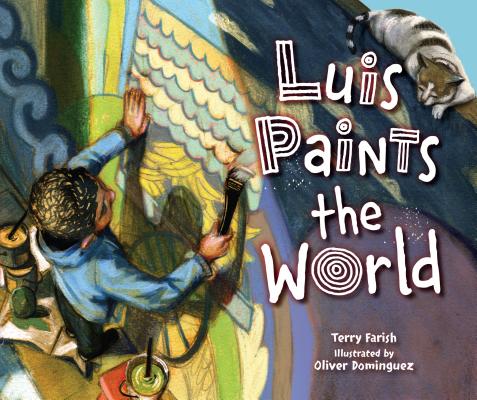 DESCRIPTION OF THE BOOK: Luis wishes Nico wasn’t leaving for the Army. To show Nico he doesn’t need to go, Luis begins a mural on the alleyway wall. Their house, the river, the Parque de las Ardillas—it’s the world, all right there. Won’t Nico miss Mami’s sweet flan? What about their baseball games in the street? But as Luis awaits his brother’s return from duty, his own world expands as well, through swooping paint and the help of their bustling Dominican neighborhood.
 ABOUT THE AUTHOR: Terry Farish’s picture books, novels, and nonfiction works often focus on immigrant and refugee populations, informed by her early work for the Red Cross in Vietnam and continual research. Terry presents literacy programs for the New Hampshire Humanities Council, and she received the New England Reading Association 2016 Special Recognition Award for Outstanding Contributions to Literacy. She lives in Kittery, Maine.
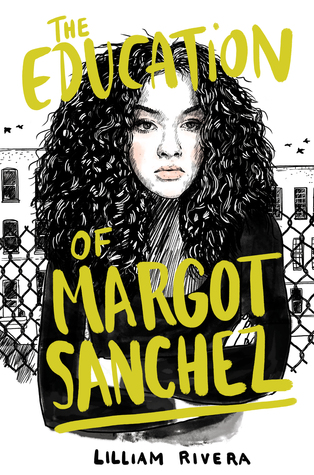 DESCRIPTION OF THE BOOK:
 ABOUT THE REVIEWER: Elena Foulis has a Ph.D. in Comparative Literature and Cultural Studies from the University of Arkansas. Her research and teaching interests include U.S. Latina/o literature, and Digital Oral History. She is currently working on a digital oral history collection about Latin@s in Ohio, which has been published as an eBook titled, Latin@ Stories Across Ohio.
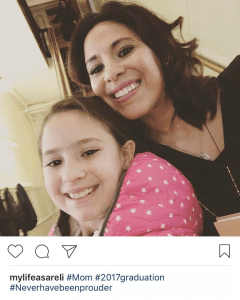 LKL: During your enrollment, you were also busy with family life. Could you share some tips for getting the most from classwork while also meeting everyday demands?
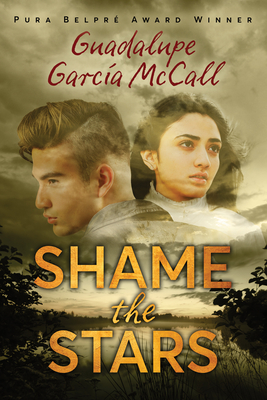 DESCRIPTION OF THE BOOK:
  ABOUT THE AUTHOR:
  ABOUT THE REVIEWER: Araceli Méndez Hintermeister is a librarian and archivist with a background in public, academic, and culinary libraries.She has an MA in history and MLIS from Simmons College where she focused her studies on the role of libraries and archives in the cultural preservation of the U.S.-Mexican border. Additionally, she holds a BA in Ethnic Studies from Brown University. Her research is greatly influenced by her hometown of Laredo, TX which has led her to work in serving immigrants and underrepresented communities. Her current work involves exploring cultural identity through oral history in her project,
  Latinxs in Kid Lit