
By Cindy L. Rodriguez
This is the fourth in an occasional series about middle grade Latinx authors. We decided to shine a spotlight on middle grade writers and their novels because, often, they are “stuck in the middle”–sandwiched between and overlooked for picture books and young adult novels. The middle grades are a crucial time in child development socially, emotionally, and academically. The books that speak to these young readers tend to have lots of heart and great voices that capture all that is awkward and brilliant about that time.
Today, we highlight Pablo Cartaya.
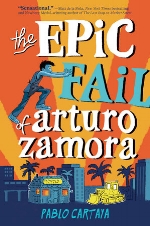
Pablo Cartaya is the author of the acclaimed middle-grade novel, The Epic Fail of Arturo Zamora (Viking, 2017); Marcus Vega Doesn’t Speak Spanish (Viking, 2018); and two forthcoming titles in 2019 and 2020 also to be published by Viking. He is a Publisher’s Weekly “Flying Start” and has received starred reviews from Kirkus, Booklist, and Publisher’s Weekly. For his performance recording the audiobook of his novel, Pablo received an Earphone Award from Audiofile Magazine and a Publisher’s Weekly Audiobooks starred review. He is the co-author of the picture book, Tina Cocolina: Queen of the Cupcakes (Random House, 2010), a contributor to the literary magazine, Miami Rail; the Spanish language editorial, Suburbano Ediciones; and a translator for the poetry chapbook, Cinco Poemas/Five Poems based on the work of poet Hyam Plutzik. Pablo visits schools and universities throughout the US and currently serves as faculty at Sierra Nevada College’s MFA in Creative Writing. www.pablocartaya.com / Twitter: @phcartaya
Pablo Cartaya
 Q. Who or what inspired you to become a writer?
A. I’ve been a storyteller since I was a little kid performing originally written shows in my living room every time my parents had someone over for dinner. During cena I would quietly (sometimes not so quietly) go over story ideas that would lead to epic performances en la sala while the guests and my parents ate dessert and sipped cafécito on the sofa. My parents always encouraged that creative spirit. In many ways, Mami and Papi were my first inspirations. Since those early days I’ve always had stories swirling around my imagination. These stories have taken many forms over the years: writing plays, teleplays, telenovelas, picture books, nonfiction, poetry (sometimes really bad poetry), and then one fateful day in graduate school, the voice of a fourteen year old Cuban American kid named Arturo made his way into my consciousness. It was the first time I let the character in the story do the talking. What I found was a kid who was like me and who had dared to dream himself into the narrative. The process of discovering Arturo’s world has been one of the great joys of my creative life. In a way, The Epic Fail of Arturo Zamora is a lifetime in the making of becoming the writer I am today.
Q. Why do you choose to write middle grade novels?
A. I don’t actually choose to write middle grade novels. It’s more like a bunch of thirteen and fourteen year olds make the loudest noise in my sub consciousness. I believe writing is an act of submission to the fictive state. Allowing a story or a character to take hold and dictate the terms of what, when, where, and how the narrative will go. As the writer I give in and let the character tell me what he or she wants to talk about. It’s frightening at times but there is something about that act of discovery that is exciting and enlightening. A character usually pops into my head and a scene plays out. For example, in my next novel, Marcus Vega Doesn’t Speak Spanish, I imagined this really tall, brooding fourteen year old trying to convince his little brother who has Down syndrome to take a bath. From there, I started asking these characters questions and they revealed parts of their lives they wanted to tell. After that it’s all about revising, revising, and more revising to get to the heart of the character’s story.
Q. What are some of your favorite middle grade novels?
A. Ah! This question is always the hardest! How do you pick a favorite child? You can’t do it! Okay I’ll name some but they are by no means a final list! We’ll just call it a fluid favorite, okay? As a kid I devoured everything Jules Verne – Twenty Thousand Leagues Under the Sea is one of my all time favorites although I don’t know if it qualifies as distinctly middle grade. I also think it’s important to recognize the great work contemporary middle grade authors are writing. Jason Reynolds is doing some pretty incredible work. I just finished Patina and it’s awesome. Celía Perez has a kick butt middle grade out called The First Rule of Punk, Rita Williams Garcia’s Clayton Bird Goes Underground is fantastic. I happen to adore R.J. Palacio because Wonder was the first novel my daughter read from beginning to end and it made her a lover of books. There are so many! Make me stop! Make me stop! I see a great mix of characters and stories out there and I’m excited for what’s to come from these and many other brilliant authors in the field.
Q. If you could give your middle-grade self some advice, what would it be?
A. Don’t be afraid to fail. You are not perfect nor should you try to be. Find your voice and hold onto it for dear life. Is that too much advice? Would my thirteen-year-old self just ignore me? Probably.
Q. Please finish this sentence: “Middle grade novels are important because…”
A. They are sneaky deep. It’s the time where wonder, adventure, occasional failure, and the possibilities of happiness coexist to create a sense of hope for the future. It’s also a place where kids get to be kids and goof off from time to time. I like that mix.
 Cindy L. Rodriguez was a newspaper reporter for The Hartford Courant and researcher at The Boston Globe before becoming a public school teacher. She is now a reading specialist at a Connecticut middle school. Cindy is a U.S.-born Latina of Puerto Rican and Brazilian descent. She has degrees from UConn and CCSU. Her debut contemporary YA novel, When Reason Breaks, released with Bloomsbury Children’s Books (2015). She will have an essay in Life Inside My Mind, which releases 4/10/2018 with Simon Pulse. She can also be found on Facebook, Twitter, and Goodreads.
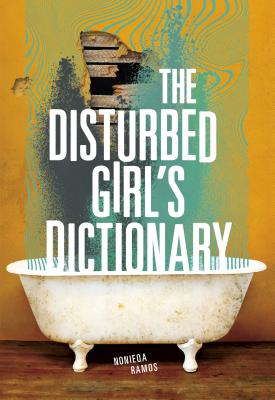 DESCRIPTION OF THE BOOK: Macy’s school officially classifies her as “disturbed,” but Macy isn’t interested in how others define her. She’s got more pressing problems: her mom can’t move off the couch, her dad’s in prison, her brother’s been kidnapped by Child Protective Services, and now her best friend isn’t speaking to her. Writing in a dictionary format, Macy explains the world in her own terms—complete with gritty characters and outrageous endeavors. With an honesty that’s both hilarious and fearsome, slowly Macy reveals why she acts out, why she can’t tell her incarcerated father that her mom’s cheating on him, and why her best friend needs protection . . . the kind of protection that involves Macy’s machete.
 ABOUT THE AUTHOR: NoNieqa Ramos spent her childhood in the Bronx, where she started her own publishing company and sold books for twenty-five cents until the nuns shut her down. With the support of her single father and her tias, she earned dual master’s degrees in creative writing and education at the University of Notre Dame. As a teacher, she has dedicated herself to bringing gifted-and-talented education to minority students and expanding access to literature, music, and theater for all children. A frequent foster parent, NoNieqa lives in Ashburn, Virginia, with her family.
 ABOUT THE REVIEWER: Mark Oshiro is the Hugo-nominated writer of the online
 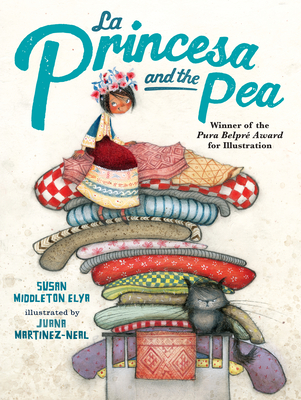 DESCRIPTION OF THE BOOK: The Princess and the Pea gets a fresh twist in this charming bilingual retelling. El principe knows this girl is the one for him, but, as usual, his mother doesn’t agree. The queen has a secret test in mind to see if this girl is really a princesa. But the prince might just have a sneaky plan, too. Readers will be enchanted by this Latino twist on the classic story, and captivated by the vibrant art inspired by the culture of Peru.
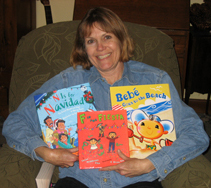 ABOUT THE AUTHOR:
  ABOUT THE ILLUSTRATOR:
 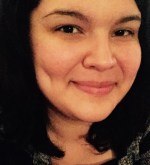 ABOUT THE REVIEWER: Dora M. Guzmán is a bilingual reading specialist for grades K-5 and also teaches college courses in Children’s Literature and Teaching Beginning Literacy. She is currently a doctoral student with a major in Reading and Language. When she is not sharing her love of reading with her students, you can find her in the nearest library, bookstore, or online, finding more great reads to add to her never ending “to read” pile!
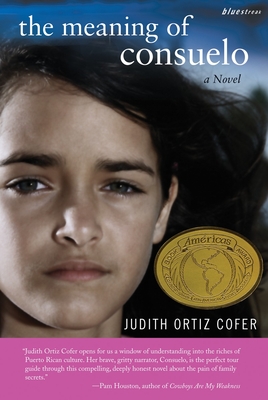 DESCRIPTION OF THE BOOK: La nina seria, the serious child. That’s how Consuelo’s mother has cast her pensive, book-loving daughter, while Consuelo’s younger sister Mili, is seen as vivacious—a ray of tropical sunshine. Two daughters: one dark, one light; one to offer comfort and consolation, the other to charm and delight. But something is not right in this Puerto Rican family.
 ABOUT THE AUTHOR: Judith Ortiz Cofer is an award-winning author known for her stories about coming-of-age experiences in the barrio and her writings about the cultural conflicts of immigrants. She is the author of many distinguished titles for young adults such as An Island Like You, Silent Dancing: A Partial Remembrance of a Puerto Rican Childhood, and The Line in the Sun. She was the Regents’ and Franklin Professor of English and Creative Writing at the University of Georgia. In 2010, she was inducted into the Georgia Writers Hall of Fame.
 ABOUT THE REVIEWER: Toni Margarita Plummer is a Macondo Fellow, a winner of the Miguel Mármol Prize, and the author of the story collection The Bolero of Andi Rowe. She hails from South El Monte, a working-class suburb of Los Angeles, and worked as an acquiring editor at a major publisher for more than ten years. Toni now freelance edits and lives in the Hudson Valley with her family. Visit her website at ToniMargaritaPlummer.Wordpress.com.
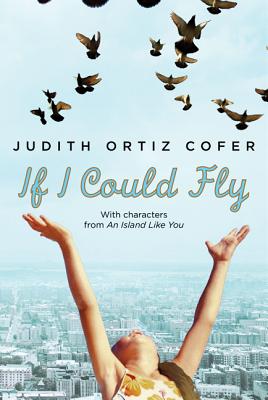 DESCRIPTION OF THE BOOK: Fifteen-year-old Doris is used to taking care of herself. Her musician parents have always spent more time singing in nightclubs than watching after her. But when her ailing mother goes home to Puerto Rico to get well and pursue a singing career there, and her father finds a new girlfriend, Doris is more alone than she’s ever been. Disconnected from her family and her best friends, who are intertwined in terrifying relationships with a violent classmate, Doris finds refuge in taking care of homing pigeons on her apartment building’s roof. As Doris tries to make sense of it all, she learns that, just like the pigeons, she might have to fly far distances before she finds out where she belongs.
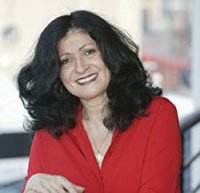 ABOUT THE AUTHOR: Judith Ortiz Cofer is an award-winning author known for her stories about coming-of-age experiences in the barrio and her writings about the cultural conflicts of immigrants. She is the author of many distinguished titles for young adults such as An Island Like You, Silent Dancing: A Partial Remembrance of a Puerto Rican Childhood, and The Line in the Sun. She was the Regents’ and Franklin Professor of English and Creative Writing at the University of Georgia. In 2010, she was inducted into the Georgia Writers Hall of Fame.
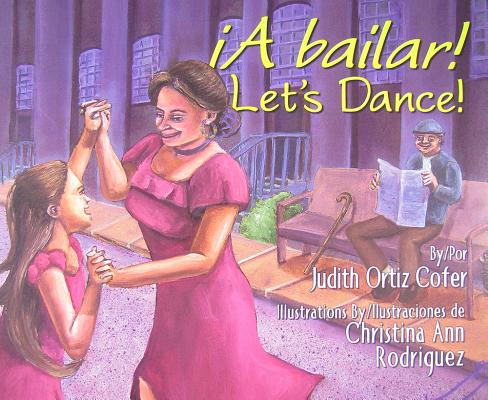 DESCRIPTION OF THE BOOK: “A bailar! There’s music in the park today—let’s dance!” Marita and her mother are finishing their Saturday chores and anticipating Papi’s salsa concert in the park that night, so Mami makes the broom her dance partner to show her daughter how to dance to the music. “Listen to the claves, the bongos, and the cowbells. Listen to the maracas, the timbales, and the giro, they will tell you how to move your shoulders, your hips, your feet.” They dance faster and faster, so fast that they fall down on the floor laughing.
 ABOUT THE ILLUSTRATOR: Christina Ann Rodriguez obtained her BFA in illustration from the University of Hartford. Her work has been included in various publications, including Spider Magazine. She lives in New Jersey.
 ABOUT THE REVIEWER: Toni Margarita Plummer is a Macondo Fellow, a winner of the Miguel Mármol Prize, and the author of the story collection The Bolero of Andi Rowe. She hails from South El Monte, a working-class suburb of Los Angeles, and worked as an acquiring editor at a major publisher for more than ten years. Toni now freelance edits and lives in the Hudson Valley with her family. Visit her website at ToniMargaritaPlummer.Wordpress.com.
 Latinxs in Kid Lit