Bilingual Border Kids: The Dilemma of Translating Summer of the Mariposas into Spanish

By David Bowles

Pretty soon after Summer of the Mariposas was published by Tu Books in 2012, teachers in the US started asking for a Spanish translation. This story of Mexican-American sisters who go on an odyssey into Mexico, confronting obstacles both supernatural and all-too-human, resonated with Latinx readers, and teachers especially wanted immigrant children and other Spanish-dominant ELLs to have full access to the narrative.

But author Guadalupe García McCall (and editor Stacy Whitman) had a very specific vision for the translation. The novel is narrated by Odilia Garza, oldest of the sisters, and it was important that her voice stay true to that of border girls like Guadalupe, even in Spanish.

Ideally, that vision meant hiring a Mexican-American from the Texas-Mexico border to translate the novel.

Five years later, Stacy approached me (full disclosure: she’s publishing a graphic novel that Raúl the Third and I created, Clockwork Curandera). I was excited at the chance to translate a book that I loved and had been teaching at the University of Texas Río Grande Valley, one written by a great friend, to boot!

Guadalupe and I dug in at once. As I translated, she was always available as a sounding board. I’ve discussed the particulars of our collaborative process on the Lee and Low Blog as well as in the journal Bookbird, but here I want to focus on a particular post-publication issue.

Some people just don’t like the translation.

Specifically, a couple of reviews—in Kirkus and elsewhere—fault the Spanish used in the translation as occasionally a “word-for-word” echo of the English, replete with Anglicisms.

Fair enough. I’m not going to actually claim there’s no truth to the critique. But there are some things you should definitely know before you leap to judgment.

The most important one is … most of that English flavor? It’s on purpose.

Quick digression. When I hear these sorts of complaints, they feel to me like code for one or more of the following: 1) this doesn’t read like typical juvenile literature written in Spanish; 2) this isn’t a recognizable Latin-American dialect of Spanish; 3) this feels too English-y in its syntax (though not ungrammatical); and 4) this has been clearly translated by someone who grew up in the US and was schooled primarily in English.

What none of those points takes into account is an obvious and pivotal fact. This book is a first-person narrative, by a Mexican-American teen. The strange Spanish? It’s how she sounds.
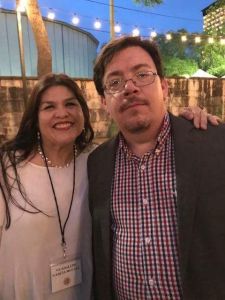
Guadalupe Garcia McCall and David Bowles

Let’s talk for a minute about Guadalupe García McCall and David Bowles. Both Mexican-American (yes, I’m half Anglo, but my family is Mexican-American and I identify as such). Both from the border (Eagle Pass/Piedras Negras versus McAllen/Reynosa). Both schooled EXCLUSIVELY in English (no bilingual education, no early efforts to promote our Spanish literacy). Both of us were robbed of that linguistic heritage. Both of us went on to earn degrees in English that we used to teach middle- and high-school English courses.

Our native dialect is border Spanish. Pocho Spanish, some would rudely put it. Rife with English syntax and borrowings, centuries-old forms and words that the rest of Latin-American might giggle or roll their collective eyes at. But it’s Spanish, yes it is. Aunque no te guste.

Now, I started studying formal Spanish in high school, then went on to minor in it for my BA and MA. I ended up teaching AP Spanish Literature for a time, etc. This process gave me a second, formal, literary dialect. I also have lived in Mexico, and I married a woman born in Monterrey. That’s where my third dialect arises, a version of Northern Mexican Spanish.

So, when I set out with Guadalupe to craft the voice of a border kid who loves to read and still has roots in Mexico, this mestizaje of Spanish dialects is what we hit upon.

It amazes me to no end that writers can do odd and/or regional dialogues all the time in English, but a similar attempt in Spanish elicits disapproving frowns.

I’m sorry, but not all books need to be translated into some neutral, RAE-approved literary Spanish. Some are so deeply rooted in a place, in a community, that we have to insist on breaking “the rules.”

To wrap this apologia up, I’ll just toss out two excerpts from chapter 8. No critic has added specifics to their negative reviews, but I will.

As a counter to the implication that the translation is too word-for-word, let’s look at this passage.

“Yup. According to this, the National Center for Missing and Exploded Children is looking for us,” Velia continued reading on.

“Exploited,” I corrected.

“What?” Velia asked, looking at me like I was confusing her.

“Exploi-t-ed, not exploded,” I explained. “The National Center for Missing and Exploi-t-ed Children.”

“Whatever,” Velia said.

Here’s the Spanish version.

—Pos, sí. Según esto, el Centro Nacional de Niños Desaparecidos y Explotados nos está buscando —continuó Velia—. Qué bueno que en nuestro caso no hay bombas.

—Claro que no hay bombas, mensa —corregí.

—¿Cómo? —preguntó Velia, mirándome como si la confundiera.

—Explotados en el sentido de “usados para cosas malas”, no explotados como “volados en pedazos por una bomba” —expliqué—. Ese centro busca a niños secuestrados, esclavizados, etcétera.

—Ah, órale —dijo Velia.

With the exception of “mirándome como si la confundiera” (someone else might’ve said “con una mirada confundida” or some other less English-y variation), the passage doesn’t ape the English at all. Sure, I can see some Spanish speakers objecting to “como si la confundiera,” expecting it to be followed by “con X cosa” (confusing her with X thing). But, yikes, this is pretty much the way lots of border folks would say it.

The other example is from the first paragraph of the chapter:

After I got back to the dead man’s houseI told Inés they were all out of newspapersthen we ate breakfast in record time.

Cuando volví a la casa del difuntole dije a Inés que ya se habían agotado los periódicos y luego desayunamos en tiempo récord.

Yes. Each part of that Spanish sentence is a (grammatically correct) mirror of its English equivalent.

Yes. There are multiple ways to have translated it more freely so that it doesn’t echo the original as much.

Yes. There are more “Mexican” ways of saying “in record time” than the (still pretty common) Anglicism “en tiempo récord.”

But that’s not what we were going for here. As a result, some people are going to not like my translation, just like some editors don’t like the peculiar voices of writers of color in English, with their code-switching and so on.

There are gatekeepers everywhere. Pero me vale.

ABOUT THE WRITER-TRANSLATOR: A Mexican-American author from deep South Texas, David Bowles is an assistant professor at the University of Texas Rio Grande Valley. Recipient of awards from the American Library Association, Texas Institute of Letters and Texas Associated Press, he has written thirteen titles, most notably the Pura Belpré Honor Book The Smoking Mirror and the critically acclaimed Feathered Serpent, Dark Heart of Sky: Mexican Myths, and They Call Me Güero: A Border Kid’s Poems. In 2019, Penguin will publish The Chupacabras of the Rio Grande, co-written with Adam Gidwitz as part of The Unicorn Rescue Society series, and Tu Books will release his steampunk graphic novel Clockwork Curandera. His work has also appeared in multiple venues such as Journal of Children’s Literature, Rattle, Strange Horizons, Apex Magazine, Translation Review, and Southwestern American Literature.
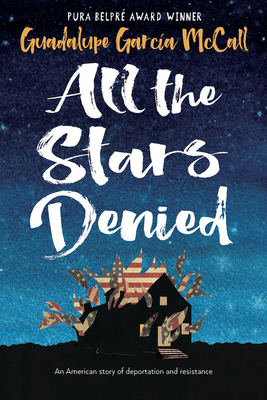
Book Review: All the Stars Denied by Guadalupe Garcia McCall


Review by Katrina Ortega

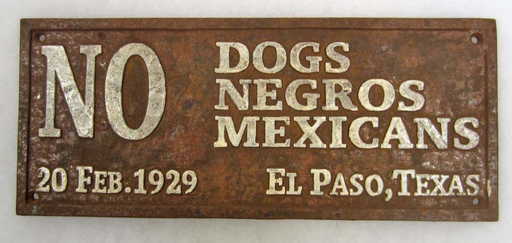
DESCRIPTION OF THE BOOK (from Lee & Low Books): In the heart of the Great Depression, Rancho Las Moras, like everywhere else in Texas, is gripped by the drought of the Dust Bowl, and resentment is building among white farmers against Mexican Americans. All around town, signs go up proclaiming “No Dogs or Mexicans” and “No Mexicans Allowed.”

When Estrella organizes a protest against the treatment of tejanos in their town of Monteseco, Texas, her whole family becomes a target of “repatriation” efforts to send Mexicans “back to Mexico” –whether they were ever Mexican citizens or not. Dumped across the border and separated from half her family, Estrella must figure out a way to survive and care for her mother and baby brother. How can she reunite with her father and grandparents and convince her country of birth that she deserves to return home?

There are no easy answers in the first YA book to tackle this hidden history. In a companion novel to her critically acclaimed Shame the Stars, Guadalupe Garcia McCall tackles the hidden history of the United States and its first mass deportation event that swept up hundreds of thousands of Mexican American citizens during the Great Depression.


Image result for no dogs or mexicans


MY TWO CENTS: The one thing not lacking in All the Stars Denied is very intense, often life-or-death, drama. Guadalupe Garcia McCall presents readers with historically accurate situations and characters and environments that many readers may connect with deeply. The story is also full of incredibly high stakes, and ultimately can be read as a coming-of-age story.

All the Stars Denied is fast-paced, and readers hit the ground running with Garcia McCall’s high-stakes, dramatic writing. Estrella Del Toro’s family’s story, particularly that of her parents, is spelled out more clearly in Shame the Stars. The story takes place in the Rio Grande valley, an area of Texas where Mexican-American or Tejano (Mexican-Americans born in Texas) identity is often built into every capacity of life. As Estrella illustrates early in the story, language in an area like Monteseco is fluid, with people switching from English to Spanish easily, as their Mexican and American identities interact. Estrella organizes her protest to show the injustices shown to people born on American soil but of (sometimes very distant) Mexican descent. This not only recognizes that, though the people of her town are U.S. citizens, their ethnicity and culture bring their citizenship into question. This also demonstrates the inseparability of ethnicity and culture of many people in Latinx communities in the U.S.

Garcia McCall’s attention to these details is especially critical in today’s political and social climate. She demonstrates how intertwined the lives of many Mexicans and Mexican-Americans are, and how similar the cultures continue to be throughout the United States. Through this, Garcia McCall exemplifies the extensive presence, scrutiny, and discrimination that Mexicans and Mexican-Americans have had in the United States for many decades.

Garcia McCall also addresses class issues in her book; readers take a close look at the disparities between economic and social classes through Estrella’s experience as a repatriate. The reader gets the impression that the family is quite comfortable in Monteseco and holds both economic and social prestige in their community. During the repatriation process, though, Estrella is thrust into the very real experience of those who do not have the economic means to save themselves from unfair judicial processes. She, along with her mother and younger brother, experience a disarmament of sorts, where anything they might have been able to use to help their cause is denied to them. Throughout their journey, Estrella’s mother tries to soften the blows of their newfound economic hardship, reminding Estrella that much of what they experience is the norm for populations more socially or economically disadvantaged than they are. Estrella learns to appreciate their newfound situation, humbles herself, and works with her mother in any way she can to make sure their family survives another day.

The points made above all contribute to the way in which All the Stars Denied is a Bildungsroman, a coming of age story about a young girl who grows exponentially as a person because of the difficult, unjust, and discriminatory situations she experiences. Estrella repeatedly looks to her family for direction through her father’s journals, her mother’s sage advice, and her grandmother’s memory, and she uses her own journal to express her thoughts and emotions. Even still, and regardless of her young age, Estrella takes a leadership role throughout the narrative. The reader can see Estrella’s development by the way that she creates plans and ideas. Though her proposals might be half-baked, Estrella’s consistently trying to help her mother, putting herself in positions to listen and learn from others to the great benefit of her family. While Estrella’s outspokenness might arguably lead to more scrutiny upon her family, her growing courage – and her notorious tenacity – assist her family in so many different ways and helps her to become a person that not only her family can be proud of, but one that she can be proud of herself.


Mexican and Mexican-American families wait to board Mexico-bound trains in Los Angeles on March 8, 1932. County officials arranged these mass departures as part of “repatriation campaigns,” fueled by fears that Mexicans and Mexican-Americans were taking scarce jobs and government assistance during the Great Depression.
Los Angeles Public Library/Herald Examiner Collection. Posted on NPR’s website 2015.


TEACHING TIPS: In All the Stars Denied, as in Shame the Stars, Garcia McCall shows readers why Mexican American studies is an incredibly important part of any school curriculum, but especially in areas of the country where a majority of the population either comes from or is descended from Latinx countries. Both books stand on their own. By reading both novels, the reader learns about a slice of history not often taught, and is able to do so in both a macro- and microscopic way. In All the Stars Denied, readers see the damage that Mexican Repatriation did to entire communities in cities across the country, as well as to individuals and their families. The life-and-death stakes were real, and this book is an excellent way to introduce not only the chaos caused by terrible discrimination in general, but specifically the destruction caused by unjust immigration laws and xenophobia.

The novel can also teach about the economic hardships experienced around the country as a result of the Great Depression. Much of what Estrella’s family faces during their time in limbo is a result of their lack of monetary resources, but also the lack felt by both the U.S. and Mexico.

Though not the only two teaching tips in the book, these points can easily be used to jump into more contemporary conversations, looking at ways in which present day immigration laws and current economic policies create waves of hardship experienced by many already disenfranchised communities. The resources that Garcia McCall includes in the appendices give excellent background information that is accessible and of significant interest to both youth and adult historians interested in learning about this piece of concealed history.

Posted on Lee & Low Books’ websiteJacqueline Stallworth, curriculum consultant and professional developer, created a guide featuring All the Stars Denied for the “Putting Books to Work” panel at the International Literacy Association (ILA) conference. Check out this guide to find out about tips and strategies for how to use All the Stars Denied alongside other great texts in your classroom.


ABOUT THE AUTHOR (from Lee & Low Books): Guadalupe Garcia McCall was born in Mexico and moved to Texas as a young girl, keeping close ties with family on both sides of the border. Trained in Theater Arts and English, she now teaches English/Language Arts at a junior high school. Her poems for adults have appeared in more than twenty literary journals. McCall is an up-and-coming talent whose debut YA novel, Under the Mesquite, won the Pura Belpré Award and was named a Morris Award finalist. McCall lives with her husband and their three sons in the San Antonio, Texas, area. You can find her online at guadalupegarciamccall.com.


FullSizeRenderABOUT THE REVIEWER: Katrina Ortega (M.L.I.S.) is the Young Adult Librarian at the Hamilton Grange Branch of the New York Public Library. Originally from El Paso, Texas, she has lived in New York City for six years. She is a strong advocate of continuing education (in all of its forms) and is very interested in learning new ways that public libraries can provide higher education to all. She is also very interested in working with non-traditional communities in the library, particularly incarcerated and homeless populations. While pursuing her own higher education, she received two Bachelors of Arts degrees (in English and in History), a Masters of Arts in English, and a Masters of Library and Information Sciences. Katrina loves reading most anything, but particularly loves literary fiction, YA novels, and any type of graphic novel or comic. She’s also an Anglophile when it comes to film and TV, and is a sucker for British period pieces. In her free time, if she’s not reading, Katrina loves to walk around New York, looking for good places to eat.
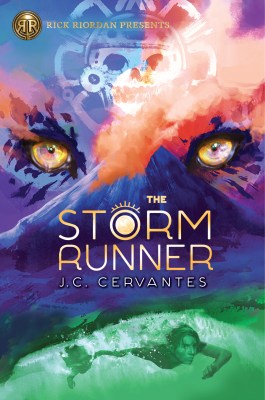
An Interview with J.C. Cervantes, Author of The Storm Runner


By Cecilia Cackley

The Storm Runner, which releases tomorrow, is the first book inspired by Latinx culture under the new Disney imprint Rick Riordan Presents. As in Rick Riordan’s many other series, it features a pre-teen who gets pulled into adventures with various gods and mythological creatures. I was able to talk to J.C. Cervantes about her process writing the book and what it’s like to be part of the Rick Riordan Presents team.

Q: How did you get connected with Rick Riordan and his imprint?

A: My agent sent me a well-timed email as soon as Disney sent out the Rick Riordan Presents announcement. I happened to have a story in mind that had been lingering in the vault. I nearly squealed with excitement. So, I polished the first three chapters and synopsis and after my agent submitted, we got a call the next day! What was it like working with him? Intimidating. Surreal. Amazing. Terrifying. Thrilling. Humbling. All of the above?

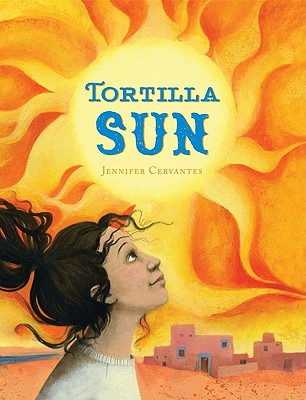
Q: The Storm Runner is an adventure novel, whereas your debut Tortilla Sun is a family story set in a close-knit village. Was your writing process for each book different in terms of plotting and character development? 

A: It was totally different. When I wrote Tortilla Sun, I had never written a book before so there was sort of an innocent navigating my way through the thorny dark with no idea where I was going vibe. But I had more experience by the time I wrote The Storm Runner and had already forced (yes, forced) myself to learn how to outline and plot in ways that I had been SO resistant to before.

Q: What was your research like for this book, not just the Maya aspects to the story, but also for your protagonist with a physical disability?

A: I relied on stories my grandmother told me to get me started and then hit the books (eight plus) to really challenge what I thought I knew. Interestingly, there were discrepancies even between texts. Additionally, I worked with two Mayanists, specifically on language aspects and pronunciation. I also watched several documentaries. One of the great challenges with learning more about the Maya and their pantheon is that most of their ancient written records were destroyed by the Spanish.

In terms of writing a child with a disability, it was important to me that his disability not define him, that I be mindful of the visibility and invisibility of his experiences and his feeling that he didn’t belong. So, I drew on personal experience with people/children I know with disabilities, but I also worked closely with a special education scholar who has dedicated her life to teaching and working with kids with disabilities. She read the manuscript as well to ensure I remained mindful and aware of my character and his experience in an authentic way.

Q: For kids who read this book and immediately want to learn more about Maya culture and cosmo-vision, what books or resources would you point them towards?

There are so many amazing books out there but depending on age range I would recommend the Popol Vuh, The Pocket Dictionary of Aztec and Mayan Gods and Goddesses, The Illustrated Encyclopedia of Aztec and Maya, the Lost History of the Aztec and Maya, and for fun, a picture book titled: You Wouldn’t Want to be a Mayan Soothsayer. There are also some really wonderful videos on YouTube like The Underworld of the Mayan Gods produced by the History channel. Warning: it’s pretty creepy!

Q: Middle grade has for a long time been the age category with the least Latinx representation. That feels like it’s starting to change, with high-profile debuts from people like Celia Perez and Pablo Cartaya and now your addition to an imprint from a middle grade superstar. What advice do you have for other Latinx writers who want to write for middle grade readers?

A: Begin with what you know, what you grew up with. Tap into the magic that is so prevalent in our cultures and let that carry you through the story. Don’t let anyone tell you that your experience doesn’t matter or isn’t ______ enough (fill in the blank) or doesn’t align with the “norm.” Read loads of books, especially diverse titles, mentor, and support diverse writers. Be authentic. And above all honor the kids you write for. They are smart and funny and so eager to see themselves and their lives reflected in the pages of books.


ABOUT THE AUTHORAbout the author: Jen Cervantes is an award-winning children’s author. In addition to other honors, she was named a New Voices Pick by the American Booksellers Association for her debut novel, Tortilla Sun. The Storm Runner‘s sequel, entitled The Fire Keeper, is slated for release in 2019. Keep up with Jen’s books and appearances at her official site.

Jen is also a member of Las Musas, the first collective of women and non binary Latinx MG and YA authors to come together in an effort to support and amplify each other’s debut or sophomore novels in US children’s literature. You can learn more about them by here.


ABOUT THE INTERVIEWER: Cecilia Cackley is a performing artist and children’s bookseller based in Washington DC, where she creates puppet theater for adults and teaches playwriting and creative drama to children. Her bilingual plays have been produced by GALA Hispanic Theatre and her interests in bilingual education, literacy and immigrant advocacy all tend to find their way into her theatrical work. Learn more at http://www.witsendpuppets.com.
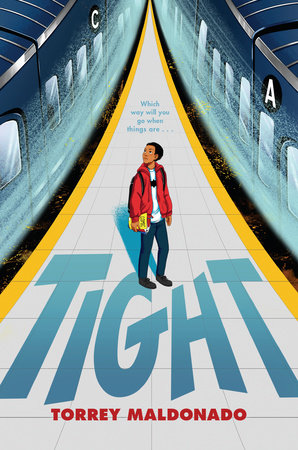
Book Review: Tight by Torrey Maldonado

.

This review by Lila Quintero Weaver is based on an advance uncorrected galley.

PUBLISHER’S DESCRIPTION: Bryan has a good idea of what’s tight to him—reading comics, drawing superheroes, and hanging out with no drama. But “no drama” doesn’t come with the territory of where he’s from, so he’s feeling wound up tight. While his mom encourages his calm, thoughtful nature, his quick-tempered dad says he needs to be tough because it’s better for a guy to be feared than liked.

And now Bryan’s new friend Mike is putting the pressure on—all of a sudden, his ideas of fun are crazy risky. When Bryan’s dad ends up back in jail, something in Bryan snaps and he allows Mike to take the lead. At first it’s a rush as Bryan starts cutting school and subway surfing. But Bryan never feels quite right when he’s acting wrong, and Mike ends up pushing him too far.

Fortunately, if there’s anything Bryan has learned from his favorite superheroes, it’s that he has the power to stand up for what he believes.

MY TWO CENTS: Starring an Afro-Puerto Rican character from Brooklyn, NY, this entertaining middle-grade novel is a brilliant read layered with emotional richness and nuance. Along with its primary selling point as a solid and strongly voiced story, Tight delivers an important but subtly threaded message on self-respect and moral courage. Bryan’s internal wrestling match, one brought on by a questionable friendship, lies at the crux of the story. In the hands of a lesser writer, this story line could have easily devolved into a morality play. But Maldonado avoids such cardboard cutouts in favor of a skillfully crafted portrait of a relatable middle-grader facing down his vulnerabilities and learning how to choose the higher road.

Sharply drawn from head to toe, Bryan is a sympathetic character with a mounting dilemma that begins as soon as a boy named Mike makes his appearance. Initially, Bryan feels suspicious of the new boy, but lets go of those reservations when Mike reveals a kindred love of superhero comic books. Still, subtle things about Mike continue to nag at Bryan, setting up an undercurrent of mistrust. As Mike works his charisma on Bryan, gradually opening doors to dangerous and alluring pastimes, Bryan begins to rationalize his original misgivings. To complicate matters, things on the home front are going south, too. Bryan’s father, who’s recently gotten out of jail, seems to be courting trouble again, putting the whole family in a state of tension.

Although at times Bryan succumbs to risky behavior, he seems most like himself when the drama is dialed way down. He actually relishes the peace and quiet of his “office,” an unused desk at his mother’s workplace, where he spreads out his homework. In this vein, we also witness him happily chatting on a park bench with his mom, who he endearingly refers to as “my heart.”

You cannot help but love Bryan. He reads as a real boy, with a real life, and a rings-true voice that expresses rich interiority. But as if to test his tender side, Bryan’s world is complicated by the code of machismo. At his school and in his neighborhood, the message telegraphed at boys is don’t be soft. This refrain of warped masculinity features in many a Latinx treatment. Fortunately, Maldonado lifts the story above such tropes by enlivening Bryan with contradictory currents and introducing fresh possibilities that will keep readers on their toes.

Other elements of Latinx life include food (chicharrones, alcapurrias) and observations on ethnic identity. In an early scene, Bryan reveals that he purchased the new Miles Morales Spider-Man comic because “he’s my age and looks like me. He’s half black and half Puerto Rican. I’m full Rican but heads rarely guess right.”

It’s obvious that Bryan has a lot on his plate. Here he is at the corner bodega presenting a note from his mom, in which she appeals for store credit.

When I finally have everything, I go to the counter. Hector checks if the list matches what I got. I can’t have nothing extra.

I stare back at the chocolate powder we can’t afford to buy. Chocolate milk tastes so good.

Right then, this girl Melanie from my school comes in and watches as Hector bags my stuff and hands me a Post-it. “This is how much your father owes.”

Dang! Why’d he have to mention us owing money? I nervous-smile at Melanie, and just like I thought, she eyes me all in my sauce and trying to know the flavor.

What’s for her to figure out? I’m a broke joke.

Does it need pointing out that Maldonado nails the art of voice?

In addition, he commands a spare approach to description, choosing a handful of small details for the sizzle they bring. One of my favorite examples of colorful scene-setting occurs when Bryan and Mike pass through a crowded train station. “Mike ducks under a turnstile and races up the steps. ‘PAY YOUR FARE!’ the teller’s voice yells through the microphone in the MetroCard booth. It sounds extra scary because it’s all metallic, like Darth Vader’s voice.”

This is a novel that kid readers across the board will go for, and that readers hungry for Afro-Latinx representation will cheer on. In Bryan, Maldonado has created a vivid, relatable character with a lot going on between his ears. He has also built a fascinating and realistic world for this character to occupy, and spun a story that packs punch, enclosing within it hidden, but never preachy, lessons about life and love and healthy self-respect.

IMG_5888ABOUT THE AUTHOR:  What do you get from teaching nearly 20 years in a middle school in the Brooklyn community that you’re from & you’re an author? Gripping relatable novels and real-life inspiration. Voted a “Top 10 Latino Author” & best Middle Grade & Young Adult novelist for African Americans, Torrey Maldonado was spotlighted as a top teacher by NYC’s former Chancellor. Maldonado is the author of the ALA “Quick Pick”, Secret Saturdays, that is praised for its current-feel & timeless themes. His newest MG novel, Tight, is a coming of age tale about choosing your own path. Learn more at torreymaldonado.com

Click here to see our recent Q&A with Torrey Maldonado.


ABOUT THE REVIEWER: Lila Quintero Weaver is the author of a graphic memoir, Darkroom: A Memoir in Black & White, and a novel for kids, My Year in the Middle. Connect with her on Twitter, where her handle is @LilaQWeaver.


Spotlight on Middle Grade Authors Part 6: Torrey Maldonado


We are back from our summer break with lots of great, new interviews, book reviews, and events planned. We start today with a Q&A with middle grade author Torrey Maldonado, who is celebrating the release of his latest novel, Tight.

By Cindy L. Rodriguez

This is the sixth in an occasional series about middle grade Latinx authors. We decided to shine a spotlight on middle grade writers and their novels because, often, they are “stuck in the middle”–sandwiched between and overlooked for picture books and young adult novels. The middle grades are a crucial time in child development socially, emotionally, and academically. The books that speak to these young readers tend to have lots of heart and great voices that capture all that is awkward and brilliant about that time.

Today, we highlight Torrey Maldonado. And it’s an extra-special day because…

Torrey’s latest novel, Tight, releases TODAY!!

HAPPY BOOK BIRTHDAY, TORREY!!


Here’s a description of the novel: Bryan knows what’s tight for him–reading comics, drawing superheroes, and hanging out with no drama. But drama is every day where he’s from, and that gets him tight, wound up.

And now Bryan’s friend Mike pressures him with ideas of fun that are crazy risky. At first, it’s a rush following Mike, hopping turnstiles, subway surfing, and getting into all kinds of trouble. But Bryan never really feels right acting so wrong, and drama really isn’t him. So which way will he go, especially when his dad tells him it’s better to be hard and feared than liked?

But if there’s one thing Bryan’s gotten from his comic heroes, it’s that he has power–to stand up for what he feels.

Torrey Maldonado delivers a fast-paced, insightful, dynamic story capturing urban community life. Readers will connect with Bryan’s journey as he navigates a tough world with a heartfelt desire for a different life.

IMG_5888

And here’s more about Torrey: What do you get from teaching nearly 20 years in a middle school in the Brooklyn community that you’re from & you’re an author? Gripping, relatable novels and real-life inspiration. Voted a “Top 10 Latino Author” & best Middle Grade & Young Adult novelist for African Americans, Torrey Maldonado was spotlighted as a top teacher by NYC’s former Chancellor. Maldonado is the author of the ALA “Quick Pick”, Secret Saturdays, that is praised for its current-feel & timeless themes. His newest MG novel, Tight, is a coming of age tale about choosing your own path. Learn more at torreymaldonado.com


And now, here’s our Q&A with Torrey Maldonado:

Q. Who or what inspired you to become a writer?

image1

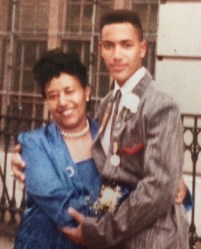
Torrey and his mom. Photo given by Torrey Maldonado.

A:  My mom inspired me to become a writer. When I was a boy, maybe no taller than a fire hydrant with my Jackson 5 Afro probably bigger than my head, she told me, “I read out loud to you when you were in my belly.” But a lot fought against my Mom trying to build me into a reader and writer. In the Brooklyn Red Hook housing projects, where I was born and raised, and in lots of neighborhoods, boys were and are bullied for our bookishness, and it happened to me. Currently, a buzz-phrase is “safe spaces.” My mom made our apartment my safe space to be bookish. The rapper 50 Cent’s debut album was Get Rich or Die Tryin’. My mom’s attitude was “Get My Kid into Lit or Die Tryin’.” My whole life, her apartment was the only in our projects where I saw a library. For being bookish, I got bullied outside and in school, then cuddled with Ma on our couch as she read to me. When she read and wrote, her eyes always smiled. As I got older, she took me far out of our projects to authors’ readings. She is my heart, loved writing, and admires writers. My motto is “Kids will be what they see,” and it’s fitting that I followed her footsteps. I represent her writing-spirit out in the world.


Q. Why do you choose to write middle grade novels?

A. I have taught middle school for nearly twenty years. I see my students as me at their ages. The middle school years are “crossroad years” where tweens need direction. Plus, so much of their awesomeness should be spotlighted. I see them unplug from books because a lot of required readings aren’t culturally responsive mirrors and windows. It inspires to give my students and other middle schoolers essential books that I needed at their ages. Pretty cool related news: a teacher recently tweeted that Tight is the “most essential reading for middle grade teachers recommending books to their readers this fall.” Let’s hope my middle students and others agree.


Q. What are some of your favorite middle grade novels?

A.  My favorite middle grade novels do for readers what my favorite books did for me. Best books are a fleeting magic carpet-ride out of problems yet show kids the magic around them. They help kids feel that their world is bigger than their zip code. Also, my favorite middle school books are culturally responsive mirrors and windows. Some think books fall in different categories: windows here and mirrors over there. My favorite middle grade books are both windows and mirrors.


Q. If you could give your middle-grade self some advice, what would it be?

image1 (1)

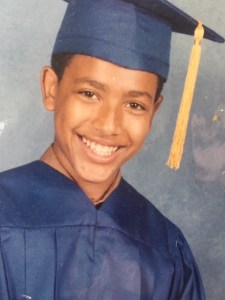
Torrey in middle school. Photo given by Torrey Maldonado.

A. What I’m about to share is what I wish I knew sooner because it would’ve steered me from drama and sped me toward my life goals faster. Here’s my advice: accept and develop all helpful sides of you and know how to code-switch, meaning switch what you show others depending on where you are. My characters of Tight do that. Here’s why accepting and developing all helpful sides of you matters. That perfect person you see over there? They’re not perfect. Everyone is not perfect. That’s a reason Insecure on HBO by Issa Rae is a hit. On it, Issa is herself, a mess, insecure, and quirky with many sides. Millions of people and I love her because we relate. Now, here’s the thing about accepting and “doing you”—you have to know how to code-switch. Issa code-switches when she talks to her boss because she knows what Bryan in Tight knows—you can’t show all of you all of the time. President Obama kicked slang with Jay-Z and Beyoncé then spoke mainstream American English in his White House meetings with advisors. Why code-switch? You see in Tight how you need to shield your candle flame so know one blows it out. Code-switching is a shield. Then the right time comes when you can bring out and shine a different light and others will welcome it. People shielded my light until I learned to shield it, and it helped me be a bullied bookish, insecure, quirky boy who developed his many sides on the DL. In time, I grew into a published book author who is lucky to be invited to shine and share light in cool interviews like this one.


Q. Please finish this sentence: Middle grade novels are important because…

A. Middle grade novels are important because middle school youth are awesome, multidimensional, heroic in many ways and all of that should be spotlighted.


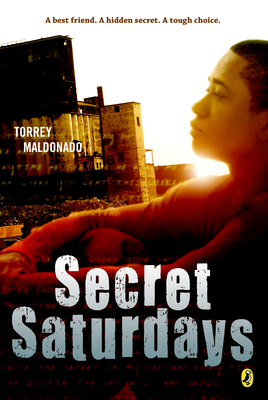
Torrey’s novels:


photo by Saryna A. JonesCindy L. Rodriguez was a newspaper reporter for The Hartford Courant and researcher at The Boston Globe before becoming a public school teacher. She is now a reading specialist at a Connecticut middle school. Cindy is a U.S.-born Latina of Puerto Rican and Brazilian descent. She has degrees from UConn and CCSU. Her debut contemporary YA novel, When Reason Breaks (Bloomsbury 2015). She also has an essay in Life Inside My Mind (Simon Pulse 2018). She can be found on FacebookTwitter, and Goodreads.

Cover Reveal of Juana & Lucas: Big Problemas


Today we are thrilled to share the cover of Juana & Lucas: Big Problemas by Juana Medina!

Juana Medina’s Juana & Lucas, the abundantly illustrated story of a young Colombian girl and her beloved dog, received wide acclaim (and a Pura Belpré Award) when it was published in 2016, with critics praising Medina’s playful interweaving of Spanish and English words, text, and images. Now Juana will return in Juana & Lucas: Big Problemas, due out in May 2019 from Candlewick Books. A description of the new book and the exclusive cover reveal are below!

Description:

When her mami meets someone new, Juana worries that everything will change in a humorous, heartwarming follow-up to the Pura Belpré Award–winning Juana & Lucas.

Juana’s life is just about perfect. She lives in the beautiful city of Bogotá with her two most favorite people in the world: her mami and her dog, Lucas. Lately, though, things have become a little less perfect. Mami has a new hairdo and a new amigo named Luis with whom she has been spending a LOT of time. He is kind and teaches Juana about things like photography and jazz music, but sometimes Juana can’t help wishing things would go back to the way they were before. When Mami announces that she and Luis are getting married and that they will all be moving to a new casa, Juana is quite distraught. Lucky for her, though, some things will never change — like how much Mami loves her. Based on author-illustrator Juana Medina’s own childhood in Colombia, this joyful series is sure to resonate with readers of all ages.

And now for the cover reveal!

Scroll down…

*

*

*

*

SCROLL some more…

*

*

*

*

*

Keeping scrolling…

*

*

*

*

What anticipation!

*

*

*

Ta-da! Here it is!


Photo by Silvia Baptiste

About the author: Juana Medina is a native of Colombia, who studied and taught at the Rhode Island School of Design. Her illustration and animation work have appeared in U.S. and international media. Currently, she lives in Washington, DC, and teaches at George Washington University. As a children’s illustrator, she has received wide acclaim and significant honors, including the 2017 Pura Belpré Medal for Juana & Lucas. Please don’t miss our studio visit with Juana! See more of her  work at her official website.