
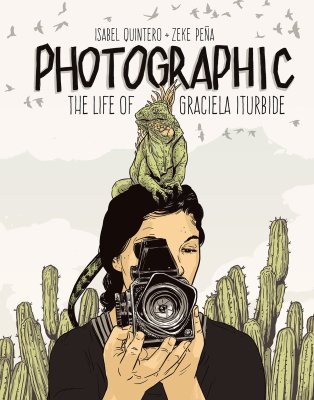
Reviewed by Lila Quintero Weaver
DESCRIPTION OF THE BOOK: “I see reality in another way with a camera. Looking through the lens, I peer into another world…”
Born in Mexico City in 1942, Graciela Iturbide wants to be a writer, but her conservative family has a different idea. Although she initially follows their wishes, she soon grows restless. After tragedy strikes, she turns to photography to better understand the world. The photographic journey she embarks on takes her throughout Mexico and around the globe, introducing her to fascinating people and cultures, and eventually bringing her success and fame. With more than two dozen photographs by Iturbide herself, Photographic explores the question of what it means to become an artist.
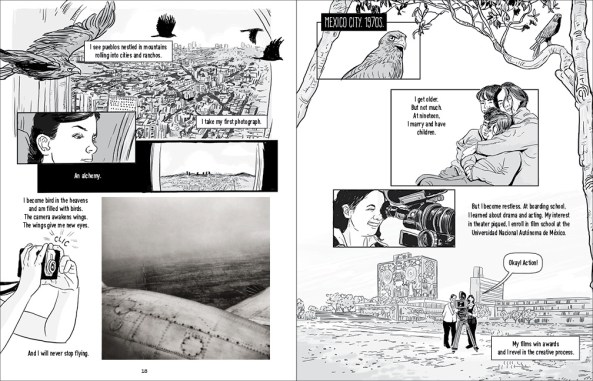
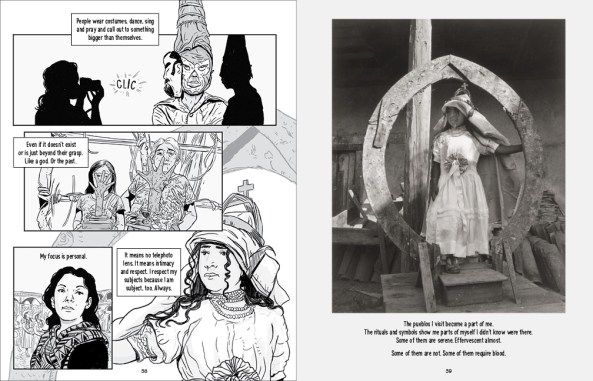
MY TWO CENTS: Photographic is a lively and compelling celebration of the life and work of critically acclaimed Mexican photographer Graciela Iturbide. Young readers and fans of nonfiction graphic novels will devour it. I certainly did. Written by poet-novelist Isabel Quintero and illustrated by Zeke Peña, this slender graphic novel from Getty Publications tells its stories through an arresting blend of text and photocomics. Not many graphic novels attempt Photographic‘s approach—that is, placing reproductions of Iturbide’s camerawork alongside Peña’s pen-and-ink drawings. Then again, Photographic is no routine examination of an artist’s life. Guided by Quintero’s lyrical narrative, it also offers a powerful and disarming time capsule of Mexico’s cultural and social glories, as encountered by Iturbide during her photographic journey.
Photographic‘s pictorial narrative crisscrosses decades, allowing readers to peer through Iturbide’s lens as she traverses the geographic spine of Mexico, ventures across the border into Latinx communities in the United States, and on to international settings. The story flows from present-day views of Iturbide to flashes of her youth, when her father buys her a Brownie camera. It resumes in young womanhood, as she studies under photography master Manuel Álvarez Bravo. From there, we witness the continuing evolution of the artist as she undertakes a series of photographic projects.
Courtesy of Getty Publications
Iturbide possesses a selective eye, one that ennobles the disregarded and humble. This is most evident in her deeply humanizing portraits of people found along the margins of society. Such subjects include young men in Tijuana whose tattooed bodies read like a codex, as well as Juchitán’s “muxes, who are both men and women at the same time,” as Quintero explains in the text.
Iturbide’s range of subjects is wide. She occasionally photographs mammals and reptiles, but birds dominate this area of interest. In her photos, they appear singly and in flocks, on perches and in flight, as living creatures and as dusty, feathered bodies. Echoing this passion, Quintero skillfully adopts avian motifs to express some of the most elusive aspects of Iturbide’s photographic instinct.
Each time I look through the viewfinder I see myself…
I use my bird sight to see the fragments. The camera as mirror as bird eye.
And I with eyes to fly.
Always midflight.
I look to the skies.
Birds like shifting stars and all of them speaking to one another—telling different stories. Wings spread and reverberate until silence.
Courtesy of Getty Publications
Although Iturbide resists being labeled magical or surrealist, her art unquestionably plays along the edges of reality. Even when photographing everyday objects, the images she captures teem with mystery and questions. A notable example is her work at Casa Azul, the house of Frida Kahlo and Diego Rivera. There, in the bathroom, which was sealed after Kahlo’s death for fifty years, Iturbide’s camera brings our attention to porcelain fixtures, detached leg braces and corsets. Although composed of ordinary objects, these tableaus wordlessly communicate Kahlo’s physical suffering and bring into sharper relief the triumph of her immense contributions.
Iturbide’s portraits of uncelebrated women are among her greatest achievements. In one striking photograph, four young women from East Los Angeles pose in front of a mural devoted to Mexican revolutionary and political figures Zapata, Juárez, and Pancho Villa. In their defiant expressions and unapologetic stances, these women testify to the subversive spirit that lives on in their community. Even more startling is Iturbide’s documentation of Juchitán, a city in Oaxaca whose inhabitants are chiefly Zapotec, and where for generations, women have called the shots. “In Juchitán, women drive commerce, and men ask for an allowance.” Out of this matriarchal setting comes one of Iturbide’s most unforgettable photographs, a portrait of a market vendor wearing a crown of live iguanas. Zobeida, as she is identified, is rendered mythical, regal, an image for the ages, La Medusa Juchiteca. Yet Zobeida is a flesh-and-blood woman, making a living selling her wares and not anyone seeking immortality as a goddess. Iturbide’s camera lens frames these dual realities. She has learned how to see what many others miss— a reflex she cannot help but exercise in one after another iconic photograph.
And now, Photographic has brought Iturbide’s empathetic, ennobling, and powerful art to young readers and fans of the graphic novel. It’s no small order to synthesize a lifetime of artistic growth and achievement, but this book delivers, thanks to the wonderful collaborative work of Isabel Quintero and Zeke Peña, who are impressive artists in their own right, with rich futures in their respective fields.
TEACHING TIPS: For middle school or high school, Photographic could be used as a supplementary text for the study of Latinx/Mexican culture and sociology, as well as in biographical examinations of artists and their working methods.
In addition to its broader classroom potential, Photographic suggests fresh approaches to the teaching of photography. Borrowing from themes found in its pages, here are some shooting assignments to consider: 1. Go on the hunt for a naturally occurring still life (not staged). 2. Locate a striking landscape or urban-scape that most people would pass by without noticing. 3. Scour your world for intriguing human faces—not necessarily pretty ones—and take care to photograph them with respect and dignity. 4. Include a self-portrait. For inspiration, examine Iturbide’s revelatory photos of herself, which offer strong and original counterpoints to the superficial selfie.
In addition, every frame of Iturbide’s work demonstrates principles of design and composition. Ask students to study her photos for their use of negative space, symmetry, asymmetry, minimalism, close ups, and judicious cropping—then have them pull out their cameras and emulate.
Finally, the wonderful teaching blog Vamos a Leer has published a preview of Photographic, which includes links to many resources, including interviews with Isabel Quintero and Zeke Peña. Don’t miss it!
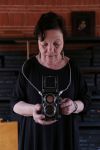
ABOUT THE SUBJECT: Graciela Iturbide lives and works in Mexico City, where she was born. Her photography enjoys worldwide acclaim and has received major international prizes. It is often the subject of solo exhibitions at heralded art centers, such as the Philadelphia Museum of Art, the Paul Getty Museum, and the Centre Pompidou. Learn more about Iturbide’s life and view galleries of her work by visiting her official website. Photo by Christopher Sprinkle
 ABOUT THE AUTHOR: Isabel Quintero is a poet and novelist of Mexican heritage, born in California. She is best known for her trailblazing Gabi, a Girl in Pieces (Cinco Punto Press, 2014), winner of the 2015 William C. Morris Award for YA Debut Novel and many other distinctions. It was reviewed on Latinx in Kid Lit by Sonia Alejandra Rodriguez. Follow Isabel’s writing journey on her blog.
 ABOUT THE ILLUSTRATOR: Zeke Peña is a comics artist and illustrator from El Paso, Texas. Among his many book covers, Zeke is the artist behind the powerful cover of Gabi, a Girl in Pieces. Explore his illustration and painting galleries at his website.
ABOUT THE REVIEWER: Lila Quintero Weaver (no relation to Isabel Quintero) is one of the founding bloggers of Latinxs in Kid Lit. She wrote and illustrated a graphic memoir, Darkroom: A Memoir in Black & White, and will release My Year in the Middle, her first children’s book, on July 10, 2018. Learn more about her work here.
 Reviewed by Lila Quintero Weaver
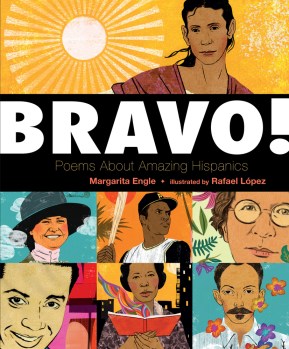
 ABOUT THE AUTHOR: Margarita Engle is the national
  ABOUT THE ILLUSTRATOR: Rafael López, who was born in Mexico City, is an internationally recognized illustrator and artist. A children’s book illustrator, he won the 2016 Pura Belpré medal from the American Library Association for his illustrations for
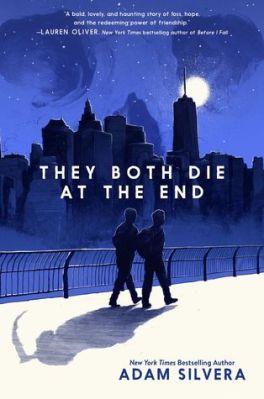 FROM THE BOOK JACKET: In the tradition of Before I Fall and If I Stay, this tour de force from acclaimed author Adam Silvera, whose debut the New York Times called “profound,” reminds us that there’s no life without death, no love without loss—and that it’s possible to change your whole world in a day.
 ABOUT THE AUTHOR: Adam Silvera was born and raised in the Bronx. He has worked in the publishing industry as a children’s bookseller, marketing assistant at a literary development company, and book reviewer of children’s and young adult novels. His debut novel, More Happy Than Not, received multiple starred reviews and is a New York Times bestseller. Visit his
 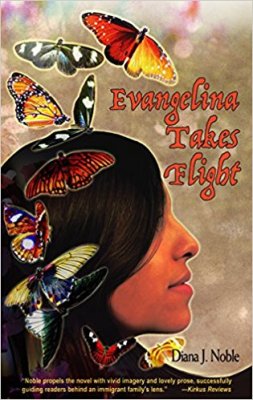 DESCRIPTION FROM THE BOOK JACKET: It’s the summer of 1911 in northern Mexico, and thirteen-year-old Evangelina and her family have learned that the rumors of soldiers in the region are true. Her father decides they must leave their home to avoid the violence of the revolution. The trip north to a small town on the U.S. side of the border is filled with fear and anxiety for the family as they worry about loved ones left behind and the uncertain future ahead.
 ABOUT THE AUTHOR: Diana J. Noble was born in Laredo, Texas, and grew up immersed in both Mexican and American cultures. Her young adult novel, Evangelina Takes Flight, is based loosely on her paternal grandmother’s life, but has stories of other relatives and memories from her own childhood woven into every page. It’s received high praise from Kirkus Reviews, Forward Reviews (5 stars), Booklist Online and was recently named a Junior Library Guild selection. [Condensed bio is from the
  ABOUT THE REVIEWER: Cris Rhodes is a doctoral student at Texas A&M University – Commerce. She received a M.A. in English with an emphasis in borderlands literature and culture from Texas A&M – Corpus Christi, and a B.A. in English with a minor in children’s literature from Longwood University in her home state of Virginia. Cris recently completed a Master’s thesis project on the construction of identity in Chicana young adult literature.

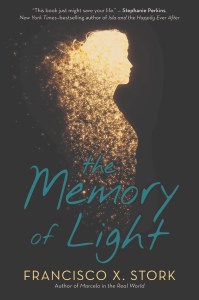
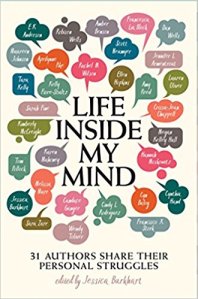 a creator stay focused on your projects, all the while managing the challenges of depression?
 FXS: Finding Cheryl Klein was either a blessing or very fortunate depending on your world view. Writing is both solitary and communal and on the communal side my writing got exactly what it needed when it got Cheryl. Her editorial genius complemented all my writing lacks while allowing me to remain true to my writing voice and my writing vision (and reminding me of that voice and vision when I strayed). Yes, there were many times when the editing process was very hard and even at times discouraging but I never lost faith that Cheryl wanted what was best for the book and for the future reader and that kept me going. What I would like to convey to young writers is that they do all they can to enjoy the actual process of writing, of being alone with the work, and have patience with regards to the results they hope to attain. Those results may or may not come, but the process of creating a work that is beautiful and true is still worth the effort. Most of all, find a way to tell your story that is unique to you. Finding that uniqueness takes a lot of honesty and it takes a lot of practice and all the mistakes and rejections that you get will only make you a better writer and a better person if you see writing not as the publication of a book or the recognition that comes with it but as a way of life you are called to live.
 FXS: I’m re-reading Rudolfo Anaya’s Bless me, Ultima. Rudolfo Anaya is in many ways the father of Mexican-American literature and there is so much to learn from him about the presentation of the Mexican-American experience in a novel. One of my favorite books I always recommend to YA writers is The Book Thief by Markus Zusak because, well, there’s an author who found a way to tell an interesting story about a serious situation in a unique way. But I would also encourage YA writers to read all kinds of books, not just YA. Read fiction and non-fiction works that have nothing to do with what you are writing and you will be surprised by how they ultimately do. Read especially those books where the author’s soul touches yours.
 Francisco X. Stork is the author of Marcelo in the Real World, winner of the Schneider Family Book Award for Teens and the Once Upon a World Award; The Last Summer of the Death Warriors, which was named to the YALSA Best Fiction for Teens list and won the Amelia Elizabeth Walden Award; Irises; and The Memory of Light, which received four starred reviews. He lives near Boston with his wife. You can find him online at
 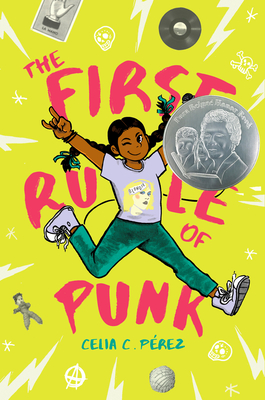 There is a scene half-way through Celia C. Pérez’s brilliant middle-grade novel
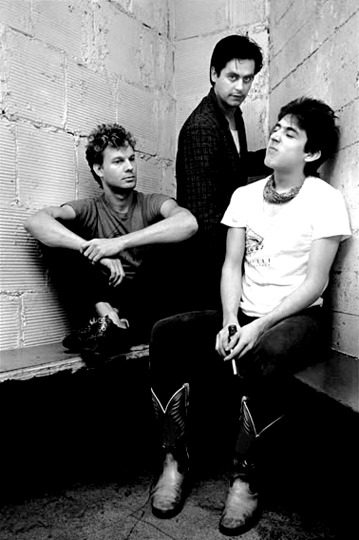
 :format(jpeg):mode_rgb():quality(40)/discogs-images/R-2797380-1301471350.jpeg.jpg) record, Malú listens to the first bars of “Swift Moves” the EP’s opening song and asks in wonder, “Who is she?” To which Mrs. Hidalgo replies, “That’s Teresa Covarrubias.” And, so begins a history lesson for the ages. By introducing Malú to Teresa Covarrubias, the legendary singer of The Brat—the best punk band ever to harken from East L.A. —Mrs. Hidaldo, in a true punk rock move, being that she’s one herself, reclaims the cultural lineages that are so often erased and suppressed by dominant narratives, by affirming to Malú: “And they’re Chicanos, Mexican Americans … Like us.” (Pérez 162). Mrs. Hidalgo opens a door and illuminates for Malú something so beautiful and lucent about our culture. She designates this beauty as being uniquely part of a Chicanx experience and sensibility. So that in this moment, Malú’s prior knowledge and understanding of the punk narrative expands to include her in it as a Mexican American girl. She too belongs to this lineage of Mexicanas and Chicanas that made their own rules, which as Malú will go on to learn, indeed is the first rule of punk (Pérez 310).
record, Malú listens to the first bars of “Swift Moves” the EP’s opening song and asks in wonder, “Who is she?” To which Mrs. Hidalgo replies, “That’s Teresa Covarrubias.” And, so begins a history lesson for the ages. By introducing Malú to Teresa Covarrubias, the legendary singer of The Brat—the best punk band ever to harken from East L.A. —Mrs. Hidaldo, in a true punk rock move, being that she’s one herself, reclaims the cultural lineages that are so often erased and suppressed by dominant narratives, by affirming to Malú: “And they’re Chicanos, Mexican Americans … Like us.” (Pérez 162). Mrs. Hidalgo opens a door and illuminates for Malú something so beautiful and lucent about our culture. She designates this beauty as being uniquely part of a Chicanx experience and sensibility. So that in this moment, Malú’s prior knowledge and understanding of the punk narrative expands to include her in it as a Mexican American girl. She too belongs to this lineage of Mexicanas and Chicanas that made their own rules, which as Malú will go on to learn, indeed is the first rule of punk (Pérez 310).

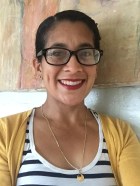 ABOUT THE AUTHOR: (from her
 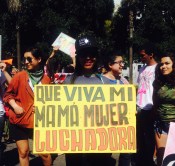 ABOUT THE REVIEWER: Lettycia Terrones is a doctoral student in the Department of Information Sciences at University of Illinois at Urbana-Champaign, where she researches Chicanx picturebooks as sites of love and resilient resistance. She’s from East L.A. Boyle Heights.
 Latinxs in Kid Lit