Why Write Books About Luchadores? A Guest Post by Author-Illustrator Xavier Garza

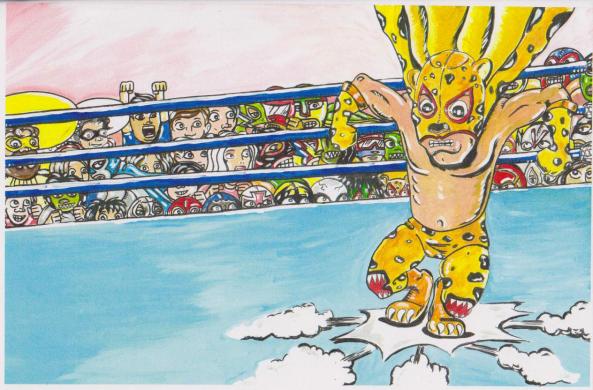
The Great and Mighty Nikko - El JaguarBy Xavier Garza

Why write books about luchadores? I remember being asked that question by a librarian one time at a book signing. I answered her that one of the reasons was its obvious appeal to boys, who can be reluctant readers at times. Lucha libre readily lends itself to create the type of action-packed stories boys just love.
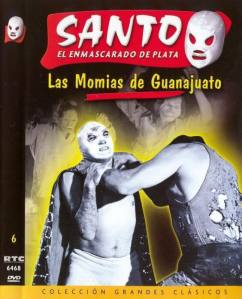
1970 El santo contra las momias de GuanajuatoBut there was another reason I wrote books about luchadores, dating back to when I was a seven-year-old child going to the movies with my dad. It was the summer of 1974 when my father took me to the H&H Drive-In in my hometown of Rio Grande City, Texas. The marquee heralded a double-feature matinee that consisted of a Japanese monster movie and an action-thriller flick from the world of Mexican cinema. The second film was titled Santo contra las momias de Guanajuato (The Saint versus the Mummies of Guanajuato). I was all too familiar with radioactive fire-breathing Japanese Kaijua monster movies of the Godzilla variety, but up until that night, I had not yet been introduced to the masked heroes and villains of lucha libre.

As the second feature began, I watched as the masked villain made his grand entrance. Heralded as a resurrected evil prince from a civilization long lost, he now sought dominion over the earth. But standing in his way was the direct descendant of his adversary from centuries past. I watched in awe as this mysterious new hero donned the legendary silver mask and cape of his ancestor and stood ready to do battle against the resurrected evil prince. I remember at that point asking my dad who was this silver masked man on the movie screen? My dad turned to look at me and smiled. “That’s El Santo, mijo… the Saint. They say he is the greatest luchador that has ever lived.”

The author-illustrator Xavier Garza as a child.

The author-illustrator Xavier Garza as a child.

My dad’s words echoed in my mind:  the greatest luchador that has ever lived. It was at that moment that I was hooked. I would be a fan of both El Santo and lucha libre for the rest of my life.

My father’s words served to spark in me a love for the sport of lucha libre that I carry with me to this day. I was in awe of the fact that these luchadores had the power to put on a mask and become something bigger than themselves. The minute they donned that mask and cape they ceased to be people with names like Rodolfo Guzman Huerta, Alejandro Marquez, or Teresa Lopez. They were transformed into the bigger-than-life personalities that lived in the world of lucha libre. They became heroes and villains with names like the evil Medical Assassin, the rabid Dogman Aguayo, and the heroic Masked Damsel. They were the living and breathing depictions of ancient heroes, cultural stereotypes, monsters, and in some cases… gods, themselves.

Their appeal was simply irresistible to a seven-year-old boy with an intense love of comic book super heroes. Except that these were no mere drawings in a comic book, oh no. These were flesh and blood individuals that nobody ever saw without their masks. To be seen or photographed without their masks was taboo, utterly forbidden. As such, it could be literally anybody underneath that mask. The person buying a gallon of milk at the grocery store could secretly be a masked luchador and you would never even know it. Was the Medical Assassin secretly your uncle? Was the Guardian Angel perhaps your local priest that gave mass at your church each and every Sunday? When it came to lucha libre, there was no way to truly know for sure.
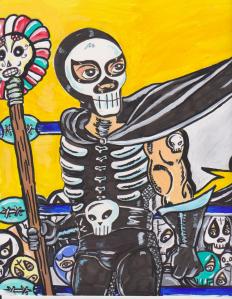
The Great and Mighty Nikko! 7  La Tabla Marina

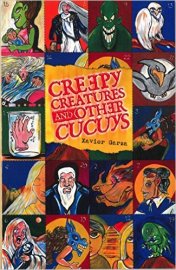
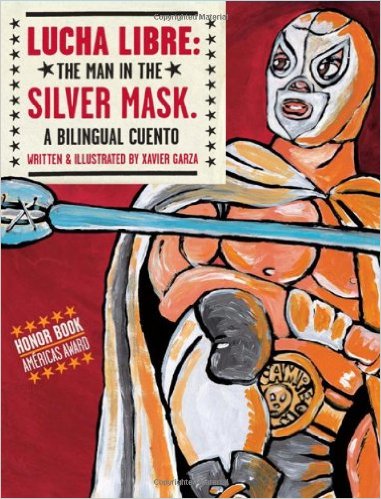
It was that sense of mystery that made lucha libre so appealing and would influence me for years to come. As I grew older, I dreamt of becoming both an artist and an author, and wouldn’t you know it that these luchadores found their way into my work. After nearly ten years of trying to get published, it would finally happen after a conversation with Dr. Nicholas Kanellos, president of Arte CucuysPúblico Press. In 2004, they would publish my first book, titled Creepy Creatures and other Cucuys, and it served as the foundation for many books to come. Among those books would be my first lucha libre book, published by Cinco Puntos Press in 2007, Lucha Libre: The Man in the Silver Mask, A Bilingual Cuento. In many ways this book was a labor of love for me. It was my great big thank-you to all those masked heroes and villains that had filled my head as a child and given wings to my imagination.
One night as I was working on illustration ideas for the book, my then-three-year-old son walked into the studio and asked me who was the silver-masked luchador that I was drawing. I instantly flashed back to that night at the movie drive-in with my father, his words echoing in my mind. I answered my son the only way I knew how. “That’s El Santo mijo… the Saint. They say he is the greatest luchador that has ever lived.”
Lucha

Don’t miss our review of Xavier Garza’s The Great and Mighty Nikko.

 

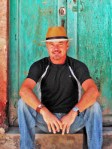
Xavier Garza hi resolution imageXavier Garza is an author, teacher, artist, and storyteller whose work is a lively documentation of life, dreams, superstitions, and heroes in the bigger-than-life world of South Texas. Xavier has exhibited his art and performed his stories in venues throughout Texas, Arizona, and New Mexico. He is the author of several books for children and young adults. His Maxmilian and the Mystery of the Guardian Angel: A Bilingual Lucha Libre Thriller received a 2012 Pura Belpré Honor designation. Follow Xavier’s adventures on Twitter (his handle is @CharroClaus) and Facebook.


Celebrating Pura Belpré Winners: Spotlight on Author-Illustrator Carmen Lomas Garza

PuraBelpreAwardThe Pura Belpré Awards turns 20 this year! The milestone will be marked on Sunday, June 26, from 1:00-3:00 p.m. during the 2016 ALA Annual Conference in Orlando, FL. According to the award’s site, the celebration will feature speeches by the 2016 Pura Belpré award-winning authors and illustrators, book signings, light snacks, and entertainment. The event will also feature a silent auction of original artwork by Belpré award-winning illustrators, sales of the new commemorative book The Pura Belpré Award: Twenty Years of Outstanding Latino Children’s Literature, and a presentation by keynote speaker Carmen Agra Deedy.

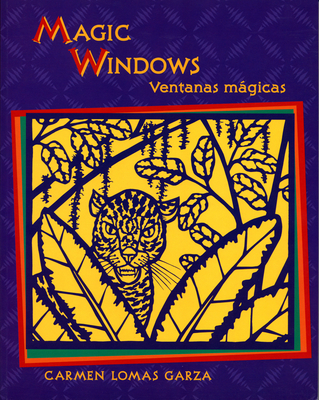
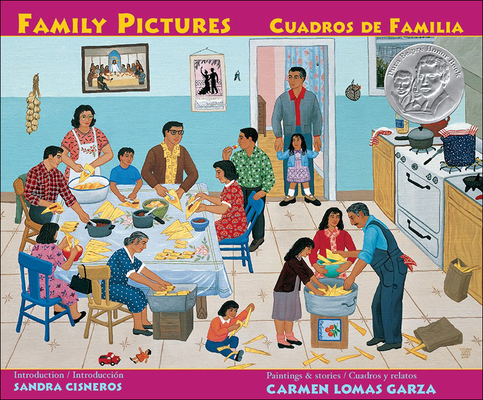
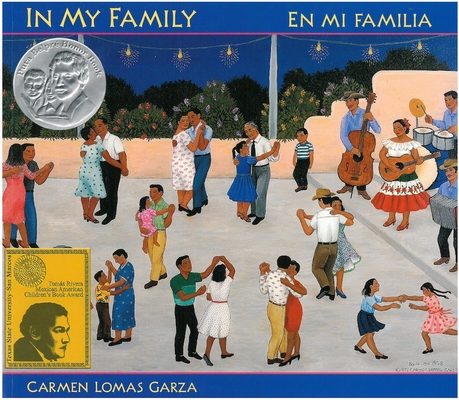
Leading up to the event, we will be highlighting the winners of the narrative and illustration awards. Today’s spotlight is on Carmen Lomas Garza, the winner of the 2000 Pura Belpré Illustration Medal for Magic Windows / Ventanas mágicas and Pura Belpré Honors for Illustration for Family Pictures / Cuadros de familia in 1996 and In My Family / En mi familia in 1998.

Review by Marianne Snow Campbell

DESCRIPTIONS FROM THE PUBLISHERS:

Magic Windows CoverMagic Windows: Through the magic windows of her cut-paper art, Carmen shows us her family, her life as an artist, and the legends of her Aztec past. We look into Carmen’s studio and see her paint a Mexican jarabe tapatío dancer; we glimpse the hummingbirds that cross the US-Mexico border to taste the sweet nectar of the cactus flowers; and we watch Carmen teach her nieces and nephews how to make their own magic windows. Magic Windows is a continuing tribute to family and community as well as a way for Carmen to connect future generations to their ancestors by teaching and sharing with them this traditional folk art.

Check out the book discussion and activity guide created by Lindsay Harris and Haley Rugger with Dr. Jamie Campbell Naidoo, provided by the University of Alabama School of Library and Informational Studies.


Family Pictures is the story of Carmen Lomas Garza’s girlhood in Kingsville, Texas: celebrating birthdays, making tamales, picking cactus, and confiding to her sister her dreams of becoming an artist. These day-to-day experiences are told through fifteen paintings and stories, each focusing on a different aspect of Carmen’s traditional Mexican American culture growing up. The paintings and stories reflect the author’s strong sense of family and community and demonstrate how her mother’s love and hard work helped Carmen achieve her dream. For the hundreds of thousands of Mexican Americans, Carmen Lomas Garza offers a book that reflects their lives and cultural traditions. For others, this beautiful work will offer insights into a fascinating life and a rich community. Sandra Cisneros provided the introduction and Pat Mora the afterword for this touchstone of Latino children’s literature. This book is bilingual (English and Spanish).

Family Pictures/Cuadros de Familia Cover


In My Family / En mi familia: In her eagerly-awaited second book for children, In My Family / En mi familia, internationally-renowned artist Carmen Lomas Garza takes us once again to her hometown of Kingsville, Texas, near the border with Mexico. Through vibrant paintings and warm personal stories, Carmen brings to life more loving memories of growing up in a traditional Mexican American community: eating empanadas, witnessing the blessing on her cousin’s wedding day, and dancing to the conjunto band at the neighborhood restaurant. In My Family / En mi familia is Carmen Lomas Garza’s second book of family pictures, a continuing tribute to the loving family and community that shaped her childhood—and her life.

For effective strategies on incorporating students’ linguistic and cultural backgrounds into social studies curricula, check out the article “Developing Literacy through Culturally Relevant Texts” by Dr. Iliana Alanís in Social Studies and the Young Learner (2007) from the National Council for the Social Studies.  Pair In My Family with the author study guide Carmen Lomas Garza: Chicana Author and Illustrator by Deborah J. Francis, part of The Alma Project, a cultural infusion model by Denver Public Schools.

In My Family Cover


MY TWO CENTS: “At the age of thirteen I decided to become a visual artist and pursue every opportunity to advance my knowledge of art in institutions of higher education. The Chicano Movement of the late 1960s inspired the dedication of my creativity to the depiction of special and everyday events in the lives of Mexican Americans based on my memories and experiences in South Texas. I saw the need to create images that would elicit recognition and appreciation among Mexican Americans, both adults and children, while at the same time serve as a source of education for others not familiar with our culture.”

With this artist’s statement, Carmen Lomas Garza sums up everything I appreciate about her autobiographical children’s books. They’re real. They’re confident. They’re hopeful. In all three of her Pura Belpré award winners – Magic Windows / Ventanas mágicas, Family Pictures / Cuadros de familia, and In My Family / En mi familia – Garza uses traditional media alongside her own words to represent her memories and celebrate common Mexican American cultural practices. While engaging with these exquisite images and clear, simple (and bilingual!) captions, readers of any cultural background can learn something about life in 1950s Kingsville, Texas and compare and contrast their own experiences with the artist’s.

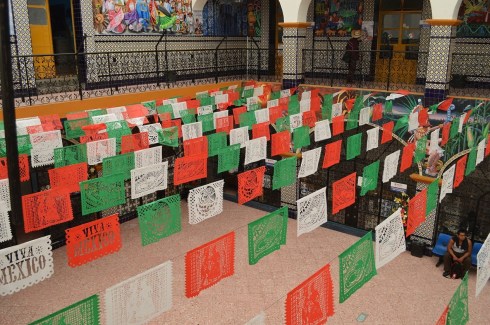
Magic Windows / Ventanas mágicas, which won the Belpré Award in 2000, provides readers with an intricate introduction to the art of papel picado, the traditional Mexican art of paper cutting that began with Mexico’s indigenous communities.

Papel picado decorations for Mexican Independence Day celebrations, Atlixco, Puebla, Mexico. Photo by Alejandro Linares Garcia.

Papel picado decorations for Mexican Independence Day celebrations, Atlixco, Puebla, Mexico. Photo by Alejandro Linares Garcia.


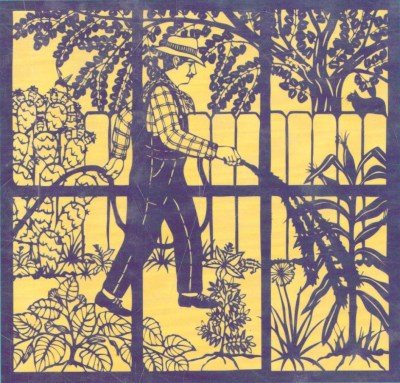
While traditional papel picado pieces often feature geometric and/or symbolic designs, Garza’s paper cutouts represent moments from her life: making paper flowers with her family, catching horned frogs, helping her grandfather water his garden.

Detail from Offering for Antonio Lomas / Ofrenda para Antonio Lomas on the back cover of Magic Windows / Ventanas mágicas.

Detail from Offering for Antonio Lomas / Ofrenda para Antonio Lomas on the back cover of Magic Windows / Ventanas mágicas.

According to Magic Windows’ introduction, Garza learned how to craft traditional papel picado with scissors from her mother and then, after decades of practice, began fashioning the larger, more representational pieces found in this book with a craft knife. I just can’t believe she cut all of these detailed, elaborate works by with her own two hands. Can you imagine the love, patience, and dedication it took to complete them? “These pieces are like magic windows,” she states. “When you look through them, you can see into another world.” What I see is a deep love for her family rendered with absolute care and skill. You can’t get much more magical than that.

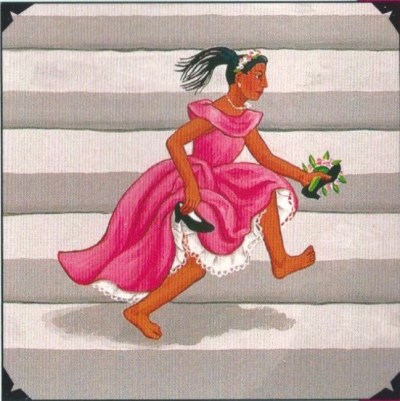
In Family Pictures / Cuadros de familia and In My Family / En mi familia, Garza’s Belpré honor winners, we can see that same care and love channeled through a very different artistic medium – painting. Both of these books contain several paintings of the artist’s childhood memories coupled once again with bilingual captions that explain the significance of each work. Page after page treats readers to sumptuous, folk-art-style snapshots of family gatherings, tender moments, and humorous scenes.

Detail from Quinceañera on the back cover of Family Pictures / Cuadros de familia.

Detail from Quinceañera on the back cover of Family Pictures / Cuadros de familia.

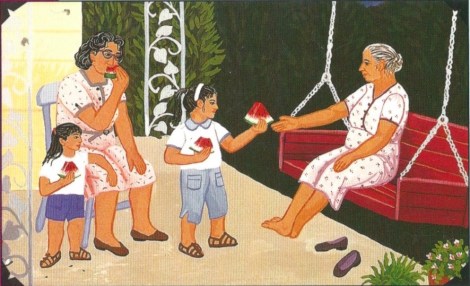
I’m just going to put it out there – Carmen Lomas Garza’s books for children are my absolute favorites. 100%, no joke. Their simplicity, honesty, and artistry make them the perfect package for me, and I know there are plenty of kids out there who will appreciate her straightforward, positive, oftentimes funny depictions of her experiences as well. The universal themes of love and family that appear in each magnificent yet humble work of art can hook any child that picks up these books. As Sandra Cisneros says in her introduction to Family Pictures, enjoying Garza’s art is like “pressing our face against the window screens and peeking inside our house. These are family pictures. And it doesn’t matter if your family is from Kingsville or Cairo, Sarajevo or Katmandu. They are your family’s pictures too. Tell me, which one is you?”

Detail from Watermelon / Sandía on the back cover of Family Pictures / Cuadros de familia.

Detail from Watermelon / Sandía on the back cover of Family Pictures / Cuadros de familia.


TEACHING TIPS:

  • Carmen Lomas Garza’s books are excellent models for autobiographical writing and art. After reading any of these award-winning books, let students create their own artistic representation of a personal memory (using their choice of medium, if possible) and write an autobiographical story to accompany the art.
  • Explore the rich history and modern practice of creating papel picado with students. Making Magic Windows, Garza’s companion book to Magic Windows, provides plenty of information about this alluring art form as well as step-by-step instructions for young artists. If possible, invite a papel picado artist to your school to share their craft.
  • Do you live in or near Chicago, Austin, El Paso, San Francisco, or Oakland? If so, consider taking your students to an art museum or library collection that features Carmen Lomas Garza’s artwork. You can find her paintings at the National Museum of Mexican Art (Chicago), the University of Texas’s Benson Latin American Collection (Austin), the El Paso Museum of Art, the Mexican Museum (San Francisco), and the Oakland Museum of California. Viewing a full-size, in-person version of a painting from one of Garza’s books can be a powerful experience, and many kids will love connecting their museum visit to books they’ve read. I’ll never forget stumbling upon Las Posadas at the Museum of Mexican Art – it was definitely a highlight of my trip to Chicago.


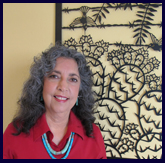
Carmen Lomas GarzaABOUT THE AUTHOR-ILLUSTRATOR (from her website): Carmen Lomas Garza was born in Kingsville, Texas, in 1948. Inspired by her parent’s activism with the American G.I. Forum, Lomas Garza joined the Chicano Movement of the 1960s and 1970s. She is a graduate of the Texas Arts & Industry University, Juarez-Lincoln/Antioch Graduate School, and San Francisco State University where she earned her M.A. in 1981. Lomas Garza is a recipient of numerous awards and has exhibited her work in galleries and museums across the United States.


ADDITIONAL RESOURCES:


MarianneMarianne Snow Campbell is a doctoral student at The University of Georgia, where she researches nonfiction children’s books about Latinx and Latin American topics and teaches an undergraduate course on children’s literature. Before graduate school, she taught pre-K and Kindergarten in Texas, her home state. She misses teaching, loves critters, and can also be found on Twitter and Facebook.

Celebrating Pura Belpré Winners: Spotlight on Doña Flor, illustrated by Raul Colón

PuraBelpreAwardThe Pura Belpré Awards turns 20 this year! The milestone will be marked on Sunday, June 26, from 1:00-3:00 p.m. during the 2016 ALA Annual Conference in Orlando, FL. According to the award’s site, the celebration will feature speeches by the 2016 Pura Belpré award-winning authors and illustrators, book signings, light snacks, and entertainment. The event will also feature a silent auction of original artwork by Belpré award-winning illustrators, sales of the new commemorative book The Pura Belpré Award: Twenty Years of Outstanding Latino Children’s Literature, and a presentation by keynote speaker Carmen Agra Deedy

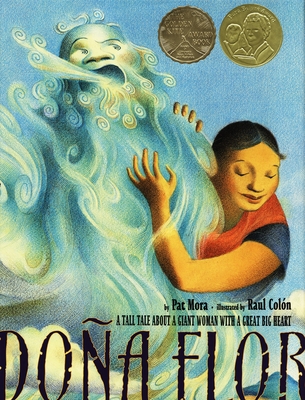
Leading up to the event, we will be highlighting the winners of the narrative and illustration awards. Today’s spotlight is on Raul Colón, the winner of the 2006 Pura Belpré Illustration Award for Doña Flor: A Tall Tale About a Giant Woman with a Great Big Heart. Colón also received Pura Belpré Illustration Honors for Portraits of Hispanic American Heroes and My Name is Gabito: The Life of Gabriel García Márquez/Me llamo Gabito: la vida de Gabriel García Márquez.

Review by Sonia Alejandra Rodriguez

DESCRIPTION FROM THE PUBLISHER: Doña Flor is a giant lady who lives in a tiny village in the American Southwest. Popular with her neighbors, she lets the children use her flowers as trumpets and her leftover tortillas as rafts. Flor loves to read, too, and she can often be found reading aloud to the children.
One day, all the villagers hear a terrifying noise: it sounds like a huge animal bellowing just outside their village. Everyone is afraid, but not Flor. She wants to protect her beloved neighbors, so with the help of her animal friends, she sets off for the highest mesa to find the creature. Soon enough, though, the joke is on Flor and her friends, who come to rescue her, as she discovers the small secret behind that great big noise.

The creators of Tomás and the Library Lady, Pat Mora and Raul Colón, have once again joined together. This time they present a heartwarming and humorous original tall tale—peppered with Spanish words and phrases—about a giant lady with a great big heart.

MY TWO CENTS: Doña Flor, written by Pat Mora and illustrated by Raul Colón, tells the story of a giant woman that sleeps on clouds and makes piles of big tortillas. She protects her village from harm and she must do just that when the villagers inform her that a giant mountain lion threatens their safety. The biography of Raul Colón included on the dust jacket describes his illustrations as “an intriguing combination of watercolor washes, etching, and colored and litho pencils.”

When I look at Colón’s illustrations, the etchings remind me of fingerprints. The loops, the arches, the whorls, and all the lines that we might associate with fingerprints are visible in Colón’s illustrations. I am not familiar with techniques or the technicalities of etching and in saying that the illustrations remind me of fingerprints I do not mean to devalue the art in any way. My favorite illustration in this story is of Doña Flor using her thumb to carve out a riverbed in the village. Doña Flor is in a squatting position with her white skirt covering her thighs, and she has used her thumb to make a squiggly path for the water while the villagers look on. The riverbed has the details I associated with the fingerprints which, in this case, could be Doña Flor’s own prints.

Colón’s illustrations are beautiful, colorful, and magical. That I saw fingerprints when I looked closely at his illustrations speaks to the uniqueness of his art. While Doña Flor wears a blue shirt in most of the illustrations sometimes the shirt looks like it is embroidered and sometimes it looks like a plain T-shirt. The clouds on one page look round and fluffy and in the illustration where she’s made her bed of clouds it appears like she’s left her own fingerprints on the clouds she has gathered. Despite the uniqueness I see in his illustrations, there is certainly a sense of cohesion throughout the story. I’ve decided to focus on the etchings, the lines, and how much they appear like fingerprints because as I examined his illustrations, I also got the thought that our stories are as unique as our fingerprints. Colón’s illustrations in Doña Flor affirmed that for me. I couldn’t help but connect the details I saw in his art to the significance of the Pura Belpré award and the necessity for more Latinx children’s and young adult literature by and for Latinx.

TEACHING TIPS:

  • For younger readers: Ask younger readers to pick their favorite illustration and to pick a part of the image they’d like to recreate. For example, in the illustration with Doña Flor making the river, students can attempt to recreate the river, the clouds, the trees and hills, etc. Ask students to outline their chosen part and to fill it in by dabbing their fingerprints. This will recreate the etching effect they see in the illustrations.
  • For middle grade readers: Discuss with students the effect and affect of etching. Does the etching force the reader to focus in a certain direction or a certain part of the page? How do the illustrations make you feel? For example, in the illustration where Doña Flor hugs the wind the lines of the etchings point in the same direction, making it appear like she is floating away with the wind.
  • For young adult readers: By the end of the story Doña Flor learns that the loud roaring frightening the village is coming from a small puma roaring into a hollow log. Discuss with students the importance of perceptions and misconceptions. How might we connect the villagers’ fear and the puma’s amplified roars to racial/ethnic stereotypes?


FullSizeRender (1)Dr. Sonia Alejandra Rodriguez’s research focuses on the various roles that healing plays in Latinx children’s and young adult literature. She currently teaches composition and literature at a community college in Chicago. She also teaches poetry to 6th graders and drama to 2nd graders as a teaching artist through a local arts organization. She is working on her middle grade book. Follow Sonia on Instagram @latinxkidlit
Celebrating Pura Belpré Winners: Spotlight on Rafael López


PuraBelpreAwardThe Pura Belpré Awards turns 20 this year! The milestone will be marked on Sunday, June 26, from 1:00-3:00 p.m. during the 2016 ALA Annual Conference in Orlando, FL. According to the award’s site, the celebration will feature speeches by the 2016 Pura Belpré award-winning authors and illustrators, book signings, light snacks, and entertainment. The event will also feature a silent auction of original artwork by Belpré award-winning illustrators, sales of the new commemorative book The Pura Belpré Award: Twenty Years of Outstanding Latino Children’s Literature, and a presentation by keynote speaker Carmen Agra Deedy.

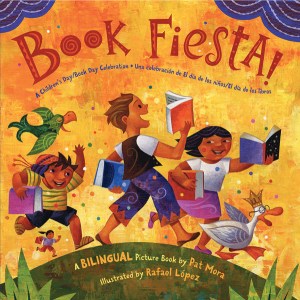
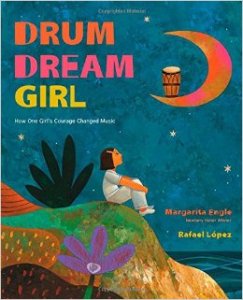
hires-cover-fiesta  Drum Dream GirlLeading up to the event, we will be highlighting the winners of the narrative and illustration awards. Today’s spotlight is on Rafael López, the winner of the 2010 Pura Belpré Illustration Award for Book Fiesta! Celebrate Children’s Day/Book Day, Celebremos El dia de lo niños/El día de los libros, written by Pat Mora, and the 2016 Pura Belpré Illustration Award for Drum Dream Girl, written by Margarita Engle. We featured Drum Dream Girl in a book talk and in a special report about a library event.
Tito book  Cazuela  Celia

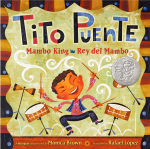
Rafael also received a Pura Belpré Illustration Honor three times: In 2014, for Tito Puente: Mambo King/Rey de Mambo, written by Monica Brown; in 2012, for The Cazuela that the Farm Maiden Stirred, written by Samantha R. Vamos; in 2006, for My Name is Celia/Me Llamo Celia: The Life of Celia Cruz/ La Vida de Celia Cruz, written by Monica Brown.

Book Fiesta!

Illustration Review by Lila Quintero Weaver

Book Fiesta! Celebrate Children’s Day/Book Day/ Celebremos El día de los niños/El Día de los libros, written by Pat Mora and illustrated by Rafael López, is a gem of a picture book that offers its wonders in two languages, English and Spanish.

Book Fiesta! exuberantly proclaims the joys of reading and introduces the concept of Día, an annual celebration of literature for children, founded by Pat Mora in 1996, and observed through special events by many libraries nationwide.

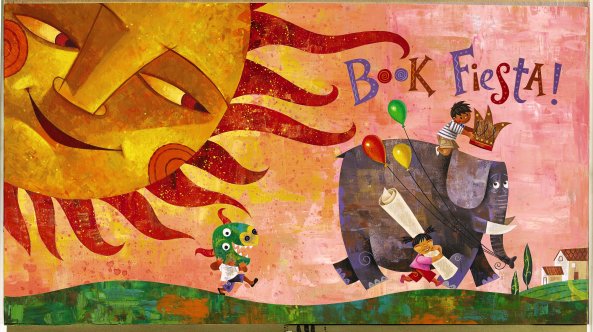
What Mexican painter, muralist, and illustrator Rafael López brings to a picture book must be seen and not just read about. His mastery as an illustrator extends to every aspect of the art: a strong concept, dynamic design, brilliant execution, and irresistible charm. It’s no wonder that the Pura Belpré committee recognized his work. Let’s take a closer look.

BookFiests_03

Used by permission from HarperCollins Children’s Books.

You don’t have to be an artist to appreciate López’s expert techniques, including his winning combination of hard-edged shapes and saturated colors, delivered through heavily textured paint and splashy accents, and supported by a golden undertone that unifies all of the spreads. In the pages above, a huge, friendly sun smiles down on the children, accompanied by a trotting elephant. Such charm!

BookFiests_06

Used by permission from HarperCollins Children’s Books.

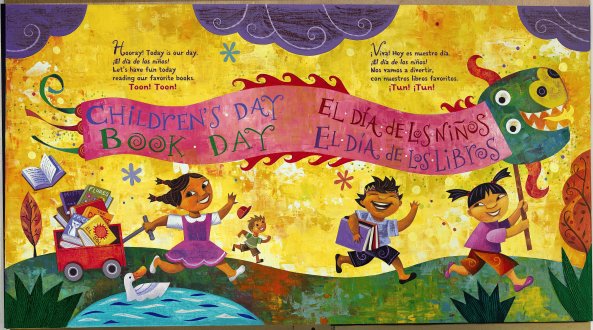
López champions diversity in his illustrations. Here, a parade of children follows a Chinese dragon whose tail doubles as a banner, announcing Día to one and all. Note the diversity represented in the races of the children. One child pulls a wagon full of books bearing titles in English and Spanish.

BookFiests_08

Used by permission from HarperCollins Children’s Books.

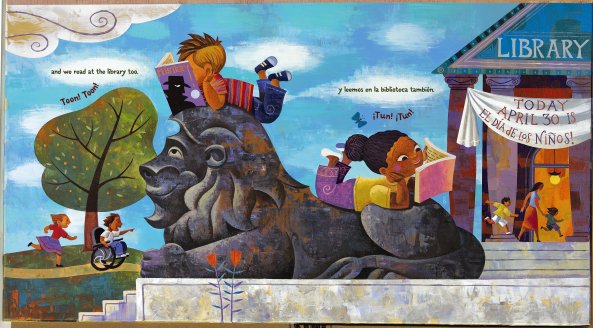
Outside the library, even the stone lion looks pleased to take part in Día. The children relaxing on the marble beast are immersed in their books. In the background, a boy in a wheelchair eagerly makes his way to the library—another evidence of the illustrator’s awareness of diverse representation.

BookFiests_15

Used by permission from HarperCollins Children’s Books.

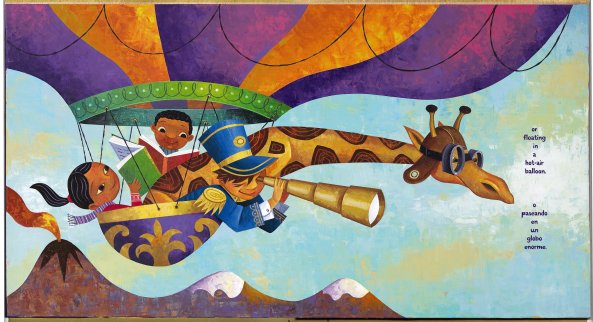
López amplifies Pat Mora’s words through many inventive means. Here, in a depiction of the glorious adventures made possible by reading, a hot-air balloon floats over a mountainous backdrop, complete with a smoking volcano. The pilot is a giraffe in old-fashioned aviator goggles. Elsewhere, books transport children by other means: on an airplane, a train, an automobile, a rowboat, on the back of an elephant, and even in a submarine. Simply put, stories hold the power to magically ferry readers to far-away places and imaginary lands. López brings this virtual travel to life through an enthralling variety of presentations and an engaging level of detail.

Fiesta_25

Used by permission from HarperCollins Children’s Books.

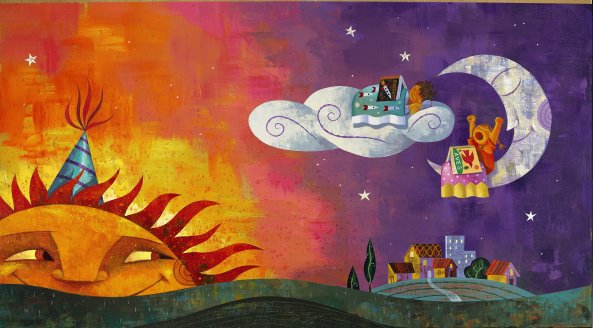
Reading in bed—what better way is there to top off a busy day? In a color-drenched scene, López presents two children indulging in this lovely pastime. One child, floating on a bed of clouds, has already fallen asleep, while the other is midway through a yawn. Her bed is supported by the curve of a crescent moon. López’s trademark brushwork fills the sky with vivid sunset hues that transition to the deep violet of late evening. It’s all grounded by rolling hills, painted in shades of teal, a color appropriate to the dying light. In the distance, the windows of buildings twinkle with warmly lit interiors, while cutout stars punctuate the heavens. Dreamy.

The richness of each spread in Book Fiesta! invites long looks and repeated views that reward readers with the new discoveries. Every page turn reveals a refreshing surprise, backgrounded by a palette that spans the rainbow. Thanks to Pat Mora’s wonderful vision and Rafael López’s dynamic illustrations, this picture book offers a perennial delight to readers of all ages.

Book Fiesta! Celebrate Children’s Day/Book Day; Celebremos el día de los niños/el día de lo libros. Text copyright ©2009 Pat Mora. Illustration copyright ©2009 Rafael López. Images used by permission of HarperCollins Children’s Books.

RafaelAbout the illustrator:

Raised in Mexico City, Rafael López makes his home part of the year in San Miguel de Allende, Mexico, as well as in San Diego, California. He credits Mexican surrealism as a major artistic influence. Besides his Pura Belpré medals and honors, Rafael is also a double recipient of the Américas Award. For more about his work, including poster illustrations and a mural project in San Diego that is the subject of a new picture book, Maybe Something Beautiful, visit his official website.

TEACHING TIPS:

  • Lead children in an imagination exercise based on the reading spots depicted in Book Fiesta. What are some places that you can take a book to? What are some places that a book takes you to? Ask students to include real-life and imaginary destinations.
  •  Devise a book parade, featuring wagons loaded with books, masks or disguises based on favorite characters, and banners heralding Día, or another book-related holiday or theme.
  • Invite children to create illustrations based on López’s style. This can include painted backdrops and cutout figures, with an emphasis on strong shapes and bright colors.

Watch Rafael López’s thank you video for his most recent Pura Belpré medal, for Drum Dream Girl:


Spotlight on Latina Illustrators Part 3: Sara Palacios, Claudia Rueda, and Tania de Regil


By Cecilia Cackley

This is the third in a series of posts spotlighting Latina illustrators of picture books. Some of these artists have been creating children’s books for many years, while others will have their first book out this year. Some of them live in the US, while others live overseas. They come from many different cultural backgrounds, but all are passionate about connecting with readers through art and story. Please look for their books at bookstores and libraries!

Interview answers from Claudia Rueda and Tania de Regil have been translated from Spanish.

Sara Palacios

Sara Palacios is an illustrator from Mexico. She studied Graphic Design at Universidad Autónoma Metropolitana, Mexico DF, School of Design, INBA  (National Institute of Fine Arts) Mexico DF, and Universidad del Claustro de Sor Juana, Mexico DF. She studied illustration at Academy of Art University, San Francisco CA, where she has been part-time faculty since 2014. She received the Pura Belpré Honor for illustration in 2012 and is the illustrator of the Marisol McDonald series by Monica Brown for Lee & Low, as well as numerous other books. Her newest picture book, One Big Family (written by Marc Harshman) will be published by Eerdmans Books for Young Readers later this year.

Q: What inspired you to become an artist?

A: I always liked to draw, but I didn’t know that illustrators even existed until I was pursuing my Graphic Design degree in Mexico. I was invited to an illustration exhibition. That was the first time I became aware of what illustration was. I was in awe! and I knew that’s what I wanted to do. The same friend who invited me to the exhibition told me that one of the illustrators was looking for somebody to help him. My friend encouraged me to go to the interview and show my drawings and I got the job! I started washing brushes and cutting paper until little by little I was taught to paint in watercolor. That job was my first school of illustration and I’ve been doing that ever since. After finishing my degree in Mexico I went on to study for my BFA and MFA in illustration in the US.

Q: Tell us about your favorite artistic medium.

A: I don’t really have a favorite medium. The first technique I ever learned was watercolor and for years that was the only medium I used until I started working toward my BFA at the Academy of Art in San Francisco. Through the classes, I began using gouache, acrylics , pastels, the computer etc. At first, I was afraid of mixing one technique with another, but I started experimenting on my own and I realized that what works best for me is mixed media. I also like collage, so all my illustrations are done with mixed media now. I use everything from colored pencils, watercolor, markers, gouache, digital. I don’t think I can just pick one technique.

Q: Please finish the sentence “Picture books are important because…”

A: They can bring some magic to children and adults alike.

12629258  17940785


Claudia Rueda

Image result for claudia rueda
Claudia Rueda
 is a Colombian picture book author, New York Times Best Seller illustrator and a 2016 Hans Christian Andersen award nominee. Her books have been published throughout North America, Europe and Asia and have been translated into more than ten different languages. In the United States, she is best known as the illustrator of the series Here Comes theCat by Deborah Underwood. Her concept books for young readers have been published in Spanish by the publisher Oceano Travesia.

Q: What inspired you to become an artist?

A: I have always liked to draw, like all kids. And I’ve always liked to imagine things and create stories, also like kids when they are playing. Basically, when it was time to put away the colored pencils and imagination to become ‘grown up’ I decided not to do it.

Q: Tell us about your favorite artistic medium.

A: Graphite pencil on white paper is my favorite medium. The capacity for expression in the strokes, it’s simplicity and versatility goes very well with my creative process.

Q: Please finish the sentence “Picture books are important because…”

A: The combination of visual narration with the verbal enriches the experience of reading and allows the story to happen in the mind of the reader that combines the two languages.

18349512  18701595  23281875  25361885


Tania de Regil

taniadrTania de Regil is an author and illustrator from Mexico City. When she was five, she moved to Stockholm, Sweden with her family, where she discovered her love of reading and decided that she wanted to be a professional author some day. Tania studied fashion design at Parsons School of Design in New York City and finished her studies in her home country of Mexico. Her work as a costume designer in film and television has helped to better grasp the art of storytelling through images. Tania’s illustration work is always filled with interesting details for children to discover. She uses a variety of media in her work, such as watercolor, gouache, color pencils, wax pastels and ink to create richly textured, engaging images. Tania’s debut picture book, Sebastián y la isla Tut, which she both wrote and illustrated, was published in November, 2015 by Macmillan Mexico.

Q: What inspired you to become an artist?

A: When I was a girl, my family and I went to live in Sweden. Since I didn’t know the language, what helped me the most was reading. My teacher gave me lots of books and among them were books by Roald Dahl, illustrated by Quentin Blake. In that moment, I fell in love completely with the stories and illustrations and I decided that one day I would be a great writer and illustrator like them. I was eight years old.

Q: Tell us about your favorite artistic medium.

A: I like watercolor a lot because I can never have complete control over it. It’s a medium full of surprises and makes it much more expressive and fun to use. I also like to mix it with other materials like colored pencil, oil pastels, gouache and ink. I liked to always continue experimenting with new materials but the basis of all my illustrations is watercolor.

Q: Please finish the sentence “Picture books are important because…”

A: They take you to worlds where the imagination never ends.


Books to Look For:

Brown, Monica. Marisol McDonald Doesnt Match

Brown, Monica. Marisol McDonald and the Clash Bash

Harshman, Marc. One Big Family

Rueda, Claudia Is it big or is it little?

Thong, Roseanne Greenfield. Twas Nochebuena

Underwood, Deborah. Here Comes the Easter Cat

Underwood, Deborah. Here Comes Santa Cat

Underwood, Deborah Here Comes Valentine Cat

Spotlight on Latina Illustrators Part 2: Juana Martinez-Neal, Maya Christina González & Laura Lacámara


By Cecilia Cackley

This is the second in a series of posts spotlighting Latina illustrators of picture books. Some of these artists have been creating children’s books for many years, while others will have their first book out this year. Some of them live in the US, while others live overseas. They come from many different cultural backgrounds, but all are passionate about connecting with readers through art and story. Please look for their books at bookstores and libraries!


Juana Martinez-Neal

Children's Illustrator Juana Martinez-NealJuana was born in Lima, the capital of Peru. She has been illustrating for children since she was 16. Juana attended the best art school ever, Pontificia Universidad Catolica del Peru – School of Fine Arts. After 3 years of a crazy 8-to-8 schedule and way too many all-nighters, she was in desperate need of a semester-break and decided to give L.A. a “test drive.” She has lived in the US ever since.

Q: What inspired you to become an artist?

A: My father and grandfather were artists. The walls of our house were full of their paintings, and we had art supplies all around the house. Drawing and painting were natural ways to use our time. Every Summer, my mom enrolled us in a different art classes. She always took us to visit Museums, and her special treat was taking us to see puppet shows. Art was part of our life. There is nothing else I could be but an artist.

Q: Tell us about your favorite artistic medium.

A: I love the process more than a specific media. I think that’s the reason why I’m a mixed media illustrator. When I add materials and change my the process, the work becomes even more interesting. The idea of solving the problem makes the process so very exciting.

Q: Please finish the sentence “Picture books are important because…”

A: They expand a child’s mind, fulfill their soul, and show new points of views.


Maya Christina González

Maya Gonzalez is an artist, author, educator, activist, peacemaker, publisher, equality lover, obsessive recycler, traveler, river lover, tree talker, sky kisser……

Her fine art graces the cover of Contemporary Chicano/a Art and is well documented as part of the Chicano Art Movement. She has illustrated over 20 award-winning children’s books, several of which she also wrote, Her book My Colors, My World won the prestigious Pura Belpré Award Honor from the American Library Association and her most recent picture book, Call Me Tree was listed in Kirkus’ Best Picture Books of 2014 that Celebrate Diversity. Since 1996, Maya has been providing presentations to children and educators about the importance of creativity as a tool for personal empowerment. Her work with children in public schools helped her develop several lines of curriculum that offer a holistic approach to learning and open doors to new ways of thinking and relating in the world. In 2009 she co-founded Reflection Press, an independent press that publishes radical and revolutionary children’s books, and works that expand spiritual and cultural awareness. And in 2013, Maya co-created an online learning environment called School of the Free Mind about expanding the mind and reclaiming the creative. The School offers e-courses for those who are ready to uncover and connect with their unique and most powerful way of living and creating.

Q: What inspired you to become an artist?

A: I remember as a child drawing my round Chicana face into the backs of books. I think on some level I knew I needed to see myself in my books. I didn’t. I know in many ways those early ‘self-portraits’ were my way of affirming my existence in a world that did not include me. We are born artists. Creativity is our greatest tool to express and transform our world. I think it was a natural act to be an artist. I think I’ve remained visually expressive because it is the most powerful and immediate way to communicate and create change.

Q: Tell us about your favorite artistic medium.

A: I am notorious for trying different mediums in my children’s books. Acrylics, watercolors, oil pastels, ink, charcoal, painted collage, photo collage, color pencils and combinations of all of those. What I love is the feeling of exploration and not completely knowing what I’m doing. I know that’s how kids feel all the time. Everything is new and curiosity rocks. So I follow that feeling. I’ve made so much art that I’m familiar with all the materials so now I’m exploring how to use them differently. More expression. More immediate and raw. This is how kids create because this is how kids feel. I’m always exploring the edges of my expression.

Q: Please finish the sentence “Picture books are important because…”

A: Picture books are important because they are powerful tools of expression, support and potential healing. I believe children’s books are one of the most radical things we can do for ourselves and our communities.


Laura Lacámara

Laura_photo_2015-300 dpiCuban-born Laura Lacámara is the award-winning author and illustrator of Dalias Wondrous Hair / El cabello maravilloso de Dalia (Piñata Books), a bilingual picture book about a clever girl who transforms her unruly hair into a vibrant garden. Laura also wrote Floating on Mamas Song / Flotando en la canción de mamá, a bilingual picture book inspired by her mother, who was an opera singer in Havana. Illustrated by Yuyi Morales and published by HarperCollins, Floating on Mamas Song was a Junior Library Guild Selection for Fall 2010 and was a Tejas Star Book Award Finalist for 2011-2012.

Laura earned her Bachelor of Fine Arts in Drawing and Painting at California State University, Long Beach. She studied printmaking at Self Help Graphics in East Los Angeles and began exhibiting and selling her work.

When a fellow artist suggested Laura’s images would be ideal for picture books, Laura signed up for a children’s book illustration class at Otis College of Art and Design. She instantly fell in love with both writing and illustrating for children. It was in that class that she wrote the first draft of Floating on Mamas Song.

Laura illustrated the 2012 Tejas Star Book Award winner, The Runaway Piggy / El cochinito fugitivo (Piñata Books), as well as Alicias Fruity Drinks / Las aguas frescas de Alicia (Piñata Books). Laura is a popular presenter at schools, book festivals, and conferences, and she is an active member of the Society of Children’s Book Writers and Illustrators (SCBWI).  Laura lives in Southern California with her husband, their daughter, and a lovable mutt.

Q:  What inspired you to become an artist?

A: Having an artist father, who made a living as a graphic designer and illustrator, inspired me and showed me that it was possible to be a working artist.  In high school and beyond, I had many artist friends – we found inspiration together in art classes and museum visits.  And, to be honest, as a young adult, doing art was the only job I didn’t get fired from!

Q: Tell us about your favorite artistic medium.

A: I like painting with acrylics on a variety of surfaces – my current favorite being wood. (I love the texture.)  I also enjoy adding collage elements to my paintings.  I’ve always loved bright patterned fabrics and papers – the more the colors and patterns clash, the better!

Q: Please finish this sentence: “Picture books are important because…”

A: Picture books are important because they teach us about ourselves, our world, our feelings, our realities.  Stories with pictures can give young kids a great deal of validation and comfort.  A picture book may be the first time a child realizes, “I’m not the only one who feels that way!”


Books to Check Out:

Lacámara Laura. Dalias Wondrous Hair

Luna, James. The Runaway Piggy

Ruiz-Flores, Lupa. Alicias Fruity Drinks

Elya, Susan Middleton. La Madre Goose (coming in July)

Gonzalez, Maya Christina. Call me Tree/Llamame Arbol

Gonzalez, Maya Christina. I Know the River Loves Me/Yo se que el rio me ama

Gonzalez, Maya Christina. My Colors, My World/Mis colores, mi mundo

Alarcon, Francisco X. Animal Poems of the Iguazu

Perez, Amada Irma. Nanas Big Surprise

Perez, Amada Irma. My Diary from Here to There

Alarcon, Francisco X. Iguanas in the Snow