
By Cecilia Cackley
This is the fourth in a series of posts spotlighting Latina illustrators of picture books. Some of these artists have been creating children’s books for many years, while others will have their first book out this year. They come from many different cultural backgrounds, but all are passionate about connecting with readers through art and story. Please look for their books at bookstores and libraries!
Carolyn Dee Flores
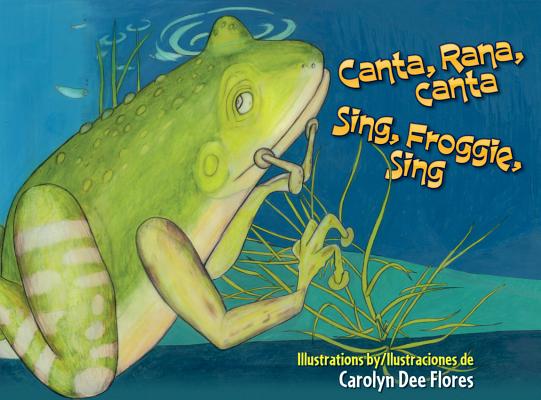
 Carolyn Dee Flores grew up around the world and now lives in San Antonio, Texas. She worked as a computer analyst, rock musician and composer prior to becoming an illustrator of children’s books. She illustrated Dale, dale, dale: una fiesta de números/Hit it, hit it, hit it: a fiesta of numbers and Canta, Rana, Canta/ Sing Froggie Sing, which were both named to the Tejas Star Reading list. Her illustrations for the book Daughter of Two Nations won a Skipping Stones Honor Award. Her most recent work can be seen in the book Una Sorpresa para Teresita/ A Surprise for Teresita, published in October 2016 by Piñata Books, an imprint of Arte Publico Press.
Q: What inspired you to become an artist?
A: My Uncle Rey. He was a professional artist. He made me realize it was something you could do. Be an artist for a living.
When I was little, I used to go over to my grandmother’s house and see his drawings and paintings framed on the wall and I would think, “How on earth does someone get that good?” Later, I found out he had gone to art school and become an artist for the Air Force. When he passed away, my aunt gave me his art books. I read every page … over and over and over. That’s when I first learned about Goya and Rembrandt and Velázquez. It meant everything to me.
Q: Tell us something about your favorite artistic medium.
A: Oil. Oil. And then oil. I am very excited about a new technique I developed for painting with oil on cardboard. It completely saturates the board until it looks like brushed felt. It also enables me to control the bleed and dry quickly. This is the first time I have been able to get those intense colors that you get with oil paints – in an illustration. I use this process in my new book “A Surprise for Teresita” which comes out this month.
Q: Please finish this sentence. “Picture books are important because…”
A: They are a child’s very first glimpse into all the possibilities of being a human being. Whether it is stepping into the Wizard of Oz, or a Dr. Seuss landscape, or playing with the pigeon in Mo Willems’s Don’t Let the Pigeon Drive the Bus – or going to a playground down the block – the reality for a child is the same. The world is full of color, and rhythm and courageous deeds and breathtaking imagination. Picture books affirm a child’s vision … forever. Nothing could be more important than that!


Christina Rodriguez
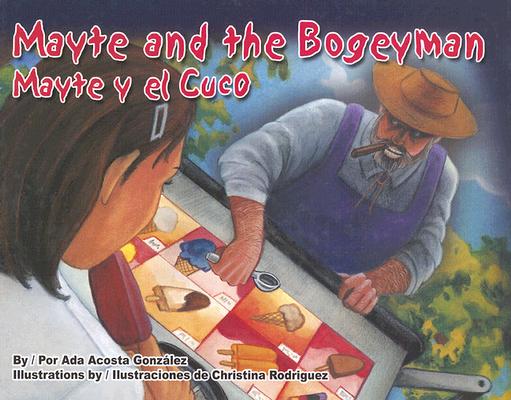
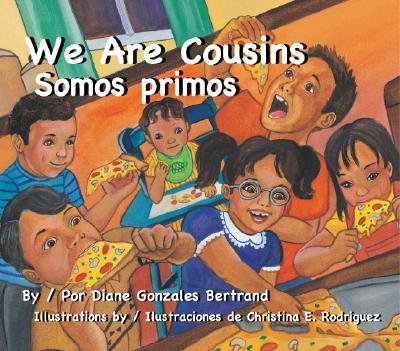
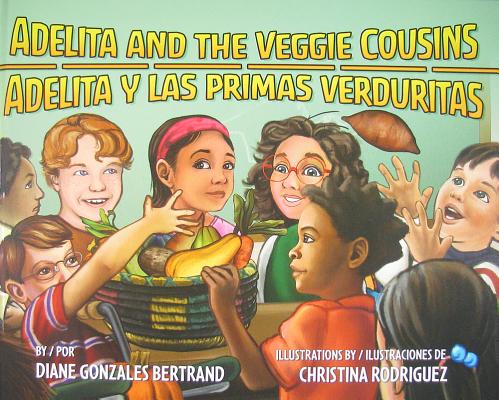
Christina Rodriguez lives in Rhode Island and has illustrated more than twelve books for children. She is a three time nominee for the Tejas Star Book Award. Among the books she has illustrated are Un día con mis tias/ A Day with my Aunts, Mayte and the Bogeyman, We are Cousins/ Somos primos, The Wishing Tree and Adelita and the Veggie Cousins.
Q: What inspired you to become an artist?
A: I became a children’s book illustrator thanks to the adults who steered me in that direction as a child: from my dad who taught me how to draw horses as a child, to my teachers who encouraged my love of art and reading, and finally to my mother for supporting my decision to go to art school at RISD. Without the continuous support of the role models in my life, I might not be where I am today.
Q: Tell us something about your favorite artistic medium.
A: I have two favorite mediums: digital and watercolors. Watercolor painting was one of the first techniques I learned, but I didn’t really get into it until college, when it became a safer alternative to oil paints (the fumes were giving me headaches). Most of my books are done in a mixture of watercolors, watercolor pencils, and gouache -an opaque type of watercolors – that gives me a lot of control in the details and the ability to add depth and texture. I also carry a travel-sized watercolor paint box with my sketchbook everywhere I go.
My other favorite medium is digital: I’ve illustrated a few books completely in Adobe Photoshop, from sketches to finished art. Many book illustrators incorporate digital programs into their workflows at some point, whether it’s resizing sketches, or cleaning up and enhancing finished paintings. I use a Microsoft Surface Pro which makes creating digital illustrations even easier.
Q: Please finish this sentence. “Picture books are important because…”
A: They introduce children to many rich and important concepts at a young age: a love of reading and art, active listening, and critical thinking of complex subjects while in a safe place. Picture books can provide the foundation upon which a rich education can be built.


Jacqueline Alcántara
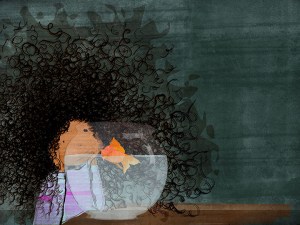
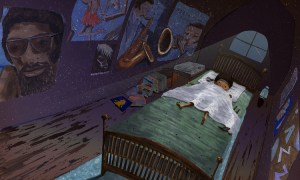
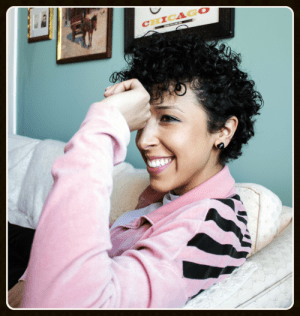 Jacqueline Alcántara is a freelance author and illustrator who previously taught high school art and photography. She won the inaugural We Need Diverse Books Illustrator Mentorship Award in 2016. Her first book is The Field which will be published in 2018 by NorthSouth Books.
Q: What inspired you to become an artist?
A: For as long as I can remember, I loved drawing, cutting, gluing, painting, inventing characters, and writing stories. As a kid, my mom would take me down to the Art Institute’s kids programs, and I still remember the texture of the paper they gave me, and how excited I felt about creating art inside the museum. When I was in high school, my dad took me to Honduras a few times, and each time, we visited with one his best friends who happened to be a fantastic painter and brilliant musician. His name was Carlos Brizzio, and he quickly became the coolest person in the world to me. By the time I finished high school, I knew I wanted to work within “the arts,” even if I hadn’t yet figured out what that meant.
After I graduated from college, I worked as an art teacher, and I decided that I wanted to combine my love of art and kids, and pursue children’s illustration. Lots of artists have inspired me along the way, but my first loves, beyond Quentin Blake and Chris Van Allsburg, were Dalí, Picasso, and Redon. I still look at a lot of art and visit my favorite paintings at the Art Institute of Chicago, but now I’m mostly inspired by silly things that happen throughout the day, serious things that are happening in the world, and all of the beauty that I find in between.
Q: Tell us something about your favorite artistic medium.
A: At this point in time, I’m most in love with markers and gouache. I love gouache because of the opaque/flat feeling of the color. I like that it’s an old medium as well—that it has history and depth. I started using markers recently, when I became interested in fashion illustration. Markers allow you to work fast and consistently, and I love the way they layer on top of one another to almost look and feel like watercolors, or digital painting. I use Photoshop for almost all of my illustrations to collage, experiment, and play with light, color and composition.
Mixed media is so much fun because you can have a plan for your piece, but so much is still left to chance and experimentation, which is exciting when you’re creating a piece, and so satisfying when it’s complete.
Q: Please finish this sentence. “Picture books are important because…”
A: Along with TV and movies, books are largely responsible for how we formulate our ideas about people, cultures, and especially, ourselves from an early age. The stories and characters we read in picture books represent some of the first ways in which we begin to explore these things, and those impressions stick with us, whether consciously or subconsciously, for a very long time. Picture books ask questions about our world and ourselves and can provide us with comfort, curiosity, hope and empathy. But my favorite part is the details, and the magical way in which the words and pictures can tell the same story while saying different things. I also love that children can “read” a picture book even before they are ready to read the text, and how repeated readings help them to discover the details, thought, humor and care that goes into the process of creating them. Picture books are important because they help us to visualize our pasts and futures, as they feed our imagination.

Books to Look For:
Dale, dale, dale: una fiesta de números/Hit it, hit it, hit it: a fiesta of numbers by Carolyn Dee Flores
Canta, Rana, Canta/ Sing Froggie Sing by Carolyn Dee Flores
Una Sorpresa para Teresita/ A Surprise for Teresita by Carolyn Dee Flores
Un día con mis tias/ A Day with my Aunts illustrated by Christina Rodriguez
Mayte and the Bogeyman illustrated by Christina Rodriguez
We are Cousins/ Somos primos illustrated by Christina Rodriguez
Adelita and the Veggie Cousins illustrated by Christina Rodriguez
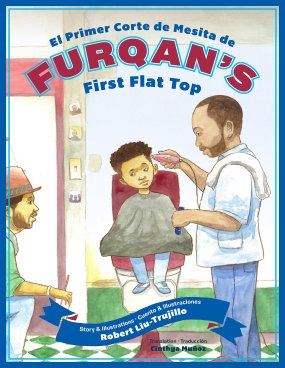 Description from back cover: “
 by Cecilia Cackley
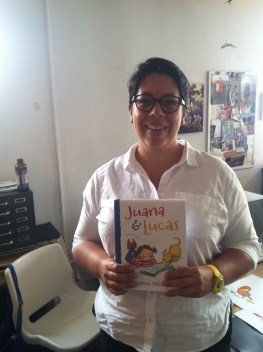
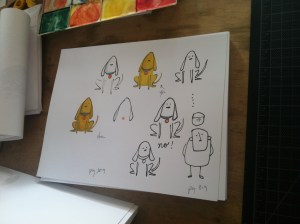 That sense of exploration is on full display in Juana and Lucas, which features a loose, sketchy quality to the ink drawings. Medina points to the British illustrator Quentin Blake as a key influence, noting that he draws with both hands, and she often does too, or sometimes draws with one hand and colors with the other. Another favorite artist is Joaquin Salvador Lavado, better known by his pen name Quino, who created the iconic comic strip Mafalda for the Argentine newspaper El Mundo. Medina gushes about Quino’s “level of expressiveness.” She points out: “He includes wit in such simple traces and achieves complexity and an incredible level of detail in just a few lines.”
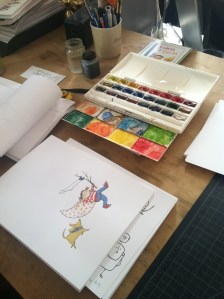 For Juana and Lucas, Medina experimented with sketches in pencil first, then used a light box to draw the final version of each illustration in ink. Watercolor came next and the drawing was then scanned so that the colors could be adjusted digitally. This process also allowed Medina to correct small errors without having to redraw an entire composition. She showed me one spread containing an airplane that hadn’t been in the original sketch. Later in the process, it was added digitally to cover up an unruly inkblot!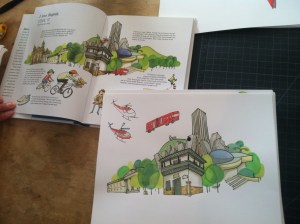
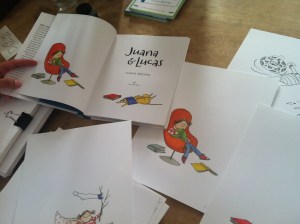 The dynamic presentation of text (words that curve, get bigger or in other ways deviate from the standard type) featured throughout the story was Medina’s idea. Her thinking is that typography is part of language, explored, and it can cue certain meanings of words that may be unfamiliar to young readers.
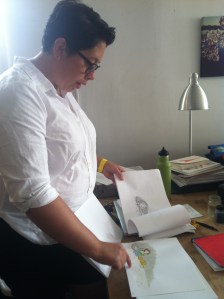 For readers in the United States used to seeing European cities such as London or Paris in children’s literature, it’s a breath of fresh air to get such a detailed, child’s-eye view of a major South American city. Medina went back to Bogotá after writing several versions, and says the trip was bittersweet. “It was the first time there without my grandparents, without having a place there to call home. It was a difficult trip, but it was sweet to see the mountains and smell the eucalyptus, and it was validating to see everything. I took some license in the book. I’m not tying myself to fact-checking everything, which was liberating in a way. There was a lot I left out, especially surrounding the conflict and civil war I grew up with. That’s something I’ll maybe address in another book. The hardest illustration was my grandparents’ house, which no longer exists. It was a safe haven, so no illustration could truly do it justice.”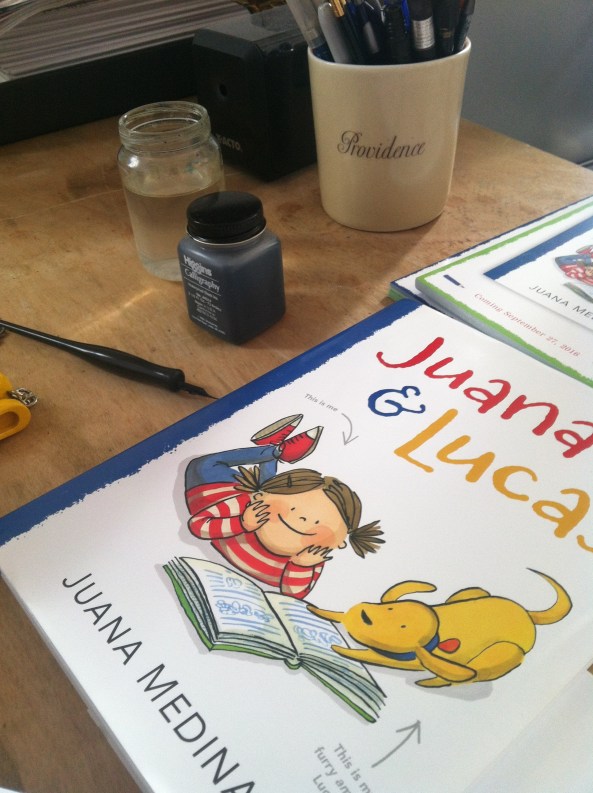
 Cecilia Cackley is a performing artist and children’s bookseller based in Washington, DC, where she creates puppet theater for adults and teaches playwriting and creative drama to children. Her bilingual children’s plays have been produced by GALA Hispanic Theatre and her interests in bilingual education, literacy, and immigrant advocacy all tend to find their way into her theatrical work. You can find more of her work at
 Aren’t children too young to think about social and political issues? Should we interfere with children’s innocence by prematurely exposing them to the darker sides of life?
 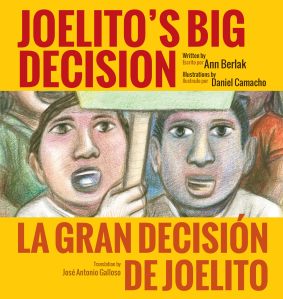 Joelito’s Big Decision/ La gran decisión de Joelito
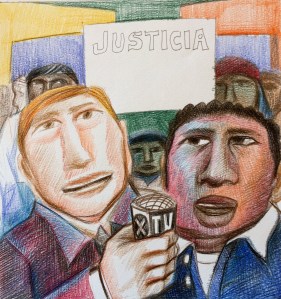
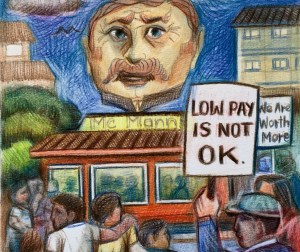 Our book tells the tale of Joelito, who eats dinner at MacMann’s Burger Restaurant with his family every Friday. The story begins one Friday when he finds his best friend Brandon and Brandon’s parents at the restaurant entrance, holding up signs saying, “Low Pay is Not OK,” and “Fight for 15,” and urging the hungry Joelito not to eat at MacMann’s tonight.
 Hope
Hope Author Ann Berlak has been a teacher and teacher educator for over fifty years. She envisions schools as places where children learn to become active, caring participants in the creation of a world that works for everyone. Joelito’s Big Decision/La gran decisión de Joelito was selected for the 2016-2017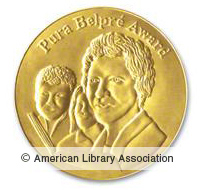
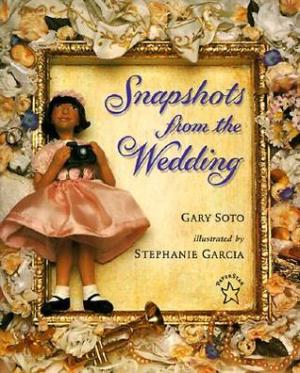 DESCRIPTION FROM THE BOOK JACKET: Meet Maya, Isabel’s flower girl, as she describes in vivid detail the exciting wedding day. Maya introduces us to Danny, the ring bearer; Aunt Marta, crying big tears; Uncle Trino, jump-starting a car in his tuxedo; and Rafael, the groom, with a cast on his arm. Of course, the big day also includes games, dancing, cake, and a mariachi band that plays long into an evening no one will ever forget.
 ABOUT THE ILLUSTRATOR: Stephanie Garcia is an illustrator, graphic designer, art director, and design consultant, with a wealth of experience in the corporate world and the classroom, where she shares her knowledge with others. Learn more about her in
  ABOUT THE AUTHOR: Gary Soto is the author of multiple picture books, including the Chato series, which won the Pura Belpré illustrator award for Susan Guevara. He also published many novels for youth, as well as books of short stories for young readers, and collections of essays and poems. His awards include the prestigious Guggenheim Fellowship, the Andrew Carnegie Medal, and the National Book Award. Learn more at
  Lila Quintero Weaver
 Ana writes: “This cover design was created in watercolor, inks and gouache. I’m so happy to share with everyone the face of an unknown, mysterious and mischievous creature: the chupacabra!”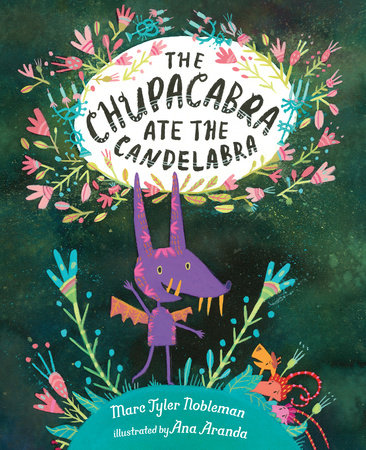
 Latinxs in Kid Lit