March and April 2018 Latinx Book Deals


Compiled by Cecilia Cackley

This is a monthly series keeping track of the book deals announced by Latinx writers and illustrators. The purpose of this series is to celebrate book deals by authors and illustrators in our community and to advocate for more of them. If you are an agent and you have a Latinx client who just announced a deal, you can let me know on Twitter, @citymousedc. If you are a Latinx author or illustrator writing for children or young adults, and you just got a book deal, send me a message and we will celebrate with you! Here’s to many more wonderful books in the years to come.

April 26

None.

April 24

Author of Lola Levine chapter book series Monica Brown and 12-year-old star of the music video “Soy Yo” by Bomba Estereo Sarai Gonzalez’s, third book SARAI SAVES THE MUSIC plus a 4th book in the fictional series based on Sarai’s life, again to Marisa Polansky at Scholastic, in a two-book deal, for publication in spring 2019, by Stefanie Von Borstel of Full Circle Literary for Brown and Monica Villarreal and Rick Doorman of Authentic Media for Gonzalez. All four books in the new series will also be available in Spanish editions.


Alvina Ling at Little, Brown has acquired Roseanne Montillo‘s The Atomic Women. The YA nonfiction book tells the stories of the little-known female scientists who were critical to the invention of the atomic bomb and an examination of the moral implications of their work. Publication is planned for fall 2019. Author agent: Rob Weisbach at Rob Weisbach Creative Management.


Zachary Clark at Scholastic has bought Rated, by Girl at Midnight author Melissa Grey, in which teens navigate a hierarchical ranking system in a Black Mirror-esque future. Publication is slated for 2019. Author agent: Catherine Drayton at InkWell Management.

April 19

Hilary Van Dusen at Candlewick Press has bought world rights to Dean Robbins‘s (l.) picture book, ¡Mambo Mucho Mambo!, which tells the story of how Latin jazz music and mambo dancing at New York City’s integrated Palladium Ballroom broke down barriers in the 1950s and set the stage for the civil rights movement. Artist Eric Velasquez will illustrate. Publication is scheduled for fall 2020. Illustrator agent: Rubin Pfeffer at Rubin Pfeffer Content.

April 17

None.

April 12

Kait Feldmann at Scholastic/Levine has acquired world rights to Aida Salazar‘s (l.) debut picture book, Jovita Wore Pants, the story of Jovita Valdovinos, who dressed as a man and commanded a battalion of revolutionaries in a fight for religious freedom in the Mexican sierras. The biographical picture book is based in part on personal accounts told to Salazar, who is related to Valdovinos. Debut picture book artist Molly Mendoza will illustrate. Publication is scheduled for 2020.Author agent: Marietta B. Zacker at the Gallt and Zacker Literary Agency. Illustrator agent: none.


Margaret Raymo at HMH has bought, in a two-book deal, Lowriders in Space illustrator Raúl the Third‘s bilingual picture book, Vamos! Let’s Go to the Market. Inspired in part by Richard Scarry’s Busytown, the book offers a guide to the food, marketplace, games, animals, plants, and more of a U.S./Mexico border town. Publication is set for spring 2019. Agent: Jennifer Laughran at Andrea Brown Literary Agency.

April 10

Jessica Garrison at Dial has acquired Red House, Tree House, Little Bitty Brown Mouse by Jane Godwin (l.), illustrated by Blanca Gomez. The picture book is an exploration of colors and patterns and counting and more, with a tiny mouse hidden on every page. Publication is planned for fall 2019. Illustrator agent: Rebecca Sherman at Writers House sold world rights.


Andrea Welch at S&S/Beach Lane has bought world rights to Here Comes Ocean, a picture book by Meg Fleming (l.) (Ready, Set, Sail), illustrated by Paola Zakimi (Secrets I Know). The book follows a child who discovers that along with every rolling wave comes a new possibility for adventure. Publication is slated for spring 2020. Agent: Emily van Beek at Folio Jr./Folio Literary Management.

April 5

None.

April 3

John Morgan at Macmillan/Imprint has acquired two picture books by Karen Kilpatrick and Luis O. Ramos Jr. (center), illustrated by Germán Blanco. When Pencil Met Eraser depicts the creative journey that brings Pencil and Eraser together. Publication is planned for summer 2019, followed by a second, untitled book. Agent: Deborah Warren at East West Literary.

March 28

Nick Thomas at Scholastic/Levine has acquired, at auction, the first three books in Daniel José Older’s Dactyl Hill Squad, a middle grade historical fantasy series that reimagines the Civil War in a world where dinosaurs roamed alongside humans. In the center of this extraordinary moment is a squad of young people from the Colored Orphan Asylum in New York City, and at their head, a brave and brilliant girl named Magdalys Roca, who wants nothing more than to flee south and rescue her injured brother. Publication of the first book is set for fall 2018, with book two to follow in summer 2019. Author agent: Eddie Schneider at JABberwocky Literary.

March 22

Alexis Orgera and Chad Reynolds at Penny Candy have acquired world rights to Thank You, Crow by Michael Minkovitz (l.), illustrated by Jose Medina. Their debut picture book stars a boy whose act of kindness toward an injured crow leads to friendship and adventure. Publication is slated for fall 2017.

March 20

Kate O’Sullivan at Houghton Mifflin Harcourt has bought world rights to journalist Beth Ferry‘s (l.) picture book, Marsha’s Magnetic, illustrated by Lorena Alvarez. In the book, Marsha uses the scientific method to try and discover just what makes her classmates popular, until she realizes the best way to attract friends is to be yourself. Publication is scheduled for spring 2020. Illustrator agent: Alli Brydon at the Bright Group.

March 15

None.

March 13

Liza Kaplan at Philomel has acquired Jenny Torres Sanchez‘s new novel, By the Water. The book follows sisters Lola and Rosie in the wake of a car accident that landed them at the bottom of a lake, as they struggle to find a new relationship amid brain damage and the lingering fear that the accident wasn’t an accident at all. The book is set for publication in summer 2020. Author agent: Kerry Sparks at Levine Greenberg Rostan.

March 8

None.

March 6

None.

March 1

Erin Clarke at Knopf has bought world rights to Salsa Lullaby, a bilingual picture book by Jen Arena (l.), illustrated by Erika Meza, in which mami, papi, and bebé dance/bailan, sing/cantan, jump/saltan, and more until bebé falls asleep. The book is set for fall 2019. Author agent:   Jill Corcoran at Jill Corcoran Literary Agency. Illustrator agent: Claire Cartey at Holroyde Cartey.


Sylvan Creekmore at Wednesday Books has acquired, in a preempt, S. Gonzales‘s Only Mostly Devastated. Pitched as Simon vs. the Homo Sapiens Agenda meets Clueless, inspired by Grease, the book follows a boy trying to navigate a family crisis and a move to a new school who is quickly adopted by a new group of friends and comes face-to-face with his summer fling—only to discover that the perfect boy he remembers now won’t even look at him. Publication is planned for spring/summer 2019. Author agent: Moe Ferrara at BookEnds Literary.


Reported by Cecilia Cackley, a performing artist and children’s bookseller based in Washington, DC, where she creates puppet theater for adults and teaches playwriting and creative drama to children. Her bilingual children’s plays have been produced by GALA Hispanic Theatre and her interests in bilingual education, literacy, and immigrant advocacy all tend to find their way into her theatrical work. You can find more of her work at www.witsendpuppets.com.

Doodling as Activism: How I Produced My Diary of a Reluctant Dreamer

Earlier this week, we published a review of Diary of a Reluctant Dreamer: Undocumented Vignettes from a Pre-American Life. Today we are pleased to present a guest post by the author-illustrator.

By Alberto Ledesma

From 1989 to 1996 I attended graduate school at UC Berkeley. During my last four years in the Ethnic Studies doctoral program, I spent almost every day studying the ways that undocumented immigrants had been represented in Mexican American novels and short stories. I read hundreds of pieces, dozens of novels and many, many short stories—the works themselves and the literary criticism that had been written about them—all in an effort to understand what role undocumented immigrant characters and stories played in the larger world imagined by Mexican American authors. I had pursued this project because of my own experience as a previously undocumented student. It’s funny how our own biographies sometimes compel us to seek answers to questions about ourselves, right?

Being undocumented had had such a profound impact on the shaping of my and my family’s cultural identities that I was eager to understand the many ways that that experience had also been represented in the collection of books and stories contained by Chicano literature. But, in the late 1980s and early 1990s, when I was in graduate school, there seemed to be few works that placed undocumented characters as the protagonists of their stories. This confused me, because I knew that there were millions of undocumented people living in the same neighborhoods like the one where I grew up. And I knew that several million undocumented immigrants had just gone through the federal amnesty process that my family and I had just gone through. Surely, I thought, some Mexican American authors must have written stories that focused on experiences like mine.

For the most part, my interest in exploring undocumented stories remained undaunted during the mid 1990s. And though the days that I spent working on my dissertation were long, often starting at the crack of dawn and ending only once the library at UC Berkeley closed, I was driven by a strong desire to show that undocumentedness was another kind of Mexican “American” experience and that it deserved to be told within the corpus of books we now called Chicano literature. In the end, however, after I finished my dissertation and published a number of articles connected to it, that scholarly dialogue that I was hoping to initiate about the role of undocumented immigrant experience within Chicano literature did not seem to want to take off. Still, I taught classes focusing on immigrant subjects, attended many literary conferences where I made impassioned presentations about the importance of incorporating undocumentedness as an important interpretive lens within the field of Chicano letters, and while I was heartened by the emergence of Gloria Anzaldúa’s Borderlands theory and analytical focus, it seemed that undocumented ways of knowing would remain largely absent from Chicano literary studies. So it was that after attending a major conference in Zacatecas, Mexico, in the late 1990s, and after noticing that once again I seemed to be the lonely voice in the wilderness, that I decided to take a break from my research while I raised my infant daughter.

That break ended up lasting eighteen years as I moved from teaching and research to doing college administrative work. As the years passed I thought that I had left my project behind; however, in 2012, while I was teaching a Summer Bridge class as part of my responsibility of being an administrator at Berkeley’s Student Learning Center, something magical happened—the Undocumented Student Movement emerged and it placed the concern over undocumented immigrants at the heart of Latinx studies. Throughout the country, undocumented students were participating in marches and protests, all in an effort to get the US Congress to pass the Dream Act. Some students had gone to protest President Barack Obama during the Democratic National Convention. Some initiated sit-ins at senator offices. And eventually, as a result of all their efforts, the Obama Administration created the Deferred Action for Childhood Arrivals policy (DACA), a policy that permitted undocumented immigrants who had been brought to the US as children to attend college and work.

The creation of the DACA policy inspired me to return to the questions I had about what being undocumented meant in the United States. But, instead of writing more essays about this issue, I decided to draw cartoons instead. It all happened because of that Summer Bridge class I was teaching when the undocumented student movement exploded across the United States. Though I was excited about doing a lecture about the undocumented student movement, my students had expressed a frustration with the amount of work that I had already assigned them. So, in order to pique their interest, I tapped into and old and neglected talent and drew a quick sketch of “A Day in the Life of an Undocumented Student.” Though my students had complained about all the work that they had had to do, I noticed that many of them began doing research on the movement on their own. So, I sketched other cartoons and shared them via Facebook. All of the sudden, I began getting hundreds of friend requests and they began asking me to draw more cartoons, to share my experience though art. After several years of doing so, of drawing vignettes based on my undocumented life, I had the makings of a book.
You might wonder why I, as a trained literary scholar in this field, decided to do something for which I had no training at all? Interestingly, it was only after I started doing cartoon sketches about my undocumented heritage that that the conversation that I wanted to get started actually occurred. What changed? Why did it my cartoons elicit a reaction that my scholarship did not? I think that the main reason my cartoons hit the nerve that my essays and stories could not do had everything to do with the form. As the saying goes, “a picture is worth a thousand words.” Here, I was creating visual essays, communicating the same ideas I had been researching, with the cartoons I was crafting. I realized that the young people who responded to my cartoons were also more accustomed to consuming visual text. Snapchat, Facebook, emojis, all of these had developed in them literacy skills for quickly digesting ideas in images.

It did not take me long to understand that my cartoon memoir was also effective because of its flexible narrative form. I did not have to assume a stuffy authorial voice to maintain my credibility. In my cartoons the fourth narrative wall was pliable; I could as easily be an overeducated omniscient narrator as I could be a vulnerable first-person witness to the same story without jarring the viewer. And yet, because my assumption was so strong that the only way my undocumented story could be accepted was if it came from an overly academic point of view, I had not even considered cartoons as a serious tool for inquiry. All those years of academic training that I had received in graduate school had led me to believe that the only option I had for sharing my undocumented experience was through dense textual analysis.

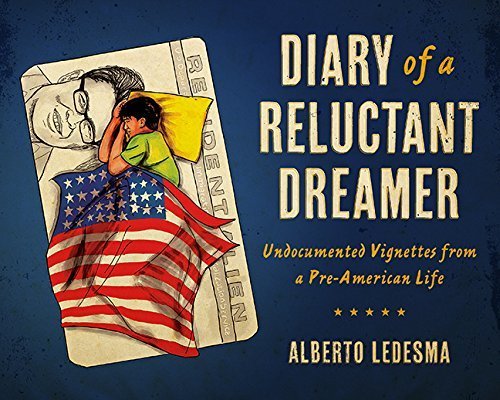
Today, when I attend important lectures and I am really into what the speaker is saying, I don’t take traditional notes. Rather, I take out my sketchbook, my favorite fountain pen, and I start doodling. I judge the quality of a talk by the complexity of the sketches I produce. Indeed, now that I have done a bit more research on it, I have learned that cartooning is an effective form of communication: it allows for better mental digestion of complex ideas; engages multiple intelligences; and, it allows viewers of an image to understand a story from multiple lenses. It is because of this that cartooning has allowed me to communicate the fears I felt when I was undocumented much more effectively than my writing ever could. This is the reason why I created my illustrated memoir, Diary of a Reluctant Dreamer.
And yet, there is only so much my little book can do. The xenophobic program that is now aiming to persecute undocumented immigrants is all too real. This program, however, is not just aimed at undocumented immigrants. The attack on undocumented immigrants is just but the most obvious aspect of what seems to be a larger policy that has taken aim at the heart of what used to be an American progressive democracy—the social infrastructure that, as a result of the labor organizing and social activism of the ‘30s to ‘60s, increased access to education, health care, and legal protections for all working class and poor people. My belief is that working class and poor people of all ethnic backgrounds now need each other more than ever and that we cannot let false debates based on false moralisms distract us from our common humanity. To view undocumented immigrant experience in the US as a totally unredeemable experience that needs to be excised without mercy is to buy into a false equivalency that has already stopped us from discerning what is lawful versus what is just.

This is the reason why I have chosen to confront my fears about what it meant for me to be undocumented, because I cannot ask that people show empathy for the undocumented community, unless I first show empathy for the totality my own undocumented experience. And that is why, in spite of my fears, I will continue to illustrate my undocumented American life.

Book Review: Diary of a Reluctant Dreamer: Undocumented Vignettes from a Pre-American Life, Written & Illustrated by Alberto Ledesma

Reviewed by Lila Quintero Weaver

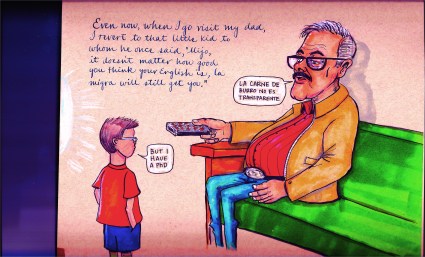
DESCRIPTION OF THE BOOK: In this hybrid memoir, Alberto Ledesma wonders, At what point does a long-time undocumented immigrant become an American in the making? From undocumented little boy to “hyper documented” university professor, Ledesma recounts how even now, he sometimes finds himself reverting to the child he was, recalling his father’s words: “Mijo, it doesn’t matter how good you think your English is, la migra will still get you.”

Exploring Ledesma’s experiences from immigrant to student to academic, Diary of a Reluctant Dreamer presents a humorous, gritty, and multilayered portrait of undocumented immigrant life in urban America. Ledesma’s vignettes about life in the midst of ongoing social trauma give voice to a generation that has long been silent about its struggles. Delving into the key moments of cultural transition throughout his childhood and adulthood—police at the back door waiting to deport his family, the ex-girlfriend who threatens to call INS and report him, and the interactions with law enforcement even after he is no longer undocumented—Ledesma, through his art and his words, provides a glimpse into the psychological and philosophical concerns of undocumented immigrant youth who struggle to pinpoint their identity and community.

MY TWO CENTS: Powerful and timely, Diary of a Reluctant Dreamer: Undocumented Vignettes from a Pre-American Life is the stunning, hand-illustrated chronicle of Alberto Ledesma’s twelve years in undocumented limbo and the psychological toll those years exacted. Drawing—or doodling, as he often calls it— became of one Ledesma’s most reliable coping mechanisms for the stresses of living in the U.S. without documentation. He began the doodling practice as a quiet act of defiance, since even privately acknowledging one‘s lack of papers broke a cultural taboo held by many insiders in Ledesma’s undocumented community. This taboo reached inside the very walls of his family home, where the fear of detection and deportation hung like a black cloud over their daily existence.

In this work, Alberto Ledesma offers a perspective of the American experience that few have written about, plumbing its layers of complexity through richly observed episodes, supplemented by striking text-and-image panels. His personal stories reveal troubling family dynamics, from the pain of feeling misunderstood to his father’s emotional unavailability and bouts of drinking. They also explore Alberto’s adolescent years, when the ache to free himself from the constant secrecy demanded by the family’s status was at its height. Stories of close calls render the fear palpable. In one vivid example, Alberto, his siblings, and their mother sit in a parked car next to a field while their father wanders into the undergrowth to pick wild cactus leaves. As cars occupied by white people pass by, some drivers cast suspicious glances at the Mexican family. When one of the sisters spots a no-trespassing sign, tension turns to panic and eventually to anger at their father for placing them in such a vulnerable position.

In 1986, the Ledesma family achieved legal status through provisions outlined in the Immigration Reform and Control Act, a law passed during the Reagan administration. But as Alberto explains, “though we were now ‘legal,’ those twelve years of conditioning did not disappear.” Long after his status is resolved, the fear of being hunted persists. He demonstrates the extent of that struggle through contemporary exchanges with his young daughter, Sofia, who peppers him with such questions as, “What does it mean that you were once illegal?”

Ledesma ultimately transitioned into academic life, earning a Ph.D. and landing a teaching and administrative position at the University of California at Berkley. He connects his academic drive to the phenomena of “hyper-documentation.” Originated by Dr. Aurora Chang, this term “describes the effort by Dreamers to accrue awards, accolades, and eventually academic degrees to compensate for having been undocumented.” The burdensome effect of this impulse comes through in one of Ledesma’s most potent drawings, which shows a brown-skinned person dressed in cap and gown, pulling a file cabinet tethered by rope and bursting with award certificates.

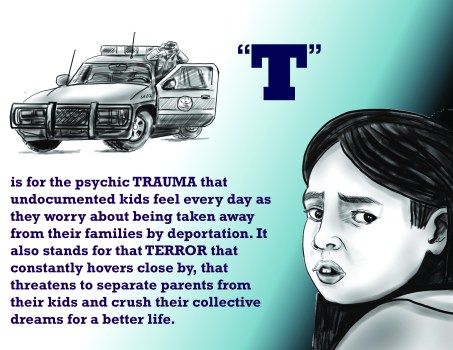
In addition to its memoir sections, Diary of a Reluctant Dreamer includes dozens of serial and stand-alone text-and-image panels, which reflect on multiple aspects of undocumented life. An entire chapter, “The Undocumented Alphabet,” illuminates twenty-six poignant realities experienced by the community. They include:

        “A” is for the ABUELITOS left back in Mexico and the knowledge that until you fix your status you can’t go visit them no matter how much you miss them.

        “E” is for the EDUCATION your mother asked you to get so that you wouldn’t end up working at the same garment factory she did.

Crossing the southern border without papers is an act fraught with peril, but as Diary of a Reluctant Dreamer makes clear, it’s only the start of a long, precarious journey that plays out in the daily existence of millions of undocumented Americans. At this writing, the future of many DACA recipients and other undocumented youth remains in limbo. Their fate is in the hands of elected officials all too willing to play political football with human lives. Alberto Ledesma’s account offers a strong and essential counterpoint to the xenophobia infecting public discourse about U.S. immigration. It brings penetrating light into the liminal spaces occupied not only by Dreamers, but all undocumented immigrants, and makes a convincing case that their stories deserve a chapter in our national narrative.


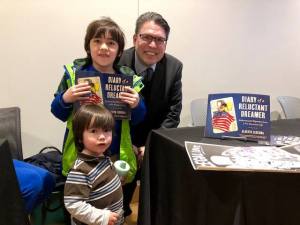
Last month, while Alberto Ledesma was at The Ohio State University for a panel on comics and immigration, he stopped for this photo opportunity with Liam Miguel and Ethan Andrés Pérez, sons of our fellow Latinxs in Kid Lit blogger, Ashley Hope Pérez.

Liam Miguel read Diary of a Reluctant Dreamer from cover to cover (even the parts in cursive, which were tricky for him at first), and he was thrilled to get his copy signed. For him, hearing Alberto’s stories was a way to better understand his father’s path to legal status as well as the realities for many young people who were not so fortunate to come at a time when that path was opened.

ABOUT THE AUTHOR-ILLUSTRATOR: Alberto Ledesma, a Mexican-American scholar of literature, holds a doctorate from the University of California, Berkeley. His publications include poetry, academic articles, and short stories, which have appeared in Con/Safos: A Chicana/o Literary Magazine, and in Gary Soto’s Chicano Chapbook Series (#17). He has also published essays  in ColorLines and New America Media. Ledesma, who participated in Sandra Cisneros’s Macondo Workshop and in the VONA Writers Workshopserves as Graduate Diversity Director for the Outreach and Diversity Office of the Arts & Humanities Division in the College of Letters & Science at the University of California, Berkeley.
Book Review: Telegrams to Heaven / Telegramas al Cielo by René Colato Laínez, illus. by Pixote Hunt

Review by Jessica Agudelo

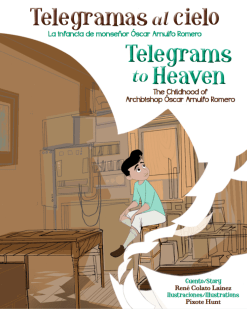
DESCRIPTION OF THE BOOK: Telegrams to Heaven / Telegramas al Cielo recounts the moving childhood of Archbishop Óscar Arnulfo Romero y Galdámez, who from an early age discovers the candor, light and power of the word, which he uses to pray and to write poetry, sending telegrams to heaven from his heart. René Colato Laínez, the renowned Salvadoran writer, has written a touching story about the great Salvadoran prophet who dreamed from his childhood of being a priest, and became not only a priest, but also a bishop, an archbishop, and the great orator of his country. His word remains, for the Salvadoran people and the world—a prayer, a poem, a sweet telegram that Archbishop Romero continues to send in the name of his people to the heart of heaven. The colorful, modern illustrations of Pixote Hunt make us reflect with deep tenderness, showing us the innocence of the great Archbishop Romero as a young child.
MY TWO CENTS: René Colato Laínez offers a bilingual picture book tribute to the Archbishop Oscar Arnulfo Romero, chronicling the icon’s early spiritual development. The Archbishop, then simply known as Oscar, grew up in Ciudad Barrios, in the San Miguel department of El Salvador. Laínez introduces us to Oscar as he works in his family’s home post office and telegram business. Oscar marvels at the telegraph, which can, “like magic” send messages across long distances. He then begins to wonder if he can also use this technology to communicate with heaven. His father clarifies that messages can be sent to God through prayer, prompting Oscar’s dedication to praying “when he woke up, when he milked the cow, after he finished his homework and to give thanks before every meal.” Oscar’s devotion permeates all aspects of his life. Even his artistic talents, like playing the flute and writing poetry and music, serve as expressions of his spirituality and commitment to God.

The story’s sole source of tension arises when Oscar expresses his desire to become a priest. His father is chagrined, and instead sends his son to work at a carpentry shop as a distraction. The text, however, does not specify why Oscar’s parents were not supportive of his wish to become a priest. His father’s admonition, “there are so many things that you can be in this life,” coupled with details in the text about businesses owned by the Romeros and their ability to hire a private teacher for Oscar, hint at a socioeconomic reason. Laínez may have highlighted the moment to demonstrate Oscar’s staunch and early commitment to the Church, but I wanted more clarity.

Indeed, Oscar is not dissuaded from entering the priesthood. When Bishop Dueñas visits Ciudad Barrios, Oscar uses his carpentry shop earnings to buy a crisp white suit to meet the prelate. This encounter is a watershed moment in Oscar’s life, and thus ends the narrative chronicling his childhood. On the following page, we see Oscar as an adolescent, headed to youth seminary in San Miguel and, as the text indicates, later on to Rome, at the behest of Bishop Dueñas, to complete his studies. The final spread is of Oscar, now ordained as Father Arnulfo Romero, palms facing up in front of the church altar, ready to celebrate mass in front of the Ciudad Barrios community, where his journey began.

The accompanying illustrations by Pixote Hunt mainly mirror the information conveyed in the text, but the images lack the warmth of Laínez’s tone. The digital, abstract style leaves characters appearing flat and expressionless, and fail to depict settings distinctly. Many of the spreads are set against surreal or monochromatic backgrounds, such as the telegram and carpentry shops, which appear almost indistinguishable because of the identical color choices. In the few scenes in which a setting is clear, such as the central plaza or the town’s church, details are limited to straight lines, and the people of the community appear as outlined shapes in a solid color with indistinguishable facial features.  Although the story is about The Archbishop, who came to be loved and respected across the world, he will be forever identified with El Salvador. The abstract visual elements used in the illustrations instead create a distance between the subject and his surroundings, an overall disappointing effect.

Laínez’s admiration and respect for the Archbishop is evident and deeply personal, as he relates in the Author’s Note. No doubt Salvadorans and other Latinxs familiar with the Archbishop will be touched and pleased to see his story in print, particularly for young audiences. This title also serves as a reminder of the hope that lives within the Salvadoran community despite many current and past hardships. However, for audiences completely unfamiliar with the Archbishop, or those looking for a comprehensive biography, the story’s narrow focus and static illustrations will fall short. I was left with many additional questions about Oscar’s childhood, his hometown, and his family. Perhaps other readers will, like me, be encouraged to seek more information elsewhere. I do, however, reserve the hope that this will be the first of many titles for young readers that will chronicle that Archbishop’s life and legacy.

Image result for rene colato lainezABOUT THE AUTHOR: Known as “the teacher full of stories,” René Colato Laínez is the Salvadoran author of several bilingual picture books including I Am René, the Boy/Soy René, el niño (Piñata Books), Waiting for Papá/Esperando a papá (Piñata Books), Playing Lotería/ El juego de la lotería (Luna Rising). I Am René, the Boy received the Latino Book Award for “Best Bilingual Children’s Book.” Playing Lotería was named a “Best Children’s Book” by Críticas magazine and the New Mexico Book Award “Best Children’s Book.” Playing Lotería and I Am René have both been nominated for the Tejas Star Book Award—the K-6 bilingual counterpart to the Texas Bluebonnet Award.
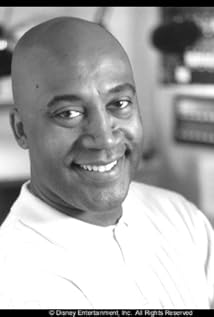
Image result for pixote huntABOUT THE ILLUSTRATOR (From his website): As a director, art director and designer in the film industry I bring more than 10 years experience in animation to every project. Highly skilled in drawing, painting and musical composition, my creative goal is to bring an innovative insight to every project. Always on the cutting edge, my experience in combining animation with live action began in 1994 when I directed and art directed THE PAGEMASTER, and continued as I designed the 3D opening and interstitials for FANTASIA 2000 that seamlessly weaved the animated sequences together. I feel my unique achievements in film and music have garnered me the honors of being a voting member of both the Academy of Motion Picture Arts and Sciences and the GRAMMYs/Recording Academy.

J_AgudeloABOUT THE REVIEWER: Jessica Agudelo is a Children’s Librarian at the New York Public Library. She has served on NYPL’s selection committee for its annual Best Books for Kids list, and is currently a co-chair for the 2018 list. She contributes reviews of English and Spanish language books for School Library Journal and is a proud member of the Association of Library Services to Children and REFORMA (the National Association to Promote Library and Information Services to Latinos and Spanish Speakers). Jessica is Colombian-American and was born and raised in Queens, NY.
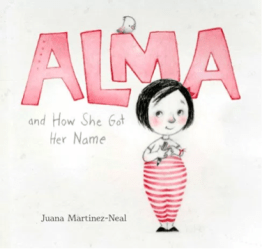
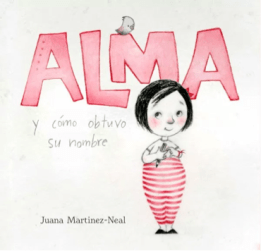
Book Review: Alma and How She Got Her Name/ Alma y come obtuvo su nombre, by Juana Martinez Neal


Coming to a shelf near you on April 10, 2018!

Reviewed by Dora M. Guzmán

PUBLISHER’S DESCRIPTION: If you ask her, Alma Sofia Esperanza José Pura Candela has way too many names: six! How did such a small person wind up with such a large name? Alma turns to Daddy for an answer and learns of Sofia, the grandmother who loved books and flowers; Esperanza, the great-grandmother who longed to travel; José, the grandfather who was an artist; and other namesakes, too. As she hears the story of her name, Alma starts to think it might be a perfect fit after all — and realizes that she will one day have her own story to tell. In her author-illustrator debut, Juana Martinez-Neal opens a treasure box of discovery for children who may be curious about their own origin stories or names.

MY TWO CENTS: What is in a name? A name is a gift given to you at birth and you carry it through all your stages of life. Parents and guardians spend months deciding on their baby’s name, sometimes even long before a baby is in the picture. But what if your name doesn’t fit on your paper because of its length?

In a world where we tend to question our differences, this story does quite the opposite. Growing up in the United States, one tends to have a single first name, maybe a middle name, and just one last name. However, this differs in certain other countries, including in Latin American, where it is not out of the ordinary to have more than one name.

Meet Alma Sofia Esperanza José Pura Candela, the main character of this story. Yes, her name is long. However, wondering about the length is what leads Alma on the journey to discover the story behind her name. Throughout the book, we learn the rich history and origins of each of Alma’s names. Many of her names were inspired by her ancestors and their humble traits and contributions to the world. The people behind her names influence Alma’s passions and character, even as she embraces each person and the love they gave her as a baby. She quickly learns that those same traits are present in her everyday life, and she rightfully claims that name through her affirmation of “I am____”. Alma soon learns that with claiming her name comes a lot of love and culture. She will now be able to contribute those gifts to the world. As Alma declares, “I am Alma, and I have a story to tell.”

This story wonderfully illustrates how to embrace YOU and the name you carry throughout life. In this story, Juana demonstrates that our name is a spotlight on not only our ancestors and the imprints they left on our lives, but also a forever part of us and what we can give to this world.

This picture book illuminates an essential connection to ancestors. Inspired by her own name, Juana reminds readers that our names are not just our own, but a reflection of our culture as well.

I am always amazed at Juana’s illustrations, especially in this picture book. The beauty of the main character connecting to her past is captured in colors and soft shades that will delight the reader’s eye. Juana also brings attention to each name through the addition of colorful accents and font styles. In page after page, the illustrations offer a collective reflection of everything that Alma’s ancestors represent, forming a visual reminder that who we are is a collection of everyone who came before us.

TEACHING TIPS: Teachers of all grade levels can use this picture book to illustrate our Latinx identity. This book is a perfect addition to an identity unit, where readers can delve into their own names and family trees. Teachers can also use this book as a reading mentor text around the main character’s learning process, as well as understanding the author’s message. The Spanish version is authentic to the Spanish language and perfect for bilingual/dual language classroom settings. Alma and How She Got Her Name/Alma y como obtuvo su nombre is a definite must add to all libraries in classrooms and homes!


ABOUT THE AUTHOR-ILLUSTRATOR: Juana Martinez Neal is an award-winning illustrator and artist. Her passion for art started as a child and led her to study at one of the best schools in fine arts in Peru. Her journey as an illustrator led her to the United States, where she continues to illustrate a variety of children’s books. For updates on her art, follow her on Instagram @juanamartinezn. Juana’s official website can be found at http://juanamartinezneal.com/


ABOUT THE REVIEWER: Dora M. Guzmán is a bilingual reading specialist for grades K-5 and also teaches college courses in Children’s Literature and Teaching Beginning Literacy. She is currently a doctoral student with a major in Reading and Language. When she is not sharing her love of reading with her students, you can find her in the nearest library, bookstore, or online, finding more great reads to add to her never ending “to read” pile!
Artist Jose Pimienta Gives Advice and Talks About Tools & Techniques


By Cecilia Cackley

Joe Pi’s almost full name is Jose Pimienta. He was born in the Imperial Valley and raised as a Cachanilla in Mexicali, BC. During his upbringing, he was heavily influenced by animation, music and short stories. He’s been drawing as long as he can remember and loved analyzing everything on the TV screen.

After high school, he left his garage band and ventured toward Savannah, Georgia, where he studied Sequential Art and discovered the wonders of Storyboarding. He also discovered a wider variety of music, traveled more and made friends. By the age of 24, he ran into a good suggestion, which was to move to SoCal and pursue a career in storyboarding. In 2009, he packed his belonging and drove to Los Angeles, with a friend. Nowadays, he resides in Tujunga where he takes walks every morning along with a big cup of coffee. He draws comics, storyboards, and sketches for visual development.

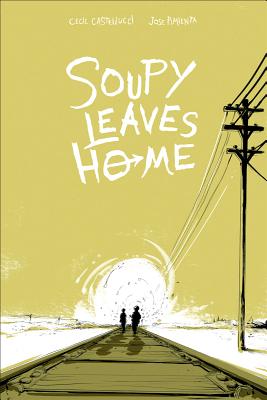
Joe’s latest book is the YA graphic novel Soupy Leaves Home, a historical fiction story by Cecil Castellucci set during the Great Depression. He was kind enough to talk to us about his background and work as an artist.
Did you read comics as a kid? What were your inspirations for becoming an artist? 

Unfortunately, I didn’t read many comics as a kid. I tried getting into superheroes several times, but they never really hit a chord with me. It wasn’t until my teens that I discovered other graphic novels, manga, and slice-of-life stories in comics that rocked my world. I did, however, read a lot of newspaper strips, but I also felt that wasn’t my fit for the type of stories I wanted to tell.

As a kid, my inspirations tended to come from animated movies, books with illustrations and music videos. As long as I can remember, I’ve always liked all those “making of-” featurettes and interviews with film makers and artists. They tended to reveal parts of the process and how a piece of art (whether it was a cartoon, a movie, or a song) was made. So, I guess I was inspired to be an artist by learning more about the arts I liked. The thought seemed logical: I like this Art and this is how they’ve done it and I want to do that because when I try it, I love it. Conclusion: learn more how to do it and keep going.

Please tell us a little bit about the tools you used to draw Soupy Leaves Home.

For Soupy Leaves Home, I drew it the way I prefer to draw comics, which is:

On regular type paper, 8.5 by 11 and a mechanical pencil (0.5, to be precise). I draw 1″ by 1.5″ rectangles and that is the thumbnail for a comic page. I draw my thumbnails small while reading the script, so it helps me to plan out the pace and what the beats of the story are. That way I know if I want to build up to a big scene or if I want to keep a steady pace for a few pages.

After that, I draw on 9×12 2-ply bristol board. Personally, I like the Smooth surface better than the Vellum, but sometimes, Vellum is all the store has, so… ANYWAYS, I draw the page with a blue-lead 0.5 mechanical pencil. I keep my pencils a bit loose, but knowing that I can tighten up later with the inks.

Once the pages are approved, I ink on top of the original pencils with micron pit pens, brush pens, India ink and brush, liquid paper white-out, and sometimes a few fountain pens. After that, I scan the pages and color them digitally with Photoshop. In this stage, I also do some more specific edits, such as deleting certain pencil marks that I couldn’t erase, or making sure the white out looks cohesive on the page. If the blacks look a bit too strokey, or if I just want a solid black instead of having visible brush marks, this is the stage to fix that. After that, my editor takes my files and has a letterer do that which I cannot: letter the book. Those are all my tools: papers, 0.5 mechanical pencils, brush pens, India ink and brush pens, AND Photoshop.

Soupy Leaves Home joins a growing field of comics of all genres, aimed at a teen audience. Are there other titles you recommend to people looking to read more YA comics?

Oh, absolutely:

Boxers and Saints by Gene Luen Yang

This One Summer by Mariko Tamaki and Jillian Tamaki

Surfside Girls by Kim Dwinell

Chiggers by Hope Larson

Nameless City by Faith Erin Hicks

Year of the Beasts by Cecil Castelucci

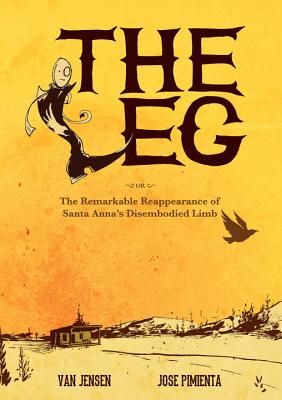
The Leg by Van Jensen and… me, hehe.

.                                                  

While comics for kids and young adults has been exploding as a publishing field, there have been comparatively few Latinx authors and artists getting attention, with the exception of the Giants Beware and Lowriders series. What advice do you have for young Latinx artists looking to break into comics? 

Dear Latinx who want to break into comics: Be bold, fearless, humble, and optimistic. Bold, because it reflects confidence and strength. Fearless, not just because of the current atmosphere, but also because that’s how we fight fear mongering, which is used to keep us quiet and divided. Humble, because, it reminds us that there is a bigger picture in our society, and that which benefits our community, automatically helps us grow to be better individuals living together. And optimistic, because as artists, our spirit is essential, so it’s important to keep it bright.

About breaking into comics? We can post and share. Ask everyone for support, launch Kickstarters, look at companies that you’re interested in, and see their submission guidelines and follow directions, while showing why your stories matter and why they’d be a great fit for their company. Go to conventions near you, small or big (of course they can be expensive, but plan for that. See how many you can make it to), make minis to hand out to show what you’re interested in doing. Go to conventions of what you like (for example, if you like baking, wrestling, cars or music; go to those conventions) get a small vendor table and sell your comic (about baking, wrestling, cars or music.) Starting a Patreon account, I hear, is a popular avenue these days. Most importantly: KEEP GOING. Do not stop making art and telling others about it. I’ve heard several quotes, and the one that still fits best is: It’s a marathon, not a sprint. Do not give up sharing your stories.

On a last note, see if I can end well here: When I first became interested in comics, I wished I had known more Latinx cartoonists (which there were, but I didn’t know about that many). To those who see my work, I hope I can make a positive impression, but furthermore, I hope that they go on to make art that inspires even more people.


Cecilia Cackley is a performing artist and children’s bookseller based in Washington, DC, where she creates puppet theater for adults and teaches playwriting and creative drama to children. Her bilingual children’s plays have been produced by GALA Hispanic Theatre and her interests in bilingual education, literacy, and immigrant advocacy all tend to find their way into her theatrical work. You can find more of her work at www.witsendpuppets.com.