
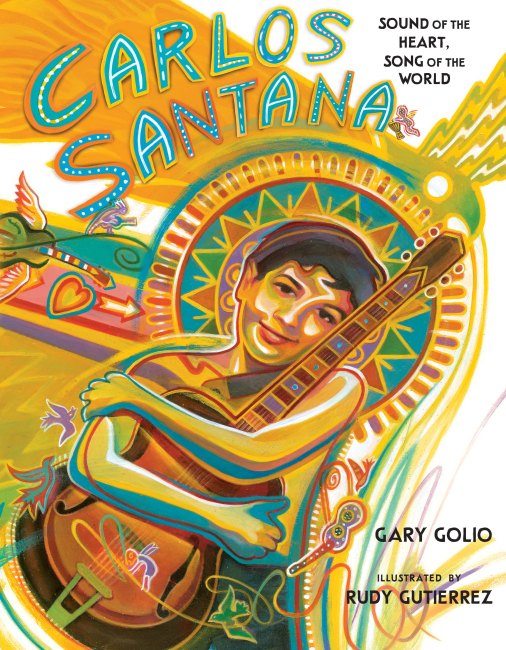
Review by Lila Quintero Weaver
DESCRIPTION OF THE BOOK: Carlos Santana grew up surrounded by music. Carlos’s father, a beloved mariachi performer, begins teaching his son how to play violin at an early age. But when Carlos later discovers American blues, he is captivated by the raw honesty of the music. Unable to think of anything else, he loses all interest in the violin and for a time, loses his way as well. Only after receiving an electric guitar of his own does he find his true life’s path.
From his early exposure to mariachi music to his successful fusing of rock, blues, jazz, and Latin influences, here is the childhood story of a legendary musician.
MY TWO CENTS: The magazine Rolling Stone places Carlos Santana within the pantheon of rock music’s greatest guitarists. But to put some perspective on his contribution as a Chicano, he was among the first to fuse blues-rock with Latinx instruments and rhythms, sometimes accompanied by lyrics in Spanish. In the mostly white world of rock and roll, Santana’s Latinidad stood in sharp relief, and his rise came at a time when Latinx performing artists rarely achieved notoriety on a national scale. Santana broke through this wall of invisibility. He did it by offering the world a sound that could not be ignored.
How did it all begin?
A captivating picture-book biography for readers of any age, Carlos Santana: Sound of the Heart, Song of the World brings us the background story. Told in poetic prose, the narrative opens in the subject’s infancy and follows the early years of his musical development, culminating in the moment when his love for blues-rock ignites.
One of this book’s greatest strengths is the art of Rudy Gutierrez, whose high-powered illustrations explode with movement and color. Page spreads vibrate with psychedelic swirls, suggesting the fluidity and intensity in Santana’s music.
Born in 1947 in Autlán de Navarro, Jalisco, Mexico—a town of “dirt roads and mud houses”—Santana’s humble beginnings do not hold him back for long. Thanks to wise and loving parents, he receives rich exposure to music. His father, José Santana, is a bandleader in the mariachi tradition. Carlos seems destined to follow his father’s career path, but then discovers a musical expression that speaks to him far more convincingly.
As a child, Carlos looks on his father with great admiration. “When Papá plays the violin, even little Carlos can see how people’s eyes light up, filled with el espíritu de la vida. Everyone wants José Santana to entertain them on their special days, and Carlos believes his father is an angel, flying on a bicycle with his golden harp as he rides to play in the church orchestra.”
At home, José is the younger Santana’s violin instructor. Unfortunately, “Carlos doesn’t really like the violin, and the smell of wood, held close to his face, gives him no pleasure.” In an effort to expand his son’s possibilities, José takes Carlos to the cantinas where he plays, offering the budding violinist time on the stage. Yet for Carlos, something important is missing in these occasions: joy.
But everything changes once he hears American blues guitarists on the radio. “Names like Muddy Waters and B.B. King seem magical, their songs raw and honest.” After this critical discovery, clashes between father and son become more frequent, especially when Carlos tries to sneak a bit of blues-style improvisation into a mariachi performance. Eventually, José leaves Mexico to pursue better paying gigs in the United States. With his father gone, Carlos finds a bit of breathing room to indulge his musical tastes.
Then, unexpectedly, a package arrives from San Francisco. It’s a used electric guitar! Coming from his father, this gift sends a profoundly affirming message. “There will be no turning back. Now [Carlos] can start to play the song inside him, the one that has been there all along.”
The book’s closing paragraph hints at the brilliant career that lies beyond the scope of this story. “Young Carlos Santana will create a new flavor of rock and roll, charged with Latin passion and the raw honesty of American blues.”
TEACHING TIPS: For a broader understanding of Santana’s significance in the history of rock and roll, check the back pages of the book, which include a “More About Carlos Santana” section, a brief list of discography, as well as Internet and print sources for further information. See also this article on the PBS website.
 ABOUT THE AUTHOR: Gary Golio is a visual artist, a child therapist, and the author of numerous other picture-book biographies, whose subjects include Billie Holiday, Jimi Hendrix, Bob Dylan, and John Coltrane. Learn more about his work on his official website.
 ABOUT THE ILLUSTRATOR: Rudy Gutierrez is the distinguished creator behind the cover art for Santana’s multiplatinum album Shaman and the recently released In Search of Mona Lisa. He also illustrated a U.S. postage stamp in commemoration of Jimi Hendrix. Learn more about Gutierrez in this interview.
 ABOUT THE REVIEWER: Lila Quintero Weaver is the author of My Year in the Middle, a middle-grade novel published in 2018 by Candlewick Press. She’s also the writer-illustrator of Darkroom: A Memoir in Black & White. Darkroom recounts Lila’s experiences as a child immigrant from Argentina to Alabama during the tumultuous 1960s. The Spanish edition is now available, under the title Cuarto oscuro: Recuerdos en blanco y negro. Learn more about Lila on her website, and follow her on Twitter and Goodreads.
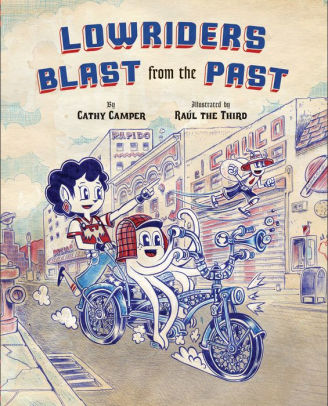
 ABOUT THE AUTHOR: Cathy Camper is the author of Lowriders in Space, Lowriders to the Center of the Earth and Lowriders Blast from the Past, with a fourth volume in the works, all from Chronicle Books. She has a forthcoming picture book, Ten Ways to Hear Snow (Dial/Penguin), and also wrote Bugs Before Time: Prehistoric Insects and Their Relatives (Simon & Schuster). Her zines include Sugar Needle and The Lou Reeder, and she’s a founding member of the Portland Women of Color zine collective. A graduate of VONA/Voices writing workshops for people of color in Berkeley, California, Cathy works as a librarian in Portland, Oregon, where she does outreach to schools and kids in grades K-12. Cathy is represented by Jennifer Laughran of Andrea Brown Literary Agency. For insights on the creative originas of the Lowriders series, read Cathy’s Camper’s
  ABOUT THE ILLUSTRATOR: Raúl the Third is an award-winning illustrator, author, and artist living in Boston. His work centers on the contemporary Mexican-American experience and his memories of growing up in El Paso, Texas, and Ciudad Juárez, Mexico. Lowriders in Space was nominated for a Texas BlueBonnet award in 2016-2017 and Raúl was awarded the prestigious Pura Belpré Award for Illustration by the American Library Association for Lowriders to the Center of the Earth. He was also a contributor to the SpongeBob Comics series. Raúl wrote and illustrated the picture book ¡Vamos! Let’s Go to The Market!, which Versify will publish on April 2. For a fun and lively conversation about art, comics, growing up in El Paso and more, check out this one-of-a-kind
  ABOUT THE REVIEWER: A Mexican-American author from deep South Texas, David Bowles is an assistant professor at the University of Texas Rio Grande Valley. Recipient of awards from the American Library Association, Texas Institute of Letters and Texas Associated Press, he has written a dozen or so books, including Flower, Song, Dance: Aztec and Mayan Poetry, the critically acclaimed Feathered Serpent, Dark Heart of Sky: Mexican Myths, and They Call Me Güero: A Border Kid’s Poems. In 2019, Penguin will publish The Chupacabras of the Rio Grande, co-written with Adam Gidwitz, and Tu Books will release his steampunk graphic novel Clockwork Curandera. His work has also appeared in multiple venues such as Journal of Children’s Literature, Rattle, Strange Horizons, Apex Magazine, Nightmare, Asymptote, Translation Review, Metamorphoses, Huizache, Eye to the Telescope, and Southwestern American Literature. In April 2017, David was inducted into the Texas Institute of Letters for his literary work.
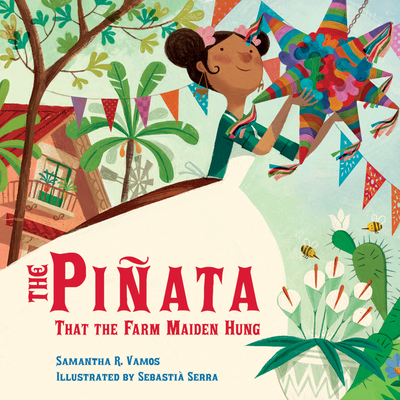 DESCRIPTION OF THE BOOK: A band of helpful animals joins the farm maiden, a farmer, and a boy in order to make a piñata from scratch and decorate the plaza. But then everyone falls asleep in the warm afternoon sun…
 ABOUT THE AUTHOR:
  ABOUT THE ILLUSTRATOR: Sebastià Serra is an award-winning artist who has illustrated more than 70 children’s books in Spain, Italy, France, UK, Portugal, Taiwan, Brazil, and the United States. Also, he has worked as a graphic designer for several television shows, family theatre, and many museums and cultural institutions. He lives in Barcelona, Spain.
 ABOUT THE REVIEWER: Dora M. Guzmán is a bilingual reading specialist for grades K-3 and also teaches an undergraduate college course in Children’s Literature. When she is not sharing her love of reading with her students, you can find her in the nearest library, bookstore, or online, finding more great reads to add to her never ending “to read” pile
 Cecilia Cackley is a Mexican-American playwright and puppeteer based in Washington, DC. A longtime bookseller, she is currently the Children’s/YA buyer and event coordinator for East City Bookshop on Capitol Hill. Find out more about her art at
 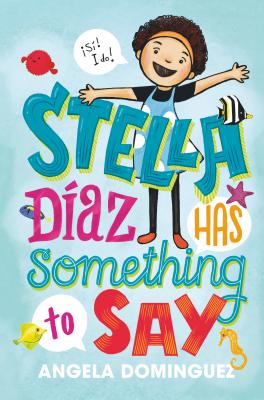 DESCRIPTION OF THE BOOK: Stella Diaz loves marine animals, especially her betta fish, Pancho. But Stella Diaz is not a betta fish. Betta fish like to be alone, while Stella loves spending time with her mom and brother and her best friend Jenny. Trouble is, Jenny is in another class this year, and Stella feels very lonely. When a new boy arrives in Stella’s class, she really wants to be his friend, but sometimes Stella accidentally speaks Spanish instead of English and pronounces words wrong, which makes her turn roja. Plus, she has to speak in front of her whole class for a big presentation at school! But she better get over her fears soon, because Stella Díaz has something to say!
 ABOUT THE AUTHOR:
  ABOUT THE REVIEWER: Jessica Agudelo is a Children’s Librarian at the New York Public Library. She has served on NYPL’s selection committee for its annual 100 Best Books for Kids list, most recently as a co-chair for the 2018 list. She contributes reviews for School Library Journal of English and Spanish language books for children and teens, and is a proud member of the Association of Library Services to Children, Young Adult Library Services Association, and REFORMA (the National Association to Promote Library and Information Services to Latinos and Spanish Speakers). Jessica is Colombian-American and born and raised in Queens, NY.
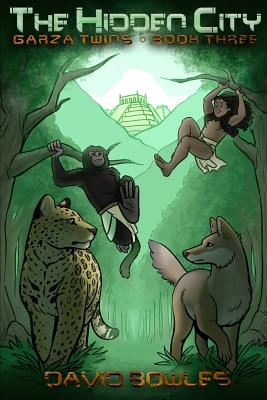 DESCRIPTION OF THE BOOK: When Carol and Johnny learn of the Ollamat, an ancient stone that can channel savage magic, they convince their parents to take them to the cloud forests of Oaxaca. With Pingo’s help, they search for the legendary city where it has been protected for a thousand years. But the twins aren’t the only ones hunting for the Ollamat. After it is stolen, they must travel through an emerald mirror into the beautiful yet dangerous Tlalocan: the paradise of the rain god. To retrieve the stone, they must face talking apes and forest elementals, rock worms and vicious elves, demons of lightning, and something even more unexpected: the souls of people they have watched die. As always, they are aided by allies old and new, though nothing can quite prepare them for the biggest foe of all – a member of their very family.
 ABOUT THE AUTHOR: A Mexican-American author from deep South Texas, David Bowles is an assistant professor at the University of Texas Rio Grande Valley. Recipient of awards from the American Library Association, Texas Institute of Letters and Texas Associated Press, he has written a dozen or so books, including Flower, Song, Dance: Aztec and Mayan Poetry, the critically acclaimed Feathered Serpent, Dark Heart of Sky: Mexican Myths, and They Call Me Güero: A Border Kid’s Poems. In 2019, Penguin will publish The Chupacabras of the Rio Grande, co-written with Adam Gidwitz, and Tu Books will release his steampunk graphic novel Clockwork Curandera. His work has also appeared in multiple venues such as Journal of Children’s Literature, Rattle, Strange Horizons, Apex Magazine, Nightmare, Asymptote, Translation Review, Metamorphoses, Huizache, Eye to the Telescope, and Southwestern American Literature. In April 2017, David was inducted into the Texas Institute of Letters for his literary work.
 ABOUT THE REVIEWER: Cris Rhodes is a lecturer in the English department at Sam Houston State University. She recently completed a Ph.D. in English with an emphasis on Latinx children’s literature. Her research explores the intersections between childhood activism and Latinx identities.
 Latinxs in Kid Lit