Book Review: The Tooth Fairy Meets El Ratón Pérez by René Colato Laínez

By Lila Quintero Weaver  the tooth fairy meets el raton perez
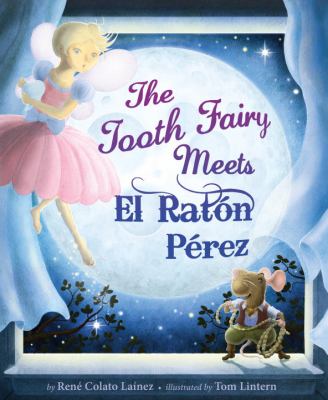
DESCRIPTION FROM RANDOM HOUSEThe Tooth Fairy has some competition. Meet El Ratón Pérez, the charming and adventurous mouse who collects children’s teeth in Spain and Latin America.

When both the Tooth Fairy and El Ratón Pérez arrive to claim Miguelito’s tooth, sparks fly under the Mexican-American boy’s pillow. Who will rightfully claim his tooth?
This magical tale introduces a legendary Latino character to a new audience and provides a fresh take on the familiar childhood experience of losing one’s tooth.

MY TWO CENTSWhat happens when beloved cultural traditions clash? Rene Colato Lainez’s flair for bilingual storytelling and Tom Lintern’s eye-popping illustrations combine in a winning picture book that addresses this question. Children will rejoice over the conclusion: there is no need to choose between the two!

The story revolves around double claims on Miguelito’s lost tooth.  Now that he lives in the United States, he’s inside the Tooth Fairy’s jurisdiction. But her Hispanic counterpart, El Ratón Pérez, is not ready to relinquish his duty to Latino children, even when they move across the border. One night in Miguelito’s bedroom, there’s a showdown between the rivals. Never fear—the tussle is well spiced with humor. Still, things get out of hand and Miguelito’s tooth lands on a high shelf, out of reach. It takes cooperation between the fairy and the ratón to retrieve the tooth, and this convinces them that future conflict is not necessary. From now on, Miguelito and other children can enjoy the toothy traditions of both cultures.

Like all picture books, the fun of this story is in repeated readings. Children will enjoy comparing the working methods and backdrops of these tiny tooth warriors. The rich color illustrations reinforce such observations. The Tooth Fairy lives in a castle. El Ratón Pérez makes his home in a cave. She searches the skies for a twinkling star that signals when a tooth is ready for retrieval. The signal he looks for is a moonbeam. Each has his or her tool of the trade; hers is a wand, his is a rope.

This is a wonderful text for children in transition between two cultures. It emphasizes the value of preserving old traditions and the joy of adding new ones.  The same lesson can be applied to other customs across nationalities, such as how birthdays and holidays are celebrated.

Spanish words and phrases are sprinkled throughout the book, always paired with the English translation. The publisher has provided a glossary.

TEACHING TIPSWe can do no better than the website dedicated to The Tooth Fairy Meets El Ratón Pérez that the author, a kindergarten teacher, has already put together! It includes a curriculum guide, creator interviews and other helpful features.

Here are a few additional resources.

The Centro Virtual Cervantes published a gallery of 79 illustrations featuring El Ratón Pérez.

Here are some craft ideas related to the Tooth Fairy.

An adorable tooth fairy pillow from MmmCrafts. And here’s another from the always reliable Martha Stewart.

Plus, how about a cute box for the tooth?

If you know where to find craft instructions for high quality El Ratón Pérez projects, please let us know!

AUTHOR: René Colato Laínez is a native of El Salvador who has written many books for young children. He teaches kindergarten in California. Want to learn more about him? Check out his interview on this blog!  

ILLUSTRATORTom Lintern is a storyboard artist, commercial illustrator and occasional illustrator of children’s books. View his impressive portfolio and more on his official site

A Conversation with René Colato Laínez

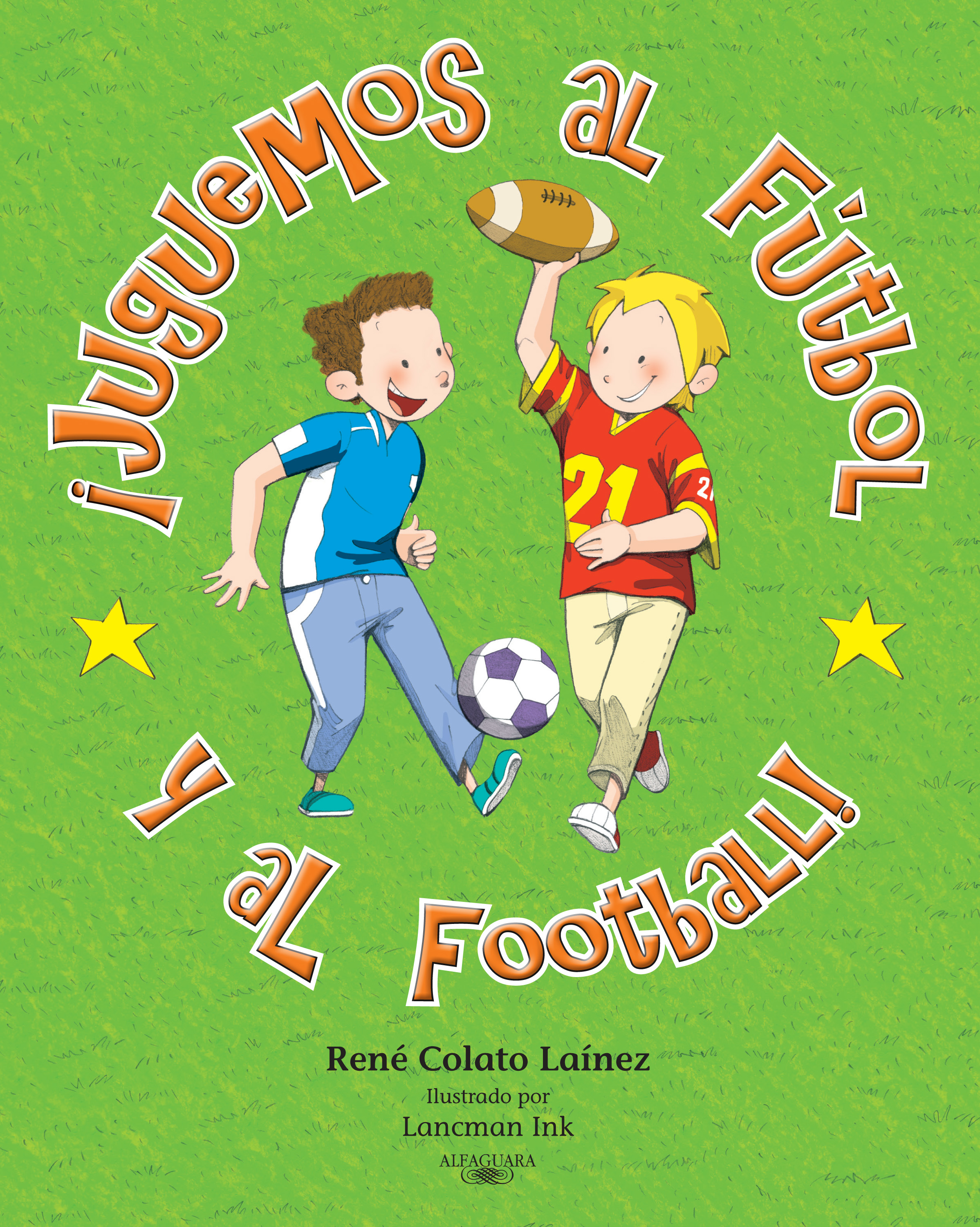
By Lila Quintero Weaver  portada-juguemos-futbol-football

If you are not acquainted with the picture books of René Colato Laínez, get thee to a bookstore right away! A Salvadoran transplant who teaches kindergarten in California, René writes joyful, bilingual picture books that children everywhere adore. I am delighted to share a one-on-one conversation with René about his life and work.

Lila: René, on your website, you express that the goal of your writing is “to produce good multicultural children’s literature; stories where minority children are portrayed in a positive way, where they can see themselves as heroes, and where they can dream and have hopes for the future. I want to write authentic stories of Latin American children living in the United States.”

As a collaborator on Latin@s in Kid Lit, a blog that exists to promote those very goals, I say BRAVO! Now for a question: What led you to adopt these goals?

René: I came to the United States when I was 14 years old. In my country, I was a smart student. I had good grades and many dreams to accomplish. In the United States, I did not know the new language. I felt lost and many times I thought that I would never be able to accomplish my goals. The inspiration to write books with a positive message to minority children came from my own life experience. I worked hard and never gave up. Yes! I accomplished my dreams. I am a teacher and an author. I want to tell minority children that they can accomplish anything they want. With “ganas” you can conquer the highest mountain.

Senor Pancho

Lila: Let me brag on your latest book. Señor Pancho Had a Rancho has received glowing reviews. It was named a top picture book by Chicago Public Library and was included in the Cuatrogatos Foundation anthology, De Raices y Sueños. I could keep going, but let me pause to ask: What inspired you to create what’s essentially a Spanish version of “Old McDonald Had a Farm”?

René: One day my ESL (English as a Second Language) teacher told us that we could learn English through music. She played the song of a man named McDonald and he had many farm animals. When I listened to the song, I was confused when the dog barked woof woof instead of gua gua. My teacher told me that in English farm animals made English sounds. I said to myself, “If I bring my perro from El Salvador, he has to learn English too!” Later on, when I became a teacher, I played the song with my kindergarteners, but I always added the Spanish sounds. After having so much fun with my students, I decided to write a book about both English and Spanish farm animals, where they could have a great time speaking two languages.

Lila: Please share a bit about your childhood experiences of immigration from El Salvador.

René: I left the country with my father, due the civil war. Along with thousands of Salvadorans, my family was looking for a better place where we could be safe from the war. But I had a happy life as a child. I loved to go to school and read all the comics books from Mexico and Argentina, like El Chapulín Colorado and Mafalda. Since first grade, I wanted to become a teacher. My favorite books were Don Quijote and Las Telerañas de Carlota. I was so surprised to find my favorite book in English, here in the United States—Charlotte’s Web.

Lila: You teach kindergarten in a California school full of Latino children. How has this influenced your writing? Is teaching what led you to write picture books in the first place?

René: In high school and college, I wrote many drafts of novels. But when I came to the classroom, I discovered picture books and soon fell in love with them. I started to write my own books for my students and they called me “El Maestro lleno de Cuentos” (“The Teacher Full of Stories”). Later on, after receiving advice from many teachers and talented authors such us Alma Flor Ada, Isabel Campoy and Amada Irma Pérez, I decided to submit my work for publication.

Lila: Your books consistently offer bilingual texts. Why is this important to you?

René: I love bilingual books because you can share them with families who speak Spanish, English or both. They can also be great tools to speak and learn to read a second language. When I started to submit my manuscripts, I always envisioned them as bilingual books—books that I could share with my students, their parents, my family here in the United States, and all my relatives and friends in El Salvador.

Lila: Your writings frequently celebrate the happy coexistence of Latino and non-Latino cultures. This occurs in The Tooth Fairy Meets El Ratón Pérez and in Juguemos al Fútbol/ Let’s Play Football (coming out this month in the bilingual hardcover edition), to name just two examples. What inspires your multicultural bent?

René: Latino children usually live in two worlds in the United States. They speak English and Spanish and celebrate holidays from the two cultures. Many times people fight to see which language or culture is most important. I love them both and in my books I want to tell children that instead of deciding which culture is better, we can celebrate both and have double the fun.

Lila: Writing a picture book looks easy only to those who have never tried it. What’s it like for you? Do you wait for inspiration to strike or do you have a disciplined routine?

René: Writing picture books is so much fun for me. It was not easy at first but I read tons of them until I was ready to write my own stories for publication. I usually start with the problem or idea for a story. Then I think it over, again and again, and begin to create the story in my mind. When I have something solid, I begin to write it. Many incidents in the classroom help me with ideas for new stories.

Lila: You graduated from the prestigious Vermont College of Writing for Children & Young Adults and have published at least nine books. That’s a lot of experience! Can you share some hints for aspiring writers?

René: Never give up, believe in yourself, and work hard for your dreams. Take creative writing classes and join critique groups. If you are writing children’s books, it is always a great idea to join SCBWI, Society of Children’s Book Writers and Illustrators. Submit your work and learn from rejection letters. Believe in your stories, because you are the only one who can tell and write them. 

renecolatolainezRené Colato Laínez is a native of El Salvador. He is the award-winning author of many picture books and the recipient of honors that include the Latino Book Award, the Paterson Prize for Books for Young People, the California Collection for Elementary Readers, the Tejas Star Book Award Selection, and the New Mexico Book Award. He is listed among “Top Ten New Latino Authors to Watch (and Read)” by the site Latinostories.com*. He received a degree from the Vermont College MFA program in Writing for Children and Young Adults. René’s full-time profession is teaching kindergarten in California. For more information, please visit his official author site

The Kid Lit World Needs Gary Soto and Others Like Him

By Cindy L. Rodriguez

When Gary Soto’s book, the one attached to the Marisol Luna American Girl doll, was released in 2005, I was in my fourth year of teaching middle school and attending graduate courses. In other words, I was buried in essays–correcting them and writing them–and was clueless that Soto’s book about a 10-year-old Chicago girl had sparked negative national media attention, protests, and harassing phone calls to the author’s home. For more information on the original story, click here.

The 2005 book-and-doll release is old news, but only a few months ago, eight years later, Soto wrote this piece in the Huffington Post, explaining why he has has stopped writing children’s literature.

I’m not going to rehash the Pilsen vs. Des Plaines debate, and I’m not going to say it was right or wrong for Soto’s fictional family to decide they wanted to move because the neighborhood was too dangerous. Those debates were had in 2005.

This post is about Gary Soto, an award-winning, prolific Mexican-American writer, leaving a business that needs him and many others like him. Gary Soto has written picture books, chapter books, poetry, and novels for middle school, high school, and adults. In the often-referenced New York Times article about the lack of Latin@ books in classrooms, Gary Soto is listed as one of the exceptions.

“While there are exceptions, including books by Julia Alvarez, Pam Muñoz Ryan, Alma Flor Ada and Gary Soto, what is available is ‘not finding its way into classrooms,’” said Patricia Enciso, an associate professor at Ohio State University.

Do we need more Latin@ books, written by a variety of authors, in classrooms? Yes. But, Soto and the others are already there, on the shelves, in students’ hands. I’ve read his short stories with my students, and a colleague recently read Buried Onions with her eighth graders based on my recommendation. He is in anthologies and on school book lists. Soto, along with a handful of other Latin@ authors have paved the way, and now he has vowed not to write any more children’s literature.

This comes at a time when 53 million Hispanics live in the U.S., according to the 2012 census. Hispanics are the second largest race or ethnic group (behind non-Hispanic whites), representing about 17 percent of the total population. Meanwhile, a study by the Cooperative Children’s Book Center reported the number of children’s books with multicultural content has not increased in 18 years.

Soto’s retirement from the kid lit world saddens me, as a reader, writer, and supporter of Latin@s in kid lit. We have lost a giant in the business, and I worry that what happened to Soto could discourage writers from including Latin@ characters in their manuscripts. Writers have legitimate fears about “getting it right” and not offending readers, especially if they are crossing into territory–gender, race, religion, ethnicity, culture, sexuality–that they do not understand first-hand. Think about it, Soto, a member of the Latin@ community, was at odds with members of the Latin@ community, over a Latina doll and her story. What does this mean for other writers, especially non-Latin@s who want to write Latin@ characters? Should they not bother? Should they use made-up locations to avoid referencing a specific community? Are the subjects of poverty and crime off limits?

I hope writers aren’t scared away from including Latin@ characters, and I hope Gary Soto reconsiders his retirement from kid lit. Also, wherever we each stand on the Pilsen-Mattel issue, I hope we all can at least tip our hat to Soto for his contribution to Latin@ literature.

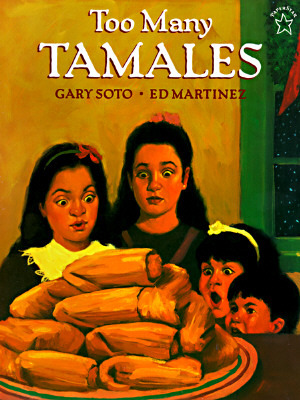
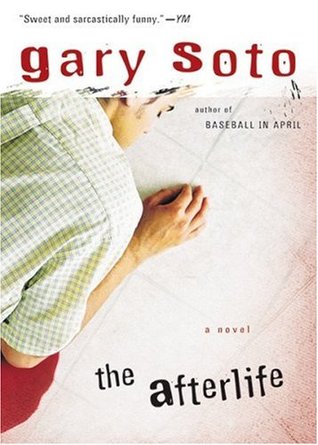
Too Many Tamales   Chato Goes Cruisin'   Baseball in April and Other Stories   Buried Onions   The Afterlife

2014 Reading Challenge: January

We are one month into our Latin@s in Kid Lit Reading Challenge, and our participants have completed an awesome array of books! Below are the covers, which link to any reviews written. Some people have chosen to read and not review (which is fine). In these cases, when you click on the cover, you will go to the book’s general Goodreads page. Have fun browsing the books below. Maybe you’ll even add a few to your own TBR list!

A note to participants: As you complete books, please send us the information, so we can share what you’re reading each month.

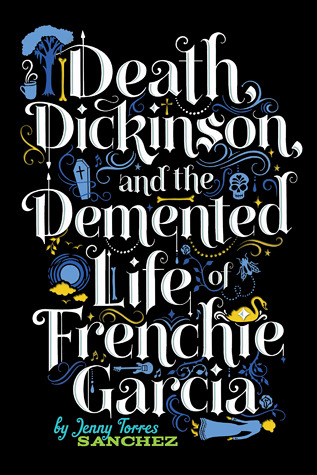
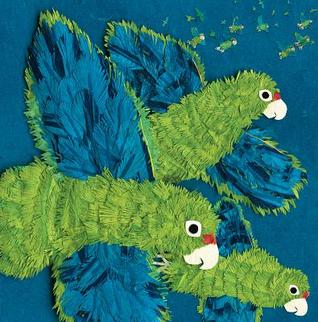
The Girl of Fire and Thorns (Fire and Thorns, #1)   Maximilian & the Mystery of the Guardian Angel: A Bilingual Lucha Libre Thriller  Death, Dickinson, and the Demented Life of Frenchie Garcia  The Knife and the Butterfly  The Wild Book  The Vicious Deep (The Vicious Deep #1)  Fat Angie   Marcelo in the Real World  The Girl Who Could Silence the Wind   Colibri   Yes! We Are Latinos!   Marisol McDonald Doesn't Match / Marisol McDonald no combina   My Abuelita   Dear Primo: A Letter to My Cousin   Moony Luna/Luna, lunita lunera   What Can You Do with a Rebozo?   Everybody Cooks Rice (Picture Books)   Parrots Over Puerto Rico   A Leaf Can Be . . . (Millbrook Picture Books)

Also, since February is Black History Month, we propose a challenge within a challenge. This month, try to read a book by/for/about Afro-Latin@s. Here are some suggestions:

Pele, King of Soccer/Pele, El rey del futbol     Celia Cruz, Queen of Salsa     Grandma's Gift     Grandma's Records     Me Llamo Celia/My Name Is Celia: La Vida de Celia Cruz/The Life Of Celia Cruz     The Poet Slave of Cuba: A Biography of Juan Francisco Manzano     Secret Saturdays     Marisol and Magdalena   Efrain's Secret

Book Review: Niño Wrestles the World by Yuyi Morales

By Sujei Lugo

DESCRIPTION FROM THE BOOK JACKET: Señoras y señores, put your hands together for the fantastic, spectacular, one of a kind…Niño! In a single move, he takes down his  competition! No opponent is a challenge for the cunning skills of Niño, world champion lucha libre competitor!

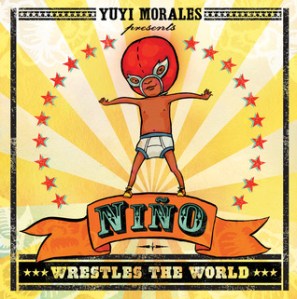
MY TWO CENTS: As soon as you take a glimpse of the book cover, you know that Yuyi Morales is presenting you with a treat of pint-sized lucha. The colorful and mixed-media artwork and its wrestling match layout, capture the energy and enthusiasm of the characters and lucha libre itself. Written in English with a dash of Spanish words and onomatopoeias, readers are exposed to an action-packed picture book filled with elements of Mexican and other Spanish-speaking cultures.

NiñoWrestlestheWorldCover“¡Niño! ¡Niño! ¡Niño!” It is through this chant that we are introduced to Niño, a paleta eater, toy-loving, and acrobatic boy. Once Niño puts on his luchador mask, contenders such as La Momia de Guanajuato, La Llorona and Cabeza Olmeca, line up to challenge him. With his playful lucha style, Niño challenges his opponents with puzzles, dolls, marbles, popsicles and tickles, showing how Morales playfully incorporates childhood glee into this wonderful homage to lucha libre. At the end of the story we also meet Niño’s toddler sisters, who are mischievous and loud and drive Niño crazy! This is where Yuyi Morales uses the opportunity to capture and address siblings’ relationships, while showcasing the “best move” to defeat sibling rivalry.

I could not deny that it crossed my mind that Niño Wrestles the World, plays as a homage and retelling of the legacy of Mexican lucha icon, El Santo. Like El Santo, once Niño puts on his luchador mask, he never takes it off. Like El Santo, in his movies, Niño challenges the mummy of Guanajuato, the llorona, and aliens. And you could say that when later in the book Niño joins his sisters and challenges new opponents, we are seeing a retelling of adventures where El Santo joins fellow luchadores Blue Demon and Mil Máscaras. Setting the wonderful El Santo references aside, in this picture book we have a fun and energetic story and lovable characters that will release the inner luchador or luchadora in kids and adults of all ages.

Niño Wrestles the World is the 2014 Pura Belpré Illustrator Winner and was named a highly commended title by the 2014 Charlotte Zolotow Award. It was also included in a series of list such as A Fuse #8 Production 100 Magnificent Children’s Books 2013, School Library Journal Top 10 Latino-themed Books of 2013, Fanfare (Horn Book’s list of the best books for young people published in 2013), Center for the Study Multicultural Children’s Literature Best Multicultural Books of 2013 and Latinas for Latino Lit Remarkable Latino Children’s Literature of 2013.

TEACHING TIPS: While early readers and kids between the ages of 4-8 might enjoy reading this picture book, it is through the activity of reading aloud that its energy and humor really stands out. Adults and childrens’ librarians can read the book, while teaching new vocabulary and words in Spanish to kids.

Language Arts, Visual Arts, and Social Studies teachers (pre-school- 2nd grade) could also use Niño Wrestles the World with their students. The book is filled with fun onomatopoeias, adjectives and words in Spanish, which will attract students to the language learning process. Art teachers can collaborate with Language Arts teachers with the masks of the different characters of the story. Templates of different lucha masks are available on Yuyi Morales’ website, or you can be creative with your own mask!

The elements of Mexican culture exposed through Niño’s opponents, the trading-card-style information of each opponent (includes pronunciation), and Yuyi Morales’ illustrations provide the opportunity to incorporate them into Social Studies curricula. Educators should be provided with resources and materials that will serve as tools to bring multiethnic/multicultural exposure and discussion into the classroom. This is especially relevant now since Mexican American and Latin@ Studies curricula and books are constantly challenged in the U.S. public education system.

LEXILE: N/A

AUTHOR: Yuyi Morales is a Mexican author, illustrator, artist, and puppet maker. She has a bachelor’s degree in Psychology and Physical Education from the University of Xalapa, México and used to host her own Spanish-language radio program for children in San Francisco, California.

She has won numerous awards for her children’s books such as the Tomás Rivera Mexican American Children’s Book Award for Just a Minute: A Trickster Tale and Counting Book (2004) and Los Gatos Black on Halloween (2008), the Pura Belpré Author Honor for Just in Case: A Trickster Tale and Spanish Alphabet Book (2009), the Pura Belpré Illustrator Award for Just a Minute: A Trickster Tale and Counting Book (2004), Just in Case: A Trickster Tale and Spanish Alphabet Book (2009) and Los Gatos Black on Halloween (2008), and Pura Belpré Illustrator Honor for My Abuelita (2010) and Harvesting Hope: The Story of Cesar Chavez (2004).

Morales divides her time between the San Francisco area and Veracruz, Mexico. Her lastest picture book Viva Frida! will be released in September 2014.

For more information about Niño Wrestles the World visit your local library or bookstore. Also check out Macmillan Publishers, Goodreads, Indiebound.org, WorldCat.org, Amazon, and Barnes and Noble.  

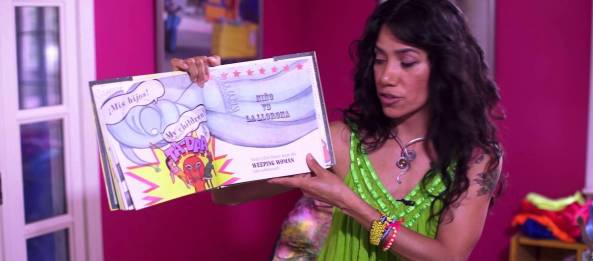
Enjoy this video of Yuyi Morales reading Niño Wrestles the World!

Book Review: Tito Puente: Mambo King / Rey del Mambo by Monica Brown

Tito Puente, Mambo King/Tito Puente, Rey del MamboBy Sujei Lugo

DESCRIPTION FROM THE BOOK JACKET: Meet Tito Puente, the King of Mambo. Tum Tica! From musical prodigy on the streets of Harlem to five-time Grammy Award winner, Tito’s life was full of rhythm. Drums and claves, saxophones and tambourines were all part of the fun. Tac Tic! Monica Brown and Rafael López, the award-winning creators of the Pura Belpré Honor Book My Name is Celia/Me Llamo Celia, team up once again for another spectacular collaboration in this upbeat tribute to a musical legend.

MY TWO CENTS: Brown was presented with the challenge of summarizing Tito Puente’s life and music career in a picture book, and with the collaboration of Rafael López and his lovely illustrations, she succeeded wonderfully. What makes this picture book stand out is how beautifully words (English and Spanish) and images resonate with Tito’s sounds. The illustrations here are so vivid that you can almost see movements and listen to the sounds that are evoked. Brown and López effectively capture the beat and feeling of Tito Puente’s music throughout every page.

The book starts with an image of a boy and girl peeking through a curtain, as if we are about to start a show. This is where we are welcomed to Tito’s story from his childhood in El Barrio to his Grammy award-winning years. López’s colorful and vibrant images, along with Brown’s words and onomatopoeia, show us how music was constantly present in Tito’s life. These same images and words also construct a fond view of Latino life and music in NYC during Tito’s life.

Brown and López give us a very entertaining book that also manages to educate us about Tito’s life and the importance of music education. It is important to remember that Tito Puente was a product of music education and a supporter of music programs in schools. He even successfully worked toward the creation of the Tito Puente Educational Foundation that offers scholarships to children interested in learning music. This is an issue that is relevant when arts and music programs are constantly facing budget cuts. Being in tune with Puente’s life (and other great musicians and singers) helps to inspire us to support arts and music education, thus this picture book also serves as a great tool to familiarize with the power of music and arts as an important aspect of the learning process.

Tito Puente: Mambo King/Rey del Mambo is the second collaboration between Monica Brown and Rafael López. Published in March 2013, the book was selected by various Best of 2013 lists such as: Latinas for Latino Lit’s Remarkable Latino Children’s Literature of 2013, School Library Journal’s Top 10 Latino-themed Books of 2013, and Center for the Study Multicultural Children’s Literature Best Multicultural Books of 2013. Here is the wonderful bilingual trailer for this picture book:

TEACHING TIPS: This is a bilingual picture book (ages 4-7) that works well for early readers, but is a perfect one to read aloud. Parents, grandparents, family members, friends, or guardians can read in English, Spanish, or both, while teaching words and sounds to their young ones. School and public librarians can also use this book during storytime, and they can incorporate Tito’s songs and beats as the closing songs.

Going along with Tito Puente’s sense of collaboration with music, teachers (pre-school-2 grade) can also collaborate in school with this book. Language Arts, English, and Spanish teachers can read this book to their students, while teaching new words (in English and Spanish), onomatopoeia, and Tito’s life (the book includes a short biography). Art teachers can encourage and help students to create different musical instruments that are mentioned in the book. Music teachers can use the basic musical notation of a rumba for timbales, bongo, and congas that is available at the end of the book to teach some beats to the students.

LEXILE: AD740L

AUTHOR & ILLUSTRATOR: (information comes from HarperCollins Publishers, Monica Brown’s website, Rafael López Books’ website, and Rafael López’ website.

Monica Brown is the author of many award-winning children’s books and an English Professor at Northern Arizona University, specializing in U.S. Latino Literature and Multicultural Literature. She has a BA in English from University of California, Santa Barbara, an MA in English from Boston College and a PhD in English from The Ohio State University. In addition to children’s books, Monica Brown also writes and publishes scholarly work with a Latin@ focus. She is a recipient of the prestigious Rockefeller Fellowship on Chicano Cultural Literacies from the Center for Chicano Studies at the University of California.
Brown has stated that her Peruvian-American heritage and her desire to share Latin@ stories are the inspiration for her books. Her first book of the Marisol McDonald series, Marisol McDonald Doesn’t Match/Marisol McDonald No Combina is the winner of the Tejas Star Book Award (2012-13), the International Latino Book Award (2012) and a Pura Belpré Honor for Illustration (2012). Other of her numerous awards are: the Américas Award for Children’s and Young Adult Literature (2005) for her picture book My Name is Celia: The Life of Celia Cruz/Me Llamo Celia: La Vida de Celia Cruz; the Pura Belpré Award (2008) for My Name is Gabito: The Life of Gabriel Garcia Márquez/Me Llamo Gabito: The Life of Gabriel Garcia Márquez; and the International Latino Book Award (2006) for My Name is Gabriela: The Life of Gabriel Mistral/Me Llamo Gabriela: La Vida de Gabriela Mistral

Rafael López is a Mexican award-winning illustrator and artist, whose work is influenced by his cultural heritage, colors of Mexican street life, and Mexican surrealism. In addition to children’s books, López has illustrated posters, United States Postal Service stamps such as the Latin Music Legends series, and he has launched street art projects to revitalize urban neighborhoods, such as the Urban Art Trail Project.

He is the recipient of various Pura Belpré Honor for Illustration awards for books such as: My Name is Celia: The Life of Celia Cruz/Me Llamo Celia: La Vida de Celia Cruz (2006), Book Fiesta!: Celebrate Children’s Day/Book Day/ Celebremos El Día de los Niños/El Día de Los Libros (2010) and The Cazuela That the Farm Maiden Stirred (2012). He also received two Américas Awards for Children’s and Young Adult Literature for My Name is Celia (2006) and ¡Yum! ¡Mmmm! ¡Qué Rico! Americas’ Sproutings (2007).

For More Information about Tito Puente: Mambo King / Rey del Mambo (2013), visit your local library or bookstore. Also, check out worldcat.org, indiebound.org , goodreads.com, amazon.com, barnesandnoble.com  & harpercollins.com