The 2014 International Latino Book Awards Finalists!

Below are the 2014 finalists for the 16th Annual International Latino Book Awards in the children’s, youth, and young adult categories. If you click on the images, you will be taken to Goodreads, Barnes and Noble, or Amazon for more information. The Awards are produced by Latino Literacy Now, an organization co-founded by Edward James Olmos and Kirk Whisler, and co-presented by Las Comadres para las Americas and Reforma, the National Association to Promote Library and Information Services to Latinos. The Awards themselves will be June 28 in Las Vegas as part of the ALA Conference. For the complete list, which includes adult fiction and nonfiction, check out the Latina Book Club site. Congratulations and good luck to all of the finalists!

Best Latino Focused Children’s Picture Book: English

18296043  15791044

Best Latino Focused Children’s Book: Spanish or Bilingual

17265250  19483940  An Honest Boy Un hombre sincero

Best Children’s Fiction Book: English

18492598  15842628  The Box of Holes  

Best Children’s Fiction Picture Book: Bilingual

17267265  17940785  15938471  16000381

Best Children’s Fiction Picture Book: Spanish

20948920  17802285  16457293  18406769  20454675

Best Children’s Nonfiction Picture Book

13610203  An Honest Boy Un hombre sincero  The Dog That Became a Lion

Best Educational Children’s Picture Book: English

17465058  18296043  15791044

Best Educational Children’s Picture Book: Spanish or Bilingual

  19483940  Hola! Gracias! Adios!  18126680  Embedded image permalink

Most inspirational Children’s Picture Book: English

18371476

Most inspirational Children’s Picture Book: Spanish or Bilingual

18198024  9542372  Embedded image permalink  Pink Firetrucks  18406693

Best Youth Latino Focused Chapter Book

10436183  16670129  Front Cover

Best Youth Chapter Fiction Book: English

16131067  17166339  16059385

Best Youth Chapter Fiction Book: Spanish or Bilingual

10162585    

Best Youth Chapter Nonfiction Book

Most inspirational Chapter Book

Front Cover  The Adventures of Chubby Cheeks: The Pro Quest

Best Young Adult Latino Focused Book: English

Insurgency: 1968 Aztec Walkout by Victor Gonzalez

17274543  15769992  Stars of the Savanna

Best Young Adult Latino Focused Book: Spanish or Bilingual

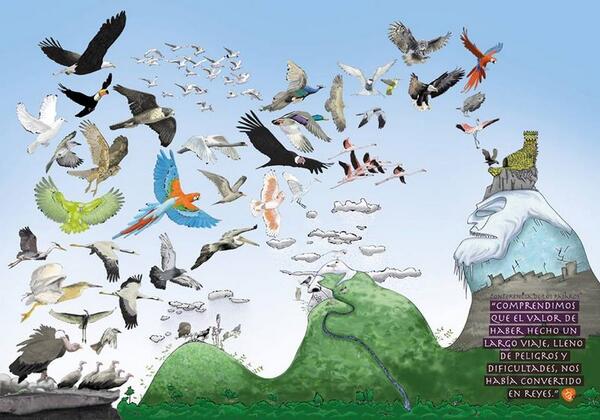
Los Pájaros No Tienen Fronteras by Edna Iturralde

18208087

Best Young Adult Fiction Book: English

17184137  12154323  15814459  15798660  A Girl Named Nina

Best Young Adult Fiction Book: Spanish or Bilingual

La Guarida de las Lechuzas by Antonio Ramos Revillas

Best Young Adult Nonfiction Book


Best Educational Young Adult Book

18462053  Stars of the Savanna  

Most Inspirational Young Adult Book

15769992  12352685  Stars of the Savanna

Best Book Written by a Youth: English

15020431  15874623

Best Book Written by a Youth: Spanish or Bilingual

  Serendipity, Poems About Love in High School

Best Children’s Picture Book Translation: Spanish to English

Avian Kingdom Feathered Tales: Birds Of A Feather  Avian Kingdom Feathered Tales: Pelican Sky  Avian Kingdom Feathered Tales: Two Hoots and a Holler  17465058

Best Children’s Picture Book Translation: English to Spanish

El Día Maravilloso de Hacer Tamales que Tuvo Sofia by Albert Monreal Quihuis; translator: Veronica Lamanes

Best Chapter/Young Adult Book Translation: English to Spanish

El Gusano de Tequila

Best First Book: Children’s and Youth

Stars of the Savanna  An Honest Boy Un hombre sincero  

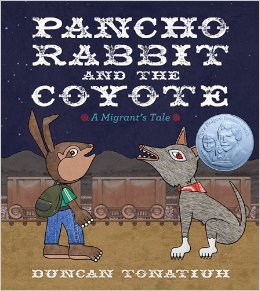
Book Review: Pancho Rabbit and the Coyote: A Migrant’s Tale by Duncan Tonatiuh

Pancho Rabbit coverBy Lila Quintero Weaver

DESCRIPTION FROM THE BOOK JACKET: A young rabbit named Pancho eagerly awaits his papa’s return. Papa Rabbit left two years ago to travel far away north to find work in the great lettuce and carrot fields to earn money for his family. When Papa does not return home on the designated day, Pancho sets out to find him. He packs Papa’s favorite meal—mole, rice and beans, a heap of still-warm tortillas and a jug full of fresh aguamiel—and heads north. He soon meets a coyote, who offers to help Pancho in exchange for some of Papa’s favorite foods. They travel together until the food is gone and the coyote decides he is still hungry…for Pancho!

Award-winning author and illustrator Duncan Tonatiuh brings to light the hardship and struggles facing families who seek to make better lives for themselves by illegally crossing the borders.

MY TWO CENTSWho does not love a fable, beautifully told? Pancho Rabbit and the Coyote is an allegory of migration, simplified for young children and illustrated with highly original art adapted from the style of Mixtec codices.

The adventure begins when Papa and his migrant companions, Señors Ram and Rooster, fail to return at the appointed time. Pancho sneaks off at night to find him. Perils along the journey provide appropriate levels of tension for early readers, but each danger that Pancho faces has a factual counterpart in the experiences of many undocumented Latino immigrants. First, there is—pardon the expression—a wily coyote who promises to guide Pancho to his father.  Children will instinctively realize that this coyote isn’t a true friend. Plus, physical dangers lurk at every turn—snakes, hunger, thirst, a river crossing, a dark tunnel, and a ride on the roof of a train. Most young children will accept these scary moments as tropes of fable and nothing more, helped by the fact that Tonatiuh softens each danger appropriately. For example, when Pancho nearly loses his balance on the roof of the train, the range of dire consequences implied by a fall will escape a child’s notice.

Pancho is a sturdy soul, driven to press through by his burning desire to reunite with Papa. As time goes by, the coyote demands more food from Pancho—food intended for Papa. This mirrors the exploitative nature of many human coyotes, infamous for charging exorbitant sums for their services and not always delivering on their promises. At last, Pancho and the coyote cross the border and spend the night in a hut. When the coyote discovers that Pancho’s food stores are depleted, things go from bad to very bad. “‘In that case,’ said the coyote, ‘I will roast you in the fire and eat you!’” As Pancho cowers in a corner, the huge shadow of a long-fanged coyote looms over him. Shades of Little Red Riding Hood! Just in time, Papa, Señor Rooster and Señor Ram burst into the hut, and the treacherous coyote runs off into the night.

Why were the returning farm workers delayed? “‘A gang of crows attacked us,’ said Señor Rooster. ‘They took the money and gifts we were bringing back to our families and left us stranded in the desert.’” This introduces yet another parallel to reality, the bandits that prey on defenseless immigrants. Back at the rancho, the welcome fiesta goes off without a hitch. The rabbit children beg their father to never leave them again, but he cannot guarantee it. “‘If it doesn’t rain again next year and if there is no food or work on the rancho, what else can I do?’” The children insist they will go with him, but Mamá has a more practical wish. “‘Let’s hope it rains.’”

No discussion of this book can be complete without delving into the art. In a video linked below, Duncan Tonatiuh explains the origins of his style and how meeting immigrants of Mixtec heritage prompted him to adapt the art for contemporary illustration.

Let’s review a few characteristics of Mixtec art:

  • Strong outlines of external and internal shapes
  • Flat colors within those shapes
  • Faces of humans and animals represented in profile
  • Stylized perspective—rugs, tables, other flat surfaces do not recede in space, but appear vertically placed

All of these characteristics are present in Tonatiuh’s art, along with notable adaptations:

  • Modern settings
  • Elements of collage
  • Textured surfaces, sometimes with photographic fidelity
  • Facial expressions that raise emotional content

To elaborate on facial expressions, take note of how variations in characters’ eyes, ears, lips and posture are used to denote sadness, fear, determination, and joy.

To learn more about ancient Mixtec people and their elaborately illustrated manuscripts, see this site

TEACHING TIPSAn author’s note addresses the human issues allegorized in the story of Pancho Rabbit and the rest of the animal characters. There is also a glossary of Spanish terms.

Pancho Rabbit and the Coyote is a fable that can be read on two levels. The average young child will relate to it exactly as it appears on the surface—an enchanting story with animal characters that embark on an adventure. Parents and teachers will have to decide how much to reveal to unsuspecting children about the characters’ human counterparts. Children who have firsthand experience or family stories that parallel the perilous journeys of Pancho Rabbit are much more likely to catch the story’s underlying meaning. A wise teacher will take this into account.

Many young children will be fascinated by the art, which is unique among picture books. Since Tonatiuh has incorporated rich textures into the illustrations, kids may enjoy a treasure hunt based on specific textures. Here is a list of those represented: ram’s wool, coyote and rabbit fur, denim and other textiles, dried chiles, wood grain, brick, corrugated metal roofing, prickly cacti, straw matting, gravel, rubber tire, snakeskin, topsoil, and feathers.

Just because it’s a picture book, there’s no reason that Pancho can’t be enjoyed by older kids, especially artistic teens. If they seem reluctant, show them Duncan Tonatiuh’s TED Talk video, “Life on the Other Side,” embedded in his website. Many teens will conclude that he’s a pretty cool dude, one worth emulating. You’ll also find a touching multi-voice poem recorded by fourth-graders in Texas. It models an excellent approach to getting young migrants or second-generation immigrants talking about their experiences and feelings.

THE AUTHORDuncan Tonatiuh was born in San Miguel de Allende, Mexico. His deep interest in the plight of undocumented immigrants originates in childhood friendships in Mexico and associations he has formed in New York, where he studied art and lives. He is the author-illustrator of other award-winning books, including Diego Rivera: His World and Ours, Dear Primo: A Letter to My Cousin, and a forthcoming book on Sylvia Mendez.

Duncan has earned a chest full of medals and awards for Pancho Rabbit and the Coyote, including:

  • Pura Belpré Author and Illustrator Honor book 2014
  • New York Public Library’s annual Children’s Books list: 100 Titles for Reading and Sharing 2013
  • Kirkus Best Books of 2013
  • Best Multicultural Children’s Books 2013 (Center for the Study of Multicultural Children’s Literature)
  • Notable Children’s Books from ALSC 2014
  • Notable Books for a Global Society Book Award 2014

Diversity in Kid Lit was ‘On Fire’ at National Latino Children’s Literature Conference

My signed conference poster! The gorgeous artwork comes from Laura Lacamara's new book, Dalia's Wondrous Hair.

My signed conference poster! The gorgeous artwork comes from Laura Lacamara’s new book, Dalia’s Wondrous Hair.

By Lila Quintero Weaver

Let me float down to earth, grab a keyboard and pound out a report about the National Latino Children’s Literature Conference. That was my self-talk on March 15. The two-day conference, held at the University of Alabama and headed by mover-and-shaker Dr. Jamie Naidoo, had wrapped up at 4 pm the previous day.

Sixteen hours later, my whole being still felt tingly with the residual vibrations of what we’d experienced: great dialogue, stimulating talks, and warm connections with people passionate about the same thing, increasing diversity in children’s books. And it’s amazing how many presentations referenced last year’s incendiary New York Times article on minority characters in kid lit. The conference stirred my juices, but before I could touch my keyboard to write about it, Marianne Snow posted a great recap on her blog. There’s no way that I could improve on her account. 

That’s not the end of the story. Over the same weekend, The New York Times published a pair of essays from prize-winning YA author Walter Dean Myers and his son Christopher, an author-illustrator of note, on the scarcity of characters of color in children’s books. Spine tingling, timely, and powerful. Clearly, diversity in children’s books is a topic on fire!

And now, back to the conference. Since Marianne’s recap covers only the second day, here are select quotes and highlights from the first day:

NLCLC LogoLiterary agent Adriana Dominguez outlined some of the challenges facing Latin@ children’s literature: “Many editors think about Latino books as niche or institutional.” Neither of these spells the huge sales figures that the industry has become hungry for. She pointed to the Harry Potter phenomenon as a watershed moment in children’s publishing. Previously, marketing departments targeted libraries and schools, but the commercial success of Harry Potter and other blockbusters has shifted the dynamics.

Members of the audience asked how to best advocate for Latin@ children’s literature. Librarians can push these books, Dominguez said. She cited the late Rose Treviño as a personal mentor and a role model in the field of library services to children. Ms. Treviño was a beloved Houston public librarian who served the local Latin@ community and brought Latin@ books to the attention of a wider audience. Her passionate advocacy was captured in this extensive interview by Cynthia Leitich Smith.

Someone else asked, would more Latinos on the “inside” of publishing help to balance the equation? Yes, Dominguez said, because “you’re a stronger advocate for something you truly believe in.” She pointed out that graduate programs in publishing are recruiting zones for the “big five.”

In her keynote, recent Pura Belpré winner Meg Medina raised the topic of universal themes, those that address the experiences of all children, regardless of demographic labels. She reminded us that “Latino” is a uniquely American concept. Many Latin@ children grapple with the additional challenges of biculturalism. She shared that in her work, she strives to present a range of Latin@ characters, a “whole tapestry,” not merely those that the public has come to expect. (In her Monday post, Meg offered a terrific conference recap of her own.)

7789203Author-illustrator Laura Lacámara gave the day’s final keynote. Her journey into publishing has taken some interesting turns. She was first an illustrator of children’s books. Then came her debut as a writer, Floating on Mama’s Song, a story inspired by her mother’s devotion to opera. But Laura didn’t illustrate it; Yuyi Morales did. Now, hot off the presses is Laura’s newest book, her first to write and illustrate, the delightful Dalia’s Wondrous Hair (see the conference poster image, above). Count on a book talk in the near future!

The variety of breakout sessions boggled the mind. Thursday, I sat in on Lettycia Terrones’s illuminating talk on image-making in Latin@ children’s literature, followed by Araceli Esparza’s “Roots of Race in Chicano/Latino Picture Books,” another enriching experience. The next day, I heard an expert presentation by Catalina Lara on the Latin@ child and language.

Social media is an excellent tool, but let’s not forget the value of face-to-face meetings. They spark connections like nothing else. Next time you hear about a conference that addresses diversity or Latin@ children’s books, consider attending.

Immigrant Stories and My Long Night in the ER

Sketch by Lila Quintero Weaver

Image by Lila Quintero Weaver, ©The University of Alabama Press

By Lila Quintero Weaver

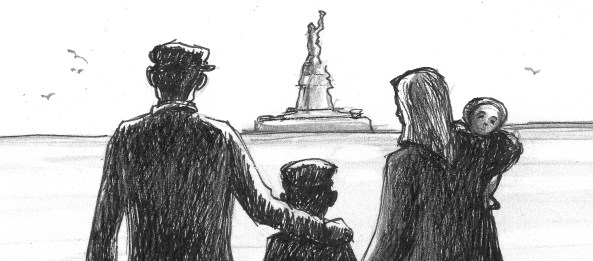
I have long been riveted by immigration stories.  These days, my focus has turned to immigration’s impact on Latino children. I was an immigrant child. With my family, I bade farewell to our relatives, native culture and language, and set off into the unknown. Nearly all immigration stories hold these elements in common, but I have a growing preference for reading about journeys that only faintly resemble mine. They expand my understanding of current immigration issues and make me feel more connected to the wider Latino community.

My family emigrated from Argentina in 1961. We landed in Alabama. Latinos were rare in the American South back then, and in our new home the prejudice we encountered was subtle—especially taking into account the intense racial bigotry that vented its full force on African Americans, and which I, for one, was horrified to witness.

Things have changed in the South lately—indeed, across America, as the immigration picture grows ever more complicated. New stories are bound to emerge from these troubled times. My eyes are peeled for them, mostly because of what I’ve seen in my backyard.

The shift in Alabama’s tolerance for outsiders came home to me one summer night in 2005, during a five-hour stretch in the emergency room. Earlier that evening, floaters sprang up in my field of vision. These are sometimes an early warning of retinal separation. The ER physician couldn’t tell me much. He instructed me to see a specialist the next day. Good news: no retinal tear.

Now for the bad news. During those long hours in the waiting room, I caught wind of  heightened anti-Latino sentiment. Out of approximately 60 people seated in the waiting room, fifteen or so were Mexicans or Central Americans. Some spoke no English, and the ER was not prepared. When I overheard halting communication between one Spanish speaker and a flustered triage coordinator, I volunteered to interpret. Soon after that, other Latinos sought my help, including a young couple with a feverish baby. They had returned to the ER a second day in a row and after a long wait, still had not been attended. They feared they were being discriminated against. I checked with the receptionist and managed to resolve their concerns. So it went. My long wait turned into a flash education on the lives of recent immigrants.

As the evening wore on, I overheard white people sitting nearby making snide comments about the Latinos. Some even put on faces of disgust. My heart sank. Alabama had reached a tipping point, I realized. It was no longer the Alabama that my family encountered in 1961, curious about foreigners, but not threatened by us. And by us, I don’t mean that I perceive myself to be a target of revived bigotry. My complexion is too light to draw notice. And my English, correct and unaccented, slips past the radar of most bigots.

But never mind all that. Injustice against anyone offends me, and racial injustice boils my blood.

Alabama’s overall tolerance of brown-skinned people began to crumble in the years that followed my visit to the ER. A recent influx of Hispanic immigrants to the state—the Latino population almost doubled between 2000 and 2010—has stirred the ancient fires of bigotry. I started hearing misinformed grumblings about “illegals” milking public assistance. In the local newspaper, letters to the editor railed against Spanish signage. Recently, a candidate for governor ran on the promise to revert driver’s-license tests to English-only. Meanwhile, farmers, foresters, landscapers, roofers, and other business owners countered that Latino employees demonstrated superior work ethic. We want them here, they said.

Somehow bigotry won out, culminating in the 2011 passage of HB 56, the harshest anti-immigration law in the United States, modeled after legislation in Arizona. Immigrant communities, civil rights activists, and religious and economic sectors around the state raised an outcry before the bill was voted into law, but the legislative body had its mind made up. As a result, thousands of recent immigrants fled the state. Ultimately, federal courts diluted the law and Latinos with strong community ties and business connections returned.  

My alarm over the plight of new immigrants took me on a circuitous route to Latino children’s literature, where I’ve discovered a strong body of immigration stories. As an immigrant, I’m finding familiar ground and fresh exposures. I’m most riveted by the contrasts, and few stories present sharper contrast to my family’s safe passage than the books I’ve been reading lately.

Pancho Rabbit cover

This January, I read La Línea, by Ann Jaramillo, and Pancho Rabbit and the Coyote, an allegorical picture book by Duncan Tonatiuh. Both deal with the fictional experiences of undocumented immigrants. (Check back soon for corresponding book talks.) The power of these narratives has led me to Enrique’s Journey, a highly acclaimed 2006 nonfiction work by Sonia Nazario that follows the arduous journey of a Honduran teenager through similar territory. In 2013, an adaptation for young readers was released, and that’s the version I’ll discuss in an upcoming book talk.

Recently, The New York Times reported on the scientific connection between reading literary fiction and the development of “empathy, social perception and emotional intelligence.” How does this transformative effect take place? Good literature narrows the gaps that exist between us and the “other.” When a character is well crafted, we don’t have to share everything in common with her to enter her point of view.

Empathy, or at least clearer understanding of the human issues involved, could make a night-to-day difference in our society’s attitude toward new immigrants. Last year, I was pleased to spot a bestselling immigration story, Esperanza Rising, on the official school-designated summer reading shelf of my local Barnes & Noble. I would love to see more immigration titles added to reading lists and classroom settings, especially those that humanize current-day migrants. In fact, if I had one additional wish regarding these books, it’s that parents would read them alongside their children. Call me a dreamer, but I believe a steady consumption of strong immigration stories could help us stem the tide of xenophobia and fortify America’s claim on the proud distinction, “a nation of immigrants.”

——————–

And now for some related immigrant stories, told through the power of music. A music video directed by Alex Rivera for Aloe Blacc’s hit song “Wake Me Up,” features actual Latino immigrants reenacting the heartbreak of separation and the joy of reunion. The singer is of Panamanian descent.

Read more in Colorlines, where you’ll find a link to a second Alex Rivera music video on immigrant life, “El Hielo,” sung by La Santa Cecilia.

Book Review: My Little Car by Gary Soto

MyLittleCarCoverBy Sujei Lugo

DESCRIPTION FROM THE BOOK JACKET: Teresa’s grandfather—her abuelo—gives her a fantastic little car for her birthday and she can’t wait to show it off to everybody. The car is so cool that the other bikes on the sidewalk part for her and even grown-ups turn their heads as she goes by. Teresa promises she’ll always take care of her beautiful carrito, but some promises are hard to keep. When Teresa’s abuelo comes to visit, will he even recognize his beautiful present?

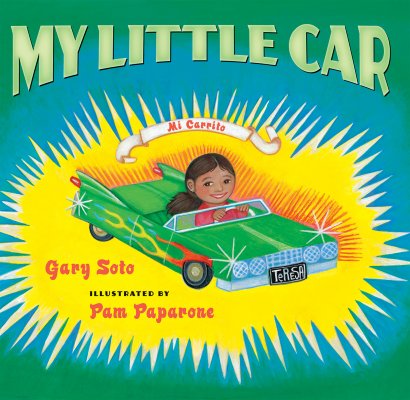
MY TWO CENTS: Through a shiny book cover of a girl riding a little car with a big smile, Gary Soto and Pam Paparone introduce us to a Chicana first-grader named Teresa. Her confidence and pride are enhanced when she receives a toy lowrider for her birthday, a customized car originated by Chicanos in California. Paparone’s bright acrylic illustrations strongly complement Soto’s words to project the subculture surrounding lowriders and other features distinctive of some Chicano and Latino neighborhoods and their communities.

When we first meet Teresa she is feeling embarrassed by her tricycle, thinking that it was a toy for “little kids.” For her birthday, she receives a beautiful lowrider with a personalized plate from her abuelito, giving her an immediate sense of independence and the confidence of being recognized as a big girl. Through this gift and Teresa’s relationship to it, Soto presents us with two important themes: the obvious one is the importance of taking responsibility and care of your belongings and the second one is presented in a more nuanced way, and perhaps silently aimed to parents: how easy it is to break the “gendering” of toys and roles.

Once Teresa receives her carrito, she pedals non-stop down the sidewalk, around her neighborhood, and she even takes it to the playground car show, where she wins first place. But as the days pass, she becomes careless with her carrito: she leaves it out in the rain, it gets pooped on by birds, it’s crushed by her dad’s truck, and it even gets sticky from spilled soda. Her mother and grandfather get preachy and stern while teaching Teresa the importance of taking responsibility of her belongings and the preaching works: in the end she learns her lesson.

Interestingly, the book never gets preachy when dealing with the gender stereotyping of toys. We live in a society where we are constantly presented with gender-stereotyped toys in books, movies, TV shows, commercials, and stores. In this book we have a Chicana girl who disrupts the gender norms around cars as toys solely for boys, and who challenges the machismo present in Latino communities. Gary Soto shows formidable restraint by not including a single line in the book that says that girls should or shouldn’t do certain things. He just provides us with a story that normalizes girls liking toy cars by showing Teresa being happy with her gift and using it without any limits. Surely this portrayal is one that car-loving kids from any gender will identify with.

TEACHING TIPS: This picture book works well as a read aloud for parents, guardians, and librarians. It can be used to teach about responsibility and ownership, while at the same time, children can learn some words in Spanish. The book includes a glossary of the few words in Spanish incorporated throughout the story.

Spanish and Language Arts teachers (Pre-K-2nd grade) can use the text to not only teach Spanish words, but also to develop classroom activities, such as sequence of events, vocabulary, and alternate endings to the story. It is also useful to incorporate Mexican-American Studies to elementary school classrooms.

LEXILE: N/A

AUTHOR: Gary Soto is a Mexican-American author, who has written picture books, chapter books, poetry collections, young adult books, plays and novels. Soto, raised in Fresno, California, has a B.A. in English from Cal State and a M.F.A. from the University of California, Irvine. He has received several awards, including the 1977 Bess Hokin Prize, the Levinson Award, the Literature Award from the Hispanic Heritage Foundation, the American Book Award from the Before Columbus Foundation, the Andrew Carnegie Medal from the American Library Association and the Beatty Award for his book, Baseball in April. He is also the recipient of fellowships from the California Arts Council, the Guggenheim Foundation and the National Endowment for the Arts. In addition to his work as a writer, Gary Soto has taught English to Spanish-speakers as a volunteer. He divides his time between Berkeley, California and his hometown of Fresno.

Some of his selected books are: The Skirt, Pacific Crossing, Chato and the Party Animals, Baseball in April and Other Stories, Neighborhood Odes, Too Many Tamales, Chato’s Kitchen, Taking Sides, Off and Running, Cat’s Meow and Chato Goes Cruisin’.

ILLUSTRATOR: Pam Paparone is an illustrator of many books for children, such as: Raindrop Plop by Wendy Cheyette Lewison, I Like Cats by Patricia Hubbell, Flip, Float, Fly: Seeds on the Move by JoAnn Early Macken, The Tattletale by Lynn Downey and Of Number and Stars: The Story of Hypatia by D. Anne Love. She is also the author and illustrator of Cinco Patitos/Five Little Ducks and Who Built the Ark?  Her paintings have appeared on the cover of The New Yorker. Pam Paparone lives in Philadelphia, Pennsylvania.

My Little Car was one of commended titles of the 2007 Américas Award for Children’s and Young Adult Literature. For more information about My Little Car visit your local library or bookstore. Also check out WorldCat.org, Indiebound.org, Goodreads, Amazon and Barnes and Noble.

Writing Tips and Diversity Points at the SCBWI Winter Conference

By Cindy L. Rodriguez

The Winter Conference of the Society of Children’s Book Writers and Illustrators in New York is kind of like a massive family reunion, with all 1,000+ people having a love of children’s literature in their blood. It’s very cool for me to break away from my full-time day job as a middle school teacher and attend this annual gathering of creative people who all want to be published or work in some capacity with kid lit. While this love of children’s literature is the common denominator at the conference, the attendants are diverse people with myriad interests. Because of this, my ears naturally perk up when speakers address diversity in publishing.

The SCBWI did not have a specific panel or break-out session dedicated to diversity in children’s publishing, but speakers included Raul Colón, Shadra Strickland, Jack Gantos, and Nikki Grimes. Also, the topic of diversity popped up throughout the conference as writers, illustrators, and editors offered great advice about craft.

During her Saturday session, Anica Rissi, an executive editor at Katherine Tegen Books, outlined seven essential things to remember about writing contemporary fiction.

  1. Just do it: write regularly. Make time for this in your life. Be fierce in protecting your writing time.
  2. Give the reader something to wonder about.
  3. Start with the story, not the back story. Throw us into the action.
  4. You need both external and internal tensions, a plot arc and an emotional arc. You need that emotional growth.
  5. Details should matter. Ask what is this book really about? Is every scene a part of that? When in doubt, take it out.
  6. You need to bring out relatable truths through your characters. Create timeless and timely essential relationships and show how the relationships change the character. During this part of her talk, she said, “Please don’t just write about white people and please don’t just write about straight people.” She added that diverse characters should not always be the “token best friend.” A writer should make every person in the novel “a real person,” she said.
  7. World building exists in contemporary fiction, too. Setting needs to be a character.

Later, Nancy Siscoe, a senior executive editor with Knopf Books for Young Readers, discussed seven essential things about writing the classic middle grade novel. They are:

  1. Audience: middle grade fiction is for readers 8-12 years old. It’s an age of independence, of becoming a person separate from your family. It’s an age of enthusiasm, optimism, and openness.
  2. Plot: Put your kid character in charge. Let them solve their own problems, keep them moving, keep the stakes high.
  3. Hope: You don’t need a happy ending, but you do have to have hope.
  4. Likeable characters: You want a main character your readers would want to be friends with, someone they will care about.
  5. Voice: Make it distinctive. It’s the quality that sets the tone and sets your book apart from others.
  6. Read it aloud: The writing should be smooth, clean, and clear. Middle grade books are often read aloud, so try it while writing.
  7. Heart: The quality that makes your own heart feel bigger and wiser and stronger for having taken the journey.
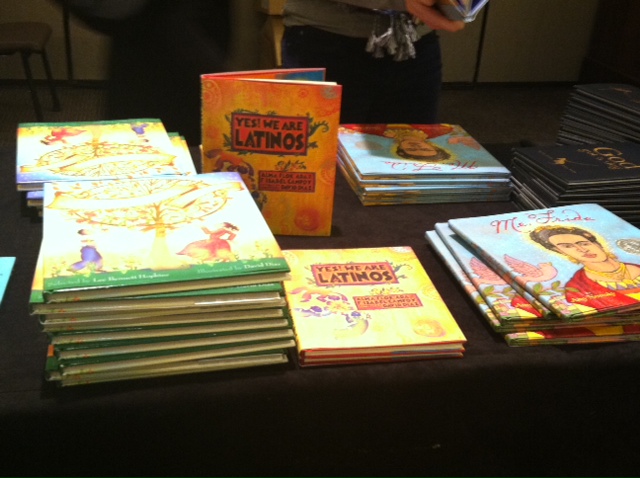
Some of the Latin@ titles at the book sale

Some of the Latin@ titles at the book sale

During her talk, Siscoe was asked about diversity. She responded by saying she is always on the lookout for diverse main characters. In fact, she said a “selling point” for the novel Unusual Chickens for the Exceptional Poultry Farmer, a middle grade debut by Kelly Jones set to release in 2015, was its Latina protagonist.

The final panel on Saturday was about book banning rather than craft. Susanna Reich, chair of the Children’s and Young Adult Book Committee for PEN American Center, floored me during this session. She said children’s and young adult books make up the vast majority of books on the ALA’s list of banned and challenged books. While I knew children’s books were often challenged, I didn’t realize that on the most recent list of the “Top 100 Banned/Challenged Books” from 2000-2009,” 72 of the top 100 are children’s and young adult books, with Harry Potter at the top of the list.

Reich also made the point that censorship isn’t only about removing books from shelves. Censorship also occurs when so few diverse titles make it onto the shelves. “It’s a form of censorship when the amount of multicultural kid lit published hasn’t increased in twenty years,” she said.

But what about those books that do make it onto the shelves? Well, it’s up to us to buy them. Reich quoted poet Alexis DeVeaux, who said, “Buying a book is a political act.” Reich challenged each of us to think about the books we choose to buy and read. Do we censor our book buying in any way? Do we make a conscious effort to read beyond our comfort zones? Do parents and teachers select books for their children and students that include diverse characters?

Multicultural books can speak to all kids, not only kids of color,” said Reich.

Hear, hear! More details from Reich’s talk can be found here on the SCBWI site.

At the end of an SCBWI conference, I am always exhausted in a good way, with a thousand things to consider as a reader, writer, parent, and teacher. This year, the speakers in the sessions I attended reinforced the idea that I can help to promote diversity in children’s literature in each of these roles. Not only can I broaden my own reading interests, but I can expand reading choices for my daughter and my students. By doing this, I will support diversity in kid lit and the members of my SCBWI familia who write, illustrate, edit, and publish books with diverse characters.