Guest Post: A Bucket-load of Talk + No Action = a Bucket-Load of Nothing

By René Saldaña, Jr.

At a cozy dinner attended recently by children’s book writers and illustrators, I listened to two conversations happening simultaneously. On the one side of me, my left, folks were talking about Daniel Handler’s blatantly stupid remarks at the National Book Award ceremony (really, in what world would anyone ever feel entitled to bring up such vile imagery, and worse, to do so in such a cavalier fashion?). Yes, these writers and artists agreed, the remarks were dumb and insensitive at best, racist at worst. But, he did offer an apology (via Twitter, of all places; how much more impersonal can a person get! It seems to be the norm though). He also donated $10,000 to We Need Diverse Books, with the promise to match whatever amount came into WNDB in the next 24 hours, up to $100,000. He apologized, went the logic, and he did give, and to such a worthy organization who is sure to do miracles with these funds (visit this organization’s web site for more information: http://weneeddiversebooks.org). And, so, reluctantly but never the less, most of the authors and illustrators that evening gave Handler the benefit of the doubt. An easy pass, in my opinion.

On the other side of me, my right, others were talking about GOP aide Elizabeth Lauten who, on her Facebook page, wrote some pretty vile material of her own about President Obama’s daughters. A conservative, I categorically disagree with her statements. They were uncalled for. I disavow them, and what consequences she suffers she brought on herself. You see, it’s one thing to attack the politics of the man, even the man himself (as happened with Bush and Palin both and with the same ferocity), but to go after a president’s children, who had no say in his pursuit of the presidency, is uncalled for.

Lauten, my table mates continued, after some soul searching (she’d written that she prayed about her situation, spoke with family who advised her to admit her wrong-doing) apologized and, furthermore, quit her post. Despite Lauten’s behavior after the fact, there was an unwillingness to the right of me, it seemed, to afford her the same “easy way out” as was being given to Handler on the opposite end of the table.

At the hotel room later than night, I couldn’t help but wonder why folks in the industry were able to find it within themselves to forgive the one but not the other? I recalled how my table mates had spoken about Jacqueline Woodson’s very touching response in the New York Times. How much class she had displayed. One or two may have asked if his donation was nothing more than Handler trying to buy his way out of a very bad situation. A token payment, so to speak. Ten thousand little tokens, and then some. A lot of then some. Others responded that no matter, the money went to a great cause, that the amount of money raised in a day’s time was enormous, and imagine all the good that can come of it. Etc., etc.

Cynical like I am, the contrasting reactions at the table that night and from across the nation, boil down to politics for me. Who is given a pass for belonging to one party or the other, and who is not because he or she is a member of the opposite one? Best I can tell, Handler is likely left-leaning, as seems to be the majority of the publishing industry. He, like President Obama, has permission to evolve. He comes, as Woodson writes, from a place of ignorance, but his intent was never to hurt surely. He made a mistake, and hasn’t he already paid for it? (Literally?) He has learned his lesson, right? He has recognized the error of his way? And he’s dealt with it, no?

Lauten, on the other hand, is a Republican; therefore, her apology and action thereafter mean little. They are proof of her and the party’s hypocritical stance on diversity. Their lack of sympathy for the downtrodden. A heartless bunch, those conservatives. After all, once a racist, always a racist. And so she can’t possibly be sincere in her request for forgiveness. Her motives questionable.

In his reaction following the Eric Garner grand jury decision refusing to indict officer Daniel Pantaleo, President Obama stated, “…this is an issue that we’ve been dealing with for too long, and it’s time for us to make more progress than we’ve made. And I’m not interested in talk, I’m interested in action.” The president was speaking, obviously, about violence against Black men at the hands of the police and a similar violence against the Black community at the hands of those charged with finding justice for the disenfranchised: the grand jury. A jury of any kind. Our peers, impartial, truth-seekers, supposedly. But who fail, sometimes more miserably than at others.

President Obama’s words can also be applied to our quest for diversity in the publishing and education worlds. We can talk the talk all day long and not get one single solitary thing done. Talk is cheap, after all. We’ve been doing nothing but talking for far too long.

The alternative is to walk the walk. This means taking hard stances some times. This is one of those times, an occasion that matters more than we can imagine. Those affected for better or worse are those for whom we claim to work. Yes, Handler apologized, but it cannot be that easy for us to wave away his brand of racism because he gives to a good cause. We can’t let Handler off the hook, I don’t care how much money he donated and helped raise.

How many times have we said of kids of all ages “Oh, they know more than we realize”? It’s true. And this moment is no different, except in terms of the context of the times: Trayvon Martin, Michael Brown, Eric Garner, and several other instances our kids are hyper-aware of. There are protests across our nation fighting racism. They will hear what happened, what he said, how he laughed it off. How we let him off easy. They will see through our hypocrisy. It either matters, or it doesn’t. Just let that sink into your mind.

Don’t get me wrong: I’m overjoyed at what Ellen Oh, et al. will be able to do for young readers from the various diverse populations. These folks are walking the walk. They are taking action.

I, like our president, though, am tired of talk. Our children’s literacy success rests largely in our hands. And talk isn’t going to improve anything. It hasn’t thus far. Proof is Handler’s imagery from that evening’s speech. Isn’t he supposed to be from amongst our more enlightened class? If he hasn’t gleaned from all this talk over decades that there are lines drawn for a reason, then all this talk hasn’t accomplished much, has it?

Talk and talk and talk about what can possibly be done to make change happen is okay, but it’s got to lead somewhere. So far, it hasn’t on a grand scale. Rukhsana Khan explained more poignantly than I can ever do the harm a lack of action on our parts can do to an already-disenfranchised child. During her opening remarks at this year’s NCTE Friday morning General Session, she described the setting: a house, which implies an indoors and an outdoors; indoors a warm fire, comfortable chairs; outside, a porch, the cruel elements; inside, people with the means to turn the world of literature and literacy on its head, but who instead sit by the fire warming themselves; outside, the marginalized looking in, freezing, invisible, worthless. One looking in dreaming of the warmth, a place at the fire; the other looking at one’s reflection in the window produced by that darkness without.

I can’t tell you what to do to begin to right the wrong, or how. I won’t. That’s entirely up to you. What I will tell you is that the matter is urgent. These kids cannot be disappeared, and we—writers, illustrators, poets, literacy advocates, educators, publishers—cannot let them be disappeared. Handler gave; Lauten resigned. Both took action to try to fix things. Most of us don’t have the kind of cash Handler does, nor can we give up our livelihoods. But we can DO. Something. And something is better than nothing.

Our children’s lives depend on it.
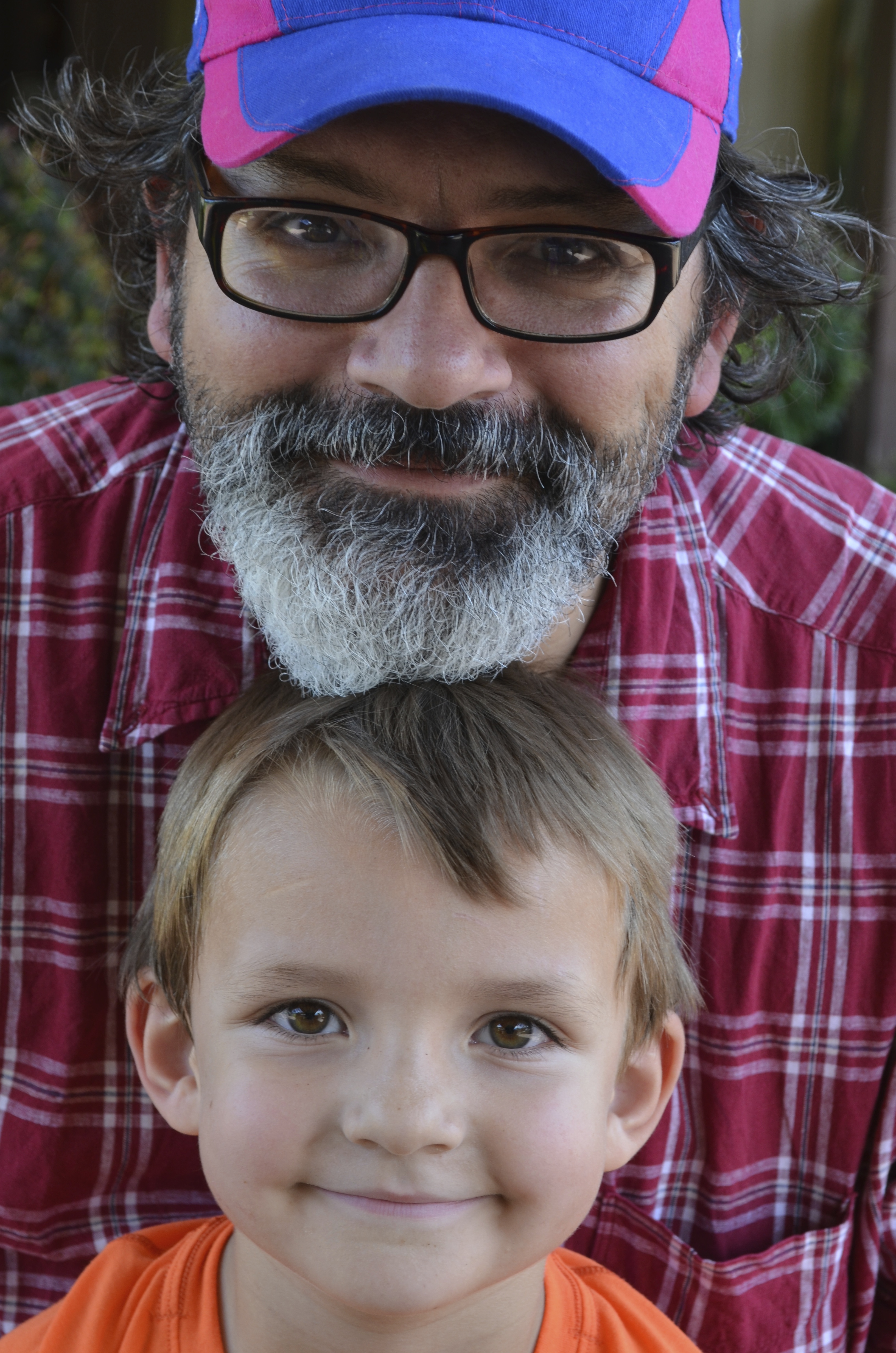
 

Rene SaldanaRené Saldaña, Jr., is the author of the bilingual picture book Dale, dale, dale: Una fiesta de números/Hit It, Hit It, Hit It: A Fiesta of Numbers. He’s an associate professor of Language and Literature in the College of Education at Texas Tech University in West Texas. He’s also the author of several books for young readers, among them The Jumping Tree, Finding Our Way: Stories, The Whole Sky Full of Stars, A Good Long Way, and the bilingual Mickey Rangel detective series. He can be reached at rene.saldana@sbcglobal.net.
Latin@s in Kid Lit at the Library: Interview with Crystal Brunelle

By Sujei Lugo

The Latin@s in Kid Lit at the Library series focuses on interviews with children’s librarians, youth services librarians, and school librarians, where they share their experiences, knowledge, and challenges using Latino children’s literature in their libraries. In this second entry of this series, I interview Crystal Brunelle.

Crystal is a library media specialist from Wisconsin. In times when schools and their libraries are impacted by budget cuts, closings, and lack of institutional and government support, there are still school librarians and media specialists striving to support their students, teachers and community.

crystalinterview
Crystal Brunelle
Library Media Specialist, Northern Hills Elementary School, Onalaska, Wisconsin
Blogger for richincolor.com (co-founder) and readingtl.blogspot.com (personal blog)

Tell us a little bit about yourself, your identity, and your library.
I am a white mid-westerner with German ancestors. My family moved many times, so my childhood years were spent in various cities in both Texas and California. I was an elementary school teacher and a certified ESL teacher for eleven years before coming to live in the Midwest.

I started working in libraries when we moved to Wisconsin and have loved making that transition. When we came here, it was clear that some of my students had a rather limited view of the world and though our library had some diverse titles, there weren’t nearly enough. I want our students to have plenty of books available so they can see other ways of living, and I want to make sure that all of our students have books that are mirrors reflecting their lives. 12-15% of our student population is Hmong, so the first author visit was with a woman who had written a book featuring a Hmong family and was written in English but also had Hmong text alongside. As I prepared the classes for her visit, what surprised me was that the word bilingual was virtually unknown for most of my students. That’s when I also started acquiring more bilingual materials in a variety of languages. I shared about that experience in more detail at the Nerdybookclub blog.

What process does your library take to select and acquire Latino children’s books for the collection? Do you have any input in this process?
As the Library Media Specialist, I have the responsibility of choosing all of the materials in the collection. Before Latin@s in Kid Lit came on the scene, I relied on the Pura Belpré Award, The Tomás Rivera Award, and The Américas Award for titles. More recently, I’ve been participating in the Latin@s in Kid Lit Reading Challenge which has provided me with a lot of more book titles. I’ve also had the opportunity to review several books published by Piñata Books for Children, a division of Arte Público Press.

What type of children and youth programming does your library offer using Latino children’s literature? How frequently?
I focus on Latino children’s literature during Hispanic American Heritage Month and in the past two years, I have also added El Día de los Niños to our activities. Beyond these two major events, I have many lessons that center around Latino works. A few examples are our first grade author study of Yuyi Morales, our second grade biography lesson using the book Tito Puente, Mambo King/Rey Del Mambo by Monica Brown and Rafael López, and a poetry lesson in fifth grade that includes poetry from Francisco X. Alarcón. I generally try to infuse Latino lit throughout many lessons and activities, though, so we see it all year long. An example of this is when we have a lesson about giving thanks and I share Pat Mora’s Gracias/Thanks along with Giving Thanks: A Native American Good Morning Message and Thanking the Moon: Celebrating the Mid-Autumn Moon Festival.

In terms of promoting events and community outreach, what does your library do?
This is an area that I am working on and have begun to make some progress. I oversee the fifth grade students as they create video announcements for the school. They’re posted on our school YouTube channel for parents and the community to view. This past summer was exciting because I asked for and received funding to have the library open during the summer. I only had two hours every other week, but it meant that students in walking distance (we are a neighborhood school) could come get library materials all summer. It wasn’t as well attended as I had hoped, but it was a start and something that I will publicize more in the future.

What is the reaction of kids, teens, and families regarding Latino children’s books and programming? And the reaction of your co-workers and library staff?
I have had very positive reactions to the inclusion of more Latino children’s materials. One of the families that came in during the summer library times (they speak Spanish at home) checked out a pile of books and were happy to even find a wonderful bilingual board book, Global Babies. The mother said she was happy to have that one (Global Babies) because that way the father could read to the baby in Spanish.

I know our English Language teacher has also been very happy to have the materials available. We don’t have many students with Spanish as their first language, but it helps so much with the few that are here and especially when we have a newcomer in the district. I love seeing the eyes of my Latino students light up when they hear or see Latino materials being featured in class. In addition, students who only know English enjoy experiencing other languages. They also seem to like seeing me working a little harder when I read aloud a book that includes Spanish text.

Any challenges regarding the acquisition of Latino children’s books or your programming? What would you like to do in terms of programming that you haven’t been able to?
There is nothing preventing me from buying more except budget limitations. I would like to expand our El Día de los Niños celebration beyond the school day with a family event. We’re going through a major building renovation so that isn’t a reasonable task for this coming spring due to space constraints, but it is something I will strive for in the future.

Do you address issues of prejudice and oppression in your library through and in children’s books?
Yes, this is something I address specifically in the fourth and fifth grade classes, but at a more subtle level in the younger grades. In line with the common core standards, I’m working to help students learn to read critically and to ask questions such as: who is telling the story, what is their perspective, is there a voice or perspective that is missing, and do we see evidence of bias or stereotypes? I could just tell them which books have issues, but I won’t always be with them and I want them to be able to spot problems on their own.

Any advice for other librarians/educators who would like to use and incorporate Latino children’s literature into their programming?
There is a lot of fantastic Latino children’s literature out there (see this SLJ post about that) and it isn’t just for Latino children. Even if your demographic doesn’t include many Latino patrons/students, these books can be a wonderful addition to your library. We have to move away from the idea that Latino literature is only created for Latinos. Latino literature can and should be present in book displays throughout the year and featured in story times or lessons across all kinds of topics. We have a small number of Latino students at our school, but I don’t just purchase Latino children’s materials for them – they’re beneficial to all staff and students.

Which are the most popular Latino children’s books at your library?
The most popular Latino books in my library are Niño Wrestles the World, Just a Minute, Gracias, Mi Familia Calaca, Dalia’s Wondrous Hair, Dora the Explorer books, Maximillian & the Mystery of the Guardian Angel, and in non-fiction, the series Superstars of Soccer: Mexico.

15953630  1660305  7123496

16057383  18654384  11538645

And finally, which Latino children’s books do you recommend?
To increase the amount of books I can recommend, I’m listing authors. If I only listed my recommendations from Yuyi Morales, the list would already be lengthy.

Picture Books by: Francisco X. Alarcón (poetry), George Ancona (non-fiction), Monica Brown, Laura Lacámara, Yuyi Morales, Pat Mora, Gary Soto, and Duncan Tonatiuh

Middle Grade by: Alma Flor Ada, Julia Álvarez, Margarita Engle, Jack Gantos, Xavier Garza, Meg Medina

Young Adult by: Patrick Flores-Scott, Sonia Manzano, Guadalupe Garcia McCall, Meg Medina, Benjamin Alire Sáenz, Alex Sánchez, and Francisco X. Stork.

From STEM to STEAM, Latino-Style

By Margarita Engle

Children are natural scientists. They ask, “Why?” They poke, peer, dissect, observe, and marvel. Sometimes they reach conclusions. Since children are also natural storytellers, the conclusions might be imaginative, rather than verifiable. That’s okay. For both children and adults, curiosity and a spirit of wonder are just the starting places for learning about STEM (Science, Technology, Engineering, and Medicine). Skills, information, and experience must follow. Without a suitable educational background, Latinos will be left behind in the twenty-first century rush toward jobs that require specialization.

I am not a specialist. Despite my training as an agronomist and botanist, I still love simple nature walks, with plenty of aha moments of amazement. That’s why I’m so thrilled that poetry and other creative approaches are being introduced into the teaching of science, especially at the elementary level, creating STEAM (Science, Technology, Engineering, Arts, and Medicine).

Poetry, after all, springs from the same sense of wonder as science, and is rooted in the same combination of observation and wonder. The arts allow us to learn with all five senses. Doesn’t it make sense to let children read, write, paint, sing, and have fun, while studying facts?

Fortunately, educators are already introducing the arts into STEM teaching. The Poetry Friday Anthology for Science (Pomelo Books) includes many bilingual poems about a wide variety of concepts. Taking the lead among Latinos, Pat Mora made sure that Día de los Niños offered mini-grants to libraries planning STEAM events in April, 2015. Other grassroots programs have sprung up in recent years, including the Americas Latino Eco-Festival, which promotes environmental activism for Latinos, and AZUL, which invites Latinos to become coastal and ocean stewards.

For someone like me, with a deep love of nature, and my own odd combination of scientific and creative training, STEAM education offers a chance to write new kinds of books for children and young adults.

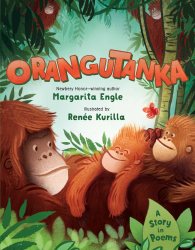
  final Silver People cover-1  MountainDog.highrescvr  OrangutankaFrontCvr

In my verse novel, Silver People, Voices From the Panama Canal (Harcourt, 2014), I blended history with rain forest biology. In two forthcoming picture books, Orangutanka, a Story in Poems (Holt, 2015), and The Sky Painter, Louis Fuertes, Bird Artist (Two Lions, fall, 2015), I’ve been thrilled by the opportunity to show animal and human interactions. In Mountain Dog, winner of the first ALBA (Americas Latino Book Award), I incorporated hiking safety and outdoor skills into a middle grade adventure story.

As STEAM efforts grow, I hope that educators, librarians, parents, scientists, environmentalists, writers, and illustrators can all join together to make sure that teaching methods honor the natural curiosity of children.


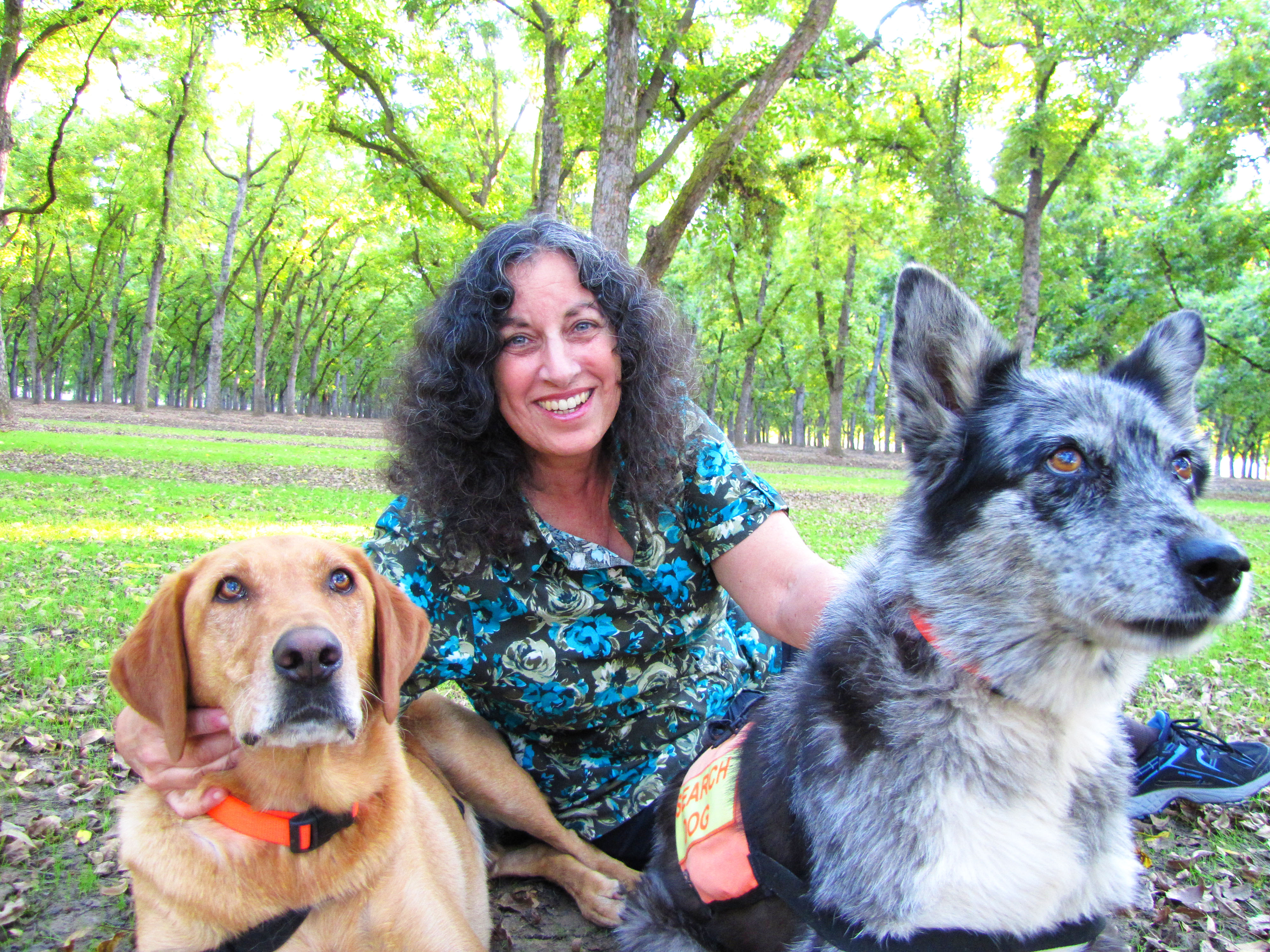
Margarita Engle, hiding so search and rescue dogs can practice finding a lost hikerMargarita Engle is the Cuban-American author of many young adult verse novels about the island, including The Surrender Tree, which received the first Newbery Honor ever awarded to a Latino, and The Lighting Dreamer, recipient of the 2014 PEN USA Award. Other honors include multiple Pura Belpré and Américas Awards, the Jane Addams, International Reading Association, Claudia Lewis, and MANA Las Primeras Awards.

Margarita grew up in Los Angeles, but developed a deep attachment to her mother’s homeland during summers with her extended family in Cuba. Enchanted Air: Two Cultures, Two Wings, a Memoir (Atheneum, August, 2015) tells the story of those childhood visits, leading up to the loss of travel rights after the Missile Crisis. Margarita was trained as a botanist and agronomist, before studying creative writing with Tomás Rivera. She lives in central California, where she enjoys hiding in the wilderness to help train her husband’s search and rescue dogs.

“A poet, América knows, belongs everywhere”: Healing & Latin@ Children’s Literature

By Sonia Alejandra Rodriguez

As a child what I desired most was to be rescued from the violence I experienced at home. I was undocumented and domestic violence was far too common. While I now know that these are real experiences for many Latino homes, these were secrets that I walked around with for fear that my family would be separated if I said anything. Retrospectively, what I probably needed, aside from the violence to stop, was to understand why the violence was happening in the first place. There was nothing or no one around to explain my feelings of anxiety, fear, and/or self-hate around the violence I witnessed and then internalized. At the time, shows like “Boy Meets World,” “Saved by the Bell,” and “Full House” only reaffirmed for me that my family was different, did not belong, or that there was something wrong us. I was reading a lot, too, but I only got more and more frustrated that the books I read did not speak to my reality. I was obsessed with Beverly Cleary’s Ramona because she was everything I wanted to be—free, adventurous, and happy. And while characters like Ramona fueled my imagination they explained nothing about the violence I endured.

My investment in Latina/o children’s and young adult literature stems from my desire to explain why violence is more prevalent in certain communities than it is in others. But it is also driven by what I have seen is the genre’s potential to provide paths toward healing for Latina/o children and young adults. Recent conversations about the need for diversity in children’s literature have discussed at length the impact that being or not being represented in books can have on a child’s self-esteem and where they see themselves positioned in society. These conversations have made visible the discrimination within publishing industries and the ways that children of color stand to lose the most. Diversity is important to my project simply because stories about children of color can save their lives.

696056I was first introduced to Luis J. Rodriguez’s América is Her Name as a graduate student and it was the first children’s book I read with a Latina protagonist. I was a taken aback that a kid’s book actually talked about immigration and included scenes of violence. Mainstream children’s literature is no stranger to violence, gruesomeness, monsters, and the like; however, it is out of the ordinary to see a story about immigration, gang violence, and abuse at home that does not depend on stereotypes or is read as ethnography. América Soliz, the protagonist, is a recent immigrant from Oaxaca, Mexico to Pilsen, Illinois— one of Chicago’s predominantly Mexican communities— who struggles to find a voice in a place that seeks to silence her. Throughout the text, the reader is privy to the discrimination she faces in the classroom, the violence in her community, and the patriarchal oppression in her home. What I found most powerful about the book was that América is given a tool to challenge the oppressions around her. Poetry becomes her outlet, and it allows her to process the violence she witnesses and experiences. In this way, the violence does not overwhelm her, but instead, she is able to find strength despite it. Rodriguez’s book opened a new world of children’s books for me, and it allowed me to see this genre as having the potential to create social change.

One of the biggest personal challenges that América faces is feeling like she does not belong. As an undocumented student in an ESL classroom, her fear is reaffirmed by her teachers:

Yesterday as [América] passed Miss Gable and Miss Williams in the hallway, she heard Miss Gable whisper, “She’s an illegal.” How can that be—how can anyone be illegal! She is Mixteco, an ancient tribe that was here before the Spanish, before the blue-eyed, even before this government that now calls her “illegal.” How can a girl called América not belong in America? (n.p)

América’s genuine question signals a history of systemic oppression demarcating who gets to belong and who is excluded from the American imaginary. By tracing her indigenous roots, América seeks to challenge who can lay claim to the land her teachers wish to erase her from. Upon first reading Rodríguez’s book, I found América’s question rather painful. Even though América is a child, her teachers have no qualms about criminalizing and excluding her. At nine years old, there is very little that América can do to challenge her teachers’ ignorance and discrimination; however, the tension in the classroom shifts when Mr. Aponte, a Puerto Rican poet, visits America’s class. Mr. Aponte encourages the class to write poetry about what they know and in whatever language they feel comfortable. América writes about Oaxaca and shares her poetry with her family. Eventually, her mother and younger siblings take part in writing. At the end of the book, Ms. Gable gives América a high mark on one of her poems, which brings great joy to América and her family.

While América remains undocumented at the end of the story, she finds that her poetry gives her a sense of belonging that she did not feel at the beginning. She says: “A real poet. That sounds good to the Mixteca girl, who some people say doesn’t belong here. A poet, América knows, belongs everywhere” (n.p.). Writing has given America a way to challenge and transform the oppressions around her. Her poetry serves as a voice and power that she lacked and has since shared with her family. When I teach this book, I am very careful about talking about the conclusion as the “happy ending.” Instead, I encourage my students to read this moment as part of América’s healing process. Leaving the book with the assumption that everything works out for América is a disservice to the book and those like it. The fears and perils of immigration do not go away because América learned to write poetry. Instead, what she has learned is a set of skills that will help her express how immigration impacts her identity and will help her challenge a system that seeks to exclude her. Reading the ending as a moment in a much larger healing process instead of a resolution further allows me to demonstrate how Latina/o kids lit can transform the lives of Latina/o children and young adults.

If a book like América is Her Name had been available to me as a child, I can imagine it having made a real difference. Feeling excluded or not belonging is a very common theme within traditional coming-of-age stories. However, those feelings become rationalized as “growing pains” or generalized as “everyone feels left out,” or they become a lesson on “not everyone is going to like you.” These motifs often learned in mainstream coming of age stories and in common (mis)understandings of American childhood do not capture América’s experience. América is excluded for specific political and historical reasons. If she were a real child, she will probably be excluded her entire life because she is an (im)migrant. Even if she were to gain legal citizenship, someone will someday ask her “where are you from?” and assume that she does not belong. When I talk about Latina/o children’s books as having the potential to heal, I mean it in reference to these specific moments of exclusion and violence that unfortunately are a reality for Latina/o children. How do we teach our children to answer questions like “where are you from?” or to respond to comments like “you don’t look American”? How do we make them feel like they belong when the world around them may be telling them otherwise? Latina/o children’s literature does not have all of the answers but it is creating conversations on the topics that still require much attention.

Other Latina/o children’s books with immigration as a theme:

52390  1006426  2235722  465967  8101398  1266138  580207  2195327

headshotSonia Alejandra Rodríguez has been an avid reader since childhood. Her literary world was first transformed when she read Rudolfo Anaya’s Bless me, Última as a high school student and then again as a college freshman when she was given a copy of Sandra Cisneros’s The House on Mango Street. Sonia’s academic life and activism are committed to making diverse literature available to children and youth of color. Sonia received her B.A. in English from the University of Illinois at Urbana-Champaign. She is currently a PhD candidate at the University of California, Riverside, where she focuses her dissertation on healing processes in Latina/o Children’s and Young Adult Literature.

Book Review: Yes! We Are Latinos by Alma Flor Ada and F. Isabel Campoy

Reviewed by Lila Quintero Weaver

Yes We Are LatinosDESCRIPTION FROM THE PUBLISHER: Juanita lives in New York and is Mexican. Felipe lives in Chicago and is Panamanian, Venezuelan, and black. Michiko lives in Los Angeles and is Peruvian and Japanese. Each of them is also Latino.
Thirteen young Latinos and Latinas living in America are introduced in this book celebrating the rich diversity of the Latino and Latina experience in the United States. Free-verse fictional narratives from the perspective of each youth provide specific stories and circumstances for the reader to better understand the Latino people’s quest for identity. Each profile is followed by nonfiction prose that further clarifies the character’s background and history, touching upon important events in the history of the Latino American people, such as the Spanish Civil War, immigration to the US, and the internment of Latinos with Japanese ancestry during World War II.

Alma Flor Ada and F. Isabel Campoy’s informational yet heartwarming text provides a resource for young Latino readers to see themselves, while also encouraging non-Latino children to understand the breadth and depth of the contributions made by Latinos in the US.

Yes! We Are Latinos stands alone in its presentation of the broad spectrum of Latino culture and will appeal to readers of fiction and nonfiction.

MY TWO CENTS:  Yes! We are Latinos belongs on every essential reading list of Latino children’s literature, as is often true of books co-authored by the acclaimed duo of Alma Flor Ada and Isabel Campoy. No single work can cover every expression of Latino life in the United States, yet this book for middle-grade readers provides a generous glimpse of historical, cultural, ethnic, and linguistic aspects of the community. The authors’ approach pairs thirteen character vignettes, written as monologues in free verse, with matching expository sections of historical and cultural information. Collectively, the alternating sections deliver vivid, easily digestible insights into what is meant by Latino. There is no single Latino identity, the characters seem to say, and each of us is worthy of your attention.

The authors’ commitment to showing a wide representation of Latino life comes through in the vignettes. The featured characters reflect a generous range of ethnic and regional groups, some of which speak no Spanish, mirroring the fact that many Latinos come from bicultural and transnational families. In one vignette, we meet Susana, a Sephardic girl who lives in San Francisco. In another, we’re introduced to Dominican-born Santiago, who now calls Detroit home.

Sometimes young Latin@s would love nothing better than to break away from traditions they consider too confining. The story of Gladys, a Puerto Rican living in Philadelphia, is the best example of this. She watches the preparations for her sister’s quinceañera, expecting that before long her mother will want to start planning Gladys’s “quinces.” But Gladys’s dreams are pulling her in another direction, toward college.

Julio is from a farm migrant family originating in Teotitlán del Valle, a village in Oaxaca, Mexico. Like other members of his original indigenous community, Julio speaks Zapotec. When his family moves to Stockton, California, he must navigate two foreign languages, English and Spanish, in order to function in a primarily Spanish-speaking Chicano community, within a mainstream American setting. He’s adjusting to life in the new country, but still looks back on his homeland with longing and pride, recalling the beautiful and prized tapestries that Teotitlán’s weaving looms are known for.

In one pair of monologues, two Latinas with Asian backgrounds form a friendship. Lili is a Guatemalan of Chinese descent, whereas Mikito’s heritage is Japanese and Peruvian. The families of both girls passed through multiple immigration journeys. In the educational follow-up, we learn about waves of Asian immigrants that landed on the shores of South and Central American countries and the descendants of these immigrants who eventually drifted northward. The section on Japanese Latinos reveals a troubling detail of American history: Wartime internment camps built to contain Japanese Americans also held Japanese families who were deported at the urging of the United States by the Latin American countries where they resided. In these internment camps, Japanese Latinos often found themselves socially isolated, since they spoke only Spanish and few others in the camp could communicate with them.

The factual sections that follow the monologues highlight each character’s nation of origin. In Santiago’s case, it’s the Dominican Republic. A brief review of the island-nation’s history includes important facts about the Trujillo dictatorship, although the achievements of outstanding Dominicans receive greater attention. These include acclaimed novelists Julia Alvarez and Junot Díaz, haute-couture fashion designer Oscar de la Renta, and professional baseball players David Ortiz and Manny Ramirez.

Outmoded characterizations of Latino life give everyone the same background, the same history, the same traditions and tastes. This book’s emphasis counteracts generalizations and brings forward Latinos’ complexity. In each vignette, the authors touch on multiple elements, including the scattered geographic settings where the characters live, the varied occupations their parents work in, and the traditions their families celebrate. Yes! We Are Latinos offers an important and long overdue contribution to children’s literature.

TEACHING TIPSYes! We Are Latinos is the work of educators and seems custom-made for later elementary and middle school classrooms. The poetic narratives bring life to the informational sections, which in turn invite further exploration of the countries and histories they feature. Teachers may want to assign students paired sections to expand upon through written reports or artistic responses. For example, students could design posters depicting specific Latino cultures. Another idea is to have students compose poetic vignettes of imaginary characters reflecting geographic regions not covered in the book.

ESL instructors are likely to appreciate the book’s short, digestible sections, which contain not only interesting stories, but also broad vocabulary.

Older readers may want to dive into Cristina Henriquez’s recent novel, The Book of Unknown Americans, reviewed here by Ashley Hope Pérez.

For additional resources:


Alma Flor AdaALMA FLOR ADA

A native of Cuba, Alma Flor Ada is an award-winning author, poet, storyteller and scholar of literature. She has published more than 200 books for children, many of them in partnership with Isabel Campoy.

In this interview, Alma Flor Ada discusses the development of Yes! We Are Latinos and other topics, including poetry and bilingualism.


Isabel CampoyISABEL CAMPOY

Isabel Campoy is a Spanish storyteller, poet, playwright, songwriter and educator in literacy and language acquisition. She is fluent in multiple languages and her work in the field of publishing includes translation. She is an award-winning author and a frequent writing partner of Alma Flor Ada.


Video visits with the authors:

Alma Flor on literacy, stories, family connections, teaching, and writing books:

Isabel discusses stories and recites lines in Spanish:

Isabel talks about her life and work:


Overflowing with Thanks, Bookwise

WNDB_ButtonThis is the week when we as bloggers pause to give thanks, starting with the fact that we have so many amazing readers–readers who care about Latin@ kid lit as much as we do! We appreciate each one of your clicks, comments, social-media shares, and other forms of participation. If you’ve been silent up to now, let us hear from you soon. We value your partnership.

Another thing we’re super grateful for this Thanksgiving is the emergence and explosive growth of the We Need Diverse Books campaign. Ceilings are cracking under the pressure of this push and all of us stand to benefit, so thank you to the bright minds that dreamed it up.

Another reason to feel grateful in 2014 is that Latin@ kid lit is in much better shape than it was in years past. As we reflect back on our own or our children’s bookshelves, we’re delighted that kids today have a growing number of Latino options.

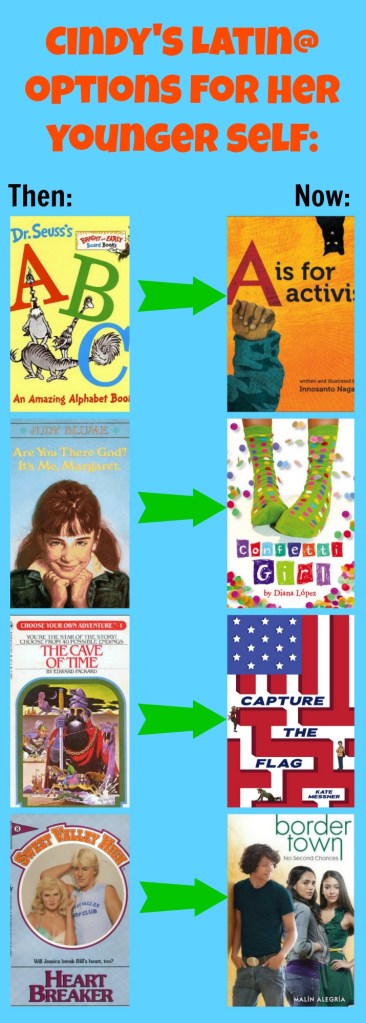
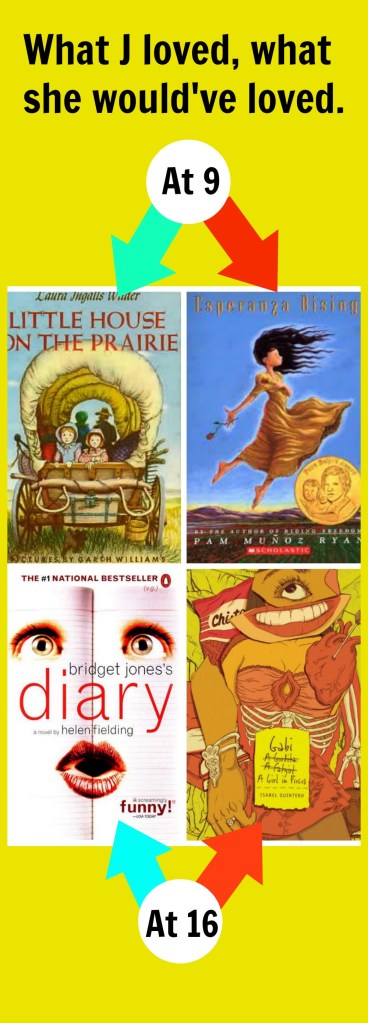
To demonstrate this point, check out a few of Cindy‘s beloved titles from her childhood, matched by current Latino options.

Cindy's Latino Option Collage

I, Lila, decided to frame this comparison through my oldest daughter’s experience. “J” was a 1980s baby who read late into the night by the light of her digital alarm clock, so you know she was crazy about books. Here are a couple of J’s favorites, matched with contemporary Latino options she would’ve loved.

What She Loved Collage

Now for expressions of thanks from two other members of the team.

Zoraida

2014 has been crazy for me. I work full time, launched the last book in my trilogy, wrote, sold and launched a New Adult romance. And I’m still not done yet. Despite a crazy work schedule, I am thankful that I do have a support system that allows me to find time to write. I have a wonderful network of friends and a boyfriend who knows me extremely well. I’m thankful that I get to be part of a wonderful group of writers here at Latin@s in Kid Lit, but most importantly that we’re getting the conversation rolling about issues dear to our hearts. I hope the next year brings even better things for us all.

LOTL.v3

Sujei

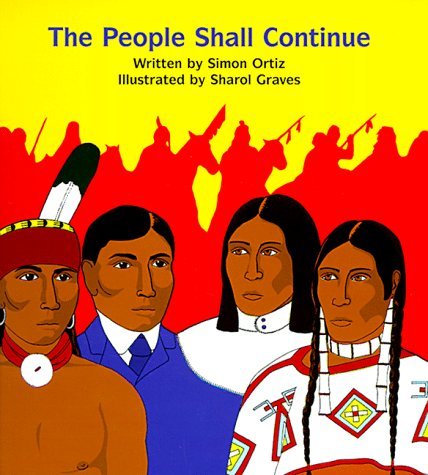
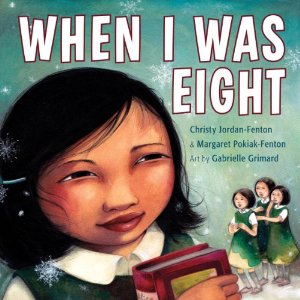
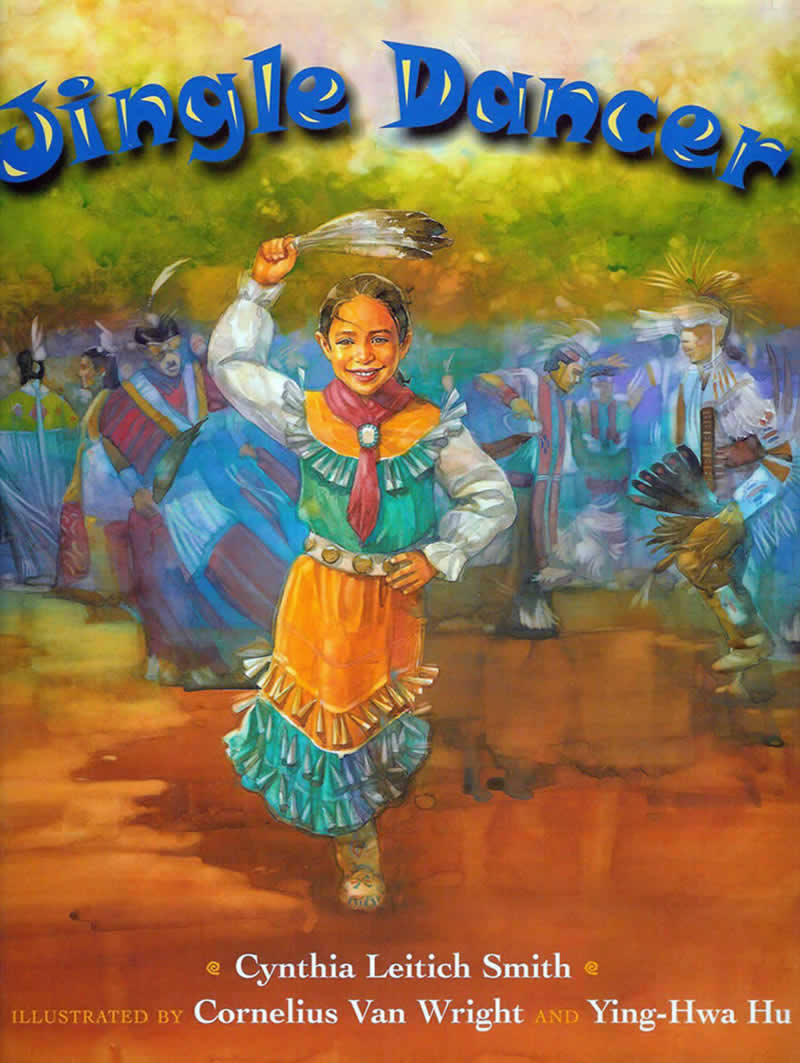
Growing up in Puerto Rico, Thanksgiving in my family seemed like “Eating Turkey with Fried Plantains Day.” Considering that November is Native American Heritage Month, I find deeper reasons to feel thankful. In my late teens, I started questioning the impact of this “first meal,” and saw it more as the beginning of genocide, colonialism, and the suffering of our indigenous people and ancestors. I’m thankful for books that teach us the real story and those that talk about Native people in the present tense and show us that they live everyday lives. Books that highlight these realities disrupt the narrative of old-school texts, which often historicize and stereotype indigenous people.

Here are three of Sujei’s recommendations for children’s books that honor the experiences and history of Native Americans.

People Shall Continue When I was 8 JingleCover_hi-res

Our mission is to promote diversity in children’s books, specifically Latin@ books and creators. So when you’re thinking about ways to diversify your kid lit bookshelves, explore our archives for reviews and posts. We’re so thankful that you care about Latino representation in children’s and teen’s books, and we want to continue serving those interests.

Happy Thanksgiving!