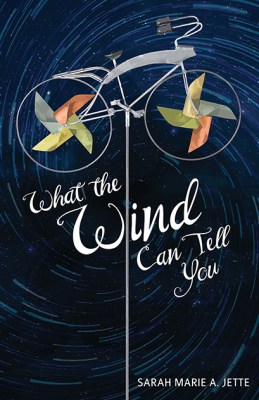
Book Birthday: What the Wind Can Tell You


Happy book birthday to What the Wind Can Tell You

(May 15, Islandport Press)

About the book:

In this new middle grade novel by Sarah Marie Aliberti Jette, seventh-grader Isabelle Perez is fascinated by wind. And this year, she’s determined to win the middle school science fair with her wind machine. She’s just as determined to have her brother, Julian, who has a severe form of epilepsy and uses a wheelchair, serve as her assistant. But after Julian has a grand seizure, everything changes.

Isabelle is suddenly granted entry into Las Brisas, a magical world where Julian’s physical limitations disappear, and one, she discovers, that he visits every night. The more Isabelle explores Las Brisas, the more possibilities she sees––for Julian, and for herself––and the more she finds herself at odds with her parents. Debut author Sara Marie A. Jette has told, with remarkable insight, humor, and a touch of magical realism, a powerful story of a family struggling to love without fear.
About the author:

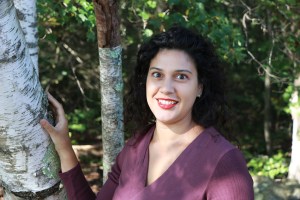
Sarah Marie Jette grew up in Lewiston, Maine, and now lives in Belmont, Massachusetts, but her route from Maine to Massachusetts was anything but a straight line. She got her degree in English and Women’s Studies at Mount Holyoke College, then went halfway around the world to serve in the Peace Corps in Mongolia. She then studied rehabilitation counseling at Boston University’s Sargent College of Rehabilitation before turning to teaching. She now teaches fourth grade at Thompson Elementary School in Arlington, Mass. Somehow, between her students and her own three young children, she finds time to write. “Finding time to write is hard, but necessary,” she says.

  1. How does your heritage affect your writing? Why did you choose to make Isabelle and her family Mexican-American? 

A: When I wrote What the Wind Can Tell You, I made Isabelle Mexican-American because I wanted to write the character I searched for as a child. I spent my childhood searching for characters who looked like me in books. Fairy tale princesses were always ‘fair.’ The books I read described characters with blue eyes and freckles. Whenever I found a character with dark hair or brown eyes, I told myself that they were like me, though, deep inside, I knew that they weren’t. Representation matters—not token characters in the background, but complex and interesting characters from diverse backgrounds that you can fall in love with. I make an effort to fill my classroom library with diverse books. There are more than there used to be, but still not enough.

Q: What was the inspiration for What the Wind Can Tell You?

A: The inspiration for What the Wind Can Tell You was a single lightning bolt. It hit me as I drove home after visiting with friends. I had just held their newborn baby and spent time with the baby’s big brother. On my drive, I imagined the relationship these boys were going to have. I thought about the love between siblings and how special it is. I pulled my car over and wrote my idea down on a paper napkin.

The baby’s big brother has epilepsy, much like my character, Julian. He was diagnosed when he was a few months old. On Sunday mornings, for about two years, I babysat him. I held him, fed him, changed his diapers, soothed him through seizures, and read to him. Sometimes, therapists visited and I learned ways to help him strengthen his muscles or track objects with his eyes. His music therapists were my favorite.

I had been writing for years, but this was the first time I found a story that felt so right. I wrote furiously and completed the first draft in three months. It would be many more years of revising before my story was ready to submit to editors, but my inspiration carried me through.

Q: Do you have any writers or books you most admire and turn to for inspiration? 

A: I admire the writing of Michelle Cuevas. The language in her books is rich and beautiful. She deals with big issues—growing up, identity, and loss—but she is also very playful in her writing. I love reading her books out loud so I can see how my students react to her words. I am also a big fan of Jonathan Auxier. I read his book Peter Nimble and his Fantastic Eyes to my students every year. His stories are unusual, engaging, and a lot of fun.
Best of luck to the brand-new What the Wind Can Tell You

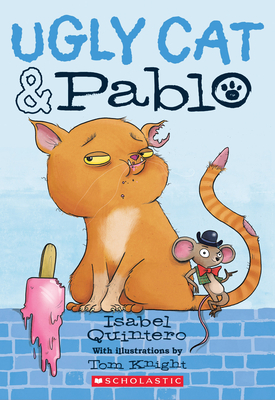
Book Review: Ugly Cat and Pablo by Isabel Quintero


Review by Cecilia Cackley

DESCRIPTION OF THE BOOK: Ugly Cat is dying for a paleta, or ice pop, and his friend Pablo is determined to help him get one by scaring a little girl who is enjoying a coconut paleta in the park. Things go horribly wrong when, instead of being scared, the little girl picks Pablo up and declares that he would make a great snack for her pet snake. Oh and there’s also the small problem that Ugly Cat may have inadvertently swallowed Pablo in all of the commotion!

Ugly Cat and his impeccably dressed mouse friend, Pablo, are an unlikely and dynamic duo who will win young readers over with their ridiculously silly antics and their search for tasty treats.

MY TWO CENTS:  As Pablo likes to say “Oh my galleta!” What a charming, silly, delightful book! I was captivated by Ugly Cat and Pablo from the very first page. They are a fantastic odd couple, one pre-occupied with food and the other with adventure. Quintero’s dialogue is snappy and if some of the vocabulary is a little above the average elementary reader, it makes it a great read-aloud and vehicle for introducing new words in both English and Spanish. I appreciate that the Spanish isn’t italicized and all the characters go back and forth between both languages, so no one is singled out as the ‘Other’.

Quintero slips in some good lessons about being kind to friends, listening, and using your words when there’s a misunderstanding. This book falls squarely in the genre of buddy animal comedy, with tons of kid appeal. The setting of an urban park is well chosen and readers will be almost as hungry as Ugly Cat by the time they finish reading the descriptions of all the great street food. Best of all, this is a series, so students who fall in love with Ugly Cat and Pablo will soon have more adventures to giggle over.

Extra points to Scholastic for great book design and back matter! Ugly Cat and Pablo each have their own font for their dialogue, giving a comic book sensibility to the pages that don’t have any word bubbles as part of the illustrations. There are pictures on almost every page to lend support to visual learners, a glossary at the back that translates the Spanish, and even a recipe for Ugly Cat’s favorite treat, paletas.

TEACHING TIPS: The strong characters and specific setting make this a great choice for elementary school book groups. Students can discuss the motivations each character, their misunderstandings and predictions for what will happen at all the cliff-hanger chapter endings. Students could also write their own endings for some of the book’s incidents and make different choices for the characters.

Another great project would be to compare the friends in this book to other animal books with friends, such as classics Frog and Toad or George and Martha, or more contemporary stories such as The Story of Diva and Flea by Mo Willems. Students could also compare the parks and streets of Paris in Diva and Flea to the parks and streets in Ugly Cat and Pablo.

ABOUT THE AUTHOR: Isabel Quintero is a writer and the daughter of Mexican immigrants. She was born, raised, and resides in the Inland Empire of Southern California. She earned her BA in English and her MA in English Composition at California State University, San Bernardino. Gabi, A Girl in Pieces from Cinco Puntos Press, her first novel, is the recipient of several awards including the 2015 William C. Morris Award for Debut YA Novel and the California Book Award Gold Medal for Young Adult. In addition, the book was included on School Library Journal’s Best Books of 2014, and one of Kirkus’ Best Teen Books of 2014, among other lists. The first in her series of chapter books for Scholastic, Inc. Ugly Cat and Pablo, was released in Spring 2017. Her first graphic novel, a biography about photographer Graciela Iturbide, released by Getty Publications in March 2018. In addition to writing fiction, she also writes poetry and her work can be found in The Great American Literary Magazine, Huizache, As/Us Journal, The Acentos Review, The Pacific Review, and others. You can follow her on Twitter @isabelinpieces or visit her website laisabelquintero.com.


ABOUT THE REVIEWER: Cecilia Cackley is a performing artist and children’s bookseller based in Washington DC where she creates puppet theater for adults and teaches playwriting and creative drama to children. Her bilingual children’s plays have been produced by GALA Hispanic Theatre and her interests in bilingual education, literacy, and immigrant advocacy all tend to find their way into her theatrical work. You can find more of her work at www.witsendpuppets.com.
Book Review: Telegrams to Heaven / Telegramas al Cielo by René Colato Laínez, illus. by Pixote Hunt

Review by Jessica Agudelo

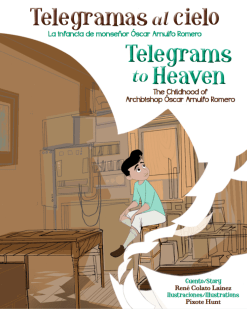
DESCRIPTION OF THE BOOK: Telegrams to Heaven / Telegramas al Cielo recounts the moving childhood of Archbishop Óscar Arnulfo Romero y Galdámez, who from an early age discovers the candor, light and power of the word, which he uses to pray and to write poetry, sending telegrams to heaven from his heart. René Colato Laínez, the renowned Salvadoran writer, has written a touching story about the great Salvadoran prophet who dreamed from his childhood of being a priest, and became not only a priest, but also a bishop, an archbishop, and the great orator of his country. His word remains, for the Salvadoran people and the world—a prayer, a poem, a sweet telegram that Archbishop Romero continues to send in the name of his people to the heart of heaven. The colorful, modern illustrations of Pixote Hunt make us reflect with deep tenderness, showing us the innocence of the great Archbishop Romero as a young child.

MY TWO CENTS: René Colato Laínez offers a bilingual picture book tribute to the Archbishop Oscar Arnulfo Romero, chronicling the icon’s early spiritual development. The Archbishop, then simply known as Oscar, grew up in Ciudad Barrios, in the San Miguel department of El Salvador. Laínez introduces us to Oscar as he works in his family’s home post office and telegram business. Oscar marvels at the telegraph, which can, “like magic” send messages across long distances. He then begins to wonder if he can also use this technology to communicate with heaven. His father clarifies that messages can be sent to God through prayer, prompting Oscar’s dedication to praying “when he woke up, when he milked the cow, after he finished his homework and to give thanks before every meal.” Oscar’s devotion permeates all aspects of his life. Even his artistic talents, like playing the flute and writing poetry and music, serve as expressions of his spirituality and commitment to God.

The story’s sole source of tension arises when Oscar expresses his desire to become a priest. His father is chagrined, and instead sends his son to work at a carpentry shop as a distraction. The text, however, does not specify why Oscar’s parents were not supportive of his wish to become a priest. His father’s admonition, “there are so many things that you can be in this life,” coupled with details in the text about businesses owned by the Romeros and their ability to hire a private teacher for Oscar, hint at a socioeconomic reason. Laínez may have highlighted the moment to demonstrate Oscar’s staunch and early commitment to the Church, but I wanted more clarity.

Indeed, Oscar is not dissuaded from entering the priesthood. When Bishop Dueñas visits Ciudad Barrios, Oscar uses his carpentry shop earnings to buy a crisp white suit to meet the prelate. This encounter is a watershed moment in Oscar’s life, and thus ends the narrative chronicling his childhood. On the following page, we see Oscar as an adolescent, headed to youth seminary in San Miguel and, as the text indicates, later on to Rome, at the behest of Bishop Dueñas, to complete his studies. The final spread is of Oscar, now ordained as Father Arnulfo Romero, palms facing up in front of the church altar, ready to celebrate mass in front of the Ciudad Barrios community, where his journey began.

The accompanying illustrations by Pixote Hunt mainly mirror the information conveyed in the text, but the images lack the warmth of Laínez’s tone. The digital, abstract style leaves characters appearing flat and expressionless, and fail to depict settings distinctly. Many of the spreads are set against surreal or monochromatic backgrounds, such as the telegram and carpentry shops, which appear almost indistinguishable because of the identical color choices. In the few scenes in which a setting is clear, such as the central plaza or the town’s church, details are limited to straight lines, and the people of the community appear as outlined shapes in a solid color with indistinguishable facial features.  Although the story is about The Archbishop, who came to be loved and respected across the world, he will be forever identified with El Salvador. The abstract visual elements used in the illustrations instead create a distance between the subject and his surroundings, an overall disappointing effect.

Laínez’s admiration and respect for the Archbishop is evident and deeply personal, as he relates in the Author’s Note. No doubt Salvadorans and other Latinxs familiar with the Archbishop will be touched and pleased to see his story in print, particularly for young audiences. This title also serves as a reminder of the hope that lives within the Salvadoran community despite many current and past hardships. However, for audiences completely unfamiliar with the Archbishop, or those looking for a comprehensive biography, the story’s narrow focus and static illustrations will fall short. I was left with many additional questions about Oscar’s childhood, his hometown, and his family. Perhaps other readers will, like me, be encouraged to seek more information elsewhere. I do, however, reserve the hope that this will be the first of many titles for young readers that will chronicle that Archbishop’s life and legacy.

Image result for rene colato lainezABOUT THE AUTHOR: Known as “the teacher full of stories,” René Colato Laínez is the Salvadoran author of several bilingual picture books including I Am René, the Boy/Soy René, el niño (Piñata Books), Waiting for Papá/Esperando a papá (Piñata Books), Playing Lotería/ El juego de la lotería (Luna Rising). I Am René, the Boy received the Latino Book Award for “Best Bilingual Children’s Book.” Playing Lotería was named a “Best Children’s Book” by Críticas magazine and the New Mexico Book Award “Best Children’s Book.” Playing Lotería and I Am René have both been nominated for the Tejas Star Book Award—the K-6 bilingual counterpart to the Texas Bluebonnet Award.

Image result for pixote huntABOUT THE ILLUSTRATOR (From his website): As a director, art director and designer in the film industry I bring more than 10 years experience in animation to every project. Highly skilled in drawing, painting and musical composition, my creative goal is to bring an innovative insight to every project. Always on the cutting edge, my experience in combining animation with live action began in 1994 when I directed and art directed THE PAGEMASTER, and continued as I designed the 3D opening and interstitials for FANTASIA 2000 that seamlessly weaved the animated sequences together. I feel my unique achievements in film and music have garnered me the honors of being a voting member of both the Academy of Motion Picture Arts and Sciences and the GRAMMYs/Recording Academy.

J_AgudeloABOUT THE REVIEWER: Jessica Agudelo is a Children’s Librarian at the New York Public Library. She has served on NYPL’s selection committee for its annual Best Books for Kids list, and is currently a co-chair for the 2018 list. She contributes reviews of English and Spanish language books for School Library Journal and is a proud member of the Association of Library Services to Children and REFORMA (the National Association to Promote Library and Information Services to Latinos and Spanish Speakers). Jessica is Colombian-American and was born and raised in Queens, NY.

Q&A and Cover Reveal with Author-Illustrator Tony Piedra


By Cecilia Cackley

Today, we’re thrilled to introduce you to Tony Piedra, a former film animator who worked on several awesome Pixar movies, including the Oscar-winning Coco! Tony will have his debut picture book released by Arthur A. Levine Books later this year. Before we get to the Q&A, here’s some background information on the author-illustrator:

tony piedraFrom his website: In a previous chapter of my life, I was a Sets Technical Director at Pixar Animation Studios. For nine years, I collaborated with some of the most talented artists and storytellers in the world to help realize the environments in films, such as, UpCars 2The Good DinosaurInside Out, and Coco, as well as several of Pixar’s short films, including The Blue Umbrella. Now, I am taking the skills and experiences from my time working in the film industry and putting them to use as an author and illustrator of children’s books. My debut picture book, The Greatest Adventure, will be released Fall 2018 through Arthur A. Levine Books an Imprint of Scholastic Inc.

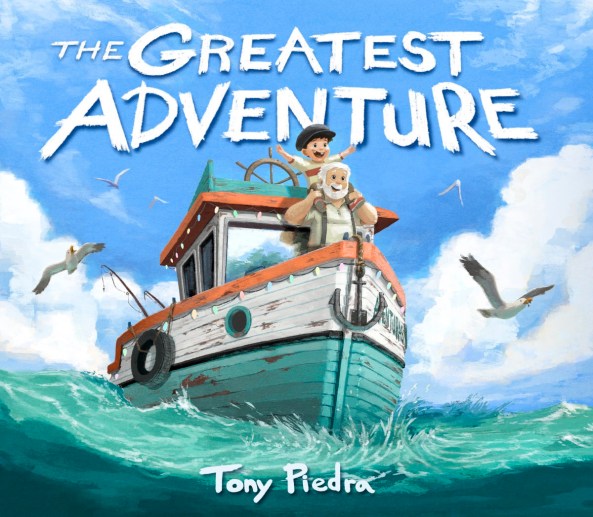
Now, here’s a brief description of The Greatest Adventure:  Eliot imagines sailing wild rivers and discovering giant beasts, right there on his block. But he wishes his adventures were real. Eliot’s grandpa, El Capitán, once steered his own ship through dangerous seas, to far-off lands. But he can’t do that anymore. Can Eliot and El Capitán discover a real adventure… together? Come find out All aboard The Greatest Adventure.

Now….here is the beautiful cover of the book, which releases September 11, 2018.


GREATEST ADVENTURE Cover

ALSO, CLICK ON THE LINK TO GET A GLIMPSE OF THE INSIDE ART: Greatest Adventure


Q. What picture books do you remember from when you were growing up? Are there any stories or artists that were especially meaningful or inspirational for you?

A. In a bright red building I affectionately remember as the “Red Library,” I discovered a book called Album of Sharks, illustrated by Rod Ruth and written by Tom McGowen. This book left such a vivid impression on my mind due to Ruth’s striking full page illustrations, that over 20 years later, when I tried to locate a copy of the book with absolutely no information other than my childhood memories, I was able to do so because I remembered each and every one of Ruth’s illustrations so clearly. I find it funny how at such young age we are intrinsically drawn to certain subjects, and for whatever reason I was then, and still am, drawn to sharks. I love the danger, mystery, and wonder they conjure in my mind, and Ruth’s illustrations captured this in a way that no photo has ever been able to do.  Later I learned that Rod Ruth and Tom McGowen paired up on over a half dozen “Album of” books, each beautifully illustrated, and I imagine, entertainingly written—I wasn’t such a good reader back in those early days.  As an homage to Album of Sharks and more specifically as a small, but deeply felt thank you to Rod Ruth, I inserted a token of admiration for one of Ruth’s most memorable paintings in my debut picture book, The Greatest Adventure.


Q. What are your favorite art materials to work with? How much (if any) of your process is digital?

A. Just give me a pencil and some white computer paper, and I will be distracted working for hours. These have been my default materials since the beginning. I dabble with gouache, acrylics, and oils, but they are not my natural mediums. If I need to do some thinking or planning there’s nothing better than pencil and paper. I followed that same practice on The Greatest Adventure. Throughout the planning and dummy stage of this book I solved compositions and decided on scene staging with these simple materials and time. All the heavy lifting happens at this humble stage. When I’m finally satisfied with a composition and ready to do a final illustration, I scan in the sketches and begin the meticulous process of painting them digitally in Photoshop.  My final paintings are 95% digital with subtle touches of texture scanned in from traditional media.

Q. You’ve come to picture books from animation (congratulations on Coco’s many wins!). How is the artistic process for the two kinds of storytelling similar or different? Are there any secrets about Coco (or Pixar in general) you can share with us?

A. Thank you for the congratulations. Coco represents the final year and a half of my career at Pixar, and I’m very proud of the film, and the work I helped bring to the screen, namely the cemetery in Miguel’s hometown of Santa Cecilia.

Fundamentally, the process of creating a picture book and an animated film are very similar in that both mediums require a team of individuals to bring to life a story and world that had never existed before. Where they differ most strikingly is in the number of individuals per team and their level of specialization. Picture book-making, though clearly a team effort, does not require an army of individuals at the creative stage. Much of the work is realized by the author and illustrator in collaboration with the editor, designer and production team. And so, in general terms, the publishing team is smaller and the skillset of each individual on that team fairly broad when compared to the specialization required in producing a computer-generated film. A typical Pixar film employs 250-300 highly-specialized people to collaborate on a singular vision. Just to give you an idea of how specialized the work on these films is, there are specialists known as “groomers,” whose sole responsibility is to create hair, and trust me this is a full-time job, especially, when you’re trying something as innovative as the wild, red locks of Merida in Pixar’s Brave, or you’re styling the hair for an entire town as was required in Coco. Imagine the equivalent in the picture book world, an illustrator who only draws hair!

My area of expertise is called Set Dressing. It is not too different from interior decoration. Think of how interior decorators bring rooms and homes to life with their choices of color and arrangement of decor. There is, however, one key difference: the set dresser’s goal in arranging objects on a film is to reveal aspects of the characters through their environment, which requires a great deal of story specificity. Think of a college dorm room versus the bedroom of someone who is obsessively organized. How would these rooms be arranged differently? What would each room say about its owner’s character? The answers to these questions are provided by set dressing. My work on Coco required the careful arrangement of flowers, candles, and foods on the graves which made up the cemetery in the film. These ofrendas were arranged to show the love and respect family members paid to their deceased relatives on Día de los Muertos. It took me nearly a year and a half to set dress the entire cemetery, and this is but one part of the process required to bring to screen one scene in the film.

Q. What are some books you’re looking forward to from Latinx creators? These can be picture books or chapter books.

I have admired the work of Julia Sardá for many years. Her work is primarily known in Europe, but I think that she is one of the most talented children’s book illustrators out there today. Somebody please bring her to the American children’s book market! I’m also excited to see what comes next from Lorena Alvarez, a Colombian children’s book author and illustrator, whose exciting work I came across last year with the release of Night Lights published by Flying Eye Books.  I also just discovered JOAN PROCTOR, DRAGON DOCTOR: The Woman Who Loved Reptiles written by Patricia Valdez and illustrated by Felicita Sala. The book was recently released and it speaks to me both through Felicita’s beautiful illustrations and the subject’s love of lizards, which I can completely relate to. I can’t wait to get my hands on it!

Q. What do you want your next great adventure to be? Is there anywhere you want to travel to or wonders you’d like to see?

At the beginning of last year, I wondered the same thing: what would be my next adventure? I had just left Pixar to pursue a full-time career in children’s books, and one of my goals outside of finishing up my first book was to find ways to travel the world as an independent artist. For the longest time, I had admired how my best friend’s sister had managed to see so much of Europe and South America with the help of playwright grants. So naturally, I figured somebody for some reason must need an author/illustrator to go to the rainforest! I then stumbled upon an artist-in-residence program called Voices of the Wilderness.  This residency sponsored by the U.S. Forest Service brings artists of all sorts to remote areas of Alaskan wilderness to witness their beauty and share the importance of conserving these wild corners with the American public. I applied for the residency and a few months later found myself standing in the rain on Admiralty Island, a 1,500 square mile rock covered in a swath of temperate rainforest and home to the greatest concentration of coastal brown bears in the world. This was not the adventure I had envisioned; it was grander. And this island and one bear in particular on it have become the centerpiece of my next story for children. Where next?  Who knows!


Cecilia Cackley is a performing artist and children’s bookseller based in Washington, DC, where she creates puppet theater for adults and teaches playwriting and creative drama to children. Her bilingual children’s plays have been produced by GALA Hispanic Theatre and her interests in bilingual education, literacy, and immigrant advocacy all tend to find their way into her theatrical work. You can find more of her work at www.witsendpuppets.com.

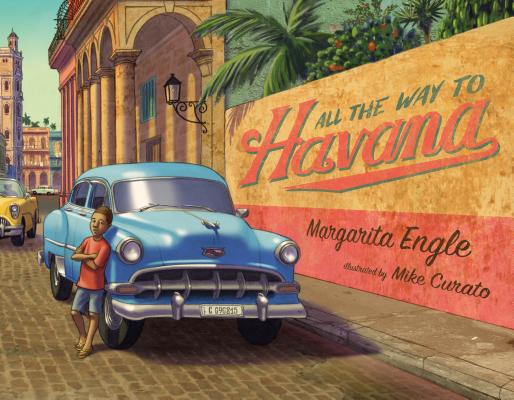
Book Review: All the Way to Havana written by Margarita Engle, illus. by Mike Curato


Reviewed by Cecilia Cackley

DESCRIPTION OF THE BOOK: Together, a boy and his parents drive to the city of Havana, Cuba, in their old family car. Along the way, they experience the sights and sounds of the streets–neighbors talking, musicians performing, and beautiful, colorful cars putt-putting and bumpety-bumping along. In the end, though, it’s their old car, Cara Cara, that the boy loves best.

MY TWO CENTS: I really enjoyed the trip this picture book takes through the Cuban countryside and into the city of Havana. It is easy to identify with the narrator, as he gets squashed in the backseat by all the passengers! Engle makes the question of whether or not the narrator and his father can get the car to work a suspenseful one, but as the journey gets underway, we don’t feel pity for the family for having an old car, but rather excitement for everything they see along the road to Havana. The bright colors of the cars alongside the blue of the sky and ocean make the pictures very attractive and illustrator Mike Curato adds plenty of detail to the vehicles and the scenery in Havana. The figures in the pictures can sometimes look a little flat, but it was nice to see an Afro-Latinx family featured—an unfortunate rarity in a lot of picture books. Both the author and illustrator include notes at the end talking a little about the background of the story and the process of researching the illustrations.

TEACHING TIPS: As might be expected, this is a perfect story time book, especially for kids around ages 2-4 who are usually VERY into cars, trucks, and trains (so much that many bookstores have a separate section just for those books). The sounds the car makes invite call and response with story time or classroom listeners. The way the narrator talks about how Cara-Cara looks compared to all of the other cars might be a good lead in to having students draw their own imaginary car, including what it would look like and what sounds it would make. The context of traveling to a family celebration is also a good discussion point, where children can talk about their own trips to visit relatives and various family celebrations.

WHERE TO GET IT: To find All the Way to Havana, check your local public library, your local bookstore, or IndieBound. Also, check out GoodreadsAmazon, and Barnes & Noble.


Margarita Headshot

ABOUT THE AUTHORMargarita Engle is the national Young People’s Poet Laureate, and the first Latino to receive that honor. She is the Cuban-American author of many verse novels, including The Surrender Tree, a Newbery Honor winner, and The Lightning Dreamer, a PEN USA Award winner. Her verse memoir, Enchanted Air, received the Pura Belpré Award, Golden Kite Award, Walter Dean Myers Honor, and Lee Bennett Hopkins Poetry Award, among others. Drum Dream Girl received the Charlotte Zolotow Award for best picture book text. Her newest verse novel about the island is Forest World, and her newest picture books are All the Way to Havana, and Miguel’s Brave Knight, Young Cervantes and His Dream of Don Quixote.

Books forthcoming in 2018 include The Flying Girl, How Aída de Acosta learned to Soar, and Jazz Owls, a Novel of the Zoot Suit Riots. Margarita was born in Los Angeles, but developed a deep attachment to her mother’s homeland during childhood summers with relatives. She was trained as an agronomist and botanist as well as a poet and novelist. She lives in central California with her husband.


ABOUT THE ILLUSTRATOR: Mike Curato loves drawing and writing almost as much as he loves cupcakes and ice cream (and that’s a LOT!). He is the author and illustrator of everyone’s favorite polka-dotted elephant, Little Elliot. His debut title, Little Elliot, Big City (Henry Holt Books for Young Readers, Macmillan), released in 2014 to critical acclaim, has won several awards, and is being translated into over ten languages. There are now four books in the Little Elliot series: Little Elliot, Big City; Little Elliot, Big FamilyLittle Elliot, Big Fun; and the latest addition, Little Elliot, Fall Friends. Meanwhile, Mike had the pleasure of illustrating Worm Loves Worm by J.J. Austrian, All the Way to Havana by Margarita Engle, and contributed to What’s Your Favorite Color? by Eric Carle and Friends. He is working on several other projects, including What If… by Samantha Berger and his first graphic novel. Publishers Weekly named Mike a “Fall 2014 Flying Start.” In the same year he won the Society of Illustrators Original Art Show Founder’s Award.


ABOUT THE REVIEWER: Cecilia Cackley is a performing artist and children’s bookseller based in Washington, DC, where she creates puppet theater for adults and teaches playwriting and creative drama to children. Her bilingual children’s plays have been produced by GALA Hispanic Theatre and her interests in bilingual education, literacy, and immigrant advocacy all tend to find their way into her theatrical work. You can find more of her work at www.witsendpuppets.com.

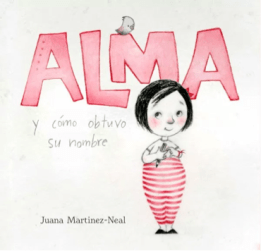
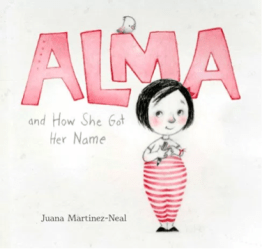
Book Review: Alma and How She Got Her Name/ Alma y come obtuvo su nombre, by Juana Martinez Neal


Coming to a shelf near you on April 10, 2018!

Reviewed by Dora M. Guzmán

PUBLISHER’S DESCRIPTION: If you ask her, Alma Sofia Esperanza José Pura Candela has way too many names: six! How did such a small person wind up with such a large name? Alma turns to Daddy for an answer and learns of Sofia, the grandmother who loved books and flowers; Esperanza, the great-grandmother who longed to travel; José, the grandfather who was an artist; and other namesakes, too. As she hears the story of her name, Alma starts to think it might be a perfect fit after all — and realizes that she will one day have her own story to tell. In her author-illustrator debut, Juana Martinez-Neal opens a treasure box of discovery for children who may be curious about their own origin stories or names.

MY TWO CENTS: What is in a name? A name is a gift given to you at birth and you carry it through all your stages of life. Parents and guardians spend months deciding on their baby’s name, sometimes even long before a baby is in the picture. But what if your name doesn’t fit on your paper because of its length?

In a world where we tend to question our differences, this story does quite the opposite. Growing up in the United States, one tends to have a single first name, maybe a middle name, and just one last name. However, this differs in certain other countries, including in Latin American, where it is not out of the ordinary to have more than one name.

Meet Alma Sofia Esperanza José Pura Candela, the main character of this story. Yes, her name is long. However, wondering about the length is what leads Alma on the journey to discover the story behind her name. Throughout the book, we learn the rich history and origins of each of Alma’s names. Many of her names were inspired by her ancestors and their humble traits and contributions to the world. The people behind her names influence Alma’s passions and character, even as she embraces each person and the love they gave her as a baby. She quickly learns that those same traits are present in her everyday life, and she rightfully claims that name through her affirmation of “I am____”. Alma soon learns that with claiming her name comes a lot of love and culture. She will now be able to contribute those gifts to the world. As Alma declares, “I am Alma, and I have a story to tell.”

This story wonderfully illustrates how to embrace YOU and the name you carry throughout life. In this story, Juana demonstrates that our name is a spotlight on not only our ancestors and the imprints they left on our lives, but also a forever part of us and what we can give to this world.

This picture book illuminates an essential connection to ancestors. Inspired by her own name, Juana reminds readers that our names are not just our own, but a reflection of our culture as well.

I am always amazed at Juana’s illustrations, especially in this picture book. The beauty of the main character connecting to her past is captured in colors and soft shades that will delight the reader’s eye. Juana also brings attention to each name through the addition of colorful accents and font styles. In page after page, the illustrations offer a collective reflection of everything that Alma’s ancestors represent, forming a visual reminder that who we are is a collection of everyone who came before us.

TEACHING TIPS: Teachers of all grade levels can use this picture book to illustrate our Latinx identity. This book is a perfect addition to an identity unit, where readers can delve into their own names and family trees. Teachers can also use this book as a reading mentor text around the main character’s learning process, as well as understanding the author’s message. The Spanish version is authentic to the Spanish language and perfect for bilingual/dual language classroom settings. Alma and How She Got Her Name/Alma y como obtuvo su nombre is a definite must add to all libraries in classrooms and homes!


ABOUT THE AUTHOR-ILLUSTRATOR: Juana Martinez Neal is an award-winning illustrator and artist. Her passion for art started as a child and led her to study at one of the best schools in fine arts in Peru. Her journey as an illustrator led her to the United States, where she continues to illustrate a variety of children’s books. For updates on her art, follow her on Instagram @juanamartinezn. Juana’s official website can be found at http://juanamartinezneal.com/


ABOUT THE REVIEWER: Dora M. Guzmán is a bilingual reading specialist for grades K-5 and also teaches college courses in Children’s Literature and Teaching Beginning Literacy. She is currently a doctoral student with a major in Reading and Language. When she is not sharing her love of reading with her students, you can find her in the nearest library, bookstore, or online, finding more great reads to add to her never ending “to read” pile!