

All art in this article is by Daniel Comacho for Joelito’s Big Decision/La gran decisión de Joelito by Ann Berlak.
By Ann Berlak
To prepare children and young people to participate in the construction of a more just and joyful future, we must tell them stories that make the invisible visible and unsettle what is taken for granted.
“Everything in the mainstream media suggests that popular resistance is ridiculous…unless it is far away, long ago.”
Solnit (2016)
Poverty is increasing worldwide in the face of unimaginable wealth for the very few. Talk of the public good has been almost silenced, public services are rapidly being privatized and the environment degraded, and we have come to take as normal wars without end. Yet, though largely obscured by mainstream media and by schooling at all levels, movements for climate, racial, and economic justice are sweeping the globe.
Given these realities, what stories should we tell young people to prepare them to participate in social transformation?
Stories that reveal:
- how the decisions and actions of each of us affect the lives and actions of others, often in hidden ways
- how differences of power in the hierarchies of race, class, gender, sexual orientation, and disability—differences that may be initially invisible– affect how we and others experience our lives differently (empathy)
- how to connect the dots between everyday injustices and the social forces that create and sustain them—for example, societal dynamics that create the vast extremes of wealth and poverty
- how ordinary people acting together can create a more just and joyful world
- that joining with others to create a more just future is a joyful life option for each of us
 Aren’t children too young to think about social and political issues? Should we interfere with children’s innocence by prematurely exposing them to the darker sides of life?
Which children are we talking about here? Certainly not those children who already experience despair, who go to bed hungry, whose parents can’t find jobs. Acknowledging these realities means acknowledging the experiences of children and young people who are often marginalized in school and in children’s fiction.
When adults are silent about the social, political, and economic dynamics of society, children internalize the perspectives that dominate public discourse and begin to believe, for example, that people get rich because they are smarter or work harder. They learn to blame “the victim,” and to normalize war, violence, and astounding inequalities.
This is disastrous for privileged children as well as for members of groups that are on the downside of the prevailing power imbalances. Both groups drift toward the belief that this is how things have always been and how they must continue to be, and these convictions become quite resistant to change. As the tree is bent, the tree grows.
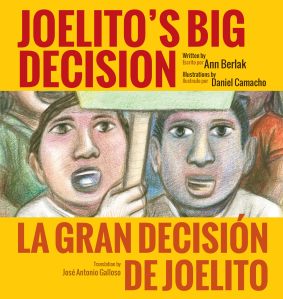 Joelito’s Big Decision/ La gran decisión de Joelito
For thirty years, I taught prospective elementary school teachers. My primary intention was to challenge them to think about what kind of future they wanted to construct through what they taught. What should schooling in their classrooms be for, beyond preparing children to be “college and career ready”?
After I retired, I went back into classrooms as a guest social-justice teacher. This experience reconfirmed my belief that if given any encouragement at all, children and young people will eagerly engage in dialogue about the social, political, and economic issues that surround and shape them.
I also realized that when adults don’t address these issues, children construct their own explanations for what they see around them, and that they weave these from the dominant ideologies of the society. For example, the children I taught had a variety of explanations for how and why some people get rich: They “won the lottery,” “worked hard at school,” “were really smart.” Of course, many also believed the inverse—that people who are poor do not work hard, or are not smart—even when these beliefs conflicted with their own first-hand experiences.
Eventually, I decided to write a storybook for children that would help teachers and parents spark lively conversations like the ones I had as a social-justice teacher, and elicit looks of surprise that conveyed “ah-ha” experiences that are our rewards as teachers. The result is the bilingual, beautifully illustrated and timely Joelito’s Big Decision/ La gran decisión de Joelito. It’s about a boy, a burger, a friendship, and the fight to raise the minimum wage. The book’s illustrator is Daniel Camacho. José Antonio Galloso provided the translation.
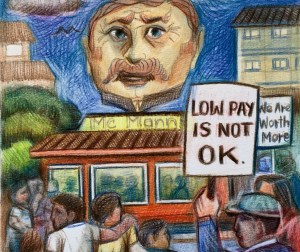 Our book tells the tale of Joelito, who eats dinner at MacMann’s Burger Restaurant with his family every Friday. The story begins one Friday when he finds his best friend Brandon and Brandon’s parents at the restaurant entrance, holding up signs saying, “Low Pay is Not OK,” and “Fight for 15,” and urging the hungry Joelito not to eat at MacMann’s tonight.
Our book explains the sources of income inequality in a way that young children can understand—Brandon’s dad tells Joelito, “I would have to work for 500 years to earn what Mr. MacMann earns in one year” —and shows that people working together are making history today.
Why don’t parents and teachers talk more about economic inequality with children and young people?
The school curriculum is increasingly controlled by the 1%. This control militates against schools teaching children and young people to question the huge discrepancies of wealth and power. Because the structure of our economy offers most people an uncertain economic future, many parents are preoccupied with their children becoming “college and career ready.” Readiness is often reduced to achieving high scores on standardized tests, while preparing children for active citizenship and critical thinking increasingly falls by the wayside.
 Hope
Hope
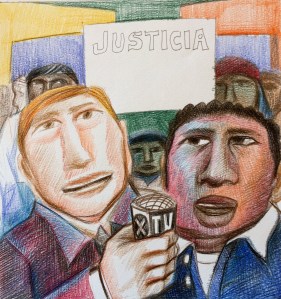
We hope that literary gatekeepers—parents, teachers, caregivers, and librarians— will include among the stories that they share with children depictions of ordinary people working together toward a better future. The bookshelves in our classrooms, libraries, and homes are crowded with the tales of solitary heroes and heroines fighting battles in worlds of fantasy, mystery, and historical fiction. Stories of contemporary people in the trenches for social change belong on those bookshelves, too.
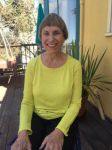 Author Ann Berlak has been a teacher and teacher educator for over fifty years. She envisions schools as places where children learn to become active, caring participants in the creation of a world that works for everyone. Joelito’s Big Decision/La gran decisión de Joelito was selected for the 2016-2017 California Reads list of teacher recommended books. Keep up with current news about Joelito on Facebook.
Illustrator Daniel Camacho lives and works in Oakland, California. His at-home studio is filled with ongoing projects, and is usually open to visitors upon request. He teaches art to elementary and middle school students and works to promote an awareness of Mexican/Latino culture through his participation with the Oakland Museum of California, the Spanish Speaking Unity Council, local public libraries and other community based organizations. Learn more about Daniel from his official website.
Translator José Antonio Galloso was born in Lima, Peru. He is a writer, photographer, and a bilingual teacher with studies in audiovisual communication, Spanish, and writing. He has published poetry and fiction and his works have been included in several anthologies. His photographic work, which he considers an extension of his writing, has been exhibited and published in different galleries, printed media and online. He has been living in the Bay Area since 2002.
 The
The 
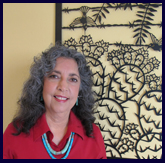 ABOUT THE AUTHOR-ILLUSTRATOR (from her
  Marianne Snow Campbell
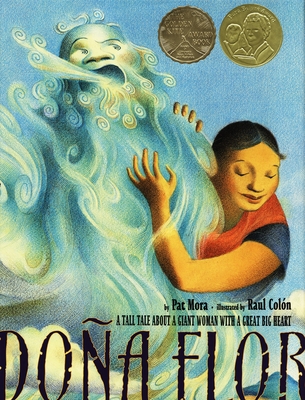 DESCRIPTION FROM THE PUBLISHER: Doña Flor is a giant lady who lives in a tiny village in the American Southwest. Popular with her neighbors, she lets the children use her flowers as trumpets and her leftover tortillas as rafts. Flor loves to read, too, and she can often be found reading aloud to the children.
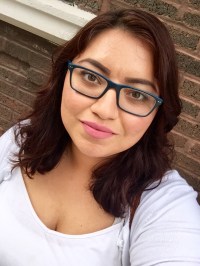 Dr. Sonia Alejandra Rodriguez’s research focuses on the various roles that healing plays in Latinx children’s and young adult literature. She currently teaches composition and literature at a community college in Chicago. She also teaches poetry to 6th graders and drama to 2nd graders as a teaching artist through a local arts organization. She is working on her middle grade book. Follow Sonia on Instagram @latinxkidlit
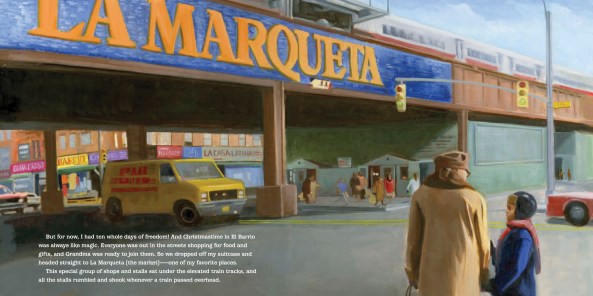
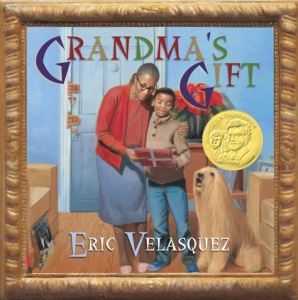 DESCRIPTION FROM THE BOOK JACKET: Every year, Eric spends his winter break with his grandmother in El Barrio while his parents are at work. There’s much to do to prepare for Christmas, including buying all the ingredients for Grandma’s famous pasteles, a special Puerto Rican holiday dish.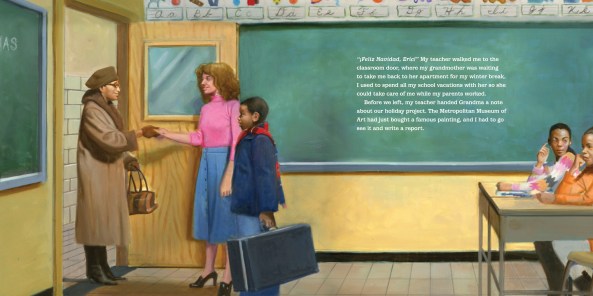
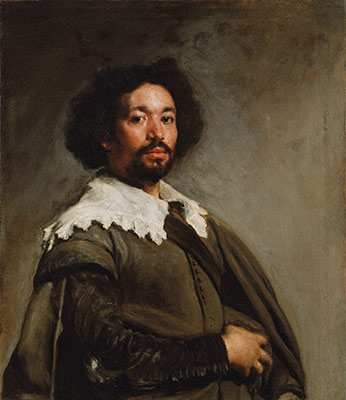
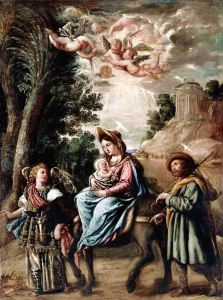
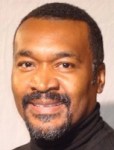 ABOUT THE AUTHOR-ILLUSTRATOR: Eric Velasquez is an Afro-Puerto Rican illustrator born in Spanish Harlem. He attended the High School of Art and Design, the School of Visual Arts, and the famous Art Students League in New York City. As a children’s book illustrator, Velasquez has collaborated with many writers, receiving a nomination for the 1999 NAACP Image Award in Children’s Literature and the 1999 Coretta Scott King/John Steptoe Award for New Talent for The Piano Man. For more information, and to view a gallery of his beautiful book covers, visit
  Lila Quintero Weaver
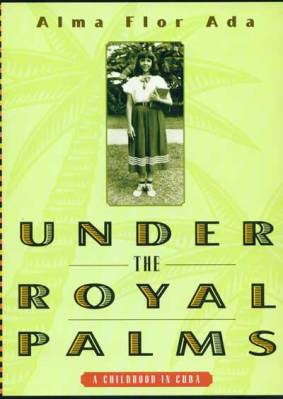 Review by Lila Quintero Weaver
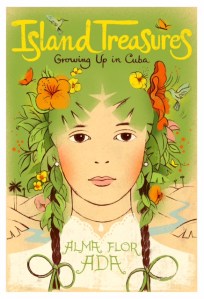 based on the Island Treasures edition.
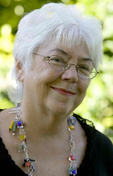 ABOUT THE AUTHOR: Alma Flor Ada is renown for her work as an educator, speaker, poet, and author of many children’s books as well as professional books for educators. In addition to the Pura Belpré Medal, her major awards include the 2012 Virginia Hamilton Award, the Christopher Medal, and the Marta Salotti Gold Medal. One of her great passions is social justice advocacy. Learn more about Alma’s dazzling career in children’s literature at her
 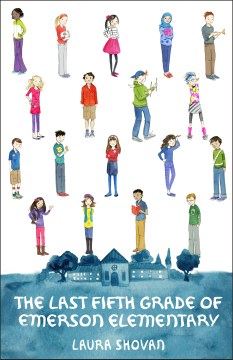 By Laura Shovan and Patricia Bejarano Fisher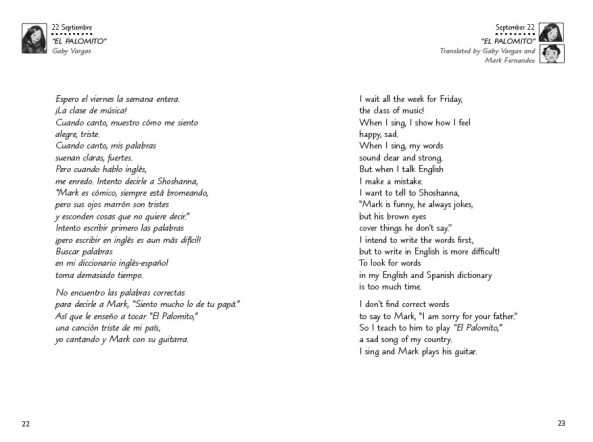
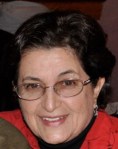 Patricia Bejarano Fisher was born in Bogotá, Colombia. A language and linguistics graduate of the University of Pittsburgh and S.U.N.Y. at Buffalo, she has lived in Columbia, MD for 33 years. She has worked as a Spanish teacher, translator and language-learning materials developer for many years but she now focuses exclusively on poetry translation. Her work includes South Pole/Polo Sur (Settlement House, 2012) and From the Diary of Mme Mao (publisher TBD), both poem collections by Venezuelan poet Maria Teresa Ogliastri, which she co-translated with Yvette Neisser Moreno. She’s an avid reader of Spanish, French, Italian, and Portuguese literatures and of all languages in translation. More poems translated by Pat can be found
 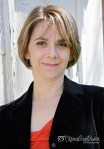 Laura Shovan is former editor of Little Patuxent Review and editor of two poetry anthologies. Her chapbook, Mountain, Log, Salt and Stone, won the inaugural Harriss Poetry Prize. Laura works with children as a poet-in-the-schools and was Howard County Poetry and Literary Society’s 2015-2016 Writer in Residence. The Last Fifth Grade of Emerson Elementary is her debut novel-in-verse for children (Wendy Lamb Books/Random House). Learn more at
  Latinxs in Kid Lit