
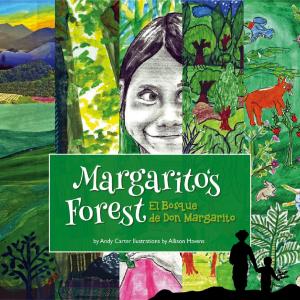
Reviewed by Lila Quintero Weaver
PUBLISHER’S DESCRIPTION: Margarito’s Forest, a bilingual book in English and Spanish with excerpts in K’iche’, is based on the life of Don Margarito Esteban Álvarez Velázquez as told by his daughter, Doña Maria Guadalupe. It is a story of Maya culture and wisdom passed from one generation to the next. As the devastating effects of climate change become clear, Don Margarito’s life and the ways of the Maya offer timely wisdom for a planet in peril.
MY TWO CENTS: Margarito’s Forest/El bosque de don Margarito is a nonfiction account of a Guatemalan man’s extraordinary devotion to the forest he loved. In addition to offering a heroic and memorable story, this picture book also enriches the range of Latinx representation in U.S. children’s literature. The story takes place in the central highlands of Guatemala, among the K’iche’ people and includes phrases in the K’iche’ language. Margarito’s Forest also expands the range of truth-telling by taking on a reality I’ve never seen acknowledged in a children’s book: Guatemala’s dirty war, which brought tremendous suffering to many Guatemalans and was especially devastating for the country’s indigenous peoples. The book makes these contributions while focusing on introducing young readers to the late Margarito Esteban Álvarez Velásquez, an unsung warrior for the environment. This humble man dedicated his life to maintaining the forest near his Guatemalan home as a place of nourishment, beauty, and ancestral significance. Don Margarito often labored alone, saving trees even as many others in the region cleared them for the sake of crop cultivation, and his story offers a powerful example of the impact one person can have even when facing obstacles and indifference.
Based on oral histories shared by Don Margarito’s daughter, María Guadalupe Velásquez Tum, the narrative is set up as a conversation between Doña Guadalupe and her young grandson, Esteban. As Doña Guadalupe makes clear, her deep knowledge of the forest came from Don Margarito, who received it as a boy from the village holy man, Don Calixto. By emphasizing this chain of communication, the text also elevates the importance of transmitting family lore and practical wisdom to younger generations. It also offers valuable opportunities to recognize bodies of knowledge and practice that are often marginalized or belittled in mainstream narratives.
Engaging Difficult Histories
As mentioned, the story also touches on a deeply troubling passage in Guatemala’s recent history. For thirty-six years, beginning in 1960, Guatemalans endured a “dirty war” in which government military forces were deployed against citizens. During this protracted horror, indigenous peoples suffered disproportionate losses at the hands of government soldiers, including deaths now classified as genocide. According to the Commission for Historical Clarification, the Guatemalan government often scapegoated Maya communities, and this was the precise fate suffered by the village where Doña Guadalupe and Don Margarito lived. Tragically, when Guatemalan forces raided their home village, Don Margarito was among those killed.
Doña Guadalupe, who witnessed the raid, describes her harrowing experience to Esteban in honest terms, yet sparing details that might disturb young readers: “While your father was still a baby, the army came and destroyed our village. They burnt our homes down to the ground and they dug up our crops.” She and her two children fled to the forest, where her father’s lessons on edible plants and healing herbs proved critical to their survival. Needless to say, this is an age-appropriate version of the story, but as Doña Guadalupe makes clear, Esteban will learn the rest later: “When you are a little older, I will tell you more about those days and the dirty war that tore us apart.” This approach carefully balances honesty with consideration for the age of readers, offering a compelling example of how to speak truthfully to young audiences about difficult topics.
Words and Images
Margarito’s Forest is also interesting in its layered approach to word and image. Incorporating the translation work of multiple contributors across three languages, the book is a multilingual text. English and Spanish sections appear on the same page along with embedded instances of K’iche’. (Adult readers may know this language by its former spelling, Quiché.) Although the presentation of K’iche’ phrases sometimes feels a bit forced and ungainly, its inclusion is a positive step toward unmaking the assumption that Spanish is “the” language of Central America by foregrounding its linguistic diversity. In fact, K’iche’ remains Guatemala’s second most widely spoken language after Spanish, and it is one of numerous surviving members of the Mayan language family.
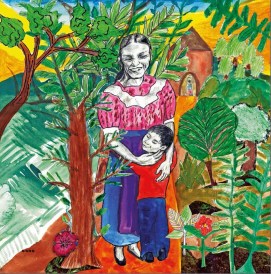
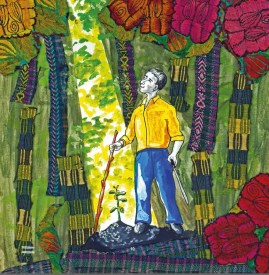
(Images are the work of Allison Havens, used here by permission from Hard Ball Press)
The illustrations in Margarito’s Forest are multimedia collages by Allison Havens, a native of Chicago who now resides in Guatemala. Her original art is central to each collage and often appears as black-and-white graphite figures framed by a patchwork of full-color elements. The collages incorporate photography, scraps of textiles, and drawings made expressly for the book by children from the village of Saq Ja’.
In sum, Margarito’s Forest offers a tender glimpse into the life of a visionary, a courageous individual who followed his heart and acquired immense wisdom without the benefit of a formal education. Although the story makes clear the tragedy of Don Margarito’s death during the dirty war, it also demonstrates the enduring impact of his passionate devotion to the forest. Thanks to his daughter’s account—and to those who took pains to preserve it—his beautiful legacy lives on as the subject of this absorbing picture book.
MORE INFORMATION:
According to the website for Hard Ball Press, Margarito’s Forest received the following distinctions: Most Inspirational Children’s Book by Latino Book Awards, a Commended Title in the 2017 Américas Award from the Consortium of Latin American Studies Programs, and a Best Book of 2017 by the Bank Street College of Education.
The final pages of the book provide study questions for educators, librarians and parents. There is also a generous author’s note, detailing how the story came to his attention, and a section about the illustrator’s collaboration with the schoolchildren of Don Margarito’s village.
For those using this book with older readers, or for parents and educators who would like to be better prepared to answer young students’ questions, it may be important to engage with the role played by the U.S. in training Guatemala’s military, including in the notorious School of the Americas, a U.S.-backed training site that played a pivotal role in violent repression in Latin America. The commission report on the Guatemalan dirty war specifically identifies the U.S. as a source of extreme and abusive military techniques that had “significant bearing on human rights violations during the armed confrontation.”
For further reading on Latinx activists working to save the environment, see this article.
And don’t miss this post by Marianne Snow Campbell about reading kid lit as an ecocritic.
Finally, experience the beauty K’iche’ as spoken by a native speaker.
 Domínguez, María & Juan Pablo Lombana (2014).
 Radnedge, Aidan (2018).
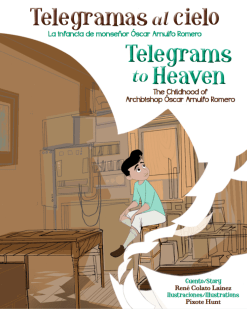 DESCRIPTION OF THE BOOK: Telegrams to Heaven / Telegramas al Cielo recounts the moving childhood of Archbishop Óscar Arnulfo Romero y Galdámez, who from an early age discovers the candor, light and power of the word, which he uses to pray and to write poetry, sending telegrams to heaven from his heart. René Colato Laínez, the renowned Salvadoran writer, has written a touching story about the great Salvadoran prophet who dreamed from his childhood of being a priest, and became not only a priest, but also a bishop, an archbishop, and the great orator of his country. His word remains, for the Salvadoran people and the world—a prayer, a poem, a sweet telegram that Archbishop Romero continues to send in the name of his people to the heart of heaven. The colorful, modern illustrations of Pixote Hunt make us reflect with deep tenderness, showing us the innocence of the great Archbishop Romero as a young child.
 ABOUT THE AUTHOR: Known as “the teacher full of stories,” René Colato Laínez is the Salvadoran author of several bilingual picture books including I Am René, the Boy/Soy René, el niño (Piñata Books), Waiting for Papá/Esperando a papá (Piñata Books), Playing Lotería/ El juego de la lotería (Luna Rising). I Am René, the Boy received the Latino Book Award for “Best Bilingual Children’s Book.” Playing Lotería was named a “Best Children’s Book” by Críticas magazine and the New Mexico Book Award “Best Children’s Book.” Playing Lotería and I Am René have both been nominated for the Tejas Star Book Award—the K-6 bilingual counterpart to the Texas Bluebonnet Award.
 ABOUT THE ILLUSTRATOR (From his
  ABOUT THE REVIEWER: Jessica Agudelo is a Children’s Librarian at the New York Public Library. She has served on NYPL’s selection committee for its annual Best Books for Kids list, and is currently a co-chair for the 2018 list. She contributes reviews of English and Spanish language books for School Library Journal and is a proud member of the Association of Library Services to Children and REFORMA (the National Association to Promote Library and Information Services to Latinos and Spanish Speakers). Jessica is Colombian-American and was born and raised in Queens, NY.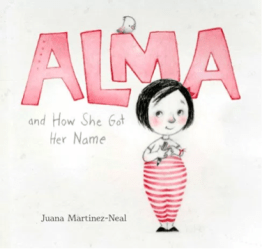
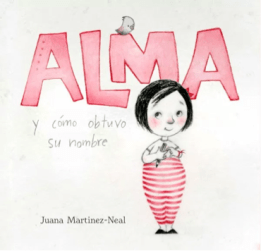
 ABOUT THE AUTHOR-ILLUSTRATOR: Juana Martinez Neal is an award-winning illustrator and artist. Her passion for art started as a child and led her to study at one of the best schools in fine arts in Peru. Her journey as an illustrator led her to the United States, where she continues to illustrate a variety of children’s books. For updates on her art, follow her on Instagram
  ABOUT THE REVIEWER: Dora M. Guzmán is a bilingual reading specialist for grades K-5 and also teaches college courses in Children’s Literature and Teaching Beginning Literacy. She is currently a doctoral student with a major in Reading and Language. When she is not sharing her love of reading with her students, you can find her in the nearest library, bookstore, or online, finding more great reads to add to her never ending “to read” pile!
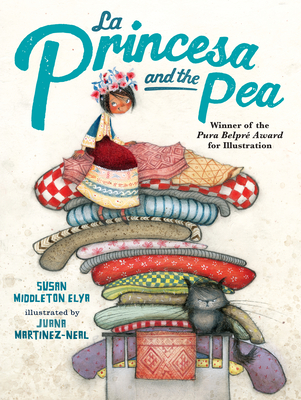 DESCRIPTION OF THE BOOK: The Princess and the Pea gets a fresh twist in this charming bilingual retelling. El principe knows this girl is the one for him, but, as usual, his mother doesn’t agree. The queen has a secret test in mind to see if this girl is really a princesa. But the prince might just have a sneaky plan, too. Readers will be enchanted by this Latino twist on the classic story, and captivated by the vibrant art inspired by the culture of Peru.
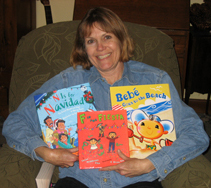 ABOUT THE AUTHOR:
  ABOUT THE ILLUSTRATOR:
  ABOUT THE REVIEWER: Dora M. Guzmán is a bilingual reading specialist for grades K-5 and also teaches college courses in Children’s Literature and Teaching Beginning Literacy. She is currently a doctoral student with a major in Reading and Language. When she is not sharing her love of reading with her students, you can find her in the nearest library, bookstore, or online, finding more great reads to add to her never ending “to read” pile!
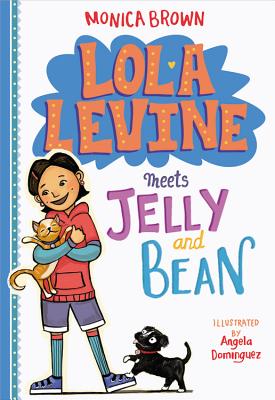 DESCRIPTION OF THE BOOK: The Levines are finally getting a pet–a furry one that is. They are excited about adopting a kitty they name Jelly, but they don’t get very far in the process when Ben starts sneezing. Oh no, he’s allergic! Lola is devastated and sets out to find Jelly a good home. Luckily, Lola is rewarded with a very happy (and still furry) ending. With Lola’s trademark humor, we can expect a few mishaps, many funny moments, and a cute new pet all wrapped in one adorable book.
 ABOUT THE AUTHOR:
  ABOUT THE ILLUSTRATOR:
 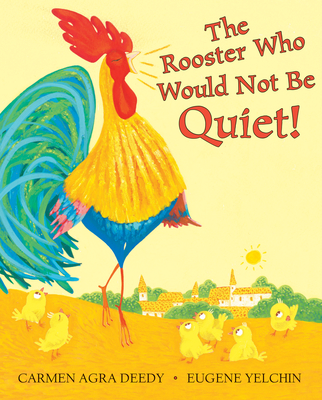 DESCRIPTION OF THE BOOK: La Paz is a happy, but noisy village. A little peace and quiet would make it just right. So the villagers elect the bossy Don Pepe as their mayor. Before long, singing of any kind is outlawed. Even the teakettle is afraid to whistle
 ABOUT THE AUTHOR:
  ABOUT THE ILLUSTRATOR: Russian-born artist Eugene Yelchin graduated from the Leningrad Institute of Theater Arts. During his studies, he designed sets and costumes for dramas, comedies and ballets. He also co-founded a children’s theatre in Siberia. Despite obstacles, Eugene traveled to the United States to share his expertise and talent as an artist. His work has appeared in magazines and newspapers and advertising campaigns, TV commercials, and animated films. His novel
  Latinxs in Kid Lit