Book Review: Salsa: Un poema para cocinar / Salsa: A Cooking Poem by Jorge Argueta


By Marianne Snow

DESCRIPTION (from Goodreads): In this new cooking poem, Jorge Argueta brings us a fun and easy recipe for a yummy salsa. A young boy and his sister gather the ingredients and grind them up in a molcajete, just like their ancestors used to do, singing and dancing all the while. The children imagine that their ingredients are different parts of an orchestra — the tomatoes are bongos and kettledrums, the onion, a maraca, the cloves of garlic, trumpets, and the cilantro, the conductor. They chop and then grind these ingredients in the molcajete, along with red chili peppers for the “hotness” that is so delicious, finally adding a squeeze of lime and a sprinkle of salt. When they are finished, their mother warms tortillas and their father lays out plates, as the whole family, including the cat and dog, dance salsa in mouth-watering anticipation.

Winner of the International Latino Book Award for Guacamole, Jorge Argueta‘s text is complemented by the rich, earthy illustrations of Duncan Tonatiuh, winner of the Pura Belpré Award. His interest in honoring the art of the past in contemporary contexts is evident in these wonderful illustrations, which evoke the pre-Columbian Mixtec codex.

MY TWO CENTS: Here’s another Jorge Argueta picture book that’ll make you hungry! Argueta has created several bilingual poetry books that celebrate traditional Latin American dishes – including Guacamole, Sopa de frijoles / Bean Soup, and Arroz con leche / Rice Pudding – and Salsa is just as mouth-watering. I love how he uses beautiful language to stir the senses, appealing to readers’ taste and smell with scrumptious descriptions of vegetables and herbs; sound by drawing comparisons between ingredients and musical instruments; and touch by weaving together the acts of cooking and dancing.

As a lover of spicy food, I particularly enjoy Argueta’s ode to hot chiles, complete with imagery that clearly evokes the crackly, wrinkled skin and the tingly burn of the peppers. Here’s a little taste:

Hay chiles con cara de abuelo

y chiles con cara de abuela.

Hay chiles rojos

como llamitas.

Al morderlos nos calientan la lengua

como si tuviéramos en la boca una lucecita.


There are chilies with faces like a grandfather

and chilies with faces like a grandmother.

There are red chilies

like little flames.

When we bite one our tongue gets hot,

as if we had a tiny light on in our mouth.


I really wish I had some salsa right now.

Meanwhile, Duncan Tonatiuh’s signature illustration style, which hearkens back to pre-Columbian Mixtec art, captures readers’ sense of sight and beautifully reminds us of Mexico and Central America’s past while celebrating a contemporary family coming together to prepare a meal. Inviting Tonatiuh to illustrate this book is a perfect choice, since his historically inspired images reflect Argueta’s description of the history of the molcajete, the mortar and pestle crafted from volcanic rock that people have long used to grind vegetables and spices. This connection of the past and present through both words and illustrations makes Salsa an especially delicious dish for me.

(My much loved molcajete.)

TEACHING TIPS: This book is an invitation for several meaningful hands-on learning activities. Students and teachers can write up bilingual recipes for salsa using the ingredients Argueta presents in the poem and then make a tasty, healthy snack to eat and share with others at school. If children have family members or friends who have experience using a molcajete to make salsa, teachers can invite these special guests to demonstrate their techniques – a perfect opportunity to welcome students’ home lives and funds of knowledge into the classroom. Afterwards, everyone can write their own food poems utilizing some of the various literary devices – similes, metaphors, rich imagery, synesthesia – that Argueta employs.

Additionally, Salsa is an excellent springboard for a science lesson about composting and plant growth. When the family in the poem finishes making their salsa, the son takes leftover lime seeds and vegetable peels outside and buries them in a hole in the ground:

Las entierro para que se conviertan en abono,

Children can do the same when they finish their own salsa, making hypotheses about what will happen to the seeds and foods scraps and then observing the changes that occur as weeks pass. Will the vegetable matter decompose and turn into soil? Will new plants emerge from the seeds? You’ll have to try it and see!

ABOUT THE AUTHOR (from Salsa’s book jacket): Jorge Argueta is an award-winning author of picture books and poetry for young children. He has won the International Latino Book Award, the Américas Book Award, the NAPPA Gold Award, and the Independent Publisher Book Award for Multicultural Fiction for Juveniles. His books have also been named Américas Award Commended Titles, USBBY Outstanding International Books, Kirkus Reviews Best Children’s Books, and Cooperative Children’s Book Center Choices. A native Salvadoran and Pipil Nahua Indian, Jorge spent much of his life in rural El Salvador. He now lives in San Francisco.

LINKS / OTHER INFO: Here are a couple of fascinating videos that teachers can use to supplement the book:

https://www.youtube.com/watch?v=Za_2VWD4nU4

FOR MORE INFORMATION ABOUT Salsa visit your local library or bookstore. Also, check out WorldCat.orgIndieBound.orgGoodreadsAmazon, and Barnes & Noble.


MarianneMarianne Snow is a doctoral student at the University of Georgia, where she researches Latin@ picture books, representations of Latin@ people in nonfiction children’s texts, and library services for Spanish-speaking children and families. Before moving to Georgia, she taught Pre-K and Kindergarten in her home state of Texas and got her master’s degree in Teaching English to Speakers of Other Languages (TESOL) at Texas A&M University. In her spare time, she enjoys obnoxiously pining for Texas, exploring Georgia, re-learning Spanish, and blogging at Critical Children’s Lit.

Book Review: Talking with Mother Earth / Hablando con Madre Tierra by Jorge Argueta

By Marianne Snow

349744DESCRIPTION OF THE BOOK (from Goodreads): Tetl’s skin is brown, his eyes are black, and his hair is long. He’s different from the other children, whose taunts wound him deeply, leaving him confused and afraid. But Tetl’s grandmother knows the ancient teachings of their Aztec ancestors, and how they viewed the earth as alive with sacred meaning. With her help, he learns to listen to the mountains, wind, corn, and stones. Tetl’s journey from self-doubt to proud acceptance of his Nahuatl heritage is told in a series of powerful poems, beautifully expressed in both English and Spanish. Vivid illustrations celebrate nature’s redemptive powers, offering a perfect complement to the poignant story.

MY TWO CENTS: History books and other nonfiction texts often speak of the Americas’ original inhabitants in the past tense, as if they completely disappeared after Europeans swept across the land. For example, I remember learning that the Spanish defeated and killed (or married) all indigenous people when they invaded Mexico and Central America in the sixteenth century. Wrong. Despite facing frequent marginalization and discrimination by “mainstream” society, Nahua people, the diverse descendants of the Aztecs, still live in El Salvador, Mexico, and the United States today.

Talking with Mother Earth / Hablando con Madre Tierra – a stunning bilingual collection of autobiographical poems and winner of the illustrious International Latino and Américas Book Awards for outstanding works of Latin@ children’s literature – affirms and celebrates the complexity of a contemporary Nahua individual. In these simple yet profound poems, Jorge Tetl Argueta, who identifies as Pipil Nahua, provides us with a window into his childhood and sensitively explores issues of cultural identity from several different angles, including his spiritual beliefs, his connection to Mother Earth, ethnic pride, racial bullying, and history of the Nahua people. As they read his beautiful words, children with Nahua heritage might see reflections of themselves, while readers from other backgrounds can learn about cultural practices and perspectives that are different from their own.

Mirroring Argueta’s poems are Lucía Angela Pérez’s vibrant pastel drawings, simultaneously striking and soft, bold and soothing as they permeate each page. Prepare to be swallowed up in color as soon as you open the cover! Also, the illustrations sustain the theme of links between the present and past as they portray young Tetl standing side by side with his grandmother, his ancestors, and Aztec gods.

Another enticing feature of this book is its relatively unusual dual language format. Although we’re seeing more and more English-Spanish dual language books on the market these days, most of these books place the English text first on the page, above or before the Spanish text. While this positioning might not seem like a big deal, it can send a message to readers that English should be the first language in their lives – that it’s better than Spanish. Books that place Spanish first do pop up every once in awhile, however, and Talking with Mother Earth / Hablando con Madre Tierra is one of them, emphasizing to Spanish-speaking readers the importance of their linguistic skills.

So if you’re searching for a book that promotes empathy, beauty, linguistic diversity, cultural awareness, and positive self-image, look no further! If you enjoy it, be sure to check out Jorge Argueta’s other works for children – they’ll leave you smiling (and probably a little bit hungry).

TEACHING TIPS: Due to multifaceted subject matter in Talking with Mother Earth / Hablando con Madre Tierra, educators can choose to use the entire text or individual poems to start fruitful, critical discussions and lessons with their students. For example, teachers might draw upon “Indio” / “Indian” – an examination of racial bullying – when facilitating analyses of racism and discrimination in schools. Additionally, they might focus on Argueta’s poems on nature and Nahua spirituality to help students understand the diversity of religious beliefs and ethnicities in contemporary Latin America. Or they might highlight this book as a mentor text when encouraging students to write their own nature poetry.

The dual language format of Talking with Mother Earth / Hablando con Madre Tierra also makes it a valuable resource for Spanish and English learners – the abundance of words related to nature can help readers describe the earth bilingually. An added bonus is the inclusion of several Nahuatl words and phrases that illustrate Latin@ / Latin American linguistic diversity even further.

ABOUT THE AUTHOR (from his website): Jorge Tetl Argueta is a celebrated Salvadoran poet and writer whose bilingual children’s books have received numerous awards. His poetry has appeared in anthologies and textbooks. He won the Américas Book Award, among other awards, for his first collection of poems for children, A Movie in my Pillow. He was the Gold Medal Award winner in the 2005 National Parenting Publications Awards (NAPPA) for Moony Luna / Luna, Lunita, Lunera. His other works for children include Xochitl and the Flowers (2003 Américas Award Commended Title), Trees are Hanging from the Sky, Talking with Mother Earth, The Little Hen in the City, and The Fiesta of the Tortillas.

RELATED LINKS:


MarianneMarianne Snow is a doctoral student at the University of Georgia, where she researches Latin@ picture books, representations of Latin@ people in nonfiction children’s texts, and library services for Spanish-speaking children and families. Before moving to Georgia, she taught Pre-K and Kindergarten in her home state of Texas and got her master’s degree in Teaching English to Speakers of Other Languages (TESOL) at Texas A&M University. In her spare time, she enjoys obnoxiously pining for Texas, exploring Georgia, re-learning Spanish, and blogging at Critical Children’s Lit.

A Rich Year for Art-Related Kid Lit with Latino Flair

By Sujei Lugo and Lila Quintero Weaver

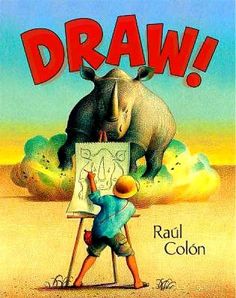
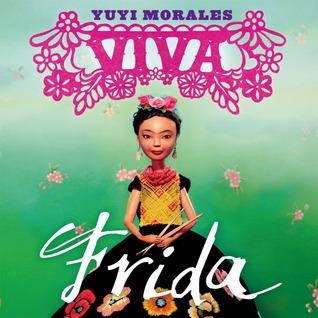
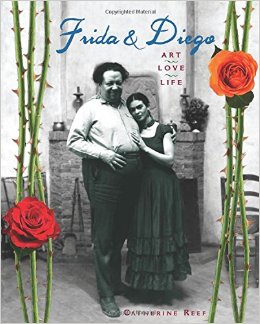
The year 2014 brought us three outstanding Latino children’s books celebrating art. Each book represents a distinct format: Draw! by Raúl Colón, is a wordless picture book; Viva Frida, by Yuyi Morales, is a poetic tribute to a beloved artist of worldwide importance; and Frida & Diego: Art, Love, Life, by Catherine Reef, is a work of non-fiction geared toward upper-level grades. These releases came in a year already brimming with strong Latino titles in children’s publishing, along with the We Need Diverse Books campaign, which challenges publishers and others in the book industry to question their views and roles regarding literature by and about people of color.

And guess what? Latin@s create art, too, so why shouldn’t they be celebrated in art-related books?

Children’s books that extol visual art serve to influence readers in significant ways. Through them, children can learn to appreciate art’s life-enriching power. They can also begin to see themselves as potential creators of art. Up to a certain age, most children freely produce drawings, collages, finger paintings, and other forms of artistic expression. But as kids reach the middle elementary years, inhibition seems to set in. Often, these kids stop making art because they have begun to see themselves as incapable. In fact, many great artists owe their success to a rediscovery of childlike abandon, to a time when the internal critic wasn’t peering over their shoulder. Also, Latin@ children are exposed to fewer artistic role models from within the community. What if good art books transmitted the opposite message–that anyone, from any culture, can create art? Great Latin@ artists already exist and kids need to become familiar with them. The following books make an ideal way to start delivering that message.

Draw!Draw! by Raúl Colón

In this lovely picture book based on Colón’s childhood, readers are transported through a flight of fancy to golden views of the African savanna, where an adventurous drawing session takes place. Initially, we see a boy drawing in his bedroom. His focus is on animals of the African grasslands. Three pages later, the boy is on the ground, somewhere on the African continent, among his subjects, observing them at close range, and capturing their likenesses with deft pencil strokes. Colón achieves this flight of imagination without the aid of words. The paintings in this book display a tender vintage feel in keeping with much of Colón’s acclaimed work in illustration. In every sense, Colón demonstrates a masterful command. His compositions are striking. He nails the anatomy of both human and wild animal subjects, as well as a wide array of studio techniques. These include the use of expressive, swirling textures and a tawny palette of hues, fitting for the story’s era and setting. This gem of a book landed on quite a few “best of” lists for 2014, including:

New York Times Best Illustrated Books of 2014

NPR Best Books of 2014: Children’s Books

Publishers Weekly Best Children’s Books of 2014: Picture Books

School Library Journal Best Books of 2014: Picture Books

School Library Journal’s Top 10 Latino Books of 2014

For extensive views of interior pages, see this article in SLJ.

Viva FridaViva Frida, by Yuyi Morales

Viva Frida is Yuyi Morales’s love letter to Frida Kahlo. The depth of Morales’s admiration for the groundbreaking Mexican surrealist painter comes through in every expertly prepared page spread. Morales incorporates acrylic painting, stop-motion puppetry and other three-dimensional elements into a series of dioramas, photographed by her collaborator, Tim O’Meara. The result is eye-popping. Each spread bursts with jewel-like colors and captivating details, including Mexican textiles, bits of jewelry and animal fur. Clay figures representing Frida, her husband, Diego, and their animal friends are central to each diorama. Readers familiar with Kahlo’s work will recognize iconic elements in the injured fawn, the monkey, Frida’s famous eyebrows, her hand-shaped earrings and much more. A simple and brief poetic text in Spanish and English complements each page’s visual design. Viva Frida is a stunner that understandably caught the attention of important list-makers.

NPR Best Books of 2014: Children’s Books

Publishers Weekly Best Children’s Books of 2014: Picture Books

School Library Journal Best Books of 2014: Picture Books

 School Library Journal’s Top 10 Latino Books of 2014

Center for the Study of Multicultural Children’s Literature: Best Multicultural Books of 2014

For interior views, see the book’s official page.

Frida and DiegoFrida & Diego: Art, Love, Life, by Catherine Reef

Frida & Diego: Art, Love, Life, by Catherine Reef, is a complex and satisfying portrayal of two giants of twentieth-century art and the development of their storied careers. The book relies on primary sources and seldom-seen photographs to describe the individual lives and work of each artist, as well as their combined lives. Reef weaves into this dual biography fascinating views of the political and social history of Mexico. Readers learn about Frida Kahlo’s medical odyssey. A childhood diagnosis of polio left her with an atrophied leg. As a young woman, she also suffered a debilitating accident that resulted in many surgeries and long periods of painful convalescence. Reef includes details of the couple’s complicated and often troubled marital life. These are not gratuitous digressions, however, since Frida’s body of work is in many ways a reflection of her physical and emotional suffering. Diego Rivera’s work as a muralist captures the era of upheaval that he lived in and reveals much about his devotion to socialist causes. The book includes behind-the-scenes stories of murals he painted in U.S. cities, which often became entangled in political controversy and resulted in conflict between Rivera and his patrons.

School Library Journal’s Top 10 Latino Books of 2014

Center for the Study of Multicultural Children’s Literature: Best Multicultural Books of 2014

These three books come from different perspectives, but their approaches overlap as they magnify works of art and what it takes to produce them. In his picture book, Raúl Colón uses imagination to portray the skills of a budding artist. Yuyi Morales’s tribute to Kahlo reflects the inner world of a powerfully emotional artist. Catherine Reef’s biography informs the reader of the complexity and suffering that composed Khalo’s internal make-up and that of her marital partner.

TEACHING TIPS

Draw! by Raúl Colón

Picture book, K-4

This picture book can be integrated into art and language-arts curricula. Teachers and librarians can use this book to encourage children to compose or tell their own illustrated stories. Art teachers will find a useful example of sound artistic practice in how Colón closely observes his subjects.

Viva Frida by Yuyi Morales

Picture book, K-3

Bilingual and ESL instructors can incorporate this book into their classroom to teach new vocabulary in English and Spanish. The text is brief and focuses on verbs. Teachers of language arts can employ the book’s model of short poetic sentences to suggest a story. In the art classroom, Viva Frida can inspire the creation of dioramas, costumed puppets and other three-dimensional works.

Frida & Diego: Art, Love, Life by Catherine Reef

Non-fiction, grades 9-12

This book holds rich possibilities as a classroom text for Mexican American studies, art history, and social studies. One of the key lessons is the importance in an artist’s life of historical context. Students of social studies can create a timeline of historical events, paralleled by notable developments in Frida’s and Diego’s life. The book includes a brief selection of reproductions for each artist and a list of resources for further study, which teachers can use as a basis for assignments. Art history classes may want to explore the work of other muralists and female painters of the twentieth century or of Mexican artists throughout the ages.

For further information on the creators, see the following:

An interview with Raul Colon at Illustration Friday

An interview with Catherine Reef at Teenreads

And please don’t miss this spectacular video featuring Yuyi Morales demonstrating the creation of Viva Frida!

Scholastic Highlights Books that Celebrate The Day of the Dead! / ¡El Dia de los Muertos!

By Concetta Gleason and Roany Molina
of the Editorial and Creative teams for Club Leo

While Hispanic Heritage Month has come to an end, it’s now time for the Day of the Dead! / ¡El Dia de los Muertos!, a significant holiday in Latin America, but most primarily celebrated in Mexico. The holiday is gaining popularity in North America and takes place over two days (November 1 and 2). It is seen as a time when the veils between the worlds of the living and dead diminish as families and friends celebrate their memories of the dearly departed.

Below are some books that explore this holiday’s unique traditions and beliefs: 

El Libro de la Vida (The Book of Life Movie Novelization) and La Travesía del Héroe (A Hero’s Journey) are fun new twists  on El Dia de los Muertos that help children learn about and celebrate the holiday. Both books are based on the upcoming movie The Book of Life, which follows the adventures of the fearless Manolo. The movie is set during the two-day celebration for the Day of the Dead. The holiday is a time to not only honor those who have passed but also appreciate the importance of life. Many people believe that during this celebration their loved ones return to visit. Families even set out offerings such as food, flowers, and games that the dead enjoyed when they were living. The Book of Life novelization and picture book allow readers to get a better understanding of the culture and tradition in an entertaining way. These books are also available in English.


La difunta Familia Díaz (The Dead Family Díaz) is a playful and humorous tale that explores the friendship of two young boys—
one living and one dead—that  changes both their (un)dead lives…and leads to some great pranks on their older siblings! The illustrations are bold and beautiful representations of ancient traditions merging with the modern, living world. La difunta Familia Díaz (The Dead Family Díaz) is also available in the Colección Herencia Hispana / Hispanic Heritage Collection.


El festival de las calaveras / The Festival of Bones expresses the joy and enthusiasm of this holiday. Gorgeous graphic illustrations of the skeletons actually dancing highlight the bilingual text, and the book includes a history of the holiday and fun activities for children.


Usborne: Motivos mexicanos para colorear (Usborne: Mexican Patterns to Color) is an activity book that explores the rich artistic history of Mexican culture with fun facts and appealing figurines to color. Special attention is paid to the Day of the Dead’s sugar skulls and costumes.


You can find all of these books online now!

Club Leo en Español supports your classroom with fun and affordable books that connect children’s home language and learning. Our books include amazing series, original titles, and winners of the Pura Belpré Award, which celebrates the remarkable contributions of artists who give voice to the Latino community through children’s literature.

Club Leo en Español apoya tu salón de clases con libros divertidos y asequibles que conectan la lengua materna y el aprendizaje de los niños. Nuestra colección incluye increíbles series, títulos originales y ganadores del Premio Pura Belpré, que celebra los extraordinarios aportes de artistas que dan voz a la comunidad latina a través de la literatura infantil.

Enhancing Children’s ABCs and Vocabulary Through 9 Alphabet Books

By Sujei Lugo

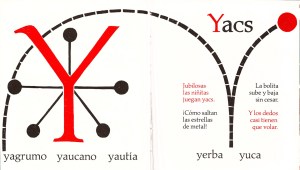
ABC… We must not forget how important the introduction of the alphabet is to children, from the shape and name of each letter, to their different sounds and functions in the construction of words. The alphabet is one of the first things you see on a classroom wall during thoY para Yacs (ABC de Puerto Rico)se early years of our school life, usually above the chalkboard. The alphabet comes in different sizes, is printed on flash cards, banners, pop-up books, felt books, board books, and even as plastic toys.
The alphabet is so basic that we might think any book can help us teach it to our young ones, but there are some qualities we should be looking for when choosing a good alphabet book. It should present an easily recognizable version of each letter; it should use illustrations and images to increase the understanding of the alphabet; words chosen to represent each letter should enhance children’s vocabulary and literacy skills; and the presentation of the alphabet in the context of a story or theme should contribute to critical thinking and story comprehension. Other issues to keep in mind: If there is a story, is it inclusive and diverse? Is the story easy to comprehend? Is the material suitable for read-alouds or early readers? Are alliteration and rhymes used effectively or are they distracting?

I want to recommend some diverse and useful alphabet books that fulfill the basic needs of this kind of text and give us the opportunity to teach something else. They carry good links between letters and sounds and depict a strong connection between words and images of everyday life and multicultural communities. This list looks at titles that represent Latino or Latin American communities, portray themes relevant to these communities and are written or illustrated by Latinos/as. They are mostly bilingual books (Spanish/English), but I also included English titles that incorporate words in Spanish, and books completely written in Spanish. These books can serve to transmit and recognize our culture, language, and history, as well as our struggles and similarities to other communities. Different communities should see that no matter our differences, the alphabet is something we hold in common. It gives us the power to construct words and to use language as a tool to name, describe, connect, and challenge, and it forms the building blocks of communication.

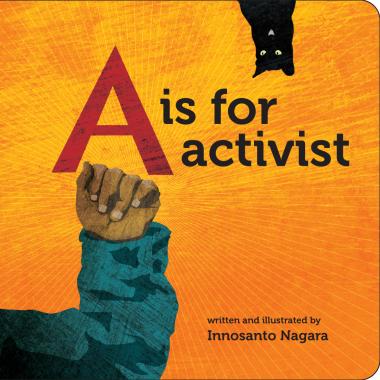
A is for Activist by Innosanto Nagara

A is for Activist

“A is for Activist” to “Z is for Zapatista of course”

This is a vibrant and powerful boardbook that introduces kids to social justice issues. The book includes alliteration, rhymes, and words such as ally, grassroots, indigenous, organize, and youth. Adults should read this book along with children, and provide assistance and context for words that are unfamiliar to them. A highlight in A is for Activist is its imagery of kids from different ethnic and racial backgrounds being active and advocating for their rights and their communities. The book is in English and includes some words in Spanish, but a Spanish edition comes out in October 2014.

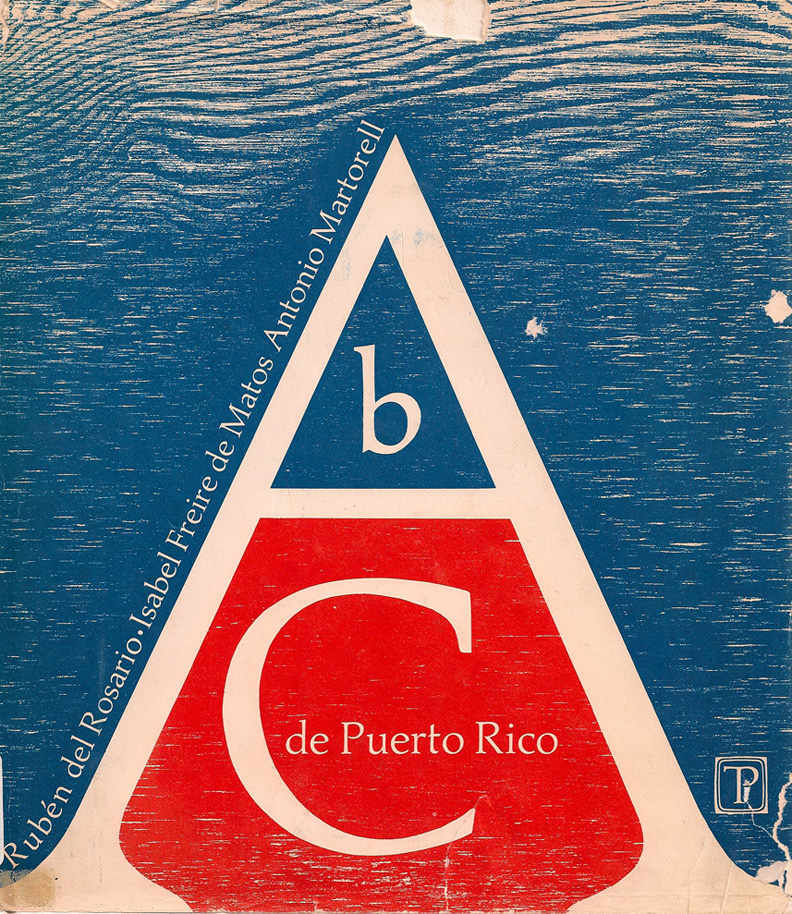
ABC de Puerto Rico by Rubén del Rosario, Isabel Freire de Matos and Antonio Martorell

ABC de Puerto Rico

“Agua, acerola, alcapurria, alelaila, ardilla, atrecho” to “zapatero, zafacón, zigzag, zumbador”

The first published Puerto Rican alphabet book, ABC de Puerto Rico includes Spanish language words and Anglicisms characteristic of Puerto Rican vocabulary and poems celebrating our heritage and culture. Each page is covered with wonderful woodcut illustrations. Children are introduced to words such as alcapurria, boricua, mofongo, ñoco, and vegigante, words that are not traditionally found in alphabet books. This book was banned by the Puerto Rican government in 1968, due to its “anti-American” and “subversive” content and the use of images like the machete and the color red.

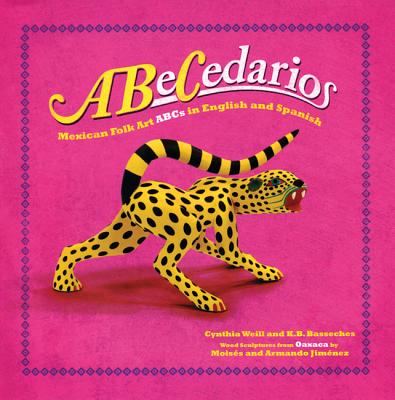
ABeCedarios: Mexican Folk Art ABCs in English and Spanish by Cynthia Weill, K. B. Basseches and Moisés and Armando Jiménez

ABeCedarios

“the Armadillo/el Armadillo” to “the Zedonk/el Zedonk”

This bilingual alphabet book focuses on animal names. Through its minimalistic design, each page includes an animal name that starts with one of the letters of the alphabet. Photographs of colorful wood sculptures accompany each name. The images will inspire children to create their own version of the folk art pieces. The book includes the letters Ch, Ll and Rr, and explains that although they are no longer letters in the Spanish language alphabet, the sounds are still in use.

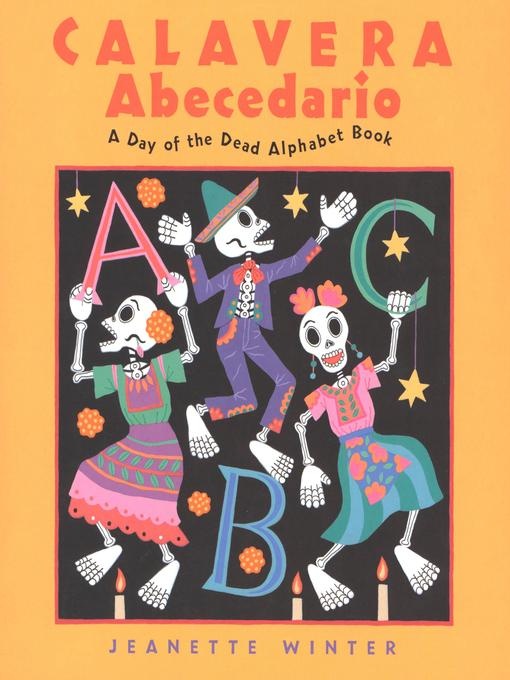
Calavera Abecedario: A Day of the Dead Alphabet Book by Jeanette Winter

Calavera Abecedario

“A – Ángel” to “Z – Zapatero”

It starts off like a regular picture book, with a story (in English) about a Mexican family and how they are preparing to celebrate Día de los Muertos. Then the book shifts to a traditional alphabet book format, which illustrates each letter with a Spanish language word and an image of a skeleton. Each skeleton resembles a character such as a bruja or unicornio, or occupations such as doctor, ilustradora, químico, and xilofonista. The illustrations are wonderful and vibrant in color, resulting in pages that resemble trading cards or lotería cards.

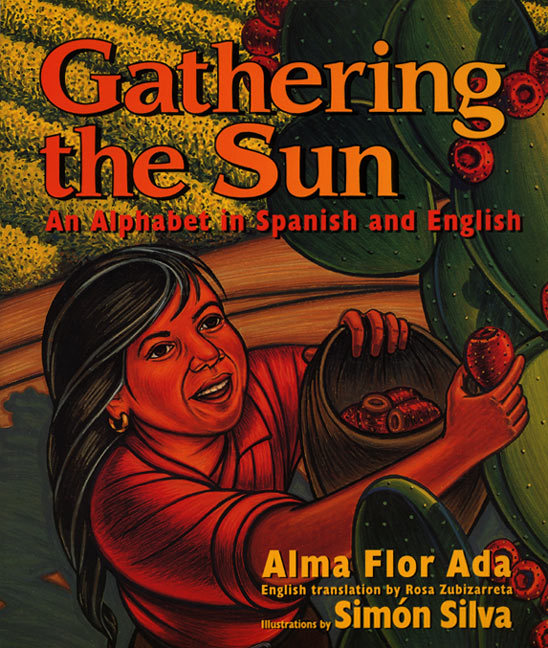
Gathering the Sun: An Alphabet in Spanish and English by Alma Flor Ada and Simón Silva (English translation by Rosa Zubizarreta)

Gathering the Sun

“Árboles” to “Zanahoria”

A 1998 Pura Belpré Illustrator Honor book, Gathering the Sun is an alphabet book that tells a story–the story of migrant workers. While introducing children to the letters of the alphabet, the book talks about ancestors and the pride and honor of cultural heritage. Each word includes a poem in Spanish and an English translation, although the first letter of the translation is not the same as the original Spanish language version. The earthy and rich illustrations are a great complement to the short, rhyming poetry.

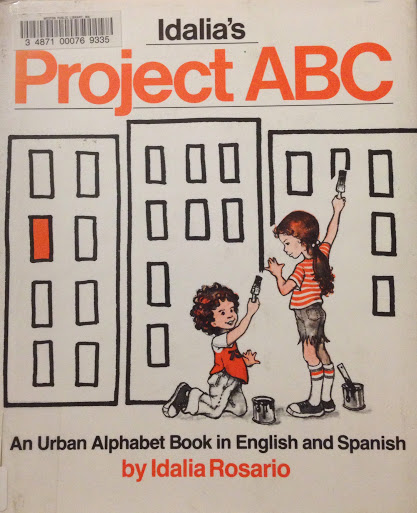
Idalia’s Project ABC: An Urban Alphabet Book in English and Spanish by Idalia Rosario

Idalia's Project ABC

“Aa is for asking. Asking Papo’s mother if he could come out to play” to “Zz is for zoo. Now I’d like to read about the zoo. Me too!”

This bilingual book centers around two friends who uses the alphabet to introduce us to their neighborhood and life in the city. Here is another example of an alphabet book in a context of a story that situates children in active roles in their community. The translation is not literal, and the author uses the opportunity to incorporate colloquial Spanish and anglicisms to reflect the vocabulary used by the characters, as well as issues that affect urban neighborhoods.

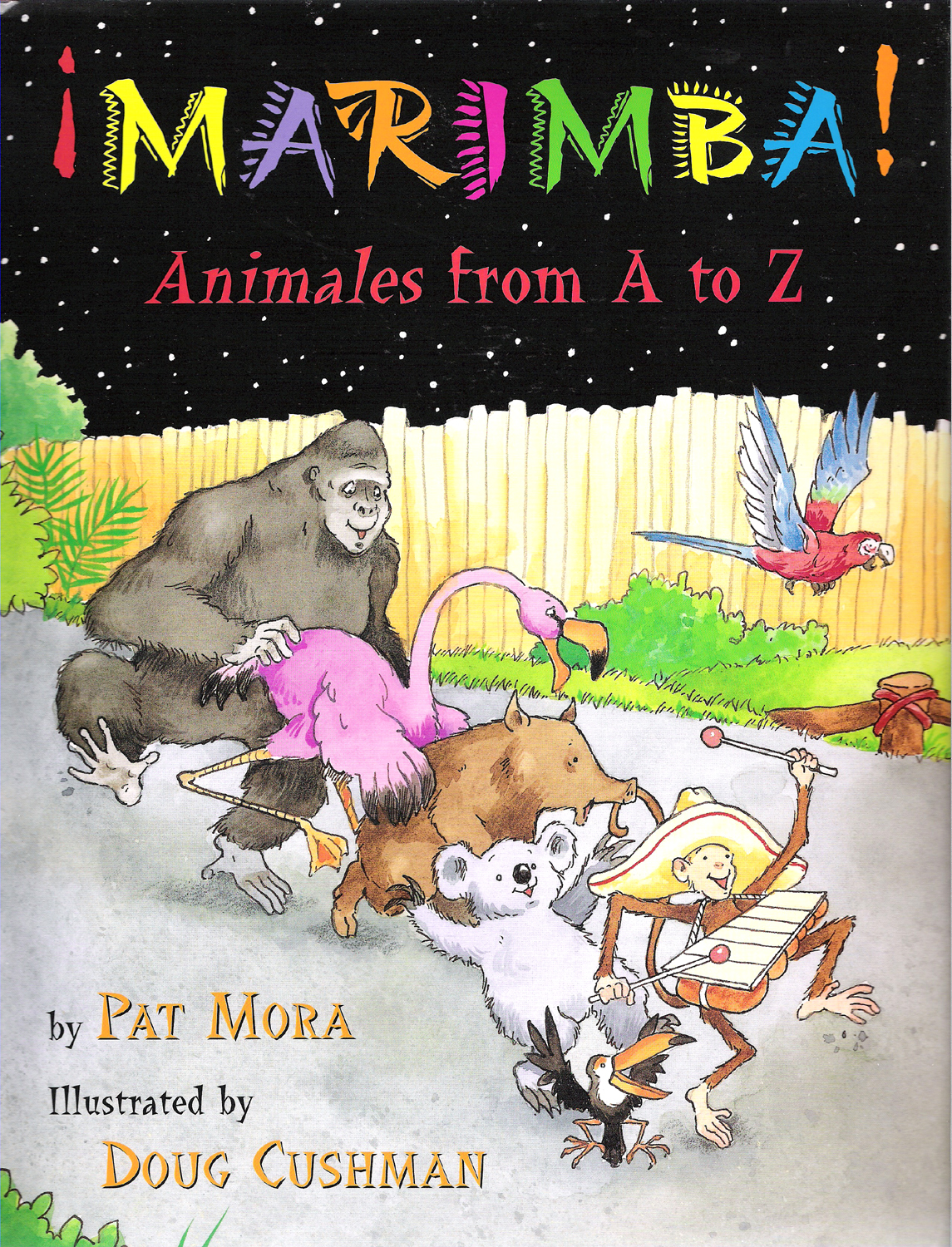
¡Marimba! Animales from A to Z by Pat Mora and Doug Cushman

¡Marimba!

“A Then the ting-tong of the marimba wakes all animales on cue” to “Z zigzagging through zebras and zebúes, zany keepers call, “Yoo-hoooooooo”

This is a playful and colorful alphabet book that sets its story around one night at a zoo. The story is in English and incorporates animal names in Spanish. Through movement and rhythm, the story mentions words related to instruments (marimba), dances (samba, salsa) and food (flan, enchiladas) of Latin American and Afro-Caribbean origin. It includes an author’s note and a translation and pronunciation guide at the end of the book.

P is for Piñata: A Mexico Alphabet by Tony Johnston and John Parra

P is for Piñata

“A is for Adobe” to “Z is for zero”

With the support of John Parra’s wonderful and characteristic illustrations, P is for Piñata is an A to Z journey through Mexico’s history. The book introduces the alphabet via short and rich poems with a historical and socio-cultural context. Extra information about the background of the word chosen to represent letters enriches  their meaning. The layout and colorful images bring this alphabet book to life.

Welcome to My Neighborhood! A Barrio ABC by Quiara Alegría Hudes and Shino Arihara

Welcome to my Neighborhood

“A is for abuela. And abandoned car” to “Z street’s loud with zooming cars.”

This one feels like an updated version of Idalia’s Project ABC alphabet book (it was published in 1981), since we have two friends who are also introducing us to the alphabet while walking around their neighborhood. Children will not only learn new words, but also more about life in a big city, including the sense of community. The book is written in English and incorporates some words in Spanish such as abuela, jíbaros and muralistas. One of the sentences that caught my attention was: “S for all the Spanish words I somehow still forget!”, an issue that some second and third generation Latino/as and Chicano/as will relate to.

ADDENDUM:

Just as I was finishing this list a new and notable alphabet book was announced. I didn’t include it officially on the list because I haven’t had the opportunity to read it. The book comes out in April 2015. It’s called Rad American Women A-Z by Kate Schatz and Miriam Klein Stahl, and it focuses on important women across U.S. America who have contributed to politics, science, activism and popular culture. Preview: D is for Dolores Huerta. Really looking forward to this children’s book!