
Reviewed by Dora M. Guzmán
The following books are amazing additions to your early concepts library! Each book introduces readers to shapes and letters by inviting them to explore diverse tastes and sights around the world.
 DESCRIPTION OF THE BOOK: In this delicious forest, the bears are made of rectangular brownies, the goldfinches are triangles of lemon tart, and the butterflies are oval jelly beans. What child could resist learning shapes from such delectable creatures as these? Collage artist Juana Medina has outdone herself with this array of tooth-achingly sweet animal desserts that come in all shapes and sizes.
MY TWO CENTS: This book takes the reader on a short and sweet (literally), path in the forest. It introduces different animals and compares their shape to decadent treats. A diverse group of animals include goldfinches and chipmunks, and sweets include baklava and carmelita. The mixed medium is interesting in this children’s book, and the use of photography in illustrating the sweets gives you an immediate sweet craving! There are also a variety of shapes that extend beyond your typical shapes like the parallelogram, oval, and crescent.
This book is a great fit for your early childhood readers who like sweets and animals. It introduces shapes in a different, yet playful manner, and it draws your eye to the positioning of treats and the animals’ silhouettes. The short and sweet text allows the reader to focus on the concepts of shapes. At the end of the book, the author shares a recipe for chocolate covered strawberries, because why not?! Overall, a great addition to your early concept collection of shape books.
TEACHING TIPS: This concept book pairs well with a five senses unit since you can use the bakery treats as realia after you read the book to your future bakers and chefs. There are other concept books in this series by Juana Medina that reinforce counting and ABCs.

Photo: Silvia Baptiste © 2013
ABOUT THE AUTHOR-ILLUSTRATOR: Juana Medina may have over-indulged her sweet tooth doing the research for this book! Fortunately, her young twin sons keep her active at their home in Washington, D.C. A native of Colombia, Juana is the author-illustrator of 1 Big Salad, ABC Pasta, and the Pura Belpré winner Juana and Lucas. Please visit her and her work at www.juanamedina.com.


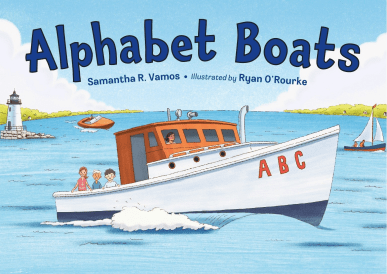 DESCRIPTION OF THE BOOK: Discover twenty-six types of vessels, from the more common–canoe and motorboat–to the unusual–umiak and Q-boat. Just like in Alphabet Trucks and Alphabet Trains, colorful art includes the letters of the alphabet hidden (and not-so-hidden) in supporting roles in the illustrations. The text features familiar as well as unusual boats from around the world, packing in tons of instant kid appeal, and upper and lowercase letters are integrated into the action of the art rather than solely in the typography. Back matter includes age-appropriate facts about each featured boat.
MY TWO CENTS: Come on a rhyming ride through the alphabet on a boat! This is no ordinary trip as you will be immersed in a rich vocabulary of boat life around the world. There are various types of boats and they have various ways of moving through the water. For example, you have the barge, the gondola, and the umiak. The illustrations are crisp and detailed, which allow the reader to search for letters within the background. A must read in the classroom for all future sailors!
This book exceeded my expectations of an ABC book, especially in the use of technical vocabulary of boats and more. I definitely learned a lot about boats and their functional parts. While certain parts may become complex for readers who are not into boats, the text includes short phrases so that readers get small doses and remain engaged in the alphabet. A glossary is included in the back to expand on each boat’s description and use. Overall, this book is a great addition, as it invites readers to a new, and maybe familiar, world especially if they live near a body of water.
TEACHING TIPS: In addition to adding this book to your collection of ABC books, one can incorporate this in their phonemic awareness and writing lessons. After each letter introduction, there is a rhyming scheme that is great for phonemic awareness mini-lessons on rhyming and/or phonics lessons around word families. Readers can also go on a letter hunt as the illustrator has placed various letters across the pages. In writing, teachers can focus on using descriptive words that go beyond describing objects using color and size, like describing boats by their speed or the way they move in the water. Videos of each boat and their function are a wonderful supplement to this read aloud and lessons, as it will bring the boats to life. Easily paired with the rest of the author and illustrator’s books around the alphabet!
 ABOUT THE AUTHOR: Samantha R. Vamos is the author of Alphabet Trains, Alphabet Trucks, and The Cazuela That the Farm Maiden Stirred, a Pura Belpré Illustrator Honor Book. Samantha and her family live in Northern California. Samantha’s favorite boats are the iceboat and the Very Slender Vessel. www.samanthavamos.com
 ABOUT THE ILLUSTRATOR: Ryan R. O’Rourke illustrated Alphabet Trains, Alphabet Trucks, and Eight Days Gone by Linda Reynolds. He both wrote and illustrated Bella Lost and Found. His art has appeared in galleries, newspapers, and magazines. Including a weekly illustration for the Boston Globe Magazine. Ryan lives in New Hampshire. www.ryanorourke.com



ABOUT THE REVIEWER: Dora M. Guzmán is a bilingual reading specialist for grades K-5 and also teaches college courses in Children’s Literature and Teaching Beginning Literacy. She is currently a doctoral student with a major in Reading and Language. When she is not sharing her love of reading with her students, you can find her in the nearest library, bookstore, or online, finding more great reads to add to her never ending “to read” pile!
 The
The  In Los Gatos Black on Halloween, the colors are layered, allowing some characters to be visible through the transparent ghosts and building up as more and more ghostly characters join what eventually becomes the monster ball in an old abandoned house. The color palette is dark and rich, contrasting the glowing moon and night sky with colored tombstones and the interior of the old mansion. Morales plays with scale and perspective to lend an otherworldly look to the spreads; sometimes we only see a pair of legs dangling over a broomstick or the round face of a ghost as its tail extends right off the page.
 The colors in Just a Minute are brighter and the spreads less crowded than Los Gatos Black on Halloween, but the story they tell is just as dynamic. This was Morales’ first project as both author and artist, and she keeps the story moving at a fast pace as Grandma goes from cleaning to cooking, to decorating. Subtle touches of color make Señor Calavera a less scary figure for the youngest readers, including the flowers for eyeballs and the expressive mouth that finally turns into a smile. As befits a heroine who is using action to delay Señor Calavera, Grandma Beetle’s poses are precise and sharp, whether she is placing cheese in a frying pan or leaning over to put pots in the oven. Grandma’s eyes and face express her cleverness and care as she watches Señor Calavera from across the room or gives a wink while chopping up fruit. Perspective shifts reinforce the upside-down nature of this story; the floor of Grandma’s house seems to tilt as we first see Señor Calavera in close-up, peeking over her shoulder and then far away in the corner of the room, stamping his foot in frustration. The little cat’s reactions to Señor Calavera are a humorous touch, and readers will enjoy finding it on each spread, looking curious, tentative or scared, depending on the page. Readers will love the final note left by Señor Calavera and cheer for Grandma Beetle, who was so resourceful in buying herself a little more time on Earth.
 Morales brings more texture and mixed media to the illustrations in Just in Case, her second effort as both author and artist. Perhaps because most of the action in the book takes place in the cemetery, rather than in Grandma’s house, the backgrounds are looser and the characters float around on the page. The new character Zelmiro the ghost blends in with the background color on each spread as he advises Señor Calavera on what to give Grandma Beetle for her birthday. The list of presents grows with the alphabet, and Morales keeps things interesting by not just including objects such as the accordion but also actions such as cosquillas (tickles) and natural phenomena like niebla (fog). One of my favorite things about this book is that it follows the Spanish, rather than the English alphabet, including letters I learned as a child, like ‘Ch’, ‘Ll’ and ‘Ñ’. Depending on where you are in the Spanish-speaking world, ‘ch’ and ‘ll’ aren’t taught as separate letters anymore, so it was nice to see them here! Some of the presents are words commonly taught in Spanish classes, such as ‘escalera’ or ‘semilla,’ but others are more colloquial and region-specific like ‘granizado’ and ‘ombligo.’ The specificity in both language and image are lovely. Careful readers will note that the historieta (comic book) that Señor Calavera gives Grandma is a handmade version of Morales’ earlier book Just a Minute and will also find the reason for the spectacular bicycle crash that ruins all the presents.
 Yuyi Morales
 Cecilia Cackley is a performing artist and children’s bookseller based in Washington DC where she creates puppet theater for adults and teaches playwriting and creative drama to children. Her bilingual children’s plays have been produced by GALA Hispanic Theatre and her interests in bilingual education, literacy, and immigrant advocacy all tend to find their way into her theatrical work. You can find more of her work at
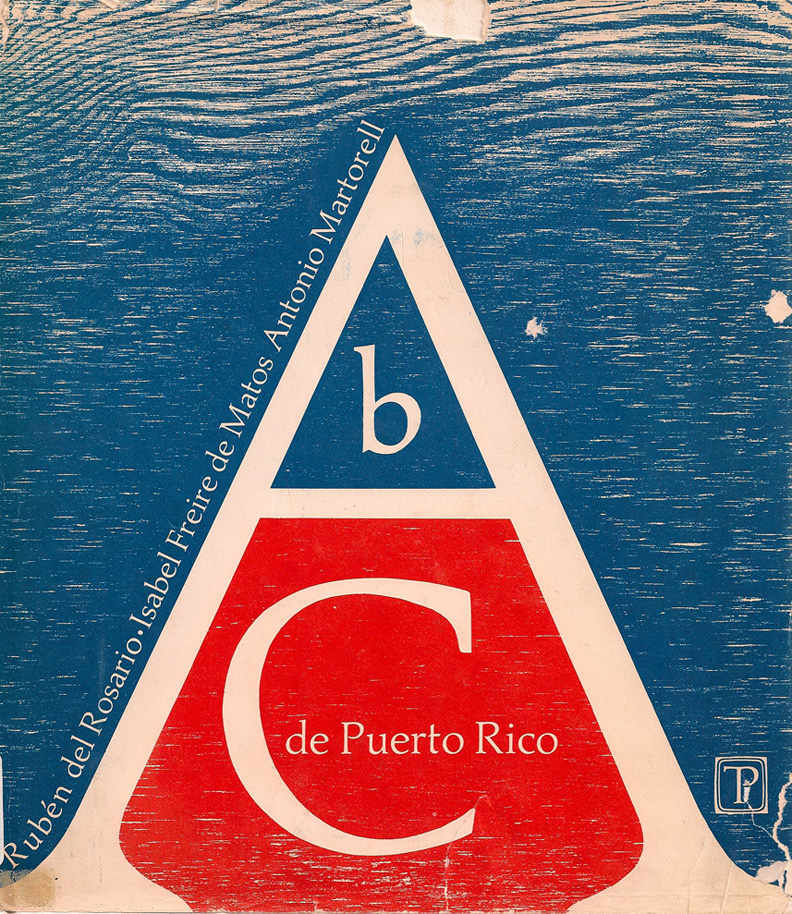
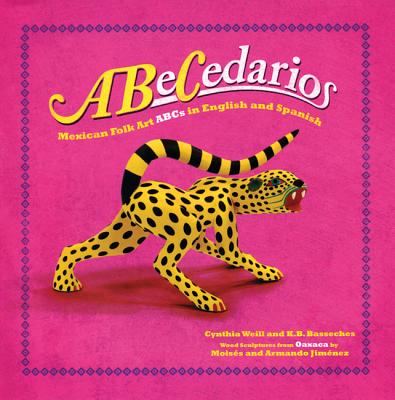
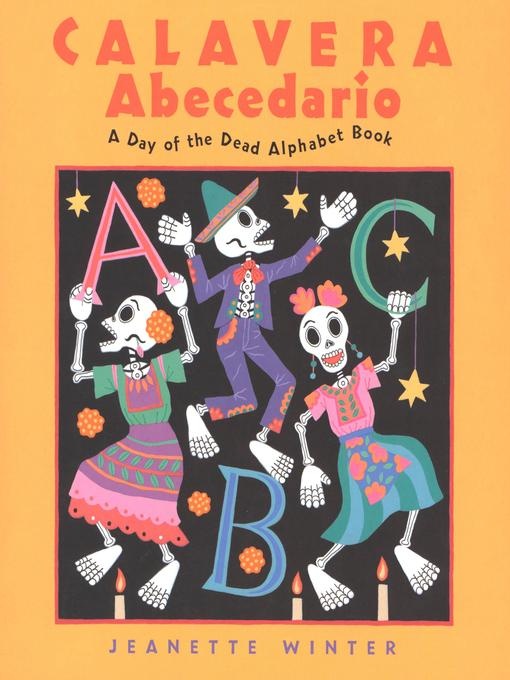
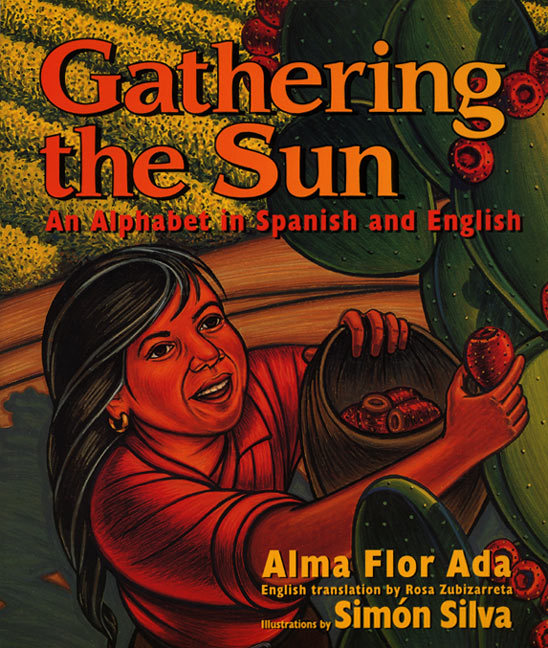
 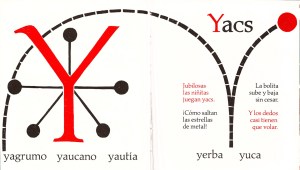 se early years of our school life, usually above the chalkboard. The alphabet comes in different sizes, is printed on flash cards, banners, pop-up books, felt books, board books, and even as plastic toys.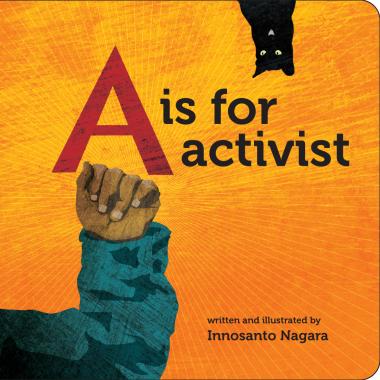


 Latinxs in Kid Lit