
Review by Marcela Peres
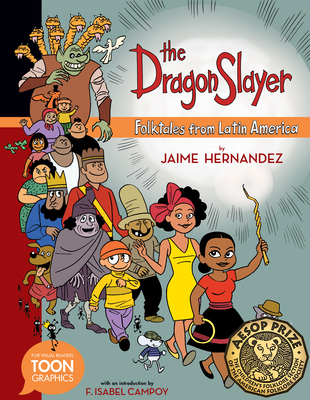 DESCRIPTION OF THE BOOK: How would a kitchen maid fare against a seven-headed dragon? What happens when a woman marries a mouse? And what can a young man learn from a thousand leaf cutter ants? Famed Love and Rockets creator Jaime Hernandez asks these questions and more as he transforms beloved myths into bold, stunning, and utterly contemporary comics. Guided by the classic works of F. Isabel Campoy and Alma Flor Ada, Hernandez’s first book for young readers brings the sights and stories of Latin America to a new generation of graphic novel fans around the world.
MY TWO CENTS: I need to get one thing out of the way early on: when I saw the title of this book, I was excited at the possibility of seeing a myth told from my own native country, Brazil. After all, Latin America is an enormous catchall term covering the nations of Central and South America. But The Dragon Slayer, as a book for children, understandably has limited space and only tells three tales. Also understandably, these tales all originate from Hispanic countries, which comprise the majority—though not the entirety—of Latin America. The book includes a forward by author F. Isabel Campoy, and closes with a Notes, Glossary, & Bibliography section. In all of these, it is acknowledged that Latin America is a widely diverse region, with influences from Native American cultures and all of those that had interacted with its European forbears, the Spaniards. However, the omission of any mention of Portuguese, French, or African influence was a disappointment. This is erasure of a large swatch of Latin American peoples that is altogether common, but always unfortunate. Hispanic and Latinx are not synonymous terms.
The tales themselves are absolutely delightful. We begin with the eponymous The Dragon Slayer, which tells the story of a family’s youngest daughter, exiled from her family and forced to find alternate means to support herself. What follows is a fantastical twist on the “typical” slay-the-dragon-marry-the-princess tale. The hero, the dragon slayer, is a poor young woman, and we watch her vanquish each and every difficulty set before her with a combination of magic, courage, and more than a small amount of cleverness. Hernandez illustrates the story in a simple 6-panel per page format, making the story easy to follow for even the newest graphic novel readers. The cast of characters are simply drawn but easy to differentiate and recognize, and the colors used are very effective in communicating changes in lighting or mood. Young readers are treated to a strong narrative, but will also learn quite a bit of visual literacy from these subtle cues throughout.
The second story, Martina Martinez and Pérez the Mouse, is penned by Alma Flor Ada, from the book Tales Our Abuelitas Told. The end notes explain that this is one version of a popular folktale, giving a nod to oral storytelling tradition in explaining that the story’s details can vary widely. This telling involves the marriage of human Martina and her mouse husband Pérez, who one day suffers a tragic accident. Various themes are featured, from the rallying of community support and grief, to the wisdom and practicality of elders. As in the first tale, the hero of the tale is a woman—the only one who knows how to save Pérez. Though this version has a happy ending and there is quite a bit of silliness to charm any child, the end notes do discuss sadder endings and the role of this tale in a traditional velorio, or wake.
The final tale, Tup and the Ants, also shares themes with the first two, specifically, the value of cleverness and common sense. The trope of the lazy son (or son-in-law here) is turned on its head as Tup devises a way to pass his fieldwork on to a colony of ants, and emerges the most successful of the family. Along the way, we see that Tup isn’t only exploiting his ant friends; he pays for their efforts and expertise by giving the colony his own daily lunch portion in exchange. The characters, from the family members to the many tiny ants, are drawn in a very expressive style and adds to the overall silliness of the story. Kid readers are sure to delight in Tup’s mischievousness and success in getting out of actually doing his chores.
Overall, The Dragon Slayer: Folktales from Latin America, is a fun collection and a very accessible sampler of Latin American folktales. It succeeds especially at being a graphic novel that can be read at storytime or bedtime, all at once or in parts, and is an easy introduction for even the newest graphic novel readers. My only hope is that, should any continuations of this series be in the works (and I really hope they are!), that more effort is taken to include and explain the wider breadth of Latin American diversity.
TEACHING TIPS:
- Oral Storytelling. The end notes spend time discussing Latin American oral tradition and the tendency of storytellers to adapt stories in their own tellings. Some “once upon a time/habia una vez” story starters are given. Have children retell popular stories using these various starters. Encourage them to change details or embellish the story where they wish.
- Exploring Latin American folktales. Hernandez provides a bibliography of further reading (books and websites), and teachers could make these or others like them available to students to read and explore. Write about common themes or character archetypes. Is there a historical reason for these recurring themes? How have stories been used in day-to-day life (e.g. in velorios)? How do similar stories vary among people of different cultures, native languages, ways of living?
- Adapting stories into visual form. One important way Hernandez makes these old stories come to life is by adapting them into comic form. Ask students to select a folk tale of interest to them and illustrate it. Use The Dragon Slayer’s 6-panel format as a starting guide. Or, select a few folktales for students to draw from, and compare and contrast everyone’s different versions. Allow students to explain why they chose certain visual elements, from character design to which plot points to illustrate.
 ABOUT THE AUTHOR-ILLUSTRATOR: Jaime Hernandez is the co-creator, along with his brothers Gilbert and Mario, of the comic book series Love and Rockets. Since publishing the first issue of Love and Rockets in 1981, Jaime has won an Eisner Award, 12 Harvey Awards, and the Los Angeles Times Book Prize. The New York Times Book Review calls him “one of the most talented artists our polyglot culture has ever produced.” Jaime decided to create The Dragon Slayer, his first book for young readers, because “I thought it would be a nice change of pace from my usual grown-up comics.” He read through tons of folktales to choose these three. What made them stand out? Maybe he saw himself in their characters. Jaime says, “I’m not as brave as the dragon slayer, but I can be as caring. I’m as lazy as Tup without being as resourceful. I am not as vain as Martina, but I can be as foolish.”

 Isabel Campoy (left, Introduction, “Imagination and Tradition”) and Alma Flor Ada (right, Martina Martinez and Pérez the Mouse) are authors of many award-winning children’s books, including Tales Our Abuelitas Told, a collection of Hispanic folktales that includes Martina Martinez and Pérez the Mouse. Alma Flor says, “My favorite moment in the story is when Ratón Pérez is pulled out of the pot of soup!” As scholars devoted to the study of language and literacy, Alma Flor and Isabel love to share Hispanic and Latino culture with young readers. “Folktales are a valuable heritage we have received from the past, and we must treasure them and pass them along,” Isabel says. “If you do not have roots, you will not have fruits.”
 ABOUT THE REVIEWER: Marcela was born in Brazil and moved to the U.S. at the age of three, growing up in South Florida. She is now the Library Director at Lewiston Public Library in Maine. Marcela holds a Master of Library and Information Science degree from the University of Illinois at Urbana-Champaign, where she Concentrated on community informatics and library services to teens. She is a copy editor for NoFlyingNoTights.com, has served on the Will Eisner Graphic Novel Grants for Libraries jury, and speaks about comics in libraries at library conferences and comic conventions. She can be found on Twitter @marcelaphane, and Goodreads .
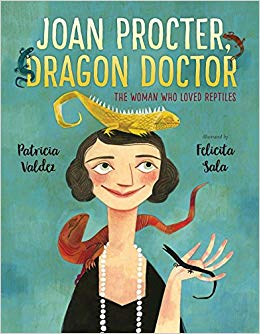 DESCRIPTION OF THE BOOK: Back in the days of long skirts and afternoon teas, young Joan Procter entertained the most unusual party guests: slithery and scaly ones, who turned over teacups and crawled past the crumpets….
 ABOUT THE AUTHOR: Patricia Valdez is a scientist who loves writing for children. She earned her PhD in molecular and cell biology from the University of California, Berkeley, and works at the National Institutes of Health. Originally from Texas, she now lives in the Washington, D.C., area. This is her first picture book. Visit her at
  ABOUT THE ILLUSTRATOR: Felicita Sala is a self-taught artist who studied philosophy at the University of Western Australia. She has worked on several animation projects, but her passion is making picture books. Felicita lives in Rome with her husband and their daughter. Visit her at
  ABOUT THE REVIEWER: Dora M. Guzmán is a bilingual reading specialist for grades K-5 and also teaches college courses in Children’s Literature and Teaching Beginning Literacy. She is currently a doctoral student with a major in Reading and Language. When she is not sharing her love of reading with her students, you can find her in the nearest library, bookstore, or online, finding more great reads to add to her never ending “to read” pile!
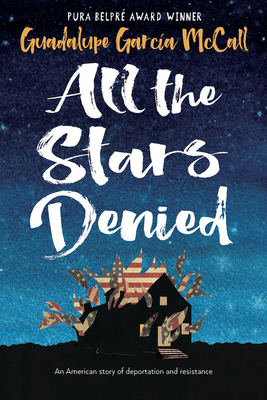 DESCRIPTION OF THE BOOK (from

 ABOUT THE AUTHOR (from
  ABOUT THE REVIEWER: Katrina Ortega (M.L.I.S.) is the Young Adult Librarian at the Hamilton Grange Branch of the New York Public Library. Originally from El Paso, Texas, she has lived in New York City for six years. She is a strong advocate of continuing education (in all of its forms) and is very interested in learning new ways that public libraries can provide higher education to all. She is also very interested in working with non-traditional communities in the library, particularly incarcerated and homeless populations. While pursuing her own higher education, she received two Bachelors of Arts degrees (in English and in History), a Masters of Arts in English, and a Masters of Library and Information Sciences. Katrina loves reading most anything, but particularly loves literary fiction, YA novels, and any type of graphic novel or comic. She’s also an Anglophile when it comes to film and TV, and is a sucker for British period pieces. In her free time, if she’s not reading, Katrina loves to walk around New York, looking for good places to eat.


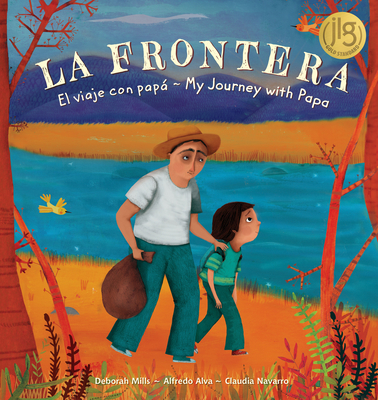 DESCRIPTION OF THE BOOK: Based on a true story! Join a young boy and his father on an arduous journey from Mexico to the United States in the 1980s to find a new life. They’ll need all the courage they can muster to safely cross the border — la frontera — and to make a home for themselves in a new land. Inspired by the childhood immigration experience of co-author Alfredo Alva, this story of perseverance is told in both Spanish and English to empower language-learning. Includes 4 pages of endnotes that unpack facts about Alfredo’s story and other stories like his and borders around the world to help parents and educators talk with children about immigration, resilience, empathy and belonging.
 ABOUT THE REVIEWER: Sanjuana C. Rodriguez is an Assistant Professor of Literacy and Reading Education in the Elementary and Early Childhood Department at Kennesaw State University. Her research interests include the early literacy development of culturally and linguistically diverse students, early writing development, literacy development of students who are emergent bilinguals, and Latinx children’s literature. She has published in journals such as Journal of Language and Literacy Education, Language Arts, and Language Arts Journal of Michigan.
 DESCRIPTION OF THE BOOK: Reeling from the truths uncovered while searching for her sister in Italy, Anastasia Phoenix is ready to call it quits with spies. The only way to stop being a pawn in their game is to remove herself from the board. But before she can leave her parents’ crimes behind her, tragedy strikes. No one is safe, not while Department D still exists.
 ABOUT THE AUTHOR: Diana Rodriguez Wallach is the author of the Anastasia Phoenix Series, three young adult spy thrillers (Entangled Publishing, 2017, ’18, ‘19). The first book in the trilogy, Proof of Lies, was named by Paste Magazine as one of the “Top 10 Best Young Adult Books for March 2017.” Bustle also listed her as one of the “Top Nine Latinx Authors to Read for Women’s History Month 2017.” Additionally, she is the author of three award-winning young adult novels: Amor and Summer Secrets, Amigas and School Scandals, and Adios to All The Drama (Kensington Books); as well as a YA short-story collection entitled Mirror, Mirror (Buzz Books, 2013).
 ABOUT THE REVIEWER: Elena Foulis has a Ph.D. in Comparative Literature and Cultural Studies from the University of Arkansas. Her research and teaching interests include U.S. Latina/o literature, and Digital Oral History. Dr. Foulis is currently working on a digital oral history project about Latin@s in Ohio, which is being archived at the Center for Folklore Studies’ internet collection. Some of these narratives can be found in her iBook titled, Latin@ Stories Across Ohio.
 Latinxs in Kid Lit