Book Review: The Other Half of Happy by Rebecca Balcárcel


On Thursday, we posted a Q&A with debut author Rebecca Balcárcel. Today, Mimi Rankin reviews her novel, The Other Half of Happy.

Review by Mimi Rankin
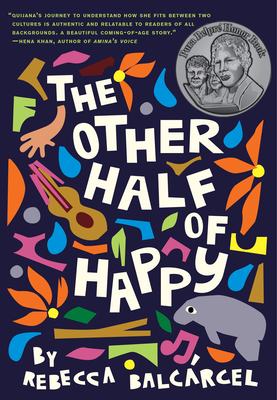
DESCRIPTION OF THE BOOK: Quijana is a girl in pieces. One-half Guatemalan, one-half American: When Quijana’s Guatemalan cousins move to town, her dad seems ashamed that she doesn’t know more about her family’s heritage. One-half crush, one-half buddy: When Quijana meets Zuri and Jayden, she knows she’s found true friends. But she can’t help the growing feelings she has for Jayden. One-half kid, one-half grown-up: Quijana spends her nights Skyping with her ailing grandma and trying to figure out what’s going on with her increasingly hard-to-reach brother. In the course of this immersive and beautifully written novel, Quijana must figure out which parts of herself are most important, and which pieces come together to make her whole. This lyrical debut from Rebecca Balcárcel is a heartfelt poetic portrayal of a girl growing up, fitting in, and learning what it means to belong.

MY TWO CENTS: I was lucky enough to receive an ARC of The Other Half of Happy at TLA from Michaela at Chronicle Books (Thank you!). Although a normal Middle Grade length, I breezed through Quijana’s story without noticing time pass. Quijana is delightfully normal in the best way possible, and yet she still feels wholly developed, along with the other characters throughout the book. By the time I reached the end, I knew these characters as fully realized, multidimensional people in my own life.

My bias as an adult reader of children’s lit is that although I can remember being twelve, I am not reading this as a twelve year old, so I am truly not reading in the perspective of a child. Likewise, I am not a mother, so while I can empathize with Quijana’s mom, I also cannot read accurately through a shared lens of a parent. Still, even with this disclaimer, Balcárcel’s writing allowed me to have both pairs of eyes; to step back into that horribly awkward preteen skin and empathize with the adult woman whose world is crashing around her as she’s spinning ten plates at once.

Quijana’s story is a beautiful yet fairly simple story of a twelve-year-old girl. She has crushes, she is figuring out her passions, and she struggles with certain school subjects. But there are so many layers to Quijana’s story that many middle schoolers may resonate with; layers that they may think no one else could possibly understand. From having a sibling with sensory sensitivities and developmental delays, to losing a loved one for the first time, to one of the most poignant parts of the story for this reviewer, understanding what it means to be a third culture kid, Balcárcel combines the personal with the universal into a story that is likely to be felt deeply by preteens far beyond the Latinx community. Quijana loves her father but feels a barrier of culture in her own home; the culture she is growing up in is not that of her father’s upbringing. Finding her own balance of defining her identity on her own terms is something she will have to decipher on her own, and I find that to be a compelling and inspiring piece of this book.

Another favorite moment was Quijana’s solidarity with other Latinx kids at the bus stop; Quijana’s perspective guesses that they are Mexican. She tries to strike up a conversation with the little Spanish she knows only to be ridiculed by another student at the bus stop who is assumed to be non-Latinx. This moment bonds together the Latinx students at the bus stop, Quijana included, although it’s made clear that they are not all Guatemalan as Quijana is. This brings up a fascinating idea of unity among Latinx communities in the US; there is some bond beyond differing cultures based solely in language and the experience of the immigrant, of coming from somewhere else.

“That’s what it’s really like being twelve. Everything rolling toward you.” -Page 1

Balcárcel effortlessly brings huge conversations about cultural identity and disabled children to a very real and very simple discussion: life as a twelve-year-old girl. When you’re twelve, everything seems monumental, even if it may not seem that way in nostalgic hindsight. Thanks to Rebecca Balcárcel and Chronicle Books for a wonderful read that brought me back to middle school!


ABOUT THE AUTHOR: Rebecca Balcárcel authored THE OTHER HALF OF HAPPY, a middle-grade novel from Chronicle Books . Rebecca took her MFA from Bennington Writing Seminars and received their Jane Kenyon Poetry Prize. Her work has appeared in journals such as Third Coast and North American Review. Pecan Grove Press of St. Mary’s University published her book of poems, Palabras in Each Fist. Find her on YouTube as the Sixminutescholar. She loves popcorn, her kitty, and teaching her students at Tarrant County College as Associate Professor of English.


file-2ABOUT THE REVIEWERMimi Rankin received her Master’s Degree with distinction in Children’s Literature from the University of Reading. Her thesis, on which she received a rating of First, centered around claims to cultural authenticity and representation in Hispanic Children’s Literature. She currently works in the publishing industry as a marketing manager. Her reviews do not reflect the opinions of her employer.


Spotlight on Middle Grade Authors Part 11: Rebecca Balcárcel


We are back from our summer break with lots of great, new interviews, book reviews, and events planned. We start today with a Q&A with middle grade author Rebecca Balcárcel, who is celebrating the recent release of her debut novel The Other Half of Happy.

By Cindy L. Rodriguez

This is the 11th in an occasional series about middle grade Latinx authors. We decided to shine a spotlight on middle grade writers and their novels because, often, they are “stuck in the middle”–sandwiched between and overlooked for picture books and young adult novels. The middle grades are a crucial time in child development socially, emotionally, and academically. The books that speak to these young readers tend to have lots of heart and great voices that capture all that is awkward and brilliant about that time.

Today, we highlight Rebecca Balcárcel.

Rebecca Balcárcel authored THE OTHER HALF OF HAPPY, a middle-grade novel from Chronicle Books . Rebecca took her MFA from Bennington Writing Seminars and received their Jane Kenyon Poetry Prize. Her work has appeared in journals such as Third Coast and North American Review. Pecan Grove Press of St. Mary’s University published her book of poems, Palabras in Each Fist. Find her on YouTube as the Sixminutescholar. She loves popcorn, her kitty, and teaching her students at Tarrant County College as Associate Professor of English.

The Other Half of Happy is her debut middle grade novel.

It was released August 20, 2019!


Here is the publisher’s description:

Quijana is a girl in pieces. One-half Guatemalan, one-half American: When Quijana’s Guatemalan cousins move to town, her dad seems ashamed that she doesn’t know more about her family’s heritage. One-half crush, one-half buddy: When Quijana meets Zuri and Jayden, she knows she’s found true friends. But she can’t help the growing feelings she has for Jayden. One-half kid, one-half grown-up: Quijana spends her nights Skyping with her ailing grandma and trying to figure out what’s going on with her increasingly hard-to-reach brother. In the course of this immersive and beautifully written novel, Quijana must figure out which parts of herself are most important, and which pieces come together to make her whole. This lyrical debut from Rebecca Balcárcel is a heartfelt poetic portrayal of a girl growing up, fitting in, and learning what it means to belong.


Rebecca Balcárcel

Q. Who or what inspired you to become a writer?
A. Storytellers, books, and teachers! My father is an entertaining storyteller, and I absorbed much from his natural sense of drama and comedic timing. He’ll also suddenly quote a poem with misty eyes and point out the beauty of Spanish sounds. All of this gave me a heightened awareness of language’s power. Books served as my dearest friends throughout childhood. From the magic of picture books before bedtime to full novels, I loved being transported to fictional worlds. I always dreamed of creating that experience for others. I still read to apprentice myself to great authors and learn their craft. And a shout out to my third grade teacher, Miss Valentine, who read Where the Red Fern Grows aloud to us chapter by chapter after lunch. I cried in school, but it was worth it! Later teachers encouraged me to write, and their confidence in me helped me take my writing seriously.

Q: Why did you decide to write a middle grade novel?

A: Can you believe that when I started writing, I didn’t know that this book was middle grade, nor that it was a novel?! Trained as a poet, I started writing prose poems in the voice of a bi-cultural twelve-year-old. She had a lot to say, and in one summer, I created about 40 little scenes. I wasn’t sure, though, if this was an adult looking back or a true MG project. It was my agent who said, “I think this would sing as a middle-grade novel.” I decided to go for it! It took two years of revision and rewriting to turn my stack of poems into a novel. It turns out, I love writing middle grade. That age is a time of deepening self-knowledge and broadening world-knowledge, the pivot point between child and adult. So much of who we are emerges in those years. It’s a psychologically rich moment to write about.

Q. What are some of your favorite middle grade novels?

A. So many! The classics, like Charlotte’s Web and Bridge to Terabithia, still make me cry. But I’m thrilled to be reading many new novels of worth. This year, I’ve especially enjoyed Caterpillar Summer by Gillian McDunn, which has a child with autism like my book does, and the just-released For Black Girls Like Me by Mariama Lockington, whose main character straddles two cultures, as mine does. I’ve sought out Latina writers, and have found an amazing community. Las Musas Books (https://www.lasmusasbooks.com/) is an entire collective of new YA and MG novelists! I’ve also loved Me, Frida, and the Secret of the Peacock Ring by Angela Cervantes and Stef Soto, Taco Queen by Jennifer Torres. And let’s not leave out this year’s Newbery winner, Merci Suarez Changes Gears by Meg Medina. Great books!

Q. If you could give your middle-grade self some advice, what would it be?

A. Don’t be embarrassed by what moves you! If a song or an idea touches your heart or blows your mind (in a good way), keep exploring in that direction. That’s the direction in which you will find kindred spirits, true friends, and your own growth. Ignore the people that pooh-pooh your music, your style, or whatever you geek out on. Fly that freak flag and own your joy!

Q. Finish this sentence: Middle grade novels are important because…

A.  . . . they inspire us to be our best selves!


photo by Saryna A. JonesCindy L. Rodriguez was a newspaper reporter for The Hartford Courant and researcher at The Boston Globe before becoming a public school teacher. She is now a reading specialist at a Connecticut middle school. Cindy is a U.S.-born Latina of Puerto Rican and Brazilian descent. She has degrees from UConn and CCSU. Her debut contemporary YA novel, When Reason Breaks (Bloomsbury 2015). She also has an essay in Life Inside My Mind (Simon Pulse 2018). She can be found on FacebookTwitter, and Goodreads.


We’re on Summer Break!


As of today, we are on summer vacation! When we return in September, we’ll celebrate more books by Latinx creators. Through the remaining summer weeks, we’ll keep in touch by tweeting past posts you may have missed, but shouldn’t!

You keep in touch, too. If you would like to contribute a blog post related to our mission, or request a review of a book, please contact us through the form on the blog or by emailing: latinosinkidlit@gmail.com. Note: We regrettably cannot guarantee a review for every book, as you’ll see in our reviewing policy.

So look for new posts in September, and don’t forget to follow us on Twitter or Facebook. Happy summer, everyone!

IMG_2938

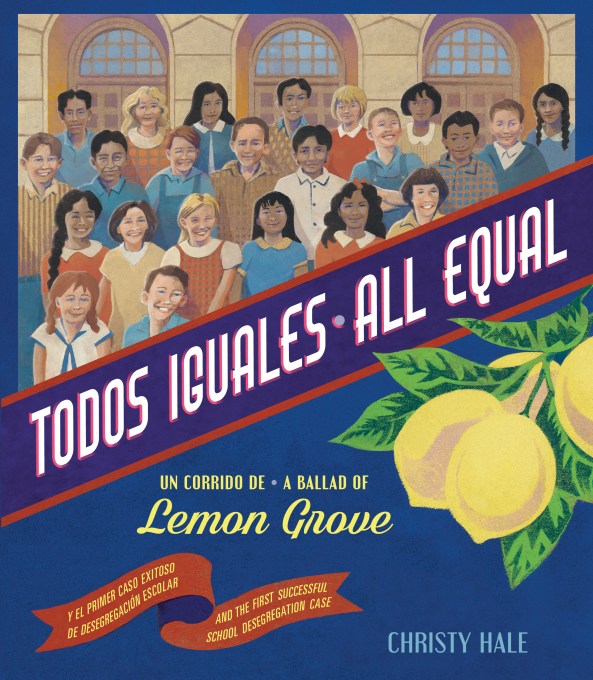
Cover Reveal: Todos Iguales: Un Corrido de Lemon Grove/All Equal: A Ballad of Lemon Grove by Christy Hale

We are delighted to host the cover reveal for Christy Hale’s picture book, Todos Iguales: Un Corrido de Lemon Grove/All Equal: A Ballad of Lemon Grove, which will be published by Lee & Low Books.

Before we reveal the cover, here is some information about the author-illustrator, taken from her website:


Christy HaleAs a young child I resisted the temptation to make marks in books by drawing on a handy little pad of paper. I tore off my “illustrations” and tucked them along side the appropriate writing passage. By age ten I decided to become a writer and illustrator. At this time my best friend and I acted out all the books we loved. A favorite was Harriet the Spy. We dressed up in disguises, lurked around the neighborhood, and took notes of anything interesting we observed. Then we began writing and illustrating our own stories after school.
I have created books as long as I can remember. I studied calligraphy, bookbinding, letterpress and all other means of printing, typography, design, illustration, and desktop publishing.

I received a B.A. in Fine Arts and Masters in Teaching at Lewis & Clark College in Portland, Oregon, then worked as an art educator for several years. I relocated to New York, earned a B.F.A. in illustration at Pratt Institute, then worked in publishing as a designer and art director. I taught at the Center for Book Arts and as an adjunct professor in the Communication Design department at Pratt Institute—all while beginning my illustration career. I’ve illustrated many books for children and now am writing stories as well.

At the end of 2001 I relocated to Northern California with my husband and daughter. I continue to work as a writer, illustrator, designer, art director, and as an educator—offering programs at museums, schools, libraries, and for staff development. I teach an online course in Writing for Picture Books through the illustration department at the Academy of Art University in San Francisco.

Now, here is some information about the book from the publisher:

Twelve-year-old Roberto Álvarez loved school. He, his siblings, and neighbors attended the Lemon Grove School in California along with the Anglo children from nearby homes. The children studied and played together as equals.

In the summer of 1930, the Lemon Grove School Board decided to segregate the Mexican American students. The board claimed the children had a “language handicap” and needed to be “Americanized.” When the Mexican families learned of this plan, they refused to let their children enter the new, inferior school that had been erected. They formed a neighborhood committee and sought legal help. Roberto became the plaintiff in a suit filed by the Mexican families. On March 12, 1931, the case of Roberto Álvarez v. the Board of Trustees of the Lemon Grove School District was decided. The judge ruled in favor of the children’s right to equal education, ordering that Roberto and all the other Mexican American students be immediately reinstated in the Lemon Grove School.

This nonfiction bilingual picture book, written in both English and Spanish, tells the empowering story of The Lemon Grove Incident–a major victory in the battle against school segregation, and a testament to the tenacity of an immigrant community and its fight for equal rights.

Finally, here is the cover of Todos Iguales: Un Corrido de Lemon Grove/All Equal: A Ballad of Lemon Grove:

Start scrolling…

*

*

*

*

*

Keep scrolling…

*

*

*

*

*

Almost there…

*

*

*

*

*

Ta-da!

TODOS IGUALES FC hi res

The book releases August 13, 2019 and is available for pre-order now.


A Conversation with Lauren Castillo, illustrator of Imagine by Juan Felipe Herrera


By Cecilia Cackley

This interview has been condensed and edited for clarity.

Cecilia Cackley: This is your twenty-first picture book! You’ve written three of them yourself, but you’ve also worked with a wide range of collaborators. How do you feel like your process has evolved as an artist?

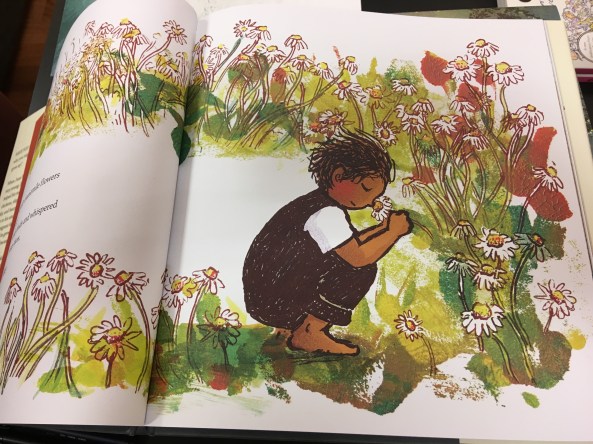
Lauren Castillo: It feels like I’m choosing a different medium for each project, but somehow it ends up looking like the same type of art to others. Imagine for instance, doesn’t look too different from Nana in the City, but to me, I definitely worked in a lot of different ways to make the art. For example, because this book had so many landscapes, I really wanted to embrace that imperfect, texture-y feeling in a more abstract way. I wanted to have a looser style, so I used something that I had been playing around with in workshops with children—printmaking by painting on foam. It’s really fun because you don’t know what you’re going to end up with until you run the print. That’s kind of the beauty of printmaking, that nothing is going to be exact and precise. I think my art, over the years, felt like I was tightening up and it felt a little too crafted. I think it was because my drawing wasn’t as strong at first, so it gave this energetic, free feeling to the work and I liked that. I’ve been trying to figure out ways to trick myself into loosening up. For this book it was helpful to use this type of printmaking for the backgrounds. I would paint on the foam and then flip it over and stamp it on the paper. I work in a much smaller scale so when it’s enlarged it gets even more texture. With each book I need to use different types of materials to keep things interesting.

fullsizeoutput_11c9


CC: Is this your first non-fiction picture book about a living person?

LC: Yes.

CC: How was the research process different than for, say, your book about E.B. White?

LC: It was very different! I did not interact at all with Juan directly. I sent some questions through the publisher Candlewick because it was a poem and it was non-descriptive in terms of the locations and the years and that sort of thing. I had this vision for it so I didn’t want to know too many details but I wanted to gauge the era, the decade and the locations that he was speaking about. I had looked at some photographs of him and most were current so I decided, although I probably could have gotten some childhood photos of him, to do my own version of him and what I imagined he looked like when he was younger. So the character development was done without photo reference. But they gave me some locations to work with so I could get photos from the computer for those. It was a lot freer than working on E.B. White’s life, for example, because that was very descriptive and specific, even down to the animals that were in the barn.

fullsizeoutput_11c8

IMG_8410


CC: Would you say this is the most poetic text you’ve ever worked on?

LC:  Probably. I would definitely call some of the other books I’ve worked on poetic, or poems but this feels most definitely like it was pulled out of a poetry book and it’s gorgeous. The first time I read it I thought “Well, I have to illustrate this!”

CC: Tell us a little about your own Latinx family background.

LC: My dad’s father is Cuban, and my mom’s mom is Puerto Rican.

CC: Is this the first book by another Latinx author that you’ve worked on?

LC: It is, which I was very excited about. I grew up asking a lot of questions about my grandparents’ lives and their parents’ lives, coming to the United States, and it seemed like I was more interested in my background and culture than a lot of my friends. I did a lot of reports as a kid, interviewing my grandparents. I would be curious to see how connected to my art Juan Felipe was, if there was anything that reminded him of his own life or if I took liberties that were very different. It would be interesting to have a conversation about it.

CC:  Do you think that you’ll ever make any work connected with your own family history?

LC:  My Puerto Rican great-grandfather was a musician, and when he moved to New York, his family lived in the Spanish Harlem area. My grandmother told me stories about when she was young and he had a band that would play around different venues in Spanish Harlem. So when I moved to New York for graduate school, we had to do a book project, and I decided I wanted to do a visual journalism project about this really old music store in Spanish Harlem called Casa Latina. I went there and asked them if I could spend a month coming in and out of their store and do drawings, so basically I did this whole visual journalism project that I turned into a book about the people in the store and how they interacted with each other and their customers. I would have conversations with them and take notes, so it was kind of like a diary, but it included drawings from the shop and portraits of people that work there, and I called it Casa Latina. I’ve wanted to turn that into a picture book at some point because when I was going to the store I had it in my mind that although that store wasn’t around then, that’s the same neighborhood that my great-grandfather was spending a lot of time in and playing music in. So I got really invested in that area, and for a while, I’ve been keeping some drafts of stories that I want to do, some ideas to turn that project into a picture book. So yes, I definitely want to do a project that connects to that Puerto Rican background.

CC: What are you working on now?

LC: At the moment I’m working on a very unusual project for me, which is completely imagined, because so far, my three picture books have all come from some sort of life experience, and so I’m working on this early chapter book. It’s about the hedgehog character that I had drawn that kept popping up in my sketchbook, and it’s all animals and one human character, and it’s very much a made up story. And also it’s a long format book, which is a lot of fun since I don’t have a lot experience with that!

IMG_8412


MORE ABOUT LAUREN CASILLO: Lauren studied illustration at the Maryland Institute College of Art and received her MFA from the School of Visual Arts in New York City. She is the author and illustrator of the 2015 Caldecott Honor winning book, Nana in the City, as well as The Troublemaker and Melvin and the Boy. Lauren has also illustrated several critically acclaimed picture books, including Twenty Yawns by Jane Smiley, Yard Sale by Eve Bunting, and City Cat by Kate Banks. She currently draws and dreams in Harrisburg, PA. You can find out more about her at http://www.laurencastillo.com/


cecilia-02-originalCecilia Cackley is a Mexican-American playwright and puppeteer based in Washington, DC. A longtime bookseller, she is currently the Children’s/YA buyer and event coordinator for East City Bookshop on Capitol Hill. Find out more about her art at www.ceciliacackley.com or follow her on Twitter @citymousedc
 

A Studio Visit with Illustrator Zara González Hoang


By Cecilia Cackley

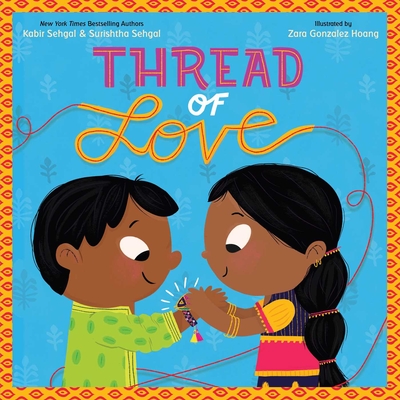
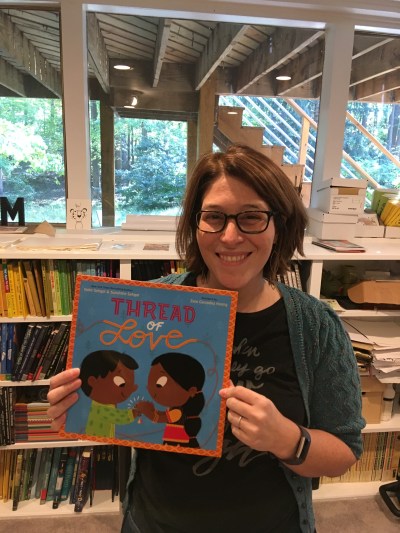
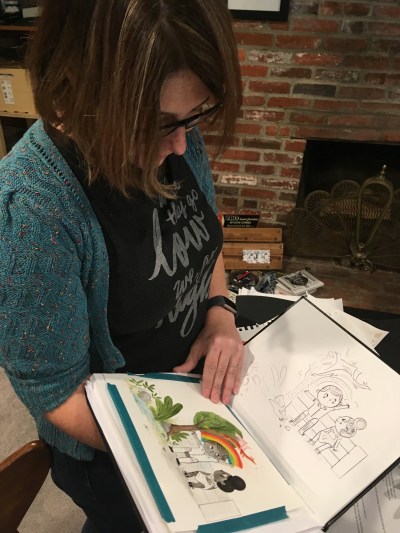
Zara González Hoang is an illustrator who is just beginning her career in children’s literature. She created the art for the picture book Thread of Love by Kabir Sehgal and Surishtha Sehgal and recently sold her book A New Kind of Wild which is inspired by her father’s experience moving from Puerto Rico to the United States as a child. We met at her studio in Falls Church, VA to talk about her journey to becoming an illustrator.

IMG_8475


Cecilia Cackley: Tell me a little about your path to becoming an artist

Zara González Hoang: When I was little my dad was really artistic and he used to draw with us. Some of my favorite memories are of me and my dad just laying on the floor in the porch or something and just drawing horses. My mom was a teacher so we always had paper and pens and I just always drew as a kid. And I think, too, everybody has things in their growing up that are probably not all that fantastically awesome and for me drawing was my escape. I would go hide in my room and draw and make up all these different worlds. I really liked to combine animals into new animals. My favorite was the “horseger”—it was a horse and a tiger which were my two favorite animals.

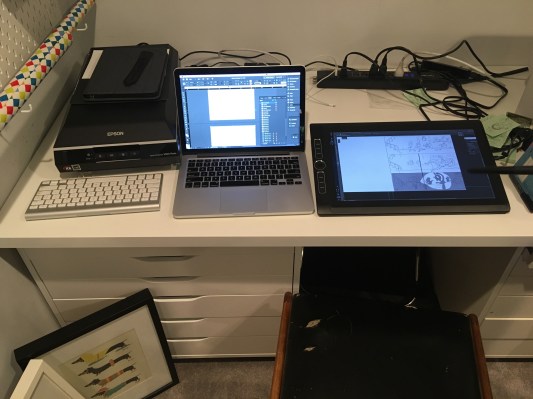
I’ve always been doing art, but I never considered doing it seriously. I went to college and took art classes but I also studied computer science and that was the practical side of me. There’s always been these two parts of me, the very logical side and the creative side. I’ve always been drawn to computers, and I’ve always been drawn to art. I majored in art, but then I worked doing network administration and web design—merging art and computers in a way. I didn’t start seriously drawing until the iPhone came out and I started a company with some friends making apps for kids and I illustrated them.

I never wanted to do kids books, it’s so weird! And it’s because I was afraid. I was afraid that I wouldn’t be able to be consistent, that it was too much work, that I just wasn’t good enough. After I had my son, and I was reading all these picture books, I came back to this place I really loved that I thought I couldn’t have anymore. I always looked at picture books and wanted to buy them, but I always thought, I don’t have any kids, I can’t buy them, which is such a silly thing. There’s no reason why you can’t have these things you want just because you’re not a child. It doesn’t mean they’re any less beautiful or valid. I’ve always been someone who hid that part of me. I always hid my sketchbooks. It was such a personal part of myself that I felt I couldn’t flaunt it.

It wasn’t until I had my son that I felt like I really had permission to do this. I was looking for something to do with more meaning, and I realized–or my sister realized for me–that I have this gift for art and for writing. So I started putting together my portfolio for children’s books, and then I started going to SCBWI conferences, and I realized that everyone there was just like me: super nerdy about books and picture books! My friends talked me into submitting my work to agents, and I got a super awesome agent who I love. When I queried agents, I queried them as an illustrator who wanted to write, and I sent my portfolio but not any writing. The reason I knew she was the right agent for me was that she read my story A New Kind of Wild, and she told me how to make it better, and we spent the next year working on it to get it to a place where we could send it out. I feel like I finally came back to where I was supposed to be.

IMG_8468


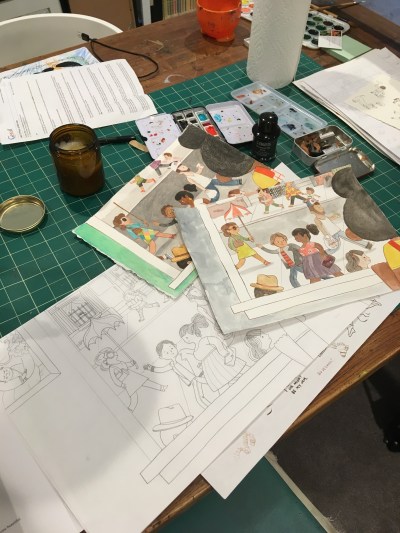
CC: You started out working digitally, but in your studio, you showed me more traditional media like pen, ink, and watercolor. How has that process gone?

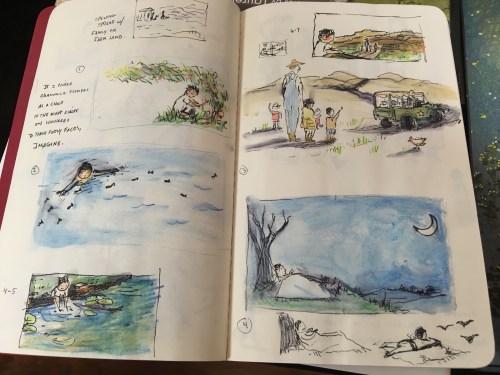
ZGH: When I did Thread of Love, I didn’t think I’d want to do anything the traditional way. I didn’t think I was any good at it. I liked digital, I liked the control of it. So when I got the manuscript of Thread of Love, that was how I was going to do it. I could see the color palette as soon as I read the manuscript. I don’t know if it’s my background in graphic design or what, but I saw the color palette first. It wasn’t until after that project that I started moving into more traditional media. Two things happened. One, I started thinking about the things that I liked and the illustrators and artists who I love the most work traditionally. There seemed to be a disconnect for me between what I did and what I liked, and I wanted to bring that closer.

When I started writing A New Kind of Wild, it had originally been digital to me, and that’s how I submitted my dummy, but I wanted to do it traditionally because in my mind that’s how it was. So I was doing all these studies of my characters traditionally and posting them on Instagram. My editor was creeping on me, and she saw them and she asked me if I would consider doing it traditionally. It was like she was seeing into my mind or my heart because that’s what I wanted, but I didn’t feel comfortable enough to say what I wanted. I’m not at the point of making the art yet, so it may end up being digital, but it may end up being a hybrid mix. And that’s fine because I have a lot of comfort with the ability to erase mistakes digitally.

I’m a perfectionist in some ways. I don’t like the mistakes and even when I’m working traditionally because I’m using watercolor and colored pencil and ink, the things I love about watercolor I also hate. If you have a big swatch of color, you’re going to see the way the water moves in that swatch of color and those imperfections are the things that make it interesting.  I’m constantly fighting with myself to be okay with the imperfect, but I want to try and embrace it because the reality is, life isn’t perfect. I think there’s more emotion and interest in things that are loose rather than tight.

IMG_8470.JPG


CC: Thread of Love is about a very specific Indian holiday, Rashka Bandhan. What was the research process like for that?

ZGH: I am not Indian, so I had to do a lot of research to make sure I got things right. It’s something that was constantly on my mind while I was working on the book. Since I’m not of that culture, I worked really had to get it right. I checked out all the books I could from the library about the holiday, and I relied a lot on the authors telling me that I was portraying things correctly.  I also talked to friends who are Indian and who celebrate Rashka Bandhan. I wanted to make sure my illustrations depicted Raksha Bandhan accurately, especially since it is a holiday that is not one that I celebrate.

IMG_8472


CC: A New Kind of Wild is inspired by your own family history, so what has the research process been like for that?

ZGH: I wrote this book without thinking that it was about my dad’s story—it wasn’t until I was reworking the book that I realized that was the story I was telling. My dad passed away, and he’s not here for me to ask him, so a lot of the stuff I’m relying on is memories of the stories he told me about him growing up. My dad grew up in Puerto Rico with his grandmother until he was ten or twelve, when his mom was in New York. So, in the book, there’s a page where he’s leaving his grandmother. Pieces of my dad’s story are woven through like that. When we went back to Puerto Rico, we went to my dad’s house that he grew up in, so there will probably be some of that place in the book.

CC: What are some goals you have for where you want your career to go as a writer and illustrator?

ZGH: I think where I want to go does involve being a writer, so it means telling my own stories, and that’s both on the Latinx side and also on my other side because I’m half Puerto Rican and half Russian/Polish/Belaruski because my mom’s family came from a place where the borders kept shifting. I want to tell stories about people who are mixed. I have all these ideas for stories about things that are interesting about being from two cultures. I’m also Jewish and I think I’m the only Jewish person I know who had a big pork roast on Hanukkah sometimes because Hanukkah and Christmas fell on the same day and we always had a big pernil and arroz con gandules. I want to write more about that experience. There aren’t really a lot of stories that talk about what it’s like to be part of a family where you eat pho and also matzo balls. It can be confusing to be in the middle of everything. I want to start telling stories about my reality and the reality of kids that are mixed growing up. I don’t really feel that there are books out there that are telling those stories in a way that shows all the fantastic things about having multiple cultures.

CC: What advice do you have for other Latinx artists who are just starting out?

ZGH: The only real advice I have is to find other people that are doing it and try to make friends. One of the best things I ever did was meet someone who created a critique group that let me in. Having people to talk to who understand what you’re going through is priceless; even if nobody’s published, just having somebody to say keep going. It’s hard to talk to people who aren’t trying to be in publishing because they don’t understand how weird this industry is. There’s no rhyme or reason, it’s just persistence and luck. The advice is keep going and find people to share the experience with.


cecilia-02-originalCecilia Cackley is a Mexican-American playwright and puppeteer based in Washington, DC. A longtime bookseller, she is currently the Children’s/YA buyer and event coordinator for East City Bookshop on Capitol Hill. Find out more about her art at www.ceciliacackley.com or follow her on Twitter @citymousedc