Book Review: Signal to Noise by Sylvia Moreno-Garcia


22609306By Eileen Fontenot

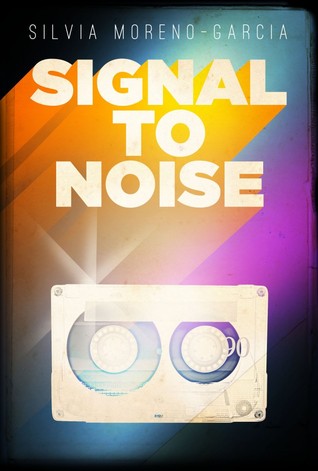
DESCRIPTION FROM THE PUBLISHER A literary fantasy about love, music and sorcery, set against the background of Mexico City.

Mexico City, 1988: Long before iTunes or MP3s, you said “I love you” with a mixtape. Meche, awkward and fifteen, has two equally unhip friends — Sebastian and Daniela — and a whole lot of vinyl records to keep her company. When she discovers how to cast spells using music, the future looks brighter for the trio. With help from this newfound magic, the three friends will piece together their broken families, change their status as non-entities, and maybe even find love…

Mexico City, 2009: Two decades after abandoning the metropolis, Meche returns for her estranged father’s funeral. It’s hard enough to cope with her family, but then she runs into Sebastian, and it revives memories from her childhood she thought she buried a long time ago. What really happened back then? What precipitated the bitter falling out with her father? And, is there any magic left?

MY TWO CENTS: This is an intimate tale that, while telling us both the story of teenage Meche and how she has grown up – and not – in the intervening 20 years, has its foundations in a pure coming-of-age romance.

Teens today should be able to relate to 15-year-old Meche, who is equal parts charismatic and surly. Growing up in Mexico City in the 1980s with an alcoholic father and an overbearing mother, she protects herself from the indignities of teenagehood in the earphones of her Walkman. (For those born after the 1980s, Walkmans are the precursors to our wonderful digital devices that can sync up with iTunes.) One day, she discovers that the power of her records can make magic–literal magic, just like her grandma, Mama Dolores says exists.

She convinces her best pals, Sebastian, a literature-loving pseudo-punk, and Daniela, who dresses all in pink and still has a soft spot for her Barbie collection, to help her use magic to meddle in romantic matters and take revenge on those who wrong her and her friends. Classic rock beloved by her father and artists like Miguel Bose and Duncan Dhu spur on her magic, which becomes dangerous as she gets deeper and deeper. Until the bonds between her and those closest to her are stretched to the utmost limit.

We hop back and forth in time from the ‘80s to 2009, when Meche, a successful professional living abroad, returns to Mexico City for her father’s funeral. We find out that they’ve been estranged, which is a surprise, since we know how much Meche’s father (through passages in his book in his point of view) adored her. Much as she did as a teen, adult Meche feels out of place in her old neighborhood. Will she find a place for her in her old neighborhood or is the magic gone forever? Sebastian may have something to say about that.

TEACHING TIPS: Much like the books that have won Alex Awards, Signal to Noise has appeal for both teens and adults. The universal themes of alienation and parental discord are emotions that anyone of any age can relate to. Modern teens may find themselves fascinated by the description of life in Mexico City nearly 30 years ago and discover it’s not so different from their lives today. Teens in local book clubs could compare and contrast how they think teens in the ‘80s would have communicated with their friends (with no fancy technology, horror!) or completed homework assignments (studying honest-to-God paper books at the library, anyone?). A fun craft that librarians could work into a book club discussion is decorating T-shirts with neon puffy paint or stylishly shredding an old pair of jeans. I know of several people who still have records (and one public library as well), so perhaps an old-fashioned listening party is in order?

Book club facilitators could also prompt teens to imagine what their lives will be like in 20+ years. What sort of technology may we see in 2035? What sort of social progress may we have made, if you’d like a deeper discussion? What sort of things have their parents seen happen in the past few decades that seems like no-brainers to youth of today. (Gay marriage and women’s rights come to mind. However, groups may want to explore how much advancement we’ve made regarding racial equality in light of the recent Charleston shooting and the events of Baltimore and Ferguson.)

S_Moreno_20150516_0492_print-1020x1530AUTHOR (DESCRIPTION FROM HER WEBSITE): Mexican by birth, Canadian by inclination. Silvia Moreno-Garcia‘s debut novel, Signal to Noise, about music, magic and Mexico City, was released in 2015 by Solaris. Silvia’s first collection, This Strange Way of Dying, was released in 2013 and was a finalist for The Sunburst Award for Excellence in Canadian Literature of the Fantastic. Her stories have also been collected in Love & Other Poisons. She has co-edited the anthologies Sword & Mythos, Historical Lovecraft, Future Lovecraft, Candle in the Attic Window and Fungi. Dead North and Fractured are her solo anthologies. Silvia is the publisher of Innsmouth Free Press, a Canadian micro-publishing venture specializing in horror and dark speculative fiction.


FOR MORE INFORMATION ABOUT Signal to Noise visit your local public library, your local bookstore or IndieBound. Also, check out GoodreadsAmazon, and Barnes & Noble.


Eileenfontenot headshot Fontenot is a recent graduate of Simmons College Graduate School of Library and Information Science in Boston. She works at a public library and is interested in community service and working toward social justice. A sci-fi/fantasy fan, Eileen was formerly a newspaper writer and editor.
 

The 2015 International Latino Book Awards Winners!

Below are the first place winners of the 17th Annual International Latino Book Awards in the children’s, youth, and young adult categories. If you click on the images, you will be taken to Indiebound, Amazon, or Barnes and Noble for more information. The Awards are produced by Latino Literacy Now, an organization co-founded by Edward James Olmos and Kirk Whisler, and co-presented by Las Comadres para las Americas and Reforma, the National Association to Promote Library and Information Services to Latinos. The Awards were announced this past weekend, in San Francisco as part of the ALA Conference. For the complete list, which includes adult fiction, nonfiction, and second place and honorable mention winners, click hereCONGRATULATIONS TO ALL OF THE WINNERS!!

Best Latino Focused Children’s Picture Book: English

18465502

Best Latino Focused Children’s Picture Book: Spanish or Bilingual

20640741

Best Children’s Fiction Picture Book: English

20759593  18106361

Best Children’s Fiction Picture Book: Bilingual

18654384

Best Children’s Fiction Picture Book: Spanish

22750429

Best Children’s Nonfiction Picture Book: English

18405521

Best Children’s Nonfiction Picture Book: Spanish or Bilingual

Best Educational Children’s Picture Book: English

18465502

Best Educational Children’s Picture Book: Bilingual

23173378

Best Educational Children’s Picture Book: Spanish

Most Inspirational Children’s Picture Book: English

18465502

Most inspirational Children’s Picture Book: Spanish or Bilingual

23058499

Best Youth Latino Focused Chapter Book

21928995

Best Youth Chapter Fiction Book

18166935

Best Educational Youth Chapter Book

Most Inspirational Youth Chapter Book


Best Young Adult Latino Focused Book: English

IslandCover.png

Best Young Adult Latino Focused Book: Spanish or Bilingual

 Micaela, Adalucía, Cholita Prints and Publishing Company

Best Young Adult Fiction Book: English

18048909

Best Young Adult Fiction Book: Spanish or Bilingual

 Micaela, Adalucía, Cholita Prints and Publishing Company

Best Young Adult Nonfiction Book

Best Educational Young Adult Book

 Micaela, Adalucía, Cholita Prints and Publishing Company

Most Inspirational Young Adult Book

The Sparrow and The Frog

Best Book Written by a Youth

Best Children’s Picture Book Translation: Spanish to English

Best Children’s Picture Book Translation: English to Spanish

Best First Book: Children’s and Youth: English

22174131

Best First Book: Children’s and Youth: Spanish or Bilingual

Book Review: Shadowshaper by Daniel José Older

22295304By Cecilia Cackley

DESCRIPTION: (from Goodreads): Sierra Santiago was looking forward to a fun summer of making art, hanging out with her friends, and skating around Brooklyn. But then a weird zombie guy crashes the first party of the season. Sierra’s near-comatose abuelo begins to say “No importa” over and over. And when the graffiti murals in Bed-Stuy start to weep…. Well, something stranger than the usual New York mayhem is going on.

Sierra soon discovers a supernatural order called the Shadowshapers, who connect with spirits via paintings, music, and stories. Her grandfather once shared the order’s secrets with an anthropologist, Dr. Jonathan Wick, who turned the Caribbean magic to his own foul ends. Now Wick wants to become the ultimate Shadowshaper by killing all the others, one by one. With the help of her friends and the hot graffiti artist Robbie, Sierra must dodge Wick’s supernatural creations, harness her own Shadowshaping abilities, and save her family’s past, present, and future. Shadowshaper releases June 30, 2015.

MY TWO CENTS: Sierra Santiago is one of my new favorite heroines. She makes plans and follows through, is clear-eyed about the shortcomings of people she loves and takes charge with attitude. As Sierra follows her grandfather’s direction to find Robbie and fix the murals in her neighborhood, more and more secrets keep coming to light and she discovers an entire spirit world that has been hidden to her, but to which she is strongly connected. Older weaves in many great discussion points among the action and supernatural fighting, including colorism, gender expectations, ethics (or lack thereof) in anthropology and handling difficult family members. The Brooklyn setting and Sierra’s group of friends add realism and humor to the story, making this fresh, exciting adventure a must read for YA fans.

TEACHING TIPS: There are many different ways this title could fit into the classroom. The themes of appropriation and anthropology would fit nicely into a history or sociology classroom. Librarians will want to recommend this to teens who love fantasy or adventure stories with urban settings. Art teachers could also add this title to a list of books involving murals and large scale public art projects, as well as discuss the tradition of honoring the dead in art or have students design their own murals.

ABOUT THE AUTHOR: Daniel José Older is the author of the Bone Street Rumba urban fantasy series, which began in January 2015 with Half-Resurrection Blues from Penguin’s Roc imprint. Publishers Weekly hailed him as a “rising star of the genre” after the publication of his debut ghost noir collection, Salsa Nocturna. He co-edited the anthology Long Hidden: Speculative Fiction from the Margins of History and guest edited the music issue of Crossed Genres. His short stories and essays have appeared in Tor.com, Salon, BuzzFeed, the New Haven Review, PANK, Apex and Strange Horizons and the anthologies Subversion and Mothership: Tales Of Afrofuturism And Beyond. Daniel’s band Ghost Star gigs regularly around New York and he facilitates workshops on storytelling from an anti-oppressive power analysis. You can find his thoughts on writing, read dispatches from his decade-long career as a NYC paramedic and hear his music at ghoststar.net/ and @djolder on twitter.

RESOURCES:

Interview from Source Latino: http://thesource.com/2015/06/08/source-latino-interview-with-shadowshaper-author-daniel-jose-older/

Review from Debbie Reese about overlap with Indigenous history: http://americanindiansinchildrensliterature.blogspot.com/2015/04/daniel-jose-olders-shadowshaper.html

Interview from School Library Journal: http://www.slj.com/2015/06/interviews/qa-urban-fantasy-counter-narrative-daniel-jose-older-on-shadowshaper/#_

Interview from The Rumpus: http://therumpus.net/2015/05/the-rumpus-interview-with-daniel-jose-older/

FOR MORE INFORMATION ABOUT Shadowshaper, visit your local library or bookstore. Also, check out WorldCat.orgIndieBound.orgGoodreadsAmazon, and Barnes & Noble.

Cackley_headshotCecilia Cackley is a performing artist and children’s bookseller based in Washington DC where she creates puppet theater for adults and teaches playwriting and creative drama to children. Her bilingual children’s plays have been produced by GALA Hispanic Theatre and her interests in bilingual education, literacy, and immigrant advocacy all tend to find their way into her theatrical work. You can find more of her work at www.witsendpuppets.com.

Libros Latin@s: Zack Delacruz: Me and My Big Mouth by Jeff Anderson


24612691By Cecilia Cackley 

DESCRIPTION (from Goodreads): Zack Delacruz is unnoticed at his middle school—and that’s just the way he likes it. But a school assembly, a typhoon of spit, and an uncharacteristic moment of bravery are all it takes to change everything. Suddenly Zack is in charge of the class fundraiser. Worse, his partner is the school’s biggest bully! If they don’t sell all the chocolate bars, there will be no dance for the sixth grade.  Zack never wanted to be a hero, but with his classmates’ hopes on the line, can he save the day? Zack Delacruz: Me and My Big Mouth releases August 14, 2015.

MY TWO CENTS: This is a light, fun read for kids who are curious about middle school and looking for something along the same lines as Diary of a Wimpy Kid, but without pictures. Zack is your typical “don’t bother me, I’m invisible” kid until a chain of events has him organizing a class fundraiser and trying to solve all the problems that come with it. The bullying part of the story is actually pretty minimal and the side characters fit easily into stock school types, nicknames and all. The supportive adults in the story (particularly Zack’s dad) smooth the way when necessary, but the fun part of the book is the building of cooperation between Zack and his classmates and watching him tackle every new disaster that hits.

TEACHING TIPS: This is probably best for elementary readers and could make a nice classroom read aloud. It could also work as a literature circle book, with discussions about the choices characters make and how their perceptions of each other change over the course of the book. There are math connections to be made with the fundraiser aspect and plenty of kids will see themselves reflected in Zack and his challenges.

ABOUT THE AUTHOR: Jeff Anderson has been sharing writing strategies with teachers and students for over 25 years. Whether presenting at national conferences like NCTE, ASCD, or in classrooms or writing his books for teachers or middle grade readers, Jeff’s passion for writing and grammar inspires teachers and young writers to soar. When he’s not writing with his “revising” dogs at home near downtown San Antonio, Texas, he’s walking, talking, or doing staff development around the US (and sometimes New Zealand).

RESOURCES:

An interview with Jeff Anderson: http://readingyear.blogspot.com/2015/03/an-interview-with-jeff-anderson-about.html

A blog post on the process of writing the book: http://pawlpblog.org/2015/06/03/guest-post-how-i-became-a-middle-grade-author-its-not-a-lone-pursuit-with-jeff-anderson/

FOR MORE INFORMATION ABOUT Zack Delacruz: Me and My Big Mouth, visit your local library or bookstore. Also, check out WorldCat.orgIndieBound.orgGoodreadsAmazon, and Barnes & Noble.


Cackley_headshotCecilia Cackley is a performing artist and children’s bookseller based in Washington DC where she creates puppet theater for adults and teaches playwriting and creative drama to children. Her bilingual children’s plays have been produced by GALA Hispanic Theatre and her interests in bilingual education, literacy, and immigrant advocacy all tend to find their way into her theatrical work. You can find more of her work at www.witsendpuppets.com.

Your 80s Were Not My 80s: Author Sofia Quintero on Race, Class, Place & Hip-Hop in YA Historical Fiction


23395349By Sofia Quintero

Almost immediately after finishing the last round of copyedits on Show and Prove did I find something that conjured my biggest fears about writing a novel set in the 1980s.

I discovered a blog post by a librarian expressing fatigue with the trend in young adult fiction about the 80s. She named a legitimate concern that haunted me throughout the writing of Show and Prove. Was setting the story in that decade integral to its telling or were the 80s just a hook driven by my personal nostalgia?

It’d be dishonest to deny that nostalgia had a role in my writing this novel. Maybe Show and Prove didn’t have to be set in the 80s to tell the stories of Smiles, Nike, Cookie and Sara.

But then I realized, so what?

With the overwhelming majority of young adult fiction set in the 80s centering on white, middle-class and/or suburban experiences, the coming of age of Generation X warrants literary treatment. In fact, those of us who grew up in that decade Black and Brown, low-income or working-class, and/or urban especially in New York City, have stories that contain an imperative richness. Not only do they offer the universal experiences of adolescence that transcends race, class, and place, they also address the important socio-political questions made necessary by the specifics of race, class, and place that we should care about.

In other words, your 80s were my 80s, my 80s were my 80s, but your 80s were not my 80s, and that is precisely why you need to engage my story as much as I need to tell it. When you belong to a community whose cultural productions are constantly devalued until deemed commodifiable, at which point they’re appropriated and your authorship erased, no attempt at historical fiction is gimmicky. It’s resistance.

Krush Groove (1985) PosterThe Smiles and Saras that I grew up with in the South Bronx saw and loved The Breakfast Club and Say Anything. Those movies played in the ‘hood with no doubt that we would relate to them, for white characters to this day are held as the purveyors of universality. But before the solidification of hip-hop as a mainstream commodity, how many white kids got the chance to watch Krush Groove or Beat Street at their local theater?

Not only did we participate in mainstream 80s pop culture, through our creation of hip-hop, we ultimately produced one of the decade’s most enduring phenomenon. Millions of youth across the globe have no concept of life without commercial hip-hop. Moreover, they keep it alive with no knowledge of the oppressive social conditions under which we created it over four decades ago.

Because we experienced the same hopes and anxieties that mark adolescence, young people of any background can connect to a story such as Show and Prove. However, we also had more at stake. We grew up beneath the twin epidemics of HIV/AIDS and crack. Instead of gentrification, we had racist landlords who paid addicts to commit arson, burning our families out of their homes to collect the insurance. If our parents or caretakers were employed, they were likely civil servants having their unions threatened if not crushed.

But if you grew up in the Bronx-is-burning Bronx, you remember something other than the drugs, the garbage, and the gangs. You remember all the colors, the rhythms, the aromas of that time, and some of them were quite beautiful. Innocence and innovation still lived here in underground trains, behind freshly tagged walls, and within the grooves of scratchy cassette tapes. Shootouts didn’t stop us from playing stoop ball.

Amidst all this socio-economic abandonment and oppression, we exhibited tremendous creativity and resilience, and you and your kids should know all about it. In historical fiction for young adults, the decade should be relevant to the story, but when the characters are teens of color in New York City and the decade is the 80s, there is no such thing as irrelevant unless you don’t care about race or class. The street culture we created despite the social, economic, and political hand we were dealt has evolved into a multibillion dollar industry and, at its best, gives voice, comfort, and inspiration to kids and adults worldwide.

Regardless of what you think of the current state of commercial hip-hop, its history deserves preservation in young adult literature since the youth of that time who invented it were not supposed to even survive.

That one fact alone is all the relevance we need.


Sofia QuinteroSofia Quintero has a BA in history-sociology and an MPA from Columbia University. She began her career as a policy analyst and advocate, working for various nonprofit organizations and government agencies, including the Vera Institute of Justice, Hispanic AIDS Forum, and the New York City Independent Budget Office. After years of working on diverse policy issues, however, she heeded her muse to pursue an entertainment career.

Sofia wrote her debut novel Explicit Content under the pen name Black Artemis. Since then, she has authored four more novels and almost twice as many short stories and novellas including her award-winning young adult debut Efrain’s Secret (Knopf 2010.)

She recently earned an MFA in writing and producing TV at the TV Writers Studio of Long Island University and contributed to the children’s anthology What You Wish For, the proceeds of which go to build libraries for Darfuri children in Chad. Her journalistic writings have been published in Urban Latino, New York Post, Ms., Cosmopolitan for Latinas and El Diario/La Prensa.

Show and Prove releases July 14, 2015. Click here to read our recent review of the novel.

Book Review: Drum Dream Girl: How One Girl’s Courage Changed Music by Margarita Engle

By Sujei Lugo

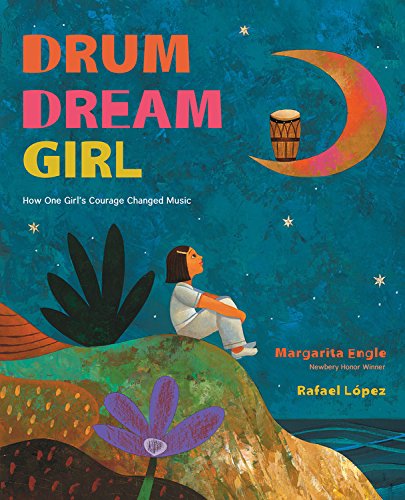
drum dream girl coverDESCRIPTION FROM THE BOOK JACKET: Girls cannot be drummers. Long ago on an island filled with music and rhythm, no one questioned that rule — until the drum dream girl. She longed to play tall congas and small bongós and silvery, moon-bright timbales. She had to practice in secret. But when at last her music was heard, everyone sang and danced and decided that boys and girls should be free to drum and dream.

Inspired by a Chinese-African-Cuban girl who broke Cuba’s traditional taboo against female drummers, Drum Dream Girl tells an inspiring true story for dreamers everywhere.

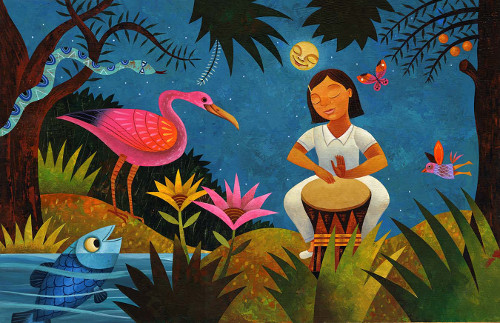
MY TWO CENTS: Inspired by the childhood of Chinese Afro Cuban drummer Millo Castro Zaldarriaga, Margarita Engle and Rafael López enchantingly encapsulate through poetic text and dreamy illustrations a girl’s dreams and her desires to play music. By focusing on our girl’s “dreaming” period and the stage when she finally achieves her dream as a child, the author and illustrator furnish a landscape where children should be free to dream, and one they can relate to and which allows them to see themselves as dreamers.

Through the first line of Engle’s poem, “On an island of music, in a city of drumbeats, the drum dream girl dreamed,” we meet our Caribbean dream girl, who dreams about congas, bongós, and moon-bright timbales on a island where everyone believes only boys should play drums. This excluding notion and the exposure to such blatant sexism at such a young age do not prevent our girl from dreaming. She plays her own imaginary music, walks around tapping her feet and plays contagious drum rhythms on tables and chairs. When her big sisters invite her to join their new all-girl dance band, the drum dream girl is excited, but her father reminds her that “only boys should play drums.” She keeps drumming and dreaming, until her father realizes that her talent deserves to be heard. With a compelling illustration of her father “pulling” her drumming and dreaming daughter from the sky to the ground, she perseveres and lands back on her island of music, making her dream a reality.

The text is really descriptive, filled with poetic repetition and acknowledgements of the natural landscape of the island. Rafael López’s trademark of colorful and vibrant illustrations enhances the musical and dreamy experience of our character, providing images where you feel you are listening to the music and the beats. Through two-page layout canvases rich with smiling moons, suns, and birds, huge instruments, and our drum dream girl with closed eyes, he captures the spirit, the breeze, and the rhythm of our little drummer. López also successfully portrays the essence of Cuban city life and its racial and ethnic demographics.

7

Drum Dream Girl is the story of Millo Castro Zaldarriaga, a mixed race Cuban girl, who defied gender roles in the 1930’s music scene. The girl and her story show the importance of family, teacher, and music-education support to expose and develop our children’s musical talents. The all-girl dance band she joined was Anacaona, an orchestra founded by Cuchito Castro and her sisters. This forgotten and overshadowed group challenged the male-dominated Cuban music scene and an environment where women were seen as incapable of playing music. For more information about this group, look for the book Anacaona: The Amazing Adventures of Cuba’s First All-Girl Dance Band, written by Alicia Castro, Ingrid Kummels and Manfred Schäfer, or watch this preview of the documentary Anacaona: The Amazing Story of Cuba’s Forgotten Girl Band.

TEACHING TIPS: The picture book will work great as a read-aloud and a rich addition to music-themed library programs, where children could also make their own drums. With older children, teachers can incorporate poetry writing, drawing, and visualizing music as poetry. The text, illustrations, and content make this book perfect to be adapted as a musical play.

Other classroom activities can include historical exploration of Millo Castro Zaldarriaga’s life, Cuban music, and other female musicians. Margarita Engle includes a publisher’s discussion guide on her website.

AUTHOR & ILLUSTRATOR:

Margarita Engle is a Cuban-American author, botanist, and professor who enjoys collaborating with her husband in volunteer work for wilderness search and rescue dog training programs. Engle is the winner of numerous awards for her children’s and young adult books, including the Newbery Honor for The Surrender Tree: Poems of Cuba’s Struggle for Freedom (2008), becoming the first Latina to win that children’s literature award. In addition to her work as a writer, she also contributes to various periodicals such as Atlanta Review, Bilingual Review, California Quarterly, Caribbean Writer, Hawai’i Pacific Review, and Nimrod. Margarita Engle is a member of PEN USA West, Amnesty International, Freedom House of Human Rights and Freedom to Write Committee.

Some of her titles are: The Poet Slave of Cuba: A Biography of Juan Francisco Manzano (2006), Tropical Secrets: Holocaust Refugees in Cuba (2009), The Firefly Letters: A Suffragette’s Journey to Cuba (2010), Hurricane Dancers: The First Caribbean Pirate Shipwreck (2011), The Wild Book (2012), The Lightning Dreamer: Cuba’s Greatest Abolitionist (2013), Mountain Dog (2013), Silver People: Voices From the Panama Canal (2014), Orangutanka: A Story in Poems (2015), The Sky Painter: Louis Fuertes, Bird Artist (2015), and Enchanted Air: Two Cultures, Two Wings (2015).

Rafael López is a Mexican award-winning illustrator and artist, whose work is influenced by his cultural heritage, colors of Mexican street life, and Mexican surrealism. In addition to children’s books, López has illustrated posters, United States Postal Service stamps such as the Latin Music Legends series, and he has launched street art projects to revitalize urban neighborhoods, such as the Urban Art Trail Project.

He is the recipient of various Pura Belpré Honor for Illustration awards for books such as: My Name is Celia: The Life of Celia Cruz/Me Llamo Celia: La Vida de Celia Cruz (2006), Book Fiesta!: Celebrate Children’s Day/Book Day/ Celebremos El Día de los Niños/El Día de Los Libros (2010), The Cazuela That the Farm Maiden Stirred (2012) and Tito Puente: Mambo King/Rey del Mambo. He also received two Américas Awards for Children’s and Young Adult Literature for My Name is Celia (2006) and ¡Yum! ¡Mmmm! ¡Qué Rico! Americas’ Sproutings (2007).

DDG Pages 32-33 Final-revised-small

For more information about Drum Dream Girl: How One Girl’s Courage Changed Music (2015), visit your local library or bookstore. Also check out worldcat.orgindiebound.org, amazon.com, barnesandnoble.com, and goodreads.com. You can also watch the book trailer below.