Book Review: América is Her Name by Luis J. Rodríguez

By Sonia Alejandra Rodríguez

696056DESCRIPTION FROM THE BOOK JACKET: Set in the Pilsen barrio of Chicago, this children’s picture book gives a heartwarming message of hope. The heroine, América, is a primary school student who is unhappy in school until a poet visits the class and inspires the students to express themselves creatively–in Spanish or English. América Is Her Name emphasizes the power of individual creativity in overcoming a difficult environment and establishing self-worth and identity through the young girl América’s desire and determination to be a writer. This story deals realistically with the problems in urban neighborhoods and has an upbeat theme: you can succeed in spite of the odds against you. Carlos Vázquez’s inspired four-color illustrations give a vivid sense of the barrio, as well as the beauty and strength of the young girl América.

MY TWO CENTS: Luis Rodríguez’s América is Her Name (1998) tells the story of América Soliz, an undocumented immigrant from Oaxaca, Mexico to Pilsen, Illinois—Chicago’s predominantly Mexican community—and her struggles to find her voice and an identity that captures the complexity of who she is. Throughout the text, América faces discrimination in the classroom, witnesses the violence in her community, and feels patriarchal oppression in her home. Through poetry, however, she gains a language and agency to challenge and transform her reality.

At the beginning of the story, the narrator makes clear that América is having a difficult time feeling like she belongs in her new home in the United States. Pilsen is not like her hometown in Oaxaca. She witnesses gun violence—a shooting between two youth groups—as she walks to school. Her white teachers marginalize her for not speaking English and she also overhears them calling her an “illegal.” While América is not sure what that means or how a person can be illegal,she understands they do not want her to belong. At home, América becomes aware of the discrimination her parents face as manual labor workers when her father loses his job and her mother comes home expressing her frustration at being called a “wetback.” The narrator also alludes to the fact that the uncle that lives with them is an alcoholic.

Despite the barrage of oppressions that América confronts on a daily basis, she is able to find a sense of self and a voice through poetry. Her classroom gets a visit from a Puerto Rican poet, Mr. Aponte, who encourages América to write her story in any form and any language that best represents her. América writes about her Mixteca indigenous culture in Oaxaca and encourages her mother and younger brother to do the same. The most beautiful scene in the book is a representation of América and her mother sitting at the kitchen table as they practice their writing.

Illustrator Carlos Vazquez depicts mother and daughter in vibrant colors as their words come alive. It is an empowering moment for América and for the reader. Poetry, and writing in general, is not reserved only for América, who has access to education and the possibility of belonging in the United States, but América also makes is available to her mother. By sharing this practice with her mother, América challenges understandings of who gets to belong, which is an extremely important theme in the book. Furthermore, by making poetry available to her family, América attempts to bridge the divide between (im)migrants and their children. América is Her Name is a heartfelt and empowering story that explores issues of what it means to belong in the United States.

AUTHORLuis J. Rodriguez is one of the leading Chicano writers in the country with fifteen published books in memoir, fiction, nonfiction, children’s literature, and poetry. Luis’ poetry has won a Poetry Center Book Award, a PEN Josephine Miles Literary Award, and a Paterson Poetry Book Prize, among others. His children’s books—America is Her Name and It Doesn’t Have to be This Way: A Barrio Story—have won a Patterson Young Adult Book Award, two Skipping Stones Honor Awards, and a Parent’s Choice Book Award. Luis Rodriguez is best known for the 1993 memoir of gang life, Always Running: La Vida Loca, Gang Days in L.A.

FOR MORE INFORMATION about América Is Her Name visit your local library or bookstore. Also check out worldcat.org, indiebound.org, goodreads.com, amazon.com, barnesandnoble.com, and Curbstone Press.

headshotSonia Alejandra Rodríguez has been an avid reader since childhood. Her literary world was first transformed when she read Rudolfo Anaya’s Bless me, Última as a high school student and then again as a college freshman when she was given a copy of Sandra Cisneros’s The House on Mango Street. Sonia’s academic life and activism are committed to making diverse literature available to children and youth of color. Sonia received her B.A. in English from the University of Illinois at Urbana-Champaign. She is currently a PhD candidate at the University of California, Riverside, where she focuses her dissertation on healing processes in Latina/o Children’s and Young Adult Literature.
Let’s All Make the #WeNeedDiverseBooks Campaign an Ongoing Movement

By Patrick Flores-Scott

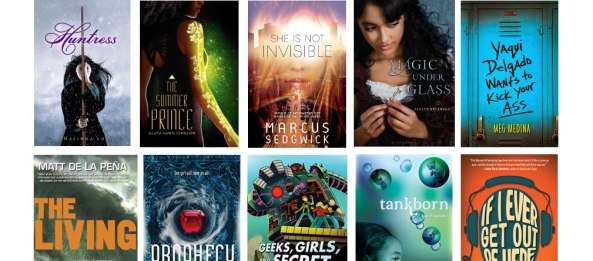
#WeNeedDiverseBooks. The trending hashtag is a channel for conversation around the huge problem of a lack of diversity in children’s literature. The problem has been noted in many recent articles and so have the reasons we need more books by diverse authors and books with complex, real diverse characters.

For many years I was lucky to be a public school teacher in very diverse schools. At different points I was both a general education classroom teacher and a reading specialist. As a classroom teacher, I was able to seek and find the books I wanted my class to hear and read. More often than not, these books had main characters of color. I had the time, energy, resources, and relationships that helped me find great books that my students loved.

My students, however, especially my reluctant readers, were not going to work so hard to find a book that would reflect the cultural, racial, socio-economic realities of their community. They were going to pick the available book, the one closest to their hand when it was time to leave the library, or the trendy book that made them look like they were in the reading “know.”

Embedded image permalink

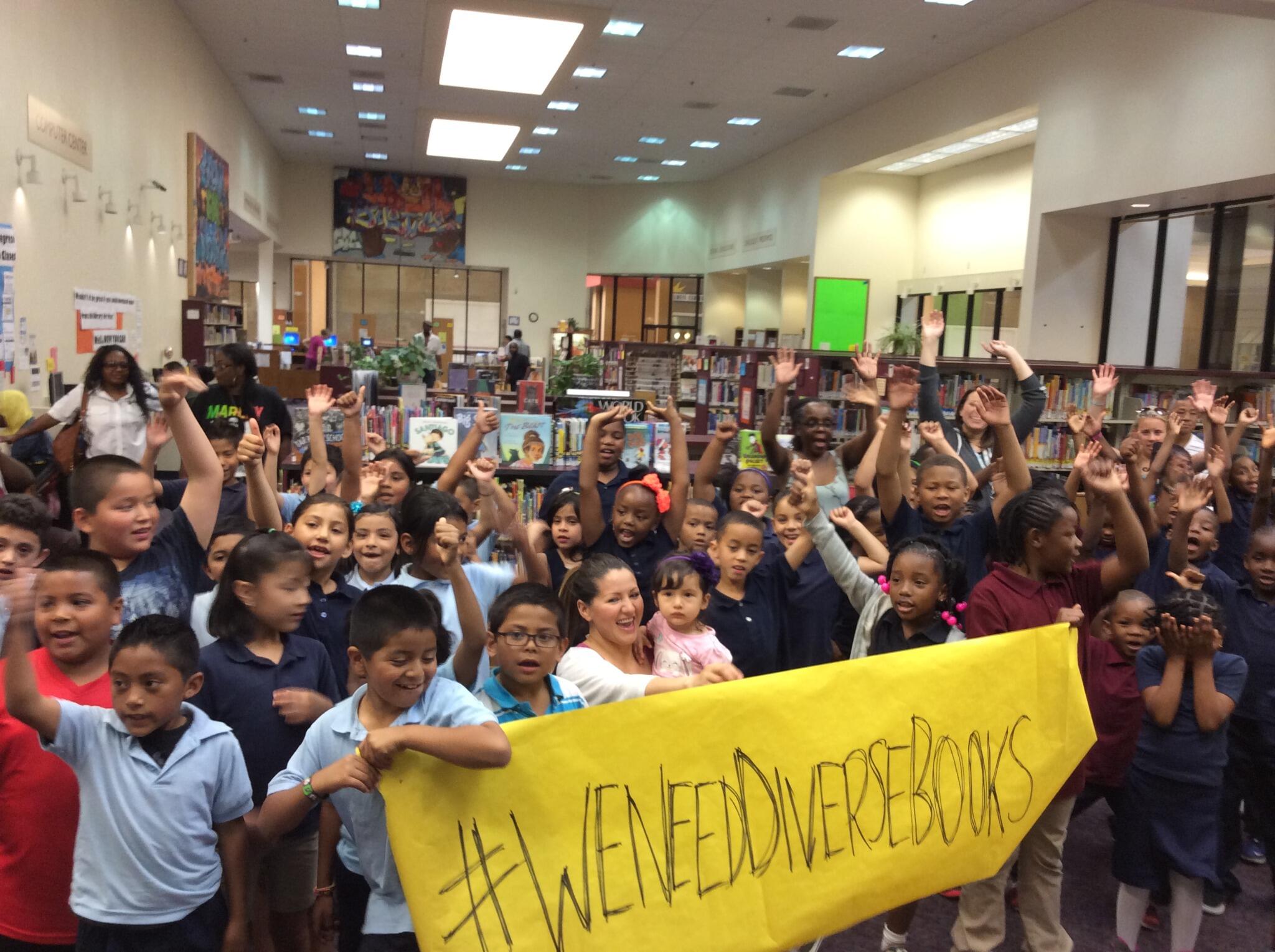
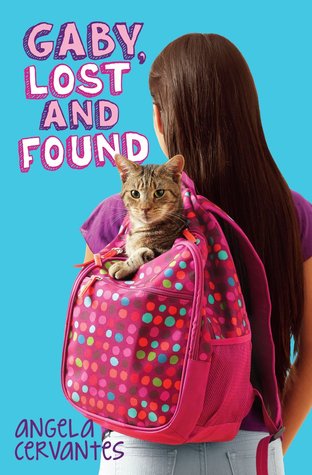
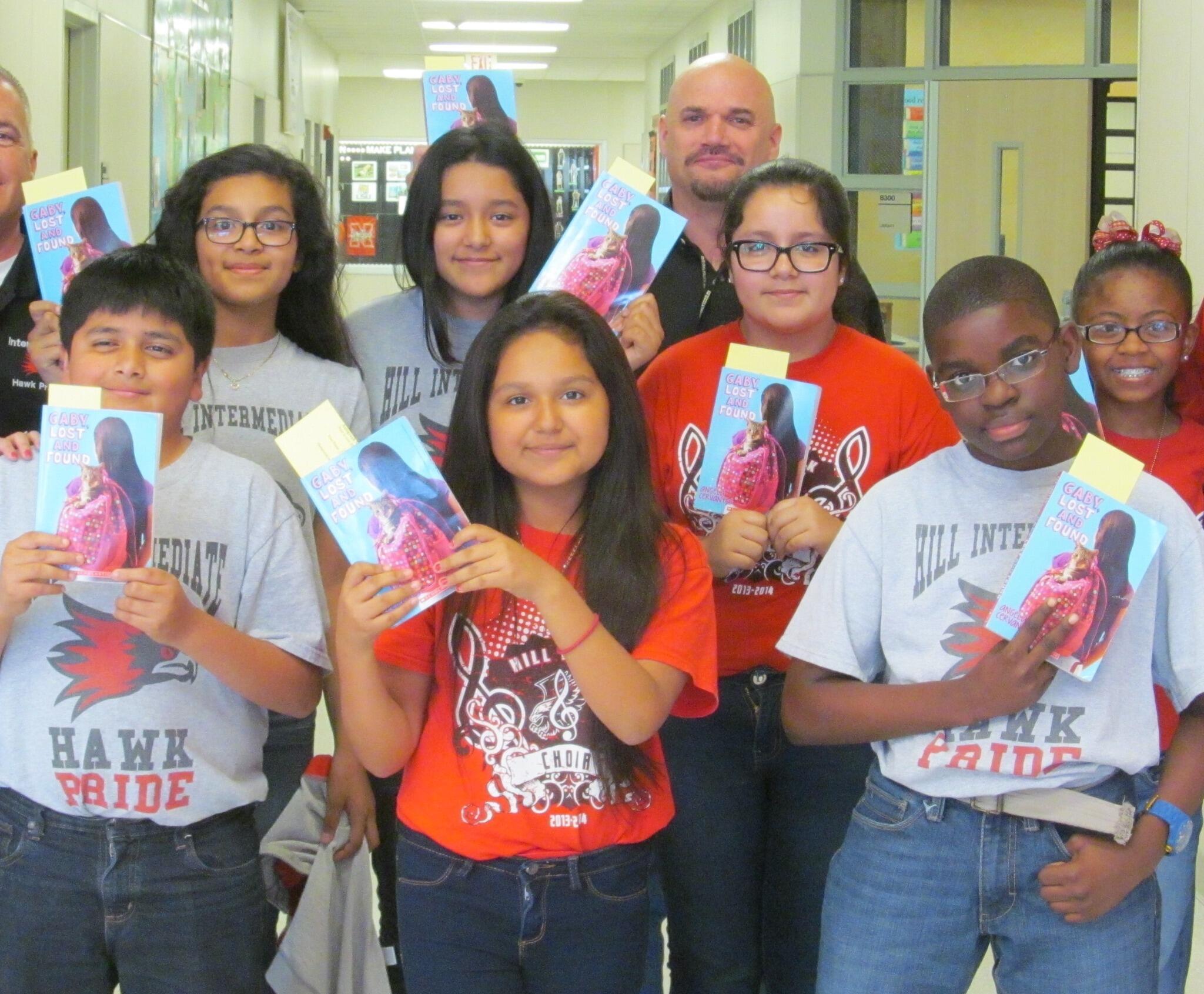
Author Angela Cervantes posted this picture on Twitter during the #WeNeedDiverseBooks Campaign.

Students need to be able to accidentally stumble their way into a great book that reflects their own background or one that opens their eyes to new characters and communities. They shouldn’t have to work for it. They shouldn’t have to fight for it. Kids have enough on their plate. Yes, some students are going to research authors, seek out new books and reading experiences, challenge their school librarian and make demands. Most fifth graders, however, are just struggling to make it through the day. They end up with the default book… and given the math of the situation, they’re going to walk out with another book by a white author with a white main character. Is this a tragedy? In the moment, no. That default book might be a great one. But this scene takes place over and over each day in most schools in the country and that great book–if the student is lucky–may just be another in a long line of books that reinforces the notion that great books are written by white authors and that white kids are the ones worthy of books written about them.  This notion is a toxic one, regardless of a student’s background.

Children’s books are a piece of a larger pie. A lack of diversity in film and television reinforces the notion that white stories are more relevant than non-white stories. The make-up the Senate (97 out 0f 100 are white) reinforces the notion that non-whites do not have a role in the highest levels of politics. Yes, there is the President, but his cabinet is made up of 70% white males. Kids see this. They see thousands of African American college athletes and they know that, in the vast majority of cases, these athletes are led to battle by white coaches. They know that the percentages of Black and Latino men in prison are crazily out of proportion with the population of Black and Latino men. Kids see all this. They take it in. The perceptions become realities for them.

My wife and I are the proud, exhausted parents of two rambunctious little boys. Their grandparents are Mexican-American on their mom’s side. My parents are white. My dad is from the U.S., my mom a Spanish-speaking Latina from South America. We will raise our boys to be proud of all that they are and proud of all the Latino, Caucasian, African-American, Asian and mixes of the aforementioned that make up their diverse extended family. While we will do our best to teach that the content of one’s character, not the color of one’s skin (one’s gender, sexual orientation, physical ability) is what is important, television, our political and judicial systems, sports…. And even the make-up of CHILDREN’S BOOKS, will send messages that complicate, skew, and even deem our parental message well-meaning, but just wrong.

Embedded image permalink

The Oakland Public Library in California posted lots of great pictures like this one on Twitter during the #WeNeedDiverseBooks Campaign.

What do we do about it? The #WeNeedDiverseBooks Movement (Can it please be a movement? We need more movements around here.) is a potentially very important call for change in the children’s book world. Now, we need to push for intentionality. Gatekeepers need to have their feet held to the fire. The Movement (!) needs to push publishers to set goals that trend their books in a more realistically diverse direction. It needs to push the industry to hire editors from diverse backgrounds and to hire and support diverse interns and entry-level assistants who can have the power to move books off the pile and into editors’ hands. The Movement needs to hold publishers accountable.

Institutions which support writers and illustrators, like my beloved SCBWI, need to recruit underrepresented writers to their conferences. (And to check out the percentage of white male panelists and speakers compared to the percentage of white male attendees.) Groups like SCBWI need to be pushed to intentionally foster and mentor a more diverse writing community.

The movement needs to push us published authors of all colors and stripes, to mentor diverse up-and-comers, to include pro-bono school visits to underfunded schools, and to write real, complex, fallible diverse characters who live the entirety of the American experience.

Members of The Movement need to request diverse books at their bookstores and libraries. We need to post reviews on Amazon and Goodreads and library websites. Members of the Movement need to advise book bloggers and to follow and support blogs like this one. We need to give diverse books as birthday presents and to talk about our favorites on the bus, at work, in line at the bookstore…

Members of The Movement need to push our political leaders to support the health, education and welfare of our future readers and writers.

Publishers, agents, bookstore workers, librarians, teachers, authors… there are bunches these folks out there doing the positive stuff that will make change possible. The Movement needs to support them and it needs to push for intentionality in those who mean well, but have not yet made the move to change.

PatrickFS1Patrick Flores-Scott was, until recently, a long-time public school teacher in Seattle, Washington. He’s now a stay-at-home dad and early morning writer in Ann Arbor, Michigan. Patrick’s first novel, Jumped In, has been named to a YALSA 2014 Best Fiction for Young Adults book, an NCSS/CBC Notable Book for the Social Studies and a Bank Street College Best Book of 2014. He is currently working on his second book, American Road Trip.

Jumped In was featured in Libros Latin@s on Thursday. Click here to see the overview.


2014 Reading Challenge: April Update and We Need More Diverse Books Campaign

We love to post the monthly Reading Challenge update because it’s fun to see what people are reading, readers give us titles to add to our book lists, people are reading more Latin@ Kid Lit (yay), and look at all the beautiful artwork on those covers. We’re even more excited than usual about this month’s post because it comes as the We Need Diverse Books Campaign is underway. The hashtag #WeNeedDiverseBooks has been trending on Twitter since before the campaign official began.

Here are contributions from our own Zoraida Córdova, Lila Q. Weaver, and Cindy L. Rodriguez (well, her daughter):

weneeddiversebooks 2  photo (1)  photo (2)
Today, people are engaged in the second part of the campaign. A Twitter chat is scheduled for 2 p.m. (EST). Use the same hashtag and share your thoughts on the issues with diversity in literature and why diversity matters to you.

Tomorrow, is the third part of the campaign, called the Diversify Your Shelves initiative to encourage people to buy diverse books and take photos of them. Before you head out to buy books, take a look at what participants in our 2014 Latin@s In Kid Lit Challenge read in April.

We will say this and mean it every month: Thank you to everyone for participating in the challenge and purposely selecting books by/about/for Latin@s. Remember, you can join the challenge any time during the year, and you’re not required to review–only read and enjoy! If you do post a review somewhere, we will link it to the book covers below. If you choose not to review, we will link the covers to Goodreads.

                1229005  12159903  13126995  3308853  7789231  1294391  177457  11973377  8220585  349744  18148193  1016493  790468  17166339  353900  696056

Book Review: Jumped In by Patrick Flores-Scott

By Edith Campbell17343397

DESCRIPTION FROM THE BOOK JACKET: Sam has the rules of slackerhood down: Don’t be late to class. Don’t ever look the teacher in the eye. Develop your blank stare. Since his mom left, he has become an expert in the art of slacking, especially since no one at his new school gets his intense passion for the music of the Pacific Northwest—Nirvana, Hole, Sleater-Kinney. Then his English teacher begins a slam poetry unit and Sam gets paired up with the daunting, scarred, clearly-a-gang-member Luis, who happens to sit next to him in every one of his classes. Slacking is no longer an option—Luis will destroy him. Told in Sam’s raw voice and interspersed with vivid poems, Jumped In by Patrick Flores-Scott is a stunning debut novel about differences, friendship, loss, and the power of words.

MY TWO CENTS: Sam is a teen who once had much going for him but has decided to give up on everything after his mother dumps him with her parents and leaves. Sam now wants to also disappear by becoming a slacker. He’s got the slacker rules down pat and he follows them quite well until the new guy, Luis, is assigned to sit near him in every single class. Everyone assumes Luis is a gangster; after all, his brother is.

Flores-Scott writes to teach the power of words and the obliterating effect of silence. Sam finds comfort in the music of Nirvana. His sadness is echoed in the gray, wet landscape that surrounds him in Seattle. The humor and optimism of his grandparents emphasize what a jerk Sam is becoming. Luis appears in poetic form and he while he really isn’t much more than a thought, a poem in the story, his presence changes Sam. We never really know what’s going on in young people’s minds, do we? Flores-Scott captures their inconsistencies as he writes about so many characters who seem one way but act another. Rupe and Dave were Sam’s touch stones, but even they grew and changed in ways Sam wasn’t quite prepared for.

The writing will attract students who don’t often find themselves in books, those who try to disappear as well as those who are fascinated by the power of language. Some of the short chapters themselves look like poems. I wanted to slow down the story and clean up the ending. I wanted the parrot to go ahead and scream “goodbye Sam” and for Sam to be OK with that. I wanted to add “Trayvon” to the graffiti on the cover because that young man in the hooded green jacket reminds us all how our young boys in hoodies too often disappear.

Jumped In was listed on YALSA’s 2014 list of Best Fiction for Young Adults and as a Favorite Chapter Book by the International Reading Association.

AUTHOR: Patrick Flores-Scott was born and raised in the Snoqualmie Valley (just east of Seattle). He studied theatre at the University of Washington and ended up getting a teaching certificate as well. He spent years working as a reading specialist by day while writing and acting in plays in his free time. While teaching at a middle school in Des Moines, Washington, he was inspired to write a novel that reflected his students’ lives, something that his struggling readers would able to enjoy, something he might have enjoyed all the years he was a struggling reader. Jumped In is his debut novel. He lives in Seattle with his wife and two children.

FOR MORE INFORMATION about Jumped In, visit your local library or bookstore. Also, check out worldcat.org, indiebound.org, goodreads.com, amazon.com, barnesandnoble.com, and Henry Holt/Christy Ottaviano Books.


Edith CampbellEdith Campbell is a mother, librarian, educator and quilter. She received her B.A. in Economics from the University of Cincinnati and MLS from Indiana University.  Her passion is promoting literacy in all its many forms to teens and she does this through her blog, CrazyQuiltEdi and in her work as an Education  Librarian at Indiana State University in Terre Haute, Indiana. Edith currently serves as the IN State Ambassador for the United States Board on Books for Young People and is a past member of YALSA’s Best Fiction for Young Adults selection committee.